Majestic Equality of Law

Anatole FranceThe law, in its majestic equality, forbids the rich and the poor alike to sleep under bridges, to beg in the streets, and to steal bread.Anatole France

This is a great quote that cuts to the heart of conservative thought. This is exactly the thinking behind the flat tax. It is also why conservatives think of themselves as, well, “fair and balanced.” And when you think like that, you need a lot of balance!

While looking for the exact quote, I came upon another: “Remember: It’s Only Class Warfare When the Poor Fight Back.” It comes from a blog called The Angry Bureaucrat. The guy tends to be a bit wordy, but he has a lot to say, and—in great Frankly Curious fashion—on a lot of different subjects. Check him out.

Wake the Fuck Up

I hear this is from the same people who brought you the great Sarah Silverman Let My People Vote 2012 video. This time we get Samuel L. Jackson, who happens to say “Mother fucker!” better than anyone on the planet. I don’t have much to say other than that this is also a fucking great video:

Also: the little girl is adorable.

Update (28 September 2012 9:24 am)

I found the non-bleeped version:

I saw in comments that some people were asking, “What good will this do?” They seem to think it is an ad aimed at Romney voters or something. Just to be clear: it is part of a long history ads designed not to convince but to excite the already convinced. And it succeeds brilliantly.

Ayn Rand and Indians

Ayn RandThe first year I was in graduate school up in Oregon, I drove back and forth to the Bay Area a large number of times. One of the things I remember was hearing conservative talk radio. It was surprising to me just how often people would mention John Galt.

For those of you who have not read the novels of Ayn Rand (I don’t recommend it), John Galt is the hero of Atlas Shrugged. He’s an unapologetic capitalist who is rich because he is morally superior to the little (read: poor) people. And because the society is not licking his boots enough, he’s going to take his toys and go home. It really is that ridiculous, but if you want to see the hero rape the heroine, you’ll have to read Rand’s other opus, The Fountainhead (’cause chicks just love that).

I bring this up, because Ayn Rand’s presence in conservative politics has grown from the freaks on the fringe to the mainstream of the Republican Party. Who is John Galt? Mitt Romney is John Galt! (Paul Ryan just thinks he’s John Galt.)

Because I was once forced to marry a woman who was an Ayn Rand fan, I’ve read pretty much everything she’s ever written—at least in book form. And I think people miss the true horror show that is Ayn Rand when they focus just on her pseudo-free market beliefs. As bad as these are, there are even worse things

Let’s Play “Ayn Rand and Indians”!

In her Address to West Point in 1974, Ayn Rand had the following to say about the theft of Native American lands:

They didn’t have any rights to the land, and there was no reason for anyone to grant them rights which they had not conceived and were not using… What was it that they were fighting for, when they opposed white men on this continent? For their wish to continue a primitive existence, their “right” to keep part of the earth untouched, unused and not even as property, but just keep everybody out so that you will live practically like an animal, or a few caves above it. Any white person who brings the element of civilization has the right to take over this continent.

Okay, okay: this is vile. And it is racist. But that’s not even what I want to talk about here. This undercuts Rand’s basic philosophy in two ways.

First, this goes against Rand’s often stated claim that she was against violence. She often talked about the need for a “revolution of thought.” But here she is making a clear “might makes right” argument. “We don’t like what you’re doing with the land so we’re taking it.” Second, she is claiming that some outside authority knows better than a land owner what his land should be used for. Her thinking could as easily be used to justify the Nazi confiscation of Jewish property. You are either for the rule of law or you are not. Rand was not.

The End of History

What most strikes me in the quote above are the scare quotes around the word “right.” This is necessary for her to make her argument: our rights are real and their “rights” are illusory. But what kind of future does that provide for her philosophy? After all, aren’t other people going to come who don’t accept our “right” to exploit the land as we do?

The subtext of this is that we have reached the end of history. No better system of government could possibly be created than the one that Rand now sees. And this goes to something I often talk about: the libertarian (or conservative, more generally) belief that their preferred system is “natural.” The truth is that it is not. Humans naturally exhibit individualistic and communal tendencies and these are constantly jockeying for prominence. But even if the cut throat libertarian ideal were natural, is that good? Murder is natural. Rape is natural. But I wouldn’t want to base a society on them.

Rand, however, does want to base a society on them. She explicitly put rape as a positive act in one novel and one play. And murder by other means (e.g. starving the “moochers”) is found throughout her writing. But as we see in the case of the Native Americans, she was also for murder in a more explicit way.

And now some horrible combination of Ayn Rand and Old Time Religion are the core of the Republican Party.

The Wily Undecided Voter

Undecided VoterThere’s been a bit of push back against the deification of undecided voters. For election cycle after election cycle, I’ve been wondering who these people are who can’t decide. After all, these are people who are supposedly in the middle. I can understand that a socialist would have a hard time deciding between the Democrat and Republican; but they wouldn’t; they’d just decide Peace & Freedom. I can understand that a fascist would have a hard time… Wait, no they wouldn’t; they’d just vote Republican. But who are these centrist voters who can’t tell whether Obama’s jobs program is better than Romney’s? After all, Obama’s jobs program will create 1.1 million jobs and Romney’s will create 87,000 jobs. Who could say which is better?

In 2004, This American Life did an episode on supposed swing voters. It was very good, but one part of it really bugged me. Ira Glass had a number of conversations with a Cincinnati doctor named James Hackett. Hackett was unhappy with Bush. But regardless of the arguments that he himself found compelling, he ended up voting for Bush. This I think is one of the two kinds of “undecided” voters: not undecided. In Hackett’s case, he was always going to vote for Bush, but he wanted to seem reasonable and open minded. This is increasingly true of Republicans. A good example of this is the Tea Party movement which is as red as can be but insists that they are independent.

The other kind of undecided voter is the low information voter. Last week on Real Time with Bill Maher, in his “New Rules” segment, Maher said, “If you’re one of the 5% of American voters who are undecided on who to vote for, it’s okay to admit: you don’t really give a shit.” Here’s the whole thing, which is funny and insightful:

Saturday Night Live gets straight to the heart of it:

Over the years, what I’ve noticed is that the undecided voters tend to break exactly as the decided voters. So if the polls indicate that Obama is beating Romney 50% to 40%, the undecideds will break the same and the final results will be Obama over Romney 56% to 44%. Regardless, the undecided votes will go roughly half and half. There have been many elections where I’ve wished it were otherwise, but that’s just the way it goes.

Ezra Klein has a good article this morning on WonkBook, Undecided voters probably won’t decide the election. He talks about some work by UCLA political scientist Lynn Vavreck that shows roughly this (and other interesting stuff). Klein sums up:

There’s little reason to believe that undecided voters in this campaign will break sharply toward one candidate. The votes of the undecideds seem to be roughly evenly split, and if any big news happens between now and the election, they’re likely to be the last to know about it, and the least interested in following up on it. If Obama is going to turn this into a rout, or if Romney is to salvage a win, it will probably require changing minds that are already made up, or increasing (or suppressing) turnout among base voters.

Which is what we already know. Now if we can just convince the networks, maybe we won’t have to keep hearing about the undecided voters. And the undecided voters will be happier too. I know it would really annoy me if people kept asking me for my opinions on Jersey Shore.

The Fine Print

The Fine Print - David Cay JohnstonEarlier this year, David Cay Johnston published a new book, The Fine Print. After reading his last book, Free Lunch, I just couldn’t take 300 more pages about how the corporations game the system.

I did, however, scan the book, reading some parts of it in depth. It’s a good book, of course, Johnston has rightly become a liberal hero to many of us. He is someone I always want to read and hear, because he has keen and well-informed insights about everything that is going on.

He starts the book by showing how AT&T manages to make more from us than it ever did, even though the cost of their primary services have plummeted. They do it by charging extra for things that most people never use, and in many cases cannot use. But it isn’t just AT&T. I was struck by the case of Bank of America over-charging for bounced checks. Currently, they change $47 for the first bounced check:

What does it cost banks to deal with a bounced check? Back in the late 1970s, when checks were still processed by a person and a machine rather than digitally, Crocker Bank (now part of Wells Fargo) was forced to reveal in a California court case that its cost was thirty cents. At that time, the bank was charging customers $6 for bounced checks, a markup of 2,000 percent. The California Supreme Court held that charging twenty times cost was not necessarily unconscionable. Adjusted for inflation, that $6 fee would now be $21, less than half what BofA charges.

What are today’s bank costs for processing a bounced check? BofA won’t tell customers, but research papers on costs in the digital era suggest it could be less than a penny, making the market by BofA in the neighborhood of 470,000 percent. But corporate values now so infuse our society that price gouging is easily brushed off as a function of competition, regardless of whether that’s the truth or an ideological fantasy.

At the end of the book, in discussing “What it All Means,” he talks about “Faux Free Trade.” I’m not in favor of free trade agreements; they are like most things that everyone in the Beltway think are good ideas: another way to make the powerful more powerful. Johnston provides more evidence. This quote strikes me as a little slippery, though (I’ll let you know if I find out more):

One crucial fact is often left unsaid: our trade with countries where we do not have so-called free trade agreements is growing faster than with countries with which we have such agreements.

Of course, when someone agrees with me about one of my favorite rant subjects, I know he must be brilliant. On the subject of the stimulus, Johnston write:

If Obama becomes a one-term president, historians will note his failure to insist on a bigger stimulus, to spend the money fast and that business tax cuts do nothing for companies that pay little or no tax. Besides, no one hires workers to get a tax cut. Businesses hire more workers when they have customers who want their goods and services, not when someone dangles a tax cut in front of them.

In Obama’s defense, the tax cuts were there to get Republicans to vote for it. The fact that almost none of them did does tarnish the argument a bit.

One can never go wrong spending some hours meditating with David Cay Johnston. The Fine Print is a good book that deserves your (and after the election, maybe my) full attention.

Syncing 32 Metronomes

MetronomeThis is really interesting even you aren’t a physicist. These people have started 32 metronomes at random times. Then, over the course of about 2 minutes, 31 of the metronomes get in sync and 1 gets perfectly out of sync. This one metronome that is anti-synced seems like it will stay that way. Apparently, this position is an unstable equilibrium, however. What that means is that while it is in equilibrium, everything is fine. But if the movement of the shaking table pushes it slightly off that equilibrium, it will just keep moving, eventually landed at the sync state—which is stable. This takes another 2 minutes.

It seems that all that is happening here is that the metronomes are placed on a swing. This internal forcing causes the metronomes to gravitate toward a shared phase. Note that the frequency of the ticking is given: all the metronomes are set at the same frequency. Setting all of the metronomes at different frequencies could create some interesting percussive music. I’m thinking John Cage.

Do We Need Better Candidates?

Matt TaibbiMatt Taibbi wrote a provocative article on Tuesday, This Presidential Race Should Never Have Been This Close. In it, he argues that Obama should have a huge lead, even if Romney were a good candidate, which he isn’t.

This goes completely against the conventional wisdom (especially among conservatives) that Obama ought to be losing this election. The idea is that the bad economy should make the incumbent vulnerable. But this is wrong. Political scientists have found that the biggest force determining whether a President is reelected is the economic trend in the few months before the election. Most of the punditocracy has misinterpreted this to mean that the determining force is the economic state. Today, although the economy is very bad, and it is improving slowly, it is still improving. As Ezra Klein wrote a couple of weeks back, “Things are going exactly as the political scientists expected.”

What I’ve noticed over the years is that all of the campaign minutia that I, as much as anyone, obsess over makes very little difference in the election. Broader trends seem to swamp everything else. We do see movement in people’s choices. Debates in 1984 and 2004 both caused a 5% swing for the challenger (as I recall), but in the end they still both lost. In 1992, pundits claimed that Bush Sr. lost the election because of the vile RNC, but I don’t think many voters even noticed. And now, people think of Romney as an entitled rich guy, but I’m sure he would still win if the economy was again in free fall.

Taibbi’s argument is deeper than this. He claims that there really is a 99%-1% divide in this country. Unfortunately, one of our candidates is owned by the super rich and the other is the super rich. He says that things would be different if we were given a real choice:

If this race had even one guy running in it who didn’t take money from all the usual quarters and actually represented the economic interests of ordinary people, it wouldn’t be close. It shouldn’t be close. If one percent of the country controls forty percent of the country’s wealth—and that trend is moving rapidly in the direction of more inequality with each successive year—what kind of split should we have, given that at least one of the candidates enthusiastically and unapologetically represents the interests of that one percent?

This is a common liberal lament: regardless of what the people call themselves, the policies they overwhelmingly prefer are liberal. Thus, the argument goes, if they were given a true liberal choice, they would vote for it by great majorities. I’m sympathetic to this idea. However, I think it is a big mistake to assume that people are rational—whether in economics or politics. As Thomas Frank shows in What’s the Matter with Kansas? many people are convinced to vote against their real economic interests for the fantasy that they are voting for their social interests. My favorite passage from his book:

Behold the political alignment that Kansas is pioneering for us all. The corporate world—for reasons having a great deal to do with its corporateness—blankets the nation with a cultural style designed to offend and to pretend-subvert: sassy teens in Skechers flout the Man; bigoted churchgoing moms don’t tolerate their daughters’ cool liberated friends; hipsters dressed in T-shirts reading “FCUK” snicker at the suits who just don’t get it. It’s meant to be offensive, and Kansas is duly offended. The state watches impotently as its culture, beamed in from the coasts, becomes coarser and more offensive by the year. Kansas aches for revenge. Kansas gloats when celebrities say stupid things; it cheers when movie stars go to jail. And when two female rock stars exchange a lascivious kiss on national TV, Kansas goes haywire. Kansas screams for the heads of the liberal elite. Kansas comes running to the polling place. And Kansas cuts those rock stars’ taxes.

That’s not the only reason that people wouldn’t necessarily flock to vote for a real economic progressive. But I think that Matt Taibbi is right that the nation would like a real choice. And in the end, “We win. Because our ideas are better.”[1]


[1] This is from Primary Colors.

Let Karen Finney Speak!

Karen FinneyAs regular readers know, I indulge my crushes on minor celebrities, academics, and grammarians. But no one knows about my most recent crush: Karen Finney. She was Director of Communications at the Democratic National Committee under Howard Dean. But I know her as a pundit on The Last Word.

As you can see in the picture, Finney is a beautiful woman. But you know me, I’m not easily impressed by a pretty face. The truth is that I find her analysis enlightening. I’m surprised that she isn’t a bigger deal—especially considering what a knock out she is. But what do I know? (Actually, I have a theory: I think the TV machine prefers androgynous women, and Finney is womanly in a Marilyn Monroe way; the TV machine wants girls, not women. More evidence of our cultural decline.)

During her segments on the last two episodes of The Last Word, Karen Finney has been allowed to talk only one time during each. Check out this last segment; her look at the end is priceless:

Lawrence O’Donnell: let this brilliant woman speak!

My Name is Alberto Asenjo…

Alberto Casillas AsenjoEverybody loves a Spanish badass!

Alberto Casillas Asenjo is the owner of the Prado Cafe in Madrid. During the clash between protesters and police, he stood defiantly in his doorway. Click on over, the video is great. What most strikes me is that he is clearly afraid. And yet, he stays. That’s true bravery.

Of course, I had hoped to hear, “Hello. My name is Alberto Asenjo. You killed my father. Prepare to die.”

It’s the Great Pumpkin, Angela Merkel!

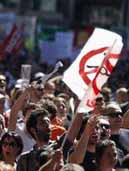
Spanish ProtestsThere continue to be major protests in Spain—one on Tuesday resulted in clashes with the police, ending in at least 22 arrests and 28 injuries. The people are rightly unhappy about the recent austerity deal. It’s very simple. The Spanish government—like most governments—has debt. Because they don’t have their own currency, potential lenders are concerned that Spain will default on this debt. Thus, interest rates on Spanish government bonds are ridiculously high (almost 7% a couple of months ago). This problem could easily be solved by the European Central Bank (ECB) guaranteeing the Spanish debt. But the ECB will only do this (more or less) in return for $50 billion in austerity—budget cuts and tax increases.

Here’s the reason that the people are angry: Spanish unemployment is almost 25%. These austerity measures will only make things worse. How do we know this? The last three years in Ireland, Italy, Greece, Portugal, United Kingdom, and Spain. Oh, and the United States. And John Maynard Keynes. And the Great Depression. You get the idea.

Austerity from Without!

The German government and the ECB have been pushing an idea that was really stupid 3 years ago but now is just loony: if these troubled economies slash the size of their governments, businesses will magically have “confidence” and start hiring. Paul Krugman has come up with the idea that these people believe in the “Confidence Fairy.” It’s kind of like the Tooth Fairy, but without the evidence to support it. Think: the Great Pumpkin. The Confidence Fairy will rise up out of the periphery giving a booming economy to all good countries.

As with most of economics, there are lots of feedbacks in these policies. Spain has to borrow money to support its debt, but because it doesn’t have its own currency, lender fears of default push up interest rates, and this in turn requires more borrowing. Cutting government spending causes the economy to shrink, the smaller economy provides fewer tax revenues, and this in turn makes more spending cuts necessary. The only way this works is if the Confidence Fairy makes an appearance. But just like in every year’s rerun of It’s the Great Pumpkin, Charlie Brown, she never does.

Moral Hand-Wringing

Here in the United States, most of the coverage on this issue is from the German perspective. It is highly moralistic. It goes like this: GIPSI (Greece, Ireland, Portugal, Spain, and Italy) borrowed too much money during the good times and so now they need to tighten their belts and tough out the recession. (25% unemployment!) The problem is that this is all wrong.

Economics is not a morality play. It doesn’t matter if GIPSI behaved badly before; their bad situation now is hurting everyone. But the fact of the matter is that of those 5 countries, only Greece’s government acted badly. Spain (and others) had a budget surplus going into this recession.

What happened was that banks in Germany (primarily) thought that the EU’s shared currency meant that loans to GIPSI were as safe as loans to Germany or France. When the recession hit and these countries had trouble paying their loans, the German bankers freaked out. Now, we’re supposed to wag a finger in the faces of GIPSI: “You shouldn’t have taken out those loans!” But somehow everyone seems to forget that it is the bankers and not the borrowers who are supposed to police the loans.

Rick Santelli and Moral Outrage

We’ve seen this same kind of thinking here in America. Rick Santelli famously started the Tea Party movement with his rant about how good people like him were being forced to pay for the bad loans other people took out. Even apart from all we know about predatory lending, this is a ridiculous contention. Parents know that if they allow it, their children will eat cookies to the point of illness. Similarly, bankers know that people want to borrow more than they can afford. Or at least they should know this.

Whether it is the Tea Party or the German government, there is no place for moralizing when cleaning up an economic mess. But of course, this idea worked half way. There was no moralizing about saving the banks. In fact, after saving them, nothing was done to stop them having to be saved in the future. But when it came to saving homes and jobs, well, those people got what they deserved.

The people in Spain are fighting back. I wish them well.

¡Viva España!

Afterword

Democracy Now! has a good story about what’s going on in Spain from the people’s perspective. It contains some interesting reporting like the fact that after foreclosure and eviction, people are still held responsible for their loans. Wow.

Update (26 September 2012 9:24 pm)

If you look on Google News, you will see that almost all of the coverage of this story is about how it is affecting the stock market. Pathetic. The AP has a good piece, Spain counts cost of anti-austerity protest, that gives an overview of what is happening. Note: its claim that 26 of the injured were police is almost certainly propaganda. Of the 28 initially listed in the CNN report, only two were police.

Update (27 September 2012 7:01 pm)

Paul Krugman wrote about all this in today’s New York Times. It is worth reading the whole article, but I was struck by this:

Much commentary suggests that the citizens of Spain and Greece are just delaying the inevitable, protesting against sacrifices that must, in fact, be made. But the truth is that the protesters are right. More austerity serves no useful purpose; the truly irrational players here are the allegedly serious politicians and officials demanding ever more pain.

He concludes:

Beyond that, a significant part of public opinion in Europe’s core—above all, in Germany—is deeply committed to a false view of the situation. Talk to German officials and they will portray the euro crisis as a morality play, a tale of countries that lived high and now face the inevitable reckoning. Never mind the fact that this isn’t at all what happened—and the equally inconvenient fact that German banks played a large role in inflating Spain’s housing bubble. Sin and its consequences is their story, and they’re sticking to it.

Worse yet, this is also what many German voters believe, largely because it’s what politicians have told them. And fear of a backlash from voters who believe, wrongly, that they’re being put on the hook for the consequences of southern European irresponsibility leaves German politicians unwilling to approve essential emergency lending to Spain and other troubled nations unless the borrowers are punished first.

Of course, that’s not the way these demands are portrayed. But that’s what it really comes down to. And it’s long past time to put an end to this cruel nonsense.

If Germany really wants to save the euro, it should let the European Central Bank do what’s necessary to rescue the debtor nations—and it should do so without demanding more pointless pain.

You can see in these comments the danger of past German government demagoguery: now that the government may want to fix the situation, it feels constrained by the Frankenstein’s Monster that it’s created in the people.