Aging and the Dignity Society Offers

Haile Selassie and the Aging ProcessI wish I believed in God. If I did, I would have constant conversations with him like Tevye in Fiddler on the Roof. Except that I wouldn’t be so respectful. Here’s the thing: God is either not all that nice or a total incompetent. I could deal with God being Jacques Clouseau — an idiot who bungled his way into getting a universe to exist. But I would tend to think of God as not nice. What’s more, any evidence that exists indicates that God would be something of a cruel practical joker. I’ve been thinking about this with regard to aging.

For me, aging has been overall a good thing. But I haven’t gotten old enough to hit the cliff of cognitive decline that is likely coming my way in two decades. We all see certain types of gradual cognitive decline as we age. I’ve very much seen it. I’m not as crisp a thinker. But I’ve become a far better “fuzzy computer.” And given my natural gifts have never been in the area of raw computation, this hasn’t been bad. But a sudden drop in my ability to suss out a passage of Kant would be horrible. But oh, how I can image it would make God laugh!

Dealing with my father’s illness over the last few days has gotten me thinking more about this. My father has always been a proud and independent man and aging has only made him more so. I know that it bothers him to find his body rebelling against him. In this case, there is something wrong with his kidneys — perhaps an infection — that is causing him great pain. But otherwise, he is, at 83 years, more healthy than I am. Pain and neglect should not be the reward for putting up with this universe for eight decades.

The Aging of Haile Selassie

As I sat at the San Francisco VA Medical Center late last night, I read Peter Schwab’s Haile Selassie I: Ethiopia’s Lion of Judah. I’ve become a bit obsessed with Haile Selassie recently. He ran Ethiopia from about 1916 to 1974. He was Emperor from 1930. And he was kind of like a god. And to the Rastafari, he is literally so. But Schwab described how Haile Selassie was deposed. He was 82 at that time, and I’m sure that his age had something to do with him losing his grip on power. Now Haile Selassie wasn’t a perfect man, but he did do much good, and it is hard not to find this description poignant:

It must have been devastating. This proud, noble man, used to having his orders followed and being in total control, comfortable with all the major leaders of the twentieth century, now surrounded by troops and being escorted away from all the power and authority he knew. Ramrod straight, dignified, peering into the distance past the horrors of the moment, he did as he was told. With his cape over his shoulders he walked outside. There in the driveway was an old blue Volkswagen. Told to get in, he adamantly refused. How could the emperor, he thought, get into this car when he was accustomed to solid gold horse-drawn carriages, Rolls Royces, and Mercedes-Benzes? The symbols of monarchy must be retained. But choice was no longer an option. At gunpoint he placed his five-foot-four-inch frame into the back of the car and sat as erect as ever.

Obviously, one can see the fall of Haile Selassie as simply what happens to powerful people. He was, after all, an emperor in exile during the Italian Fascist occupation of World War II. But I see it about aging mostly. Life is an arc and we end it much as we start it: helpless. But as a civilization, we have the power to push back against whatever you want to call it: the lack of God’s competence, goodness, or existence. We have the power to allow the old to have the dignity they have earned throughout their lives — whether they be Haile Selassie or my father.

The Second Post of the Day About Why There Is Only One Post Today

Writer: Second PostUnder normal circumstances, I would not be writing this second post today. I would just let it go with the single post. In fact, I discussed the fact that I might only post one article in a day when I announced the new schedule, Goodbye Morning Music and Anniversary Posts. And if ever there would be a day in which I should get away without doing a second post, it would be today — at least in a case where nothing terrible happened.

My 83-year-old father started urinating blood while doing some construction work for a lady friend of his who lives about an hour and a half away. But because my father is very much a Great Generation man, he said nothing until the work was done. Then he drove himself to the emergency room — an hour and a half away back at home. But after 5 hours at the hospital, he looked terrible. They had put a catheter in him, which was filling bright red. And they sent him home with a referral to a urologist. But he was sweating and his hands were shaking wildly.

Back to the ER

I tried to get him to go back to the emergency room. But he insisted that it only hurt when he urinated. But after 24 hours, even he couldn’t take it any more. This is a man who gets dental fillings without novocaine. In one way, I’m really impressed with this because I’m a wimp when it comes to pain. On the other hand, this “real man” nonsense bugs me. But if he admits to pain, I know it’s bad.

When I got him to the hospital, he could barely walk. He was hunched over, breathing hard, sweating profusely.

When I got him to the hospital, he could barely walk. He was hunched over, breathing hard, sweating profusely. They got him in very quickly and I hung out in the waiting room. At that point I felt great because I knew he would be taken care of. But the hours ticked past. It was time well spent. I got to read a number of long-form articles that I haven’t had time for. The internet connection at the hospital was great! I suppose I could have worked on my second post, but I find writing on my phone to be pretty hard.

Finally, I asked what was going on and they told me that they were preparing for his release. That was good, because I had been worried that they were going admit him. Anyway, they let me go back and I talked to the doctor and nurse and they told me that they were just getting the catheter installed and that I was welcome to come into the room. I said, “No, no, no!” But given that my father is hard of hearing, I asked that they call me before releasing him, because he often leaves without knowing what he’s supposed to do.

This Is Not the Second Post

It was still over another hour. And, of course, they didn’t call me in. But when he burst through the doors, I could see that there was nothing to be concerned about. The change was so stark and I knew it wasn’t due to any drugs that they had given to him. He was clearly ill when he walked in and he looked liked his normal self when he came out. Apparently, there had been three blood clots in his bladder, and that was undoubtedly what was causing all of his pain.

Interestingly, after telling me repeatedly that he only had pain when he urinated, he told me that when the doctor asked him what his pain was like on a scale of 1 to 10, my father said, “Ten when I urinate; five otherwise”! Thanks for all the honesty, dad!

Anyway, this is the second post today that would have been about something else if all this hadn’t happened. But I’m glad it all worked out well.

How We Make Education Worse Than Random

Education: Boy Studying - Lewis Hine

There are a lot of aspects of education that that are complicated and that we don’t pay enough attention to. Commenter Colin Keesee brought my attention to a curious fact about sports. Since there are date cutoffs for which league a child will play in, those who just miss the cutoff will be up to 12 months older than those who just make the cut off. Thus they will be up to 12 months bigger and more physically and mentally developed. This is all discussed in an interview Malcolm Gladwell gave with ESPN, Q&A with Malcolm Gladwell.

The result of this is a self-fulfilling prophecy. The older students get more playing time and attention, thus making them even further ahead of their younger competitors, who would often have as much if not more talent. In the interview, this is applied in terms of hockey and the NHL, but the data do not show what they claim (the correlation is in the opposite direction that the theory would indicate). But the point is a valid one.

I remember in little league baseball, there was a huge difference in the size of the boys. I’m sure some of this had to do with the ages of the boys. But another issue is just that some boys mature faster than other boys. It doesn’t really matter what the reason is, they are all arbitrary. Just because a boy is small an uncoordinated at 8-years-old does not mean that he won’t be big and graceful at 14.

We have a great problem with focusing on early bloomers. Mozart was an early bloomer but Beethoven really wasn’t. And Einstein wasn’t. And certainly Cervantes wasn’t…

But what I noticed in my very limited experience with organized sports was that far more coaching time was spent with the boys who needed the least help. And the reason for that is obvious enough: people think that greatness is something you are born with. Thus, why waste your time coaching an incompetent given that they are never going to be any good?

Education for Those Who Don’t Need It

Throughout my life, I’ve been shocked that this attitude is everywhere. I don’t really care about sports. But this is applied to math and writing and every other human activity that involves education. Because I do have a knack for systems and analysis, I’ve look back in horror at the way people “taught” me to write and play chess — two things I’m rather good at, but only because I taught myself in adulthood.

It’s especially true with chess education which is concrete. When I teach a child to play chess, I first teach them the moves, but then we go on to basic tactics like combinations and forks. And I teach basic strategy from the beginning. What’s so frustrating about all this is that the way chess is normally taught goes entirely against the march of human progress. We don’t expect each generation to rediscover the entire intellectual history of humanity. But we do when teaching chess.

Interest Trumps Natural Ability

The way I learned to write was very interesting in that it shows someone with mediocre talents can become pretty good if they are obsessed with it and work on it a lot. I know lots of people who used to be better writers than I am and who still know a lot more about the mechanics. They were born with more talent. I was born with more interest. And interest trumps talent.

My favorite example of this is Mozart, because everyone thinks of him as the ultimate example of intrinsic greatness. But it just isn’t true. He was trained from the youngest age. And he worked very hard. After he studied counterpoint in France, his compositions took a great leap forward. None of this is to say that he didn’t have natural ability, although I do wonder how much of that was in the genes and how much of it was being surrounded by music even before his birth.

Education Often Makes Things Worse

We have a great problem with focusing on early bloomers. Mozart was an early bloomer but Beethoven really wasn’t. And Einstein wasn’t. And certainly Cervantes wasn’t — having written his only great works starting in his late fifties — and mostly in his middle to late sixties.

The universe is a cruel and fickle place. The problem I have is that as a species, we haven’t learned to push against that. In fact, in education, we have a strong tendency to reinforce it, or even make what would normally be random be distinctly unjust.

Imperative Programming to Start: Please!

Imperative ProgrammingNormal people don’t even know what imperative programming is. Even most programmers are at most vaguely aware of the different classes of programming languages. But there are a lot of programming paradigms.

For example, there is logic programming, which is unlike what most people even think of as a programming language. You can get an idea about it by checking out Prolog. In it, you don’t say, “Do this, then do that.” You define relationships and then ask the system questions. It’s pretty far abstracted from what a computer is actually doing. And the same is true of the object-oriented programming paradigm. And this is why people should stay away from these kinds of paradigms when they first start coding.

My big boss sent me an article recently, 30 Years Later, QBasic Is Still the Best. In it, Nicolas Bize talks about how he introduced his son to programming with QBasic and how easily his son picked up on it. So QBasic rocks, am I right?! But he doesn’t dive into why QBasic worked so well for his son. Because the issue is not QBasic or the Basic programming language at all. The issue is that it is easiest to learn simple imperative programming languages: languages where you tell the computer, “Do this, then do that.”

The reason is that they model the natural way that we go about solving problems. Here’s an example of a bit of imperative programming that pretty much everyone has written:

IF "Man on sidewalk ahead is having angry conversation with himself"
THEN "Cross the street."

In more traditional code, it would look like this:

crossStreet = 0;
crazyBehavior = 1;

if crazyBehavior = 1
  crossStreet = 1;

In object-oriented programming, it’s far less direct. The man would be an object. One of the object’s characteristics would be crazyBehavior. The object would have functions for setting and reading crazyBehavior. There are lots of reasons why this is a better way to code. And one of those reasons is that it makes the code more abstract. But that also makes it that much more difficult for someone new to programming to learn what’s actually going on.

When I first learned to program for Microsoft Windows, it was in the imperative programming language, C. The basis of every program was running a function that returned any messages that had been sent to the program. Then, the program would loop through all the messages that it was interested in. Is the message to redraw the window? Then I’ll do that! Is the message to resize the window? Then I’ll do that! And so on.

But later, I wrote everything with C++, an object-oriented language. In that, these was no checking for messages. Instead I just wrote functions for objects to do the things that needed to be done, and all that messiness of checking messages was gone. Sure, it was still in the code somewhere. But it didn’t involve me as a programmer. And if I had never coded the old imperative programming way, I wouldn’t have had much of an idea what was really going on.

Computers are stupid. So the closer you are to how they really work, the easier it is to understand. It just so happens that the closer you are to how they really work, the more work you have to do. So there is a very good reason to program using high level abstractions. But it is no way to learn.

Yet Nicolas Bize is in the minority when it comes to programmers. If you ask most programmers what language you should learn because you are just starting out, they will usually scoff at things like Basic or Fortran or even C. Personally, I think people who want to learn programming should start with some form of simple Basic. Then they should learn assembly language or take a course in digital electronics. Then they can branch out into other languages where they can be more productive. But by that time, they will understand how computers work.

Kitty Genovese and the Myth of the 38

Kitty GenoveseKitty Genovese was the young woman who was stabbed to death in New York in 1964. She became famous in death because of reporting by The New York Times and later by Times‘ editor AM Rosenthal’s book, Thirty-Eight Witnesses: The Kitty Genovese Case. The story was that as she was attacked 38 neighbors watched and did nothing. I’ve long known that the story was largely a myth, but it was only today when I listened to CounterSpin that learned just how much of a myth it was.
The show interviewed Marcia Gallo, who last year published the book, “No One Helped”: Kitty Genovese, New York City, and the Myth of Urban Apathy. The main thing I knew about the case was that when Genovese was first attacked by Winston Moseley, a man opened his window and yelled at the perpetrator — who then ran away. It’s just that she had already been stabbed; Moseley came back later and finished her off.

What I did not know was that after Moseley first ran away, she then went around the corner and collapsed inside a vestibule where the door was locked. When Moseley again attacked and attempted to rape her, she was yelling for help, but feebly (for obvious reasons) and out of sight. A friend of her’s in the building opened his door, scaring away Moseley again. As the friend called for help, another neighbor held Genovese in her arms until the ambulance arrived. It’s actually a touching scene all around with tenderness as well as the horror of it all with neighbors trying to hold themselves together enough to be helpful. Unfortunately, Genovese died of her wounds on the way to the hospital.

All of us can get behind the idea of individuals being nice to each other. But this is a traditional conservative dodge — used effectively to limit solidarity.

So where does the this notion of 38 witnesses who did nothing come from? Well, the police. In trying to find her murderer, the police were frustrated by neighbors’ lack of interest in helping them — in many cases, refusing even to open the door. But this got morphed into the idea that there were all these people who just sat by and watched Kitty Genovese be murdered. It’s certainly true that some number of people saw or heard some part of one or the other of the attacks. But as we see: at least three of them did do something.

Kitty Genovese’s Murder as Ideological Fodder

What I got from the interview with Gallo was how the case was used for other purposes. In particular, AM Rosenthal was very interested in how individuals allow bad things to happen by not speaking up. He was particularly interested in the rise of Nazism and so on. But he also seems to have been fundamentally conservative. He did not like the social movements that were rising at the time. So he used the case (probably without knowing it) as a way of putting down social movements in the name of individuals treating each other well.

Now, all of us can get behind the idea of individuals being nice to each other. But this is a traditional conservative dodge — used effectively to limit solidarity. It is very curious in the Kitty Genovese case, however, because even had he been right, the issue wouldn’t have been the lack of one-on-one care, but the lack of social cohesion — the lack of solidarity.

Interestingly, we know Rosenthal to be conservative in a couple of ways. For one, he was very keen on the Iraq War. But the other is that he was highly homophobic and this resulted in The New York Times being slow to report on the AIDS epidemic. But Kitty Genovese was a lesbian herself. And I wonder if that fact didn’t contribute to his more easily using Kitty Genovese as simply a means to his ideological ends.

Afterword

Winston Moseley was caught six days after the attack, because his neighbors turned him in for a burglary they had witnessed. This whole idea that city people lose their sense of community is just ridiculous.

We Don’t Need to Memorize the Multiplication Table

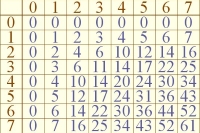
Octal Multiplication TableI’ve had something on my mind for a long time that greatly bothers me: the multiplication table. This is because I think that education should be fun — full stop. Memorizing the multiplication table is not fun. But more than that, I believe they are the source of most people’s hatred of math. At the same time, I’ve long thought that one should probably know them. And that created a conflict in me because I thought that it was really only possible to know them by memorizing them. But the other day it occurred to be what hogwash that is.

To begin with, I’m really good at math. Yet I’m pretty flaky on the multiplication table. I remember in the sixth grade, I had this teacher who seemed more like a drill sergeant. And he used to do this thing where he would go desk by desk asking each student one question, “Seven times eight?” He went sequentially through the table and the desks, so I always calculated which question I would get so I could figure it out and say it the moment he asked me. In that case, there was clearly some mathematics education going on for me, but it had nothing to do with the multiplication table.

I have never memorized what 6×7 is. Instead, I know that 6×6 is 36, and so I know 6×7 must be 6 more than that, which is 36+6, which is 42.

The rationale for knowing your multiplication table is that if you know them, then you can do things like multiply and divide arbitrarily large numbers. But if that’s true, why were we taught the table from 1 through 12? It should have been 1 through 9, right? You can calculate 11×12 — you don’t need to memorize that it is 132. And I think the reason for it is that it was a way to fill the curriculum. It didn’t take long enough to force the students to learn up to 9×9, so they went up to 12.

And as you get into higher math, you don’t even much deal with numbers. And for people like me who are naturals at math, it never is about numbers but rather elaborate games you make up. You think about things like the way the nines go down by one as you go up the table, and elevens go in the opposite direction. If you are lucky, you get introduced to octal and start seeing numbers in a whole new way. But you are unlikely to ever play with numbers if they are forced on you in the same way that the ordering of the alphabet is. (I am still quite fuzzy about which letters go before others without the help of the song.)

Multiplication is just a matter of counting. I have never memorized what 6×7 is. Instead, I know that 6×6 is 36, and so I know 6×7 must be 6 more than that, which is 36+6, which is 42. I don’t find this fun, but I did think it was a nifty trick when I was a kid — one I was never taught. And I fear that many if not most children memorize their multiplication table without having a profound sense that all they are doing is counting. That’s sad.

As everyone should know, math is extremely abstract. That’s why I say it is the closest thing to theology, and certainly it is the closest I ever get to God. But the mindless memorization of the multiplication table is not just boring. For many students, it turns math into alchemy. Sure, it’s abstract. But much more, it is mysterious in the same way God is: unknowable. And why even try?

There is no need for children to learn the multiplication table. I have a simple proof:

  1. What is 9×9?
  2. 9×9 = 9+9+9+9+9+9+9+9+9.
  3. QED.

Political Science 101 for Political Reporters

Bill ClintonI’m a big fan of Brian Beutler. And I agree with his conclusion in his recent article, The Trump Crack-Up Is Just the Beginning of the Republican Civil War. His point is that even if Trump loses the general election badly, the Republican Party won’t change. But he pushed one of the most common and ignorant claims about the Democratic Party, and more generally political science.

According to Beutler, after the three presidential losses (1980, 1984, and 1988), the Democratic Party reassessed itself and decided that it had to move to the right. Thus brought Bill Clinton and victory. That’s a nice narrative. But it’s totally wrong. Carter wasn’t a liberal. He was the beginning of the emergence of what would become the New Democrats. What’s more, he was — as were Walter Mondale and Michael Dukakis after him — part of that new breed of Democrats who weren’t really ideological but just technocratic.

We look back on them now as liberal, not because of their policies, but because they lost. Remember, I was around during Bill Clinton’s term. And according to the conservative movement, he wasn’t just liberal, he was a radical — a communist, even. That’s because Democrats are always leftist radicals in the minds of conservatives. And this is why it makes no sense to try to take welfare “off the table.” Did Bill Clinton ending welfare as we know it make the Democratic Party any less prone to attacks that it was the party of welfare recipients? Of course not!

It would have been very surprising if the Democrats had won any of those races, because the fundamentals were not only against them, they were against them forcefully.

But as I’ve shown elsewhere, and as is documented with scientific precision in Lynn Vavreck’s book, The Message Matters, the economic fundamentals favored the Republicans in 1980, 1984, and 1988. It would have been very surprising if the Democrats had won any of those races, because the fundamentals were not only against them, they were against them forcefully. Carter eked out a slight victory in 1976 because the fundamentals were only against him slightly.

Neither the nation nor the Democratic Party base was begging for the Democratic Party to move to the right in 1992. Bill Clinton was not the answer to the previous three elections. He was, however, a gifted politician in a party that had mostly been taken over by conservative elites. The only thing the party was responding to was the desires of powerful people in or aligned with the DLC.

I find this stuff really annoying because it just isn’t hard. My job — what people are willing to pay me for — is technology writing. If you want me to make Fortran 77 interesting and understandable, I’m your man. I have a basic understanding of computer science and programming. But political writers generally don’t know anything about political science. And it is particularly sad in the case of Brian Beutler, because he’s both smart and insightful. But how about learning a little about the science of it? Instead, it is just fine to depend upon what everyone “knows” — which turns out to be untrue.

So yes, the Republican Party won’t change even if Trump only manages to get 30% of the vote. But the Democratic Party is no different. What’s more, why is the presidency such a big deal? Does political science teach us that the presidency is all that matters? No, of course not. And as it is, 31 state legislatures are controlled by Republicans, compared to just 11 by Democrats! They also control the Senate and the House. And after the next election, they will almost certainly still control the House — and might control the Senate. It seems to me that the Republican Party is doing okay.

This all disturbs me. But we aren’t going to change it unless we can see the truth and look clearly at the political science. And believing that Bill Clinton was a response to political changes in the country is perhaps the biggest part of the problem. Because now conservatives win even when the Republican Party loses. And someone as smart as Brian Beutler should understand that.

The Daily Show and the Smug Style

Jon Stewart - Smug StyleI noticed a couple of weeks ago that I had totally stopped watching The Daily Show. So I went back and watched a week of it. It’s still quite a funny show. But it is nothing you won’t see on countless other late night talk shows. There is nothing insightful about it. And I say this as one who had my problems with the show under Jon Stewart. I agree with Emmett Rensin in The Smug Style in American Liberalism. There was always a problem with it trying to be non-ideological and thinking that policy fights were really just a question of everyone accepting what the facts are.

But the new show with Trevor Noah is just an exercise is triviality. I have to question the idea of giving the show to a recent immigrant, given the tendency to see one’s new locale as charming and benign. And the United States is really not either of those things. Or at least not things that make for good social satire. Another problem may be his age. Certainly, John Oliver seems to be more in the tradition of Jon Stewart, and he is both older and less of a newcomer to the nation.

Oliver definitely is continuing the smug style of liberalism. But that’s not necessarily a bad thing. As I’ve noted in the past, when Jon Stewart hosted The Daily Show, I may have had problems with it but I watched it every day. And John Oliver’s long segments on Last Week Tonight are incredible. His most recent was an excellent example, but also telling because it isn’t about politics at all. It’s about scientific studies and the terrible job that the media does in discussing them. Check it out:

This is an old problem in statistics. If you do the same study enough times, you will occasionally get a study that finds something that is incorrect. This is something that drives me crazy about the way polls are presented. I often hear things like, “Candidate A and B are in a statistical tie.” This is because the two candidates are closer than the margin of error. But this is meaningless. The margin of error is just a measure of how many people were sampled. No one poll is very meaningful, although it might by chance be correct.

The reason that the smug style of liberalism is really not a problem to me is because our society is so out of kilter that just getting the facts right is a big deal. It reminds me of what I said about Paul Krugman years ago: he’s a lot more conservative than I am and I look forward to the day that I start disagreeing with him. That day is at hand, of course. Just check out his recent blog post, The Facts Have A Well-Known Center-Left Bias — a clear case of false equivalence.

But it is sad to see The Daily Show sink even below the smug style. It isn’t helped by the fact that Noah now has Donald Trump to slam night after night. It does make me wonder what will happen once Donald Trump goes away and Noah doesn’t have permission to go after so much else that is just as dangerous, but perhaps not as obviously so.

It’s sad to say, but I miss Jon Stewart’s smug style of non-ideological liberalism. I can’t imagine a day in my lifetime that we won’t need it.

Acrophobia and Free Will

Golden Gate Bridge - AcrophobiaI remember a time I was hosting a programmer from Romania (yes, that guy). And he wanted to take some pictures of the Golden Gate Bridge before he left. So I drove him over to the north side of the bridge where there is parking with a great view of the bay and the city. And it is just a short walk to the bridge itself. I went with him. But after only 30 feet onto the bridge, I had to leave him. I was suffering from extreme acrophobia. I was panicked.

I had suffered with acrophobia my entire life, yet this was a little surprising to me. As part of my work at that time, I spent a tremendous amount of time flying around in a little 2-seat Cessna. It was something that I very much did not want to do when the company had started. But the hardware/software system that we were developing was so complicated and fragile at the time that I was the only one who could do it. I managed it in part by just focusing on the work I had to do. But the truth is that it wasn’t that big a deal regardless. I have never had aerophobia — the fear of flying.

(I do have a very rational fear the wings falling off planes because I’ve known too many engineers in my life and I don’t have a high opinion of them. But that’s another issue.)

I’ve seen The Matrix a dozen times, and every time Neo goes out on that ledge, I squirm in my seat. I’m doing so right now just thinking about it.

The truth is that I don’t have to be on the Gold Gate Bridge to have a panic attack. I get pretty much the same thing walking over an overpass. And I’ve come to think that the basis of my acrophobia is my sense of free will. (I don’t believe in actual free will, of course.) It doesn’t much matter that I’m not suicidal. When I see a ledge that I could run to and throw myself over, I panic. It’s not the ledge; it’s my imagination that terrifies me.

I’m the same way when I watch films. I’ve seen The Matrix a dozen times, and every time Neo goes out on that ledge, I squirm in my seat. I’m doing so right now just thinking about it. The mind is a crazy thing and what goes on inside it is often much more threatening than what’s going on outside in the “real” world.

None of this is to say that I don’t have a general fear of heights. But if I’m in something like an aerial tram, I might be ill at ease, but I’m not freaking out. On the other hand, if the tram was open air, I’d be lying on the floor convulsing. And to be honest, I’m not sure I would want to get rid of this kind of fear. One of my better abilities is to visualize hypotheticals really well in my mind. I’d hate to lose that just for the sake of being able to walk across the Golden Gate Bridge.

How can you hate a fear that allows you to imagine what it would be like to take that step — even if the the reality is tragic?

The Pros and Cons of Being in a Political Party

Donald Trump Give Nothing to His Political PartyPolitical scientists Boris Heersink and Jeffery Jenkins wrote what I think is an incredibly insightful article over at The Monkey Cage, GOP Voters Picked Trump. Party Leaders Aren’t Falling in Line. Here’s Why That’s Surprising. The basis of the article is what politicians gain by joining a political party and what they give up.

They note that there has been a great deal of research done on what being in a political party provides. The biggest thing is that parties help individual politicians win — elections as well as battles over law making. They also note that relatively little research has been done on what they give up in joining a political party. That may be because it’s kind of obvious: they give up their independence.

Give a Little and Get a Little

Now I understand, none of this is shocking. Everyone has been a member of a group. And you know that you give a little and you get a little. This is, by the way, why I’m against the Bernie or Bust movement. While it’s true that Hillary isn’t my perfect candidate, neither is Bernie. If I wanted perfection, I would write in myself for every elected office in every election ever.

The problem that Heersink and Jenkins highlight is that Donald Trump hasn’t given anything to the party. He is entirely himself without making any compromises to the party. Thus, why should the party offer him all the good things that come with being in the party when he hasn’t and likely won’t reciprocate. I’m very much with John Dean: Donald Trump is a classic authoritarian leader. He’s also a narcissist. It’s all about him. I’m sure that a 1% chance of his becoming president more than offsets a 99% chance that he will destroy the political party he is nominally attached to.

Cruz Is Even More Disloyal to His Political Party

Ted Cruz Give Nothing to His Political PartyBut what goes unmentioned in the article is Ted Cruz. And I think he is an even better example of this. That’s because Trump has used the Republican presidential nomination for his own purposes, but he hasn’t really used the party otherwise. He might have been able to do this well as an independent. Ted Cruz on the other hand, has used the Republican Party to win at the state level and then at the national level. But he has been the very definition of disloyal. He’s been one of the Democrats’ most potent weapons since he entered the Senate.

The conclusion of the Heersink and Jenkins article is that by Republican elites not going along with what their voters clearly want, “The result could be a complete fracturing of the party.” But I think that the fracture appeared a long time ago when candidates like Ted Cruz started getting elected. If you look at the primary so far, over 70% of all Republican votes have been for Cruz or Trump — candidates who take and do not give to the party. The base doesn’t care about the party. The base has been trained by the party itself to think that the base should get everything it wants and should never have to compromise about anything.

And I can’t blame them. Since at least Bill Clinton, the Republicans have not argued that the Democrats, as a political party, are wrong about policy, but that they are foreign interlopers bent on destroying the nation. The Republican Party is already fractured. The question is whether it will be destroyed.

The New Look of Frankly Curious

Frank MoraesI know what you’re all thinking, “I don’t like this new website look!” But trust me, you’ll get used to it. This is hardly the first time that the website has changed. And every time it changes, people don’t like it at first and then they can’t even remember what it was like before.

But there are a number of good things about this new design. The first, and most obvious, is the new header. I always liked the Lego Don Quixote, but it did have it’s problems. The biggest is that the windmill was there. And as a lover of Don Quixote, it’s a bit embarrassing to have the cliche up — especially given that it happens early in the first book. What’s more, there was no Sancho Panza, and he is as important to the book as Don Quixote.

A smaller problem was that more and more I thought it made the website look like something aimed at 7-year-olds. Now given that in many ways, I still am a 7-year-old, there is something to be said for that. But I am more serious most of the time. The 7-year-old is more the spice — not the meat. And the artwork by Andrea English is great.

The most notable thing about this new theme is the slider thingy that currently scrolls through the six most recent articles. I like that quite a lot. Eventually it may drive me crazy. But I like it now. And the cool thing about it is that I can change it so that it shows random articles. I’m thinking of doing something like Random Mondays or something. I haven’t tried it out so I don’t know how well it will work. But with 7,000+ articles to choose from, it should be interesting.

A Brief History of the Website’s Look

Anyway, I thought I would share with you the way that the website used to look. All the designs were done by Andrea. The first one was the most brilliant. It was based on René Magritte’s self-portrait, Clairvoyance. It combines many of my other interests like the Indian Rope Trick, Christopher Marlowe, puppets, Madame Tutli-Putli. There’s other stuff.

Frankly Curious Website 2010

To be honest, I could have lived with that header forever. The problem with it is that it is so high. I don’t like to hide the content. So after two years, we changed it. Andrea came up with the following design. But it did not last long.

Frankly Curious Website 2012

I get the idea of it: the different interests that the website is supposed to reflect. But that head still just creeps me out. But you can see that the sidebar has become more sophisticated. So this design only stuck around for a year, then we got what you all are very familiar with:

Frankly Curious Website 2013

That was three years ago! And it hadn’t changed much. When we moved from the Nucleus CMS to WordPress, the designed opened up. But otherwise, it was pretty much the same. And what we have now is structurally very similar. The changes are really all cosmetic.

The only thing I wonder about is whether it isn’t all just too much blue. I’m curious what you all think. Feel free to complain. I doubt I’ll change anything, but it might make you feel better!

Medieval Coins and Monetary Policy

JP Koning - Monetary PolicyEconomist JP Koning wrote a fascinating article last week, What Makes Medieval Money Different From Modern Money? The quick answer: medieval money didn’t have its value printed on it. So, for example, a testoon wasn’t worth any set amount. So if you wanted to buy something that cost a pound, you wouldn’t automatically know how many testoons would be required to pay off that debt. The value of the testoon would be set by royal decree. So if the testoon was decreed to be worth one-twentieth of a pound, you would need 20 of the little buggers to buy the product. Now what has this got to do with monetary policy.

Think back on the 2008 financial crisis. That was just the most obvious sign of the bursting of an $8 trillion housing bubble. And it was that burst bubble that caused the recession. People all over the country woke up one day to find that they actually had a lot less money than they thought they had. Or more often, they learned that they were in a lot more debt than they had thought. That would have been a great time for some inflation. Instead, we got a short period of deflation and then very low inflation for the next 7 years.

The Federal Reserve has had a hard time keeping inflation even at its low 2% target. But what if the Fed could have just dictated inflation? Think of our example above. If the kingdom found itself in recession, the king could proclaim that there were now only 19 testoons in a pound. People aren’t idiots, of course. They would realize that a pound was only worth 95% of what it used to be. So they would raise their prices (products and labor) by roughly 5%. Ta da! It’s like a magic trick: instant inflation.

If the Fed had the ability to do this, it might have used it in very minor ways to help out after the 2008 crash. But it wouldn’t have done so aggressively.

But now, without doing anything at all, you have helped out the debtors. They would owe fewer testoons than they had before the new decree. This would allow them to deleverage more quickly and get the economy going that much faster. Given that lenders are generally rich, we aren’t worried that modest inflation would reduce their consumption. The king could also use this system to fight inflation by increasing the number of testoons in a pound to 20 or even 21.

Obviously, this is a gross generalization. Koning’s point is that the medieval monetary system was more flexible than one might have thought. But I take away something more sobering. If the Fed had the ability to do this, it might have used it in very minor ways to help out after the 2008 crash. But it wouldn’t have done so aggressively. The Fed chair at that time, Ben Bernanke, has been very clear that he think he and the Fed did a great job.

The problem with the Federal Reserve hasn’t really been a lack of tools, but rather a philosophy that hurting the rich even the smallest amount (a 5% inflation rate would be considered outrageous by those now in power) is unacceptable. I don’t know how much the kings of old used such monetary tools to make life better for the people. I doubt it was used much and for the same reason that our monetary policy is to have a 2% level of inflation: because those in power don’t actually care about the vast majority of the people.