Anniversary Post: Constantine Finds God

ConstantineOn this day in 312, Constantine had his Vision of the Cross. He was marching with his men to the Battle of the Milvian Bridge — which would lead to his total control of the Roman Empire. But before that, he looked up in the sun and saw a cross and the words, “Εν Τούτῳ Νίκα.” This roughly means, “Through this sign, conquer.” He didn’t know what it meant, but luckily Jesus came to him in a dream that night and explained it to him: follow me and you can dance on the ashen skulls of their enemies.

Now some people will say that this doesn’t seem very Christian — Prince of Peace, and all. But it shows how God used to work. You followed him and he destroyed your enemies, show you could dance on their ashen skulls. It’s kind of like Christmas: you believe in Santa and he brings you presents. How many kids would continue to believe in Santa Claus if he never delivered? Yet Christians watch as God disappoints over and over again, and to them, it is all the more proof that God is on their side. So in this case, God helped Constantine destroy Maxentius. Good for him! If God had ever done something like that for me, I’d convert too.

Of course, this was really when Christianity died. No religion ever survives this kind of power. As long as people have to choose a religion, it can still be vibrant (though it usually isn’t). But the moment that a religion is able to compel belief, it is nothing but an authoritarian dictatorship. That’s what Saint Constantine brought. Oh, and don’t forget: without his 100,000 troops, Constantine would have had his ashen skull danced upon.

Anniversary Post: Massachusetts Bans Quakers

Salem Witch TrialOn this day in 1656, Massachusetts enacts the first punitive law against the Quakers. The colony was set up in 1620, so that’s 36 years without systematizing their religious intolerance. Of course, that gives entirely the wrong idea, because the Quakers didn’t come until later. The only reason I find this interesting is because — like most Americans — from a young age, I had this idea crammed down my throat that the Pilgrims came to America for religious freedom.

That wasn’t true, of course. The truth was that the Pilgrims did suffer oppression in England. So they moved to Holland. And there they found freedom of religion. But they found it economically difficult. The young people were wandering off to find jobs. Many of the older Pilgrims moved back to England. When things like this happen, you would think people would wonder if God really did have their backs.

Anyway, so they made it to America where they found it necessary to enact laws to stop other religions, because like most religious people, they don’t actually think that God has their backs. It’s all about power. And the best way to protect your particular form of religion is by not letting anyone compare it to any other form of religion.

It’s interesting that Philadelphia became the biggest and most prosperous city in America by the start of the Revolutionary War. Why? Because the Quakers settled it and governed it liberally. Meanwhile, Massachusetts became something of a backwater. By 1692, it was charming all the colonies with its Salem witch trials, where 20 people were executed.

Ain’t freedom of religion grand!

We Atheists Should Admit We Might Be Murderers

Lauren NelsonIn the Friendly Atheist section of Patheos, Lauren Nelson wrote, Before You Claim the UCC Shooting Was About Christian Persecution, Consider All the Evidence. It’s a relatively deep dive into whether the shooter was an atheist and whether this had anything to do with singling out Christians. And the answer to the first question is clearly no. He certainly had a problem with organized religion, but he doesn’t seem to have been an atheist. We now have some indication that the answer to the second question is also no.

But I think it is a mistake to make such an argument. Implicit in it is the claim that an atheist wouldn’t target random people for execution as an expression of atheism. That might not be the case here, but given the frequency of mass shootings, it may well happen — and soon. And then atheists will be in the same place that Christians now find themselves: committing the no true Scotsman fallacy. We’ll have to listen to people claiming that anyone who really understood the tenets of atheism wouldn’t have committed this horrible act.

I am an atheist, but I know the atheist community far too well to rely on this. There are many atheists who get mad at me for saying this, but there really is a strong connection between atheism and libertarianism. Atheism doesn’t necessarily turn someone into a humanist. Many atheists feel it is perfectly acceptable to let human beings die in the name of their primitive economic theories. In general, they don’t think it is all right to explicitly kill others. But it is hardly far off the beaten path. Ayn Rand was very much enamored with serial killer William Hickman and Nietzsche’s Übermensch. It doesn’t take any effort at all to actually become the serial killer and imagined Übermensch.

But there is a more fundamental point here. Humans are clever. It does not take much to use just about anything to justify something that you did or want to do. True, it would be harder to justify murder using Jainism than Judaism. But I feel certain it can be done. And atheism is a hell of a lot closer to Judaism than it is to Jainism — at least judging from the way that prominent atheists talk. So I think we atheists ought to give our theist brothers and sisters a break. We should just assume that some very prominent horrific act has already been committed by an outspoken and clear atheist.

Does this mean that atheism is bad? Not at all. It is just an acknowledgement that people use all kinds of things to justify their terrible behavior. And that would allow my fellow atheists to better see that the acts terrorists, lone gunmen, and Republican politicians do not necessarily say anything about the religion of those people. If there is one lesson from religion that I wish that atheists would learn, it would be the dangers of hubris taught in the Old Testament. As a group, we atheists are very full of ourselves. I would hate for me and my philosophy to be judged on the basis of Sam Harris and Christopher Hitchens.

Jeb Bush’s Hypocrisy on Religion and Science

Jeb BushJeb Bush is a Roman Catholic. And so, as for many conservative Catholics, Pope Francis’ visit was a bit uncomfortable. But it shouldn’t have been. Liberal Catholics have a long tradition treating the pope with a certain amount of skepticism. But conservative Catholics are the authoritarians. The pope is the guy who dictates what the church is. The conservative Catholics should fall in line. They are certainly the first to say so when the pope says something that they agree with. But not now. And truthfully, not ever when it meant believing something they didn’t want to. If anything, conservative Catholics were even more upset with Vatican II in the mid-1960s.

But that doesn’t make me any more understanding of the obvious hypocrisy. As soon as Pope Francis started saying liberal-sounding things, I started hearing conservatives making excuses. Basically it was some variation on, “I turn to the pope for religious guidance, not political guidance.” But that’s clearly not true. They were more than willing to turn to the pope for political support when it came to abortion or homosexuality. It’s just that they’ve decided that those are religious, whereas things in the Bible about greed and the environment are political. Clearly, I think they ought to do what the liberals do and just admit that they take what they like from the pope and leave the rest.

“He’s not a scientist, he’s a religious leader.” —Jeb Bush

A recent quote from Jeb Bush really blew my mind, however. In relationship to the pope’s position on global warming, Bush said, “He’s not a scientist, he’s a religious leader.” This goes along with the new Republican line on global warming, “I’m not a scientist.” Bush uses this line himself, “I’m a skeptic. I’m not a scientist. I think the science has been politicized.” So he can’t take advice from the pope because he’s not a scientist. But he can’t take advice from scientists, because the science has been politicized. And that leave him only to trust what he just wants to believe.

Pope FrancisThis is the modern world in a nutshell: no one in public life is ever expected to suffer for their beliefs. So Bush can go around talking to Latino Catholics about his Catholicism, but that doesn’t mean that it has any effect whatsoever on his thinking. So he could demagogue the Terri Schiavo case because of his faith, but he doesn’t even need to consider a rethink of his anti-environment, pro-oil policies, because it is outside his faith. His faith is defined by his political desires.

This is why it really is different for liberals. We may like it that Pope Francis seems to be on our side on the issues of poverty and global warming. But we never claimed these or any other positions were based on our religious principles. Well, most of us anyway. There are people like Elizabeth Stoker Bruenig, who are liberal, anti-abortion Catholics. But note that she actually lets the religion guide her politics, not the other way around. And that is exactly what Jeb Bush and almost all of the Republicans do. They use their religion in the most depraved, sacrilegious way to do the bidding of their politics.

Bush is right: Pope Francis is not a scientist. And neither are the people he listens to for “advice” on global warming. So given that being a scientist isn’t a prerequisite for his taking advice, why doesn’t he listen to Pope Francis? Oh, that’s right: because it isn’t what he wants to believe; it isn’t useful for his political goals; and most of all, because he’s a hypocrite.

Anniversary Post: Pope Urban VII’s Short Run

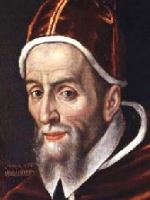
Pope Urban VIIOn this day in 1590, Pope Urban VII died. Given all this Pope Francis madness last week, I thought it would be nice to talk about Urban VII. He did some nice things. He banned tobacco from in and around churches. He subsidized bakers in Rome so they could sell bread cheaply to the poor. But mostly, he’s known for dying: he was only pope for 13 calendar days. That’s the shortest papacy in history.

But he has a lot of competition. Of the 266 popes that the Catholic Church has had, there are ten who served for between 16 and 34 days. A total of at least 23 served less than a year. And there’s also Pope-elect Stephen — a man who died so fast (Three days!) that he didn’t even make it to his consecration and thus isn’t generally considered a pope.

Currently, Pope Francis is sitting at roughly a quarter the way up with two and half years, but he is still alive of course. Benedict XVI served almost 8 years, and that puts him in the middle of popes. Of course, he’s still alive too — just not pope. Well, he still has the title — it’s kind of weird. He’s pope but not the real pope. Anyway, I suppose I should mention that the longest reigning pope was Pope Pius IX (1846 – 1878). He did live a long time, but it was mostly due to the fact that he became pope at the age of 54. He is the joker who came up with “papal infallibility.” The same is true for the number two man, John Paul II, who was only 58. That gave him 26 years to shame AIDS-ravaged Africa into avoiding condoms. We might have been better off if these men had served terms more like Urban VII.

What Institution Does the Pope Represent Again?

Matt TaibbiTo me the Church is just a giant evil transnational corporation operating on a dreary business model, one that nurtures debilitating guilt feelings in its followers and then offers to make them go away temporarily in exchange for donations. I realize the Church does some nice things with the money it raises and that other people have a different opinion, but this is my experience…

Meanwhile Francis chugs along as the head of one of the most socially regressive organizations on earth, doing nothing to take on the Church’s indefensible stances on things like birth control, gay rights, discrimination against women, celibacy and countless other issues. He claims the moral authority to reform global capitalism, but he’s somehow not ready to tell teenagers it’s okay to masturbate, which seems bizarre.

People have such impassioned political fights over the pope because everyone wants the endorsement of the guy closest to God. But what if he’s not closer to God, and is just a guy in a funny hat? Doesn’t that make all this fuss and controversy ridiculous? It seems strange that it’s the year 2015, and we still can’t say that out loud.

—Matt Taibbi
Why Do We Care Whose Side the Pope Is On?

If Pope Toed Republican Line, Catholic Republican Would Listen to Him

Paul GosarIf the Pope stuck to standard Christian theology, I would be the first in line. If the Pope spoke out with moral authority against violent Islam, I would be there cheering him on. If the Pope urged the Western nations to rescue persecuted Christians in the Middle East, I would back him wholeheartedly. But…

—Paul Gosar
Why I Am Boycotting Pope Francis’ Address to Congress

The Recent Development of Public Religion

One Nation Under God: How Corporate America Invented Christian AmericaThis history reminds us that our public religion is, in large measure, an invention of the modern era. The ceremonies and symbols that breathe life into the belief that we are “one nation under God” were not, as many Americans believe, created alongside the nation itself. Their parentage stems not from founding fathers but from an era much closer to our own, the era of our own fathers and mothers, our grandfathers and grandmothers. This fact need not diminish their importance; fresh traditions can be more powerful than older ones adhered to out of habit. Nevertheless, we do violence to our past if we treat certain phrases — “one nation under God,” “In God We Trust” — as sacred texts handed down to us from the nation’s founding. Instead, we are better served if we understand these utterances for what they are: political slogans that speak not to the origins of our nation but to the specific point in its not-so-distant past. If they are to mean anything to us now, we should understand what they meant then.

—Keven Kruse
One Nation Under God: How Corporate America Invented Christian America

Anniversary Post: Mormon Religion

Joseph SmithOn this day in 1828, the 22 year old Joseph Smith was supposedly given the Golden plates by the Angel Moroni, effectively starting the Mormon Church. Given that it is the anniversary of this exciting day, I thought I would reprint some of what I wrote two years ago, Joseph Smith and the LDS Ossification. Unlike most of my fellow atheists, I try to take religion seriously and not just discard it as an irrational activity. Because here’s the secret: all human activity is irrational.

Was Joseph Smith a religious visionary or a charlatan? You know, I really think that he was both. And I think that’s true of most religious leaders. Of course, that’s the best way that I can put it. A less charitable person would say, he bought his own nonsense. I mean, his story is amazing with golden plates and the “seer stones” and all that. But I suspect that if he told the truth — he had a mystical or at least creative experience — no one would have cared. It probably didn’t hurt that he told men they could have multiple wives. (I’ve never quite gotten that myself; I always though one wife was too much; I’d be more into a wife that just spends Tuesdays with me.)

And that name! Could there be a more white bread name for a white bread religion? Why, yes; yes there could: John Smith. But still: it’s second in line. But you gotta give the man credit; he was continuing to expand the religion to the end. And if there is one thing that religious people don’t like it’s uncertainty. And that really did lead to his death. And like most of the founders of religions, death was a great career move. I doubt very seriously that the Mormon Church would have become the colossus that it is today without his untimely death.

There is no doubting that he is a very important figure in the history of the United States. In general, I would say he’s been a net harm. But I’m not sure that’s true during his lifetime. That period of spiritual awakening in America was authentic. It is sad to see how religions like the LDS and the JW have ossified into what they are today. Certainly their founders didn’t want that.

But it sure is powerful today. I mean that in a political and economic sense. I’m not sure it adds anything at all to the theological diversity of the world.

I Want the Word “Atheist” Back, Antitheists!

Lawrence KraussAs the days go on and atheists make me more and more annoyed, I’ve begun to wonder if I shouldn’t call myself something else. It’s kind of annoying, because I feel like this is my turf and they’ve taken it over. A great many atheists are former theists who have “seen the light.” But I was never a theist. It always seemed absurd to me. But as a result, I think I am much less combative about it. I don’t much care. There are all kinds of people with all kinds of stupid ideas. Is religion worse on that account? I don’t think so.

The common atheist claim is that religion teaches irrationality. But humans hardly need any help. Everything I’ve read about neurology indicates that most of our ideas about “choosing” and “deciding” are just clever lies we tell to ourselves to continue our fantasy that we aren’t just very big chemistry based machines. But the idea that all religions are irrational is just nonsense. There’s even a word, fideism, which means “reliance on faith rather than reason in pursuit of religious truth.” The fact that most atheists don’t know this word is indicative of their own special blend of ignorance and arrogance.

My problem is that I’m starting to think that the atheist community is becoming kind of dangerous in itself. I recently read a comment on another blog where someone said that he was rational and that was why he was an atheist. And more recently, Lawrence Krauss wrote an article, All Scientists Should Be Militant Atheists. In it, he said that in science “the very word ‘sacred’ is profane.” This is because everything is open to question. But he shows he either doesn’t know what the word “sacred” means or he too has a sense of the sacred. How can such smart people be so ignorant?

Here is a short interview clip with David Mitchell talking about atheism. Not surprisingly, people tend to think that he’s an atheist. I think he makes one very good point. He goes after the idea that religion has caused a lot of killing. “Humans have killed humans in the name of anything… Humans just like to kill each other.” I know some atheists will respond, “Yeah, but Muslims kill while quoting from the Quran!” Which sounds good, but doesn’t counter the argument.

On the other hand, Mitchell calls himself an agnostic, in part, because, “I do want there to be an all powerful benevolent God.” And that to me makes no sense whatsoever. You might want it, but clearly we don’t have it. If this universe has a God, it is at best indifferent. So Mitchell can’t seriously be suggesting that he thinks he might be wrong about that God. If he were, he would have to fundamentally change his definition of “benevolent.”

But I do find myself much more in Mitchell’s camp than Krauss’. And I think when you really get down to it, both Mitchell and I are atheists. No one knows for sure — you can’t prove a negative — Russell’s teapot, and all. But I’m as certain of a lack of an Abrahamic kind of God as I am of anything in my life. And I suspect that Mitchell is the same. So here’s my idea: we get the term “atheists” and Krauss and all the New Atheists can have the term antitheists.[1] That would make the most sense. Because I think they are giving us true atheists a really bad name.


[1] I know: antitheism is a different kind of thing. But it isn’t the atheism I have a problem with. It is all the antitheistic rhetoric that goes along with it. I still want my word back.

There Are Two Evangelical Movements and the Conservative One Supported Slavery

Elizabeth Stoker BruenigElizabeth Stoker Bruenig wrote a great article over at New Republic, Can the Evangelical Left Rise Again? Now, I’m not very interested in the question she raised there. But for the record: probably not. It is true that in recent years, the GOP has treated Evangelicals fairly poorly under George W Bush. Remember the 2004 election that for Evangelicals was all about same sex marriage, but suddenly turned into “privatizing Social Security” as soon as Bush won? That does tend to foster a certain amount of resentment. Just the same: conservative Evangelicals support the Republican Party for mostly non-Christian reasons. Both sides are really focused on hatred of “those” people.

When it comes to the evangelical left, they just aren’t as much in sync with the Democratic Party. For example, my neighbor across the street is a loyal Democrat, but also an Evangelical. He isn’t keen on the party’s positions on abortion or same sex marriage. But the economic issues trump that. I’m not sure that Bruenig is correct to suggest that Evangelicals are “in lockstep with the GOP.” It’s just that they don’t about care issues like economic fairness. Liberal Evangelicals just seem to be more aware of the issues.

But what I found most interesting about Bruenig’s article was the history of it. The United States used to have a really big liberal evangelical movement. These were the people who were fighting for the end of slavery. There were conservative Evangelicals then too. They were the ones who (Quite rightly!) pointed out that slavery was in the Bible — in a very positive way. And later, they were the ones defending Jim Crow and segregation with Genesis 9:27, “May God enlarge Japheth, and let him dwell in the tents of Shem; and let Canaan be their servant.”

I think this is really important to remember: there are liberal and conservative Evangelicals — and there always have been. It’s long annoyed me that conservative Christians run around grabbing onto the liberal Evangelical legacies from abolitionism through Martin Luther King. I knew it wasn’t right. I knew that during King’s day, the John Birch Society — a major conservative Christian organization — was totally against the Civil Rights movement. They were the ones claiming that King was a communist. I knew that these were not the kind of Christians who were fighting for African slaves in the Antebellum Period. I just didn’t have a narrative to explain it.

As recently as the 1960s, liberal Evangelicals were a well established group. “These left Evangelicals were anti-war, pro-civil rights, and deeply concerned with people on the margins of society.” And they are still around, just not a defined group. The reason that “Evangelical” has become synonymous with “conservative Christian,” is that the right has done so much to promote that. It’s pretty much the same thing that they did with the Tea Party movement. It’s a whole lot easier to have a clear “movement” when there are evil rich people ponying up money for conferences and other get togethers.

But the bottom line is the same: when these Republican Evangelicals claim that their movement is an extension of abolitionist movement, they are either ignorant or just disingenuous.

Anniversary Post: Pope Boniface VIII’s Arrest

Pope Boniface VIIIOn this day in 1303, Pope Boniface VIII was taken prisoner by King Philip IV of France. There, he was beaten almost to death. He died three days after his release just a month later.

So what was up with that? Well, Boniface had this theory that since everyone’s salvation depended upon the Catholic Church, everyone needed to be subordinate to it — and thus him. And this wasn’t some “kingdom of God” sort of thing. He was actively involved in foreign affairs. So Philip had him arrested for sodomy. That was pretty much Philip’s default charge against his enemies. He probably thought it was something that everyone was guilty of anyway. The truth is that under some definitions of sodomy, masturbation and sex with condoms qualify.

What’s more interesting is that Dante threw Boniface into hell in The Divine Comedy. Since it was set in 1300 — three years before Boniface died. We simply learn that, yeah, the old bastard is coming to the eighth circle of hell for the sin of simony. That’s the selling of church titles. There is no doubt that Boniface was guilty of that charge. It would be damned hard to find a pope of that time who didn’t.

Still, was Boniface a terrible pope? By the standards of the time? Well, he did massacre the entire town of Palestrina just because he was pissed off at one family. But it is important to remember that this isn’t what got him in trouble. What can I say? It was a time when being a pope meant something!