Georgia Senator Johnny Isakson and Convenient Science

Johnny IsaksonGeorgia Senator Johnny Isakson wants to do something about the Zika virus. Because scientists have said that it is very dangerous. But like a lot of people, Johnny Isakson only thinks science is important when it doesn’t get in the way of his dogma. A lot of those convenient science believers are in my family.

My mother’s side of the family was made up of a bunch of conservative Christians. In fact, by family lore, my aunt gave Oral Roberts $5,000 or more. The reason we believe this is because she received a hand written note from him. But it was one of those things where a Christian is going through a bad time and think if they can just give a big pile of cash to “God,” then all their problems will work out. But they were definitely more interested in talking about abortion than feeding the poor. But the thing they most liked to talk about was the evils of science — evolution specifically.

My parents were both the black sheep of their families, so I didn’t have to worry about this. My parents believed in science. But whenever we would visit this part of the family, I would hear them scoff at the idea of evolution. It’s was curious, because in many ways they knew more about it than most people. They could give you reasons for why carbon-14 dating didn’t work and holes in the fossil record and stuff like that. It was just because they listened to people like John Morris Pendleton. Normal people just assume that scientists know what they are doing and don’t get into the weeds.

Science Is Often Inconvenient

When I would listen to the arguments made against evolution, I would get angry. To me, even as a teenager, science was something you either accepted or you didn’t. It wasn’t a la carte — something you could accept when it was convenient and reject when it wasn’t. That’s not the way that science works.

I even remember a conversation that I had when one of my physics professors when I was in college. I was still struggling with quantum mechanics — not in a scientific way, but in a philosophical way. I told him that I just didn’t like the fact that reality seemed to not be deterministic. He told me he agreed with me. It sucks that the universe is not the way that we want it to be.

Johnny Isakson wants more money to fight the Zika virus since the CDC “convinced him that Zika could be more dangerous for the US than Ebola.” I wondered if Senator Isakson was also as accepting of the scientific consensus on global warming.

But our job is to uncover the universe, not to define it. My professor, Joe Tenn, didn’t say that last part because he didn’t need to. It was enough that he shared my discomfiture. Of course, we weren’t alone. Einstein felt the same way, and that’s what his famous line is all about, “God does not play dice!”

What bugged me about this side of the family is how they picked and chose what science they were going to believe. They were more than willing to take the good things that science gave them: air conditioning, automobiles, MRIs. But they weren’t willing to take the science that demanded anything from them. They didn’t believe evolution, even though it being wrong would have ripple effects throughout all of science. And this offends me.

In all areas of science, they just accept without thinking much about it. But when their pastor tells them that this or that bit of science is not true because it appears to disagree with their religious dogma, they are suddenly experts on science. It’s offensive to actual scientists — and to the entire civilization that has been built on science.

Of course, it isn’t just religious people who do this. On many occasions, I’ve had conservatives tell me that global warming is a hoax. They try to set me straight. They get their information from Fox News and Breitbart. And that makes them more qualified than I am with my ten years of study the subject as a graduate student and then physics professor. But again, these same people accept all the other aspects of science that don’t get in the way of their preferred policy positions.

Johnny Isakson Thinks Science Is Useful This Time

And that brings us back to our good friend Georgia Senator Johnny Isakson. On Thursday, I heard a story on NPR, Southern Lawmakers Lead Fight Over Funding To Combat Zika Virus. In it, I learned that Johnny Isakson wants more money to fight the Zika virus since the “Centers for Disease Control and Prevention in Atlanta convinced him that Zika could be more dangerous for the US than Ebol.” I wondered if Senator Isakson was also as accepting of the scientific consensus on global warming.

Well, Johnny Isakson is not a Stage I Global Warming Denier. He’s at Stage II: there is global warming, but humans aren’t the cause! And the truth is in 2015 (when he cast his vote to this effect), that’s the most intense level of global warming denial. The only people who say it isn’t happening at all are those who claim there is a conspiracy.

What I wonder is why it is that Johnny Isakson is willing to believe the scientists at the Centers for Disease Control and Prevention. We know far more about radiative forcing of the atmosphere than we do about the spread of the Zika virus. But it’s the same thing as with my conservative Christian family members: it doesn’t require that he do any intellectual work and counter his dogma to accept science when it comes to Zika. But when it comes to global warming any other science that isn’t convenient, well, that’s a whole different thing.

How We Make Education Worse Than Random

Education: Boy Studying - Lewis Hine

There are a lot of aspects of education that that are complicated and that we don’t pay enough attention to. Commenter Colin Keesee brought my attention to a curious fact about sports. Since there are date cutoffs for which league a child will play in, those who just miss the cutoff will be up to 12 months older than those who just make the cut off. Thus they will be up to 12 months bigger and more physically and mentally developed. This is all discussed in an interview Malcolm Gladwell gave with ESPN, Q&A with Malcolm Gladwell.

The result of this is a self-fulfilling prophecy. The older students get more playing time and attention, thus making them even further ahead of their younger competitors, who would often have as much if not more talent. In the interview, this is applied in terms of hockey and the NHL, but the data do not show what they claim (the correlation is in the opposite direction that the theory would indicate). But the point is a valid one.

I remember in little league baseball, there was a huge difference in the size of the boys. I’m sure some of this had to do with the ages of the boys. But another issue is just that some boys mature faster than other boys. It doesn’t really matter what the reason is, they are all arbitrary. Just because a boy is small an uncoordinated at 8-years-old does not mean that he won’t be big and graceful at 14.

We have a great problem with focusing on early bloomers. Mozart was an early bloomer but Beethoven really wasn’t. And Einstein wasn’t. And certainly Cervantes wasn’t…

But what I noticed in my very limited experience with organized sports was that far more coaching time was spent with the boys who needed the least help. And the reason for that is obvious enough: people think that greatness is something you are born with. Thus, why waste your time coaching an incompetent given that they are never going to be any good?

Education for Those Who Don’t Need It

Throughout my life, I’ve been shocked that this attitude is everywhere. I don’t really care about sports. But this is applied to math and writing and every other human activity that involves education. Because I do have a knack for systems and analysis, I’ve look back in horror at the way people “taught” me to write and play chess — two things I’m rather good at, but only because I taught myself in adulthood.

It’s especially true with chess education which is concrete. When I teach a child to play chess, I first teach them the moves, but then we go on to basic tactics like combinations and forks. And I teach basic strategy from the beginning. What’s so frustrating about all this is that the way chess is normally taught goes entirely against the march of human progress. We don’t expect each generation to rediscover the entire intellectual history of humanity. But we do when teaching chess.

Interest Trumps Natural Ability

The way I learned to write was very interesting in that it shows someone with mediocre talents can become pretty good if they are obsessed with it and work on it a lot. I know lots of people who used to be better writers than I am and who still know a lot more about the mechanics. They were born with more talent. I was born with more interest. And interest trumps talent.

My favorite example of this is Mozart, because everyone thinks of him as the ultimate example of intrinsic greatness. But it just isn’t true. He was trained from the youngest age. And he worked very hard. After he studied counterpoint in France, his compositions took a great leap forward. None of this is to say that he didn’t have natural ability, although I do wonder how much of that was in the genes and how much of it was being surrounded by music even before his birth.

Education Often Makes Things Worse

We have a great problem with focusing on early bloomers. Mozart was an early bloomer but Beethoven really wasn’t. And Einstein wasn’t. And certainly Cervantes wasn’t — having written his only great works starting in his late fifties — and mostly in his middle to late sixties.

The universe is a cruel and fickle place. The problem I have is that as a species, we haven’t learned to push against that. In fact, in education, we have a strong tendency to reinforce it, or even make what would normally be random be distinctly unjust.

We Don’t Need to Memorize the Multiplication Table

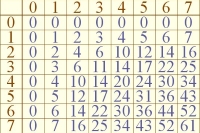
Octal Multiplication TableI’ve had something on my mind for a long time that greatly bothers me: the multiplication table. This is because I think that education should be fun — full stop. Memorizing the multiplication table is not fun. But more than that, I believe they are the source of most people’s hatred of math. At the same time, I’ve long thought that one should probably know them. And that created a conflict in me because I thought that it was really only possible to know them by memorizing them. But the other day it occurred to be what hogwash that is.

To begin with, I’m really good at math. Yet I’m pretty flaky on the multiplication table. I remember in the sixth grade, I had this teacher who seemed more like a drill sergeant. And he used to do this thing where he would go desk by desk asking each student one question, “Seven times eight?” He went sequentially through the table and the desks, so I always calculated which question I would get so I could figure it out and say it the moment he asked me. In that case, there was clearly some mathematics education going on for me, but it had nothing to do with the multiplication table.

I have never memorized what 6×7 is. Instead, I know that 6×6 is 36, and so I know 6×7 must be 6 more than that, which is 36+6, which is 42.

The rationale for knowing your multiplication table is that if you know them, then you can do things like multiply and divide arbitrarily large numbers. But if that’s true, why were we taught the table from 1 through 12? It should have been 1 through 9, right? You can calculate 11×12 — you don’t need to memorize that it is 132. And I think the reason for it is that it was a way to fill the curriculum. It didn’t take long enough to force the students to learn up to 9×9, so they went up to 12.

And as you get into higher math, you don’t even much deal with numbers. And for people like me who are naturals at math, it never is about numbers but rather elaborate games you make up. You think about things like the way the nines go down by one as you go up the table, and elevens go in the opposite direction. If you are lucky, you get introduced to octal and start seeing numbers in a whole new way. But you are unlikely to ever play with numbers if they are forced on you in the same way that the ordering of the alphabet is. (I am still quite fuzzy about which letters go before others without the help of the song.)

Multiplication is just a matter of counting. I have never memorized what 6×7 is. Instead, I know that 6×6 is 36, and so I know 6×7 must be 6 more than that, which is 36+6, which is 42. I don’t find this fun, but I did think it was a nifty trick when I was a kid — one I was never taught. And I fear that many if not most children memorize their multiplication table without having a profound sense that all they are doing is counting. That’s sad.

As everyone should know, math is extremely abstract. That’s why I say it is the closest thing to theology, and certainly it is the closest I ever get to God. But the mindless memorization of the multiplication table is not just boring. For many students, it turns math into alchemy. Sure, it’s abstract. But much more, it is mysterious in the same way God is: unknowable. And why even try?

There is no need for children to learn the multiplication table. I have a simple proof:

  1. What is 9×9?
  2. 9×9 = 9+9+9+9+9+9+9+9+9.
  3. QED.

Anniversary Post: Royal Greenwich Observatory

Royal Greenwich ObservatoryOn this day way back in 1675, King Charles II ordered that the Royal Greenwich Observatory (RGO) be built. If you’ve ever wondered why we have the random Greenwich Mean Time, it is thanks to this iconic observatory — the first specifically built one in Britain. It really isn’t an observatory anymore. Slowly, work at the RGO was moved to other, more appropriate locations. Since 1998, it is a museum. But what a museum! That’s my idea of a good vacation — as long as there are pubs close by.

Oh, what a long way we’ve come! Just 340 years ago we had kings who cared about theoretical and practical science. And now here in the United States, we have a major political party for whom science is but a play thing to be used when it furthers its ideological goals but mostly just ignored and treated with derision. A civilization cannot long flourish when half of its people look down on the smart people “who think they’re better than us.” I’ve written about that before.

But it is nice to look back on a time when the power elite of the world weren’t quite so evil and parochial as we are here in the United States. I often wonder: would we be worse off with crazy King George III or with “reasonable” Republicans like Jeb Bush and Marco Rubio and John Kasich? It probably would be the same. It doesn’t matter if a leader is insane or he simply thinks he must pretend to be to maintain power to do what he sees as his most important work: taking money from the poor and giving it to the rich.

Happy anniversary Royal Greenwich Observatory!

Ted Cruz Knows 1 Thing About the Carbon Cycle

Ted Cruz appears to have a vague notion of the carbon cycle in this tweet. It is indeed true that humans breathe out CO2 and that plants consume it. But, of course, he’s trying to use this to say that CO2 is no problem in the atmosphere. This I suppose is a step up from the notion that humans create CO2 — an issue that I’ve dealt with before, Humans Do Not Create CO2.

So Cruz seems to be aware that the carbon atom is just being swaps from animals to plants and back again. But if this is all that is happening, then why is it that CO2 levels have gone up over 20% since 1960? I mean, this is not one of those cases where Ted Cruz can pick one early high year and claim it is actually going down. Temperatures are highly variable, but CO2 stays in the atmosphere so long that its concentrations are very smooth. Here is the CO2 concentration as measured at the Mauna Loa observatory over the last six decades. (The squiggling is the annual cycle.)

CO2 Mauna Loa - Carbon Cycle

So if animals (not just humans) are swapping all this CO2 back and forth, why is it that the level of CO2 just keeps going up? That would be a good question for Ted Cruz and all of the rest of the anti-science conservatives. Even if they know, they would not be keen to admit it. You see, there is lots of carbon that is in the ground. While it is in the ground, it shockingly doesn’t have an effect on the atmosphere. But once it is released from the ground, it interacts with animals and gets turned into CO2 — eventually. And so we get to the atmospheric carbon cycle.

Now most of this is just plants taking it out of the ground. But that is just more of the carbon cycle. And it is ridiculously complicated. Animals eat plants (directly or indirectly) and use the carbon to build their bodies. Part of living is taking in oxygen and breathing out CO2. The plants take the CO2 back in. And when the plants die, they get buried and the carbon is sequestered. The same thing happens to the animals, of course. This is all be very simple stuff that should be taught to all children by the time they finish grammar school.

The Deeper Carbon Cycle

What’s more interesting is what happens to stuff that gets buried. That carbon still reacts with its environment. But in general, those reactions will be anaerobic — without oxygen. And so that carbon, under the right conditions, turns into hydrocarbons. And we have been busy over the last two centuries, pulling those hydrocarbons out of the ground and burning them, thus releasing CO2 into the atmosphere. And that is why the concentration of CO2 at the Mauna Loa observatory is so much higher today than it was in 1950.

Now I know: this is all kind of complicated and very science-y. It’s much easier to say, “CO2 is what every human breathes out; every plant, in turn,consumes CO2.” And if you are an incurious person — or just a demagogue — that’s where you stop. But it offends me. If Ted Cruz wants to deny science, fine; that’s his right. But I wish he wouldn’t use some minor bit of science to justify his science denial. Science isn’t about saying, “I know one thing, so let’s stop talking.” The carbon cycle is a beautiful thing. Ted Cruz is a great symbol of everything that is ugly about humanity.

Anniversary Post: Halley’s Comet’s Very Close Approach

Halley's CometOn this day in 837, Halley’s Comet came the closest to the Earth in the entirety of human history. It came within almost three million miles (0.03 AU), which, by astronomical standards, is nothing. It is estimated that its tail spanned 60° across the sky. To see it today would be awe inspiring. To most of the people at that time, it was probably terrifying.

I’ve written before about going out to the beach in the early morning in 1986 to see it. The comet was at a distance of 0.42 AU and nothing but a smudge on the sky. It was the worst observational opportunity for at least 2,000 years. I remember seeing Carl Sagan speak on his book tour for Comet and he said that if anyone was alive in 2061, it would be a much greater show. And in 2134, it would be spectacular.

What did he mean? In 2061, we will at least be on the same side of the sun when Halley’s comet reaches perihelion. Unfortunately, I can’t find any data on just how close we will come. But in 2134, we will come within 0.09 AU. That should be quite a show. Of course, as time goes on, the comet gets smaller and smaller, so if we really want to dream, we should imagine being around in 837.

It’s these kinds of things that make me regret our short lifetimes. Usually, the changes of the human body, the degradation of the mind, make me welcome death — at least eventually. Not that one can reasonably complain. I mean, did we not just get to see the unmasking of Pluto in real time? And I still thrill to see the occasional shooting star. Every time has its advantages. And I’ve lived during the most exciting time in the history of astronomy.

Anniversary: Kepler’s Third Law of Planetary Motion

Johannes Kepler - Planetary MotionI’m not sure of this, but maybe on this day, our man Johannes Kepler discovered his third law of planetary motion. Now we all know the first law, right? Planets orbit the Sun in ellipses where the Sun is at one of the foci (which I would write “focuses” if this weren’t math we were talking about). The reason that this was a big discovery is because most planets don’t have very elliptical orbits. So it was pretty subtle. The eccentricity of the earth is just 0.017 — damned close to a circle.

The second law of planetary motion is really the most interesting. Basically what it says is that planets move faster when they get closer to the Sun. Now this is exactly what we would expect, but that’s just because we all know Newton. But at that time, Newton wouldn’t even be born for another 25 years. The way the law is presented is this: “A line segment joining a planet and the Sun sweeps out equal areas during equal intervals of time.” That’s the thing about Kepler: he was really a mathematician. He thought in terms of geometry. That’s probably why I’ve always felt a special kinship to him.

Now the third law of planetary motion, well, that’s an odd one. It is stated thusly: “The square of the orbital period of a planet is proportional to the cube of the semi-major axis of its orbit.” Now that’s real analytic geometry! The semi-major axis is more or less the radius for objects like the Earth that move more or less in circles. For a highly elliptical object like Halley’s Comet, you can think of it as half the distance from its closest and furthest approaches to the Sun. So imagine that: this mathematical relationship is the same for the Earth as it is for Halley’s Comet.

Big Caveat on Planetary Motion

I’ve been slowly making my way through Small Gods and there is some discussion in there of how philosophers only raise questions. Any question that is raised only leads to dozens of new ones. So all this stuff that Kepler worked out is true in a universe that has exactly two objects. Clearly, all the planets affect each other. And that’s especially true, I would assume, of Halley’s Comet. Plus, Halley’s comet is losing material via the solar wind, which has got to screw up its momentum. So nothing I’ve discussed is exactly true. But then, what is truth? Is truth beauty? Or is beauty truth? Or should we all be weapons designers?

Anniversary Post: Copernicus Makes the Index of Forbidden Books!

Nicolaus CopernicusOn this day in 1616, De Revolutionibus Orbium Coelestium was placed on the Index Librorum Prohibitorum. But I put it that way because I’m suffering from heartburn and feeling very old today. (It is my little sister’s 51st birthday today!) Anyway, the book in question is Copernicus’ On the Revolutions of the Heavenly Spheres, and it was placed on the Catholic Church’s Index of Forbidden Books.

As I’ve noted before, Copernicus had the right idea, but his theory was a mess. Since he assumed that the planets go around the sun in circles, his predictions weren’t good. It would take Johannes Kepler — who was working this all out just as Copernicus was placed on the Index of Forbidden Books — before we got a proper theory of the solar system.

I was thinking, though, that maybe it’s not wrong to withhold distressful information from people. To me, it is more a matter that the idea would never occur to me. That way of thinking is so foreign to me that I’ve never given it any real thought. Obviously, that’s mostly due to the time and place of my birth. But I know a lot of people who are always jumping to the conclusion less information is better. And I just find it bizarre.

Of course, it doesn’t appear that Copernicus’ book was banned because the Church was concerned that it was going to cause riots. It appears it was placed on the Index of Forbidden Books for the same reason that most government documents are classified: because it was embarrassing. It’s not like the Church had made countless reversals previously without everyone losing faith in the Church.

And note: this all happened over 70 years after the book was published. And the book was published after Copernicus died, because he was a careful man. And the Church didn’t care that much anyway. It was just that Galileo was making a lot of noise, and there are always people, as I said, keen to stop the flow of information.

Anniversary Post: Nicolaus Copernicus

Nicolaus CopernicusOn this day in 1473, the great Nicolaus Copernicus was born. He’s the guy who put together the first model of the solar system with the sun in the middle. That was a brilliant insight. I remember a story about a student talking to his teacher, “Those primitive people were so stupid to think the sun goes around the earth.” And the teacher replied, “Yes, just imagine how it would have looked if that were true!” The point is that it would look the same. There is nothing obvious about thinking the earth goes around the sun. Indeed, did you see this article, Poll: 26 Percent in US Do Not Know Earth Goes Around Sun? And the funny thing? “[Americans] did better than EU residents on the question about whether Earth moves around the sun.” Go figure.

There’s an interesting thing about Copernicus’ model, though. It wasn’t very successful. He had a brilliant insight, but it still wasn’t right. He had planets moving around the sun in circles. Well, they don’t move in circles. The world had to wait almost a hundred years for Johannes Kepler’s insight that the planets moved in ellipses. (Yes, I know that circles are ellipses!) So all those old models with the earth at the center of the universe might have been complicated, but they were still better at predicting where things would be in the sky. So old Copernicus made a necessary (And difficult!) contribution to knowledge, but all alone, it wasn’t sufficient to improve the practical science.

Also: Copernicus was old. And wise. He waited until he was dying to publish his book. No torture for him! That’s my kind of guy.

Happy birthday Nicolaus Copernicus!

Anniversary Post: Halley’s Comet Last Perihelion

Halley's CometOn this day in 1986, Halley’s Comet last reached perihelion — its closest approach to the Sun. This was right about the time I decided that I was not going to be a musician and that I was going to kill myself if I had to continue to be a baker. So I had started studying physics and math in my spare time and took a few courses at the local junior college. I befriended a guy who was really into astronomy. And I went out with him and his wife to view the fabled comet.

It was uninspiring, to say the least. The last visit of Halley’s Comet didn’t bring it very close to the Earth. So it looked like a smudge in the sky. But that was more or less my introduction to experimental astronomy. And by that, I mean standing out in the cold near telescopes. I had gone with the same friend a year earlier to see Carl Sagan give a talk on his book Comet. But this was rather different. And in the coming years, I would spend a lot of time at the Sonoma State University Observatory.

But that really wasn’t about astronomy. I only ever learned any astronomy when I was forced to teach it as a lowly college professor. At that time, the observatory had just gotten a CCD camera that we hooked up to a telescope (a 13″ reflector, as I recall). I had written some very small part of software for the system and I was usually the guy who controlled it for public viewings. But that just meant that I was where I am almost always when I’m awake: sitting in from of a computer.

As nerd activities go, astronomy is one of the better ones. And it takes place outside. At the same time, it is at night, which is more in keeping with nerd sensibilities.

How Betting Lines Work — Super Bowl Example

Betting LinesIf you are like me, you are not watching the Super Bowl. If you are like me, you are only vaguely aware of it. I had to be reminded yesterday at 4:00 that it was even happening. And it was only today that I learned that it is taking place here in the Bay Area. It’s not that I don’t follow the news. But when talk turns to sports — most especially football — I just tune out. But I thought it might be interesting to talk a bit about how betting lines work.

This all started because I was talking to Will and he told me that 70% of the action was supposedly on the Panthers. I already knew that the line was Panthers -6. That’s a points line and it means that if you bet on the Panthers, they need to win by more than 6 points. That also means that if you bet on the Broncos, you get 6 extra points. So if they lose by only 5 points, you would win your bet. But when Will told me about all the action on the Panthers, I asked what the line was originally. He told me: Panthers -6. That didn’t make any sense.

When betting lines first come out, they are based upon the work of sports nerds: analysts who crunch numbers to determine how the teams will perform against each other. It will probably not surprise you, given my colorful life, that I used to be one of those guys. (I didn’t do it for sports books, of course; I wrote commercial software that did these kinds of calculations for sports bettors.) So that’s fine. But betting lines don’t stay where they start. They move based upon how the betting is going.

The thing that non-betting people don’t understand (and I assume that describes most Frankly Curious readers) is that the sports books are not at all interested in who wins. When you bet, there is a vigorish or “vig.” That means you bet a dollar, but if you win, you are paid something less, like 90¢. That would be a 10% vig. That’s all the books care about. So they want to have as much money bet on one team as is bet on the other. That’s what the betting lines are all about. Then the books pay the winners with the losers’ money, and keep the vig. It’s a simple and beautiful system.

Why Betting Lines Move

The initial lines that the sports nerds come up with are not always right. But even if they are, it isn’t a question of how the teams stack up; it is a question of how the bettors think they stack up. So if there is too much money bet on one team, the sports book will move the line in the opposite direction. This is why I asked Will what the starting line was. If 70% of the action was on the Panthers, then the line should have gone up — to Panthers -6.5 or higher still — whatever it took to equalize the amounts bet.

Given that the betting lines didn’t move except maybe at some small books, I have to assume that the 70% number has to do with the number of bets. The books don’t care about that. They aren’t going to change the betting lines over that. What must be happening is that the little bettors are going strong for the Panthers and that the bigger bettors are going for the Broncos. (This doesn’t mean they think the Broncos will win, of course; just that they won’t lose by more than 6.) But if I were a betting man (And I’m not!) I would go with the Broncos, just because I have more confidence in people who are putting big money on the game.

Of course, I don’t know that this is what’s going on. Maybe the big money is on the Panthers, it is just that there is a lot of medium money on Broncos. As I understand it, there are a lot of middle class white folk who don’t like that uppity colored quarterback. And with that, I have gotten as close to the Super Bowl as I care to get.

Update (7 February 2016 3:36 pm)

I just got email from Will that the line actually did start at Panthers -3. So there has been excessive money bet on the Panthers to move the line to -6. I’m not going to change any of the above, because it is all still valid for discussion’s sake. The fact that the line did move, however, greatly complicates how the books have to manage their bets. This is why they hire really smart people, hoping to get it right to start.

Update (7 February 2016 3:43 pm)

That makes my “middle class white racist” theory invalid.

Anniversary Post: Pluto Gets Closer Than Neptune

PlutoOn this day, and for the first time since they were discovered, Pluto slipped inside the orbit of Neptune. It stayed closer to the sun until 11 February 1999. But you might wonder, given that Pluto is such a puny object compared to Neptune (or even the Earth), why the larger planet hasn’t “cleared” it (basically: crashed into it). Well, there are a few reasons for that.

Right now, it would be impossible for Pluto to crash into Neptune because the dwarf planet orbits in a plane that is at quite an angle from that of the other planets — including Neptune. And when it is at the same axial distance to the sun as Neptune, it is way off the plane. And I do mean way off the plane: along the axis of the solar system, it gets as far as 8 times the distance from the Earth to the Sun (AU).

Pluto OrbitBut that wouldn’t save Pluto forever. Orbits precess (this explains part of the Earth’s ice age cycle). So there have been and will be times again when it will be on the plane at the right time. But again, Pluto is not in danger. Obviously, if it were in danger, Neptune would have long ago swallowed it up and we never would have had to have this argument about whether Pluto is a planet or not.

The two planets are in a 2-to-3 orbital resonance. This means that for every two times Neptune goes around the sun, Pluto goes around it three times. And they end up right back where they started. This sounds amazing, but there are lots of examples of this kind of thing in our solar system. Thus, they will not run into each other, because their precessions are locked together.

But Pluto Is Doomed Anyway!

Pluto is so small and so far away from the sun that it is chaotic. I mean that in a strict mathematical sense. Models of its future are highly constrained because very minor perturbations can have huge nonlinear effects on its orbit. But thus far, it really is the little planet that could. It has defied the odds and maintained its independence — to a large extent due to its having a powerful friend in Neptune. But it’s okay that Pluto is doom because so is everything. And it is going to last a whole lot longer than humanity.