Creed: the Best Swan Song for the Rocky Franchise

Creed Would Be the Best Song Song for the Rocky FranchiseOver the weekend, I watched the 2015 hit Creed. This is not surprising. Since I saw the first Rocky in early 1977, I’ve been a fan of it. That first film remains a great cinematic accomplishment. Although utterly genre, John Avildsen’s direction makes the film seem almost cinéma vérité. It was the first film to make major use of the steadicam — but primarily for financial reasons. Thus, it adds to the film rather than distracting as it did in many films to follow, most notably Goodfellas. The acting was exceptional, and the script establish Sylvester Stallone as one of the best genre writers in Hollywood.

I was almost as happy with Rocky II. Although Stallone directed it, he did his best to imitate Avildsen. I remember going to see Rocky III on opening day and being crushed. It was clear at that point that any art in the Rocky franchise was gone and that it was now commodity. Rocky IV was an offense of epic proportions. Even without getting into the politics of it, the casting of Dolph Lundgren was rediculous. Rocky V is an odd film. It is Stallone’s weakest script, but it manages to succeed more than it deserves with the return of Avildsen as director. Finally, Rocky Balboa managed to charm, but the boxing was ancillary and even more unbelievable than usual.

Creed Is a Reboot

I just don’t think Creed could have been a hit four decades ago, which is all the more reason it makes a fine bookend to the Rocky franchise.

Creed is distinct in many ways. Primarily, it is a reboot — essentially a remake of the first film. It is the only one in the Rocky universe in which the title character does no boxing. Unlike all the other films that you could say were Stallone’s, this one is writer-director Ryan Coogler’s. (It was co-written with Aaron Covington.) And there is much to like about him. I think he has a fine career ahead of him. But Creed is hardly a great film, even though only the original Rocky is clearly superior.

The biggest problem with the film is that it tries to do far too much in what is, after all, a simple genre picture. The film is based on the same “give a nobody the chance of a lifetime” plot that the original was based on. I have no problem with that. But I’m not sure how a writer could create a story based on that kernel and then expect us to take seriously the chemotherapy treatments of the trainer. But more than that, this is a film that is cluttered with too many subplots and a lead character that doesn’t have much in the way of a personality.

Creed Washes Racist Tint of Original

Still, I’m very glad the film was made, because it makes up from what I always saw as a problem with the first film: its implicit racism. By this, I’m not talking about the film itself. Rather, I’m talking about what I discussed in Zulu and the Racism We Bring to It. I simply don’t think that Rocky would have been a hit had the races of the fighters been swapped. That’s just a fact of American life. Maybe its more accurate to say that the problem is ethnocentrism: whites want to see a white man win — especially in the mid-1970s — when whites in the US were still in their migration from the cities to the suburbs to escape the “horrors” of busing.

Creed does manage to reverse the races of the characters. And it does it effectively and affectingly. Just the same, Tony Bellew as the “bad” British boxer Ricky Conlan isn’t quite the threat that Apollo Creed (Carl Weathers) was. Creed was a stand-in for the ultimate white terror: an intelligent and powerful black man. In fact, that’s one of the high points of the original movie where Creed is working on his various business dealings while we watch Rocky punching raw frozen beef on the television.

Let Creed Be the Franchise’s End

I find it impossible not to see Creed in political terms — and very positives ones at that. The first was a huge hit, and I just don’t think Creed could have been a hit four decades ago. And it makes a fine bookend to the Rocky franchise. Unfortunately, a sequel was in development and may become a film. I doubt that Coogler would be much involved, given he is finishing Black Panther and seems generally of a mind to make films of some substance.

My hope is that Creed is the end of the franchise. It is the way to go out. What would a sequel offer us anyway? It would almost certainly be a combination of Rocky II and Rocky III. Adonis Johnson (Michael B Jordan) would marry Bianca (Tessa Thompson). And Rocky would die — but probably much later in the film than Mickey (Burgess Meredith) did in Rocky III. And Creed would become the champion. I just can’t see it being anything but filmmaking by the numbers.

Creed would be the best swan song for this very uneven franchise. I dearly hope that it is.

The Soviet Union in 1960s Television – Unconscious Propaganda

Star Trek - The Soviet Union in 1960s Television - Unconscious PropagandaIn my page on Space: 1999 at Psychotronic Review, I wrote, “And the original Star Trek had its stupid Soviet Empire proxy in the Klingons — actually more pernicious propaganda than you got from the John Birch Society newsletter.” Lawrence defended the show, pointing out how liberal it was. And he’s right. But it wasn’t my intent to pick on Star Trek. For one thing it was hardly alone.

Hogan’s Heroes had Marya (played by the television Rosalind Russell, Nita Talbot), who was a Russian spy who perfectly encapsulated American’s strange reaction to the fact that the Evil Empire was our ally during World War II. First, she could never be trusted. In the end, she always turned out to be on the ally’s side, but her commitment was at best unclear. What’s more, she just stood around and let the Americans take care of everything. This was, and still largely is, the way that Americans see the war. The idea that in the simplest terms it was the Soviet Union more than anyone else who defeated the Germans and the Japanese is something most Americans have a very hard time dealing with.

There’s also The Rocky and Bullwinkle Show where Boris Badenov and Natasha Fatale act as the perfect foil to our all-American heroes: evil for the sake of itself and incompetent. But note: I’m a big fan of both Hogan’s Heroes and The Rock and Bullwinkle Show. And I am rather fond of the original Star Trek — especially when it did comedy. So I’m not putting these shows down just because they fully embraced our country’s international propaganda. In the case of Hogan’s Heroes and The Rocky and Bullwinkle Show, it was done in quite a charming way. And I certainly don’t think that any of the writers of these shows thought they were creating propaganda.

Unconscious Propaganda Is the Most Powerful

To my original claim, I do think that Star Trek was far more effective anti-Soviet propaganda than the John Birch newsletter.

But it is exactly because these shows didn’t know what they were doing that made them such powerful propaganda delivery devices. This is another issue of fish and water. If someone says that the Soviety Union is the Evil Empire, you can question the claim. But when such a belief is simply in the air — when no one even knows that they are making an assumption — that is when you are really in the danger zone. That is the sort of thing that causes the Cuban Missile Crisis.

(And speaking of the Cuban Missile Crisis: who won that confrontation? Certainly it was presented to Americans as a victory. But that’s not true. The US installed nuclear weapons in Turkey — a clear first-strike threat to the Soviet Union. In response, the Soviet Union installed nuclear weapons in Cuba. The Soviet Union got what it wanted: nuclear weapons out of Turkey and southern Italy. It was the US, not the USSR, that blinked.)

My point is that it is the unstated assumptions that are the most dangerous. Lawrence noted, “For when it was made Star Trek was about as liberal as you could get.” And that’s exactly the point. When the conservative assumptions go unnoticed, even the liberals spread them. And they do it even when they are specifically trying to be liberal.

The John Birch Society

So to my original claim, I do think that Star Trek was far more effective anti-Soviet propaganda than the John Birch newsletter. It’s not hard to read Birch material and see that they are true believers who have a faith-based take on the world. It’s hard to fight against the Klingons given that they don’t actually exist.

But note that in the first run of the show (Klingons have evolved as a people), Klingons weren’t very good characters. There was no depth to them. They were just bad. And accepting that the world worked that way in the 23rd century makes it all the more easy to accept that it works that way today.

The Chicken and the Egg

The Federation wanted to allow people choose for themselves but the Klingons wanted to force people to do as the Klingons said. It’s funny that this is literally exactly what the United States still says of itself; why we support so many despots is just one of those unknowables. Every war we get into, we do so reluctantly. It’s truly amazing how different we think we are from every other empire in history. The one way we are the same as every other empire in history is in thinking that we are different and only trying to do good.

Now I understand: there is a chicken-egg issue here. People accept the Klingons between they accept the Evil Empire mythology. But the truth is that the two feed each other. And this is why people should watch for the themes in movies other forms of entertainment. It is also why I’m not crazy when I talk about fascism in super hero movies.

Our entertain defines us. And I think we were doing far worse in our 1960s television shows than the Ancient Greeks were in their myths and stories. And that embarrassing.

Two Articles About Rick and Morty

Rick and MortyThe Pain of Rick

In the television series Rick and Morty, there have been a few episodes that indicates that despite Rick’s obvious persona, he is a deeply unhappy man. First, of course, there is the fact that he’s a drunk. But more important, in the episode “Ricksy Business,” Birdperson explains what Rick’s catchphrase “Wubalubadubdub!” means. He says, “In my people’s tongue, it means, ‘I am in great pain. Please help me.'” (Note: the producers will regret killing off Birdperson, who is one of the best characters created in the show.) But this is not when we see Rick at his worst.

Rick and Unity

In the episode “Auto Erotic Assimilation,” Rick is reunited with Unity, a collective hivemind, who he used to date. At the end of the episode, Unity leaves him, and Rick returns home, dejected. But when asked what happened, he says, “Honestly, we’re talking about an entity that thrives on enslavement, you know? Not cool. Fun’s fun. But who needs it.” And then he walks into the garage and does something very odd — something that Schopenhauer would have done if he had made cartoons.

Rick creates (or reanimates) a creatures that is clearly in great pain. He pets the creature lovingly. And then he puts the creature in between two beams that disintegrate it. It is clearly an act of kindness. Then Rick changes some kind of power supply, and sticks his head between the beams. But before they can fire, he passes out, thus surviving.

The Ethics of Rick and Morty

That is undoubtedly the most shocking moment in all of Rick and Morty. But it’s probably key to Rick’s likability. Morty has a child’s understanding of morality. Rick’s idea is much more sophisticated. That’s especially on display in the episode “Mortynight Run.” In it, Morty is angry with Rick for selling a gun to an assassin. Rick’s thinking on the matter is that the assassin will get a gun whether it is from Rick or not.

Morty says, “Selling a gun to a hit-man is the same as pulling the trigger.” Rick responds, “It’s also the same as doing nothing. If Krombopulos Michael wants someone dead, there’s not a lot that anyone can do to stop him.” And it turns out that Morty’s attempt to stop the hit ended in killing Krombopulos Michael and dozens of other people. What’s more, it turned out that Fart (the gaseous target) was going to kill all organic lifeforms in our universe. So Morty is forced to kill it anyway.

On Being Whores

This relates to my blunt admission that I’m a whore. It’s not that I, like all people, don’t have my own ethics. But I’ll do pretty much anything if the price is right. And the reason for this is that I’ve learned that it is the system that is screwed up. I have friends who work for do-gooder non-profits, and they feel as much like whores as I do. In fact, it is usually worse for them because they feel like hypocrites too. Most of the work of non-profits is to sustain themselves.

So Rick is right. And being right makes him hate himself. As I wrote before (see below), it is Rick and not Morty who hides his true self from the world. All his antics are in the service of hiding that. And Unity dumping him affects him in a more profound way that usual, because like a teenager, even Rick thinks that love can save him. And when he’s reminded that it can’t, he impulsively reaches for the logic of suicide. In a meaningless universe, you either pretend that it has meaning or your exit stage left. When Rick tries to kill himself, he is being the most authentic that he ever is.

Update

I just saw the first episode of season 3 and I see that they brought back Birdperson. Kind of. And the friend of Summer who was going to marry him is alive. I thought she was killed. But I guess not.

–Frank Moraes (13 April 2017)

Rick and Morty and Me

Some time ago, I was watching an episode of The Simpsons. And in the opening “couch” section, a spaceship crashes into their house, killing the family. And out pop these two characters named Rick and Morty who I had never seen before. Thus was I introduced to Rick and Morty. It looked to me like the kind of show I would love. I mentioned it to Andrea and she pooh-poohed it, saying it was coarse and vulgar. Well, I’ll put up with a lot of coarse and vulgar for brief moments of brilliance. Still, it took until this weekend for me to watch an episode. I ended up watching the entire two seasons.

First, an example. In the episode “The Ricks Must be Crazy,” the spaceship won’t start. Rick and Morty get out of the ship and Rick pops the hood. Morty says, “Is it the quantum carburetor or something?” Rick is disdainful, “Quantum carburetor? Jesus, Morty, you can’t just add a sci-fi word to a car word and hope it means something… Huh. Looks like something’s wrong with the micro-universe battery.” Yes, I know: I’m a sucker for this kind of meta-humor. But that’s a solid joke no matter how you look at it.

The Most Cynical Show

While watching the shows this weekend, I was struck by the fact that Rick and Morty was about the most cynical television show I’d ever seen. And it amazed me that Andrea said she didn’t like it. So I asked her again, and she too had gotten drawn into it thanks to her husband, and now appreciates it. (Clearly, she could do with fewer of the sexual references and the ridiculous amount of gore.) That made me feel as though all was right in the universe. Too much of it is typical of her sense of humor. This may also explain why I’m one of her few remaining friends. (Oh, I kid! Sorta.)

I think much of the appeal of the show to its target audience (basically me, but skewing younger) is that we all wish (at least superficially) we were Rick but always feel like Morty. (Excluding the evil Morty with the eye-patch who we met in “Close Rick-Counters of the Rick Kind.”) Rick is, after all, the cool kid in high school. Indeed, he becomes so explicitly in “Big Trouble in Little Sanchez.” But I’ve seen it a lot during those unfortunate times when I’ve been on the bus when the high school lets out. Almost everyone in high school wants to be Rick (not caring about anyone else) and lives in terror of being seen for the Morty who they are.

The Essence of Rick

You’ll note that I said “almost.” Rick is, as far as any likable character can be, a psychopath. The show does an excellent job of showing just enough of Rick’s inner life to see that ultimately he is Morty — just older and wiser. In “A Rickle in Time” he proves, mathematically, that, “As far as grampa is concerned, you’re [Morty and Summer] both pieces of shit.” But as a viewer, I’m unconvinced. I’m just impressed with any character who would be willing to say such a thing. And it is, after all, in the service of saving their lives.

Maybe We Have Rick and Morty Backward

But if Rick is really just Morty with a great con, then isn’t he the one who is really insecure. Morty just is who he is. Sure, perhaps this is just a function of his youth and stupidity. But he is authentic in a way that Rick clearly is not. So in the end, I’m ashamed to want to be Rick. Because the truth is: I am Rick — just not a very successful one. And I’ve long ago reached a point where I value authenticity above any of my childhood dreams.

What’s most interesting about Rick and Morty is that the series seems to understand this. It knows that all of Rick’s brilliance is ultimately impotent. Why has he come to live with his daughter? Because he knows he’s a fraud. He’s seeking meaning. But like the rest of us, he’s lost. It’s like in the episode, “Something Ricked This Way Comes.” Rick creates a robot to pass the butter. When it finds out that its purpose, it reacts as any of us would. Although I have to say: that’s more of a meaning that I think my life actually represents. And I’m not just saying that because Rick would. I’m in my fifties. Some insights are inevitable.

–Frank Moraes (12 December 2016)

Movies! Or Why I Stopped Worrying About Politics

Movies, Movies, Movies!

Why so much writing about movies?

I don’t quite know what it is, but it’s hard to write about anything but film these days. In the past, people have asked why I didn’t write about this or that political issue. Sometimes the answer was just that I hadn’t had the time. But more often, it was that I didn’t have anything new to offer. I’ve noticed that a lot of political bloggers are fine just regurgitating what others have said. In fact, this is what blogging is for a lot of people: a brief introduction, and then a long quote by someone else.

Politics Is Depressing

These days, I find I don’t have that much to say about politics. The election of Donald Trump as president has really been a bad thing. What is there to do but wait for the next election. I suspect that 2018 will go okay. But what if Trump wins re-election in 2020? Political parties aren’t mostly about ideology. If this really is the country of ethno-nationalism, what is the Democratic Party going to do? I don’t know. And it is really depressing to even think about.

Movies Are Fun

As a result, I’m writing more about movies than ever before. And that means less work to be done here. So I’ve created another page over at Pyshchotronic Review: Space: 1999. It includes an article, Great 1970s TV: Space: 1999. Hopefully, I can get Will to write something for the page. I remember that he was something of a fan of the show at the time, whereas I had never even seen it until the last year.

But I hope that the continued posting of quotes will keep you all engaged and discussing the issues of the day. They do seem to get a fair amount of discussion. But I’ve noticed that I tend to get more comments when I have something to say myself. And I will continue to have things to say. Just the same, my political thinking has gotten broader. I still think elections are really important. But I’m more worried about the system itself. I fear we are doomed if we continue to think that the way things are is the way things ought to be.

Our Biggest Political Problems

Hierarchy is the fundamental problem. Our belief that we should have a pecking order is what allows us to continue to justify ridiculous levels of income inequality. And it’s what makes everyone think that capitalism is somehow natural and right.

I get tired of having to argue with people who tell me how capitalism is the reason we have cool phones and without it, the poor would be even worse off. I can counter these arguments, but it’s exhausting. Why is it that most people just accept an economic system that doesn’t work for them? I really don’t know. And so it’s more fun to write about movies, even if Space: 1999 clearly demonstrates a hierarchical society in a positive light. Even when you are reduced to 311 individuals, people don’t question hierarchy.

Yes, we are doomed, but I have some great movies we can watch as the end approaches.

So Many Changes on Psychotronic Review

Psychotronic Review - Running Multiple WebsitesJust yesterday, I wrote A Much Darker Take on Barton Fink. Now that was an article that I really could have put on Psychotronic Review. But it seemed like it went more here because it is more of an art film than a psychotronic film. Just the same, it would have worked — especially when you consider just how wide-open the definition of of the term is. And who knows: I may end up transferring it over there at some point. As it is, the new website is not going without love. Let me tell you what I did just over the weekend.

Omega Doom

The main thing is that I created a page for the film Omega Doom and wrote an article for it, The Post-Apocalyptic Yojimbo. Omega Doom is quite an interesting film starring Rutger Hauer.

I’m almost to the point of saying that anything that Hauer stars in must be psychotronic. He has had an uncanny tendency to pick odd films. He really has the stature to have starred in more traditional films, but instead, he’s spent most of his career starring in what most people would call trash. It’s probably a matter more than he’d rather star in second tier films than to have a second tier role in a first tier film. But it’s nice to think that he’s just really into unusual material.

Omega Doom is hardly a great film, but I think you’ll be interested in checking it out after reading my article. There is much to like about it. And if you know Yojimbo, well… There’s been a cowboy version and a gangster version. So why not a robot version?

Other Changes to Psychotronic Review

As a result of this, I moved a couple of articles from Frankly Curious to Psychotronic Review. Whenever I do this, I end up making some changes. In many cases, I make really big changes. One where I didn’t make much of a change was in my new page on Turbo Kid. It is based on an article I wrote pretty recently, Gory Post-Apocalyptic Nostalgia.

The main thing I did in adding the film to the site was putting together the credits for the film. I’m sure I knew this before, but it’s still remarkable: Turbo Kid was written and directed by three guys. I wonder how that was all done. The truth is that the film is fairly standard. You wouldn’t get the idea that it was such a group effort. It makes me want to get the DVD just to see if there’s any information about how they worked together. I suspect there wasn’t much to it: just three friends who decided to make a film.

How I Rate a Film

I also managed to publish my third blog post for Psychotronic Review: How I Rate a Film: Yojimbo Edition. Now that’s an old article — one I wrote almost exactly five years ago. But it’s also one that I changed a lot. It’s interesting, however, to see that my thinking on film rating hasn’t changed that much. But the article did end up about twice as long as it was.

More to Do

There’s still lots more to do. The problem is that nothing is easy. It isn’t just a matter of moving material over. I always do at least some rewriting. And then links and images have to be dealt with. And then there is the whole issue of making sure that the articles here (and for the older articles, the ones still on the Nucleus site) get redirected correctly to Psychotronic Review. Also involved in this is getting rid of them on Frankly Curious.

The reason for this last part is that this is a blog. So even though an article might get redirected, it will still show up in the blog roll. And in searches. For example, if I hadn’t removed the article on Turbo Kid and you searched for “turbo kid,” it would have displayed here. Now that’s not a problem for you, the reader. But Google would see that as duplicate content and penalize me. I’m not exactly sure how that works, but it does mean that people would be less likely to find my Turbo Kid page through Google.

I’ve Made Website Management Harder

It’s amazing. There’s so much to do running a website. It’s no wonder that so many blogs are done so poorly. Of course, some of this is my own damned fault. It would have been smart to just start my blogging career using by far the most popular blogging software — or even something close. Instead, I started with something almost no one used that was literally discontinued. (Some users of it started their own replacement project, but who knows how long that will continue on.)

Also, I could have started a more focused blog. Frankly Curious has almost 500 articles on film. That works out to somewhat more than one film article per week for seven and a half years. That alone represents a fairly successful personal blog. But I’m too interested in too many things. So I get myself into this trouble. That’s part of what Psychotronic Review is all about: me trying to do something structured. And really, at this point, it would be so much easier to spend all my free time working on that.

I Just Need Four Websites!

But I know I would come back here. Because I’m not a single-issue person. But I do think that film and politics is it. Oh, and grammar/writing. Maybe I will do that. I’ve got my film writing on Psychotronic Review. And I’m thinking of moving my political writing to Frankly Furious. I could put all my grammar writing on Frankly Curious Media. (Something needs to be done about it. It’s been in maintenance mode for over a year.) And then my random thoughts would go here.

And with the remaining hour per day, I could sleep!

A Much Darker Take on Barton Fink

Barton FinkWhen I first saw Barton Fink in the early 1990s, I was blown away. There were a couple of reasons for this. The most obvious was the pointless symbolism. For example, the ending seems to weird people out. Barton (John Turturro) is sitting on a beach, looking at the real-life image of a young woman that has been hanging on the wall above his typewriter throughout the film. Should anyone think it is intended to mean anything, Barton asks her, “You’re very beautiful; are you in pictures?” And she replies, “Don’t be silly!” It’s probably the funniest joke the Coen Brothers have ever come up with. She’s not in pictures; she’s right there!

There’s much more of that in the film. But the other thing I liked in the film was that Barton is such an unlikable character. Now, that’s probably not true in an absolute sense. But he’s rather too much like me, without my good points. For example, “I do listen!” The first time I saw the film it was cathartic when Charlie (John Goodman) tells Barton that he messed with his life because Barton doesn’t listen. I’d spent the movie up to that point being so annoyed that Barton was always cutting Charlie off. Sure, Charlie has stories he could tell, but Barton isn’t interested in hearing any of them.

A New Look

I’ve watched Barton Fink a number of times over the years, but it’s been a while since I have. Every time I thought about watching it, I was put off at the thought of spending two hours with this unpleasant character. But I put it on last night, for reasons I can’t fully explain. And I was really struck with one scene. It’s after Barton has finally managed to write his wrestling picture. And it’s the best thing he’s ever done. So he goes out to a dance hall to celebrate.

The place is filled mostly with military men and he gets into a confrontation and starts ranting, “This is my uniform! This is how I serve the common man!” And a guy in the Navy decks him. But this act of violence sets off the tension in the room (it is the eve of World War II, after all). And as Barton lays on the floor, a brawl breaks out between the Navy men and the Army men. These are the common men that Barton is writing for.

It was the first time that I really saw Barton in a positive light. He’s still pretentious — still lost in his own world. He’s still utterly uninterested in the world as it is. Clearly, he should have stayed in New York writing plays for the common man that only the rich come to see. His trip to Hollywood is a trip to the real world. And that world is made explicitly hell as Charlie, with a shot gun, marches down the hallway, which is aflame, killing two cops and shouting, “Look upon me! I’ll show you the life of the mind!”

Developing a Feeling for Barton Fink

I have to admit to feeling a bit like Barton. Hollywood is made up of two kinds of people. There are the military men who seem well summed up by the Elvis Costello line, “If it moves then you fuck it, if it doesn’t then you stab it.” There is also Charlie, a serial killer, but one who seems to see murder as an act of mercy. He also explicitly says that he wishes someone would do the same favor for him. These are the common men that the
“pictures” are created for.

The other kind of people in Hollywood are those who work in the “dream machine.” They are probably best represented by Ben Geisler (Tony Shalhoub), the producer of the wrestling picture that Barton is writing. He might as well be producing lawn fertilizer as films. But you see his life perfectly encapsulated at lunch where he drinks whisky and a big glass of milk. Despite his ranting and appearance of power, Geisler is a man who could use some of Charlie’s mercy.

Barton Fink is more naive than anything. In fact, he’s a little exasperating. The one person in the whole film that it is easy to identify with is Audrey Taylor (Judy Davis). I love when she is trying to help Barton with his script. She says, “Barton, look, it’s really just a formula, you don’t have to type your soul into it.” And that’s about it. What’s exasperating is that I know that there are things I write for myself and there are things I write for money. And the fact that Barton doesn’t understand or accept that makes him more relatable. I was like that too — in my teens.

The Dark Side of Art

Barton Fink is a lot like Sullivan’s Travels. In that film, Preston Sturges presents a director who is known for his comedies but wants to create serious and important films for “the common man.” Then some very bad things happen to him and he decides that he wants to continue to make comedies. The film ends with Sullivan saying, “There’s a lot to be said for making people laugh. Did you know that that’s all some people have?”

But Barton has been through a literal hell. His girlfriend has been murdered. So has his family. His career is over. There’s a good chance he’ll be convicted of murder. The film ends with him sitting on the beach with the head of his murdered girlfriend. And all he’s gained from the experience is confusion.

It’s very possible that’s the best you can hope for. Because the world is evil. And there’s no reason for that. Theologians have been trying to figure that out for centuries and have made no real progress. And artists who try to create something more than pure entertainment end up like W P Mayhew (John Mahoney), drinking the world away, or Barton, lost in a sweet picture he once saw.

Bubba Ho-Tep on Psychotronic Review

Bubba Ho-TepI watched Bubba Ho-Tep the other night and wrote about it over on Psychotronic Review. I’m sure I’ll write more about it later. This last time I watched it, I was most struck with how it worked as a very serious film about the way that we abandon the elderly.

Of course, the film remains quite a fun romp, but there is lots of meaning if you are inclined to see it.

Getting People to Watch It

Bubba Ho-Top has been a troublesome movie for me for many years. When I first saw it, I loved it. So I introduced it to just about everyone I met. Yet it seemed no one could even make it half way through. I think it’s all the business about cancer on Elvis’ penis. I understand the problem. But if people would just push through, they would find that they really enjoy it. That’s especially true after it becomes a buddy picture. Bruce Campbell and Ossie Davis make a wonderful pair.

If you have somehow managed to miss it these last 15 years, you really should find it. It’s extraordinary.

Zulu and the Racism We Bring to It

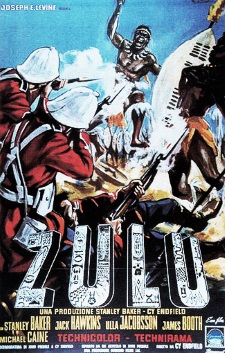
Zulu (1964)I watched part of the 1964 classic Zulu last night. I recommend reading an article I wrote about the film a few years ago, Zulu and the Politics of Power. But something struck me while watching it this time: how much it is like the Iliad.

What I mean by that is that the poem is Greek, written for Greeks to make them feel good about themselves. But it doesn’t vilify the Trojans. Certainly the Trojans are considered in the wrong. They supposedly started the war by kidnapping Helen. And so the Greek reader can be happy that the “good guys” win the battle. But mostly, it’s kind of like a sporting event: there’s our side and their side. And reasons don’t much matter. (Indeed, in the Iliad, it isn’t clear whether Helen was kidnapped by Paris, simply ran away with him, or something in the middle.)

Zulu Isn’t Objectively Racist

This is the case in Zulu, the movie. (For information on the actual battle, check out my article.) The Zulu aren’t really bad. In fact, it isn’t clear why they are attacking at all. There is no discussion of the Anglo-Zulu War, which really was an act of imperialist aggression by the British. But it hardly matters: the Zulu are attacking and, in this case, the British are defending. And other than the very beginning, it is told entirely from the perspective the British military.

It is because of this that the film isn’t racist. However, it is ethnocentric — shockingly so. The film does everything it can to humanize the Zulu. But it is a film for the British by the British. And that’s fine. A South African filmmaker who wanted to do the same thing would doubtless tell the story of the Battle of Isandlwana (the one right before the events shown in the film).

It’s also interesting that the film is anti-war. At the end of the film, Lieutenant Chard admits that this had been his first experience of combat and says, “You think I could stand this butcher’s yard more than once?” There’s no doubt that he’s not talking about his own troops. But even if war is hell, that doesn’t mean you can’t feel good about winning.

The Racism We Bring to Zulu

What’s troubling about the film, however, is that while it may not be racist objectively, it is easy to see a racist film while watching it. And that’s especially true of Americans. All of the “good guys” are white and all of the “bad guys” are black. What’s more, King Cetshwayo is the only black character who has a name. The white characters have superior technology. And in the context of the film, they are completely innocent. The leader of the whites is only there because he wants to build a bridge.

The story of the pure, advanced white man defeating the immoral, primitive black man dates to at least to D W Griffith’s The Birth of a Nation in 1916. And with our history of chattel slavery still very much with us in continued inequality and everything that goes along with that (eg, over-represented black criminals on the nightly news), there’s little doubt that Zulu is viewed as a racist film by many.

Rocky Is Similar to Zulu

I’ve long felt much the same way about Rocky. The film itself isn’t racist, but it is hard for white Americans to not watch it in that way. In fact, I think if Apollo Creed had been a white character, the film probably wouldn’t have been the blockbuster that it was. I’m not sure the same can be said of Zulu, although it probably was a lot more popular in the US because of the easy racist reading of the film.

The Power of the Reader

This is all very disturbing to me. I have written a lot about how the reader (listener, viewer) of a work of art is the ultimate arbiter of its meaning. And in this way, our social problems soil our art. But it also gives us hope. Recognizing racism in Zulu or Rocky is recognizing racism in our society. And as we (slowly) move beyond racism, the art works will be healed automatically.

On the other hand, how much of the power of these films comes from our own latent racism? I really don’t know. But I do know that racism and other social dysfunctions soil everything we do.

Re-Evaluating Attack of the Puppet People

Attack of the Puppet PeopleFive years ago, both Andrea and I wrote reviews of the Bert I Gordon film Attack of the Puppet People. We were actually fairly fond of it, although I attacted its screenplay savagely.

But Saturday afternoon, I came upon it on YouTube and I totally changed my mind about it. The screenplay is actually quite good. I loved the film. You can read all about it over at Psychotronic Review: Attack of the Puppet People. As is the idea with these pages, this one has three articles: the two that Andrea and I wrote back in 2012, plus a new one with my more evolved thinking on the film. It’s worth checking out.

(Also, I’ve removed the pages from here. Or rather, if you go to those pages, they redirect you to the Psychotronic Review article. That’s a little pro blogging tip. 301 redirects are amazing things!)

It’s also worth checking out the following absolutely wonderful print of the film. Don’t let the image fool you: this is not a frightening film. It is suspenseful though.

The Roger Corman Poe Cycle

The Roger Corman Poe CycleI added another page to Psychotronic Review, The Roger Corman Poe Cycle. For those who don’t know it, it probably sounds horrible — like something Arnold Schoenberg wrote in 1930 that still no one quite gets. But it’s actually something really great: eight films that Corman directed (and sometime produced) between 1960 and 1965 based on stories by Edgar Allan Poe. (Actually, one of them is based on an H P Lovecraft novel, but the title is taken from Poe.)

I’ve been watching these films since I was a kid. Yet when I sat down to write about them, I found it really hard. Since Roger Corman was King of the Cheap Movie, the films largely look alike. That’s especially true of House of Usher, The Pit and the Pendulum, and The Raven. And so I found myself confused about just what memory went with what movie.

In addition, fully half of the films deal with someone buried or entombed alive. It’s kind of amazing to think how much drama you can get out of that one idea. But I suspect that most people find the idea of being buried alive to be pretty terrible. And none of the stories are the same. So there you go.

One thing I noticed while going over the films is that they’re a bit on the sexist side. Women are either devoted spouses (or would-be spouses) or they are the most treacherous creatures imaginable. Hazel Court is really the best at that. I do have a kind of bizarre crush on the characters she plays. Oh, to spend my life with such a deliciously smart and evil woman! The only problem would be, of course, that she almost certainly would have murdered me. If not, she would have left me for someone richer and more evil.

Films Worth Watching

All these movies are about an hour and half. If you leave 15 minutes for intermission, that’s 13.75 hours. It would be awesome to rent a movie theater and show all eight films, starting at 10:00 am and running until midnight. It’s shocking that people don’t do that kind of thing more often. I suspect you could rent the films pretty cheaply. The question is: just how many freaks like me would pay ten bucks (And I’d pay a hell of lot more!) to sit in a movie theater all day watching movies made before I was born? Not enough, I’m afraid.

Go check out The Roger Corman Poe Cycle. Over time, I’m sure I (hopefully others too) will write articles about the individual films. I’m sure to write about The Raven. It’s my favorite. The truth is, I like Vincent Price most when he plays a good guy. And the film is a comedy. And it has the great trio: Peter Lorre and Boris Karloff join Price. Plus, there’s Hazel Court — really at her best.

New on Psychotronic Review: Horrors of Spider Island

Psychotronic Review - Horrors of Spider IslandOver at Pychotronic Reviewwe’ve created a new page for the classic German horror-girly film, Horrors of Spider Island.

If you know the film, it is probably because Mystery Science Theater 3000 featured it in their final season (10th if you don’t count the KTMA season, 11th if you have any class at all). As I’ve been working on the Psychotronic Review project, I’ve been surprised at how often I run into the show. Of course, Michael Weldon’s The Psychotronic Encyclopedia of Film was their bible, just as it is mine.

But the film is quite good all on its own. I wish I could find it in German. You can get a taste of it in a short clip. In addition to hearing the original language, the picture quality is fantastic — at least compared to all the English language versions online.

Anyway, head over to Psychotronic Review to check it out. The page includes the full movie from Archive.org. It’s the perfect film to watch on this rainy Friday afternoon.

Psychotronic Review’s First Blog Post

Psychotronic ReviewI fear that many of you may see this image and have the same let-down that I did as a child when I was expecting Night Gallery to come on and instead they aired The Sixth Sense. But what I write there I just would have written here.

The interesting thing about Psychotronic Review is that it isn’t a blog. It is meant to be more of an encyclopedia. While all the articles on Frankly Curious could never be compiled into a book, I suspect that those of Psychotronic Review could be — certainly if I ever manage to write as many articles as I have here.

So on Psychotronic Review each film has a page rather than a post. The different in CMS-speak is that posts are sequential — one after the other. Pages just are. So my page on A*P*E has no indication of when it was create — even relative to other articles.

Anyway, this made me wonder what I was going to use the blog for. I’ve decided that it will mostly be on theory. This first article, however, isn’t that much theory (although I couldn’t come up with a better category for it). It’s The Good and Bad of Mystery Science Theater 3000. It deals with my deeply divided thoughts on the show. On the one hand, it introduced a lot of people to psychotronic films. On the other, it seems to think they are all bad.

Go take a gander.