About Frank Moraes

Frank Moraes is a freelance writer and editor online and in print. He is educated as a scientist with a PhD in Atmospheric Physics. He has worked in climate science, remote sensing, throughout the computer industry, and as a college physics instructor. Find out more at About Frank Moraes.

And I Won’t Even Complain About Not Much Liking Shakespeare

Are you lucky you tuned in today! Probably not, but as usual: you should be. I have found a great short lecture (Okay! It’s 58 minutes, but the time flies.) by David Timson:


David Timson Speak the Speech

If you know who Timson is you are doing better than I am. He is certainly a guy who reads books on tape (or CD now). He has done a lot of Shakespeare and Sherlock Holms. He also seems to have done some film acting; and lots of radio broadcasts. As you will see—if you take the time to listen to the lecture, and you should—he has a great voice.

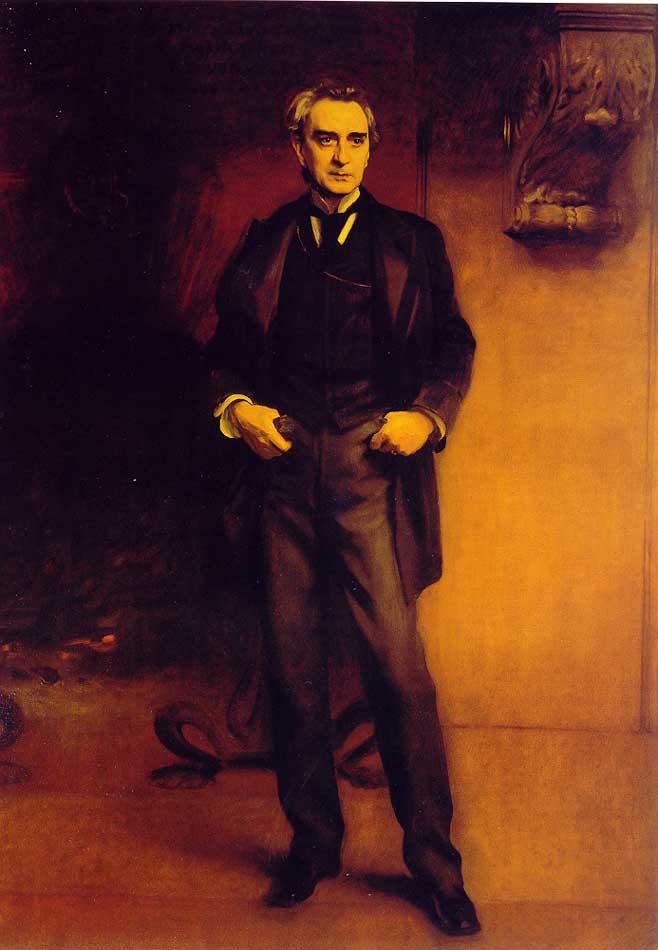
In this lecture, Timson discusses the changing style of Shakespearean performance since the invention of audio recording. Unfortunately, he is not terribly insightful, but this may be because he feels his wonderful examples speak for themselves. And largely they do. He plays very early recordings of Edwin “Am I My Brother’s Keeper” Booth (the unfortunate brother of John “Et tu, Brute?” Wilkes)—check out this great John Singer Sargent painting on him, Sir Henry “Big Hank” Irving (just kidding about the “Big Hank” moniker), and Lewis “Sugar Ray” Waller (not kidding about the “Sugar Ray”; no, just kidding; I was).

I have been fascinated with Edwin Booth for a long time, because I wonder what it would be like to be the brother of a famous murderer (I used to live with Melvin Simpson). But I have never heard his voice. In fact, since he died in 1893, I didn’t even think there was a recording. Not surprising, he has an excellent voice (so does Melvin). He actually sounds a bit like Orson Welles (so does Melvin; no, just kidding). If that doesn’t get you to listen, little will.

The lecture moves up to the present from Sir John Gielgud to Laurence Olivier to Kenneth Branagh (who really is amazing).

The point of the lecture is that Shakespearean acting has moved from a highly musical or operatic style to a more conversational and (to our ears) natural one. We could extrapolate backwards and conclude that acting during the Elizabethan period would be unintelligible to us. This is not unreasonable (but I don’t know how reasonable it is, and that’s why I put it that way). According to the iconoclastic Shakespearean scholar Gary Taylor, the sounds of the words themselves have changed so much that we would likely get little meaning from them. In effect, Shakespeare—written in (more or less) modern English—has to be translated for modern readers every bit as much as Aristophanes—written in (more or less) ancient Greek.

A World in Which I Don’t Have to Watch “The Princess and the Frog”

I always thought that I liked kids, but I have come to the conclusion that this is not the case. If there were no children, no one would have made The Princess and the Frog. If no one had made it, I would not have spent the afternoon watching it. If I had not spent the afternoon watching it, I would feel better about myself. It isn’t that I didn’t enjoy it; some of it was very funny and I was on the verge of crying pretty much from beginning to end—and I didn’t even realize that Oprah Winfrey was in it. But that is exactly the problem.

Randy Newman shows once again that talent can be used for evil. The songs—pretty much without exception—suck. But that’s okay. Newman has been writing poor songs on and off since the beginning (think: Laughing Boy) and always since about Toy Story (think: You’ve Got a Friend in Me). It was his score that was so evil. I was emotionally bruised (and worse, but I don’t want to go into details). I should now be made to weep over a dead firefly’s romantic life.

What bothered me most about the film was how it dealt with race. It takes place in 1930s (give or take 20 years) Louisiana, with its accompanying racial segregation and economic stratification. The fact that all the black people were smiling didn’t make me accept the racist expectations of the whites any better—from the implicit racism of Big Daddy LaBouff and his annoying daughter to the explicit racism of the real estate agents. What’s more, I couldn’t get past the fact that Prince Naveen is vaguely Indian and thus brown and thus acceptable to be paired with the light-skinned black girl. Certainly the prince could not be pasty-English white and the girl be Miles Davis black; or visa versa. If this is a film for kids, then perhaps such delicate racial issues should be taken out of it, by setting it somewhere other than 1930s (give or take 75 years) Louisiana.

It seems like a minor thing, but it’s worth mentioning: the animation. This film is what they call “hand drawn”. By this, it seems what they mean is that the base artwork is hand-drawn and then scanned into a computer and then animated the way they always do. Off hand, I would say, “So what?” But there is a difference: it really isn’t very appealing. I guess they are going for something like Lady and the Tramp. The problem here is that Lady and the Tramp is really not that appealing. I’m a Pinocchio guy.

Kids: there were a bunch of them. And they seemed to like it a lot. And they were very well behaved. (When I saw Babe in the theater the little joys were running up and down the isles.) I guess I can accept the occasional Disney movie for their benefit, but why did the dead firefly’s romantic life have to be so sad?

Blue Moon

As I am a big fan of all messed up creative people, let me start by quoting Lorenz Hart in one of my favorite Rogers & Hart songs:

Blue moon
You saw me standing alone
Without a dream in my heart
Without a love of my own.

I only bring this up because Andrea did not know what a “blue moon” was, as of this morning. At that time, she probably read something like Donna Henes’ Article on Huffington Post. It isn’t a great article, but some people are easily impressed.

Henes informs those people who don’t already know that a blue moon is the second full moon in a calendar month. This means, of course, that blue moons are meaningless because calendar months are arbitrary. But as yet another anachronistic unit of measure, the blue moon cycle is very cool: it is an odd period of time (a little less than three years) that is slightly different all of the time.

You may ask, “Why is a blue moon roughly three years in length?” But I would prefer that you not. Why? First, a blue moon is no length at all, but rather an instant. (This is not even exactly right because the moon oscillates by more than two degrees on either side and that means that even though the same part of the moon always faces us, we can see more than 50% of the surface, but I digress.) The three year number is the amount of time between blue moons.

The second reason this question is best not asked is that anyone reading this blog should really know better. But I will explain because I am kind and just. This requires some background.

You do understand that the moon does not go around the earth each night, right? I mean, pretty much the moon stays in the same place (like the sun) and it is the earth rotating at a break-neck speed that makes it look like the moon is going around the earth. In point of fact, if the earth did not rotate, the moon would move from directly overhead, all the way around the earth, and back to directly overhead in 29.5 days (roughly).

Without going into the phases of the moon, you ought to be able to conclude from this that there will be a full moon every 29.5 days (roughly). Unless you are Andrea, in which case, just take my word for it. Because of this, if you are going to squeeze a second full moon into a 30 day month, you’ve got to have your first full moon during the first 0.5 days. For a 31 day month, you have to have your first full moon during the first 1.5 days. This means you will never have a blue moon during my favorite month February when such notables are Christopher Marlowe and I were born.

On average, how often will you have a full moon on the first day of the month? About 3% of the time, right? (Andrea: just take my word.) How many months would that be? About 33, or three years, using 11 months because the sainted month of February is out.

But if all else fails, there is another song about blue moons by the great Pat Alger and Gene Levine:

I got your letter in my mailbox today
You were just checking if I was okay
And if I miss you, well you know what they say
Just once in a very blue moon.

15 November 2013: Added Gene Levine credit to the writing of “Once in a Very Blue Moon.”

The Passionate Shepherd to His Love

Some time ago, I stumbled upon Christopher Marlowe’s “The Passionate Shepherd to His Love.” It delighted me—it is so beautifully written. Instinctively, I picked up my guitar and quickly set it to music. But I’m getting ahead of myself. First, you really need to read this poem:

Come live with me and be my love,
And we will all the pleasures prove
That hills and valleys, dale and field,
And all the craggy mountains yield.

There will we sit upon the rocks,
And see the shepherds feed their flocks,
By shallow rivers to whose falls
Melodious birds sing madrigals.

There I will make thee beds of roses
And a thousand fragrant posies,
A cap of flowers, and a kirtle
Embroider’d all with leaves of myrtle;

A gown made of the finest wool
Which from our pretty lambs we pull;
Fair linèd slippers for the cold,
With buckles of the purest gold;

A belt of straw and ivy buds,
With coral clasps and amber studs;
And if these pleasures may thee move,
Come live with me, and be my love.*

Thy silver dishes for thy meat
As precious as the gods do eat,
Shall on an ivory table be
Prepared each day for thee and me.

The shepherd swains shall dance and sing
For thy delight each May-morning:
If these delights thy mind may move,
Then live with me and be my love.

Not long after discovering this—even before my dear friend Andrea could ruin it by pointing out that it was foolish youthful sentimentality—I discovered that Sir Walter Raleigh (yes, that guy) had written a response: “The Nymph’s Reply to the Shepherd.” It too is a beautiful poem (although Marlowe’s is clearly superior in poetic beauty):

If all the world and love were young,
And truth in every shepherd’s tongue,
These pretty pleasures might me move
To live with thee and be thy love.

Time drives the flocks from field to fold
When rivers rage and rocks grow cold,
And Philomel becometh dumb;
The rest complains of cares to come.

The flowers do fade, and wanton fields
To wayward winter reckoning yields;
A honey tongue, a heart of gall,
Is fancy’s spring, but sorrow’s fall,

Thy gowns, thy shoes, thy beds of roses,
Thy cap, thy kirtle, and thy posies
Soon break, soon wither, soon forgotten—
In folly ripe, in reason rotten.

Thy belt of straw and ivy buds,
Thy coral clasps and amber studs,
All these in me no means can move
To come to thee and be thy love.

But could youth last and love still breed,
Had joys no date nor age no need,
Then these delights my mind may move
To live with thee and be thy love.

I don’t have a lot to say about this poem, other than that it says exactly what Andrea would have said had I posted only the “The Passionate Shepherd.” However, it occurred to me that the two poems would work well together as a male-female duet. In fact, the phrasing of the two poems are identical—so I didn’t even have to change the music. Here is the chord structure which would cover two verses:

A / / / | A / / / | D / / / | A / / / |
E / / / | D / / / | E / / / | D / / / ||

And the structure would consist of four male verses (two music), four female verses, two male verses, two female verses, and then the last two verses sung at the same time by both—sort of like “Touch me in the Morning.” This is six verses each. You might have noticed that Marlowe’s poem has seven verses; I omit the verse above that has an asterisk after it.

I am not yet happy with the second part of the melody, but here is the first part (the AADA part). Note that the triplets are not strict (as you can tell from the chord structure, it is kind of bluesy and thus loose). Eventually, I will try to get a couple of kids from the local college to come over and record it and I’ll post it here. But even before that, I’ll post the second half of the melody.

Passionate Shepherd Music Part 1

Philomel

PhilomelIn Greek mythology, Philomel (Usually: Philomela.) and Procne are sisters. Procne’s husband, King Tereus agrees to escort Philomel to Thrace on vacation. But you know how it is with Greek men: Tereus can’t control himself. He kidnaps and rapes Philomel. But you know how it is with Greek women: Philomel can’t keep her big mouth shut. So she tells him that she has no intention of hiding his misdeed out of some sense of shame; she is going to tell everyone. But you know Greek men: Tereus cuts out her tongue so she can’t rat him out. But you know Greek women: Philomel weaves a tapestry that tells the whole story. But you know Greek wives: when Procne finds out, she kills Tereus’ only son and then feeds the body to him. But you know Greek men: he eats it. But you know Greek myths: Zeus and company change Philomel, Tereus, and Procne into birds.

I have no idea what the point of the story is, except maybe that you shouldn’t trust your husband with your sister. This is good advice.

She Said “No”

What is with these “You’re a loser but I love ya, babe” songs? The classic is Midnight Train to Georgia, but I’ll let that one slide because it is totally kick-ass. What I have in mind is Please Come to Boston. Here is the last verse:

Please come to L.A. to live forever
The California life alone is just too hard to live
We’ll live in a house that looks out over the ocean
There’s some stars that fall from the sky, livin’ up on the hill

That’s beautiful. First, he asks her to come and live forever. Then he tells her that he needs her—life is too difficult without her. Finally, he has a house on the ocean and stars fall from the sky!

And what is her answer? “No. I love you, but not enough to leave beautiful Tennessee. I’ll be waiting here for you to fail and come back with your tail between your knees.”

On second thought, why don’t you just stay in Tennessee and marry a tobacco farmer.

No More Butcher Knives

Butcher KnifeDo I ever have egg on my face! For years, I have been extolling the virtues of the butcher knife for culinary purposes. No kitchen is complete without one of these knives; or so I thought. Just today, after years of pestering my sister about the lack of a butcher knife in her kitchen, it came to a head. “What is a butcher knife,” she asked. After several minutes of stammering and inept attempts at mime resulting only in bruised knuckles, I turned to the Internet. It was then that I saw just how ill-defined a term “butcher knife” is. Just check out the image on the left.

The dictionary definitions are especially useless in this matter. For example, Dictionary.com defines a butcher knife as: “a large, very sharp knife for cutting or trimming meat”—somehow the modifier “very sharp” doesn’t seem to make sense; is there an “idiot’s knife”, defined as “a large, very dull knife for kitchen accidents”? Typical of a dictionary: unhelpful in practical matters.

Most butcher knives do look very much like the knives that I have always used. In fact, most people would say that the image above looks more like a cleaver and that the following image is a butcher knife:

Chef's Knife

But this is not a butcher knife; it is a chef’s knife. (Note how the former refers to the verb rather than the noun butcher—interesting, don’t you think?) This is what I have always thought of as a butcher knife. In point of fact, I have always thought that a butcher knife was any large, relatively triangularly shaped knife that allows one to chop ingredients without bumping one’s knuckles on the counter top. Now I know better.

Even with a chef’s knife, one can get into trouble. There are two kinds of chef’s knives: German and French. (This is amusing when one knows that the chef’s knife is often referred to as the French Knife. Thus, one might be using a German French knife or a French French knife. Imagine the problems the owner of the latter would have had at the start of the Iraq War: “No, no. It’s a Freedom Freedom knife.”) The German version—pictured above—has a rounder tip, so that it can be used more easily with a “rocking” cut: up and down. The French version is straighter and is used by pulling the knife toward the chef’s body: back and forth.

There is a Japanese knife called a Santoku, which I have called a butcher knife during my ignorant youth (that is, before about noon today).

Santoku Knife

It differs from the Chef’s Knife, primarily by having a straight edge—it is closer to the French Chef’s Knife. In general, I have not liked these knives as much. However, I have learned (thanks to a brief, unreferenced article on Wikipedia) that these knives are particularly good for people with small hands. Also: a skilled chef may do more precise cutting with the Santoku. As a result, I believe my past displeasure stems from unfamiliarity. The next knife I buy will be a Santoku. And, of course, I will write about it here. (Can you stand the excitement?)

Update

It has been over a year since I wrote this. During this time period I have used several Santoku knives. The result: I’ve given up on them. I have small hands, and yet, I do not find them particular good. I just don’t find them useful. A chef’s knife, a paring knife, a bread knife: all of these are essential. It is never the case that I need a Santoku. In fact, I only use my Santoku when everything else is dirty and I need a knife for something I could just as easily do with a steak knife.

Everything Interesting for Everyone Interesting

In grad school, I had—we all had—the most boring professor on the planet: Dr. Greene (the extra ‘e’ did not help). He taught the graduate seminar in theoretical mechanics, and through this course was the derision of almost all the physics student body. “If he were slightly less irrelevant,” people would say, “he might be able to teach classical mechanics.” For those not steeped in the ways of the upper echelon of physics education, graduate level classical mechanics is generally considered of little value: a course of little practical interest—as measured in a field where little has much practical interest. In fact, few physics programs require it any more. It is a wanker course, and that made Dr. Greene a third-degree wanker: the teacher of a course that built on a wanker course.

Dr. Greene had a religious reverence for the Lagrangian—which, although sounding like a runny French cheese, is in fact, just a system’s kinetic energy minus its potential energy. This is all very “first term graduate school” of course—even upper division undergraduate. Dr. Greene took the concept to new levels, however—fascinated, as he was, endlessly, with its quirks, especially as applied to General Relativity.

In his mid-50s, Dr. Greene had the same excitement one sees in high school nerds who are (by definition) so excited by their interests—be they role-playing games or rocket building—that they don’t realize how uncool they and their interests are. Greene would approach hyperventilation during his more “exciting” derivations and qualitative lectures. This made us ridicule him all the more.

We were aware, of course, that most people would find our interests boring. We had all been labeled the same way. Part of our ridicule of Dr. Greene came from our own positions as second-tier nerds. We needed to find someone worse than us—as if life were graded on a curve. “Sure I killed my wife, but look at that guy: he killed his kids too!” As a result, I can give us all a little slack: we were young and insecure. But there was a much more important issue at work.

Over the years, it gradually dawned on me that Dr. Greene was not boring. But he had some very boring students. His fascination with obscure topics in mathematical physics was justified; we were just too boring to see it. In the final analysis, Greene was the winner—he was happy tinkering around under the hood of the Lagrangian, whether without company or with (and I’m sure he had the occasional companion). We were the ones who wasted thirty hours during which we could have been enthralled.

I am not like Dr. Greene in that he was a specialist and I am a generalist; my passions are promiscuous: thin and broad. However, we share the same excitement about things we really should know are boring. But I am happy that way, and I’m sure he was too. I know there are boring things in the world: people who can’t share my fascinations. But even they’re pretty interesting in that fact; don’t you think?

Recycled Genius

RecycleI’m in the process of updating the look of the site. And in the process I will be getting rid of this pinned post, for reasons that will become clear later. I’m hoping I can add something like it to the sidebar. Anyway, the change should take place in the next week.
Also: I’m really sick today. I have the 11:05 post scheduled. But I haven’t done either of the morning posts, and may not get to them.