About Frank Moraes

Frank Moraes is a freelance writer and editor online and in print. He is educated as a scientist with a PhD in Atmospheric Physics. He has worked in climate science, remote sensing, throughout the computer industry, and as a college physics instructor. Find out more at About Frank Moraes.

Kick the Poor Then Jail Them

Tea PartyEd Kilgore made a good point over at the Political Animal blog, More Pain For Economic Victims. In it, he talked about the widely reported William Dickens and Rand Ghayad paper (pdf) that showed that employers would rather hire a less qualified applicant who has been unemployed for a short time than a more qualified applicant who has been unemployed a long time. He noted that this is part of the environment where the people who suffered because of the 2008 financial crisis were widely blamed for it.

You may remember this. Rick Santelli performed a live CNBC rant about how people taking out mortgages they eventually couldn’t afford were the reason for the financial crisis. This, of course, was entirely off base and entirely typical of elite opinion. The way the system is supposed to work is that a poor person goes to the bank and asks for a loan. The bank then decides if the poor person is a good risk. It is not surprising that poor people would ask for loans they can’t afford. It is the bank’s obligation to protect itself by only loaning money that is likely to be repaid. Santelli and his stock broker friends just loved the idea of turning this on its head. Those poor bankers! They were taken advantage of by those thoughtless poor people!

What’s more, we heard not a peep out of Santelli when it came to TARP, the law that paid out hundreds of billions of dollars to banks. It was only when the government decided to spend about a tenth of that with the Homeowners Affordability and Stability Plan that he started ranting. So you can see where the Santelli crowd was coming from. What was surprising was that the Tea Party movement would burst into existence as a result of Santelli’s rant. These were, after all, middle and upper-middle class people whose interests were better represented by the later Occupy Wall Street movement. But no, helped along by Fox News and the Koch Brothers, they were on the streets demanding that government not help individuals. (In fairness, the Tea Party claimed to be against TARP, but almost without exception, they have backed candidates who are against helping individuals and for helping corporations. We can either say that the people in the Tea Party hate regular Americans or they are stupid/ignorant, but we can’t say that they are smart and don’t hate their neighbors.)

The outcome of the Tea Party movement has been a more radicalized Republican Party and generally a more conservative and fearful Democratic Party. This despite the fact that the Tea Party never did have any real power. They were just the right flank of the Republican Party—now with a catchy name. And generally it’s meant a much more callous attitude toward those who are struggling in this economy. Perhaps the worst aspect of this has been the focus of Washington on debt over the last three years while ridiculously high levels of unemployment have just been ignored.

Kilgore notes that some of the army of long-term unemployed may eventually be driven to economic crime. But not to worry:

At some point, if this status produces anti-social behavior, I’m sure a lot of comfortably situated people will share some additional self-righeousness with these folk, and find it in their hearts to support even more public expenditures for incarcerating them than anyone proposed for helping them get back into the mainstream economy.

But I don’t totally agree with him. The 20% of Americans who associate themselves with the Tea Party have always been of the philosophy that if you fall down they’ll kick you but if you mess up they’ll jail you. The only question is whether reasonable politicians will continue to fear these vile and hateful conservatives enough to go along.

Samuelson: Economics Is Confusing

Robert SamuelsonYesterday was Sunday and that can mean only one thing: Robert Samuelson wrote something stupid in his column over at the Washington Post and Dean Baker destroyed it with mockery and, you know, facts. I really don’t like Samuelson; he’s the embodiment of the Very Serious Pundit who claims to simply explain what the facts are, when he actually pushes conservative ideology. And given that Samuelson writes about economics and finance (what I care most about), he is one of “the most slappable people on earth.”

This week, he really outdid himself. His argument is that all this austerity that he’s been pushing for four years hasn’t worked and now none of the people he’s been listening to know what is going on. He wrote, “The public is confused, because economists are divided.” But that’s not really true. As Paul Krugman noted, there are economists who have been right and economists how have been wrong. Samuelson insists on talking to the economists who have been wrong. And given that these austerity economists still don’t want to admit that they were wrong, they just claim that no one knows and that the macroeconomic field is divided.

Jared Bernstein makes fun of Samuelson’s claim that nothing we seem to do helps the economy:

This is like someone who’s supposed to be getting in shape for a race saying “I’ve tried eating extra snack foods, sitting around watching TV, and napping… but nothing seems to be improving my speed. It’s a mystery!”

Or to put it less fancifully, “We’ve done everything we can to slow the economy down, but it all just seems to slow the economy down. It’s a mystery!”

But what is most surprising about Samuelson’s article is it’s ending. And no one has mentioned it, perhaps because everyone expects this kind of thing from him. Samuelson uses the fact that “no one knows” what’s going on in the economy to justify—Wait for it!—more austerity!

But now a cycle of overconfidence has given way to a cycle of under-confidence. The trust in macroeconomic magic has shattered. This saps optimism and promotes spending restraint.

So when we “knew” that austerity was good we pursued austerity. But now that we don’t know if austerity is good we should pursue… austerity?

If economists somehow prove to Samuelson that austerity is bad, I guess he will tell us to pursue… austerity.

I guess he’s right: economics is confusing!

Lesbians, Short Hair, and the Frumpy Years

Sue PerkinsLast night, I watched this video 24 Hours of Madness. It is some kind of British celebrity game show. You know the kind where everyone goes on just to show that they are more clever and charming than the Yankees? And I got sucked in. It was loads of fun. But if you are going to watch it, fast forward to about 10 minutes, because it is a raw tape and you can’t hear anything up to that point.

One of the celebrities was comedian Sue Perkins. And I thought—in addition to being, of course, clever and charming—she was lovely. And then I thought, “I’ll bet she’s a lesbian.” So I looked it up in “Who’s a lesbian,” also known as Wikipedia, and sure enough: she’s a lesbian. And that got me wondering, “Why do I always find lesbians so attractive?”

My answer is that it is the hair. I love short hair on women. Normally, I would call for more straight women to cut their hair short. But the truth is that it works for me that short hair appears to be a lesbian thing. That way, I can have unrequited crushes on women and know that it absolutely is nothing personal. And that’s a very comforting thought as I make my way through the frumpy years.

Miranda and Terror

Dzhokhar TsarnaevThe New York Times just reported that Dzhokhar Tsarnaev will be tried in a civilian court. Thank God for small favors. Really, there should have been no question. Unfortunately, there are a lot of people in the United States who are hellbent on destroying the United States Constitution, even while they claim to love it. And the current occupant of the White House is one of them.

Over the weekend, Glenn Greenwald discussed the Democratic and “liberal” responses to Lindsey Graham’s tweet, “The last thing we may want to do is read Boston suspect Miranda Rights telling him to ‘remain silent.'” Although Graham’s tweet is repellent, it goes right along with Obama administration policy over at least the last two years. Greenwald is genuinely confused about how Democrats can support the president when he does it but oppose it when Graham calls for it. To me it is very simple: Democrats trust that Obama would only use such powers in extreme situations. And this is not that bad an assumption as can be seen in this recent news about a civil trial. The problem, of course, is even if we should always trust Obama (and I don’t think we should), eventually, the White House will be occupied by someone more like Bush Jr or Dick Cheney. Giving these powers to Obama is giving them (And more!) to every future decider.

Yesterday, Ari Melber wrote an excellent article for Reuters, Can Tsarnaev Be Ruled an ‘Enemy Combatant’? In it, he discusses three major legal questions that relate to this case. The first question is the title of the article: can this young man be treated as an enemy combatant? Melber says that in general he can’t. The only authority the president has to do this comes from the 11 September 2001 authorization of force. And to use this, the government would have to directly link Tsarnaev to al Qaeda or the Taliban.

I find the entire question offensive, but entirely America. We have defined a new term, “enemy combatant.” This places anyone we like in a no man’s land between civilian (where civil courts are in power) and soldier (where the Geneva Conventions are in power). Thus, we can effectively disregard hundreds of years of habeas corpus, even while we still maintain that the United States is the land of liberty. And what is it exactly that people like Graham and McCain think they get by pretending we are in some kind of traditional global war? It reminds me very much of Jeff Trent in Plan 9 from Outer Space. When told about a bomb we are about to develop that will destroy the universe, he says, “So what if we do develop this Solanite bomb? We’d be even a stronger nation than now!” “Belligerent” and “dangerous” are not synonyms for “strong.”

Melber’s second legal question is whether being an accused terrorist should change what legal rights Tsarnaev is given. (I know: rights are not supposed to be given. Mark that down on the list of lies you were taught in civics.) It is on this question that the Obama administration (with little push back from “liberals”) has been really bad. In 1984, the Supreme Court found that Miranda Rights did not have to be given to a suspect if there was a public safety concern. For example, “Are there any more bombs? Is your apartment booby trapped?” I don’t even understand why the court allowed this exception. Police can ask any questions they want. Miranda only matters when it comes to which statements are admissible in court. I don’t see any reason why these necessary public safety questions need to come up in court. But as Liberal Viewer noted last night, Deval Patrick has said there is no danger, so there really is no justification for the “public safety” exception.

Regardless, this exception has only ever been allowed for a matter of minutes. The longest time ever was 50 minutes. But in 2010, the Obama administration announced that it would seek the legal authority to never give Miranda Rights to terror suspects. And that is Melber’s third legal question. Instead of going to Congress, Obama did what the Bush administration was so good at: make up the rules themselves—which they did in March 2011. The problem, as Melber points out, is that the Obama administration is a lot smarter than the Bush administration. Bush was publicly slapped down by none other than Antonin Scalia. But Obama pushes the envelope and thus gets away with it.

The common reaction is, “So what? They’re just terrorist?” Of course, the point is that they are terror suspects. But that aside, there are important reasons to care, as Ari Melber makes plain:

A great weight of evidence shows that programs which unilaterally revoke the rights of a class of citizen, or suspect, rarely remain very limited. As Yale law professor Jack Balkin has documented, when governments erect a parallel track of reduced rights to combat terrorism, the conventional law enforcement system faces a huge temptation to “increasingly [follow] the parallel track.” It’s not only the “bad guys” that have to worry about the government’s powers. In the areas of indefinite detention, drone targeting and Miranda, the administration is uncorking temptations that require a much deeper public debate.

There is one final wrinkle in the external constraints at work here. Bush set the bar so low, many influential political analysts have suggested his successor deserves praise simply for not breaking the law, for not operating black sites and not torturing people.

This is as absurd as it is depressing. Obeying the Constitution is a prerequisite for every president. Not a metric on which to be scored.

And that is an important point. Because we like Obama, we need to hold him accountable. Accepting him as “not as bad as Bush” does him a disservice as well as ourselves.

Immanuel Kant Was a Real Pissant

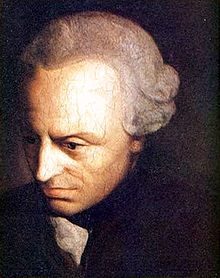
Immanuel KantCool birthdays are not evenly distributed. Some days, it is hard to find anyone to talk about. Look at Friday, for example—and it wasn’t even close to the worst. And then there are days like today that are overflowing with interesting people. Let’s start with Henry Fielding who was born on this day in 1707. He wrote Tom Jones and thus would be the standout guy most days. But alas, not today. Vladimir Lenin was born in 1870. And another notable Russian, novelist Vladimir Nabokov was born in 1899. Charles Mingus was born in 1922. On a normal day, any of these people could win the birthday prize.

The same goes for the living. Glen Campbell is 77 today. Jack Nicholson is 76. John Waters is 67. And Peter Frampton is 63. (Okay, maybe not him.)

But the day goes to Immanuel Kant who was born on this day back in 1724. He was an amazing thinker, but I don’t recommend trying to read him. It’s very difficult, painstaking work. You are better off with something like Roger Scruton’s Kant: A Very Short Introduction. After trying to read Kant in high school, I really got started with him by reading Ayn Rand and her obsequious follower Leonard Peikoff. She hated him and dismissed him so much that I knew there must be something to him. And there is. Lots. In fact, Rand’s primary critique that Kant is some kind of relativist who doesn’t believe in absolute reality is nonsense, but so too is Rand’s idea about objective reality. Is your brain starting to hurt? Imagine what fun awaits you!

Happy birthday Immanuel Kant!

Afterword

And there’s this:

Insulting Ayn Rand

Ayn RandI have major problems with Christopher Hitchens. One of the biggest is that he chose to use his incredible intellect for such trivial pursuits. But when he was right about something, I was on his side. And the fact is that he was right about quite a lot. Unfortunately, he used the last ten or so years of his life dedicated to his racist complaint about Islam. But in the following video he attacks Ayn Rand. He starts with a two word response that is all one really needs to say, “The novels.” But he goes on from there. It is fun, but not all that insightful. In particular, when Rand made sense, whatever she was saying was obvious. Her clever thinking (such as it was), she left for her most ridiculous ideas like her constant pronouncement that altruism doesn’t exist.

There is one part of this short clip that bothers me. Hitchen quotes something great from Lillian Hellman. I don’t know why it is, but conservative intellectuals seem to not be able to control themselves from insulting that poor lady even when they are complimenting her. I’m not suggesting that she was some wonderful person. But there is definitely something that gets under their skin. I think it speaks well for Ms. Hellman.

Witches and Hippies

DragnetThis video parody of Dragnet is very funny with some clever computer effects. But what I think is most interesting about it is the original stuff that sadly very few people in a society can see at the time: how law enforcement is mostly just cultural bias, and in-group and out-group signifying. The original episode is all about the good people symbolized by the cops and the bad people symbolized by the hippies.

It is based on “The LSD Story” episode—which was ironically the first color episode of the show. This is interesting because at the end, the dealer dies of an LSD overdose. In fact, it is not clear that anyone has ever died from an LSD overdose. So much for the stories being true. But that is wholly beside the point. The episode is intended to portray the heroic police officers saving our youths from a life of sin and debauchery. In another time, the story could have been about the demons lurking in the woods waiting to have sex with our daughters and turn them into witches. It is exactly the same thing.

But forget my ranting. Check this video out. It’s a lot of fun, and as I said, funny:

Dobson’s Negro as Other

Dobson's EncyclopaediaIn the complexion of negroes we meet with various shades; but they likewise differ far from other men in all the features of their face. Round cheeks, high cheek bones, a forehead somewhat elevated, a short, broad, flat nose, thick lips, small ears, ugliness, and irregularity of shape, characterize their external appearance. The negro women have the loins greatly depressed, and very large buttocks, which gives the back the shape of a saddle. Vices the most notorious seem to be the portion of this unhappy race: idleness, treachery, revenge, cruelty, impudence, stealing, lying, profanity, debauchery, nastiness, and intemperance, are said to have extinguished the principles of natural law, and to have silenced the reproofs of conscience. They are strangers to every sentiment of compassion, and are an awful example of the corruption of man when left to himself.

Dobson’s Encyclopaedia, 1798
Entry for “Negro”

Larry Summers’ Last Chance

Larry SummersLet me tell you about Larry Summers. He’s an economist and was the Secretary of the Treasury under Bill Clinton. Before him, Robert Rubin was Treasure Secretary, and Summers, being an acolyte of his, continued his strong dollar policies. Now I know that a strong dollar sounds like a good thing, but it isn’t. Politicians love a strong dollar because it makes them feel powerful. But even more important, all of the rich people who are the true constituents of the politicians love a strong dollar. If you have a lot of dollars, a strong dollar is great. If you have to work for a living, a strong dollar is bad.

The economics of this is very simple: if the dollar is strong, imports will be cheap and exports will be uncompetitive. If markets truly were the magical entities that conservatives claim, we would have no trade deficit; instead, our dollar would be worth less and trade would adjust accordingly. But anyway, if you want to decimate American manufacturing, then keep the dollar strong.

Now Larry Summers is a good, even a great economist. So why did he believe in a strong dollar? I don’t know. I guess because he thought it was more important to protect the wealth of the rich than the jobs of the poor. But since the financial crisis of 2008, he has been making lots of sense. So I’m divided in my thinking about him.

Last week, he did a little political science over at the Washington Post, Sometimes, Gridlock Is Good for America. I agree with the title. When Republicans are in the White House, we could use a good deal more gridlock. He even said so when it comes to the Bush Jr years. Of course, Summers is a New Democrat so he thinks the Reagan and Bush Sr years were a-okay! Whatever. But mostly, his point was that we’ve had gridlock in the past as if blanket Republican opposition in the 1960s is the same as blanket Republican filibusters today.

The great Norman Ornstein and Thomas Mann took him to task late last week, Gridlock Is No Way to Govern. They come right out swinging:

Larry Summers is a brilliant, award-winning economist. Monday, in his monthly op-ed column for The Post, he opined about politics and history. Our advice, as political scientists, is that Summers should stick to economics.

Then they go onto argue more or less the same thing that is in their book, It’s Even Worse Than It Looks: How the American Constitutional System Collided With the New Politics of Extremism. Check it out.

The point is not so much that Summers is wrong. It just bugs me how much all of these elite people prove that we do not live in a meritocracy. Once you get to the level of Larry Summers or Robert Rubin, it doesn’t matter how wrong you are about anything. There is still great demand for your thinking. Meanwhile, an 18 year who old gets arrested for cannabis possession sees his life effectively over.

The nobodies are never given a second chance. The somebodies are never given a last chance. Don’t talk to me about equality of opportunity and don’t mention “meritocracy” except to say that it doesn’t exist—in America anyway.

Afterword

Last year, I wrote about a tax reform proposal by Larry Summers that I really liked. So I don’t mean to be too hard on him.

Come Back Obama

Obama CopeJust one more quick note about all the aftermath of the Boston Marathon bombing. I believe that Obama was so quick to call the bombing a terrorist act because, as usual, he’s a wimp. I’m sure he is worried that just like in Benghazi, the right wing will attack him for not calling it a terrorist attack. I’m all for being a wimp when it protects a person. I’ve managed to avoid fights all my adult life by being a wimp. But Obama will not avoid fights this way. If he hadn’t called it a terrorist attack, the right would have attacked him. If he said that Dzhokhar Tsarnaev should be given his Miranda Rights, the right would have attacked him. As it is, he has indicated that Tsarnaev will be tried in our regular court system, so the right is attacking him for that.

Will the president never learn that the right will attack him regardless of what he does?

I have an idea for the president. It’s radical, I know, but here goes: why doesn’t President Obama try to please his base? It is very possible he would actually succeed at that. Trying to please the Republican Party is a fool’s errand. In fact, trying to please the centrist Washington insiders is also a fool’s errand. Did you read Maureen Dowd yesterday? The defeat of the gun bill is apparently Obama’s fault. She’s a great example of how Obama just can’t win with the only people he seems to care about winning with.

The clock is running out for the president. He needs to come back to the liberals he was courting all the way through 6 November of last year. Because despite everything, we still like him. And we’re the only ones who ever will as long as he is in power.

Racism Toward Muslims

Electronic IntifadaAli Abunima at The Electronic Intifada has written an article that I wish all Americans would read (even though I fear their reaction would be no better than it was to Marc Ambinder’s article), Obama’s Rush to Judgment: Was the Boston Bombing Really a “Terrorist” Act? The basis of his argument is that our definition of “terrorism” requires that the perpetrator being politically motivated. At this point, we don’t have any information indicating that this is the case so we should back off on the talk of terrorism.

There are two comparisons that I think are important. The first is that this could well be just another Columbine. As we now know, that crime was committed by one “clinically sadistic sociopath” who manipulated another who suffered from depression. When all the information comes out about the Tsarnaev brothers, I think we will at least see that dynamic going on. I will be surprised if the older brother didn’t have some “reason” for the attack, but I have a hard time believing it was really about it. Regardless, if it turns out they did the attack for al Qaida or Chechnya of the lack of Russian representation in USA Boxing, then it will be a terrorist attack. Until then, it isn’t.

Abunima as notes that the attack last August on the Sikh Temple of Wisconsin is almost never referred to as a terrorist attack. But of course it was. I would go further: a lot of people still bristle at calling the Oklahoma City bombing a terrorist attack. What’s more, no one on the right wants to call abortion clinic bombings and assassinations terrorist attacks. That’s because in America, a “terrorist” is only a Muslim. This is, admittedly, strange. We have long known about terrorist acts in Northern Ireland and Spain. And Timothy McVeigh was executed before 9/11.

I think what is really going on is that Americans see people from the Middle East writ large (so large that India is included) as the enemy. And these people are all assumed to be Muslims (even though most of them aren’t). On Wonk Blog this morning, John Sides wrote about some of his research, Americans Who Distrust Muslims Are Likelier to Back the War on Terror. He started the article by displaying the following tweet from game show host Chuck Woolery who is saying what most Americans think:

Sides went on to present data that shows that Americans find Muslims far more violent and untrustworthy than any other group, including blacks and Latinos (even though the rated them high in these regards too). It is extremely sad to see.

But in this way, I think I might disagree with Abunima’s concern about the tendency of Americans to call anything that Muslims do terrorist. I think the problem is that Americans hate Muslims and are eager to find anything to blame them for. Even still, I’m kind of hopeful. Over time, I think it will be like the LGBT community: as more and more people get to know Muslims, it will be harder to hate them. And it will be the same dynamic: the young and liberal will embrace them first and the old and conservative will be the hold outs.

None of this means we shouldn’t fight back against these unfair stereotypes. And I hate to think about the small scale terrorist attacks that are being perpetrated on American-Muslims right now. Remember, the Sikh Temple was attacked because the white supremacist thought the worshipers were Muslim. And that does make plain the fact that hatred of Muslims is racism pure and simple—unless they also hate all Basques and Northern Irish. That may provide a way forward.

Abunima is right, though: we need to push back on fools like Chuck Woolery who think Muslims are violent. Adam Lanza was a white guy who killed 27; I don’t think it is right to lay that on me just because I’m also white.

Missing Cat/Dog/People Signs

Lost CatI rarely torture you all with my own poetry but this rhymes! And yes, I know what you’ll say, “It’s bad enough that this is all about death; do you really have to end it by saying that death is a good thing?” Well, yes, as a matter of fact I do. I’m no fan of death, but there are a great many things that are worse than death. For example (and I hate to bring this up because it really bothers me), I would rather die than have my toes cut off one by one with a pair of cutter pliers. The same thing goes for my fingers now that I think about it. And now that you have that image, enjoy the poem!

Hopefully perky
Each sign I saw said
Please bring back my Muffin
But Muffin is dead.

Not all the king’s horses
Nor pharmacy meds
Will bring back poor Muffin
Cause Muffin is dead.

Maybe on a highway
Or under a bed
There aren’t happy endings
Cause Muffin is dead.

Kristin can tell you
When her Muffin fled
And stayed gone for two weeks
Muffin was not dead.

But that’s the exception
Of which you have read
Cause generally speaking
Muffin is dead.

I know that I’m dreary
And filled up with dread
But ration’ly speaking
Poor Muffin is dead.

She could be in much pain
Tortured in a shed
Then isn’t it better
If Muffin is dead?