About Frank Moraes

Frank Moraes is a freelance writer and editor online and in print. He is educated as a scientist with a PhD in Atmospheric Physics. He has worked in climate science, remote sensing, throughout the computer industry, and as a college physics instructor. Find out more at About Frank Moraes.

People Not as Much in Favor of Single-Payer as Seems

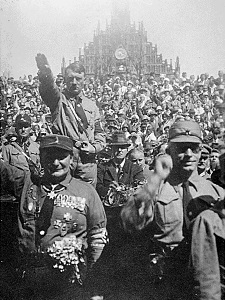
Nazi Rally - People Not as Much in Favor of Single-Payer as SeemsI’ve been hearing a lot about single-payer healthcare and how popular it is with conservatives. It all started when the Republicans got to work trying to destroy Obamacare. The most recent showed up in Sarah Kliff’s article, I Ran a Focus Group With Trump Voters. Half Said They Support Single-Payer. So liberals want single-payer. And half of conservatives want single-payer. Why don’t we have single-payer?!

I’m so sick of this because it means absolutely nothing. Think about Obamacare itself. Recently, it’s become much more popular. According to Gallup, 55 percent of Americans are now in favor of it. Just last November (you know: when we had the election that made reality television star and racist authoritarian Donald J Trump our president), only 42 percent of Americans were in favor of Obamacare. I suspect that Obamacare has more or less stabilized and that people will generally be in favor of it in the future.

The Insanity of Obamacare Opposition

But for the last seven years, the American people have been very much against it. Of course, if you asked them about the things that were in it, they were for them. If you described Obamacare but didn’t name it, they were in favor of it. But they were against whatever the law named Obamacare was. And it wasn’t just some vague notion. They voted based upon their hatred of the law they hated when you called it Obamacare.

This is politics in the United States. It doesn’t make much sense. So Sarah Kliff can go door-to-door and talk to all 325 million Americans and find out that they are overwhelmingly in favor of single-payer healthcare. It still means nothing. And the reason is because it isn’t real. Sure, people have the capability to think about things and come to their own conclusions. But they rarely do. Instead, they find out what the tribe thinks and they go with that.

My Father’s Love of Single-Payer

This is very personal for me. And because it is personal, it is annoying. Not long after Obamacare was passed, my conservative father asked me why they had to pass such a complicated bill. “Why didn’t they just create something like they have in Canada?” Well, this first annoyed me because I knew he was complaining about the bill being complicated because someone (most likely Charles Krauthammer, because my father has a man-crush on him) had been complaining about the “20,000 pages” of the bill. (It wasn’t that long, but that’s a typical number I used to hear.

But even more annoying was that we got Obamacare because if they just created “something like they have in Canada,” people like my father would have been screaming that it was “Socialism!” and that America was on the edge of oblivion. If the Democrats had proposed “Medicare for all,” my father would have asked me why they didn’t do something moderate like Romney did in Massachusetts. Remember: the Heritage Foundation plan, which was the foundation for Obamacare, was created explicitly so that the Republicans could have something to offer as an alternative to the more liberal HillaryCare.

Republican Bait and Switch

The Republican Party is all about the bait and switch. Remember: it is the party of the rich. All it cares about is making the lives of the rich better. Everything else it does is just to get enough votes so that they can pass tax cuts and deregulation. If they could do that by being pro-choice, they would. They really don’t care about anything else. So when it comes to healthcare, all they are interested in is pretending to care. Whatever the Democrats propose will be wrong.

Think about it. If the Republicans had offered Obamacare to Clinton in 1993, he would have taken it. On the other hand, if the Democrats had said, “Hey, we really like your healthcare proposal, let’s pass it,” the Republicans would have suddenly found that it wasn’t good enough. Suddenly there would have been all kinds of problems with it that they hadn’t seen before.

We know this is the case because when the Democrats did just that 15 years later — when the problem of healthcare in America was much worse — the Republicans claimed it was “Socialism! Socialism, I tell you!” And this led to what was actually a very funny period of conservative healthcare wonks like Avik Roy running around the globe looking for a healthcare system that was more conservative than Obamacare. They were always claiming to have found one, but it always turned out that the other country’s system was more liberal. These conservative healthcare “wonks” were really just conservative healthcare propagandists who didn’t understand healthcare. But they did understand their jobs: to be against any healthcare idea that a Democrat ever had.

Conservatives Like Single-Payer — Before the Propaganda Starts

“One of these days we are going to spend our sunset years telling our children and our children’s children, what it once was like in America when men were free.” –Ronald Reagan on the passage of Medicare

So sure: when single-payer healthcare was brought up in Kliff’s forcus group, “Half of the hands shot up.” But imagine things after Fox News spent a week shouting, “Socialism! Socialism, I tell you!” Imagine what would happen when hundreds of articles were published about all the people who come to America from Canada because they just can’t get the care they need. This is a favorite conservative talking point — and a myth. After just a week of that, none of those hands would have shot up.

What’s more, most of the people in the focus group would repeat the same talking points that they’d heard on Fox News and hate radio and their friends who listen to these garbage news sources.

Facts Don’t Matter in the US

I understand. In a reasonable nation where the mainstream press called out lies when they heard them instead of just claiming that opinions differ, we would not just live in a country that supporters single-payer healthcare; we would live in a country that had single-payer healthcare. But we don’t live in that country. That’s why we live in a country where the very existence of global warming is a matter for “debate.” The Republicans have played the media perfectly so now any crazy idea a Republican has must be treated with respect.

Eventually, I think we will get single-payer healthcare. It will probably happen gradually as the age requirement for Medicare is slowly lowered. This will happen because we have no choice. But it is pure fantasy that if we put single-payer healthcare up for a vote that it would win by a huge margin. The truth is that after all the conservative (And insurance industry!) propaganda, I’m not even sure it would pass at all. But I am sure that if it passed, it would pass by a small amount.

Authoritarians Do as They Are Told

To a large extent, people are Republicans because they are authoritarians. And that means that they follow directions. Roughly half of the people in the Republican Party really didn’t like Donald Trump on 8 November 2016. But they voted for him anyway — because he was the Republican candidate. And if single-payer came up for a vote, Republicans would vote against it because the party was against it.

So let’s not all of us liberals get lost in fantasy land where conservatives are in favor of single-payer healthcare. The people in Sarah Kliff’s focus group hadn’t been fed the propaganda that they will be fed (in abundance) if single-payer ever becomes a real possibility. If we’re going to get Medicare-for-all, it’s going to be a tough fight. It’s a worthwhile fight. And it’s a fight we can win. But it won’t be easy. The Republicans are not on our side. And if you think their freak-out over Obamacare was ridiculous, just wait until they get started on single-payer.

Republicans Will React as They Have Before

Remember that the following was said by a man who would today be considered a squish in the GOP:

If you don’t [write letters to Congress], this program [Medicare] I promise you, will pass just as surely as the sun will come up tomorrow and behind it will come other federal programs that will invade every area of freedom as we have known it in this country until one day as Normal Thomas said we will wake to find that we have socialism, and if you don’t do this and I don’t do this, one of these days we are going to spend our sunset years telling our children and our children’s children, what it once was like in America when men were free.

How many hands will Sarah Kliff get after the same thing is said about single-payer healthcare? Not only will there be none, even asking the question might start a riot.

Women Don’t Just Happen to Choose Lower Paying Jobs

Majority ReportOne of the things you hear morons say is that the reason why women make less money is because they make different choices that cause them to make less money. Now you are probably well aware that women make somewhere between 77 and 79 cents for every dollar a man makes when they work the same work schedules. And even smaller percentages for women of color.

Critics will say that the raw gap doesn’t show you. That’s just because there’s a bunch of choices that women make. If you take into account education, experience, race, industry, and occupation, the gap gets smaller. If women and men with similar characteristics are compared, women make just about 90 percent of what men make. And women do stay home with young children at higher rates than men. And so she writes, “If women want to earn equally, it should stand to reason that they should simply get more education, and add experience to their resumes, and choose high paying industries and jobs, and stick with their careers.”

But the idea that women choose lower paying work may put the horse behind the cart. Because every time women begin to dominate a profession, the pay goes down. And every time men end up dominating a position, the pay goes up. Women make less than men in every industry, even for work that’s remarkably similar. Low-wage jobs dominated by women pay just three-quarters of what low-wage jobs held by men. Housekeepers are mostly women, make 17 percent less than people who clean vehicles and equipment, mostly men. Cashiers make 10 percent less than parking lot attendants, mostly men. High-paid female jobs pay about two-thirds of what male-dominated jobs pay.

A study looking at a century of census data found that when the share of women in a particular occupation increases, the pay drops. When women took over in working parks and camps, wages fell 57 percentage points. Thirty-four points in designing. Twenty-one points in housekeeping. And 8 points in biology.

By contrast, computer programming used to be done mostly by women. When men took over, prestige rose along side pay. Employers simply value work less when it’s done by women.

–San Seder
The Majority Report

Note

Seder is reading from a few different sources in this quote. I don’t know what they are. If you do, please list them in the comments.

Bubba Ho-Tep on Psychotronic Review

Bubba Ho-TepI watched Bubba Ho-Tep the other night and wrote about it over on Psychotronic Review. I’m sure I’ll write more about it later. This last time I watched it, I was most struck with how it worked as a very serious film about the way that we abandon the elderly.

Of course, the film remains quite a fun romp, but there is lots of meaning if you are inclined to see it.

Getting People to Watch It

Bubba Ho-Top has been a troublesome movie for me for many years. When I first saw it, I loved it. So I introduced it to just about everyone I met. Yet it seemed no one could even make it half way through. I think it’s all the business about cancer on Elvis’ penis. I understand the problem. But if people would just push through, they would find that they really enjoy it. That’s especially true after it becomes a buddy picture. Bruce Campbell and Ossie Davis make a wonderful pair.

If you have somehow managed to miss it these last 15 years, you really should find it. It’s extraordinary.

The Federal Reserve Keeps People Unemployed

Dean Baker on 2016 July Jobs ReportThe New York Times had an interesting piece that reported on the ways in which Uber uses techniques learned from behaviorial economics to get drivers to work longer hours than they might want. The article concludes by saying that with changes in the economy, many workers may have no choice but to rely on Uber jobs.
In this context, it is worth mentioning the Federal Reserve Board. The Federal Reserve Board has raised interest rates twice in the last four months because it is concerned that the economy is creating too many jobs. It is expected to raise interest rates three more times this year.

If people consider it bad that workers have few options other than working for Uber, they should be very upset that the Fed is raising interest rates. These interest rates are helping to ensure that millions of workers have limited job opportunities.

–Dean Baker
Uber and the Federal Reserve Board

Zulu and the Racism We Bring to It

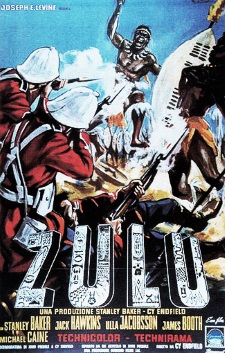
Zulu (1964)I watched part of the 1964 classic Zulu last night. I recommend reading an article I wrote about the film a few years ago, Zulu and the Politics of Power. But something struck me while watching it this time: how much it is like the Iliad.

What I mean by that is that the poem is Greek, written for Greeks to make them feel good about themselves. But it doesn’t vilify the Trojans. Certainly the Trojans are considered in the wrong. They supposedly started the war by kidnapping Helen. And so the Greek reader can be happy that the “good guys” win the battle. But mostly, it’s kind of like a sporting event: there’s our side and their side. And reasons don’t much matter. (Indeed, in the Iliad, it isn’t clear whether Helen was kidnapped by Paris, simply ran away with him, or something in the middle.)

Zulu Isn’t Objectively Racist

This is the case in Zulu, the movie. (For information on the actual battle, check out my article.) The Zulu aren’t really bad. In fact, it isn’t clear why they are attacking at all. There is no discussion of the Anglo-Zulu War, which really was an act of imperialist aggression by the British. But it hardly matters: the Zulu are attacking and, in this case, the British are defending. And other than the very beginning, it is told entirely from the perspective the British military.

It is because of this that the film isn’t racist. However, it is ethnocentric — shockingly so. The film does everything it can to humanize the Zulu. But it is a film for the British by the British. And that’s fine. A South African filmmaker who wanted to do the same thing would doubtless tell the story of the Battle of Isandlwana (the one right before the events shown in the film).

It’s also interesting that the film is anti-war. At the end of the film, Lieutenant Chard admits that this had been his first experience of combat and says, “You think I could stand this butcher’s yard more than once?” There’s no doubt that he’s not talking about his own troops. But even if war is hell, that doesn’t mean you can’t feel good about winning.

The Racism We Bring to Zulu

What’s troubling about the film, however, is that while it may not be racist objectively, it is easy to see a racist film while watching it. And that’s especially true of Americans. All of the “good guys” are white and all of the “bad guys” are black. What’s more, King Cetshwayo is the only black character who has a name. The white characters have superior technology. And in the context of the film, they are completely innocent. The leader of the whites is only there because he wants to build a bridge.

The story of the pure, advanced white man defeating the immoral, primitive black man dates to at least to D W Griffith’s The Birth of a Nation in 1916. And with our history of chattel slavery still very much with us in continued inequality and everything that goes along with that (eg, over-represented black criminals on the nightly news), there’s little doubt that Zulu is viewed as a racist film by many.

Rocky Is Similar to Zulu

I’ve long felt much the same way about Rocky. The film itself isn’t racist, but it is hard for white Americans to not watch it in that way. In fact, I think if Apollo Creed had been a white character, the film probably wouldn’t have been the blockbuster that it was. I’m not sure the same can be said of Zulu, although it probably was a lot more popular in the US because of the easy racist reading of the film.

The Power of the Reader

This is all very disturbing to me. I have written a lot about how the reader (listener, viewer) of a work of art is the ultimate arbiter of its meaning. And in this way, our social problems soil our art. But it also gives us hope. Recognizing racism in Zulu or Rocky is recognizing racism in our society. And as we (slowly) move beyond racism, the art works will be healed automatically.

On the other hand, how much of the power of these films comes from our own latent racism? I really don’t know. But I do know that racism and other social dysfunctions soil everything we do.

Mitch McConnell Admits He Has No Principles

XXXAfter Antonin Scalia died, in February of 2016, Mitch McConnell justified his decision to blockade the vacancy on the grounds that neither party would approve a Supreme Court justice during an election year. (The truth is that there was simply little precedent for this either way.) McConnell was simply acting on a “principle” that, he explained, had been understood by all sides but never ratified in a formal way. …

A good test of any principle is whether the person claiming it is willing to make it apply to all circumstances going forward. If McConnell were willing to make “fill no election-year vacancies” a formal rule, it would hardly prove his good faith — he might have embraced the rule as a post hoc rationale for his power play — but it would be at least consistent with the idea McConnell was acting in good faith. And he would be binding himself, and his party, to the “rule” he forced Obama to follow, that a president may fill only those Supreme Court vacancies that occur during the first three years of a four-year term.

But instead McConnell simply brushed off the idea of making it a rule… …

So, no rule. McConnell blockaded the Supreme Court vacancy because he had the votes to do it. There’s no principle guiding Supreme Court nominations other than: “Does the president have 50 Senate votes?”

Instead of trying to understand the Calvinball rules, Democrats should work within the order that exists. Which means they have to filibuster Neil Gorsuch, and let McConnell formally eliminate the filibuster for Supreme Court nominations, so that they can confirm their nominees with 50 votes, too.

–Jonathan Chait
Mitch McConnell Admits the “Rule” That Blocked Merrick Garland Is Not Actually a Rule

Why Is Trump Tanking? Lies and an Unpopular Agenda

Greg Sargent - Why Is Trump Tanking? Lies and an Unpopular AgendaThe health bill, the travel ban, and the border wall are all either defeated or in deep trouble. As veteran Washington consultant David Gergen put it, Trump is “flailing because he doesn’t know where to find his natural allies.”

But if this is so, surely it is partly because the policies are so unpopular. Take health care: Many blame House conservatives for tanking the GOP bill. But more pragmatic GOP lawmakers also played a big role. They opposed it in large part because the policy was so regressive that even they could not abide by it. The plan would have cut over $800 billion in Medicaid spending — which would have left 14 million fewer on Medicaid, according to the Congressional Budget Office — while delivering an enormous tax cut for the rich.

A number of moderate House Republicans opposed the plan precisely because it would have taken coverage away from many of their poorer constituents. Moderates were also alienated in part because the plan was broadly unpopular: A recent poll found that only 17 percent of voters backed the plan, and core Trump voter groups opposed it. The Medicaid cuts were a key reason for that: 74 percent of voters, including 54 percent of Republicans, opposed its Medicaid cuts — revealing broad opposition to its most prominent mechanism for massively rolling back spending to cover poor people. …

Something similar is happening on the travel ban and border wall. The original travel ban, which was blocked by the courts, was the result of a laughably slapdash process that could not conceal its anti-Muslim animus. The new version was also put on hold, in part because Trump and his advisers themselves revealed that its true rationale and goals were very similar, thus making it just as vulnerable to legal challenges, even as its stated rationale has been undercut by Homeland Security’s own analysts. (The fact that there’s no serious rationale for it may help explain why it’s unpopular.) Meanwhile, the wall on the Mexican border may also stumble over one of Trump’s big lies. He claimed Mexico will pay for it, but now that Congress actually has to do so, Republicans are privately saying they don’t really want to fight for that spending. The fact that the wall is also very unpopular probably makes this easier for them. …

Why is Trump tanking? The bottom line is that the ongoing translation of Trump’s agenda into policy specifics is showing that major elements of it are unpopular, or unworkable because they are premised on lies, or both.

–Greg Sargent
Why Is Trump Flailing? Because Americans Hate His Agenda, and It’s Based on Lies.

The Modern Willy Loman Has Simply Yielded to Power

Death of a Salesman - The Modern Willy Loman Has Simply Yielded to PowerDeath of a Salesman is an amazing play. Formally, there are many things I don’t like about it. I’m not keen on the use of flashbacks, to start. And I don’t like the standard theatrical drama. Yet unlike most of Shakespeare that I now find boring, I never tire of Death of a Salesman. And I think the reason for that is that the play is as relevant to American life today as it was in 1949. The modern Willy Loman is more tragic than the original.

When people analyze the play, they tend to focus on Willy Loman’s delusions. But I don’t think he’s delusional at all. I think he understands the society that he lives in. And he understands that he is one of its losers. What makes him fascinating is that he tries to cover. His ideas about what it takes to be successful are really just bravado. After all, what does it mean to say, “He’s liked but not well-liked”? That’s an astrology-level of explanation — there to prove absolutely anything at all.

Willy Loman Was Self-Aware

But under this bravado is the understanding that Willy just hasn’t had the kind of luck that leads to the kind of life that he thinks would represent success. And here, my focus is not on Willy’s environment, but on who Willy is. He’s limited in his thinking. He’s leveraged his one talent — an appealing, outgoing personality — into a reasonably successful sales career. But with age, his charm has declined to the point where he is fired.

I come back again and again to something that David Foster Wallace (PDF) wrote:

There is no such thing as not worshiping. Everybody worships. The only choice we get is what to worship. And an outstanding reason for choosing some sort of God or spiritual-type thing to worship … is that pretty much anything else you worship will eat you alive. If you worship money and things … then you will never have enough … Worship your own body and beauty and sexual allure and you will always feel ugly. And when time and age start showing, you will die a million deaths before they finally plant you. … Worship power — you will end up feeling weak and afraid … Worship your intellect … — you will end up feeling stupid, a fraud, always on the verge of being found out.

The Modern Willy Loman Has Crammed the Truth Deep

What I fear most about modern American life is that the people who worship power are not self-aware enough to feel weak. The people who worship beauty don’t feel ugly. The people who worship intellect don’t feel stupid. Understand: they still act the same way. That’s why the millionaire is always a million away from happiness while the billionaire is always a billion away. But as a society, we manage to stuff these truths so deep that we rarely if ever grapple with them.

This isn’t some kind of law of nature. This is a law of our political, economic, and legal system, which is designed by the powerful to protect themselves.

Willy Loman spends all of Death of a Salesman grappling with this truth. Many people who analyze the play contend that he was never a good salesman. That’s nonsense. He’s been at the same company for 34 years. At the time of the play, that means, he’s been working for the same company since 1915 — that he managed to sell his way through the Great Depression. This is a man who was good at his job — maybe even great. But he’s forced to grapple with his idea that being charming and hard-working is all it takes to succeed as he gets older and therefore less charming and less able to work hard.

The Death of the American Dream

Today, people have turned against the idea of the American Dream — even as idiosyncratic as the idea always was. Now they see things the way pre-industrialism royalists did. You just are or aren’t a success. Of sure, as a society, we continue the pretense. We have people like Daymond John[1] to do a turn on the red carpet so that no one gets any ideas like that maybe all that really matters is who your parents were. But even though we’ve stuffed it really deep, we know the truth: all that really matters is who your parents were.

Willy Loman Has Given Up

This isn’t some kind of law of nature. This is a law of our political, economic, and legal system, which is designed by the powerful to protect themselves. The problem is the system itself. But Willy Loman at least reflects on his place in the system (regardless of how feebly). Today, people seem to be suffering from learned helplessness. They just accept their lot in life because they have no memory of a time when they had any control.

In 1949, it was Death of a Salesman. Today, it is “Salesman Becomes Walmart Greeter, Works Part-Time at McDonald’s in Retirement.” And it’s not a life-action film; it’s a Lego animation.


[1] And note that John was hardly the son of a crack addict. He grew up in a fairly stable household and went to a good high school.

Trump: “Can’t Live in Country With Me President”

Donald Trump InaugurationAt an impromptu press conference, President Donald J Trump announced that he was stepping down as President of the United States as of Monday morning 8 am EST after which he will be immigrating to Iceland. “I just can’t live in a country that would have me as its prsident,” the clearly distraught president stated. He went on to explain that he only ran for president to give himself an excuse to quit his job on The Apprentice before its sagging ratings caused NBC to tell him, “You’re fired.” But, Trump said looking down and shaking his head, “It all got out of control. And now I just can’t continue to live in a country that is this vile and stupid.”

The president dismissed insightful questions shouted from the press corps, like “How many square feet will your Icelandic house have?” and “What wardrobe changes will Melania make?” Trump said, “I did everything I could to lose this election.” He then went through a list of what he said should have been disqualifying actions: admissions of sexual assault, not paying contractors, punishing his infant nephew over a financial grievance with his brother, and three dozen other acts that “only a psychopath would do.” Throwing up his hands he concluded, “What kind of country would elect me?!”

America More Racist Than Trump Thought

“But it’s the racism that really did it for me.” He went on, “I never thought that this country would elect a man as racist and hateful as I am!” After noting that this was a country built by immigrants, he said, “How could half the nation vote for me? It boggles the mind; it really does.”

He went on to say that he felt bad for all the losers who had no choice but to stay a country that was so messed up and vile as to vote him into office. “And now you’re stuck with Mike Pence! I really do feel bad about that. But I have to do what’s best for me and my family, and that means getting the hell out of this country and into a place the people value competence and humanity.”

Presidency as Vile as His Candidacy

This is just what America is: a country that accepts me as its leader. I’m not even a mediocrity; I’m a total incompetent with clear mental problems.

At that point, President Trump opened the floor for questions. Samuel Fronk from Breitbart New Network asked if this wasn’t just a reaction to the president’s recent failure with healthcare reform. “No!” Mr Trump said curtly. “It’s quite the opposite.”

Seeming to calm, he leaned onto the lectern and said, “I thought maybe America was just confused. I thought, ‘If I act just as vile as president as I did on the campaign trail, maybe people will wake up.’ I figured surely you all would impeach me — or at least assassinate me. But no. This is just what America is: a country that accepts me as its leader. I’m not even a mediocrity; I’m a total incompetent with clear mental problems. But I’m not crazy, so I’m leaving America.”

TracyAnn Sheffield of Fox News asked what he thought the future holds for him. Trump responded that the one good thing about his presidency has been that it’s made him feel better about himself. “At least I would never elect me to be president. There really is something wrong with America.”

Mixed Reactions Throughout America

Vice-President Pence was unavailable for comment because he was in a briefing with someone anonymous White House sources say goes by the name Nikolay. Speaker of the House Paul D Ryan released a statement saying in part, “I am saddened that I will not be able to lower President Trump’s taxes.”

Trump supporters around the nation had mixed reactions. Dick Dongle of West Virginia said, “If I’d known Trump was so introspective, I never would have voted for him in the first place.” On the other hand, Maxine Wellstone of Franklin, Pennsylvania said, “Iceland on the west coast, right?”

Political Scientist Jennifer Collins of the Brookings Institute speculates that this news will ripple all the way through to the 2020 presidential election where, “Donald Trump Jr is now clearly the front-runner.”

Mainstream Media Outlets Need to Earn Respect

Glenn Greenwald - Mainstream Media Outlets Need to Earn RespectLast week, we published documents that definitively debunked and disproved a claim that numerous media outlets had circulated and affirmed for years: that Edward Snowden lied about where he was during his first 11 days in Hong Kong. Contrary to the fable these outlets dispensed to their readers — that Snowden did not check in to the Mira Hotel on May 21 as he claimed but only did so on June 1, 11 days later — these new documents, obtained from the Mira, prove that Snowden arrived there exactly when he always said, rendering their published stories factually false. …

Even the best and most careful journalists get things wrong sometimes. But the minimal requirement for journalistic credibility and integrity is acknowledging and fixing mistakes. When the debate over Fake News first emerged, advocates of the term insisted that it was this attribute — a willingness to admit and correct errors — that distinguishes credible news outlets that sometimes err from fakes and frauds.

Yet in this case, only one of the media outlets that published what is now a significant and documented falsehood — Brazil’s Folha — has even acknowledged these new documents. In Folha‘s case, they did so lamely and grudgingly: Rather than add an editor’s note or correction to their original story by reporter Igor Gielow (which still stands uncorrected), they published a short news article about these new hotel documents, which merely noted that I claim that these new documents “resolve a mystery” about Snowden. The Folha article also neglects to note that they were one of the outlets originally publishing the false story. But at least they said something.

That stands in stark contrast to all the US outlets that published this falsehood and yet, 10 days later, have said literally nothing, continuing to allow what they now know is a factually false story to remain online uncorrected. They have simply refused even to address or acknowledge this new evidence. That includes the newspaper that first printed this falsehood and then re-published it most frequently — The Wall Street Journal — but also outlets such as Business Insider, Yahoo! News, and Slate… …

If you publish serious claims without any basis that mislead readers, and then refuse to acknowledge new evidence that disproves your original claims — all because you dislike the people you originally smeared with falsehoods too much to correct your error or because you hope the embarrassment will disappear faster if just you ignore it — why should anyone view you as being different than Macedonian teenagers or “alt-right” conspiracy sites? What are the cognizable differences?

A vibrant and powerful fact-checking media is supposed to be one of the great safeguards against demagoguing authoritarians and assaults on democratic institutions. That only works if they earn the trust that they need to fulfill that function.

–Glenn Greenwald
Why Has Trust in Media Collapsed? Look at Actions of WSJ, Yahoo, Business Insider and Slate.

Afterword

Greenwald noted in an update that the media outlets Slate and Business Insider have added corrections. I don’t think the Slate correction is nearly good enough. Business Insider did it right: in bold at the beginning of the article. But apparently, they haven’t done it on all the articles.

CGI: an Interface Not a Programming Language

CGI - Black BoxCGI is not a computer language, and you can date me by the fact that I’m going to rant about it for a few hundred words. That’s because I set up my first web server in 1993. It was on an IBM RS/6000 named Eeyore which sat right on the internet. It was a time when the internet was basically Usenet (eg, rec.arts.startrek) and annonymous FTP for people who knew anything and AOL for their parents. The funny thing is, for most people not much has changed. Then the internet was AOL and now the internet is Facebook. At least it is for most people.

In 1993, there wasn’t much you could do with web pages. It was cool. You could put pictures on pages. You could have section headers and paragraphs. Text could be bold and italics. And there were lists and forms. But there was no interactive content — except with CGI. CGI stands for Common Gateway Interface. And it was a way to run programs remotely through your web browser. In theory, you could create a content management system using CGI.

But what was really cool about CGI was that it was, as its name indicates, an interface. I wrote a bunch of CGI programs. Some of them were compiled C programs, other were shell scripts, and still others were Perl scripts. It didn’t matter. As long as the web server could run the programs, and the programs were written to receive and transmit data correctly, you were golden.

CGI: Time Waster

Now you might wonder why I was writing these things. There’s a simple answer: I was a graduate student. And unless you are less than six months from defending your dissertation, finding ways to not do your work is critically important. I did many other things along these lines: I wrote a graphic program for X-Windows, I wrote an editor in 8086 assembly language, and I did a lot of really destructive things what I will say with complete humility was due to my genius for digital electronics.

I didn’t know anyone who was running a web server for a few months. So messing around with CGI was just play for me. Truthfully, at the time, GNU/Linux seemed like a much more serious thing. And by the time Netscape came around and made the web a much more serious thing, I was finishing my dissertation and then teaching pre-meds physics. (That was a scarring experience because I now know that doctors are (1) mentally insignificant; and (2) soulless.)

People Don’t Know Anything

The world can be forgiven for thinking that CGI is a programming language. Because what we used to do with CGI we now do with programming languages like PHP. But it still annoys me. Most things about computers annoy me. What cars were to my father’s generation, computers are for mine. As simple tools, they’re fine. It doesn’t matter. I remember one time I was an undergraduate doing some work for a research faculty member. I couldn’t leave a note because I didn’t have a word processor, so I wrote a really rudimentary one that allowed me to output to the printer. It’s better to just have a word processor.

Just the same, if you’re into computers on a deeper level, it seems to me that you ought to know how a CPU works. You should know what the difference is between a heap and a stack. You should know what a line of Pascal code would look like in assembly language. But I know that’s asking too much. Almost no one knows why the moon has phases. We’ve all become so specialized that should there ever be even the smallest tremor in our social networks, we’d be doomed.

Meaning Requires Knowledge

It’s no wonder people struggle to find meaning in their lives. Every thing in their lives is a black box.

But I’m grumpy enough. Don’t tell me CGI is a programming language.

Forget Tax Reform; Paul Ryan Wants Tax Redistribution

Paul Ryan - Tax RedistributionNow that repealing and replacing Obamacare has failed, Republicans in Congress say they are moving on to something different: tax reform. They are actually moving on to the same thing all over again. The American Health Care Act was a plan to give high-income Americans a big tax cut that would be financed with cuts to health-care subsidies for low- and middle-income people. Tax reform, at least as Paul Ryan and his allies envision it, is a plan to give high-income Americans an even bigger tax cut, financed by tax increases on lower- and middle-income Americans. Both plans are deeply unpopular (a poll found Americans opposing tax cuts for the wealthy by a three-to-one margin) and also have drawn opposition from powerful lobbies (in the case of tax reform, retailers violently oppose the border-adjustment tax that would offset much of the lost revenue).

Republican debates about tax policy are shrouded in a mist of obfuscation, since the party’s central goal, reducing taxes for the rich, is too unpopular to be described frankly. Instead, the intra-party strategy has been hashed out euphemistically, which has made the media coverage difficult to decipher. The terms “tax reform” and “tax cuts” have been thrown around almost interchangeably to describe the Republican plans. They’re very different. Tax reform is what Ryan and many of his allies say they’ll do, and possibly want to do. Tax cuts are what they will do.

Tax reform means a revenue-neutral adjustment of the tax code, which cleans out tax deductions and other preferences, and uses the revenue gained by this to reduce tax rates. The attraction of tax reform is that it avoids a drawback in Senate rules. The only kind of legislation that can pass the Senate by a majority vote, without being filibustered, is a budget-reconciliation bill. But these budget-reconciliation bills can’t increase the budget deficit after ten years. That requirement forced the Bush tax cuts to phase out after a decade. Republicans hope to avoid this fate by writing a bill that does not increase the long-run deficit. Hence their stated desire to pass tax reform rather than tax cuts. …

Why would Ryan attempt to shepherd into law a bill so dangerous, creating many times more losers than winners? Because Ryan does not want to settle for ten years of lower taxes that will expire automatically when he could have a permanent decrease. (Leave aside the fact that a “permanent” tax reform could be rewritten the next time Democrats win full control of government.) Ryan has repeatedly described the current government as “a once-in-a-generation opportunity.” Remember, the 1986 Tax Reform Act passed with bipartisan support. If Ryan wanted a 1986-type bill, the current all-Republican government wouldn’t be such a unique chance. Opportunities to pass bipartisan legislation arise all the time. In 2014, Dave Camp, the retiring chairman of the Ways and Means Committee, produced a plan that reformed the tax code without lessening the burden on rich people. The Republican Party pretended it never happened. That’s because tax reform is not their goal. Tax redistribution is.

–Jonathan Chait
Tax Reform Is Hard. Tax Cuts Are Easy.