
 Erik Loomis wrote an article a while back, The Rheeist Scam Goes Global. It’s about Michelle Rhee and the whole “education reform” movement. But I was taken by the cartoon he used, which showed men building a charter school by taking away materials from a close-by public school. I have always thought of “education reform” in terms of intent: the destruction of teacher unions. But until I looked at the cartoon (which is not making this point), I had never really thought about what will be the result of “education reform.”
I think we should be clear about those leading the “education reform” movement. As Deep Throat says in All the President’s Men, “These are not very bright guys.” They know they want to destroy unions. They know they want to turn education into some kind of a factory process. But after that, it’s all faith. It’s like the old Sidney Harris cartoon where the second step in a proof is, “Then a miracle occurs.” That’s the “education reform” movement all over. Step 1: destroy education as we know it. Step 2: then a miracle occurs. Step 3: all people grow up well educated and healthy.
What “Education Reform” Working Would Mean
But let’s give all these reformers the benefit of the doubt. They will change education into employment skills training. And we don’t end up with Idiocracy (which is a tedious film). We end up with something that looks more like the B F Skinner dystopia. It would be like Modern Times but with everyone content doing their jobs because that’s all they would know. The search for meaning would be obsolete because everyone would know the meaning of their lives: to make the owners of Walmart rich.
It made me think of Babe: Pig in the City. More specifically: the most poignant scene in the film. It is when Babe and company free all the animals from the “jail.” Thelonius, the old orangutan, insists upon dressing before they leave, even though time is a factor. He has found a meaning in his life — and he’s too old to change. (He gets the best ending in the film, handing clothespins to Herself.) And I imagine myself that way at 80.
I suppose that all people feel this way to some extent as they grow older. But in general, things change for the better. “Education reform” is moving us in a rather worse direction — ignorantly, but quite deliberately. And for the most base of motives. I mean, who do you think is paying Jonathan Chait’s wife to “reform” education? It’s a bunch of super rich conservatives and neoliberals. How proud they must all be: destroying the very concept of childhood so that Microsoft and Facebook will have a well-trained workforce. It keeps wages down too!
Trivial Meaning
But none of that would be so bad if it weren’t for the total disregard for everything educational outside what is useful for IBM and Apple. You could force children to learn Scratch and still give them time to escape in literature and music and mud pie creation. Instead, what I see is 6 hours of school and 3 hours of mind-numbing homework. No time for novel reading, because reading is meant for technical manuals.
It isn’t like the meaning I find in life is perfect. It is distinctly imperfect and incomplete. But at least I know it is worth the search. I don’t like the idea of being my own version of Thelonius — stupidly looking for meaning when the product of decades of “education reform” has trained society to get with the program and sing the company song.
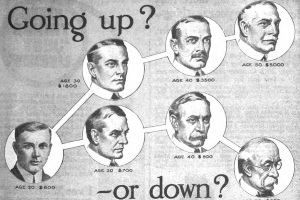 Against a rising chorus of concern about increasing income inequality, some economists are pushing back, suggesting that it is not income inequality we should be concerned with but rather income mobility. Income mobility describes the ability of individuals to move up and down the income ladder over some period of time. As long as mobility is healthy, they argue, society can remain egalitarian in the face of inequality, because the poor can move up and the rich down.
 When I was a teen, there was some comedy competition that ran on HBO or something. It was first done regionally. And then the winners of each regional one met. As I recall, Eddie Murphy won. Now I think Murphy is one of the best comedic actors ever. But I never thought much of him as a stand-up comic. It just doesn’t play to his skills. But in that competition, I discovered the comedian Larry Miller. He was interesting in one particular way: he was the only comedian who did a different routine in the final than he had done in the region — an indication of his greatness.
 I saw a curious article in Forbes titled,
  This movie [
 Will sent me a video from the Vox folks,
  Obama has before compared the drone program to dealing with a sniper on a roof of a building who is pointing the rifle at children on a playground. And he say, you know, “I understand what the ACLU’s objections are and human rights people and stuff. But do we need to go to a judge to get authorization to take that shooter down before he kills a bunch of kids on a playground? No we don’t.” And I think… everyone in this room agrees with that. If you have someone who’s going to kill a bunch of kids, and they’re a sniper, and they’re not responding to any kind of attempts to get them to put the rifle down, people in this society overwhelmingly would say, “Yes. If we need to kill that person we’ll kill them.”
 As many of you know, I have a soft spot for losers. Even when a clear serial killer is on trial, I feel bad for them. And as a result, I’ve long felt somewhat protective of the Neanderthals. Over three years ago, I wrote,
  There is a difference between focus and exclusion. If something matters, this does not imply nothing else does. If I saw “Law Students Matter” it does not imply that my colleagues, friends, and family do not. Here is something else that matters: context. The Black Lives Matter Movement arose in a context of evidence that they don’t. When people are receiving messages from the culture in which they live that their lives are less important than other lives, it is a cruel distortion of reality to scold them for not being inclusive enough…
 Donald Trump was on
  John Jay was the first Chief Justice of the United States. Appointed at a time when the Supreme Court played a far more diminished role than it does today — the Court heard only four cases during Jay’s six years on the bench — Jay took a break from his judicial duties to serve as President Washington’s envoy to negotiate a trade agreement with Great Britain.