Demand the Impossible

The Progressive - Oct 2011In the October 2011 issue of The Progressive Matthew Rothschild writes a commentary called “Demand the Impossible.” In it, he discusses income inequality and how it has affected democracy in the United States. He points out that the rich own those with political power: “Their Republican servants in Congress, and their contract employees among the Democrats, have so rigged the legislative process that the vast majority of the American people can’t get what they desperately want and need.” And that our savior is no help: “Meanwhile, President Obama readies the public for cutbacks in Social Security and Medicare.”

His answer: demand the impossible.

What to do? An old slogan of the surrealists applies here: “Be Realistic: Demand the Impossible.” It was a slogan that the French students adopted in their uprising in 1968. We should adopt it again today.

Instead of going along with the neoliberal acquiescence that so typifies the Obama Administration, we should put forward robust demands that will lead us toward the kind of society we want to build and inhabit.

I agree completely. Rothschild provides his own list. I agree with everything on his list and it informs my own.

  • Instead of not taxing income above $106,000, the Social Security Tax should be double the normal rate (6.2%).
  • Increase the minimum wage to a level where anyone working 40 hours per week would make four times the average rent in their area.
  • Demand that the Fed target a 2% unemployment rate and when they don’t meet that require the federal government to hire any unemployed people who want a job.
  • Require that no public school class size exceed 10 students. Require that no college class size exceed 20 students.
  • Demand free college education and job training for all students who qualify.
  • Universal healthcare now.

For those who say we cannot afford it, Rothschild has an excellent answer.

I refuse to believe this. Whenever a President wants to go wage a war somewhere, he can always find $3 trillion to do it. Whenever the banks need bailing out, suddenly trillions more become available. So don’t tell me we can’t afford it.

Tom Brokaw and the False Equivalence Lie

Tom Brokaw was on The Last Word spouting the mainstream media lie of equivalence. He used Rush Limbaugh’s ditto-heads as an example of people who are committed to a certain ideology regardless of facts. In his new book, Brokaw writes, “He has earned his fortune by creating an enormous audience of the faithful, or “ditto heads,” as they like to be called. A ditto-head is someone who worships at the altar of Limbaugh’s preaching, never questioning his conclusions or reasoning.” Okay. That sounds about right. But Brokaw can’t leave it at that. In the interview, he says, “On the left you’ll find a lot of people who don’t want to hear any ideas if they possibly come from right of center.”

So that’s the equivalence: Rush Limbaugh and his many clones are the same as “a lot” of people on the left who don’t want to hear ideas from the right. Brokaw doesn’t mention where we will find these people on the left, but whenever conservatives make this argument, they always point to NPR, which is about the most even-handed news source in America. But I want to defend these people on the left who don’t want to hear any ideas if they possibly come from right of center.

The center of mass of American politics (at least as far as the media are concerned) has moved radically to the right over the last 30 years. Most of the reasonable conservatives of the past are now considered liberal. Consider, for example, John Dean, or the fact that Richard Nixon was the most liberal president we’ve had since 1970. The fact is that we very rarely hear any ideas from right of center. All we hear is the same ideology we’ve been hearing for 30 years: destroy regulation and lower taxes, especially on the wealthy. This is why the flagship of modern conservatism—Fox News—provides heavily biased coverage (many big stories aren’t even covered while they cover unimportant stories) and misleading and downright deceitful stories. Is it any wonder that people on the left have little patience for “ideas from the right”?

Few people like to listen to people they disagree with. But there is a distinction between this and being closed minded. The very definition of a liberal is one with an open mind. That fact doesn’t stop Brokaw, of course; each side is equally wrong.

Breaking News: Bill O’Reilly is Evil

Bill O'ReillyI just saw on his show, Bill O’Reilly say that there are many things about President Obama that are “scary.” O’Reilly wants people to see him as a reasonable conservative. And indeed, in the current environment of conservatives, he does seem moderate. But calling the President “scary” is the same as calling him “the other.” I’m sure that he never called Bush “scary.” The use of that word is not a statement of policy differences. It is part of the conservative movement’s push to define Obama as an outsider—as someone who isn’t really American. That is what the birth certificate nonsense is all about. And that is what “scary” is all about.

CREDO Mobile: Fighting for the Liberal Buck

Credo Mobile AdAccording to UPI, “Protesters gathered outside President Obama’s fundraising lunch in San Francisco Tuesday, speaking out on a variety of issues.” Many of the protesters were organized by a cell phone company: CREDO Mobile. People talk a lot about companies being good corporate citizens[1], but I don’t see much of it. CREDO comes as close to this ideal as I’ve seen.

Earlier today, I was reading The Progressive and on the inside cover was the image you see above (click on it to see a high-resolution version). It looks like a social cause ad. It says, “Does your phone company want a Tea Party president?” Then it states that AT&T gave Michele Bachmann’s presidential campaign $386,000 and Verizon Wireless gave another $35,500. That got my attention and made me glad that I don’t use either of these companies. But then I noticed: this was not a social cause ad; it was an ad for a competitor: CREDO Mobile.

The truth is that we can’t wait around for companies to behave as we would like. It is necessary for companies like CREDO to use their own good behavior and their competitors’ bad behavior to get business. You don’t have to go without a cell phone. You have an option. And as it turns out, a rather good option. According to Wikipedia, they (formerly known as Working Assets Wireless) have, “raised over $65 million for nonprofit organizations such as GreenPeace, Planned Parenthood, Democracy Now etc.”

If you have AT&T or Verizon or you are just looking for a cell phone company, consider CREDO Mobile.


[1] I don’t like the phrase “good corporate citizen” because it implies corporations are not only people but citizens. They are not. Perhaps at a later date, I will write more about this. I have much to say.

Word Processing

I found a delightful little poem in The Grammar Bible by Strumpf and Douglas. I plan to write a write more about little gems I’ve found in this fine book. But for now, here is the poem of unknown origin:

I have a lovely spelling check
That came with my PC,
Witch plainly marks, four my revue,
Miss takes I can not sea.
I’ve run this poem threw the thing,
I’m sure your please too no.
It’s latter perfect in every weigh.
My checker tolled me sew.

Transient Global Amnesia: Forget Free Will

Transient Global Amnesia (TGA) is a form of short-term memory loss that goes away after 24 hours. While it is occurring, the patient’s memory resets on a set period. You can see the effect in the following video. It is a conversation between a mother who is in the middle of a TGA event and her daughter.

The behavior of the mother in the video is typical of all people suffering from TGA. This makes me more convinced than ever that free will is an illusion. The short-term memories of patients reset every X seconds and what do they do? They repeat the same behavior over and over. Even though the environment changes substantially. The daughter varies her response but the mother stays on topic.[1]

This behavior is very much like a computer when it boots. Every time you restart your computer, it goes through a number of steps: the same steps in the same order every time. That is what people experiencing a TGA event are doing. Each cycle is like a computer reboot. And just like with a computer, each time they go through the same steps as they try to make sense of the world. The fact that they do the same thing time after time indicates that their behavior is determinate. It is so determinate that we can see it. It is not subtle.

Clearly, as more time goes by the predictability of a person’s actions will decrease. For example, if a person’s memory resets every hour, environmental factors would become more important and the conversation at the end of each hour would likely be quite different. It is a chaotic system after all. But that is not the point. Rather, given the starting conditions (the brain and the environment), future behavior is predictable. How long it is predictable is determined by how skilled the predictor is. The behavior is nonetheless predetermined. As the period of memory reset increases, the more the mother acts as though she has free will. But her behavior is only unpredictable (By us!), it is no less predetermined.

The implications of this are extraordinary. The universe really is just a wind up toy that does the only thing it can do. Or at least it seems that way. But if the human brain—one of the most complex things imaginable—is determinate, is it such a leap to suggest the entire universe is?

Regardless, human behavior certainly seems to be determined. This idea is freeing. And terrifying. And vindicating. I always knew the universe was unjust.


[1] This video is toward the end of this woman’s TGA event. The repetition earlier on is much more rigid. You can hear it on Radio Lab’s Season 10 Episode 3: Loops.

Most Dangerous Jobs

Taxi and CopOn a Last Word internet exclusive, Michael Moore makes a plea to the police officers of New York to join the Occupy Wall Street protests. Absolutely. He is right about this and I hope that some answer his plea. I have nothing particularly against the police. They are working stiffs just like the rest of us 99%. But then Moore said something that really bugged me. Actually, he said two things that really bugged me. Both fall under the same category: people very often defend the police (sometimes to justify their misbehavior) because of their supposed dangerous jobs and their low pay. Ha!

Did you catch the one about danger? “You have the most dangerous job in the country.” Sorry. Not even close. I am so tired of hearing this lie. Here is a list of the ten most dangerous jobs from the Bureau of Labor Statistics for the year 2009 (the numbers represent the number of deaths per 100,000):

  1. Fishing: 116
  2. Logging: 91.9
  3. Aircraft engineering: 70.6
  4. Farming: 41.4
  5. Mining machinery: 38.7
  6. Roofing: 32.4
  7. Refuse collection: 29.8
  8. Driving: 21.8
  9. Industrial machinery: 20.3
  10. Policing: 18.0

What most strikes me here is that taxi drivers are at number 8 (along with truck drivers). Unlike most of the other workers on this list, taxi driving is not much more than a minimum wage job. This relates to the thing Moore said about the police salaries, “You aren’t paid enough.” Nationwide, police officer recruits are paid $51,000 according to Indeed. This does not include overtime. And it does not include the excellent benefits that the police get. Perhaps most important of all: police salaries go up with time; this is the average starting salary. For example, sergeants are paid $71,000. (They all make a lot more where I live in expensive California.) Police officers commonly make two to ten times what a taxi driver makes and they have less dangerous jobs.

Police officers can and should be part of Occupy Wall Street. But can we please stop whining about how hard they have it? We all (all 99% of us) have it hard.

Normally I Say There Are No Stupid Questions

Paul KrugmanPaul Krugman has an excellent post about Ricardian equivalence. What is Ricardian equivalence? It is an economic model that claims that any money spent by the government will be offset by money not spent by the private sector. Basically, it goes like this: if the government spends $100, the private sector will know that at some point that $100 will have to be paid back in taxes, so they will set aside $100 that they would normally spend. Unfortunately for the model and the conservatives who believe in it, the model depends upon such untrue assumptions as “[C]onsumers have perfect foresight, live forever, have perfect access to capital markets.” Krugman shows that even if you do accept this highly questionable model, government stimulus can still be used to help the economy. But then one of his commenters—CES from California—responds:

Or people just don’t think that the government spends money wisely…

I wish you would make a detailed list about where you think the government should be spending the additional $2 trillion you think it needs to spend to get us out of this liquidity trap. Without saying that, you’re just waving your hands around.

Just so you understand: although it would be nice if the government spent money on useful things, it doesn’t matter. Remember how World War II got us out of the Great Depression? Wars are not a good way to spend money; they don’t build infrastructure. And yet, even though much that government spending was effectively thrown away, it still got us out of the Great Depression!

Any more foolish comments CES?

The Sentence as Will and Idea

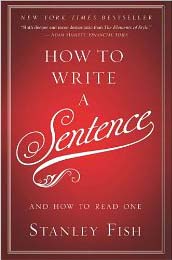
How to Write a SentenceI just read Stanley Fish’s How to Write a Sentence. It is an interesting and often enjoyable book. Fish writes beautifully and is very funny. Unfortunately, his whole philosophy is utterly contrary to my own untrained, intuitive approach. Yes, it is true that I love reading about writing and grammar—that’s why I picked up this book. But I don’t take anyone’s word for anything; if I can see that some advice will improve my writing, I accept it; if I can’t, I scratch my head and move on. Fish makes grammar conservatives look liberal. Here is the thing: he thinks all great (his opinion) sentences can be reduced to a number of forms and that as a writer, one should mimic those forms.

What’s wrong with that? Isn’t much of the technique of writing just imitation of those who write well? To a large extent, yes. But there is a big difference between trying to create a story as great as Irwin Shaw’s “The Eighty-Yard Run” and diagramming each sentence in the story. This distinction is at the heart of what is most bothersome about Fish’s book: his love of the isolated sentence. I love language on a small scale too. Take, for instance, the following poem fragment by Sappho, translated by Mary Barnard:

Pain penetrates
Me drop
by drop

That’s beautiful. It is also, as it happens, poetry. I think the point is made very well by Fish himself in discussing last sentences. He starts by mentioning four great last lines: “Well, nobody’s perfect” from the movie Some Like it Hot; “After all, tomorrow is another day” from the movie Gone With the Wind; “Isn’t it pretty to think so?” from the novel The Sun Also Rises; and “He loved Big Brother” from the novel 1984. I agree with him: these are all great last lines. However, Fish has something else on his mind:

But these sentences will not serve my purpose here, because any assessment of their impact depends on a full knowledge of what has preceded them. Standing alone, “Nobody’s perfect” is a cliche; “Tomorrow is another day” is a banality; “Isn’t it pretty to think so?” an unremarkable question [I disagree. -FM]; and “He loved Big Brother” an apparent piece of sentimentality. [Italics are mine. -FM]

He is right, of course: these are great lines because of what preceded them. But no one reads a novel or sees a movie for the experience of a really great sentence. And just as a reader cannot divorce a sentence from the work it is in, neither can a writer.

None of this would matter if Fish explained how to write a great sentence. He doesn’t. He explains how to write sentences like those that you admire. That’s not the same thing. That’s just copying. There is something to be said for that. Maybe his technique can teach writers to improve their sentences. But at what cost? The same goes for readers: are they to miss the glories of the story for those of the sentence? Appreciate the sentence—sure—but not outside its context.

Save at Amazon

Check out this great deal!

<%image(20111012-SaveAtAmazon.jpg|450|576|Save at Amazon)%>

So let me get this straight, if I buy this book and sell it back to Amazon, it only costs $92.95? Otherwise, it will be $94.95!? That’s a hard deal to pass up. For Amazon.