
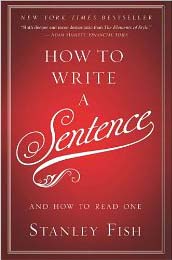
 I just read Stanley Fish’s How to Write a Sentence. It is an interesting and often enjoyable book. Fish writes beautifully and is very funny. Unfortunately, his whole philosophy is utterly contrary to my own untrained, intuitive approach. Yes, it is true that I love reading about writing and grammar—that’s why I picked up this book. But I don’t take anyone’s word for anything; if I can see that some advice will improve my writing, I accept it; if I can’t, I scratch my head and move on. Fish makes grammar conservatives look liberal. Here is the thing: he thinks all great (his opinion) sentences can be reduced to a number of forms and that as a writer, one should mimic those forms.
What’s wrong with that? Isn’t much of the technique of writing just imitation of those who write well? To a large extent, yes. But there is a big difference between trying to create a story as great as Irwin Shaw’s “The Eighty-Yard Run” and diagramming each sentence in the story. This distinction is at the heart of what is most bothersome about Fish’s book: his love of the isolated sentence. I love language on a small scale too. Take, for instance, the following poem fragment by Sappho, translated by Mary Barnard:
Me drop
by drop
That’s beautiful. It is also, as it happens, poetry. I think the point is made very well by Fish himself in discussing last sentences. He starts by mentioning four great last lines: “Well, nobody’s perfect” from the movie Some Like it Hot; “After all, tomorrow is another day” from the movie Gone With the Wind; “Isn’t it pretty to think so?” from the novel The Sun Also Rises; and “He loved Big Brother” from the novel 1984. I agree with him: these are all great last lines. However, Fish has something else on his mind:
He is right, of course: these are great lines because of what preceded them. But no one reads a novel or sees a movie for the experience of a really great sentence. And just as a reader cannot divorce a sentence from the work it is in, neither can a writer.
None of this would matter if Fish explained how to write a great sentence. He doesn’t. He explains how to write sentences like those that you admire. That’s not the same thing. That’s just copying. There is something to be said for that. Maybe his technique can teach writers to improve their sentences. But at what cost? The same goes for readers: are they to miss the glories of the story for those of the sentence? Appreciate the sentence—sure—but not outside its context.