A Modest Proposal for Israel-Palestine

Hiroshima BombI have a modest proposal for the Israel-Palestine conflict: genocide. It’s time tested. After all, if the conflict were going on 500 years ago, the Israelis would have just gone in, slaughtered all the Palestinians who weren’t able to flee, and the conflict would be over. And would it really matter? Yes, there would be people who would be very upset. But there already are! Why should Israel care? They are the only country in the region with nuclear arms and they have the biggest military. Plus, anything the United Nations would try to do would be vetoed by the United States. So I say: go for it!

Now I know what you bleeding heart liberals will say, “Just because you got bumped out of art school by a better Jewish painter doesn’t mean you should commit a genocide against the Jewish people.” I see that point, but you have to draw a line somewhere. For example, some Palestinian idiots fire a couple of rockets into Israel wounding two people. So the Israelis respond in their usual proportional way. They didn’t go after the people that fired the rockets, of course. They just did their usual (And totally justified!) collective punishment, which killed at least 23.

This, of course, is following the kidnapping of three Israeli youths. It appears to have been a usual thing where thugs kidnap people and exchange them for money. But when it became a political issue, they thought it was best to just kill them. [Update: it now seems it was a Hamas splinter group that did it. -FM] This led to some sicko Israeli folks kidnapping a Palestinian youth and then burning him alive. So let’s see there. Step one: unpolitical act of murder by individuals. Step two: political act of torture murder by extremists. Step three: political act by extremist Palestinian faction. Step four: official Israeli attack on Palestinian population.

It’s not a good situation. And I know that many conservatives in the United States will say that the at least five Palestinian children who were killed in the recent attack should have been born to different parents or something. So given that it is perfectly acceptable to kill civilians if you think you have just cause (Defined as: whatever!) why don’t we just get systematic about this!

Of course, it will be sad to see all the Palestinians killed. But we’ll get over it. I mean who remembers the genocide of the Ottoman Empire? Who cares about the American genocide of the native peoples? All of them would be dead by now anyway. So in a hundred years, who will really care?

But let me be clear: it doesn’t have to be an Israeli genocide of the Palestinians. It could be the other way around. It is just that there are problems. One is militarily, the Palestinians really aren’t up to it. What’s more, if they did manage to do it, the United States wouldn’t be there to protect Palestine at the UN because we only believe in justifying absolutely everything that Israel ever does.

What’s really great about my idea is that the Palestinians are hardly clean in this matter. Sure, there’s about a thousand to one Israeli reaction to anything Palestinians do. But the Palestinians aren’t a bunch of Jains out sweeping the road in front of them to make sure they kill no living things. And it certainly doesn’t help that Hamas can’t decide if it’s a government or a revolutionary group. It was sad that they supported the murder of those three Israeli youths. So the point is that Israel has justification for attacking Palestine. And they don’t ever seem to be concerned about an appropriate level of force. So let’s get some of those nukes out. Let’s get this over with!

Afterword

Of course, the two countries could act as adults and not allow the extremists on both sides to destroy diplomatic efforts. But I’m sad to say that this idea is even more fanciful than my modest proposal.

Why Americans Don’t Work Less

Dean BakerDean Baker has long advocated a response to economic recessions that one never really hears about: work reductions. Suppose that there is a recession and a company decides that it needs to layoff 20% of its workforce. Instead of doing this and putting the laid-off workers on unemployment, the company could cut everyone’s work hours by 20%, and the government would make up the extra 20% in compensation. This would lead to a faster recovery where the company would again be running at full steam.

This is a system that works really well in other countries, most notably Germany. But it would be especially great in the United States because workers here are notoriously bad about taking time off. But the main thing is that it is just good economic policy. It provides more stability. And the truth is that our country produces far too much stuff anyway. Over the last many decades, other advanced economies have used increased productivity in the form of more leisure time. In the United States, at least for the last 35 years, we have used increase productivity to make the rich even richer.

Let’s think about the issue of leisure for a moment. When most people think of leisure, they imagine drinking a cold beer on a Caribbean beach. But the truth is that for most people, leisure is actually something else. Most people really do go by the old saying, “A change is better than a rest.” People putter in their gardens, they knit sweaters, they play with their children (which helps in their proper development). Leisure is not a lack of work, it is just a lack of pay. And that is why as a country we should embrace leisure. It isn’t wasted time. The only way you can see that is if they only thing that matters to you is making money. And although that might be true of the power elite, it shouldn’t be a worldview that the rest of us accept.

Today, Dean Baker wrote a wide ranging article about the problems we face today because of our lack of economic demand, High Asset Prices, the Savings Glut, Secular Stagnation, and Unemployment. After discussing the standard economic approaches to the demand problem, he notes that we could have full employment if everyone just decided to work less. For a great many people, this sounds like a great idea. And the fact is that most Americans work so much not because they need to, but because they are afraid that if they don’t work unreasonable numbers of hours, they will lose their jobs.

Still, there are a lot of people like me who do very much live to work. I’ve seen this a lot in the high tech industry where programmers just want to work ridiculous numbers of hours. But there is no reason why they need to do all that work for some company that frankly abuses such work ethics. These programmers could go home at 5:00 each night and code cool new apps or code controllers for fly sized drones.

But I don’t see us moving in this direction. And the reason is not that people wouldn’t like it. The reason is that the power elite love having a work force that is terrified of losing their jobs. So given the option of laying off 20% of a work force or cutting back hours by 20%, most owners would rather lay off the employees. For one thing, it is less disruptive to the company. But more important, it sends a message to the employees: stay in line, don’t ask for more money, work longer hours, and most of all, tenderly smooch my bottom.

GOP Picks Perfect RNC Location!

Cuyahoga River FireI don’t want to hit this too hard, but it is funny as hell. The Los Angeles Times reported, Cleveland Picked to Host 2016 Republican National Convention. I’ve never been to Ohio, much less Cleveland. And I’m sure it’s a perfectly nice city with wonderful people. And I understand: Ohio is a swing state. Good choice Republicans! I guess.

There’s just this one little thing that bothers me. It’s the Cuyahoga River. You know: the river that caught fire. And not once. According to Wikipedia, “At least 13 fires have been reported on the Cuyahoga River.” This is because it has often been one of the most polluted rivers in the United States. It’s not on fire right now, but that’s only because the Republican Party is not able to dictate environmental policy. Otherwise, I’m sure the free market would have it all ablaze.

The big city on the Cuyahoga River is, of course, Cleveland. Randy Newman was being sarcastic when he wrote:

Cleveland, city of light, city of magic!
Cleveland, city of light, you’re calling me!
Cleveland, even now I can remember,
‘Cause the Cuyahoga River
Goes smoking through my dreams!

But what could be a better symbol of the Republican Party: a river so polluted that it self-immolates. The modern Republican Party has become toxic with its mixture of insanity, stupidity, deliberate ignorance, shortsightedness, hatefulness, and greed. And through the smoke and flames it can’t see that America is drifting ever further away from it. In fact, the party hallucinates due to smoke inhalation—thinking that it is just what the country is waiting for.

“There’s a red moon rising on the Cuyahoga River”!

Burn on big party—burn on!

Gothic Novelist Ann Radcliffe

Ann RadcliffeOn this day in 1764, the pioneering Gothic novelist Ann Radcliffe was born. I’ll be honest, I’m not that fond of the Gothic novel. But Radcliffe had a great influence on novelists who I don’t even think of as writing in this style. Part of this is because a lot of her work wasn’t exactly Gothic. So she influenced Jane Austen, although not directly. She parodied her in Northanger Abbey where Catherine just loves the novels of Radcliffe. Austen did this sort of thing a lot. Most people miss it today, but Sense and Sensibility is a scathing attack on the Romantics and what Austen thought was an affected love of nature.

One thing is for sure: we would not know of the Bronte sisters if it weren’t for Radcliffe. Jane Eyre definitely has that Gothic thing going on in the middle of the book with the mysterious estate. But the worst part of book is the most Gothic when Jane’s considering marrying St John and she hears Rochester’s voice from the ether, “Jane! Jane! Jane!” If I were to rewrite the the novel, she would hear, “Jane, come back to me! But first kill St John because he is the most annoying character ever!” But certainly, it was Emily Bronte who perfected that Gothic novel with Wuthering Heights. To this day, while I admire that book, I feel very strongly that Emily Bronte needed to be slapped.

The middle section of Jane Eyre is actually more in keeping with what Radcliffe wrote. In her novels, things seem strange but there is always a rational reason for it. Intellectually, she was definitely part of the Enlightenment, even if she was a big source of inspiration for the Romantics. Edgar Allan Poe was clearly aware of her work, although (as usual) he didn’t think much of her. And she was an influence far past that. Rebecca by Daphne du Maurier is clearly influenced by her.

Like a lot of the early novelists, I think that Radcliffe thought of herself as more a poet than a novelist. Just like Cervantes, she peppered her novels with poetry. And just like with Cervantes, everyone agrees she was a mediocre poet. Walter Scott, who was an admirer of her, noted that “her prose was poetry and her poetry was prose.” But you have to give artists credit who, while slogging out what the people want, still take the time to do what they love. I’ve always admired that about about Thomas Hardy, although in his case it is generally admitted that he was a rather good poet. And anyway, given his trajectory, any novel after Jude the Obscure was certain to cause widespread suicide.

As you can probably tell, I’ve never read any of her novels. It’s just not my kind of thing. I have read some of her poems, however. They aren’t bad — at least in a technical sense. In fact, she a fine feel for the formalism of the time. But given her reputation for evocative descriptions in her novels, it is shocking how banal her poetry is. Again, as with Cervantes, I think that the rigidity of the form suppresses the great creativity that existed in her. So I think you can take a pass on reading any of her poetry. But if you are in love the Brontes, Ann Radcliffe is probably worth checking out.

Happy birthday Ann Radcliffe!

Why Are Libertarian Party Candidates Always Republicans?

Libertarian Party: Just Kidding, We're Republicans!Speaking of conservatives who lie to themselves and the world, Ed Kilgore brought my attention to something, even if he didn’t note the irony, The Buses of Doom. It has to do with Bob Barr who is running for the Republican nomination for Georgia’s 11th District congressional seat. “What?” you say. “Wasn’t he the Libertarian Party Presidential candidate in 2008?” Why yes he was. I always find it interesting that libertarians always bounce around from the Libertarian Party to the Republican Party. That’s what Ron Paul did, after all. Yet if you talk to a libertarian, they’ll tell you that they dislike both the Republican and Democratic parties. They’re both evil in their own way!

Well, yes, theoretically, they are both evil in their own way. When it comes to police powers, civil rights, drugs, war, reproductive rights, and a whole lot more, the Democratic Party is far more libertarian than the Republican Party. On the other hand, when it comes to taxes (really only on the rich), the Republican Party is far more libertarian than the Democratic Party. Given this, you would think that when libertarians decide they wanted to be a part of the two-party system, they would go to the Democratic Party far more often than the Republican Party. But that isn’t the case. In fact, I don’t know of a Libertarian Party politician ever moving to the Democratic Party. And I think that tells you about all you need to know: lower taxes on the rich don’t just outweigh everything else, when you put them on a scale, the taxes issue causes all the other issues to fly into the stratosphere.

But that wasn’t even the irony I was talking about. Now that Bob Barr is a good Republican, he is freaking out about all them Latinos coming over the border. He even has a conspiracy, “As tens of thousands of illegals continue streaming across our southern border, citizens of Georgia are increasingly concerned that the Obama Administration is planning to surreptitiously ship many to locations in our state…” But he admits he could be wrong; it could be that the Obama administration has already done it in sneaky ways only Kenyans know about. This is ironic, because libertarians are supposedly for open borders. This is a big part of the Libertarian Party platform. Or at least it was when I was a fellow traveler. Regardless, the Libertarian Party is very pro-immigration and very anti-human trafficking, which is what this is all about anyway.

I don’t think any of this speaks badly of the Republican Party. It has its own problems, mostly focusing on being crazy, stupid, ignorant, shortsighted, hateful, and greedy. But I think this speaks terribly of the Libertarian Party. The long-time slog of the Libertarian Party is, “The Party of Principle.” But the truth is that they’ll allow anyone to run as a libertarian. When I was a libertarian, the party platform was pro-choice, but they nominated Ron Paul who was not just anti-choice, but rabidly so. Even though I normally voted straight Libertarian at that time, I did not vote for him.

Now we see that the 2008 Libertarian Party candidate is anti-immigrant. But it’s not just that. Bob Barr was a big sponsor of the Defense of Marriage Act, although he did apologize for that in 2008 when he was running as a libertarian. He voted for the USA Patriot Act, which again he claimed to regret when he was running as a libertarian. He was a strong supporter of the War on Drugs—until he was running as a libertarian. He so believed in religious freedom that he tried to “ban the practice of Wicca” at the Pentagon. That last one not only shows intolerance, but a strange interest in a tiny religious belief. Oh, one other thing: he is fanatically anti-choice. Now admittedly, he reversed his positions on the ones I mentioned. But he only did so right before running as a libertarian, and generally only after officially becoming a libertarian.

But none of that matters because Bob Barr is for repealing the 16th Amendment—you know: the income tax. And do you know why conservatives hate the income tax most of all? Because it is the one tax in the United States that is fairly progressive. And that’s the one thing that the Libertarian Party really believes in: reducing taxes in a way that shifts more of the burden onto the poor. And quelle surprise, that is exactly what the Republican Party stands for.

So the question for the Libertarian Party is: why do you exist? You might be the party of principle in theory, but in practice, you’re just the Republican Party. I know there are little things like unnecessary wars and constant surveillance and homophobia and a lot of other stuff that you don’t like about the Republicans. But that’s but a fly buzzing around the elephant of tax cuts that you do agree about. Stop pretending. I don’t like SPAM™, but that doesn’t stop me from shopping at the grocery store where they sell SPAM™. Or you could start walking the walk. But it’s been almost 43 years and you’re still a joke—a group of Rush Limbaugh listeners who consider yourselves iconoclasts. You’re wasting everyone’s time and money. A third party should stand for something other than a very minor variation of one of the major parties. The Peace and Freedom Party isn’t the Democratic Party Lite. When the Libertarian Party nominates established Republicans like Ron Paul and Bob Barr and Gary Johnson (Republican until 2011!) to run for President, they just show that they are a joke.[1]

Afterword

I don’t mean to cast too wide a net here. I do think that about 5% of people who call themselves libertarians are serious about it. I think they are misguided, but they are honest brokers. And I was pleased that when I took the Libertarian Party ideology test, it not only correctly labeled me a “Left (Liberal)”; it also provided what I think is a pretty objective description of that ideology:

Liberals usually embrace freedom of choice in personal matters, but tend to support significant government control of the economy. They generally support a government-funded “safety net” to help the disadvantaged, and advocate strict regulation of business. Liberals tend to favor environmental regulations, defend civil liberties and free expression, support government action to promote equality, and tolerate diverse lifestyles.

Here is their slightly less objective description of “Right (Conservative)”:

Conservatives tend to favor economic freedom, but frequently support laws to restrict personal behavior that violates “traditional values.” They oppose excessive government control of business, while endorsing government action to defend morality and the traditional family structure. Conservatives usually support a strong military, oppose bureaucracy and high taxes, favor a free-market economy, and endorse strong law enforcement.

I’m not sure exactly who the “Statist (Big Government)” people are. Other than being for high taxes, they sound kind of like the Republican Party. But this description is okay:

Statists want government to have a great deal of power over the economy and individual behavior. They frequently doubt whether economic liberty and individual freedom are practical options in today’s world. Statists tend to distrust the free market, support high taxes and centralized planning of the economy, oppose diverse lifestyles, and question the importance of civil liberties.

Of course, where the test is least objective is in its description of “Libertarian”:

Libertarians support maximum liberty in both personal and economic matters. They advocate a much smaller government; one that is limited to protecting individuals from coercion and violence. Libertarians tend to embrace individual responsibility, oppose government bureaucracy and taxes, promote private charity, tolerate diverse lifestyles, support the free market, and defend civil liberties.

It is simply not true that, “Libertarians support maximum liberty in both personal and economic matters.” What is true is that, “Libertarians support maximum liberty in both personal and economic matters as far as the government is concerned.” Their definition of coercion is so narrow that virtually nothing fits in it. Suppose you were born to a family without property and every employment opportunity only allowed you a subsistence level of existence. By libertarian standards, there would be no coercion even though you had literally no choice. Also: there is absolutely nothing about libertarianism that implies the promotion of private charity; Ayn Rand was apoplectic on that issue; this is just a way for libertarians to pretend that they aren’t jerks. So even at it’s best, libertarianism is a silly ideology developed by people who would benefit from it without regard to its effects on society in general.


[1] Of the ten presidential candidates the Libertarian Party has offered, four of them have been explicitly Republicans. To be fair, Harry Browne ran twice and I generally think he is an honest libertarian. But even Michael Badnarik, who is not explicitly a Republican, is anti-choice in that he thinks that the states ought to have the right to force women to carry unwanted pregnancies. Well, sometimes. It really depends upon when you ask him. On the issue of abortion, what you see is the early candidates were pro-choice and the later candidates were anti-choice. That’s interesting because in the early days of the Libertarian Party, Republicans were generally pro-choice. So the evolution on abortion in the Libertarian Party has been the same as in the Republican Party. Regardless, in eleven elections, 36% of the Libertarian Party candidates have been explicitly Republican Party members.

Con Intellectuals Only Do Apologetics

John HoodI don’t have a problem with people disagreeing with me. There are times that I’m wrong. Here is a really embarrassing example: Chained-CPI Madness. If you look at that article, you will notice that right at the top I note the error that I made. The point is that I may have a political ax to grind (I do have a political ax to grind!) but it is based upon how I see the world. I would never intentionally manipulate data. I would never, for example, say that raising the minimum wage absolutely won’t cost jobs. But it is de rigueur for conservatives to claim that raising the minimum wage absolutely will cost jobs. The data are mixed, but they tend to side with me. If the data tended against me, I might still argue for raising the minimum wage; but I wouldn’t just quote the studies that agreed with me and pretend that the others didn’t exist.

This is my primary problem with the conservative movement. Look, I understand. If you pull a conservative and a liberal off the street, they will both spout a lot of nonsense. But when it comes to liberal intellectuals, a great deal of care is taken to get the facts right and to not deceive. That just isn’t true on the right. Except for Bruce Bartlett and Josh Barro (both of whom are far from perfect), I can’t name any major conservative thinkers who seem to care about getting the facts right. (And yes, I am especially thinking about Avik Roy.) Paul Krugman made note of this just today. Danny Vinik wrote an article where he pointed out that conservative wonks have abandoned Paul Ryan. But he noted that, “Ryan has long had passionate supporters among conservative intellectuals.” Krugman responded that it was always obvious that Ryan was a charlatan, noting, “And what does that say about the supposed wonks who passionately defended him?”

What it says is that the conservative intellectual class are themselves a bunch of ideologues who don’t care about having a real argument about policies. In other words: there is no major conservative intellectual movement; it is all apologetics. There is no greater example of this than John Hood’s recent The Wall Street Journal article, North Carolina Got it Right on Unemployment Benefits.[1] In the article, he argues that North Carolina was right to cut unemployment benefits because it really did encourage workers to go out and find jobs:

According to the U.S. Bureau of Labor Statistics, the number of payroll jobs in North Carolina rose by 1.5% in the second half of 2013, compared with a 0.8% rise for the nation as a whole. Total unemployment in the state dropped by 17%, compared with the national average drop of 12%. The state’s official unemployment rate fell to 6.9% in December 2013 from 8.3% in June, while the nationwide rate fell by eight-tenths of a point to 6.7%.

That’s a whole lot of numbers, even for a math geek like me. Luckily we have the national treasure who is Dean Baker to cut through all these lying statistics. First, North Carolina grew by more than the nation, but this has been true for the last four decades. The southern states are seeing more growth. Compared to the rest of that southern region, North Carolina actually grew less. So much for lie number one.

Second, total unemployment in the state dropped a lot in the state. Why? Because people who claimed to be looking for jobs before (because they had to in order to get unemployment benefits) simply stopped looking for work. Thus: the unemployment rate went down, but actual unemployment did not go down. As Baker put it, “While the size of the labor force in the rest of the [southeast] region grew by 1.0 percent over the last year, the labor market shrank by 0.2 percent in North Carolina.” Baker concluded:

In short, if we look at the data instead of playing games with it, the story is pretty clear. There is zero evidence that cutting unemployment benefits in North Carolina or the rest of the country did anything to spur job growth. There is much evidence that it led those who saw their benefits to end to give up looking for work and to drop out of the labor force.

There are two possibilities for what is going on with John Hood. One is that he knows he is lying and he just sees himself as a good foot soldier in the ideological fight. But I think it is more likely that he is just a true believer and so regardless of what happened in North Carolina, he was going to hunt around and look for any bit of data that backed up what he knew to be true.

This is my problem with the conservative movement. What Hood did is pretty much what every conservative “thinker” does. Facts are simply things to be used to justify what they already know to be true. Facts are never used alter policy, much less to create it. And this is why our country is on the verge of political crisis. We have two political parties. One is the usual kind of mediocre mixed blessing. The other is crazy. And we have a mainstream media that insists that the two parties are mirror images of each other. During the most recent debt ceiling negotiations, the idea that it would be no big deal got a lot of coverage in the mainstream press. When facts are just an ideological plaything for half the political leaders of a nation, catastrophe is a constant threat.


[1] John Hood is president of the John Locke Foundation. This is something I really hate. Conservatives take people like John Locke, who were very liberal (and even radical) in their own time, and grab onto them. Yes, the conservatives have finally caught up to the liberal thinking of three and a half centuries ago. You can imagine in the year 2525, conservatives will start the Martin Luther King Foundation. I hate that conservatives do this: co-opt great liberal thinkers of the past. Note that no conservatives want to name their foundations after Thomas Paine because after two and a quarter centuries, they are still far behind his thinking.

Fedoras, Libertarians, and Russell Edson

FedoraI have one final article relating to yesterday’s brouhaha, but this one has nothing to do with David Weigel. I was having a nice conversation with Abenomix, and I happened to note that the grainy photo he uses (of himself I assume) would look like Sam Spade if you added a fedora. He tweeted back, “whereas I am certain it was not your intention to insult me, you did just manage to.” I immediately assumed it was the Sam Spade reference but it wasn’t. After a few more tweets, I learned from Matt Christman that, “Fedora = Bad.” When I asked for clarification, I was told, “Fedoras have become the online talisman of a certain strain of man-babyish libertarian white guy.”

I had no idea! I did, however, note that “libertarian implies man-babyish white guy.” But I can totally see this. What the bow-tie was to George Will and Tucker Carlson, the fedora has become to a younger generation. There is a slight problem, however. I went out looking for libertarians wearing fedoras and found that many of them were not wearing fedoras. Part of the problem is that people have started calling just about any similar hat a fedora. Both the Homburg and some styles of pork pie hat are misidentified as fedora. As you can see, I like hats. And it’s not just old style hats or western hats. Some Islamic followers wear the most gorgeous kufi caps. And it isn’t just men’s hats, either. Women are never as beautiful as when they wear hats. Hats are great!

But this revelation that libertarians (Abenomix brilliantly calls them “libertaryans”) are using fedoras as cultural signifiers is of great concern. And I can see why it is. Undoubtedly, they look back on what they consider the good old days when men were Humphrey Bogart and women were manipulative deceivers who get their comeuppance like Mary Astor. It also signals a kind of Eurocentrism. I don’t doubt that it is an intellectual response to the baseball caps worn by those “idiots” who don’t understand the libertarian utopia that awaits them if only they will wake up—and an anti-religious response to the growing popularity of kufi caps. (See my articles: The Atheist Libertarian Connection, Libertarianism Incompatible With Atheism, and Are There Libertarian Atheists?)

Russell EdsonThe facts of my life are that I almost never where any of my old fashioned hats. When I was younger, I was a bit of a dandy. Now I just don’t care. In fact, worse than that; mostly I wear badly damaged and worn baseball caps and the occasional communist workers’ hat. (I’m well aware that libertarians might soon start wearing them ironically.) But I still love the old hats and especially the fedora. But my love for the hats does not stem from old movies that I love. (Or more modern ones; see my thoughts on Miller’s Crossing.) It comes from a poet I discovered when I first went to college: Russell Edson.

Edson was (sadly, he died earlier this year) what I will call a surrealist poet. But I don’t know of anyone else who calls him this. No one is sure what to make of his work other than that it is brilliant and wonderful and beautiful. But the thing is, Edson had this thing about hats, most especially fedoras. When I first read him, I didn’t even know what a fedora was, so I had to look it up. And thus was born my love not just of fedoras but of all hats. Here is one of those poems from what was probably the first of his books I read, The Very Thing that Happens. This is “Someone”:

A man put a fedora on a cabbage, oh please be somebody I know.
Now who it is, as the brim is low, he cannot tell, but someone is certainly someone.
Someone, who are you?
Someone says nothing.
One and cabbage and now the moon. Round things are not unavailable in a square room.
The moon comes wearing a crown of clouds, worn too low to know who it is.

Or let us consider this much more recent poem, “Let Us Consider”:

Let us consider the farmer who makes his straw hat his
sweetheart; or the old woman who makes a floor lamp her son;
or the young woman who has set herself the task of scraping
her shadow off a wall….

  Let us consider the old woman who wore smoked cows’
tongues for shoes and walked a meadow gathering cow chips
in her apron; or a mirror grown dark with age that was given
to a blind man who spent his nights looking into it, which
saddened his mother, that her son should be so lost in
vanity….

  Let us consider the man who fried roses for his dinner,
whose kitchen smelled like a burning rose garden; or the man
who disguised himself as a moth and ate his overcoat, and for
dessert served himself a chilled fedora….

My first reaction to the fact that libertarians had grabbed the fedora as a cultural signifier was more or less Bush the Elder’s, “This will not stand, this aggression against hats and poetry and all that is good.” But I’m not up for a pointless fight. In its way, it’s nice that libertarians have latched onto the fedora. It’s the most charming thing about them. And maybe Russell Edson predicted this: who is that fedora wearing cabbage? Why it’s the next Libertarian presidential candidate!

Brilliant and Strange Arthur Evans

Arthur EvansOn this day in 1851, the great archaeologist Arthur Evans was born. What I find fascinating about Evans is that he was an incredibly important scientist, and yet he was totally wrong in his central idea that the Minoan civilization was distinct from the Bronze Age Greeks who he thought were just a backwater. But that take on his career is undoubtedly colored by my love of the Iliad and my admittedly childish wish that it be true. But Evans really blasted Heinrich Schliemann’s idea that the Trojan War had taken place, and during Evans’ lifetime, it was generally thought that the war was a myth. Now the evidence is overwhelming that it was not—it was a real thing.

Of course, that was just one thing and he was hugely important, especially his excavation of Knossos. And he was the guy who first discovered early Bronze Age Greek writing. Of course, he was absolutely certain that it is was not Greek. And then right after he died, the linguist Alice Kober noticed that the language seemed to have the some words with different endings. This indicated that the language had inflections. For example: call, called, calling. This indicated that although the writing had more the look of Egyptian, it acted more like Greek or Latin. This clue led the brilliant young self-taught amateur linguist Michael Ventris to make some brilliant educated guesses, which eventually led to his discovery that the Minoans spoke Greek—or at least a very early form of Greek. (Ventris died in an auto accident at the age of 34, a couple of weeks before the official publication of this work, but by that time everyone in the field knew.)

All of this perhaps makes Evans seem less than a brilliant scholar. That is wrong. As for the writing, I think the man can be forgiven. Here is a little Linear B. It looks nothing like Greek to me. And I understanding the issue in translating is not really the look of the text, but this was a difficult problem that many great minds worked on with little success for 65 years.

Linear B

More important, Evans excavation of Knossos is arguably the greatest of any settlement ever. I’m especially interested in his work on the Neolithic settlements. It seems that around 9,000 years ago, a group of people arrived in Crete, most likely from the sea. Of course, Evans wasn’t really interested in the Neolithic settlements. His great interest was the palace that was first constructed around 4,000 years ago. I think I have a greater interest in the earlier periods because of the relative egalitarianism of it. It seems that as humans have advanced, they have used technology more and more to separate themselves. The rich were further above the poor 4,000 years ago than 9,000 years ago because they could be, not because they were better. This is a problem that haunts us more today than ever, and one I’m afraid that we must solve or will eventually destroy us.

Evans was also a curious fellow. He not only excavated the palace at Knossos; he restored parts of it as you can see in the following picture. I still don’t really get it. I guess it gives visitors a better idea of what it was like 3,000 years ago. But I doubt that’s why Evans did it. And that blue on the wall? I don’t think that flies. Homer lived a thousand years after the palace was abandoned, and he didn’t seem to know the color blue. Blue is a hard color to make, and only showed up much later. But what the hell?

Knossos Palace

Happy birthday Arthur Evans!

Apologia for David Weigel’s Apologia

Cognitive DissonanceEarlier today, I wrote what I thought was an unexceptional article about a David Weigel column. The only thing that worried me was that the last time I had written about Weigel, he retweeted my article announcement. The thing about this is that when I’m ragging on a public figure, I don’t mean anything personal. So I make a point of not including their twitter handles in the tweet. But somehow, they always find out. This time, I figured surely he wouldn’t do so. After all, the article isn’t even really about him. But I was wrong. I don’t know quite know how to take it. It is either that he is a far better man than I am and really wants an open conversation; or he thinks I’m such an idiot that retweeting me makes that fact sell-evident.

Whenever this kind of thing happens, of course, the small trickle of Frankly Curious “readers” becomes a deluge. I put the scare quotes there because I wonder how many of these people click, see that the website is not decorated with animated gifs from Evil Dead and leave. But I got a really cryptic tweet from Abenomix. This is not unusual. I generally think I was not meant for the last two centuries, I’m certainly not meant for Twitter. So a lot of stuff just goes by me. But his profile read, “Math dork…” Well, that was all I needed to read so I asked for clarification. For the record, the original tweet was, “Why? Access. Acela=Hollywood for ugly people, & in showbiz sometimes gotta pretend the turd is a blossom, for work, nbd.”

After a two-part tweet, what he meant was crystal clear. He was saying that since Weigel has to report on the conservative movement, he can’t come right out and say that they are a bunch of bigots. He needs to see them in the best possible light. And Abenomix added that this probably isn’t something that Weigel is doing intentionally. That makes sense. It’s easy enough for me to imagine followers of Chris McDaniel to be drooling racists who could have been extras in Deliverance. “Squeal like a pig!” But Weigel actually deals with these people and I’m sure they don’t come off as any more racist than anyone else.

It makes me think of the film Flock of Dodos where much time is spent interviewing proponents of Intelligent Design. They are stone cold wrong and in their way, disingenuous. But they’re nice people. They are like my Christian conservative aunt, who has some of the most vile opinions in the world. But on a personal level, she is nice as could be. And let’s face it, I know where the Mississippi Republicans are coming from. When the Republicans did more or less the same thing to Ned Lamont in 2006, I was mad as hell. Not that this doesn’t excuse what is often explicit racism coming from the Mississippi Republicans, but I understand the anger and it is certain that politics is more racially polarized there than it was in Connecticut.

There is, of course, the other issue: the JournoList scandal. That was how Weigel got fired from The Washington Post (A good career move!) because he had made private disparaging comments about the right wing fringe, which of course, is just the right wing. Weigel is what I call a bleeding heart libertarian—the kind of libertarian I was when I was young. Libertarians of this ilk tend to think that they aren’t conservatives and so tend to disdain Republicans. (Note: Weigel is a registered Republican and even when I was a libertarian, I hated the Republicans and always thought it was better to have a Democrat in office.) So I can see that Weigel would be extra sensitive to the feelings of the conservatives that he covers.

Just the same, apologia is apologia. I never said that Weigel was a racist—in fact I explicitly said that I thought he wasn’t. But I think the facts are very clear in this case. Most of the support for the Republican Party is based on racism and misogyny. When given the chance, state Republicans have made it harder for minority groups to vote. They aren’t interested in courting the black vote, for example; they are interested in stopping the black vote. If David Weigel feels that he has to report this behavior in such a way as to make it seem reasonable, that’s his choice. He has to work with these people. But in terms of the country, it isn’t healthy to pretend that fringe groups aren’t fringe. And I will continue to make note of it when I see it. Because I care a lot more about the country than I do Weigel’s career. I suspect he doesn’t see the same danger as I do. Cognitive dissonance. Regardless, he is right to be concerned about his own career.

David Weigel Tries Too Hard to Explain Away Conservative Racism

Dave WeigelDavid Weigel is a smart commentator, but he really doesn’t get it when it comes to racism in the Republican Party. I wrote about this before, Dave Weigel’s Racist Apologetics. And I’ve written about it in a more general sense, Why My Father Watches Fox News. The fact that Republicans get behind people like Allen West and Herman Cain is because they are black men who ask nothing of the party. They are iconoclasts who are willing to pretend that racism is a thing of the past. A black conservative who was upfront about racism would be marginalized. Just look at Colin Powell, who probably couldn’t win a Republican primary in a single state of the union.
This seems to be a foreign concept to Weigel who wrote today, What Conservatives Mean When They Talk About “Race-Baiting” in Mississippi. He’s right in a certain way: Mississippi conservatives don’t hate all blacks, just the ones who make the slightest demands on their fantasy world where racism was abolished 9 April 1865. I really do mean to go back that far, because it is clear that the conservative movement now thinks the civil rights laws of the 1960s were a form of tyranny. That is, after all, what was behind John Roberts’ decision to gut the Voting Rights Act: to pretend that racism is that thing that used to occur in the United States.

If Mississippi conservatives were really concerned about fairness and not just stopping blacks from voting, they would have changed their voting system. Instead of requiring voter identification, they would have required partisan primaries. Instead, they did the opposite. And their most conservative voters then freaked out when the blacks who they had intended to stop from voting at all went ahead and voted for a Republican that they didn’t like. I’m sorry, but this is racism pure and simple.

This is how Weigel sums up the complaints of the Mississippi Republicans, “The ‘racist’ party is the one that wins black votes by promising largesse, and the colorblind party aims to win them by talking free markets and social values.” This in itself is a racist view of the situation. What, after all, was Medicare Part D, but a giveaway to a Republican coalition? What was the attempt to privatize Social Security, but a giveaway to a Republican coalition? What was the recent farm bill, but a giveaway to a Republican coalition and an attack on a Democratic coalition? The whole idea that it is just blacks who are won over by a party’s pandering is racist. And add to that, the idea that rich people vote for the Republican Party because of their embrace of “free markets (!) and social values,” and you have a frighteningly racist statement.

I don’t know how long Weigel can go on making excuses for the clearly racist attitudes on the party of conservatives. And what’s more, I don’t know why he does it. There is no indication that Weigel harbors any more racist attitudes than we all do. And he is certainly smart enough to know what he’s doing. Does he think that he needs to be the one to always be out in front making the best case for the Republican Party’s racist language and policies? Or does he have a real blind spot where he can’t see that even his best case apologia for conservative racism is itself racist.

Let me make it easy for Weigel. The Mississippi conservatives are complaining because they know there are not that many black makers, so it must have been all those black takers who won the election for Thad Cochran. That’s the blunt way of putting, “The ‘racist’ party is the one that wins black votes by promising largesse, and the colorblind party aims to win them by talking free markets and social values.” I really want to know if Weigel would still claim that the conservatives making that argument aren’t really racists.

Welcome to Neo-Feudalism

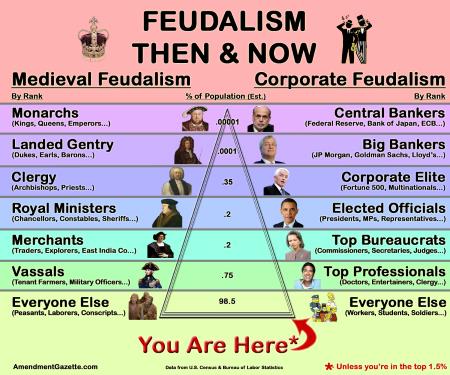
Feudalism Then Now - Via The Amendment Gazette

You probably know the idea of “creative destruction.” Basically, it means that smart people come into a poorly performing company. They get rid of the dead wood—they fire people. Then the company’s prices go down so that consumers have money they can spend on other things, increasing demand elsewhere. Then the fired people and even more can be better employed doing something else. The idea is that it may be disruptive, but in the long run, everyone is better off.

I have always had a problem with this idea. The reason is that prices do not reflect costs. Let’s suppose that I manufacture chairs and they cost me $5 each to make. I’m not going to sell them for $10 because that’s a reasonable markup. If I can get people to pay $100 for them, I’ll sell them for that price. On the other hand, if people will only pay $2 for the chairs, I will sell my existing inventory at that price and discontinue the line. So the only way that costs matters to me is if I’m not making enough. Otherwise, if people want to pay a million bucks for my $5 chair, that’s just fine.

Those of you who know a little economics will say, “Yeah, but you aren’t the only person who makes chairs!” And this is right. In the perfect markets of Chicago School models, other producers will come in and beat down my price. We will go back and forth until we get a price that is some reflection of the cost of bring the product to market. But such truly free markets are almost nonexistent. Let’s look at the way things normally work.

There are a bunch of little drug stores and they employ a whole bunch of people. A Walmart comes into town and puts them all out of business for both good (Walmart really has perfected the supply chain) and bad (Walmart illegally suppresses unions and can provide lost leaders) reasons. So there is lots of disruption but consumers really do get better prices. But the extra savings in the community is not equal to the loss wages. So creative destruction creates profits for the already rich and destroys the incomes of the community.

I was thinking about this after reading a great interview at Truthout between Jason Hickel and Alnoor Ladha, Are Economic Growth and Social Justice Incompatible? I recommend reading the whole thing, because it discusses the way the economy actually works and not the myths that we are constantly told. Take this frightening bit of information from Hickel:

We can see this level of corporate power being advanced even further by the new free trade agreements that are in the pipeline. Take the Trans-Pacific Partnership (TPP), for example, which is set to become a global version of NAFTA. It includes what are called “investor-state dispute mechanisms” that allow corporations to sue sovereign governments for passing laws that reduce corporate profits. Corporate lawyers will judge these cases in secret tribunals that operate above the laws of any nation.

So let’s say politicians in Malaysia pass a law that increases the national minimum wage. This means that sweatshop owners will lose some marginal part of their profits, which gives them the right to sue the government of Malaysia for lost future earnings. What’s amazing about this is that it essentially gives corporations the power to regulate democratic states, rather than states regulating corporations. So it’s a total inversion of our existing regulatory logic.

That’s right boys and girls. In the mind of my father’s generation, “capitalism” was the same as “democracy” and “freedom.” But the oligarchs want to create a new kind of system. Feudalism became capitalism, but it seems very much like we are headed to what I call neo-feudalism.

What’s most upsetting about all this is that it has always been a farce. There have never been “free” markets. The system has always been geared to maintain the status quo. On the whole, the rich are not rich because they are smarter or more knowledgeable or harder working. They are rich because they are rich. They are rich because their parents were rich or simply because they were lucky. Being brilliant brings many rewards, but great wealth is not usually one of them. Richard Stallman and Linus Torvalds truly revolutionized computing, but it was the subgeniuses Bill Gates and Steve Jobs who became billionaires.

So unless we stand up and do something about it, we will end up not only serfs, but serfs who are beholden to mediocrities. Kind of like we are now, but worse.


Image taken from The Amendment Gazette, Feudalism Then and Now.

Satchel Paige

Satchel PaigeOn this day in 1906, probably the great baseball pitcher ever, Satchel Paige was born. I think it’s funny that after the recent steroid scandal in Major League Baseball, people were wondering what this was going to do to the hallowed baseball statistics. Yet for many decades, blacks were not allowed to play for MLB teams, but when blacks and whites did play together as they did in the California winter league, the blacks very often totally out-shined the whites. That was more true of Paige than anyone.

When the Sporting News put out its Baseball’s 100 Greatest Players, it rated Cy Young, Grover Alexander, Christy Mathewson, and Walter Johnson ahead of him. As much as I admire Walter Johnson, all he did was pitch fast. He never developed a decent curve ball. Paige threw everything well. Of course, in that regard, he had the advantage of having such a long career. As he got older and his speed lessened, he increasingly used other pitches including the knuckleball.

Because Paige was black he was forced to pretty much play year round. At the beginning of his career, he played as a freelancer—something that he couldn’t have done in MLB. And he played outside the country on a number of occasions, causing various problems with his relationship with the Negro League. The end of that was when he played the 1939-40 season in Puerto Rico where he ended the season with a record of 19-3, 1.93 ERA, and 208 strikeouts over the course of 205 innings. In one game, he struck out 17 batters.

The next seven years he played with the Kansas City Monarchs and “barnstormed” in the off season. It wasn’t until 1948 that Paige was allowed in MLB with the Cleveland Indians. He was 42 years old—the oldest rookie ever. His first season he had a record of 6-1 with an ERA of 2.48. He played four more seasons where he wasn’t as good, but he was a decent relief pitcher. He was in his late 40s by then. It’s just sad to think of what he would have been able to do had he been allowed to play 20 years earlier. Of course, lots of people got to see him play. He was a huge star. But the man doesn’t get as much respect as he deserves. I mean: Christy Mathewson? Really?!

Happy birthday Satchel Paige!