
 Is there anything that shows the bias and prejudice in our current criminal justice system than, on the same day, seeing the acquittal of an all-white group of men who illegally took over a federal facility and actively encouraged the potential use of violence while peaceful protesters who are defending sacred Indian land that is theirs by treaty get shot and arrested in order to allow big business to build a pipeline through their land?
The Bundy group was treated with kid-gloves and were eventually arrested peaceably. It was a remarkable show of restraint by law enforcement that worked out in the end. But, because it did end so peaceably, it perhaps made it easier to acquit them. Those peacefully protesting the Dakota Access Pipeline have been met with a declaration of a state of emergency by the governor that mobilized the National Guard, allowed the use of outside police forces, and the deployment of militarized police vehicles. This is a stark contrast to the treatment of the Bundy group that occupied the Malheur National Wildlife Refuge headquarters.
—m2c4
Two Faces Of American Justice — Bundy Acquittal And Dakota Pipeline Protests
 Economist Gregory Mankiw is very pleased to have been gouged by a scalper, he informs us in a recent New York Times column. Mankiw recently went to see the Broadway musical Hamilton, and paid the going rate for a ticket: $2,500. Yet he was far from dismayed at having paid this extraordinary sum. In fact, he describes those who object to price-gouging as “pernicious.”
 In its 144-year history, The Yale Record has never endorsed a Democratic candidate for president. In fact, we have never endorsed any candidate for president. This is, in part, due to our strong commitment to being a tax-exempt 501(c)3 organization, which mandates that we are “absolutely prohibited from directly or indirectly participating in, or intervening in, any political campaign on behalf of (or in opposition to) any candidate for elective public office.”
 Research shows that people in the South are 84 percent less likely than their counterparts in other parts of the country to learn about evolution, or to learn about it in a way that is accurate. Similarly, studies such as my quant study in preservice teachers and Laura Rissler’s study of undergrads in Alabama show that religiosity is a strong negative factor that impacts acceptance of evolution.
 I understand Joe Heck now wishes he never said those things about Donald Trump. But they’re on tape. They’re on the record. And now that Trump’s poll numbers are cratering, suddenly he says, well, no, I’m not supporting him.
 [Peter] Thiel did touch on the private sector, touting his native Silicon Valley as an example of a properly functioning community:
 One of Fox News Channel’s favorite recent stories involved a newspaper ad that claimed African-Americans benefited from slavery, and owed America for the favor. The ad’s author, conservative activist David Horowitz, claimed to be a victim of censorship and “political correctness” because a number of college newspapers refused to publish his ad, which argued against the idea of slavery reparations. Fox saw this as a major issue: Horowitz and his ad were mentioned at least 21 times on the network between March 6 and April 3 [in 2001].
 At the debate last night, moderator Chris Wallace challenged both candidates on the question of cutting Social Security and Medicare. The implication is that the country is threatened by the prospect of out of control government deficits. The question was misguided on several grounds…
 The “takeaway,” as we say in the pundit game, was what Donald Trump said, or didn’t say, about “respecting” the results of the election. Good lord, people were fighting for space on the fainting couch all day on Thursday, too, and likely will be for the foreseeable future. Can we stop with the civics class pieties, please? Yes, what Donald Trump said on Wednesday night about keeping us all “in suspense” as to whether he’ll “accept” the results of the presidential election was a great soundbite and an easy way to emphasize further the fact that the Republican Party has nominated a petulant child for president. But enough with the shocked faces from the pundits who drape themselves in imaginary togas and weep on cue for this assault on the fragile American democracy. This is nothing new…
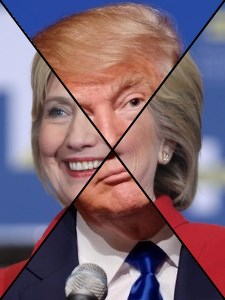 At the third 2016 presidential debate in Las Vegas, Nevada, on Wednesday night, a few things did not happen.
 With those who feel that the use of an ordinary word for an ordinary notion does not do justice to their vocabulary or sufficiently exhibit their cultivation, feasible is now a prime favorite. Its proper sense is “capable of being done, accomplished, or carried out.” That is, it means the same as “possible” in one of the latter’s sense, and its true function is to be used instead of “possible” where that might be ambiguous. A thunderstorm is possible (but not “feasible”). Irrigation is possible (or, indifferently, “feasible”). A counter-revolution is possible: that is, (a) one may for all we know happen, or (b) we can if we choose bring one about; but, if (b) is the meaning, “feasible” is better than “possible” because it cannot properly bear sense (a) and therefore obviates ambiguity.
 If she’s in office, I hope we can start a coup. She should be in prison or shot. That’s how I feel about it. We’re going to have a revolution and take them out of office if that’s what it takes. There’s going to be a lot of bloodshed. But that’s what it’s going to take… I would do whatever I can for my country. —Dan Bowman, a true patriot who would do anything for his country except support its system of government.