The Danger of Certainty

Saddam Hussein - Ace of SpadesAmericans are muddled thinkers. People are constantly pointing out how in polls, Americans contradict themselves. I do it myself. But it’s not the worst thing that as a nation we are confused. Americans are at their most dangerous when they are certain of things that just aren’t so.

Generally, I would not say that polls don’t matter. If you give people binary choices, polls are pretty reliable. Are you going to vote for Obama or Romney? People can make a decision. But most of life cannot be phrased this way and that is where we get into trouble.

The Terrorist

Yesterday, Glenn Greenwald wrote an article where he noted America’s contradictory thoughts on extrajudicial killing of American citizens on foreign soil. Americans are very much against this: Democrats and Republicans alike. Only 41% said we should do that kind of thing. But when it came to the specific case of killing US citizen and suspected terrorist Anwar al-Awlaki, 69% of Americans were in favor of it.

Think about that for second: it is really horrible. I can see it the other way: people think it is okay in the abstract, but when it is done to a real person, they are horrified. But this is seriously screwed up: people think it is wrong in the abstract, but when the government does it, they just accept the government’s word that it was a really bad guy they killed. Greenwald thinks it is just good old fashioned American racism. I don’t doubt that he’s right. But I think there is something even deeper going on.

The Deficit

Also yesterday, Kevin Drum reported on a Democracy Corps poll that asked people to name their two most important political concerns. Their answers: increasing spending and decreased spending. In particular, the top 5 things were: (1) protecting retirement benefits; (2) reducing the federal deficit; (3) cutting ineffective programs; (4) making sure education is affordable; and (5) fixing infrastructure to create jobs. You know: increase; decrease; decrease; increase; increase. Now, we know that Americans define waste as “programs I don’t like.” But in general, Americans want to spend as much as we have been (and in many cases more) on all programs except “foreign aid.” (Because politicians long ago demonized such aid, Americans think it takes up to a half of all our spending when it is usually less than 1% and most of that goes to the hugely popular state of Israel.)

In addition to these two examples, we have the polls that come out each election cycle that tell us that the voters just hate negative advertising. Pity the foolish politician who actually uses these polling results to run his campaign. People may hate negative advertising, but it effects them all the same.

The Secret Sauce

It isn’t that these polls are wrong. What is really going on is that Americans don’t think seriously about any of these issues. They don’t like the idea of the government just up and killing people—unless they are bad guys. They hate the idea of the government spending too much money—unless it causes any programs to have less money. And of course negative advertising is a terrible thing. But they want to know if a politician is fucking around on his wife. As you can see, all of this is not explained by ignorance and poor thinking alone. It requires the Secret Sauce!

The Secret Sauce is the propaganda machine that the combined media and government systems provide. Americans really do have a natural abhorrence to unjustified killing. But we are complete suckers for the public vilification of our alleged enemies. We did it to Saddam Hussein to justify war—twice! And we’ve done it to Anwar al-Awlaki. We never even question it unless there is some powerful source pushing back on the propaganda campaign. And there very really is.

Americans would never even think about the budget deficit if there weren’t a constant drumbeat from the media telling us that it is important. And even then, the only way we contextualize the federal debt is by analogy to our own budgets—which, of course, is invalid and leads to misunderstanding the issue. As for negative ads: we don’t like them but that doesn’t stop us from believing them. It must be true; it’s on the TV machine!

Naive America

This is one of the most terrifying things about modern America. We are a surprisingly naive people. In fact, we are so naive that most of us have no idea we are naive. We think we have a good bead on what’s really going on. I thought the Cold War was a great illustration of this. Most Americans couldn’t believe that people in the USSR accepted the obvious lies told to them by their government. (I hear the same things today regarding North Korea.) But the truth was that most of the people in the USSR were far more skeptical than the people of the USA. Among the people I knew, almost no one even questioned that the government or media would lie to us. And when these institutions were caught lying, it was always justified as a special case.

Now we have a whole network, Fox News, dedicated to pushing the idea that you can’t trust the regular news. That’s great. But what they provide instead is straight Republican Party propaganda. And again, their viewers are certain they are getting the Truth™. Of course, any news source is going to be biased. The problem is not the bias; the problem is the belief of the viewer that it isn’t biased. I’ve long said that the issue between Fox News and MSNBC is not that one is more biased than the other; the issue is that MSNBC viewers know that the news is biased; the Fox News viewers do not.

Too often, I find people either accept everything they hear uncritically, or they refuse to believe anything. This second group is even more problematic. You see, they aren’t as cynical as they claim to be. They use their cynicism as a filter to dismiss anything they don’t want to believe. In my experience, a large fraction of Fox News viewers fall into this latter category. And the worlds that they allow their filters to paint are often troubling indeed: bigoted, reactionary, simple-minded.

Polls provide a snapshot of what we as a people believe. And sadly, it is heavily skewed toward what we have been told to believe. I remember back at the end of Reagan’s administration when the Drug War was really gearing up. I read about a poll of CEOs of major corporations. They were asked what the most important issue facing their companies were. Less than 10% said “drugs in the workplace.” Six months later, the same poll found over 50% of the CEOs saying “drugs in the workplace” was the most important issue facing their companies. The only thing that had changed was six months of constant Drug War propaganda. Now if CEOs are this malleable about the issues facing their very own businesses, what can we expect from regular people asked about items on the federal budget or America’s enemies abroad?

The Danger of Certainty

Our biggest problem as a nation is how information flows to the people. With the right (wrong) flow of information the people will gratefully change our constitutional republic into a Job Creator Dictatorship. We could easily look back 20 years from now and think that these were the glory days. Confusion is not the worst thing. It is our certainty—like the certainty that Saddam Hussein was a serious threat to our nation—that gets us (and the rest of the world) into the most trouble.

Just Good Enough: Richard Dawkins

Richard DawkinsI feel that I should clarify something about my birthday posts. I don’t just name everyone I’ve heard of or everyone who I think is famous enough. For example, it is Utah Jazz superstar John Stockton’s birthday, but I won’t even mention how old he is because he doesn’t make the cut. And that is what it’s all about: who makes the cut. The cut is defined as (1) someone who I happened to notice had a birthday and (2) someone I care about enough to mention. Some of these are real judgement calls. Like Sarah Jessica Parker on yesterday’s list. On the one hand, I don’t think much of her as an actor. On the other hand, I don’t think much of her as a person. So I don’t know why I even put her on the list. But somehow, she made it.

Today I have a real problem. There are plenty of people on the list. There are even plenty of people who I really admire. But there is no one who I think I ought to have “win” the day. And even as I write this, I do not know what I’m going to do about it. (Exciting, isn’t it!) First, though: let’s get to the birthday’s of dead people.

Robert Frost was born on this day in 1874. He is not one of my favorite poets, but his work is really beautiful. The religion writer Joseph Campbell was born in 1904. The great playwright Tennessee Williams was born in 1911. Finally, we have two actors: Sterling Hayden in 1916 and Strother “Failure to Communicate” Martin in 1919.

John Stockton wasn’t the only birthday I skipped today; there were lots. Of those who did make the cut, let me start with the entertainers. Bob Elliott is 90 today. He was one-half of the great comedy team Bob and Ray. I just found out that he is also the father of Chris Elliot. (Can you say, “America is not a meritocracy“? How about “nepotism”?) Leonard “Mr. Spock” Nimoy is 82. Alan Arkin is 79. James Caan is 70. The wonderful Diana Ross is 69. And spazedian Martin Short is 63.

We have a few birthdays in the world of politics. Former Supreme Court Justice Sandra Day O’Connor is 83 today. President of the Palestinian National Authority, Mahmoud Abbas, is 78. Former Speaker of the House, Nancy Pelosi, is 73. And annoying political reporter Bob Woodward is 70.

I’m very fond of a number of these people: Tennessee Williams and Bob Elliott and Diana Ross especially. But there is one birthday who doesn’t fit into the two categories above and who is not only a very important person, but also very important to me. It is the 69th birthday of the brilliant evolutionary biologist Richard Dawkins. Sometimes his very comfortable English middle class values bother me—they are, after all, very close to my own very comfortable American middle class values. And I don’t think his work on atheism is all that good, even if I do largely agree with him on the subject. But his popular work on biology has had a profound effect on me. So I have no problem giving the day to him, even if I wasn’t even thinking of doing it when I started writing this article.

Happy birthday Richard Dawkins! And this song goes out to you, good doctor:

Farewell Gay Liberals

Same Sex Marriage - Homer - SimpsonsI’m interested in where the gay rights movement is going. I will always feel a great kinship to my gay brothers and sisters. What’s more their cause of gender orientation equality will always be my cause as well. Although this particular cause is definitely liberal, the LGBT community, is not. In fact, in many ways, it is conservative. And so, as time goes on, I’m afraid that I will have to say goodbye to many of my gay colleagues as they are more and more at odds with me on important issues. (I mean goodbye to them from the liberal movement; I’m not talking about cutting off people from my life just because we have policy disagreements.)

A large part of this is simply that as a group, gays and lesbians are more economically successful. Why this is, I’m not sure. The lack of unplanned pregnancies undoubtedly helps. And the lack of gender limited roles can’t hurt. But the fact is that gay individuals and even more so gay couples are wealthier than their straight counterparts. We all know: the rich vote Republican. And as the Republican Party slowly gives up on its absurd anti-gay policies, we will see more and more of the LGBT community join it.

Dan Savage

There was an interesting moment on Up with Chris Hayes yesterday. Hayes asked a question that I must admit has occurred to me a few times: is it possible that the Supreme Court will vote overwhelmingly to overturn the Defense of Marriage Act. On one level, it seems like a no-brainer. I don’t even understand the constitutional argument for upholding it.

But gay activist and liberal pundit Dan Savage called out the lie in that kind of thinking, “Thomas, Alito, Scalia: they will twist themselves into any shape to avoid—I think—overturning DOMA. I think they’re partisans and I think they’re Republican hacks and I don’t think they’re justices who can be trusted to do the constitutional thing. I have no illusions; it’s going to be very close; it’s not going to be Brown [v. Board of Education].” Of course he’s right. I am, however, curious to see what those jackasses will come up with to justify their bigotry.

I bring up Dan Savage because I was reading about him this morning in Kathleen Geier’s excellent The Siren Song Of War: Why Pundits Beat The Drums For Iraq. Savage is generally a pretty good supporter of liberal causes. But has was a liberal pro-war pundit in the lead-up to the Iraq War. And his 2003 call-to-arms is a repellent read, Say “YES” to War on Iraq. This reminded me that for years I’ve thought that the gay community generally is not long for the liberal movement.

Soon, gay rights will stop being a political issue at all. That’s as it should be. But I don’t think that someone being in favor of gay rights makes them a liberal. And as we move into the future, we will see increasing numbers of gay pundits slip away from liberal causes as they become unmoored from gay rights. Savage is especially likely, given that his politics often tend toward the center and even conservative.

On the other hand, there are activists like Urvashi Vaid who was also on Up with Chris Hayes. She said what I’ve been saying about the Rob Portman policy change, “I’m not in the same movement as Rob Portman. I’m happy that he loves his gay son and wants to now eradicate a barrier. But so many of the things he still stands for are antithetical to the lives of many LGBT people.” Right! Because if your concern is about “the people” more than “the cause” you will always be a liberal. And if I had to choose between Urvashi Vaid and Dan Savage, I would pick Vaid any day.

So I don’t mean to suggest that all our gay brothers and sisters are going away. Just the marginal ones. Anyway: the Republican Party is badly in need of an influx of new blood that, while wrong on a lot of issues, is not crazy. I look forward to having a loyal opposition, even as I mourn the inevitable loss to the liberal movement.

Enough with the Iraq Pseudo-Mea Culpas

Jonathan ChaitJonathan Chait made a mistake earlier this week: he explained why he supported the Iraq War. It was very disappointing.

The main argument he makes is exactly the one that Peter Beinart makes in The Icarus Syndrome. He documents all the fear about the Gulf War based on our experiences in Vietnam. This is very true; everyone feared a total clusterfuck. So after the Gulf War was just a raging hard-on of a success for everyone, he was “conditioned” to trust the military hawks.

Let’s step back a moment and think about that. After the Gulf War, I was glad that it was brief and that the US didn’t lose many people. But I certainly didn’t think it was a success. The purpose of the war (to put a monarchy back in power in Kuwait) didn’t seem a particularly great reason to go to war. What’s more, we ended up killing about 30,000 Iraqis, almost all of whom were poor conscripts. There were also several thousand civilian deaths. And the Iraqi Republican Guard was pretty much untouched by it. So Chait’s takeaway from this war is entirely based upon its effects on the Coalition.

But even if we accept Chait’s take on the Gulf War that it was ripping good fun, how could he equate the very clear and careful planning done by the Bush Sr administration with the slapdash preparations of Bush Jr? This is where Chait really gets himself into trouble. He knew that the administration’s rationale for the war was a pack of lies. But this didn’t bother him because he came up with an alternative way to justify the war.

This was an extremely popular way to support the Iraq War. Chait is not alone by a long shot. But this is faulty reasoning. One must assume that the administration is providing the best rationale for war. They have the best information access, after all. If that case is weak, then coming up with your own is nothing but an exercise in apologetics. The administration’s case for war is the case for war. Any other arguments are simply your own justification for supporting the administration.

And this gets to my primary problem with all of these pseudo-mea culpas: they aren’t mea culpas. They are justifications for why support for the war was reasonable or at least understandable. When an administration is recklessly pushing us into war, it is no less reckless to follow them—regardless of the justification. It was clear at the time that the administration was hell bent on going to war. If that doesn’t cause a person to call for restraint, what will?

I don’t mean to beat up on Jonathan Chait. I am using him as an example because he is one of the most reasonable people offering such justifications. And that just shows how flawed this whole exercise is. It isn’t about having a “conversation” or about learning from our mistakes. As I just wrote about in America’s Arrested Development, this just allows people to go on to repeat the same mistakes over and over again.

Afterword

Chait ends his article with an attack on Matt Yglesias’ general anti-interventionist stance. He seems to be arguing that just as the Gulf War tainted his thinking on war generally, so did the Iraq War taint the younger Yglesias’ thinking. This is false equivalence. Yglesias has yet to be shown to be dead wrong about his anti-war opinions. But more important: what the hell is such an attack doing in Chait’s supposed mea culpa?

Letter to Barbara Boxer

Barbara BoxerDear Senator Boxer:

I am a big supporter of yours. However, it has been hinted that you are one of the senators who blocked filibuster reform. I’ve written to you about this before: at minimum, we need serious filibuster reform.

I’m not a one issue voter. Anyway, you would have to lose half your mind and three-quarters of your soul to be as bad Carly Fiorina would have been. But this is very important to me. I’m still smarting over what happened in 2009.[1]

I want to know your position on filibuster reform. What do you support and what do you not? Are you for the elimination of the filibuster? And if you are not, do you believe that the Republicans will not eliminate it once they are in power.

Otherwise, continue to make us proud and grateful that you aren’t Dianne Feinstein. (Not that she’s at all worse than Elizabeth Emken!)

Sincerely,
Frank Moraes

Afterword

It is easy to write your representatives and so effective. Or if you prefer, you can call them. This is a great way to have a big influence on politics. I’m all for voting, but contacting politicians on specific issues is really powerful. Make a habit of it!


[1] What happened is that we had a 78 seat advantage in the House (59%) and up to a 10 seat advantage in the Senate (60%) and control of the White House. Nonetheless, we got very little progressive legislation because of the Republican use of the filibuster in the Senate. We will have to go through another Republican caused catastrophe before we again have those kinds of numbers in Washington. What’s it going to take to get anything good done? 65 Democrats in the Senate (a few extra to make up for the “blue dog” Democrats)?

My Hero Phil Davison

Oh My God!This is a blast from the past. I just came upon it. Two and a half years ago, Phil Davison spoke to the Stark County (Ohio) Republican Party Executive Committee. He wanted to be the Republican nominee for Stark Country Treasurer. When I first wrote about this, I did not embed the video for whatever reason. But here goes. This is only five minutes and I really hope that you will watch it. It is amazing to behold.

Here was my reaction at the time:

So Phil: if we are ever in the same town, I would definitely like to take you out for a beer. To be honest, you could use it! This may be the opportunity you are waiting for! Forget that treasurer business. Forget about infestation. I’m talking about the opportunity to drink beer with me in a well fumigated bar where we can watch football—not touch-football—winner take all, football! Let me repeat that so there is no miscommunication: if we are ever in the same town, I would definitely like to take you out for a beer and watch non-touch football in a well-fumigated bar! In all honesty, I think it would be fun. Because, like it or not: you are a nut. (And I mean that in the best way!)

Thank you very much!

Phil Davison was not given the nomination.

Afterword

Here is the Volkswagen commercial that used Davison and other internet spazzes with Jimmy Cliff doing a really great version of the Partridge Family’s “Come On Get Happy!”

The US Has Always Been at War with Ghana

America's Future Enemy: Ghana!Earlier today, Glenn Greenwald took “reasonable” Republican David Frum to task for his revisionist look back on Iraq, David Frum on the Rhetoric of Iraq. In particular, he demolishes Frum’s claim that he was never that impressed with Ahmed Chalabi. But somehow the unimpressed Frum wrote of Chalabi in 2004 in The National Review, “Compared to any other possible leader of Iraq—compared to just about every other political leader in the Arab world—the imperfect Ahmed Chalabi is nonetheless a James bleeping Madison.” But who knows? Madison believed in democracy and Frum is a Republican, so maybe Frum isn’t that impressed with Madison.

What I took away from the article, however, was Greenwald’s statement, “Americans are quite good at regretting their past wars but quite poor at applying the lessons to newly proposed ones.” To document this, he links to two recent articles. First, one in The Hill that discusses a Gallup poll that showed that people think we shouldn’t have gone to war in Iraq:

Fifty-three percent say their country “made a mistake sending troops to fight in Iraq,” according to a new Gallup poll released on Monday. Forty-two percent say the decision was not a mistake.

Second, an article from CBS News that discussed a CBS News/New York Times poll that shows that people think we should start a war with Iran:

The poll, which surveyed more than 1,000 adults nationwide between March 7 and 11, showed that 51 percent of Americans would support U.S. military action in Iran for purposes of stopping the country from developing a nuclear weapon. Thirty-six percent say they would oppose such action, and 13 percent say they are unsure.

Imagine it: March 2023! In Newsweek, a prominent Obama speechwriter would publish, “Jon Favreau on the Rhetoric of Iran.” In it, he would write something like, “It seems amazing to people today, but ten years ago, everyone thought Iran had a nuclear weapons program. How could we have known?” At the same time, Gallup would release a poll that showed that most people think it was a mistake to start a war with Iran. But CBS News would report that most Americans think we should go to war to stop that dangerous Ghanaian Navy!

Attorney General to Appeal Milke Case

Debra MilkeAs I reported last week, Debra Milke’s conviction for the murder of her son 23 years ago has been overturned. So of course the Arizona Attorney General Tom Horne has decided to appeal the ruling to the Supreme Court.

The statement from Horne is typical of these people. He doesn’t defend the conviction at all. Instead, he dredges up the tragedy of the boy’s death as though he thinks that the wrongful conviction and continued punishment of the boy’s mother will somehow bring him back. We all understand how horrible the crime was; that doesn’t make his mother a murderer.

It seems likely that the Supreme Court will not take the case. But Horne’s efforts in this regard show that his only real intent is to save face for the Arizona justice department. It has only been a couple of days since Milke’s conviction was overturned. There certainly hasn’t been sufficient time for him to look at the case anew and determine that it should be appealed.

This is very easy. We have a broken criminal justice system. It is a system that rewards police and prosecutors for punishing innocent people. And even when the innocents are exonerated, these same people are not only allowed to continue in their careers, they are allowed to make public statements about how they just know that this or that person is guilty. Because in their minds, everyone is guilty. It’s good for business.

Afterword

Note that Tom Horne is not calling for a retrial. How could he? The state has no case. Instead, he wants to appeal so that Milke can be put to death on the bad evidence that convicted her in the first place. I wonder: if everything went wrong and she was to be put to death, would Obama have the courage to pardon her? I doubt it.

Republicans Blind to Racism

Tea Party Racists

There was a racist dust up at CPAC on Friday during a K. Carl Smith session sponsored by the Tea Party Patriots on how to get African Americans to vote Republican. Smith’s talk was filled with divisive and irrelevant lines like, “I’m not going to join the KKK. The Democratic Party founded the KKK.” During the question period, Voice of Russia radio host Kim Brown apparently asked how many black women were at CPAC and the whole session went off the rails.

She was shouted down and told she wasn’t wanted there. But then a young white supremacist spoke. He said that all this outreach to blacks was just going to alienate young white males. Smith responded with what I think is a non sequitur about how Frederick Douglass forgave his slavemaster. The young man replied, “For giving him shelter? And food?” At that point the session exploded.

Benjy Sarlin reported all of this for Talking Points Memo. After the whole thing was over, he talked to a number of people who had been at the event. And they were all angry. But not at the white supremacist. They were angry at the young black woman, Kim Brown. The session speaker Smith later released a statement saying Brown “rudely interrupted” him. But all he could say of the white supremacist was that he made a “racially insensitive” comment but that they “left as friends.”

This illustrates what is wrong with the Republican base. Smith isn’t trying to get the Republican Party to be more appealing to African Americans; he is just trying to brand the Democratic Party as racist. On the details, he’s right: the Democratic Party has a long history of racism. But for my entire life, the Republican Party’s main electoral power has come from its implicit and explicit appeals to white racial resentment. If it were 1850, I would almost surely be a Republican. Is that really all that the Republican Party has to offer?

Of much greater concern is the reaction of the attendees to the white supremacist. No one would say that he was wrong or that his statement was repugnant. Instead, they made excuses for the remarks. When asked if he was offended by the white supremacist, one of the few blacks at the event even said, “No they were just telling the truth.” There is a strength in this kind of behavior: Republicans apparently stick by each other no matter what. That helps in their quest for power. But there is obviously a very dark side to this. And what’s more: it seems that the reason the Republican Party claims not to be racist is that they don’t even know it when they see extreme examples of it.

Naive Democrats Make it Easy for Republicans

Kyrsten Sinema

Ah naivete! If it is authentic, it can be charming. But if it is inauthentic, it is just annoying. Yesterday morning on Up with Chris Hayes, Kyrsten Sinema was on the panel.

She is a member of the “Gang of 32” — the bipartisan group of new House members who are getting together to solve those problems they can agree on.

That’s all fine. But at one point she said, “This may surprise you, but our Gang of 32 statement—the very first thing we talk about is protecting and strengthening Social Security and Medicare.”

After she says that, Sam Seder almost jumps out of his chair. Here’s the question: is she naive or just stupid?

Republicans Don’t Mean What You Think They Mean

Can Sinema really think that when Republicans say they want to “protect and strengthen” entitlement programs that they mean literally that they want to protect and strengthen entitlement programs? Because that is most definitely not what they mean.

Republicans have been very clear on this point. In fact, it was a big deal in the last presidential election. Republicans want to savagely cut entitlement programs so that the programs will be around in the coming years.

The theory is that we just can’t afford the entitlement programs so we must cut them. Then we will be able to have some shadow of the programs in the decades to come—with the same name!

Block Grants

The best example of this is the block-granting of Medicaid. The idea here is that the federal government will give each state a block of money to support healthcare for the poor. The states can do with this money as they please.

But the big aspect of it is that the money will not keep up with the increasing price of healthcare. Eventually, Medicaid will be so starved for funds that it will be irrelevant as a program. But it will still exist! And in its uselessness, it will be robust!

With Pros Like Sinema

Yesterday, Jonathan Bernstein asked why it was that the “neutral” press was so in favor of cutting the budget deficit. If professional Democratic politicians like Kyrsten Sinema don’t understand the subtext of Republican claims to “strengthen” entitlement programs, how can the mainstream press, much less the average voter?

I fear that Sinema is both naive and stupid.


Image cropped from Kyrsten Sinema by Gage Skidmore under CC BY-SA 2.0.

No Long Term Budget Problem?

Sarah KliffLate last week, Sarah Kliff brought attention to the new Economic Report of the President. In the article, she notes that healthcare costs over the past few years have only grown at the rate of inflation. If this is not just a recession fluke, there are huge policy implications.

As anyone who reads this site knows, the only budget problem we have is the long term growth of healthcare spending. In fact, healthcare spending has been rising so fast the last few decades that if nothing is done, it will bankrupt our whole economy, much less the government. But if healthcare costs stabilize, we have no budget problem.

So the question is whether the slowdown is a long term trend. There is reason to believe that it is. One issue that Kliff does not mention is that we already pay far too much for our healthcare. Thus, it may be that the healthcare market has hit a ceiling. Remember: prices are set by what the customer will pay, not what the companies must pay to provide the good or service. But this doesn’t mean that we’ve necessarily reached a new normal in healthcare costs.

But let’s suppose we have. If that’s the case then all of the deficit hysteria is for nothing. And that is one of the biggest problems with all of this Chicken Little nonsense regarding Social Security and Medicare. We are being asked to cut these programs because in the future there may be a funding problem. This is just madness.

Now we have much of the Democratic Party—including President Obama—pushing for a Grand Bargain to cut Social Security and Medicare. And for what? So we can get the rich to pay a tiny bit more in taxes at a time when their taxes are extremely low by historical standards? And note: the Grand Bargain that Obama is pushing (any real deal would be worse) is 2/3 entitlement cuts to 1/3 loophole closing.

All liberals need to pay close attention to this issue. As Kliff points out, “It’s taken as an article of faith inside the beltway: Policy makers need to do something to tamp down on out-of-control health-care costs.” We need to counter this idea at every opportunity. Because we do not know that something must be done. And until we do, there is no reason to cut these programs. Unlike global warming (which we aren’t doing anything about), we can deal with any budget problems once they actually become budget problems.

Afterword

Most of the push for cutting entitlement programs is a cover for cutting taxes on the rich. Note that all the big conservative and moderate budget plans start with a big tax cut. In any normal world, this would make these plans Very Unserious indeed. But because they also do great harm to the poor, they are considered Very Serious.

Fred Hiatt’s Circuitous False Equivalence

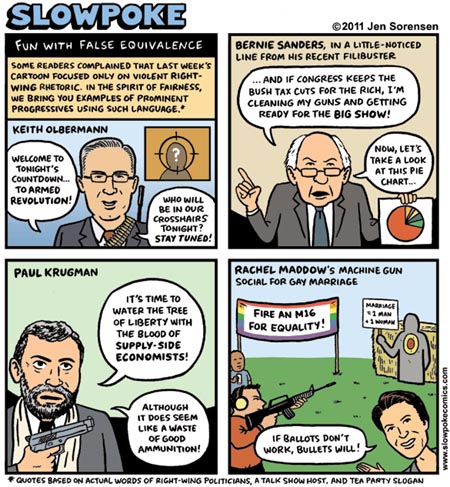
Not EqualLast week, Fred Hiatt over at the Washington Post came out in favor of presidential leadership, Obama Could Get Things Done by Governing Today. It is a wonderful example of false equivalence by a writer who knows that false equivalence is a bad thing. As a result of this, he cloaks the whole thing in an attack on Steve Israel’s claim that the Democrats really need to retake the House if Obama is going to get much done in his second term.
Who is Steve Israel? Only the chairman of the Democratic Congressional Campaign Committee. In other words, he is boosting for the DCCC. His statement is not standing policy of the Democratic Party. No Democrat is standing around waiting until they control the House to do any work. But Hiatt has to pretend that they are so he can compare it to an unnamed Tea Party idiot who does think that the best strategy is for the Republicans to obstruct until they get a decisive electoral victory.

All of this is just a smokescreen for what Hiatt really wants to say: both sides do it! The meat of his article is found in the following two sentences:

Before his reelection, many Republicans presented Obama as a wild-eyed radical, a European-style socialist who had to be stopped. Today, many Democrats present the opposition as unnaturally extremist, pathologically opposed to progress.

The first sentence is mostly true. It is deceptive to say that “many” Republicans presented Obama that way. He should say “nearly all.” That image of Obama was and still is a staple of Fox News, Hate Radio, and the vast majority of Republicans in Congress. Hiatt’s second sentence is roughly the same. I would say that “most” Democrats present the Republican Party as “unnaturally extremist, pathologically opposed to progress.” What’s more, I would say this is largely a factual statement. It is possible that if a Republican were in the White House, the Republicans in Congress would be more reasonable. But that’s not saying much and last time I checked, there was not a Republican in the White House.

After this stunning bit of false equivalence, Hiatt brings the article back to his cover story: the parties can’t just wait until they have full control of the government! But even in making this point, he puts the onus entirely on the Democrats. This is at the end of an article in which he’s admitted that Obama is trying to work with the Republicans. This begs the question: what was the point of the whole article? His argument comes down to: both sides say the other is extremist (And who can say which side is right? Certainly not Fred Hiatt!); Obama is trying to work with the Republicans; Obama should do what I already said he is doing.

Brilliant, right?

Slow Poke False Equivalence

H/T 15 March Counterspin