Lope and Cervantes: the Feud

Melveena McKendrick's CervantesBack in 1980, Professor Melveena McKendrick wrote a stunning biography of Miguel de Cervantes. I went through several biographies before landing on this treasure that is written in a more lively and engaging style than most modern novels. I’m no expert, so I don’t know if the research in the book is out of date. I do know that certain aspects of Cervantes’ life which have been shown to be untrue—like the contention that he started Don Quixote while in prison—are discussed and refuted here. So any inaccuracies must be small. One certainly could not pick a book that more vividly brings Cervantes and his times to life.

Spanish Theater

One especially interesting aspect of the biography is the picture it provides of the Spanish theater scene at that time. This is the same time when the English theater was dominated by Shakespeare and all those other playwrights we no longer perform. In Spain, theater was dominated by Lope de Vega—in a way Shakespeare never did in his own time. And it just sounds like a lot more fun than what was going on over at the other side of the English Channel. One particularly telling part of this is the use of women in the theater. In England, there was no law against women performing on stage.[1] Rather, the theaters kept women from performing because they feared the government would shut them down if they did so. (Also: English boys loved dressing up as women.) In Spain, women played the female parts on stage. Sometime around 1600, the government passed a law making this illegal. The Spanish theaters just ignored it and nothing happened. Viva España!

The Feud

Lope de Vega and Cervantes knew each other and there are even indications that at one point they were close. This all came to a crashing halt when Lope came to Seville in 1602 only to be publicly attacked by three sonnets, savaging him for his work and his scandalous private life. Cervantes wasn’t there at the time, but Lope believed that he had written them. First, there is the fact that the poems seem to have been written like Cervantes had written earlier in his career. And second, there is the fact that Cervantes had always been critical of Lope’s style of drama; Cervantes was more or less unable to write for the theater because of the revolution that Lope created.

Lope fired back. He wrote a sonnet that referred to Don Quixote as “trashy” and made fun of Cervante’s damaged hand. (This wasn’t as out of line as it may appear; they played rough in those days.) Around the same time, Cervantes lampooned Lope’s efforts to appear more erudite than he was in the Prologue to Don Quixote. The whole thing reached its peak around this time when Lope wrote in a letter, “Of poets, I say nothing! what an age we live in … but there is not one as bad as Cervantes, nor so stupid as to praise Don Quixote.” In the same letter he mentions Cervantes having written that Lope’s plays were “odious.”

After this, the two men seem to have called a ceasefire. There were still publicly cool to each other, but the flaming rhetoric stopped. Nonetheless, long after Cervantes’ death in 1616, Lope continued to write critical things about Cervantes. Around 1620, Lope wrote in To Love Without Knowing Whom that Don Quixote was “extravagant” and called upon God to forgive Cervantes for writing it.

There is little doubt that there was some bad blood between the two men. This is especially true on Cervantes’ part. Lope was hugely successful and Cervantes was not. Cervantes must have felt bitter and resentful. Nonetheless, this whole feud seems to have been based upon Lope’s mistaken belief that Cervantes had insulted him rather than any real slight.


[1] I know that most people say that it was against the law for women to perform on stage. However, I remember reading from an authoritative source that this is widely believed but false. I am researching it and will come back to this. However, it doesn’t change the point I’m making.

A Charming Fuck Variation

Cock-a-doodle-dooWhen I recently discussed fucktard, I was sad to see that the tard ending was short for retard. (I know! I’m dense! Go read someone else if you don’t like it!) Up to that point, I had thought that fucktard was a charming linguistic invention. It is true that retard is not generally a word used to describe those with Down’s Syndrome and such—at least not among the sort of people I know. It is normally used to describe someone like me, “What a retard! You didn’t know that fucktard was a contraction for fuck and retard?” But the word retard has a bad history—generally as bad as nigger or kike.

This has brought me back to a variation that is nothing but a delight: fuck-a-doodle-doo. (Of course, what do I know? But I’m pretty sure this is just putting fuck at the beginning of cock-a-doodle-doo. Right?) There are two definitions of this word on Urban Dictionary. The first, entered in September 2004, is:

A sarcastic exclamation of joy. Said by Pete in “Shaun of the Dead”. Interesting sidenote; the original line was “scooby-fucking-doo”, but had to be changed for legal reasons.

“He’s fun to have around.”

“Why? ‘Cos he can impersonate an orangutang? Fuck-a-doodle-doo!”

The second is from March 2005, but it misspells the word “Fuck-a-doodle-do”:

Used as a sarcastic comment of not caring, similar to “whoopty-do”.

Wayne: “He’s cool because he has nice hair…”

Shaun: “Fuck-a-doodle-do…”

It is interesting that both of these definitions refer to Sean of the Dead. It is a good reference, but certainly not the first. The first appearance of the word that I know of (although almost certainly not the first) is 11 years earlier in Four Weddings and a Funeral. In it, after Carrie says “I do” at her wedding, Charles says to himself, “Fuck-a-doodle-doo.” He is heartbroken.

This scene also shows that the definitions on Urban Dictionary are wrong. Fuck-a-doodle-doo is just an expletive. It can be used in joy or sadness, but as with all expletives expresses something ineffable.

Fuck-a-doodle-doo.

I am Rita

The Pleasure of HatingThere is a librarian who, on seeing me, is fond of yelling out, “Frank” in the Liverpudlian accept of the title character in the film Educating Rita. I find this charming. What’s more, I would only be too delighted to think of myself as the erudite and emotionally wounded Frank Bryan. I’ve always been fond of his big plunge into the dark side, and his vicious comment, “Found a culture, have you Rita? Found a better song to sing? No, you found a different song to sing, and on your lips it’s shrill and hollow and tuneless.”

What a cruel remark. But also: how true. At least, I always thought so.

This evening, I was reading William Hazlitt’s The Pleasure of Hating, a collection of essays, including that for which the book is titled.[1] And Hazlitt is nothing so much as a revaluation. First, he is a wonderful writer. As a 19th century British essayist, he commonly writes thousand word paragraphs. This is such a delight in a time when most magazines will only accept stories that are less than 2000 words. But more than the pure joy of the writing, Hazlitt is a radical thinker—both in his time and ours.

I have a new hero. And you are likely to hear much more about this great man from me.

Reading through these essays in an almost religious ecstasy, a thought came crashing into my mind: you are not Frank. Frank Bryan, that is. Certainly, I accept this song that I now sing is in no objective sense better than the song I was born to. But that isn’t the point. It is a matter of perspective. For Bryan, this was the song he was born to. For Rita and me, it is a song we’ve worked very hard to sing in key. Love is never objective, but that doesn’t make it any less fundamental. And those who feel that our song is shrill and hollow and tuneless have sunk to the point where all songs sound that way.


[1] Just to give you a taste of what Hazlitt is like, I offer you some quotes from the essay The Pleasure of Hating, which he wrote when he was exactly my age. Here is the essay in brief:

Pure good soon grows insipid, wants variety and spirit. Pain is a bittersweet, which never surfeits. Love turns, with a little indulgence, to indifference or disgust: hatred alone is immortal.

Here he could be writing about Frank Bryan, but then, I expect that Hazlitt knew more than a few of them:

We hate old friends: we hate old books: we hate old opinions; and at last we come to hate ourselves.

I marked this one because I thought it worthy of Dorothy Parker:

For my own part, as I once said, I like a friend the better for having faults that one can talk about. “Then,” said Mrs. —, “you will never cease to be a philanthropist!”

There is no question that Hazlitt liked the plays of Shakespeare very much. However, if people today were as broad minded on this subject, I would never feel the need to complain about That Bard:

To cry up Shakespeare as the God of our idolatry, seems like a vulgar, national prejudice: to take down a volume of Chaucer, or Spenser, or Beaumont and Fletcher, or Ford, or Marlowe, has very much the look of pedantry and egotism. I confess it makes me hate the very name of Fame and Genius when works like these are “gone into the wastes of time,” while each successive generation of fools is busily employed in reading the trash of the day…

The essay itself is an indictment of the writer and the reader:

As to my old opinions, I am heartily sick of them. I have reason, for they have deceived me sadly. I was taught to think, and I was willing to believe, that genius was not a bawd—that virtue was not a mask—that liberty was not a name—that love had its seat in the human heart. Now I would care little if these words were struck out of the dictionary, or if I had never heard them… Seeing all this as I do, and unraveling the web of human life into its various threads of meanness, spite, cowardice, want of feeling, and want of understand, of indifference towards others and ignorance of ourselves—seeing infamy—mistaken as I have been in my public and private hopes, calculating others from myself, and calculating wrong; always disappointed where I placed most reliance; the dupe of friendship, and the fool of love; have I not reason to hate and to despise myself? Indeed I do; and chiefly for not having hated and despised the world enough.

All is Clarity

All is VanityA long time ago, I wrote poetry, just like too many sensitive young people. But I was marginally successful, reaching the height of my art with a couple of things published in Andrei Codrescu’s Exquisite Corpse (now just known as The Corpse). But in looking back at my work, on balance, I would have to say it was all crap. (I didn’t put the image on the left because it was a skeleton. I put it there because it is the painting All is Vanity — What a card those artists are! — and the title of this article is a play on that.)

Recently, I wrote a love poem of sorts for one of my many passing fancies for librarians and bank tellers — the only women I come into physical contact with. So I sent it off to my friend Kristen McHenry. Now she’s an actual poet. And, well, great. Her first book is The Goatfish Alphabet. It is very good and will appeal to most people. It has some amazing moments like her poem “Museum,” which I don’t think she will mind me reprinting here:

For Dolly Arthur, Resident of 24 Creek Street, Ketchikan

They took the furtive jouney all alone,
Up the dank path, heads bent, ashamed and thrilled.
Feeling their blind way through the drenched black pines
Into her thick arms and opulent hips;
To remember themselves lost in pleasure,
Weakended with the ache of want and release.

They smoothed out their fivers like ironed shirts,
Laid down their sore bodies for the giving.
Dolly rocked them in her pillow thighs
As the rain spread on the swaybacked ceiling,
And the house slumped inch by mouldering inch,
Towards the soft enchantment of gravity.

It splays there still now, sunken and silent
In all its perishing pink and pearl.
And we fish out our damp five dollar bills
To gawk at the remnants of the floozy—
This corpulent blonde audacious whore
Redolent with bright tarty birds and bras.

I forage for clues to which ones she loved,
Who she conjured in her last loneliness.
Two miles uphill at the hatchery
The salmon writhe in their florescent tanks,
Sniffing out the rank scent of their birthplace:
the fluid, forgiving bed of home.

Wow. I could write thousands of words about that poem. But what would be the point? What could I possibly say that would begin to get at the power of the work itself. It is, quite simply, perfect and better than anything I’ve ever done.

The truth is, however, that not all the poems in The Goatfish Alphabet are this strong. They are all good, but they are culled from years of writing over which McHenry refined her craft. And so, it is not surprising that her most recent book, Triplicity, is this good throughout. I plan to write about it in detail, but I’ve only read it four times and I’m still not ready. But you don’t need me to walk you through the book; she does an excellent job herself.

Triplicity is combined with Chella Courington’s Paper Covers Rock, which is also quite good, but I’ve only read it once and can’t say much more. Together they are well worth the $16 cover price. You really should buy it now!

So I sent this horrible poem off to Kristen and she worked it over and sent it back to me. It was amazing. What she’d done was kind of like an etching: she’d removed all the crap and left only what was good. Frankly, it was humiliating. She told me that all she does when she works on other people’s stuff is to try to make it as clear as possible.

That sounds simple enough, but it is so profound. It is a truth that any halfway decent writer knows, but which we all forget. So I am forever thinking back on it. Clarity is all.

Unless you’re five:

Calvin

Some Thoughts on Fucktard

There are currently 403 definitions of “fucktard” on the Urban Dictionary. Of course, many of them are like number 402:

The fucktard that wrote definition 201 is a fucktard. A fucktard is anybody whom makes up their mind before hearing the issue at hand.

Love that “whom” don’t you? Just so you know: I don’t have time to put in all the necessary sic entries; I copied them directly, so you can assume that what is written is how they wrote it. We’ll be nice and just look at number 201:

1. a person that makes you so angry that it induces you to say the word “fuck!” even at the mention of said the tard.

2. not to be confused with a ligitimately mentally retarded person, a fucktard is also known as somebody who has such a lack of vocabulary that they have to use “fuck” in almost every other sentence. generally fucktards hang in colonies. beware. note: this definition was posted by a person who just recently encountered an entire clan of fucktards.

1.jami:” hey sam, look its bill. don’t you have bio chem with him?”
sam: “fuck! i hate fucking bill! he is such a fucking fucktard!”
jami: ” yeah, poor guy, he doesn’t even know it.”

2. ftard1: “yeah man, the kegger was totally fucking awesome! I was so fucking wasted, i was like fuck, where the fuck am i? u know?”

ftard2:” yeah fuck man! i was so fucked up! have u fucked brittany yet? greg said she is a lousey fuck.”

The best definition by far in number two, for obvious reasons:

Someone who sees 13 pages of definitions for a basic combination of two words and feels the need to add another, identical one.

1) A fucking retard
2) A retarded fuck
3) A fuck, who is also retarded
4) …

But the truth is that there are apparently a lot of different definitions for “fucktard.” In particular, I thought Number 5 was quite useful as a word used by specialists (although it seems to me that dancers may well call their leotards “fucktards” for very different reasons; this one sounds too much like a male fantasy):

A leotard with a hole in the crotch instead of snaps so you can get some quick in and out action between ballet performances.

Damn that ballet was boring, but Jenny wore her Fucktard and gave me a piece if I promised to stay for the whole show. It was worth it!!!

Very similar (at least in the male sexual fantasy way) is this one:

Noun. A combination of the word “fuck” (to fornicate) and the word “tard” (to delay). Therefore, a fucktard is a girl who won’t let you fornicate with her until like the third or fourth date.

Most catholic girls are fucktards.

But by far the most common definition, repeated over and over, is “a contraction of ‘fucking retard.'”

All of this research has frankly put me off what I have thought of as a charming word. The fact that “retard” might be part of its etymology never occurred to me. But I’m dense in this way. I had to be told that Ben & Jerry’s Cherry Garcia was a play on “Jerry Garcia.” Up to then, I knew the ice cream flavor reminded me of the Grateful Dead, but I had no idea why. (Sadly, this is absolutely true.)

Many years ago, Andrea English developed a theorem that people were either stupid or evil. I hypothesized that the “or” was not exclusive and that some people (quite a lot, actually) were both stupid and evil. To me, “fucktard” is the perfect word for this: stupid and evil. (See, just like with the ice cream, my subconscious knows, but the thought never makes it to my cortex.)

Now I am deeply torn: to fucktard or not to fucktard, that is the question…[1]


[1] Am I the only one who has noticed that about a decade into his career Shakespeare fell in love with the weak ending of his iambic pentameter?

To be, or not to be, that is the question:
Whether ’tis Nobler in the mind to suffer
The Slings and Arrows of outrageous Fortune,
Or to take Arms against a Sea of troubles,
And by opposing end them: to die, to sleep

I might also point out that the “weak ending” of the last line is not weak. Sometimes Shakespeare was such a fucktard.

How Good is Scott Turow?

Scott TurowScott Turow is about the only modern “Best Selling” novelist who I will read. I give him credit for teaching me how to write a mystery/suspense novel, and to some extent how to write a novel at all. So while in the Hong Kong Airport, I found myself without anything to read. So I picked up a copy of Turow’s newest novel, Innocent, the sequel to his first novel, Presumed Innocent. I’ll write about the novel later, because I have much to say. For now, I want to focus on one sentence that Turow wrote in the following short paragraph:

“Compared to my father? Yes. I know a lot more than him.”

This is the character Nat, son of the main character Rusty. He is talking about his father’s computer skills. He was asked, “Are you computer literate?” And this is the question he appears to be answering, but isn’t.

There are two ways the last sentence can be written:

  1. I know a lot more than him.
  2. I know a lot more than he.

The first sentence means, “I know a lot more about computers than I know about my father.” The second sentence means, “I know a lot more about computers than my father knows about computers.”

Clearly, when speaking, only a pedant like me would say, “I know a lot more than he.” So maybe Turow wrote the sentence that way because that’s the way people talk.

But I’m not sure. All of Turow’s books are fundamentally about how unknowable everyone is. And this theme is very much on display in Innocent. Nat does not really know his father. So the question is whether Turow is such a good writer that he knew he was doing that when he wrote that line.

“I know a lot more about computers than I know about my father.”

Full Sentences Inside Parenthetical Enclosures

Parenthetical EnclosuresBecause I am a freak, I suffer some considerable anxiety about the proper way of dealing with complete sentences inside of parenthetical enclosures. Most of this is purely aesthetic. For example, I hate constructs such as “XX XX (XX XX.).” I just hate the period-parenthesis-period. Or anything similar: “XX XX (XX XX!).”. So I will never put a complete sentence inside an inner-sentence parenthetical enclosures at the very end of a sentence. But before I go any further, we should look at what The Book says.

According to The Chicago Manual of Style 15th Edition:

A parenthetical enclosure of more than one sentence should not be included within another sentence. If a final period is needed at the end of such an enclosure, rewording may be necessary to keep the enclosure independent of the surrounding text…

I don’t think I have ever included more than one sentence inside a parenthetical enclosure in a sentence. Certainly, doing so outside a sentence is done all the time. In fact, one or more paragraphs are sometimes put inside a parenthetical enclosure, although it seems to me that such things should be put into footnotes. What’s more, I feel no compunction about putting rather complex sentences (including: colons and semicolons) inside inner-sentence parenthetical enclosures. But care must be taken.

It is a matter of opinion, but any writer must ask if a parenthetical statement is so long that it causes the sentence on one side of it to lose contact with that on the other. If that’s the case, the whole construction must be reevaluated. There are always alternatives. Often, I find that things I initially put inside parenthetical enclosures really want to be independent sentences. This is especially true when what’s inside is very long. Consider putting it in its own paragraph—without parentheses. Often what at first seems parenthetical is not.

The quotation from The Book seems to indicate that these inner-sentence parenthetical enclosures should never end with a period. However, there is no admonition against any other full stops and there is no guidance whatsoever about capitalization. This is where my biggest concerns lie. These are the rules I’ve developed for complete sentences inside of inner-sentence parenthetical enclosures:

  • If it is at the end of a sentence, put it outside the sentence. If this makes the meaning confused, rewrite the paragraph and find something that does work.
  • Otherwise, capitalize the first letter in the sentence.

What I often see are parenthetical enclosures that end with question marks or exclamation points that do not capitalize the first word of the sentence. This is certainly what The Book seems to dictate. But—because I’m a freak—it drives me crazy. And I think it is confusing, because these are full stops. But I don’t know of anyone else formatting inner-sentence parenthetical enclosures in my way. But they should. Anything else is inconsistent and just odd.

Who is Mista Moose-Puppet-Head?

This is a cry for help.

For a couple of weeks now, I’ve been signing off my email with, “As Mista Moose-Puppet-Head would say, ‘Ha-cha-cha-cha!'” It speaks volumes about who I am and how long I have been, that not a single person has thought to ask, “Who is Mista Moose-Puppet-Head?”

Maybe they all assumed that it is just another obscure reference from a guy known for obscure references. Or maybe they just thought that if someone named Mista says something, there’d best be no backtalk. But I think it all comes down to the fact that unless you know Mista Moose-Puppet-Head, you really can’t care about him. And you should. You really should.

I so wish that I could provide a picture of Mista Moose-Puppet-Head, but alas, I no longer have one. So all I can do is describe him and where he lived. You see, Mista Moose-Puppet-Head was not a nice guy. He was a despot. He ruled over the Puppet Theater and generally abused all of its inhabitants. All except one: the antimatter baby—the only non-puppet in the whole place. And Mista Moose-Puppet-Head? He was this tall guy with a puppet head who acted like Frank Sinatra in Randy Newman’s Lonely at the Top: filled with himself, but a star by any measure.

Mark Neville

The Puppet Theater was a kind of post-apocalyptic universe where all the puppets were safe. Think: Beckett’s Endgame. It lived inside a little magazine called Naked Toast. But it would perhaps be more accurate to say that it existed inside the supremely twisted mind of artist and writer Mark Neville. No, not that Mark Neville. Or that. Or that. Damn these common names! (And yes, I am perfectly aware there are no links there.) I thought my Mark Neville would be easy to find. Certainly by now he would have scanned his Puppet Theater cartoons and put them on the internet! But no. Certainly there would be some mention of Mista Moose-Puppet-Head. Again: no. In fact, Google provides no results at all for the way I believe his name was actually spelled: Mista MoosePuppetHead. There is nothing on Naked Toast or its predecessor Orange Toast.

Could it be that Mark is dead, literally or artistically? What if he is? That’s bad news and there’s only one thing to say.

Ha-cha-cha-cha!

Update

I have managed to find two old chapbooks of Mark’s: The Time Dog (1991) and Died: Not Yet (1992). That second title is a bit ominous.

Carole Slade Saves Tobias Smollett

Carole SladeFor years, I’ve noticed these special classics published and sold by Barnes & Noble. I’ve never bought one, probably because the bindings seemed to be poor. But yesterday, over at Treehorn Books, I found a used copy of their Don Quixote for $5—only half its already low cover price of $9.95. I can rarely pass up a used copy of anything by Cervantes, so I snatched it up. The book is in pretty good shape. It looks like it has been read only once. But despite this the spine is badly bowed. This is always a problem with long books, but here it seems somewhat extreme.

This edition is based upon Tobias Smollett’s 1755 translation[1], but it is so much more. I already have The Modern Library Classics edition of Don Quixote that is also based upon the Smollett translation. Other than an introduction by Carlos Fuentes and rather meager notes by Stephanie Kirk, this edition does not offer a great deal. The Barnes & Noble edition, however, is a real gem. According to the back cover:

Barnes & Noble Classics offers readers quality editions of enduring works at affordable prices. Each edition presents new scholarship with commentaries, viewpoints, chronologies, notes, and discussion questions.

As grand as this sounds, it actually understates how good this book is. To begin with, the editor, Carole Slade, did not simply modernize the spelling of Smollett’s translation. She re-translated parts of it that she found unclear or too archaic—a common problem with all the Don Quixote translations, at least up to Putnam’s 1949 translation.

As impressed as I am that Slade retranslated parts of Smollett’s Don Quixote, the truth is that I don’t know this translation well enough to say what she did. I picked over The Modern Library version and was unable to locate any differences. What does stand out is the collection of abundant notes that Slade added to the text. What’s more, these are provided as footnotes rather than endnotes, which makes them far more useful.[2] One of these notes I found particularly interesting:

Sancho’s donkey, to which Smollett here gives a name [Dapple]; Cervantes does not name the donkey, variously referring to it as asno or jumento (ass or donkey). I have retained Smollett’s name for it from here forward.

Putnam mentioned that the traditional name for Sancho’s donkey is rucio, which means “gray.” He is discussing why he chose not to use the name “Dapple”—he found it too quaint. But I didn’t know (though I should have) that rucio was just the traditional name and not one that Cervantes applied. Also, I didn’t know that we have Smollett to thank (or blame) for “Dapple.” This is but one of many interesting notes that Slade provides in this edition.

The Barnes & Noble Classics edition also includes almost a hundred illustrations by Gustave Doré—I believe originally created for a later edition of Louis Viardot’s French translation of Don Quixote (but I’m not sure, so don’t quote me). They are not just beautiful, but historically, they are important; as much as the text itself, Doré’s illustrations define our modern conception of Don Quixote and Sancho Panza.

The only thing that is really bad about this edition of Don Quixote is that it is based on the Tobias Smollett translation. It simply isn’t nearly as good as Putnam (or even Charles Jervas). More than anything, Putnam provides a very modern read. For example, the first two paragraphs of Chapter 6 are not only turned into one paragraph by Smollett, they are turned into one sentence:

While the knight was asleep, his friends came, and demanded of his niece the key of the closet in which those books, the authors of his misfortune, were kept, and she delivering it with great cheerfulness, they entered together, housekeeper and all, and found upwards of a hundred volumes, great and small, extremely well bound; which were no sooner perceived by the housekeeper, than she ran out with great eagerness, and immediately returned with a porringer of holy water, and a sprig of hyssop, saying: “Here, Master Licentiate, pray take and sprinkle the library, lest some one of the many enchanters contained in these books, should exercise his art upon us, as a punishment for our burning and banishing them from the face of the earth.”

Wow! Although Cervantes too provides a whopper of a sentence for most of his first paragraph (before the dialog), he isn’t nearly as verbose. I will spare you a quote. However, I think I would be doing a disservice to you if I did not provide the same text as translated by Putnam:

As Don Quixote was still sleeping, the curate asked the niece for the keys to the room where those books responsible for all the trouble were, and she gave them to him very willingly. They all went in, the housekeeper too, and found more than a hundred large-sized volumes very well bound and a number of smaller ones. No sooner had the housekeeper laid eyes on them than she left the room, returning shortly with a basin of holy water and a sprinkling-pot.

“Here, Senor Licentiate,” she said, “take this and sprinkle well, that no enchanter of the many these books contain may remain here to cast a spell on us for wishing to banish them from the world.”

I doubt much need be said here. If you prefer the Smollett, then by all means, read him. I don’t understand you, but I’m happy for you. For most people, the Putnam translation is clearly superior. But then, Putnam had many advantages: 200 years and our modern voice. Nonetheless, the Bares & Noble Classics edition should be owned by any Don Quixote lover for Carole Slade’s notes: very informative and lots of fun.


[1] Smollett first published his translation in 1755, but he greatly revised it six years later. This edition is based upon the 1755 version.

[2] As much as I like the Putnam translation, I get annoyed having to flip to the back of the book for every note—especially given that his notes are so often really interesting.

Lucky’s Spam

Lucky from Waiting for GodotI was cleaning out spam earlier today and I noticed another bout of random acts of spamness: “If you’re not acceptable at this ratio, afresh either you are traveling afterwards the amiss projects or you’re angle and presentation abilities charge a tune-up…” I now see them in a different light, however. I know that their purpose is to seem kind of like English without actually saying anything. This is very similar to Lucky’s speech in Waiting for Godot: it is one academic cliche after another that has the style of serious argument without any content.

Given the existence—as uttered forth in the public works of Puncher and Wattman—of a personal God, quaquaquaqua[1], with white beard, quaquaquaqua, outside time without extension, who, from the heights of divine apathia, divine athambia, divine aphasia[2], loves us dearly, with some exceptions, for reasons unknown, but time will tell, and suffers like the divine Miranda[3] with those who, for reasons unknown, but time will tell, are plunged in torment, plunged in fire, whose fire flames, if that continues and who can doubt it will, fire the firmament, that is to say, blast hell to heaven, so blue, still, and calm, so calm, with a calm, which even though intermittent is better than nothing, but not so fast, and considering what is more that as a result of the labors left unfinished, crowned by the Acacacacademy of Anthropoppopometry…[4]

There is meaning to be found in this fragment, but it takes digging. Lucky is hypothesizing the traditional Judeo-Christian God, who lives in a realm that transcends time. He (which we must assume given that he has a white beard) loves us, even though he has no emotion. This is a hypothesis, of course, because God is incapable of communicating his feelings in a way that we can understand. What’s more, why God’s love is given to certain people and not to others is unfathomable. God suffers just like we do, but he is able to push through this and live in peace—but not for long. This is a vision of the universe that Schopenhauer would have considered gloomy. For the normal person, it treads very close to a reasonable argument for suicide. But this hardly matters, because one only gets this much meaning out of the speech after great effort. For those sitting in a theater, the speech is nothing more than logorrhoea. However, the fact that a speech about the unfathomability of the universe is itself unfathomable was certainly Beckett’s intention.

Unfathomable Speech: Spam

In Lucky’s speech, Beckett lampoons the language constructs that hinder communication. Today’s spam creates this same kind of language. The purpose of Beckett and the spammers are different, however. Beckett’s purpose is to show how word combinations that sound meaningful can be entirely without meaning; the spammers’ purpose is to create meaningless word combinations that sound meaningful. Thus, it is not surprising that they would sound similar.

The text created by the spammers is not their actual product. Their products are links—viruses that live on a host site; the text is a kind of defense system that hinders their removal. To accomplish this, the spammers wish to create text that is not repeated from infection to infection. There are two reasons for this, I believe: to avoid possible legal problems with posting identical comments for very different articles[5] and to make the work of those checking comments more difficult and error prone (that is, make it more likely that the spam will survive).

In his day, Beckett was not confronted with intentional meaninglessness. People certainly tried to obfuscate, but this was not the main issue. He wasn’t attacking advertising. The much more fundamental problem was people trying to communicate truthfully and succeeding only in obfuscating. Thus, he would not have been attacking spammers, if they had even existed. But his solution to the problem of showing the effects of literary cliche on meaning deterioration is the same as the spammer’s solution to the problem of creating original text that sounds meaningful but is not. The solution: combine phrases in a random way. The difference between Beckett and the spammers is primarily in the phrases chosen. Beckett’s phrases are substantially more complex; the spammers rarely use phrases longer than two words. Also, Beckett takes great care in how he matches these phrases, to make them sound even more compelling. He is subtle and clever in how he combines them. Thus, it is only on a cursory reading that one would mistake one for the other. But the similarity of them in terms of their sound and rhythm is unmistakable.

Intentions matter. Even if the spammers could somehow create great Lucky-like (or Not I-like) speech, their output would still be unwelcome. It would still be evil. I am waiting for the day when Yesterday is used to sell an SUV.

Here is the brilliant, if flawed, scene from the Beckett on Film Waiting for Godot with Stephen Brennan as Lucky:


[1] What exactly is meant by “quaquaquaqua” is a point of some debate. Beckett is in no way a careless writer and so we can’t assume that it is a meaningless statement or an error. There are only two occurrences of it in the whole play and they are placed just as shown here: within four words of each other. It could be a pun on the word quaquaversal, which means “sloping downward from the center in all directions.” This is an appealing interpretation because this certainly sums up the traditional view of monotheistic religions. It could also be a pun on the Latin phrase quaque die (Q.D.), which means “every day.” This too has a certain appeal as it relates to the omnitemporal nature of monotheistic gods, or as Beckett writes, God that is “outside time without extension.” However, having studied the speech in some depth, I conclude that it is a kind of onomatopoeia indicating that Lucky’s mind is having difficulty getting started—like a cold car forced to accelerate too quickly.

[2] These three words (apathia, athembia, aphasia) are quite challenging. By apathia, Beckett is probably referring to the Latin word, which means “freedom from emotion.” Who knows what athambia means. It may mean the state of calmness. Aphasia is an actual English word (in the traditional latinized Greek sense). It means “the loss or impairment of the power to use or comprehend words usually resulting from brain damage.”

[3] Although it sounds like it, there is no mythology related to Miranda. In Latin, “miranda” means “to be admired.” Does that help? Of course not.

[4] Lucky’s six to seven minute speech is a single sentence without any stops like semicolons. I have inserted some punctuation to make it easier to read. These reflect just my interpretation, although they are in keeping with all performances I’ve seen.

[5] Related to this is the ability to automatically detect such spam. If the link text was always “Happy Happy Joy Joy!” then it would be easy to spot this text and remove the spam infection. If the text is always different, it would not be possible to do this. Although it is easy for a human to read the text that protects these spam links, computers still have great difficulty distinguishing between Beckett and noise.

Word Processing

I found a delightful little poem in The Grammar Bible by Strumpf and Douglas. I plan to write a write more about little gems I’ve found in this fine book. But for now, here is the poem of unknown origin:

I have a lovely spelling check
That came with my PC,
Witch plainly marks, four my revue,
Miss takes I can not sea.
I’ve run this poem threw the thing,
I’m sure your please too no.
It’s latter perfect in every weigh.
My checker tolled me sew.

Books to Frighten and Delight

The other night, I was lying in bed unable to sleep because my odd little mind was running amok. “Will you be able to pay your son’s tuition? Jeez, I hope so. He’d never forgive you if he had to quit and go to community college. Say goodbye to grandchildren. Speaking of grandkids, it’s too bad you aren’t 30 anymore. Right? I mean, not even taking into account the loss of skin elasticity, the middle-aged hairstyle (‘style’–that’s funny), or the loss of muscle tone, that extra 15 pounds–yikes! What? I’m just sayin’. Aging sucks. Sadly, in this country, only youth matters. OMG. I just thought; what if Tom loses his job? Holy shit that would be bad. Maybe you should get a part-time job at WalMart. You are so qualified for that! Really. Although, now that I think about it, why bother? You wouldn’t make enough to pay the electric bill, much less the mortgage. Oh well. The house won’t be paid off in your lifetime anyway so why worry? Someone will take it off your hands if you can’t afford to keep it and then you can move into a teeny-tiny low-maintenance apartment in a relatively safe neighborhood somewhere. Can you please make your heart stop palpitating like that? It’s really distracting.”

At that point… no, first my mind noticed the interesting similarity between “feat” and “feet”. Then it very cleverly (I thought) came up with, “Having great big feet is no great feat.” Actually, that wasn’t the first draft, we had to collaborate on just the right wording and then discuss the best way to illustrate such a clever play on words. That led to thinking about books. I wondered, of all the books I’ve read, which three did my mind and I find most disturbing. What about the most delightful? Here’s what we came up with:

The Three Most Unsettling Books I’ve Ever Read

lotf.jpg

Cover art by a talented artist (unkown) for a horrifying story.

Lord of the Flies by William Golding

The son-of-a-bitch English teacher who made me read that bit of horror at the age of 11 should have had his head stuck on a pike while savage little children dance around it.

1984
Edition designed by Shepard Fairey.

1984 by George Orwell

It’s scary because it’s happening and no one seems to notice.

The Bible
Cover intelligently designed by an anonymous
typesetter (probably an agnostic).

The Bible by Committee

It’s scary because it isn’t true and yet continues to be one of the most powerful weapons of mass propaganda ever created.


The Three Most Delightful Books I’ve Ever Read

Phantom Tollbooth
Artwork by Jules Pfifer

The Phantom Tollbooth by Norton Juster

I wished I had a little electric car that could drive me out of this boring, tedious, senseless existence into a world of adventurous wordplay. I felt sorry for Milo when he had to come home, but his hopefulness in the face of impending indifference was truly inspiring.

The Hobbit
Beautiful cover, designer unkown

The Hobbit by J.R.R. Tolkein

One of the most enjoyable and unique respites from reality I’ve ever read. Short people can be heroes, not just comedy relief.

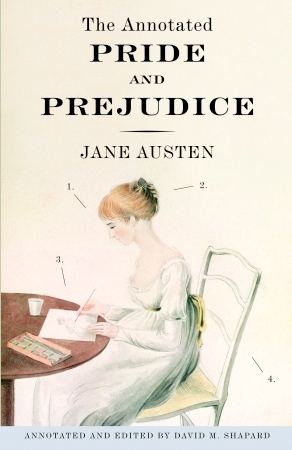
Pride and Prejudice
Cover art by Cassandra Austen

Pride and Prejudice by Jane Austen

Anyone unable to appreciate this book is vapid, insufferable, and probably too plain to dance with.