Ginger Baker Is a Very Typical Jerk

Beware of Mr BakerI just watched the documentary about iconic drummer Ginger Baker, Beware of Mr Baker. It is quite good, but I don’t mean to talk about the movie here. I want to discuss Baker himself. You see, he really is a vile man. And if you eliminate his amazing musical abilities, he is just like countless men that I’ve known. It’s a curious thing. There is a mixture of narcissism and hopelessness that don’t seem to go together. He clearly thinks that the most wonderful and perfect thing is himself. But that hasn’t made him happy. So he blames the rest of the world.

There is a telling moment toward the end of the film. Baker is, bizarrely, into polo. As a result, he owns about thirty horse. He has to, because apparently, no one will allow him in their polo clubs because, as I said, he’s a vile person. While petting one of his horses, he says, “Horses don’t let you down. Nor do dogs. They all know who I am.” Who is he? I assume he means the center of the universe. This is coming from a man who is known in the music business as one of the very greatest drummers, but someone who no one wants to work with because he’s so unpleasant. He is estranged from his children. Even his current wife seems to have glommed onto him as the best of bad options.

If I hadn’t know so many men who are like this, I might think this is all a function of Baker’s musical brilliance. But it isn’t. Most men who behave as he does don’t have anything particularly impressive to offer to the world. So I’m sure that if Baker had simply become a coal miner, he would be exactly the same. So it’s hard for me to consider him just a lovable rogue. He’s very unlovable. But people are more willing to give him a pass because of his past accomplishments. Obviously, I’m not.

Another moment, just about a minute after Baker’s comment about horses and dogs, the filmmaker, Jay Bulger, asked him if he thought about going back into music. This is following Baker’s never ending complaints about being broke. Bulger tells him that he may be forced to if his ranch is going to be foreclosed on. And he adds, “Besides, it’s who you are.” And Baker, ever the charmer, spits back, “Oh, for fuck’s sake, why are we talking about this shit?!” I get it: Baker is unhappy. But this is just bully nonsense.

During the credits, Bulger runs through various clips of Baker insulting him. In some cases, it is clear that he’s half joking. But mostly, he’s just angry because he isn’t being asked the right questions and given the right respect. But there is no joking at all when Baker slams his cane into the nose of Bulger. The reason he does this is incredible. Baker doesn’t want him to interview people that Baker has left behind “on my film.” His film. His life. His world. But Bulger’s ultimate reaction to this is part of the problem, “I realized: the madman is alive and well!”

But not really. In that sentence, “madman” is a euphemism for what the Frankly Curious style dictates I call a “jerk” but would prefer to call something more colorful and forceful. And more important, Baker may be alive, but he is not well. He is miserable. And he is one of countless men who deal with their unhappiness about the fact that the world does not worship them by making everyone pay. As a James Thurber cartoon I once saw said, “You’re disappointed? We’re all disappointed!” Most of us manage to get through life without making everyone else more miserable than they already are.

Why People Like Moonrise Kingdom

Moonrise KingdomThere is a wonderful moment in Moonrise Kingdom. Suzy just revealed a painful secret to Sam and he laughed at her. She stormed away and hid inside the tent. Shortly after, Sam opens the entrance to the tent and says, “I’m sorry… I’m on your side.” And the conflict is over. It’s very mature. Yet those two are outcasts in the world. No one understands them. But more important, they don’t understand the world. They are looking for a way to navigate the world in the same way they attempt to french kiss. And in this way, they are connected to everyone else.

Despite its extreme charm, Moonrise Kingdom is an existential nightmare. It is a narrative demonstrating what Schopenhauer said in The World as Will and Idea, life consists of “momentary gratification, fleeting pleasure conditioned by wants, much and long suffering, constant struggle, bellum omnium [everyone against everyone], everything a hunter and everything hunted, want, need and anxiety, shrieking and howling; and this goes on in saecula saeculorum [forever and ever] or until once again the crust of the planet breaks.” Physical circumstances may change — generally for the better in this film — but no one is anymore happy at the end than at the beginning. They simply make it through today in order to be allowed to make it through tomorrow.

None of this depresses me. This is simply the way I see the world. At least for the time, I have made my peace with the Will. But most people find my outlook on the world to be a decidedly unpleasant one. So why does everyone seem to find this film so pleasant? Is it just that they don’t over-think films like I do? Or is it just that it is about children and we assume that things will work out? After all, we all know how well things work out for our childhood selves! I don’t think it is any of this.

Wes Anderson creates such odd characters that we don’t see them as real people, even as we recognize ourselves in them. The characters are taciturn as they suffer through their lives — just as we all secretly think we are. It doesn’t matter how much we complain about the injustices that plague us, there are more profound wounds that we simply don’t have the language to communicate. But only in an Anderson film do we see characters manifested who share this existential dread that, just as always, today will be just like yesterday.

A good part of Wes Anderson’s work leaves me cold. But as big a part of it is exceptional work. And I think Moonrise Kingdom is the best film of his that I’ve seen — unquestionably a great film. But it is great almost by accident. And this may be why so many of his films don’t really work. They are cut off from external reality, and so only sometimes do they manage to grab hold of an internal truth and sing it. Otherwise, it is just odd characters acting in odd ways.

Having said this about his films working, I want to be clear that they are always well made. He has a distinct visual style that is usually rendered with great care. And that really is the case here. Moonrise Kingdom is an incredibly beautiful film. It could consist of only still images and it would be compelling. What’s more, it is genuinely funny with an extremely well structured story that triumphs over its own cherished absurdity. But what makes it work escapes me. And I think it escapes Anderson too.

So what is the “happy” truth in Moonrise Kingdom? I think it is that we are all lost — muddling through life on a hopeless quest. One moment we are the shame of the troop and the next, we are the hero. But always, we should cut each other some slack. Not that it matters.

Thematic Analysis of Fantastic Mr Fox

Fantastic Mr FoxI watched Fantastic Mr Fox. I thought it was wonderful. So I watched it a second time. And it all made sense. It is an allegory about class. The three farmers represent the power elite. The other humans represent the liberal class — as defined by Chris Hedges in Death of the Liberal Class. And the animals are the working class. So let me go through this because it probably isn’t obvious.

The hardest characters to understand are the non-owning humans: the liberal class. We aren’t talking the middle class. We are talking about the upper half of the upper class: the people in the top 10% of incomes. These are the people who are supposed to keep the power elite (the top 0.1% — more or less) from getting out of hand and taking everything for themselves. And in so doing, they prevent the working class from rebelling. But like in our own time, this class has totally lost track of this first duty. All they do is allow the power elite to take more and more by oppressing the working class.

The three farmers are a very accurate representation of the rich in our society. But this kind of representation is so out of favor that it has an anachronistic feel to it. This is probably because the farmers are the one thing that I most remember being the same from the book. And the book was written in 1970. You know: when powerful labor unions still existed in the US and UK — when workers still saw their wages go up with productivity and took it for granted. I know that the rich don’t think of themselves as Boggis, Bunce, and Bean. It’s called cognitive dissonance. It’s what allows people to have billions of dollars while others starve and then use those billions to buy elections so that they can acquire more money. Now that I think about it, Boggis, Bunce, and Bean are too good a representation of these “people.”

Now clearly, Mr Fox has his personality issues. He’s a narcissist. Yet most great leaders are. Does he create a better future for all the other animals? I think the answer is less muddled in the book. There, Mr Fox is only stealing chickens to feed his family. And in the end, the animals seem to be in a better place. In the film, the farmers’ attacks on the animals are really the fault of Mr Fox’s narcissism. And at the end, the animals are living in the sewer and stealing from the grocery store. I’m not sure that is a long-term strategy for success. But it is clear that the animals had no choice after the farmers started their campaign against Mr Fox.

The film provides the other alternative by way of the wolf: the animals could separate themselves from human civilization. In other words, unlike the truly ridiculous notion in Atlas Shrugged where the rich “go on strike,” the workers actually could leave. And it would shutdown everything else. Of course, that isn’t the case in Fantastic Mr Fox because unlike in the real world, the humans do not depend upon the animals (workers). So on that point, the allegory breaks down. But those are the choices for the working class. We can flee or we can fight. We workers have enormous power if we stick together. Because there is no doubt: the system is broken. The farmers are destroying our homes, without a thought to the fact that they are only harming themselves. Even for their sake, we need to stop them.

Afterword

As a film, it is really charming. And it is totally Wes Anderson. I was curious about it because he’s not known for animation. But it looks exactly like you would think it would. And it is filled with flights of fancy. It’s just a wonderful film, even if you don’t care about the politics.

Reality, Fantasy, and Professional Wrestling

Bret 'Hit Man' HartI live in a no man’s land with regard to professional wrestling. On one hand, I absolutely hate it. It represents everything that is wrong with American entertainment. It is all about good versus evil. There is no subtlety to the characters. Good guys are good because that’s just how they are. And, of course, the same thing goes for the bad guys and those in the middle. It’s more or less like Hogan’s Heroes, but even that displays far more complexity than professional wrestling. Ultimately, this is all a political problem for me, because Americans generally think of the world just as wrestling presents it: black and white.

On the other hand, I admire professional wrestling. I understand that from top to bottom, it is a very professional form of entertainment. Within its constraints, it is wonderfully creative. The writers create interesting conflicts. And the performers are shockingly good at the kind of improvised performance art that they practice. In addition to all this, professional wrestling is ultimately the artistic representation of archetypes. As Roland Barthes put it, “What is thus displayed for the public is the great spectacle of Suffering, Defeat, and Justice. Wrestling presents man’s suffering with all the amplification of tragic masks.”

When I was a kid, I hated wrestling. That was simply because I hate boasting. And also because big men scare me. And, of course, it was “fake.” But after I read Barthes, I turned around on it. I was able to understand and appreciate what Andy Kaufman and Jerry Lawler were up to. Just the same, I would never willingly watch professional wrestling. I’m no more interested in it than I am the newest variation on The Expendables or Sabotage. And I still find it pernicious. We really should have gotten past such simplistic representations of archetypes.

As a result of all this, I have a problem when dealing with others discussing wrestling. Articles about it tend to focus on this stuff that is self-evident once you combine two notions: that wrestling is “fake” and that its being “fake” doesn’t matter. When a corporate executive spends a whole season in shouting matches with Hulk Hogan (Or whomever — I said I don’t watch the stuff!) a few things are clear. First, these performers didn’t just decide to have this argument that will lead up to the season finale where a grudge match takes place. That was scripted. But it wasn’t scripted the way that an Alan Parker film is. It was scripted in the way that a Christopher Guest film is. So the performers are as creative as the writers. And we should respect that!

This all came up to me while listening to the Radio Lab episode, La Mancha Screwjob. I listened to it because it has a discussion of Don Quixote (which I haven’t listened to at this point). But the wrestling story is actually really stupid. It is about this “Montreal Screwjob” where wrestling supposedly got real. But the truth is that professional wrestling has always played with the line of real versus fantasy. The story specifically mentions a case where a woman left one wrestler for another wrestler and the two wrestlers went into the ring over this issue. So it was both not real (it was a performance) and it was real (because the conflict was real). But this kind of postmodern approach to the sport goes back at least to Kaufman-Lawler, and I assume as far back as professional wrestling has existed.

The story does show the power of wrestling in that even these people who cover it are confused about what is going on. Or maybe not. The truth is that the nature of wrestling is that no one will ever fully admit to what is scripted and what is not. So just as the wrestlers won’t admit that what they do is “fake,” it may be that the journalists who cover it are the same way. The current fashion is for people to admit that wrestling is scripted but that there are real aspects of it too. And this brings up perhaps the most important aspect for me: I assume that it is all “fake” regardless.

Consider the Montreal Screwjob itself. It involved the move of wrestler Bret “The Hitman” Hart from WWF to WCW. Supposedly, there was this incident that took place. One thing was supposed to happen in the ring, but in fact another thing happened. According to Wikipedia, it was a real incident. I don’t believe it. I believe it was a double con. I don’t think it was a coincidence that it worked out perfectly for the WWF and for Hart who went on to be the WCW champion and then retired with a boatload of money. Was there some reality in the mix? That’s the wrong question. The right question is: who cares?

Ultimately, great art plays with the same issues of reality and fantasy. But that “reality” is not “what really happened” but rather “what is eternal.” And so professional wrestling or American Idol or any of the countless varieties of “reality television” will never be great art. Or art at all. Because it can’t be deep.

So I’m left in this no man’s land. I don’t dismiss professional wrestling for not being a “real” sport. But the people who cover it as a subject don’t seem to get much past the thinking of those who hate it for this reason. Whether professional wrestling is “real” or “fake” is not what determines whether it is good or bad. But that seems always to be the focus of the coverage. And that means that the coverage of wrestling is as shallow as the sport itself.

Morning Music: La-Le-Lu

Wenn der Vater mit dem SohneDo want to have a good cry? Then listen, my friends, to the story of Wenn der Vater mit dem Sohne (I don’t really know what it mean: “When the father with the son”?) — the 1955 directorial debut of Hans Quest. It stars Heinz Rühmann who plays Teddy, a man who runs a joke shop who has raised his landlady’s foster child — Ulli — as a son, since the boy was abandoned by his mother at birth. One day, Ulli comes upon a clown suit and Teddy explains that once upon a time, he was a famous clown who performed with his son. But after his son died, Teddy lost the ability to laugh and started the joke shop. Ulli convinces Teddy to begin performing and joins him on the stage. Happily ever after? Not at all! We aren’t even half way through the movie.

The mother returns — now married. She wants to take Ulli back with her to America. So Teddy and Ulli run away together. But alas, there is nothing to be done and the mother eventually takes Ulli back with her, leaving Teddy emotionally destroyed for the second time in his life. Now if this were some piece of garbage like Kramer vs Kramer, the mother would return Ulli to Teddy. But thankfully, this is not a piece of garbage. So the film ends with Teddy as a sad clown, performing “La-Le-Lu Nur Der Mann im Mond Schaut Zu” (Only the Man in the Moon Watches).

Here is a video with three times that the song is performed in the film. It’s very sweet:

Depression and City Lights

City LightsI’ve been really depressed recently. And as anyone who is a fellow sufferer knows: there is no reason. It is just, as a friend once put it to me, as though you are living in a world of black and white; and sun never comes out. As a result, I’ve been trying — in vain — to cheer myself up with much cinematic comedy: Wallace and Gromit, Monty Python, and most especially Charlie Chaplin. Tonight, I watched City Lights for probably the first time in thirty years. There are reasons why I’ve avoided it for so long.

I disagree with most critics. I don’t think it is the high point of Chaplin’s career. I think that both The Gold Rush and Modern Times are better films. The main problem with City Lights is that it has some distinct dead spots. I think the fact that it is an incredibly compelling story has made viewers miss the fact that a number of bits just don’t live up Chaplin’s best work. What’s more, I really do think that Virginia Cherrill as the flower girl is weak. In fact, her performance is so poor that the viewer wouldn’t know what to make of the ending if Chaplin hadn’t directed it well by focusing on the continued holding of hands.

All that said, City Lights is a fantastic film. By the end of it, I was sobbing. Like everyone, I assume, I very much identify with the tramp. What is so special about him is that he isn’t all good. He’s lazy. He’s often dishonest. But most of all, he’s self-important. He thinks rather highly of himself, as is represented here by his interactions with the newspaper boys who mock and shoot spitballs at him. Yet we forgive all these sins because ultimately, the tramp is a decent person.

A wonderful expression of this is near the end of the film. The tramp has just absconded with the rich man’s money. (It was given to him, but justice is as rare in a Chaplin film as it is on the streets of Ferguson.) He gives her money for the rent and money for her eye surgery. But he pockets one bill — I assume a hundred dollars. This is his tendency. He looks out for number one. But in the end, the better angels of his nature win out. And I think that’s universal. It seems to me that every time someone has complimented me for doing something nice, I’ve always wanted to blurt out, “Yeah, but I almost didn’t do it!” Because that’s true. My instincts are not evil, but they are also not the best of who I am.

Of course, the true brilliance of the film is found in an early scene where Chaplin manages to establish the blind flower girl thinking that the tramp is a rich man without a word. It starts with, once again, the tramp being anything but upright. Rather than cross the street like normal people, he just walks through the cars — in the door on one side and out the door on the other. It’s funny, and it’s been used by a lot of people since, but here it is used primarily to establish the sound of the door closing so that the girl thinks he is getting out of his own car. Of course the real brilliance comes on the exit when the tramp buys a flower, and while waiting for his change, a wealthy man gets in his car and goes. She thinks it is the tramp disregarding his change.

I’m not sure that watching Chaplin when I’m depressed is a good idea. It does make me feel good in its universality and the ultimate sense of goodness. But things always work out for the little tramp in ways they just don’t in the real world. And that lays heavy after the film is over.

Anniversary Post: Daffy Duck

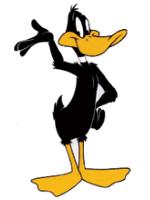
Daffy DuckOn this day in 1937, the first appearance of Daffy Duck was made in the Looney Tunes short, “Porky’s Duck Hunt.” In those early shorts, Daffy is a much more likable character. He’s kind of like Bugs Bunny, but absolutely insane. He’s also a lot more like a real duck. I find him quite charming. And this sets up a long collaboration with Porky Pig. Although in subsequent shorts they are more friends or, as was more true later on, Daffy was often trying to con the trusting Porky. My favorite is “Fool Coverage” where Daffy sells Porky accident insurance that will pay a million dollars, “Provided the accident occurs as the result of a stampede of wild elephants in your own living room, on the Fourth of July — of any year — between the hours of 3:55 and 4:00 pm, during a hailstorm.” Which of course is exactly what happens.

Anyway, here is the short that started it all:

There is a middle period where Daffy is still kind of duck like, and still mostly insane. “Yankee Doodle Daffy” is a good example of it:

Later, the portrayal of Daffy Duck turned very meta — with Daffy constantly jealous of Bugs Bunny. These are still quite good, but I don’t really like the two characters being pitted against each other. It doesn’t show either of them in the best light. My favorite later Daffy Duck cartoon is “Duck Amuck” where he is all alone. Or is he?

Happy birthday Daffy Duck!

See Also

Joe Miller Joke Book
Bugs: Rabbit or Hare? (One of my favorite articles!)

Anniversary Post: Charlie Chaplin

Charlie ChaplinOn this day in 1889, Charlie Chaplin was born. I remember reading a quote from Woody Allen talking about how he preferred Chaplin’s films to Buster Keaton’s. And he admitted that Keaton made the better films. This is true. Chaplin’s films really do suck in terms of cinematic art. Basically, he just set up a camera and shot the whole scene in a medium shot. In other words: he was filming plays.

But I’m with Allen. I admire Keaton. But I almost never watch his films anymore. But I own both The Gold Rush and Modern Times. And just recently, I watched The Kid. And City Lights is an outstanding film. It’s not even that they are funny — even though they still make me laugh from time to time. They are just so sweet at the same time that they are subversive. The Little Tramp is not exactly a believer in the American Dream. He’s just trying to get by. America would do better if it stopped believing in the “American Dream,” because it’s pretty tattered at this point — more the American Myth.

Anyway, I don’t have much to say about Chaplin the man; the films are enough. And here is the whole 1971 re-released cut of The Kid, which is 15 minutes shorter than the original cut. I don’t know the film well enough to say what’s different. But I got twenty minutes into watching the video before I managed to pry myself away to finish this article.

Happy birthday Charlie Chaplin!

Family Feud And Economic Data

Family FeudI was watching Family Feud and during the “fast money” sequence, one of the questions was “Name something that goes up every year in America.” The contestant said, “Inflation.” Steve Harvey commented something along the lines of, “You’ve got that right.” The survey said “0”! That didn’t surprise me. Most people don’t think about inflation unless it is out of control. And it isn’t out of control. In fact, it has been decades since it’s been out of control. Inflation is only something that the rich care about now. Harvey is worth an estimated $100 million, so I can see where he might be concerned about inflation.

Of course, inflation does not go up every year. In fact, it has been going down for years. This is one of the many examples of things that everyone knows that just isn’t true. Here is the FRED data since 1980:

Inflation - 1980-2015

The second contestant answered “taxes.” As I discussed about the legacy of Ronald Reagan, it is true that we at the bottom of the income scale have seen our taxes go up even while those at the top go down. But in general, taxes have not gone up as you can see in the following graph. Although there is one thing worth noting: individual taxes have gone up while corporate taxes have done down.

Total Federal Taxes as Percent GDP

The survey said “33”! So that probably makes taxes the number one answer. Family Feud is a game of perceptions, of course — not reality. There are a lot of things that do go up every year. Population goes up every year. In general, GDP goes up. But there is one thing that definitely goes up each year that I’m sure was not reflected in the survey: inequality. Here is the Gini Coefficient:

Gini Coefficient

A big part of the problem in the United States is that as a people, we don’t really know what’s on. Our taxes stay the same, but we think they are constantly going up because a bunch of rich people — whose taxes are going down — say very loudly that taxes are sky high. Meanwhile, more and more money gets funneled to those at the top and few people engage with this, and most of those who do claim that it doesn’t matter.

The Puns of Wallace and Gromit

Wallace and Gromit Complete CollectionOne thing that is really interesting in the Wallace and Gromit films is that they are filled with puns. But Gromit is not fond of them. He is forever rolling his eyes at Wallace’s lame attempts at humor. For example, in The Curse of the Were-Rabbit, they come to Tottington Hall to find the place overrun with rabbits. Wallace says, “They must be breeding like, well, rabbits.” So it is interesting that so many puns should circle around Gromit’s life — specifically, his tastes in books, music, and film.

There isn’t much of this in A Grand Day Out, except for “Electronics for Dogs.” But then, that film has always seemed rather like a proof of concept. Other than the skiing obsessed machine on the moon, I’m not that fond of it. It is really with The Wrong Trousers that the Aardman folk really get going with fully decorated sets — including walls and bookshelves. (Fun fact: Gromit’s birthday in 12 February!) While sleeping downstairs to get away from Feathers McGraw’s loud music, Gromit was reading The Republic by Pluto — which he is reading at breakfast the following morning. In his dog house, there are four books on the shelf: Kennels, Poodles, Sticks, and Sheep II.

Gromit's Birthday

In A Close Shave, we see Gromit in jail reading Crime and Punishment by Fido Dogstoyevsky. In A Matter of Loaf and Death there is much more. While Wallace and Piella are doing their Ghost thing downstairs, Gromit tries to sleep upstairs in his bedroom where we see a movie poster for Citizen Canine and a record album on the floor of “Poochini.” Later, when Fluffles returns Gromit’s stuff, we see the records “Puppy Love” by Doggy Osmond and a “McFlea” album. After discovering that Piella is a serial killer, he consults, Electronic Surveillance for Dogs.

Probably the best single run of puns is found in The Curse of the Were-Rabbit. Gromit has put Wallace on a diet — all vegetables. Wallace goes looking for some hidden cheese, on the bookcase. And the books are:

  • The Hunt for Red Leicester
  • Brighton Roquefort
  • How Green Was My Cheese
  • Brie Encounter
  • Swiss Cheese Family Robinson
  • East of Edam
  • Grated Expectations
  • Fromage to Eternity
  • Waiting for Gouda.

That last one is my favorite. And the list is a pretty good run of cheese puns. Later, Gromit plays The Plant Suite for his watermelon. Toward the end of the film, Gromit and the evil dog Philip end up in airplanes taken from a carnival ride “Dog Fight.” It’s all quite wonderful.

I’m sure that I’ve missed a whole lot of things. If anyone would like to point out things that I’ve missed, I would welcome hearing about them. One of the great things about the Aardman productions is how rich they are. Animation has the advantage (from the viewer’s standpoint) that everything has to be created from scratch, so great creativity goes into the productions. For example, I had seen The Wrong Trousers many times before I noticed that The Republic was written by Pluto instead of Plato. I love this kind of stuff — and there isn’t nearly enough of it.

Blade Runner and Memory

Blade RunnerLast night, I watched Blade Runner for the umpteenth time — but the first in a while. I began thinking about the main issue in the film: identity. It’s been bugging me because recently I had heard that the director, Ridley Scott, had said that he thought that the main character, Deckard (Harrison Ford), was a replicant. There is no indication in the film that this is the case. And it most certainly isn’t the case in the novel, Do Androids Dream of Electric Sheep? What’s more, such a reading of the film creates all kinds of problems. Replicants supposedly don’t have empathy — something Deckard clearly has, at least with regard to Rachael.

The one thing that really distinguishes humans from replicants is empathy. This raises a problem, because not all humans have empathy. Lack of empathy is more or less the definition of psychopathy. And if ever there were a job that would be helped by a lack of empathy, it is a bounty hunter. Whereas a prosecutor is supposed to look for the truth (which they don’t), a bounty hunter is only supposed to hunt down people. It’s like in that great scene in The Fugitive where Dr Kimble says he didn’t kill his wife and US Marshal Gerard replies, “I don’t care.”

And this makes the ending of the film quite interesting. As Roy (Rutger Hauer) gains empathy, he saves Deckard. But if the roles were reversed, Deckard would not have done the same. That gets to the issue of empathy as a continuum. Clearly, when empathy came to Roy, it came in full measure — a measure that probably doesn’t exist in humans. Is it possible that the replicants are destine to be more human than we are? After all, how empathic is a four year old child? And I wonder if the humans who mandate that replicants only live four years don’t do so because it would be only too clear who are the better creatures.

Regardless of this, the question remains: other than empathy, how would any human know that she was not a replicant? After all, our memories are nothing but chemical storage. The only thing that we can be certain of is that we exist in this moment. Everything else is just a phantom: a construct of what we call time. But I’ve long been suspicious of time. It seems to me just our primitive way of experiencing the totality of the universe. And in that way, Roy is wrong in his final speech:

I’ve seen things you people wouldn’t believe. Attack ships on fire off the shoulder of Orion. I watched C-Beams glitter in the dark near the Tannhäuser Gate. All those moments will be lost in time, like tears in the rain. Time to die.

There are only two ways to look at it. It could be that time is an illusion. All our memories are effectively implants. There is only an eternal now. The past is a lie we tell ourselves to explain what is happening now. Or it could be that time is just our limited view of a larger cosmos: we are stuck seeing the three-dimensional world from our perspective in Flatland.

I remember reading that scorpions — some of them anyway — have no ability to create memories. It strikes me that memory is a necessary condition for an animal to develop empathy. So I think that the ideas of identity and empathy are really bound up in the notion of memory. Whether memory has some actual basis in past events hardly matters. And maybe this is why Rachael in the movie seems to have empathy: because she was given memories. Roy was not. Imagine what a great creature he would have been with a longer life.

Three Thoughts on Game of Thrones Season 4

Game of Thrones - Season 4I watched the fourth season Game of Thrones over the last two days. It is not as good as previous seasons, I think. The biggest problem is that there are a lot more action sequences and I frankly don’t think they are well directed. They are trying to render huge scenes, but they are still ultimately limited to one on one combat. So there is a disconnect. Also, the characters seem only to get more psychopathic over time. Even little Arya is beyond a mercy killing. (You have to question what the point of vengeance is if it will just turn you into the people you hate.)

But I want to discuss three issues that came up for me while I was watching the show. Let me start with a kind of pleasant one. There are only two main characters who are consistently likable. And they just happened to be the book worms: Tyrion Lannister and Samwell Tarly. One is a dwarf and the other is fat. But if the series has heroes, they are them. I’ve noticed this among any number of other writers. I think it is very common for writers to be book worms, short, and fat. So who better to be the only characters in a psychopathic world who have empathy. This is probably the only way that Game of Thrones is true to reality. That, and the fact that dragons don’t really discriminate between sheep and humans.

The primary story in the fourth season is the murder of King Joffrey and the trial of Tyrion for doing it. But here’s the thing: everyone knows that Tyrion didn’t do it. And in particular, his sister and father use the murder to frame him just because they don’t like him. That’s all fine — that’s done every day in America. But in so doing, they aren’t the least bit interested in who actually did kill the little tyrant who all viewers were thrilled to watch die. But why is this? As I said: this happens all the time. Why do people react to injustice (not that Joffrey’s death was an injustice in an objective sense) with an irrational anger rather than a desire for, you know, justice? I really don’t understand — at least apart from the observation that people are irrational. And if that’s the case, the cause of justice is doomed.

My biggest problem with both and third and fourth seasons of Game of Thrones is the story of Ramsay Snow and his sadistic torture of Theon Greyjoy or “Reek.” The show has clearly crossed the line at times between drama and torture porn. What’s more, Ramsay’s fortune has done nothing but grow as a result of his behavior. The worst that tends to happen to truly vile characters in the series is that they have a quick death. Given that almost all the good (by the standards of the show) characters get the same, it is not very satisfying. So even if Ramsay eventually does die, it won’t much matter.

But the character of Reek has a larger significance. He has been totally broken and is now totally devoted to the psychopath who castrated him. But I don’t think that Reek is all that special. We are all Reek. He is not only what society turns us all into; he is what society proclaims is the best that we can be. Every time I hear someone gushing about how America has “the greatest healthcare system in the world,” I think of Reek. These are people who can’t see reality — who are so wedded to the approbation of their captors that they are willing slaves. Here in America, we call it, “Patriotism!”

I suspect that I will continue on with the fifth season of Game of Thrones. I want to know what happens to Tyrion and Sam. And also Arya and Varys. And there are some minor characters who I may never see again like Osha. But mostly, I don’t much care what happens. In the end, someone will unite the Seven Kingdoms. And it doesn’t matter in the least who it is. So I guess that’s another way that Game of Thrones reflects reality.