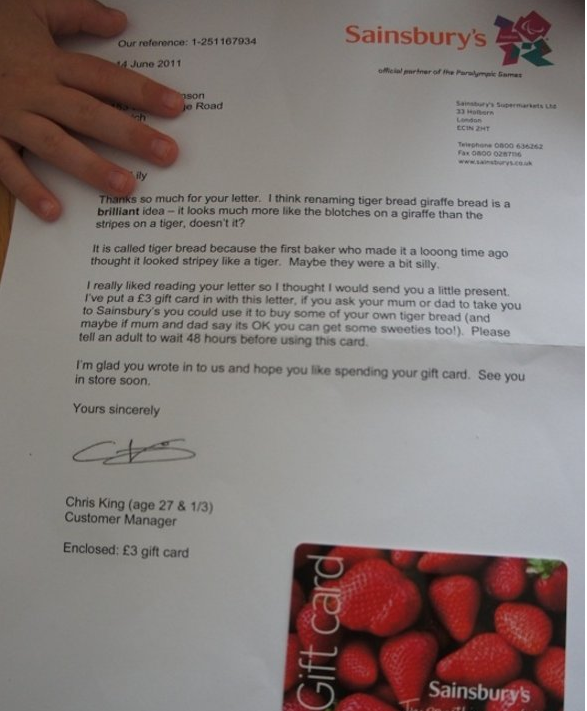
Frequent commenter Jurgan posted a charming couple of letters that rocked the bread world a few years back. (I’ll write about it later today.) But it is all on Tumblr, and as you know, I don’t much understand new technologies. This is odd given that I’m paid to write about technology. But I guess it isn’t exactly true that I don’t know what it is. It’s a blogging platform. I just don’t understand why it is considered an innovation. I spend much of my life in awe of the fact that people get money for things that are not new. Like Facebook: how was that new? For those who don’t know (and this apparently includes the vast majority of Facebook users), it is an image sharing application. Really: that’s all it is. And those were around for years before Facebook.
None of this should be taken as a slight against people who use Facebook or Tumblr. They are fine tools. What’s annoying is that the press and investors treat these things as revolutionary when they aren’t. In particular, Facebook is useful because a lot of people use it. That appears to be the case with Tumblr as well, which hosts 271.5 million blogs with 126.6 billion posts. (Note: that’s an average of 466 posts per blog, which is pretty good given my experience with blogs is that a dozen is about average.)
In 1999, in an example of the kind of thinking that has shaped the internet for the last two decades, eXcite turned down an offer to buy Google for $750,000.
The thing about Tumblr, Facebook, Twitter, and many other of these social networking sites is that they are closed systems. To me, this is a great step backwards for the internet. Everyone should be on an equal footing. There are obvious advantages to having a closed system, but they are mostly advantages for the company. And you can see the problem on sites like Booman Tribune or Lawyers, Guns & Money. These sites require that you have an account to comment. They are big enough that they still host lively discussions, but they clearly limit discussion as well. (They probably do this because they haven’t realized that there is now software that filters out virtually all spam.)
It leads me back to the old Peter Thiel quote, “We wanted flying cars, instead we got 140 characters.” Now personally, I never wanted a flying car. This is because I’m still reasonably attached to living and you can just imagine if we have a quarter billion cars flying around with their drivers drinking hot coffee and texting photos of the thousands of car crashes they see each day. But there is a reason that we got 140 characters: because there is very little actual innovation that goes on in the realm of high tech.
Let me share with you a personal story. A couple of years back, I was working with Mikhail, a brilliant young hardware designer, on an amazing technology. I’m prevented by contract to explain it to you, but it had to do with extreme sports. It combined a number of advanced technologies to do something that frankly I didn’t think was possible before we started. But we couldn’t get money for it. At the same time, we knew a couple of guys who got a half million dollars to produce a wired toy submarine that had a camera in it. Wired. Almost a decade ago, Mikhail and I were streaming video from RC helicopters in our spare time, and these guys had money dumped on them for a toy that would have been only marginally cool in 1980.
The truth of the matter is that capitalism is not a good system for creating innovation. And capitalists know this. This is why the big pharmaceutical companies depend upon the government to do the research on anything actually innovative. Otherwise, they just stick to the tried and true: yet another erectile dysfunction drug, yet another benzodiazepine, yet another Vicodin knockoff. And in the area of high tech, who wants to invest in something that is actually new, when they can just market a photo sharing site as if it were a major innovation? Or yet another blogging platform like Tumblr, which sold for over a billion dollars less than three years ago? We don’t have innovation because we don’t value innovation; we value profit.
Afterword
Oh, you know what was revolutionary? The Google algorithm. And they had a hell of a time getting money. In 1999, in an example of the kind of thinking that has shaped the internet for the last two decades, eXcite turned down an offer to buy Google for $750,000. (That’s just over a million in today’s currency.) In America, what passes for innovation is Mitt Romney investing in Staples with the brilliant idea that business supplies could be sold through a chain that gets lots of government funding to put small business supply stores out of business.

 As promised before, Jurgan brought my attention to a charming pair of letters. But let me tell you the whole story, because it is pretty great from beginning to end.
 Frequent commenter
 On this day in 1970,