Paul Krugman provided the following graph of total public and private debt, which I altered with red with the presidents at the different times. The only Republican who doesn’t look too bad is George H. W. Bush, who was an old-fashioned conservative. What it shows, as I’ve discussed before, is that modern Republicans are not economically conservative. In general, I don’t care about the budget deficit. But Republicans supposedly do. I’ve come to the conclusion that Republicans are not hypocritical; they are good old-fashioned 1984 styled authoritarians who care about one thing and one thing only: power for its own sake. And as a country, we really need to wake up to this.
Monthly Archives: January 2012
A Really Big Problem
As regular readers of this blog know, my background is in climate change science. And recently, I have become very angry about continued global warming denial, because now it sounds so much like evolution denial. I think I may have a way to talk to conservatives about it.
I just heard Fred Thompson talking about Newt Gingrich and he said something like, “I’m a father and a grandfather and therefore…” I suspect that he would have gone on to talk about the economy. It doesn’t matter what Fred Thompson says—ever. But it got me thinking: most conservatives are old and therefore have children and grandchildren. And as ridiculous as their opinions are, they do care about these young people.
Given this, I have a question. Let’s suppose there is only a one percent chance that global warming is actually happening. If it does happen, it is going to have a profound effect[1] on future generations, and certainly for the next five generations, it is going to be worse for the next than it was for the last. If this has only a 1% chance of happening, isn’t it a good idea to be truly conservative and try to stop it from happening, rather than continuing on as we have for the sake of the fossil fuel industry?[2]
[1] People (myself included) have argued that there will be positive changes of global warming. In particular, it is likely that the biodiversity of the earth will increase. There are several reasons for this. First, more CO2 is good for plants. Second, within reason, higher temperatures are good for plants. And third, the temperatures at the equator will change little and the poles lots. But what this all means is that there will probably be more biodiversity in bacteria, plants, and insects. The situation for mammals, for example, looks very bad. And regardless, the rapidness of the heating could cause the whole life-cycle of the planet to go haywire, causing biodiversity to go way down for millions of years. The fact is that we just don’t know.
[2] The case is always made that fighting global warming would hurt the economy. In a booming economy, that is certainly true. But in a depressed economy like we now have and will continue to have? It is not true. Now is the perfect time to get all forms of pollution under control. All more oil drilling does is make more billions of dollars for oil companies. Have you ever wondered why the oil companies are so keen to drill up in Alaska, even though the total amount of oil they will get is a fraction of a percent of what America needs each year? It is because even though the oil means nothing to our country, it means billions of dollars for the oil companies. Don’t be fooled.
RICO Laws and Regulation
Last Thursday on The Daily Show, Jason Jones did a very funny segment about the over-regulation of the Mob via the RICO laws:
I really like this and I think it gets at the heart of what is wrong with the economy: it is largely controlled by thieves. But as usual with The Daily Show, I’m not really sure that they get it. Too often, such segments are only about making the interviewees look stupid. And there was a lot of that in here, although in general, Jason Jones tends to play the fool in his segments. And no one came off looking particularly bad except (maybe) Lou Ferantte, who is just trying to sell his book Mob Rules: What the Mafia Can Teach the Legitimate Businessman.
But I still think the middle right of the middle right of the middle right philosophy[1] that dominates at The Daily Show probably sees this feature as an attack on getting rid of all regulation. It is still a highly corporate-friendly philosophy that believes (without knowing it) that regulation must be kept as low as possible so those in power can have as much as they can get away with without having their heads end up on a bunch of pikes.
[1] Most people in the US think that institutions like MSNBC and The Daily Show are liberal because they frequently go after the Republicans. This misses the grand scope of political debate and the profound change that has taken place in America over the last 40 years. President Nixon’s policies were slightly to the right of current “Socialist” Barry Sanders. What used to be center-right in America is now what conservatives call “Socialist!” or “Communist!” or “Nazi!” (Because, as Glenn Beck will tell you, the Nazis were socialists because “Nazi” is just short for “National Socialism.” Of course, for the ignorant Atlas Shrugged quoter, this is true because socialism—collectivism—is any form of government that requires any form of taxation—or much else—from the governed.)
I’m Not So Bad
Now I don’t feel so bad about The Revolution Will Be Televised. In that article I had a vision (Fantasy?) about a time when the people would rise up in this country and exact vengeance for what has become a very unjust country. And in particular, I pointed out that many more or less good people would end up being hurt. This was sort of my gentle take on Ward Churchill’s Some People Push Back.
Yesterday, Brad DeLong tweeted the following:
That was my point.
She So Crazy
I know it’s hard to tell because of my well-rounded interests, but I’m so far from being in the Hip Hop Loop, I’m not even sure exactly what qualifies as hip hop. The only reason Nicki Minaj blipped on my radar was because of her appearance on Ellen D’s show. And the only reason I saw that was because another little blip from Britain caught Ellen’s eye. Meet Sophia Grace.
Here’s where Nicki Minaj comes in…
Nicki is, as far as I know, a YouTube Cinderella. Good for her. Sophia, as far as I can tell, is an adorable (from a distance) little spaz. Good luck to her parents. My question is, why does any parent allow a precocious child to listen to, much less emulate, a young woman who sings songs like the explicit, “Stupid Hoe“?
Full Sentences Inside Parenthetical Enclosures
Because I am a freak, I suffer some considerable anxiety about the proper way of dealing with complete sentences inside of parenthetical enclosures. Most of this is purely aesthetic. For example, I hate constructs such as “XX XX (XX XX.).” I just hate the period-parenthesis-period. Or anything similar: “XX XX (XX XX!).”. So I will never put a complete sentence inside an inner-sentence parenthetical enclosures at the very end of a sentence. But before I go any further, we should look at what The Book says.
According to The Chicago Manual of Style 15th Edition:
I don’t think I have ever included more than one sentence inside a parenthetical enclosure in a sentence. Certainly, doing so outside a sentence is done all the time. In fact, one or more paragraphs are sometimes put inside a parenthetical enclosure, although it seems to me that such things should be put into footnotes. What’s more, I feel no compunction about putting rather complex sentences (including: colons and semicolons) inside inner-sentence parenthetical enclosures. But care must be taken.
It is a matter of opinion, but any writer must ask if a parenthetical statement is so long that it causes the sentence on one side of it to lose contact with that on the other. If that’s the case, the whole construction must be reevaluated. There are always alternatives. Often, I find that things I initially put inside parenthetical enclosures really want to be independent sentences. This is especially true when what’s inside is very long. Consider putting it in its own paragraph—without parentheses. Often what at first seems parenthetical is not.
The quotation from The Book seems to indicate that these inner-sentence parenthetical enclosures should never end with a period. However, there is no admonition against any other full stops and there is no guidance whatsoever about capitalization. This is where my biggest concerns lie. These are the rules I’ve developed for complete sentences inside of inner-sentence parenthetical enclosures:
- If it is at the end of a sentence, put it outside the sentence. If this makes the meaning confused, rewrite the paragraph and find something that does work.
- Otherwise, capitalize the first letter in the sentence.
What I often see are parenthetical enclosures that end with question marks or exclamation points that do not capitalize the first word of the sentence. This is certainly what The Book seems to dictate. But—because I’m a freak—it drives me crazy. And I think it is confusing, because these are full stops. But I don’t know of anyone else formatting inner-sentence parenthetical enclosures in my way. But they should. Anything else is inconsistent and just odd.
Shakespeare Apologists
So I’m reading Shakespeare. And I’m watching Shakespeare.[1] In particular, I am studying the Henry IV plays and Henry V. And I notice something: all these low characters (Falstaff, Prince Hal) speak in prose, while all the high characters (Henry IV, Henry V) speak in verse. This does not come as a shock. I think that for a layperson to really appreciate Shakespeare, he must admit the poet’s defects—which are many. And perhaps his biggest defect is how much he sucks up to authority.
It is hard not to see Shakespeare’s personal story as anything but a 16th century Horatio Alger: poor young man goes to the big city and comes back home triumphant. And therefore, it is hard not to see Shakespeare as primarily a businessman rather than an artist. He apparently did not write anything the last several years of his life. It is doubtful that this is due to the high standards he had by this time, because his last few plays were garbage. Maybe the old man (My age!) just felt he didn’t have it in him any more. But doesn’t it make more sense that his fortune was secure and that it was always about the money?
One of his last plays, Cardenio is lost to us. There is probably a reason for this, like: it was not very good. It is believed to be based upon Don Quixote. So perhaps Shakespeare and Fletcher[2] can be forgiven, because as I know, Don Quixote is a damned hard book to adapt; it’s the novel version of The Illiad. But this does provide a nice contrast: Shakespeare as the landlord during his last years compared to Cervantes, who pretty much died with pen in hand.
Shakespeare Apologists
I tried to find some information on how much of the various plays were verse and how much prose. I’m sure I’ve seen this kind of information before, but I couldn’t find it online. Instead, I found the following on Cummings Study Guides:
This is the ultimate. It would make Christian apologists proud. “Yeah, it’s true that Shakespeare clearly thinks that royalty are better than common men, but there are exceptions so it isn’t true!” Let’s see the logic here. Hamlet—an enormous part—is sometimes written in prose. The same goes for a minor character in Coriolanus. Does this need comment?!
The witches in Macbeth and Caliban, son of a witch, in The Tempest are written in verse. Maybe the fact that they are not, you know, part of the normal world has something to do with this? Consider, if you will, A Midsummer Night’s Dream.
It is hard for me to speak of The Merchant of Venice, because I don’t know it very well due to the fact that it is such an offensive play—far more offensive than Christopher Marlowe’s The Jew of Malta. Let me only say that the evidence here is pretty unsatisfying. Are we really to believe that Shakespeare, the landlord, really thought it was the dirty world of money?
And Much Ado About Nothing? I just don’t see how a comedy written almost entirely in prose is an argument against the original claim.
The Case for Shakespeare
Let me make the case that Shakespeare wasn’t a classist asshole: he was. But everyone was. He wasn’t writing in modern America. You have to take an artist in the context of his time. I make this case to people about film all the time: Citizen Kane is not a great film because it is better than films today; it is a great film because it was head-and-shoulders better than anything in 1945. So why should Shakespeare be held to a higher standard?
Now let me demolish this argument, which I think is as strong a defense as one can make for Shakespeare: Cervantes. Miguel de Cervantes was very much a man of his time. He too was a classist. He was a Catholic. He was in no way a modern man. And yet, Don Quixote and Exemplary Novels transcend this in a way that Shakespeare’s work never did.
Still, I accept the argument I made above for Shakespeare. But I also accept the fact that Shakespeare was simply one of the best five or so playwrights in London at the end of the 16th century. I don’t think he was the best at that time and place, much less the best in the English language or (Gasp!) ever. This is what I find so frustrating about Shakespeare. There is so much to like. Hell, I memorize speeches from his plays for no reason but the joy of it. There are characters I love like Benedick and Beatrice in Much Ado About Nothing. But there are also characters I despise like Claudio and Hero in Much Ado About Nothing. Why can’t people see this? Why are good plays by Ben Jonson and John Webster and many others so rarely performed, while bad plays of Shakespeare are finely tuned to make them palatable? I don’t know. It is all about history, I suppose. But so are the Nazis. That doesn’t mean we honor Nazism as the greatest form of governance the world has ever know![3]
[1] It is wrong to say that I, or anyone, watches Shakespeare. Each play gets so much help from editors, writers, directors, costume designers, art directors, and perhaps most of all, actors, that any Shakespeare play or movie is a collaboration, with That Bard giving less than he gets. It is perhaps also wrong to say that we read Shakespeare. Gary Taylor has pointed out that pronunciations have changed so much since the late 16th century, that when reading Shakespeare, we are reading another language. This, of course, does not stop the worshipers. Just one example about a production of Titus Andronicus from Wikipedia [Underlining is mine -FM]:
[2] I really don’t know why I mention Fletcher, because many of Shakespeare’s plays were collaborations (probably many more than we know). In general, Shakespeare gets all the credit, so I see no reason why he should not get all the blame.
[3] Might as well cut to the chase and end with Godwin’s Law.
Journalism for the Masses
I do not care for puppets. Even as a child I found them to be at best moderately amusing, but mostly just weird. Mr Rogers’ puppets in particular, so as to seem normal in his neighborhood, were curiously creepy. Even the subtle condescension in his own voice and manner gave the impression that Mr Rogers was addressing insane and potentially violent viewers rather than very young children. As I was being raised to see any and all strangers as potential threats, his opiate personality were unsettling and suspect.
In later years, I experienced the other end of puppetry, kneeling behind a puppet stage, arm raised over the edge with a googly-eyed puppet on my hand. As an evangelical enabler, part of my missionary position involved performing puppet shows for the poor dumb kids whose sadistic parents dragged them to church every Sunday. My puppet was a felt flower with the insipid name, Flower. I don’t have the scripts of any of those charming morality plays (many of which I helped author), but I know they were funny as hell.
As an adult I can now appreciate, if not always the humor, at least the skill required to manipulate a puppet well. That isn’t my point in exposing this shocking puppet exposé. The point is, there is an Ohio-based television station that is using puppets to get the news to the people. As stated in what I hope will be an award-winning article by Thomas J. Sheeran, “…a television station barred from using cameras during a high-profile corruption trial covers the highlights with a nightly puppet show. It stars a talking squirrel ‘reporter’…”. That Mr Sheeran felt the need to put “reporter” in quotations gives you some idea of his “take” on the story.

I can only say that combining news or “gossip” with puppetry is simply brilliant. Not only are WOIO and it’s sister station WUAB Job Creators, have stumbled upon a so-crazy-it-just-might-work method for propagating “information” to the people of Ohio. Information that, sadly, they would be unable to process using yesterday’s news methods. Of course, the real credit goes to Jon Stewart and Stephen Colbert who have succeeded in making humor a necessary part of a healthy information digestive system. Kudos.[1]
Of course, this will put even more pressure on Sesame Street, which is already under pressure from the Society That Undermines Philanthropy Intelligence and Dedication (STUPID) to make learning more fun and less educational. I think we can all agree that the goal is within reach. It’s only a matter of time until the news is animated by Koreans and directed by Matt Groening.
Until that day, remember, while corporations may be people, puppets are tools like most other members of the media. Tools we can use to shape a tomorrow that is easier to digest.
[1] In your face Colbert! I mocked it first! How does it feel when the puppet master is not you, but a MILF in New Jersey? Well, not fromNew Jersey, I was born in California and moved here about ten years ago, so technically… Nevermind! You have just been puppet-powned.
Falstaff “Railed Against Our Person”?
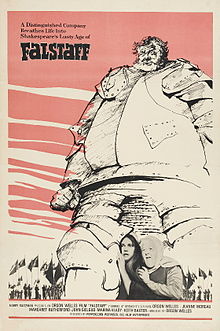
I’ve been thinking about Falstaff for a couple of weeks now, as is evidenced by my trolling around over at Shakespeare Geek. So I’ve been hitting The Book (my old and rather bad Complete Works of That Bard), trying to make some sense of Orson Welles’ Chimes at Midnight. In particular, there is a scene after Henry turns away from Falstaff, in which Henry says, “Enlarge the man committed yesterday.” At this, one of the king’s advisers asks, “Falstaff?” That was a bit of surprise, but I wasn’t sure if it wasn’t just because I hadn’t been paying attention.
King Henry’s line is from a speech in Henry V, where he uses it to trap (sort of) Richard Earl of Cambridge, Henry Lord Scroop of Masham, and Sir Thomas Grey:
That railed against our person: we consider
It was excess of wine that set him on;
And on his more advice we pardon him.
Going back to Kenneth Branagh’s filmed version of Henry V, I watched and listened carefully: was he talking about Falstaff? No. But that hardly means anything. I knew from experience that Branagh had cut the hell out of the play and added some of Henry IV Part 1 and Part 2—quite awkwardly, I think, which is too bad because Robbie Coltrane is really wonderful as Falstaff (better than Welles).
So I went to the text itself, and the truth is that it could be. Henry gives the speech in Act 2, Scene 2 and we don’t find out that Falstaff is dead until Act 2, Scene 3. So it could be Falstaff he is talking about. But it doesn’t matter. And it probably isn’t. In fact, it is probably the case that there was no one “that railed against our person.” The scene uses it only as a ruse.
Thus we come to Welles’ brilliance as a storyteller. There is a real problem with Henry V: after two Henry IV plays, he is clearly a dick. Welles manages to fix this problem by taking this little speech entirely out of context, to show that Henry really does still care about Falstaff. It is interesting that in My Own Private Idaho, Gus Van Sant uses the two funeral scenes to do the same thing. As much as I like Van Sant, I doubt he would have come up with this on his own. Welles was a great director (film and theater) almost from birth and this is a perfect example of his greatness.
Tune in Tomorrow
Tomorrow, I will write about something else that has been bugging me about Falstaff. And even more so: That Bard.
Update
Make that “today” because it is already tomorrow.
Why Google AdSense Sucks
I had Google AdSense for four months, through most of December. In all that time, I made almost no money from it. That was fine, I understand that Frankly Curious only gets about 150 unique visitors per day and not all of these are actual people. I wasn’t expecting to make any real money, but I wanted to have the system set up. What a mistake.
Halfway through December, I (like many others) received an email from Google telling me that I had been kicked out of the program because of “invalid clicks.” I appealed. And even though it took upwards of two weeks to get into the program, they denied my appeal within one day. What’s more, Google will not explain what was wrong with my site—even in the vaguest of terms. Given that we are talking about only a couple of dollars after months, I do not get it to this day.
So I put up ads for Amazon. This is a temporary measure. With Amazon Associates, people who click on the links must actually buy something. And then, I get 4% of the price of the item (not counting Amazon’s horrible shipping charges). Like I said: a temporary measure.
In the first twenty days of January (After Christmas, right?), I have made twice from Amazon Associates what I made in four months from AdSense. So I assume that Google kicking me out of the program was a crock. I wouldn’t take Google AdSense back now if they begged (which they won’t).
But I still like Google. No other search engine has this site so well indexed, even though according to Alexa, only 8% of the traffic here comes from search engines. (I have readers? Shocking.)
Al Green Not Demented, Just Asshole
Ten years ago, I went to see Al Green in San Jose. It was a very annoying concert. Green finished less than half of his songs. He would start on something, go for a few bars, and then stop the band and say, “I don’t want to do that one.” It happened so often, that I decided that he had some form of early Alzheimer’s Disease. Nothing else explained it.
But then, I heard there was a video of Al Green doing Let’s Stay Together live with David Gilmour on Friday Night with Jonathan Ross on BBC TV. I had to see that. It was just a year and a half ago. I figured maybe Green would just stand at the mic and bob his head, kind of like Syd Barrett towards the end. Who better to back him up but Gilmour? Here’s the clip; watch it; it’s great.
So I guess the Reverend doesn’t have Alzheimer’s Disease after all. It is just when playing before 5,000 people in San Jose, he doesn’t (as they say in the business) “put out.” In other words, he’s just an asshole.
And Lizzie Borden
This is something I hear a lot, “But isn’t it wrong to start a sentence with a conjunction?” (When I read it, there is no conjunction at the beginning of that sentence.) And I always reply, “You learned that in grammar school, didn’t you?” And they always respond in the affirmative.
I don’t know what these teachers are thinking, but I have a guess. Before we get to that, however, remember that grammar school teachers say a lot of things that are wrong. I believe that the rule against starting sentences with a conjunction is to avoid writing like this:
Don’t write like that. But don’t worry about starting a sentence with a conjunction, either.
[1] Much better is the creepily cheery poem:
And gave her mother forty whacks
When she saw what she had done
She gave her father forty-one.