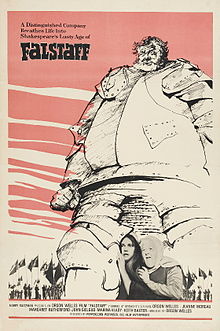
Shakespeare Apologists

XXXSo I’m reading Shakespeare. And I’m watching Shakespeare.[1] In particular, I am studying the Henry IV plays and Henry V. And I notice something: all these low characters (Falstaff, Prince Hal) speak in prose, while all the high characters (Henry IV, Henry V) speak in verse. This does not come as a shock. I think that for a layperson to really appreciate Shakespeare, he must admit the poet’s defects—which are many. And perhaps his biggest defect is how much he sucks up to authority.

It is hard not to see Shakespeare’s personal story as anything but a 16th century Horatio Alger: poor young man goes to the big city and comes back home triumphant. And therefore, it is hard not to see Shakespeare as primarily a businessman rather than an artist. He apparently did not write anything the last several years of his life. It is doubtful that this is due to the high standards he had by this time, because his last few plays were garbage. Maybe the old man (My age!) just felt he didn’t have it in him any more. But doesn’t it make more sense that his fortune was secure and that it was always about the money?

One of his last plays, Cardenio is lost to us. There is probably a reason for this, like: it was not very good. It is believed to be based upon Don Quixote. So perhaps Shakespeare and Fletcher[2] can be forgiven, because as I know, Don Quixote is a damned hard book to adapt; it’s the novel version of The Illiad. But this does provide a nice contrast: Shakespeare as the landlord during his last years compared to Cervantes, who pretty much died with pen in hand.

Shakespeare Apologists

I tried to find some information on how much of the various plays were verse and how much prose. I’m sure I’ve seen this kind of information before, but I couldn’t find it online. Instead, I found the following on Cummings Study Guides:

Why are some [lines] in verse and others in prose? The answer some Shakespeare commentators provide—an answer that is simplistic and not wholly accurate—is that Shakespeare reserved verse for noble, highborn characters and prose for common, lowborn characters. It is true that royalty and nobility often speak in verse and that peasants and plebeians—or wine-swilling hooligans, like Falstaff (Henry IV Part I and Henry IV Part II)—often speak in prose. But it is also true that noble characters, like Hamlet and Volumnia (Coriolanus), sometimes speak in prose and that lowborn characters, like the witches in Macbeth, often speak in verse. Even the lowest of the low—the beast-man Caliban in The Tempest—speaks often in verse. In The Merchant of Venice, the characters associated with the dirty world of money speak frequently in verse, and the characters associated with the rarefied world of nobility and refinement speak often in prose. Shakespeare’s comedy Much Ado About Nothing is almost entirely in prose, with highborn characters only occasionally speaking in verse.

This is the ultimate. It would make Christian apologists proud. “Yeah, it’s true that Shakespeare clearly thinks that royalty are better than common men, but there are exceptions so it isn’t true!” Let’s see the logic here. Hamlet—an enormous part—is sometimes written in prose. The same goes for a minor character in Coriolanus. Does this need comment?!

The witches in Macbeth and Caliban, son of a witch, in The Tempest are written in verse. Maybe the fact that they are not, you know, part of the normal world has something to do with this? Consider, if you will, A Midsummer Night’s Dream.

It is hard for me to speak of The Merchant of Venice, because I don’t know it very well due to the fact that it is such an offensive play—far more offensive than Christopher Marlowe’s The Jew of Malta. Let me only say that the evidence here is pretty unsatisfying. Are we really to believe that Shakespeare, the landlord, really thought it was the dirty world of money?

And Much Ado About Nothing? I just don’t see how a comedy written almost entirely in prose is an argument against the original claim.

The Case for Shakespeare

Let me make the case that Shakespeare wasn’t a classist asshole: he was. But everyone was. He wasn’t writing in modern America. You have to take an artist in the context of his time. I make this case to people about film all the time: Citizen Kane is not a great film because it is better than films today; it is a great film because it was head-and-shoulders better than anything in 1945. So why should Shakespeare be held to a higher standard?

Now let me demolish this argument, which I think is as strong a defense as one can make for Shakespeare: Cervantes. Miguel de Cervantes was very much a man of his time. He too was a classist. He was a Catholic. He was in no way a modern man. And yet, Don Quixote and Exemplary Novels transcend this in a way that Shakespeare’s work never did.

Still, I accept the argument I made above for Shakespeare. But I also accept the fact that Shakespeare was simply one of the best five or so playwrights in London at the end of the 16th century. I don’t think he was the best at that time and place, much less the best in the English language or (Gasp!) ever. This is what I find so frustrating about Shakespeare. There is so much to like. Hell, I memorize speeches from his plays for no reason but the joy of it. There are characters I love like Benedick and Beatrice in Much Ado About Nothing. But there are also characters I despise like Claudio and Hero in Much Ado About Nothing. Why can’t people see this? Why are good plays by Ben Jonson and John Webster and many others so rarely performed, while bad plays of Shakespeare are finely tuned to make them palatable? I don’t know. It is all about history, I suppose. But so are the Nazis. That doesn’t mean we honor Nazism as the greatest form of governance the world has ever know![3]


[1] It is wrong to say that I, or anyone, watches Shakespeare. Each play gets so much help from editors, writers, directors, costume designers, art directors, and perhaps most of all, actors, that any Shakespeare play or movie is a collaboration, with That Bard giving less than he gets. It is perhaps also wrong to say that we read Shakespeare. Gary Taylor has pointed out that pronunciations have changed so much since the late 16th century, that when reading Shakespeare, we are reading another language. This, of course, does not stop the worshipers. Just one example about a production of Titus Andronicus from Wikipedia [Underlining is mine -FM]:

In 1995, Gregory Doran directed a production at the Royal National Theatre, which also played at the Market Theatre in Johannesburg, South Africa, starring Antony Sher as Titus, Dorothy Ann Gould as Tamora, Sello Maake as Aaron and Jennifer Woodbine as Lavinia. Although Doran explicitly denied any political overtones, the play was set in a modern African context and made explicit parallels to South African politics. In his production notes, which Doran co-wrote with Sher, he stated, “Surely, to be relevant, theatre must have an umbilical connection to the lives of the people watching it.” One particularly controversial decision was to have the play spoken in indigenous accents rather than Received Pronunciation, which allegedly resulted in many white South Africans refusing to see the play. Writing in Plays International in August 1995, Robert Lloyd Parry argued “the questions raised by Titus went far beyond the play itself [to] many of the tensions that exist in the new South Africa; the gulf of mistrust that still exists between blacks and whites […] Titus Andronicus has proved itself to be political theatre in the truest sense.”

[2] I really don’t know why I mention Fletcher, because many of Shakespeare’s plays were collaborations (probably many more than we know). In general, Shakespeare gets all the credit, so I see no reason why he should not get all the blame.

[3] Might as well cut to the chase and end with Godwin’s Law.

Journalism for the Masses

I do not care for puppets. Even as a child I found them to be at best moderately amusing, but mostly just weird. Mr Rogers’ puppets in particular, so as to seem normal in his neighborhood, were curiously creepy. Even the subtle condescension in his own voice and manner gave the impression that Mr Rogers was addressing insane and potentially violent viewers rather than very young children. As I was being raised to see any and all strangers as potential threats, his opiate personality were unsettling and suspect.

In later years, I experienced the other end of puppetry, kneeling behind a puppet stage, arm raised over the edge with a googly-eyed puppet on my hand. As an evangelical enabler, part of my missionary position involved performing puppet shows for the poor dumb kids whose sadistic parents dragged them to church every Sunday. My puppet was a felt flower with the insipid name, Flower. I don’t have the scripts of any of those charming morality plays (many of which I helped author), but I know they were funny as hell.

As an adult I can now appreciate, if not always the humor, at least the skill required to manipulate a puppet well. That isn’t my point in exposing this shocking puppet exposé. The point is, there is an Ohio-based television station that is using puppets to get the news to the people. As stated in what I hope will be an award-winning article by Thomas J. Sheeran, “…a television station barred from using cameras during a high-profile corruption trial covers the highlights with a nightly puppet show. It stars a talking squirrel ‘reporter’…”. That Mr Sheeran felt the need to put “reporter” in quotations gives you some idea of his “take” on the story.

Courtroom Puppetry

I can only say that combining news or “gossip” with puppetry is simply brilliant. Not only are WOIO and it’s sister station WUAB Job Creators, have stumbled upon a so-crazy-it-just-might-work method for propagating “information” to the people of Ohio. Information that, sadly, they would be unable to process using yesterday’s news methods. Of course, the real credit goes to Jon Stewart and Stephen Colbert who have succeeded in making humor a necessary part of a healthy information digestive system. Kudos.[1]

Of course, this will put even more pressure on Sesame Street, which is already under pressure from the Society That Undermines Philanthropy Intelligence and Dedication (STUPID) to make learning more fun and less educational. I think we can all agree that the goal is within reach. It’s only a matter of time until the news is animated by Koreans and directed by Matt Groening.

Until that day, remember, while corporations may be people, puppets are tools like most other members of the media. Tools we can use to shape a tomorrow that is easier to digest.


[1] In your face Colbert! I mocked it first! How does it feel when the puppet master is not you, but a MILF in New Jersey? Well, not fromNew Jersey, I was born in California and moved here about ten years ago, so technically… Nevermind! You have just been puppet-powned.

Falstaff “Railed Against Our Person”?

Chimes at MidnightI’ve been thinking about Falstaff for a couple of weeks now, as is evidenced by my trolling around over at Shakespeare Geek. So I’ve been hitting The Book (my old and rather bad Complete Works of That Bard), trying to make some sense of Orson Welles’ Chimes at Midnight. In particular, there is a scene after Henry turns away from Falstaff, in which Henry says, “Enlarge the man committed yesterday.” At this, one of the king’s advisers asks, “Falstaff?” That was a bit of surprise, but I wasn’t sure if it wasn’t just because I hadn’t been paying attention.

King Henry’s line is from a speech in Henry V, where he uses it to trap (sort of) Richard Earl of Cambridge, Henry Lord Scroop of Masham, and Sir Thomas Grey:

Enlarge the man committed yesterday
That railed against our person: we consider
It was excess of wine that set him on;
And on his more advice we pardon him.

Going back to Kenneth Branagh’s filmed version of Henry V, I watched and listened carefully: was he talking about Falstaff? No. But that hardly means anything. I knew from experience that Branagh had cut the hell out of the play and added some of Henry IV Part 1 and Part 2—quite awkwardly, I think, which is too bad because Robbie Coltrane is really wonderful as Falstaff (better than Welles).

So I went to the text itself, and the truth is that it could be. Henry gives the speech in Act 2, Scene 2 and we don’t find out that Falstaff is dead until Act 2, Scene 3. So it could be Falstaff he is talking about. But it doesn’t matter. And it probably isn’t. In fact, it is probably the case that there was no one “that railed against our person.” The scene uses it only as a ruse.

Thus we come to Welles’ brilliance as a storyteller. There is a real problem with Henry V: after two Henry IV plays, he is clearly a dick. Welles manages to fix this problem by taking this little speech entirely out of context, to show that Henry really does still care about Falstaff. It is interesting that in My Own Private Idaho, Gus Van Sant uses the two funeral scenes to do the same thing. As much as I like Van Sant, I doubt he would have come up with this on his own. Welles was a great director (film and theater) almost from birth and this is a perfect example of his greatness.

Tune in Tomorrow

Tomorrow, I will write about something else that has been bugging me about Falstaff. And even more so: That Bard.

Update

Make that “today” because it is already tomorrow.