Illusory Superiority

This is actually a field within Social Psychology. In general, I am trying to avoid it these days, but the Wikipedia article on Illusory Superiority is really good. The most interesting thing I learned from the article is that people find any member of a group to be above the median of the group itself. Also: people rate themselves less better compared to specific individuals than to the abstract “average”. I think this has something to do with how we find it easier to empathize with a single individual than with a group—even a group of two. (Sorry that I don’t have a reference for this; I heard it on On The Media last week.)

Worse Than Average Effect

There is another effect—the opposite of Illusory Superiority: The Worse Than Average Effect. This is the tendency for people to under-estimate their chances of doing something that they think they have a very low chance of doing. For example, people tend to underestimate how likely they are to find a $20 bill on the ground during the next two weeks.

After writing this article (when I had read about the WTA effect, but did not write about it), I thought, “Yeah, right; that’s not going to happen to me.” It had happened: four years earlier, but I expected it to never happen again. While writing, I estimated my chances of finding a twenty in the next two weeks at about one-half of one percent. That meant that I should find a $20 bill on the ground every four years, so if my estimate was right, I was due.

It turned out that nine days later, I found a $20 bill on the ground. Freaky cool.

80% of All Statistics

Many years ago, I was introduced to the snarky statistic that 80% of drivers believe they are above average. This annoyed me from the start. Initially, I thought it was just another useless statistic; its snarky meaning had to be explained to me, “You see—idiot—only 50% of drivers can be above average; so at least 30% of the people are fooling themselves!”

The statistic has the feel of an urban legend. It seems reasonable—but then such stories always do. In fact, it appeals to my prejudice (very common among the kind of people who would pass on such information) that people over-estimate their own skills and under-value those of others. Just like an urban legend. And, of course, there is no real reference, and one has to wonder who would pay to find out how many people think their driving is better than it really is. (It turns out that a number of people would; see the caveat at the end.)

The biggest problem is that the snarky aspect of this “fact” is incorrect. It is quite possible for 80% of a population to be above the average (mean). Just imagine if driver quality were rated on a scale of 0 to 100. Further, imagine that there were ten drivers with the following ratings: 0, 100, 100, 100, 100, 100, 100, 100, 100, 100. Clearly, the average would be less than 100 and so 90% of the population would be “above average”. (I’m slow, not stupid.) This is hardly a normal distribution, however. And you would think that driver ability would be a normal distribution, or something like it. (But maybe not; my father thinks that the road is filled with “idiots” and him.)

At this point, the worst case scenario is that someone comes forward with an actual study that shows, more precisely: 80% of drivers believe they drive better than the median. On its face, this cannot be factually true: 50% of a population must be above the median and 50% must be below; this is the definition of “median”. However, this too is a ridiculous claim and leads me to the whole point of this article.

What does it mean to be a good driver? We must know this before we can know if one driver is better than another. For one person, a good driver might be one who can control his car at high speeds. For another, it may be one who always drives the speed limit. Given that most people are rather good at the kind of driving they value—and thus practice regularly—it is surprising to me that only 80% consider themselves “above average”. [caveat]

People are foolish. And at least in political matters, people tend to under-estimate others. For example, Americans consistantly over-estimate how racist their neighbors are: almost always rating them as more racist than they rate themselves. But this is exactly the appeal of this little statistic: “I am not one of those silly people who think that their driving is better than it really is.” My driving, however, definitely is above average.

[Caveat: Illusory Superiority]

Justice as Commerce

One could say that the justice system in the USA where prosecutors have most of the power and a career/financial interest in convicting the guilty and innocent is nothing but commerce. I will need to think another couple of decades on this issue.

Non-Reversible Errors

I have long felt that Scott Turow taught me how to write a novel. In particular, I experienced an epiphany while reading his third novel Pleading Guity. It was probably just that it was the third novel of his that I had read, and that I had figured out his tricks. Although I have previously thought that Turow is a character-oriented writer, he is in fact a plot-oriented writer—clever and capable in his way. Regardless, he did not teach me everything I needed to know about writing a novel—it took me seven years and many aborted attempts to complete my first, deeply flawed and largely lost novel Camping on Asphalt. But I can say this for sure: Turow showed me how to trick the reader. And I am strip-mining that territory in my current work on Treading Asphalt. [Note]

I just read Turow’s sixth novel Reversible Errors. Here’s my review: it’s a Scott Turow novel. Other than that, I don’t want to go into all the reasons that this is an entirely workman-like effort, fiction by the numbers—the same numbers we have seen in his previous five novels. If you like his books, you will probably like this one. It annoyed me for a couple of reasons, but the main reason was its treatment of the romantic subplot. (Don’t worry, there are no real spoilers here, even though I talk about events at the beginning and end of the novel.)

The main character, Arthur, becomes involved with a woman who used to be a judge, but is no longer because she was convicted of taking bribes. This is pretty bad, because judges are supposed to come to just decisions and when justice becomes a bidding war, it becomes simple commerce. [Note] Arthur does not seem to have a problem with this, perhaps just because he has the hots for her. Fine. One nice thing about Turow is that he has always been willing to show that people over thirty have sex drives (often more explicitly than I would prefer in such a novel).

We know from the beginning, however, that the judge was really being bribed because some people in power knew that she was a heroin addict. When Arthur finds this out he does what pretty much all Americans do when they hear the word heroin: freak out. Thomas Metzger has written wonderfully on the history of perceptions of heroin from its invention to the present in The Birth of Heroin. As Metzger points out, the modern perception of heroin is as a dirty, evil “other”. And this is precisely why people like Turow approach it as though it were the worst thing in the world.

Arthur can deal with the judge committing felonies that have a direct effect on her job. But he can’t deal with her drug choices. A corrupt, drunk judge: yes. A junkie judge: no. The novel ends with the judge begging for Arthur’s forgiveness. Arthur gives it. But what Arthur really needs is a clue. As does Turow.

Snarky

I am of two thoughts about the word “snarky”, and apparently everyone else is too. First, it seems like it used to mean testy. Second, it seems like it is now mostly used to mean sarcastically pithy. Dictionary.com states that it is, “Testy or irritable; short.” And the Urban Dictionary says that it is, “A witty mannerism, personality, or behavior that is a combination of sarcasm and cynicism. Usually accepted as a complimentary term.”

Personally, I would not use the word “snarky” to describe something I approved of—at least publicly. I might use it to indicate a bit of hidden delight, however.

To be continued…

And I Won’t Even Complain About Not Much Liking Shakespeare

Are you lucky you tuned in today! Probably not, but as usual: you should be. I have found a great short lecture (Okay! It’s 58 minutes, but the time flies.) by David Timson:


David Timson Speak the Speech

If you know who Timson is you are doing better than I am. He is certainly a guy who reads books on tape (or CD now). He has done a lot of Shakespeare and Sherlock Holms. He also seems to have done some film acting; and lots of radio broadcasts. As you will see—if you take the time to listen to the lecture, and you should—he has a great voice.

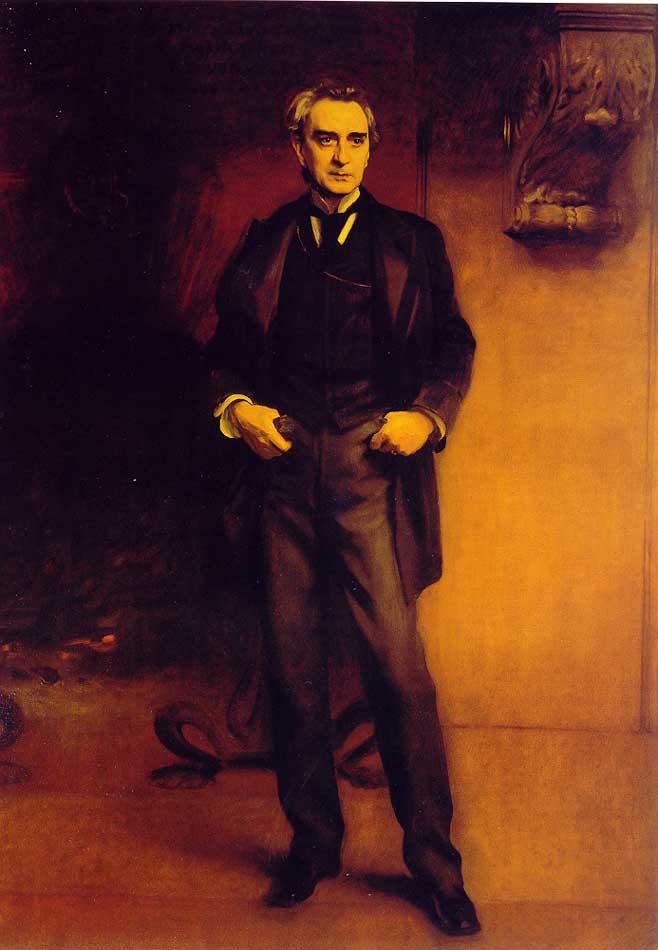
In this lecture, Timson discusses the changing style of Shakespearean performance since the invention of audio recording. Unfortunately, he is not terribly insightful, but this may be because he feels his wonderful examples speak for themselves. And largely they do. He plays very early recordings of Edwin “Am I My Brother’s Keeper” Booth (the unfortunate brother of John “Et tu, Brute?” Wilkes)—check out this great John Singer Sargent painting on him, Sir Henry “Big Hank” Irving (just kidding about the “Big Hank” moniker), and Lewis “Sugar Ray” Waller (not kidding about the “Sugar Ray”; no, just kidding; I was).

I have been fascinated with Edwin Booth for a long time, because I wonder what it would be like to be the brother of a famous murderer (I used to live with Melvin Simpson). But I have never heard his voice. In fact, since he died in 1893, I didn’t even think there was a recording. Not surprising, he has an excellent voice (so does Melvin). He actually sounds a bit like Orson Welles (so does Melvin; no, just kidding). If that doesn’t get you to listen, little will.

The lecture moves up to the present from Sir John Gielgud to Laurence Olivier to Kenneth Branagh (who really is amazing).

The point of the lecture is that Shakespearean acting has moved from a highly musical or operatic style to a more conversational and (to our ears) natural one. We could extrapolate backwards and conclude that acting during the Elizabethan period would be unintelligible to us. This is not unreasonable (but I don’t know how reasonable it is, and that’s why I put it that way). According to the iconoclastic Shakespearean scholar Gary Taylor, the sounds of the words themselves have changed so much that we would likely get little meaning from them. In effect, Shakespeare—written in (more or less) modern English—has to be translated for modern readers every bit as much as Aristophanes—written in (more or less) ancient Greek.

A World in Which I Don’t Have to Watch “The Princess and the Frog”

I always thought that I liked kids, but I have come to the conclusion that this is not the case. If there were no children, no one would have made The Princess and the Frog. If no one had made it, I would not have spent the afternoon watching it. If I had not spent the afternoon watching it, I would feel better about myself. It isn’t that I didn’t enjoy it; some of it was very funny and I was on the verge of crying pretty much from beginning to end—and I didn’t even realize that Oprah Winfrey was in it. But that is exactly the problem.

Randy Newman shows once again that talent can be used for evil. The songs—pretty much without exception—suck. But that’s okay. Newman has been writing poor songs on and off since the beginning (think: Laughing Boy) and always since about Toy Story (think: You’ve Got a Friend in Me). It was his score that was so evil. I was emotionally bruised (and worse, but I don’t want to go into details). I should now be made to weep over a dead firefly’s romantic life.

What bothered me most about the film was how it dealt with race. It takes place in 1930s (give or take 20 years) Louisiana, with its accompanying racial segregation and economic stratification. The fact that all the black people were smiling didn’t make me accept the racist expectations of the whites any better—from the implicit racism of Big Daddy LaBouff and his annoying daughter to the explicit racism of the real estate agents. What’s more, I couldn’t get past the fact that Prince Naveen is vaguely Indian and thus brown and thus acceptable to be paired with the light-skinned black girl. Certainly the prince could not be pasty-English white and the girl be Miles Davis black; or visa versa. If this is a film for kids, then perhaps such delicate racial issues should be taken out of it, by setting it somewhere other than 1930s (give or take 75 years) Louisiana.

It seems like a minor thing, but it’s worth mentioning: the animation. This film is what they call “hand drawn”. By this, it seems what they mean is that the base artwork is hand-drawn and then scanned into a computer and then animated the way they always do. Off hand, I would say, “So what?” But there is a difference: it really isn’t very appealing. I guess they are going for something like Lady and the Tramp. The problem here is that Lady and the Tramp is really not that appealing. I’m a Pinocchio guy.

Kids: there were a bunch of them. And they seemed to like it a lot. And they were very well behaved. (When I saw Babe in the theater the little joys were running up and down the isles.) I guess I can accept the occasional Disney movie for their benefit, but why did the dead firefly’s romantic life have to be so sad?

Blue Moon

As I am a big fan of all messed up creative people, let me start by quoting Lorenz Hart in one of my favorite Rogers & Hart songs:

Blue moon
You saw me standing alone
Without a dream in my heart
Without a love of my own.

I only bring this up because Andrea did not know what a “blue moon” was, as of this morning. At that time, she probably read something like Donna Henes’ Article on Huffington Post. It isn’t a great article, but some people are easily impressed.

Henes informs those people who don’t already know that a blue moon is the second full moon in a calendar month. This means, of course, that blue moons are meaningless because calendar months are arbitrary. But as yet another anachronistic unit of measure, the blue moon cycle is very cool: it is an odd period of time (a little less than three years) that is slightly different all of the time.

You may ask, “Why is a blue moon roughly three years in length?” But I would prefer that you not. Why? First, a blue moon is no length at all, but rather an instant. (This is not even exactly right because the moon oscillates by more than two degrees on either side and that means that even though the same part of the moon always faces us, we can see more than 50% of the surface, but I digress.) The three year number is the amount of time between blue moons.

The second reason this question is best not asked is that anyone reading this blog should really know better. But I will explain because I am kind and just. This requires some background.

You do understand that the moon does not go around the earth each night, right? I mean, pretty much the moon stays in the same place (like the sun) and it is the earth rotating at a break-neck speed that makes it look like the moon is going around the earth. In point of fact, if the earth did not rotate, the moon would move from directly overhead, all the way around the earth, and back to directly overhead in 29.5 days (roughly).

Without going into the phases of the moon, you ought to be able to conclude from this that there will be a full moon every 29.5 days (roughly). Unless you are Andrea, in which case, just take my word for it. Because of this, if you are going to squeeze a second full moon into a 30 day month, you’ve got to have your first full moon during the first 0.5 days. For a 31 day month, you have to have your first full moon during the first 1.5 days. This means you will never have a blue moon during my favorite month February when such notables are Christopher Marlowe and I were born.

On average, how often will you have a full moon on the first day of the month? About 3% of the time, right? (Andrea: just take my word.) How many months would that be? About 33, or three years, using 11 months because the sainted month of February is out.

But if all else fails, there is another song about blue moons by the great Pat Alger and Gene Levine:

I got your letter in my mailbox today
You were just checking if I was okay
And if I miss you, well you know what they say
Just once in a very blue moon.

15 November 2013: Added Gene Levine credit to the writing of “Once in a Very Blue Moon.”

The Passionate Shepherd to His Love

Some time ago, I stumbled upon Christopher Marlowe’s “The Passionate Shepherd to His Love.” It delighted me—it is so beautifully written. Instinctively, I picked up my guitar and quickly set it to music. But I’m getting ahead of myself. First, you really need to read this poem:

Come live with me and be my love,
And we will all the pleasures prove
That hills and valleys, dale and field,
And all the craggy mountains yield.

There will we sit upon the rocks,
And see the shepherds feed their flocks,
By shallow rivers to whose falls
Melodious birds sing madrigals.

There I will make thee beds of roses
And a thousand fragrant posies,
A cap of flowers, and a kirtle
Embroider’d all with leaves of myrtle;

A gown made of the finest wool
Which from our pretty lambs we pull;
Fair linèd slippers for the cold,
With buckles of the purest gold;

A belt of straw and ivy buds,
With coral clasps and amber studs;
And if these pleasures may thee move,
Come live with me, and be my love.*

Thy silver dishes for thy meat
As precious as the gods do eat,
Shall on an ivory table be
Prepared each day for thee and me.

The shepherd swains shall dance and sing
For thy delight each May-morning:
If these delights thy mind may move,
Then live with me and be my love.

Not long after discovering this—even before my dear friend Andrea could ruin it by pointing out that it was foolish youthful sentimentality—I discovered that Sir Walter Raleigh (yes, that guy) had written a response: “The Nymph’s Reply to the Shepherd.” It too is a beautiful poem (although Marlowe’s is clearly superior in poetic beauty):

If all the world and love were young,
And truth in every shepherd’s tongue,
These pretty pleasures might me move
To live with thee and be thy love.

Time drives the flocks from field to fold
When rivers rage and rocks grow cold,
And Philomel becometh dumb;
The rest complains of cares to come.

The flowers do fade, and wanton fields
To wayward winter reckoning yields;
A honey tongue, a heart of gall,
Is fancy’s spring, but sorrow’s fall,

Thy gowns, thy shoes, thy beds of roses,
Thy cap, thy kirtle, and thy posies
Soon break, soon wither, soon forgotten—
In folly ripe, in reason rotten.

Thy belt of straw and ivy buds,
Thy coral clasps and amber studs,
All these in me no means can move
To come to thee and be thy love.

But could youth last and love still breed,
Had joys no date nor age no need,
Then these delights my mind may move
To live with thee and be thy love.

I don’t have a lot to say about this poem, other than that it says exactly what Andrea would have said had I posted only the “The Passionate Shepherd.” However, it occurred to me that the two poems would work well together as a male-female duet. In fact, the phrasing of the two poems are identical—so I didn’t even have to change the music. Here is the chord structure which would cover two verses:

A / / / | A / / / | D / / / | A / / / |
E / / / | D / / / | E / / / | D / / / ||

And the structure would consist of four male verses (two music), four female verses, two male verses, two female verses, and then the last two verses sung at the same time by both—sort of like “Touch me in the Morning.” This is six verses each. You might have noticed that Marlowe’s poem has seven verses; I omit the verse above that has an asterisk after it.

I am not yet happy with the second part of the melody, but here is the first part (the AADA part). Note that the triplets are not strict (as you can tell from the chord structure, it is kind of bluesy and thus loose). Eventually, I will try to get a couple of kids from the local college to come over and record it and I’ll post it here. But even before that, I’ll post the second half of the melody.

Passionate Shepherd Music Part 1