Full Sentences Inside Parenthetical Enclosures

Parenthetical EnclosuresBecause I am a freak, I suffer some considerable anxiety about the proper way of dealing with complete sentences inside of parenthetical enclosures. Most of this is purely aesthetic. For example, I hate constructs such as “XX XX (XX XX.).” I just hate the period-parenthesis-period. Or anything similar: “XX XX (XX XX!).”. So I will never put a complete sentence inside an inner-sentence parenthetical enclosures at the very end of a sentence. But before I go any further, we should look at what The Book says.

According to The Chicago Manual of Style 15th Edition:

A parenthetical enclosure of more than one sentence should not be included within another sentence. If a final period is needed at the end of such an enclosure, rewording may be necessary to keep the enclosure independent of the surrounding text…

I don’t think I have ever included more than one sentence inside a parenthetical enclosure in a sentence. Certainly, doing so outside a sentence is done all the time. In fact, one or more paragraphs are sometimes put inside a parenthetical enclosure, although it seems to me that such things should be put into footnotes. What’s more, I feel no compunction about putting rather complex sentences (including: colons and semicolons) inside inner-sentence parenthetical enclosures. But care must be taken.

It is a matter of opinion, but any writer must ask if a parenthetical statement is so long that it causes the sentence on one side of it to lose contact with that on the other. If that’s the case, the whole construction must be reevaluated. There are always alternatives. Often, I find that things I initially put inside parenthetical enclosures really want to be independent sentences. This is especially true when what’s inside is very long. Consider putting it in its own paragraph—without parentheses. Often what at first seems parenthetical is not.

The quotation from The Book seems to indicate that these inner-sentence parenthetical enclosures should never end with a period. However, there is no admonition against any other full stops and there is no guidance whatsoever about capitalization. This is where my biggest concerns lie. These are the rules I’ve developed for complete sentences inside of inner-sentence parenthetical enclosures:

  • If it is at the end of a sentence, put it outside the sentence. If this makes the meaning confused, rewrite the paragraph and find something that does work.
  • Otherwise, capitalize the first letter in the sentence.

What I often see are parenthetical enclosures that end with question marks or exclamation points that do not capitalize the first word of the sentence. This is certainly what The Book seems to dictate. But—because I’m a freak—it drives me crazy. And I think it is confusing, because these are full stops. But I don’t know of anyone else formatting inner-sentence parenthetical enclosures in my way. But they should. Anything else is inconsistent and just odd.

Shakespeare Apologists

XXXSo I’m reading Shakespeare. And I’m watching Shakespeare.[1] In particular, I am studying the Henry IV plays and Henry V. And I notice something: all these low characters (Falstaff, Prince Hal) speak in prose, while all the high characters (Henry IV, Henry V) speak in verse. This does not come as a shock. I think that for a layperson to really appreciate Shakespeare, he must admit the poet’s defects—which are many. And perhaps his biggest defect is how much he sucks up to authority.

It is hard not to see Shakespeare’s personal story as anything but a 16th century Horatio Alger: poor young man goes to the big city and comes back home triumphant. And therefore, it is hard not to see Shakespeare as primarily a businessman rather than an artist. He apparently did not write anything the last several years of his life. It is doubtful that this is due to the high standards he had by this time, because his last few plays were garbage. Maybe the old man (My age!) just felt he didn’t have it in him any more. But doesn’t it make more sense that his fortune was secure and that it was always about the money?

One of his last plays, Cardenio is lost to us. There is probably a reason for this, like: it was not very good. It is believed to be based upon Don Quixote. So perhaps Shakespeare and Fletcher[2] can be forgiven, because as I know, Don Quixote is a damned hard book to adapt; it’s the novel version of The Illiad. But this does provide a nice contrast: Shakespeare as the landlord during his last years compared to Cervantes, who pretty much died with pen in hand.

Shakespeare Apologists

I tried to find some information on how much of the various plays were verse and how much prose. I’m sure I’ve seen this kind of information before, but I couldn’t find it online. Instead, I found the following on Cummings Study Guides:

Why are some [lines] in verse and others in prose? The answer some Shakespeare commentators provide—an answer that is simplistic and not wholly accurate—is that Shakespeare reserved verse for noble, highborn characters and prose for common, lowborn characters. It is true that royalty and nobility often speak in verse and that peasants and plebeians—or wine-swilling hooligans, like Falstaff (Henry IV Part I and Henry IV Part II)—often speak in prose. But it is also true that noble characters, like Hamlet and Volumnia (Coriolanus), sometimes speak in prose and that lowborn characters, like the witches in Macbeth, often speak in verse. Even the lowest of the low—the beast-man Caliban in The Tempest—speaks often in verse. In The Merchant of Venice, the characters associated with the dirty world of money speak frequently in verse, and the characters associated with the rarefied world of nobility and refinement speak often in prose. Shakespeare’s comedy Much Ado About Nothing is almost entirely in prose, with highborn characters only occasionally speaking in verse.

This is the ultimate. It would make Christian apologists proud. “Yeah, it’s true that Shakespeare clearly thinks that royalty are better than common men, but there are exceptions so it isn’t true!” Let’s see the logic here. Hamlet—an enormous part—is sometimes written in prose. The same goes for a minor character in Coriolanus. Does this need comment?!

The witches in Macbeth and Caliban, son of a witch, in The Tempest are written in verse. Maybe the fact that they are not, you know, part of the normal world has something to do with this? Consider, if you will, A Midsummer Night’s Dream.

It is hard for me to speak of The Merchant of Venice, because I don’t know it very well due to the fact that it is such an offensive play—far more offensive than Christopher Marlowe’s The Jew of Malta. Let me only say that the evidence here is pretty unsatisfying. Are we really to believe that Shakespeare, the landlord, really thought it was the dirty world of money?

And Much Ado About Nothing? I just don’t see how a comedy written almost entirely in prose is an argument against the original claim.

The Case for Shakespeare

Let me make the case that Shakespeare wasn’t a classist asshole: he was. But everyone was. He wasn’t writing in modern America. You have to take an artist in the context of his time. I make this case to people about film all the time: Citizen Kane is not a great film because it is better than films today; it is a great film because it was head-and-shoulders better than anything in 1945. So why should Shakespeare be held to a higher standard?

Now let me demolish this argument, which I think is as strong a defense as one can make for Shakespeare: Cervantes. Miguel de Cervantes was very much a man of his time. He too was a classist. He was a Catholic. He was in no way a modern man. And yet, Don Quixote and Exemplary Novels transcend this in a way that Shakespeare’s work never did.

Still, I accept the argument I made above for Shakespeare. But I also accept the fact that Shakespeare was simply one of the best five or so playwrights in London at the end of the 16th century. I don’t think he was the best at that time and place, much less the best in the English language or (Gasp!) ever. This is what I find so frustrating about Shakespeare. There is so much to like. Hell, I memorize speeches from his plays for no reason but the joy of it. There are characters I love like Benedick and Beatrice in Much Ado About Nothing. But there are also characters I despise like Claudio and Hero in Much Ado About Nothing. Why can’t people see this? Why are good plays by Ben Jonson and John Webster and many others so rarely performed, while bad plays of Shakespeare are finely tuned to make them palatable? I don’t know. It is all about history, I suppose. But so are the Nazis. That doesn’t mean we honor Nazism as the greatest form of governance the world has ever know![3]


[1] It is wrong to say that I, or anyone, watches Shakespeare. Each play gets so much help from editors, writers, directors, costume designers, art directors, and perhaps most of all, actors, that any Shakespeare play or movie is a collaboration, with That Bard giving less than he gets. It is perhaps also wrong to say that we read Shakespeare. Gary Taylor has pointed out that pronunciations have changed so much since the late 16th century, that when reading Shakespeare, we are reading another language. This, of course, does not stop the worshipers. Just one example about a production of Titus Andronicus from Wikipedia [Underlining is mine -FM]:

In 1995, Gregory Doran directed a production at the Royal National Theatre, which also played at the Market Theatre in Johannesburg, South Africa, starring Antony Sher as Titus, Dorothy Ann Gould as Tamora, Sello Maake as Aaron and Jennifer Woodbine as Lavinia. Although Doran explicitly denied any political overtones, the play was set in a modern African context and made explicit parallels to South African politics. In his production notes, which Doran co-wrote with Sher, he stated, “Surely, to be relevant, theatre must have an umbilical connection to the lives of the people watching it.” One particularly controversial decision was to have the play spoken in indigenous accents rather than Received Pronunciation, which allegedly resulted in many white South Africans refusing to see the play. Writing in Plays International in August 1995, Robert Lloyd Parry argued “the questions raised by Titus went far beyond the play itself [to] many of the tensions that exist in the new South Africa; the gulf of mistrust that still exists between blacks and whites […] Titus Andronicus has proved itself to be political theatre in the truest sense.”

[2] I really don’t know why I mention Fletcher, because many of Shakespeare’s plays were collaborations (probably many more than we know). In general, Shakespeare gets all the credit, so I see no reason why he should not get all the blame.

[3] Might as well cut to the chase and end with Godwin’s Law.

Journalism for the Masses

I do not care for puppets. Even as a child I found them to be at best moderately amusing, but mostly just weird. Mr Rogers’ puppets in particular, so as to seem normal in his neighborhood, were curiously creepy. Even the subtle condescension in his own voice and manner gave the impression that Mr Rogers was addressing insane and potentially violent viewers rather than very young children. As I was being raised to see any and all strangers as potential threats, his opiate personality were unsettling and suspect.

In later years, I experienced the other end of puppetry, kneeling behind a puppet stage, arm raised over the edge with a googly-eyed puppet on my hand. As an evangelical enabler, part of my missionary position involved performing puppet shows for the poor dumb kids whose sadistic parents dragged them to church every Sunday. My puppet was a felt flower with the insipid name, Flower. I don’t have the scripts of any of those charming morality plays (many of which I helped author), but I know they were funny as hell.

As an adult I can now appreciate, if not always the humor, at least the skill required to manipulate a puppet well. That isn’t my point in exposing this shocking puppet exposé. The point is, there is an Ohio-based television station that is using puppets to get the news to the people. As stated in what I hope will be an award-winning article by Thomas J. Sheeran, “…a television station barred from using cameras during a high-profile corruption trial covers the highlights with a nightly puppet show. It stars a talking squirrel ‘reporter’…”. That Mr Sheeran felt the need to put “reporter” in quotations gives you some idea of his “take” on the story.

Courtroom Puppetry

I can only say that combining news or “gossip” with puppetry is simply brilliant. Not only are WOIO and it’s sister station WUAB Job Creators, have stumbled upon a so-crazy-it-just-might-work method for propagating “information” to the people of Ohio. Information that, sadly, they would be unable to process using yesterday’s news methods. Of course, the real credit goes to Jon Stewart and Stephen Colbert who have succeeded in making humor a necessary part of a healthy information digestive system. Kudos.[1]

Of course, this will put even more pressure on Sesame Street, which is already under pressure from the Society That Undermines Philanthropy Intelligence and Dedication (STUPID) to make learning more fun and less educational. I think we can all agree that the goal is within reach. It’s only a matter of time until the news is animated by Koreans and directed by Matt Groening.

Until that day, remember, while corporations may be people, puppets are tools like most other members of the media. Tools we can use to shape a tomorrow that is easier to digest.


[1] In your face Colbert! I mocked it first! How does it feel when the puppet master is not you, but a MILF in New Jersey? Well, not fromNew Jersey, I was born in California and moved here about ten years ago, so technically… Nevermind! You have just been puppet-powned.

Falstaff “Railed Against Our Person”?

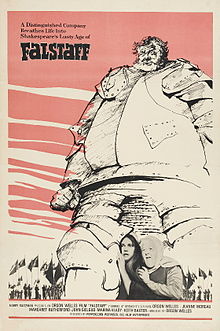
Chimes at MidnightI’ve been thinking about Falstaff for a couple of weeks now, as is evidenced by my trolling around over at Shakespeare Geek. So I’ve been hitting The Book (my old and rather bad Complete Works of That Bard), trying to make some sense of Orson Welles’ Chimes at Midnight. In particular, there is a scene after Henry turns away from Falstaff, in which Henry says, “Enlarge the man committed yesterday.” At this, one of the king’s advisers asks, “Falstaff?” That was a bit of surprise, but I wasn’t sure if it wasn’t just because I hadn’t been paying attention.

King Henry’s line is from a speech in Henry V, where he uses it to trap (sort of) Richard Earl of Cambridge, Henry Lord Scroop of Masham, and Sir Thomas Grey:

Enlarge the man committed yesterday
That railed against our person: we consider
It was excess of wine that set him on;
And on his more advice we pardon him.

Going back to Kenneth Branagh’s filmed version of Henry V, I watched and listened carefully: was he talking about Falstaff? No. But that hardly means anything. I knew from experience that Branagh had cut the hell out of the play and added some of Henry IV Part 1 and Part 2—quite awkwardly, I think, which is too bad because Robbie Coltrane is really wonderful as Falstaff (better than Welles).

So I went to the text itself, and the truth is that it could be. Henry gives the speech in Act 2, Scene 2 and we don’t find out that Falstaff is dead until Act 2, Scene 3. So it could be Falstaff he is talking about. But it doesn’t matter. And it probably isn’t. In fact, it is probably the case that there was no one “that railed against our person.” The scene uses it only as a ruse.

Thus we come to Welles’ brilliance as a storyteller. There is a real problem with Henry V: after two Henry IV plays, he is clearly a dick. Welles manages to fix this problem by taking this little speech entirely out of context, to show that Henry really does still care about Falstaff. It is interesting that in My Own Private Idaho, Gus Van Sant uses the two funeral scenes to do the same thing. As much as I like Van Sant, I doubt he would have come up with this on his own. Welles was a great director (film and theater) almost from birth and this is a perfect example of his greatness.

Tune in Tomorrow

Tomorrow, I will write about something else that has been bugging me about Falstaff. And even more so: That Bard.

Update

Make that “today” because it is already tomorrow.

Why Google AdSense Sucks

Google AdSense SucksI had Google AdSense for four months, through most of December. In all that time, I made almost no money from it. That was fine, I understand that Frankly Curious only gets about 150 unique visitors per day and not all of these are actual people. I wasn’t expecting to make any real money, but I wanted to have the system set up. What a mistake.

Halfway through December, I (like many others) received an email from Google telling me that I had been kicked out of the program because of “invalid clicks.” I appealed. And even though it took upwards of two weeks to get into the program, they denied my appeal within one day. What’s more, Google will not explain what was wrong with my site—even in the vaguest of terms. Given that we are talking about only a couple of dollars after months, I do not get it to this day.

So I put up ads for Amazon. This is a temporary measure. With Amazon Associates, people who click on the links must actually buy something. And then, I get 4% of the price of the item (not counting Amazon’s horrible shipping charges). Like I said: a temporary measure.

In the first twenty days of January (After Christmas, right?), I have made twice from Amazon Associates what I made in four months from AdSense. So I assume that Google kicking me out of the program was a crock. I wouldn’t take Google AdSense back now if they begged (which they won’t).

But I still like Google. No other search engine has this site so well indexed, even though according to Alexa, only 8% of the traffic here comes from search engines. (I have readers? Shocking.)

Al Green Not Demented, Just Asshole

Ten years ago, I went to see Al Green in San Jose. It was a very annoying concert. Green finished less than half of his songs. He would start on something, go for a few bars, and then stop the band and say, “I don’t want to do that one.” It happened so often, that I decided that he had some form of early Alzheimer’s Disease. Nothing else explained it.

But then, I heard there was a video of Al Green doing Let’s Stay Together live with David Gilmour on Friday Night with Jonathan Ross on BBC TV. I had to see that. It was just a year and a half ago. I figured maybe Green would just stand at the mic and bob his head, kind of like Syd Barrett towards the end. Who better to back him up but Gilmour? Here’s the clip; watch it; it’s great.

So I guess the Reverend doesn’t have Alzheimer’s Disease after all. It is just when playing before 5,000 people in San Jose, he doesn’t (as they say in the business) “put out.” In other words, he’s just an asshole.

And Lizzie Borden

Lizzie BordenThis is something I hear a lot, “But isn’t it wrong to start a sentence with a conjunction?” (When I read it, there is no conjunction at the beginning of that sentence.) And I always reply, “You learned that in grammar school, didn’t you?” And they always respond in the affirmative.

I don’t know what these teachers are thinking, but I have a guess. Before we get to that, however, remember that grammar school teachers say a lot of things that are wrong. I believe that the rule against starting sentences with a conjunction is to avoid writing like this:

Lizzie Borden was crazy. And one day she got real mad at her parents. And she went into the barn. And she picked up an ax. And she went into her mother’s room. And she gave her mother forty whacks. And then she went to her father’s room. And she gave him forty whacks. And then she gave him another.[1]

Don’t write like that. But don’t worry about starting a sentence with a conjunction, either.


[1] Much better is the creepily cheery poem:

Lizzie Borden took an ax
And gave her mother forty whacks
When she saw what she had done
She gave her father forty-one.

In Defense of Brad DeLong

Vincent Price Strangling HimselfRecently, I published an article Bad Blog Quoting, where I complained about how some bloggers—Brad DeLong in particular—create articles that are simply quotes without any value added. They could, as Mark Thoma often does (and as often does not), just provide the link. I still think this is a bad idea. For example, yesterday, DeLong posted William Hazlitt’s Political Essays: The Character of Mr. Burke, a 2,000 word essay, in its entirety. It is well worth reading, by the way. However, a link and a synopsis would have been better. Yet there is another side of the story.

Yesterday, I found out that the ventriloquist Nina Conti was the daughter of actor Tom Conti. All I really wanted to do was put up some hilarious video with Nina and Monk—the missing link that proves depression is our natural state. But I couldn’t just do that. Posting videos alone is just the same as quoting. Of course, I could just have added something like, “I just found out that Nina Conti is the daughter of delightful Scottish actor Tom Conti. Here she is performing with Monk.” That thought even occurred to me. But unfortunately, we just don’t do things like that around here. It’s against the style guide! (But not, apparently for Curiously Clever which consistently does whatever the hell it wants.)

So I wrote an article about the Best Actor category of the 1983 Academy Awards: Nina Conti Not Nominated for Oscar. Why? Because her father was nominated that year. Also, I got my wires crossed, thinking that Tom Conti was nominated in 1980, which would allow me to rant about how much better John Hurt and Robert Duvall were than the winner: Robert De Niro. Even without this, however, there is the kernel of a good article here. All I had to do was spend an hour or two on it. You can see it in the article as it stands: not only was Nina Conti’s father nominated for an Oscar, but she starred in For Your Consideration, which is about the ridiculousness of Oscar hysteria. As it stands, it is all kernel and no article.

So Brad DeLong has a point. Not that I plan to changed a damn thing. And to prove it, here’s another video of Nina Conti, looking kind of pregnant.

Nina Conti Not Nominated for Oscar

Nina ContiI remember an amazing year for the Best Actor category of the Academy Awards: 1983. There were four actors nominated from the UK and one from the US. And, of course, the American actor won. But that’s not important. There were three English actors: Michael Caine (Educating Rita), Tom Courtenay (The Dresser), and Albert Finney (The Dresser). One from Scotland: Tom Conti (Reuben, Reuben). And the one from America was Robert Duvall (Tender Mercies).

Caine is the curious one on this list, because I can’t remember ever thinking he was particularly good. That isn’t to say I don’t like him; there are lots of good Caine movies: Zulu, The Italian Job, and Sleuth[1] come easily to mind. But is he really all that good? I doubt it. But the only proof I can provide is that he’s won two Best Supporting Actor Oscars: the first for his insipid performance in Hannah and Her Sisters, and the second for The Cider House Rules—apparently for finally being able to do an American accent in an American film. Certainly, Caine’s acting in Educating Rita was nothing special. He has an annoying tendency to over-play drunks. Enough already!

Tom Courtenay and Albert Finney show off just what the Royal Academy of Dramatic Art can do with a lot of talent. (Caine didn’t go.) Their performances in The Dresser are as riveting today as they were when I saw them almost 30 years ago on the big screen. But that’s the thing about great acting, there isn’t a lot to say about it.

Much the same can be said for 1983’s winner: Robert Duvall. He’s more or less untrained, but in America, that’s generally a good thing given the pernicious effect of the Actors Studio on the likes of Robert De Niro[2] (even if there are Actors Studio graduates I like, such as Eli Wallach). However, I hardly think that his work on Tender Mercies is even close to his best work. Whatever.

I’ve left Tom Conti to the end, not because his performance was great or that he is a particularly good actor—he is not. Like Michael Caine, I enjoy watching Conti on film. He was trained at the Royal Scottish Academy of Music and Drama, but he doesn’t seem to have much depth. In Reuben, Reuben his performance is nuanced, but again like Caine, his drunkenness is over-played, if not nearly so badly.

The reason I’ve left Conti to the end is that I’ve just found out that he is the father of Nina Conti, the wonderful ventriloquist in the mostly awful For Your Consideration—the film that shows what a sham the Academy Awards are. Nina Conti’s stand-up doesn’t have any more depth than her father’s acting, but it isn’t supposed to. The main thing is that, like her father but more so, she is funny.


[1] I’m referring to the 1972 version with Laurence Olivier. I have nothing for or against the 2007 version, except that I haven’t yet seen it.

[2] De Niro is a very good actor, but limited. He is the perfect example of what a lot of talent added to Lee Strasberg’s ideas can do. Imagine if De Niro had been trained in England.

That Radical Shakespeare!

Tempest Film - 2010Although I would feel sorry for them, I do think that children should be compelled to read the Bible and Shakespeare. Yes, I am an atheist. Yes, I think Shakespeare is overrated in the extreme. But a culture must have a foundation. What’s more, I truly believe that any objective reading of the Bible will find it anything but divinely inspired. And those who actually read Shakespeare will see that he has his good and his bad, and that in the end, he is just a middling playwright. May we all know the Bible and Shakespeare until we can all agree on something better (finding something better, of course, is trivial; it is the agreement where we run into trouble).

Apparently, the State of Arizona disagrees. One of the less-reported aspects of the SB 1070 “Papers Please” law is what it says about what cannot be taught in Arizona schools.[1] There is a lot of crap like a statement that students can’t be encouraged to overthrow the US government; the last time I checked, that was already pretty much a no-no by Article 3, Section 3 of that very obscure document known as the United States Constitution. But the law also has some very nasty language against treating people as groups. I’m not against that idea necessarily, but certainly with respect to law, it brings up many possible evils. For example, the truth is that it wasn’t the English who were enslaved in America. Can we not teach that there is a legacy of slavery that affects us all—and in particular blacks—to this very day? Of course, the law is not being used that way; it is only being used against Latinos.

The wackiest use of the law is the prohibition of teaching one of Shakespeare’s more dreadful plays: The Tempest. Richard Martinez, who is representing the Tucson teachers and students in this matter, was on FAIR’s Counterspin today:

With respect to what can be done in class, no one knows. One of our teachers[2] who teaches the English Latino literature class for juniors and seniors, teaches The Tempest. He was expressly told by school officials that he could no longer teach The Tempest because it deals with issues of slavery, it deals with issues of conquest, you know, of people being oppressed and the themes were too racialized and that it was inappropriate within the context of Mexican-American Studies to teach Shakespeare.

Unbelievable? Hardly. It seems to be what we expect today.

But what is The Tempest all about, anyway? It does seem to be performed more than it used to be. Unfortunately. They even made a movie a couple years back that was based upon it. But just as few people go to the theater, few went to see this cinematic catastrophe. But really: who wants to see this? Duke Prospero gets exiled to an island with his young daughter at the hands of his brother Antonio. A decade passes and Antonio is sailing by the island. Prospero uses his magic to cause a tempest, which shipwrecks his brother. Prospero becomes Duke once again, forgives everyone, and gives up magic.

Gripping, wasn’t it?!

And controversial?! All that magic and usurpation? Wow! Gotta keep the kids away from that!


[1] I could find no stories about the Ethnic Studies aspect of the SB 1070 through prominent newspapers on Google News.

[2] Martinez seems to be referring to the teacher Curtis Acosta. You can learn more about the whole issue over at Save Ethnic Studies.

Who is Mista Moose-Puppet-Head?

This is a cry for help.

For a couple of weeks now, I’ve been signing off my email with, “As Mista Moose-Puppet-Head would say, ‘Ha-cha-cha-cha!'” It speaks volumes about who I am and how long I have been, that not a single person has thought to ask, “Who is Mista Moose-Puppet-Head?”

Maybe they all assumed that it is just another obscure reference from a guy known for obscure references. Or maybe they just thought that if someone named Mista says something, there’d best be no backtalk. But I think it all comes down to the fact that unless you know Mista Moose-Puppet-Head, you really can’t care about him. And you should. You really should.

I so wish that I could provide a picture of Mista Moose-Puppet-Head, but alas, I no longer have one. So all I can do is describe him and where he lived. You see, Mista Moose-Puppet-Head was not a nice guy. He was a despot. He ruled over the Puppet Theater and generally abused all of its inhabitants. All except one: the antimatter baby—the only non-puppet in the whole place. And Mista Moose-Puppet-Head? He was this tall guy with a puppet head who acted like Frank Sinatra in Randy Newman’s Lonely at the Top: filled with himself, but a star by any measure.

Mark Neville

The Puppet Theater was a kind of post-apocalyptic universe where all the puppets were safe. Think: Beckett’s Endgame. It lived inside a little magazine called Naked Toast. But it would perhaps be more accurate to say that it existed inside the supremely twisted mind of artist and writer Mark Neville. No, not that Mark Neville. Or that. Or that. Damn these common names! (And yes, I am perfectly aware there are no links there.) I thought my Mark Neville would be easy to find. Certainly by now he would have scanned his Puppet Theater cartoons and put them on the internet! But no. Certainly there would be some mention of Mista Moose-Puppet-Head. Again: no. In fact, Google provides no results at all for the way I believe his name was actually spelled: Mista MoosePuppetHead. There is nothing on Naked Toast or its predecessor Orange Toast.

Could it be that Mark is dead, literally or artistically? What if he is? That’s bad news and there’s only one thing to say.

Ha-cha-cha-cha!

Update

I have managed to find two old chapbooks of Mark’s: The Time Dog (1991) and Died: Not Yet (1992). That second title is a bit ominous.