Peter Wintonick’s Direct Cinema

Peter WintonickDocumentary filmmaker Peter Wintonick died today at the age of 60. If you know of him, it is probably from his film Manufacturing Consent. And if you are younger, you probably know Noam Chomsky from the film. Made in 1992 with Mark Achbar, it is a three-hour long exploration of Chomsky and his work, most especially his ideas about how the corporate media push narratives that are beneficial to the interests of the power elite. It is a really good (Dare I say “fun”?) film and an excellent introduction to Chomsky.

It isn’t Wintonick’s only work. He made a number of other films on politics as well as the direct-cinema movement itself that he was part of. But he is most important because of his wide ranging collaborations in the documentary filmmaking community—especially in Canada.

Last fall, he was diagnosed with a rare liver cancer, Cholangio Carcinoma. And on Friday, he was admitted to the hospital for problems related to the cancer, where he died today.

For those who haven’t seen it, I am embedding the entire Manufacturing Consent video here:

Obamacare Website on the Mend

We Heart ObamacareJonathan Chait has written a welcome salve for us liberals still bothered by the problems that have plagued the Healthcare.gov website, Obamacare Hyperventilation to Continue Forever! It is important to remember the “dog bites man” aspect of modern journalism. Things that don’t go wrong are not news. Thus we hear about what’s going wrong with Obamacare and completely miss everything that is going right with it.

Chait mentions any number of the “right” things. Perhaps the biggest thing is that Obamacare has been in effect for years. It is only the exchanges that are six weeks old. And these other parts have been going really well. Healthcare costs have been lower than expected. People with preexisting conditions have been able to get insurance. And kids have been able to stay on their parents policies. Even since the rollout of the exchanges, things have gone pretty well. People are signing up for the Medicaid expansion at a good clip. The state run exchanges are working really well. And the website is getting fixed.

The main point of his article is that it just isn’t true that Democrats are abandoning Obamacare. It is all just wishful thinking on the part of conservatives with a major assist by the mainstream press who would just love the feeding frenzy of an actual Democratic Party war. After the coverage of the supposed civil war in the Republican Party, you would think that everyone would just calm down. But no. And in a couple of months it will be like it never happened.

Of course, the issues with the Healcare.gov website remain. I wrote before that given what I know about software development, it is only about now that we would start to see the system get better. Well, it turns out that we are seeing the website get better. On Friday, Elise Viebeck at The Hill reported, Official: HealthCare.gov Errors Below One Percent. According to the article, the website can now handle between 20,000 and 25,000 users at one time. That is an enormous increase from last month. I don’t think most people appreciate just how good that news is. It mean that almost certainly the website will be working well by the end of the month.

The main thing is that Obamacare is moving forward. I don’t see it stopping. Because computer software is mysterious from the outside, there has been a tendency to assume that the website problems couldn’t be fixed. And it certainly didn’t help that the process of fixing bugs requires a lot of start-up effort that doesn’t produce apparent results. But now that we are at the point where improvements are noticeable, I think even the media narratives will change. And the conservatives can go back to their standard lines about Obamacare being socialism and the end of all that is good in America.

Odds and Ends Vol 6

Odds and EndsWell, boys and girls, it has been a while since our last Odds and Ends. That may be because I’m just generally slowing down. The fact that there has been little real political news doesn’t help. But I’ve been lazy too, I think. Yesterday, I watched both The Lost Skeleton of Cadavra and The Lost Skeleton Returns Again. I’ve also been cooking a lot. In fact, I have a couple of new recipes that I will publish when I’ve perfected them. One of them is the best potato chowder ever. Ah, food and silly movies!

And now the news.

  1. Are you as surprised as I am about what’s going on with BlackBerry? In case you missed it, the dying technology company was given a billion dollars to restructure. (It also happens that BlackBerry has $2.3 billion in cash on hand. This is one of the countless examples of all the companies that are sitting on huge piles of cash and doing absolutely nothing with it: no investment, no hiring. I’ve never heard a compelling conservative answer to why this is and how exactly Obamacare and “high” taxes are stopping them.) I just don’t get how this is a good investment. I don’t see how BlackBerry fits into the modern world. But we’ll see.

    But what I really don’t get are things like Sean Vitka’s article, BlackBerry’s New CEO Has Raised the Dead Before. Can He Do It Again? I don’t mean to put down Vitka, because I don’t think he necessarily buys into this crap. The main thing though it that I don’t. I think that good management is critically important to businesses. But the rock star mentality is totally bogus. It mostly comes from the fact that some CEOs are very good at marketing themselves. And some are just very lucky—being in charge during exactly the right years. (See, for example, Bill Clinton.) That’s not to say these guys aren’t good. An idiot can destroy even the best of luck. (See, for example, George Bush Jr.) John Chen is no more likely to pull BlackBerry back from the brink than any other competent manager. It isn’t rocket science nor is it witchcraft. It’s just management and larger market forces.

  2. It had to happen. A third person—this time a woman—has come forward with allegations that New Mexico authorities did the same things I’ve reported before. Basically: a dog indicated that the woman had drugs. So they took her to a medical office where she was x-rayed and anally probed. But I don’t feel like getting into that subject any more until we start seeing some actual court proceedings. Click over and check it out yourself, though.
  3. Matt Yglesias alerted me to the fact that quite recently, both Standard & Poor’s and Moody’s have downgraded the big banks. As I wrote last Sunday, the ratings agencies are awful. Yglesias at least partially agrees with me, ” I think they’re ratings of large sovereign countries largely reflect politics rather than real economic analysis.” He adds, however, “But corporate debt is close to their core competencies and I think people should take these claims from Moody’s and S&P seriously.” In the more recent Moody’s downgrade, they said they don’t think the federal government will save the banks anymore. In other words: “too big to fail” is over. Dean Baker has laid out why we shouldn’t have “too big to fail” banks and why TARP was unnecessary. So these downgrades are a good thing. But I am absolutely not sure that “too big to fail” is over. The federal government always looks out for the interests of the big guy.
  4. In case you haven’t heard, in the Virginia Attorney General’s race, after all the votes were counted, Mark Herring came from behind to win it by 164 votes. This may change, of course. I don’t think anyone trusts Virginia’s election process with Ken “I’ll do anything to protect zygotes” Cuccinelli in charge. And the margin is “wafer thin”: 0.007%. So there will be a recount. But in these situations, you would rather be up than down. And in general, you would rather be a Democrat than a Republican, because Democratic votes are more likely to go “missing.” This one’s for Herring’s opponent, Mark Obenshain, because even things that are “wafer thin” can be dangerous:
  5. The controversial IQ-race researcher Jason Richwine seems to have found a home at the National Review. Good for him, I guess. I don’t have it out for him the way a lot of liberals do. He’s just another conservative who does sloppy work. As for his IQ work, I don’t really accept any IQ work, but clearly he has entered into the field because he has an ax to grind. I mean, really, who would choose to look at racial disparities in IQ tests when you could look at the truly massive generational disparities. But whatever. I don’t think the guy deserves to never have a decent job again. This is something the Republicans are much better at than the Democrats. If such a scandal happened on the left, the guy would be working at a book store now.
  6. And finally, thanks to The Drinking Atheist, I know that lots of animals masturbate. In an article at I Fucking Love Science, we get the tenderly phrased headline, Self-Love in the Animal Kingdom. It provides a rather long but incomplete list of animals that masturbate with details that you never knew you were desperate to hear. For example, “Yes, even cute fluffy squirrels will take matters into their own paws and they even eat their own ejaculate when they are done.” And why not? The ability to masturbate is one of the few things in the universe that argue for a loving God.

Until next time, my friends!

GOP Needs to Look Into Alien Abduction

Hanry FarrellOver at The Monkey Cage, Henry Farrell reports on some really interesting political science (pdf) research, About as Many People Say They’ve Been Abducted by Space Aliens as Say They’ve Committed Voter Fraud. But that headline may give you the wrong idea; the research is very clever and shows that voter impersonation pretty much never happens.

Unlike other research that looks at allegations and prosecutions of voter fraud, this research just asked people. But given that it is a crime, they couldn’t just ask, “Have you ever committed this federal felony?” So what they did was create two groups and gave them a list of innocuous things that people do. But the test group had “voter fraud” added to it. All the people were asked if they had done any of the things listed. By comparing the two groups, they could tweeze out how many had committed voter fraud. The number came out to 2.5%.

That’s pretty high. So the researchers did the experiment again, but this time instead of testing for “voter fraud,” they tested for “abducted by extraterrestrials in the previous year.” And the percentage of people who claim they have been abducted by aliens is—Wait for it!—2.5%. It would seem that roughly 2.5% of the people who take these tests do not pay close attention. Or maybe we have a bigger problem:

The implication here is that if one accepts that 2.5% is a valid lower bound for the prevalence of voter impersonation in the 2012 election then one must also accept that about 2.5% of the adult U.S. population – about 6 million people—believe that they were abducted by extraterrestrials in the last year. If this were true then voter impersonation would be the least of our worries.

But there is a more basic issue here. I understand that political scientists need to test the claims of the voter ID proponents. But these activists are being totally disingenuous. Maybe it isn’t such a bad thing to make people show ID to vote. But if that were your actual concern, then you would go about it differently. If you must have ID to vote then the government must facilitate you getting an ID free of charge. Otherwise, it is like a poll tax. No one pushing for voter ID laws is at all concerned about voter fraud. Simply put: voter ID laws begin and end with voter suppression.

The authors of the paper note that as real as actual voter fraud may be, it is dwarfed by other problems in our voting system:

To give one idea of the scale: a review of allegations in the 2008 and 2010 elections in Texas found only four complaints of voter impersonation, out of more than 13 million votes cast, and it is not clear whether any of the complaints actually led to a prosecution. By contrast, the 2000 presidential election almost certainly was altered by poor ballot design in Palm Beach County, which resulted in at least 2,000 voters who intended to vote for Al Gore and Joe Lieberman casting their ballots for Pat Buchanan by mistake.

But we aren’t seeing any laws passed to deal with these kinds of problems. And that’s because voter ID laws are created to suppress the vote of Democratic leaning citizens. In future decades this will be as big a shame as the voter suppression leading up to the Voting Rights Act.

Afterword

And please don’t tell me that those southern bigots were all Democrats. We all know that the big political shift over the 60s and 70s was those southern Democrats becoming Republicans. Southern bigotry has been the core of Republican victories from Nixon through Bush Jr. If the Republicans are going to use racial resentment to get elected, they should at least own it and not make out like they are still the party of Lincoln.

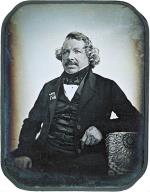
Pictures of Louis Daguerre

Louis DaguerreOn this day in 1647, the French philosopher Pierre Bayle was born. He is noted for arguing in favor of religious tolerance. But there’s an interesting aspect to words like “tolerance” and “diversity.” They are exclusive. Sure, we do want diversity in our culture. But if we are to have real diversity, we can’t think in terms of that. And with tolerance, there is an implied limit: we tolerate diversity up to a point. In Bayle’s case, he thought various kinds of protestants should be tolerant of each other. But Catholics? Not so much. And let’s not even start with Jews. Personally, I don’t want to be tolerated; I want a lot more.

The great playwright and and lyricist W S Gilbert was born in 1836. He is best know for his collaboration with the composer Arthur Sullivan. And now is as good a time as ever to watch Linda Ronstadt kill it in Pirates of Penzance:

Fox News host Megyn Kelly is 43. Normally, I wouldn’t even bring her up. But according to Joe Muto in An Atheist in the Foxhole, it’s all an act. He said that she was very funny and smart, and not especially conservative when he first worked with her. She went for the dumber host act to become a star at Fox News. I’m not sure what I think of that. Is it more evil to just play the part people pay you to? I tend to think that it is. News readers are nominally journalists; they aren’t actors. Their audiences believe them. Say what you will about Glenn Beck, I don’t doubt that he really believes what he says. So yeah, of all the women on Fox News, I would probably most like to hang out with Kelly. (Of all the people, it would be Shepard Smith, just because he’s such oddball.) But I think what she’s doing is vile.

Other birthdays: Scottish painter David Wilkie (1785); the great botanist Asa Gray (1810); physicist August Kundt (1839); writer Clarence Day (1874); painter Wyndham Lewis (1882); pollster George Gallup (1901); songwriter Johnny Mercer (1909); astronaut Alan Shepard (1923); trumpet player Don Cherry (1936); and actor Owen Wilson (45).

The day, however, belongs to the great physicist Louis Daguerre who was born on this day in 1787. He invented the Daguerreotype process, which was the first practical photographic process. If you’ve seen a photograph from the first half of the 19th century (for example, Edgar Allan Poe), it used this process. It isn’t that different from later processes. Basically, a lens focuses the image on a plate that was coated in silver. The chemistry is kind of complicated, as you can see in this excellent little video:

Happy birthday Louis Daguerre!

Stagnation is Still All Income Inequality

Larry SummersPaul Krugman has written quite a laudatory article about a recent talk given by Larry Summers. I think part of this is just an attempt for Krugman to make nice after being fairly critical of Summers as a possible Federal Reserve chair. But there is no denying that what Summers has to say is interesting. You can read Krugman’s description of it, Secular Stagnation, Coalmines, Bubbles, and Larry Summers. But the basic idea is pretty simple. And troubling.

What Summers noted was that since Reagan, the only time that our economy has been at full employment has been when some kind of bubble is going on. Part of this goes along with our huge increase in private debt over that time. But it is has not caused inflation. Summers suggests that we have a new normal where the economy is depressed. The takeaway from all of this is what we already know: individual saving during bad economic times is bad for the economy generally. Given that individuals won’t spend, the government ought to be spending more. This is all very basic Keynesian theory.

But having read the article, one thought immediately occurred to me. The real problem here is not how the economy is working on average. The problem is how the economy is being divided up. You may remember a TED Talk by Nick Hanauer that I wrote about last year. In his lecture he talks about how if workers had the same share of the economy as they had in 1970, they would make almost twice as much as they do today. Just imagine what that kind of extra buying power would do for our economy! Instead, we have rich individuals and corporations sitting on huge piles of money—money that could be spent on salaries for the unemployed.

I didn’t come up with this idea all by myself. It came from reading Dean Baker for years. So I was interested to see what he had to say about Summers’ talk. He made four points, Bubbles Are Not Funny. First, when bubbles burst, they tend to cause wealth to trickle upwards—they make income inequality worse. Second, he talks about income inequality. Third, he mentions how our trade deficit harms us (and how it is partly the fault of Summers’ strong dollar policy). And finally, he talks about a very big issue for him: work sharing. The truth is that part of our problem is that Americans work too many hours and don’t take vacations. If they worked less, more people could have jobs.

To me, the biggest issue by far is what I originally spoke about: productivity gains over the last 35 years have not been equitably shared (in fact, to a large extent, they haven’t been shared at all). As Baker noted, “The upward redistribution in the last three decades, from middle and lower end wage earners to the high end wage earners in the 80s and 90s, and to corporate profits in the last decade, likely had an effect in depressing consumption.” Simply by increasing the total taxes paid by the rich, and providing better services at the bottom would greatly help the poor and middle classes. This actually gets to a point that Matt Yglesias makes a lot: if companies can’t think of anything creative to do with their piles of cash, then maybe they should just lower their prices. Well, if the rich can’t think of anything creative to do with their cash, I can think of a lot of creative things the government can do with it.

As Krugman hammers on all the time: economics is not a morality tale. All the Ayn Rand sycophants can talk all they want about “makers and takers.” But the fact is that the bad economy hurts the rich as well as the poor. The rich are not concerned, as Rand always claimed they needed to be, with their enlightened self-interest. The rich are as short sighted as anyone. We need to do what is best for the economy as a whole. And that works out well, because it also means that the economy works well for everyone inside it.

Update (17 November 2013 9:57 pm)

Krugman wrote a column based on the same stuff, A Permanent Slump?

Where’s My Third Lost Skeleton Film?!

The Lost Skeleton of CadavraMy friend, can your heart stand the shocking facts of another “Lost Skeleton” film? Well, even if it can’t, I don’t know if it matters. I’ll discuss it in a moment. But first, you may ask, “What does he mean by this ‘Lost Skeleton’ film of which he speaks?” It is a natural question that a person with questions such as yourself might naturally ask. Since I am a man of the type that enjoys the answering of questions that a person with questions will find themselves liking to ask, I will enjoy answering for you.

In 2001, Larry Blamire wrote and directed a film, The Lost Skeleton of Cadavra, a parody of low budget science fiction films of the late 1950s. Until that time, I had never seen a movie that was so silly. Here is the trailer for it, but I will warn you, the overpowering glory of its silliness can only be experienced by watching the whole film:

Blamire shot the film with a group of his friends, including established actors Brian Howe, Fay Masterson, and Andrew Parks. So after the first took off among film geeks, the band got back together in 2008 to create the sequel, The Lost Skeleton Returns Again. Unlike the original, it is beautifully shot, going after that studio B-picture look. Actually, it does a lot better than that. When the film is not chin-deep in silliness, it is presenting really beautiful shots. Here is the trailer with what I thought was the funniest monologue in the film:

That laugh in the middle of the monologue is priceless. And the back-lighting! Everyone’s working so hard on it: actor, director, cinematographer. Unfortunately, the writer just phoned it in, and he was really drunk.

Well, it is 2013 and we’ve been promised another “Lost Skeleton” film. Larry Blamire teamed up with special effects artist Cleve Hall to produce, The Lost Skeleton Walks Among Us. Last year at this time, Blamire tweeted out the following image to announce the collaboration:

The Lost Skeleton Walks Among Us - Cleve Hall

Then on 18 January of this year, Blamire released the following image to announce that they would soon be announcing a kickstarter drive:

The Lost Skeleton Walks Among Us -  Kickstarter

And then… Nothing! But don’t worry. I’m on the case. There will be updates! My friend, can your heart stand the wait?

Update (17 November 2013 3:46)

I just saw that The Lost Skeleton of Cadavra is currently streaming on Netflix. But the DVD has lots of nice extras. Regardless, if you haven’t seen it and you have Netflix, you owe it to yourself to watch it.

Update (18 November 2013 10:32)

Larry Blamire responded:

John Rawls and Disingenuousness

John RawlsI’m in the process of reading John Rawls’ Justice as Fairness. It is not easy reading. But still, I’m sure you’ll hear me talking more and more about Rawls as time goes on. That’s the way I am.

Reading this book got me thinking of another of his books, Political Liberalism where he tries to answer the question of political legitimacy. Basically: why should we even accept “justice as fairness” as the basis of our society? Why not just accept the idea that what it says in some holy book as the basis of our society? His answer is universality. Only people who accept the book as the word of God think, for example, that God cries whenever a sperm is wasted. But no one can reasonably argue that beating up innocent children is a good thing to do. (Actually, the Bible is pretty big on that too!)

As a society, we accept this. So in general, you don’t see people arguing against gay marriage because “God” is against it. Instead, you see arguments cloaked in a patina of universality when the actual point is simply a plea to a particular religious or cultural doctrine. So they argue (against all actual facts) that same sex couples are bad for children. Sure, their holy book is very clear that God hates fags, but that has nothing to do with their argument. It’s just about the children!

What this all comes down to is the fact that policy debates usually have a high percentage of content that is disingenuous. What’s more, those arguments come mostly from the conservative side. Consider abortion. The only argument against abortion rights is that the fetus should be considered a full citizen. But this isn’t a reasonable argument when you are talking about a zygote that has no brain. Again: it is a religious argument about souls masquerading as a universalist argument about protecting the innocent.

It isn’t just social issues either. Almost every conservative economic argument I hear is based upon the aristocratic idea that the rich really are better than the rest of us. It is a belief of pure faith and is completely unsupported by the facts. But the argument is rarely put in this way. Instead of “the rich are better” we get the Job Creator myth. By this myth, the poor will only have jobs if we let the rich keep all their money. Again: a disingenuous argument intended to hide the real argument.

Related to this is the evolution debate. In the 19th century and through much of the 20th, the argument was purely religious: God said it was seven days, dontcha know! But over time, the creationists realized they were losing the battle with all this religious talk. So they got disingenuous. They started making scientific-like arguments against evolution. They developed Intelligent Design. But regardless of how much mumbo jumbo you pile on, it is still Genesis 1.

I love theoretical discussions and I think John Rawls is brilliant and adds a lot of insight into my thinking about these things. But such serious discussions don’t mean much in the practical world. The conservatives know how to play the game, even if they don’t really understand the game. And as a fairly practical guy, I want to know how to deal with all this disingenuousness. I wish the Christians would just go back to their old way of arguing: God said it; I believe it; that settles it. At least it’s truthful.

Afterword

I would never try to prove natural selection by offering Bible verses. I really do not understand why they think it is alright to pollute my science as they do. They think they have the whole truth. If it were me and I just knew that after I died God was going to take me to heaven for eternity, I wouldn’t care much about this life. I know there are Christians like that out in the world. But most American Christians seem awfully angry when they talk about anything but how much Jesus loves them. Why does it matter to them what I believe? By their way of thinking, the best that’s going to happen to me is that I’m going to cease to exist. Given I only get one go at this, why not at least let me have my science and politics unpolluted by their faith-based disingenuousness?

Lightfoot, Scorsese, and Others

Gordon LightfootOn this day in 1503, the great Italian Mannerist painter Bronzino was born. I love his work, but I’m especially taken with his name. Because “Bronzino” was not his last name. His actual name was Agnolo di Cosimo. He apparently went by Bronzino because of his dark skin. It’s like if John Boehner were a painter, he might sign them, “Orange Man.”

The mathematician August Ferdinand Mobius was born in 1790. He is best known for the Mobius strip, which is a three-dimensional object that has only one side. When people are introduced to it in grammar school, it is usually referred to as “one sided piece of paper.” Mobius was a student of Gauss, which is generally enough to make anyone famous. But of course, most of his work was highly technical and not really suitable for children or basically anyone educated in the United States. His main work was in projective geometry and number theory. He also apparently did work in astronomy, but I don’t know what it was.

The great comedian Peter Cook was born in 1937. Here he is doing a great bit as a coal miner talking about his work, “My Experiences Down the Mine.” It is very funny:

The great film director Martin Scorsese is 71 today. I specifically did not give him the day because I don’t especially like him for the things that other people like him for. Most notably: Raging Bull and Goodfellas. I don’t like how Taxi Driver is widely misunderstood. But he’s directed some of my favorite films: Kundun and Bringing Out the Dead most especially. But what I most like about Scorsese is his appreciation of film. You can hardly watch a documentary about a film without Scorsese there saying the most insightful things. He really loves film—and in a way that resonates for me. If he had not been a filmmaker, he could have been a truly great film critic—like Roger Ebert in his love for the art form but with far greater insight. (Of course, he wouldn’t necessarily have been as good a writer; Ebert’s prose was really good.)

And just for JMF, Jeff Buckley was born in 1966. Here he is doing “Hallelujah”:

Other birthdays: Grace Abbott (1878); philosopher Mikhail Bakhtin (1895); actor Lee Strasberg (1901); historian Shelby Foote (1916); actor Rock Hudson (1925); singer-songwriter Gene Clark (1944); actor Danny DeVito (69); television producer Lorne Michaels (59); baseball player Tom Seaver (59); actor Mary Elizabeth Mastrantonio (55); and actor Rachel McAdams (35).

The day, however, belongs to the singer-songwriter Gordon Lightfoot who is 75 today. I tend to like folk music of his type because I like stories. And he always sounds kind of sad and wrote “Rainy Day People.” In general, I can listen to him for a fair amount of time before he starts to annoy me. Now I’m going to play one of his big hits, “The Wreck of the Edmund Fitzgerald.” But understand this: I think the song could have used a few more rewrites. The story itself is so compelling that the song works. But the lyrics are weak and the music could be a whole lot less plodding. So given that rousing introduction, here it is!

Happy birthday Gordon Lightfoot!

The Three Types and the Truth

Three Kinds of People When it Comes to Truth

Austin Frakt posted this image over at The Incidental Economist (it is originally from Dog House Diaries.)

It got me to thinking who these three types of people are. I think the “Awesome” people are your general liberally minded people. I don’t mean “liberal” in a political sense. I just saw that 60% of Republicans are in favor of raising the minimum wage. (Fewer are for adjusting it to inflation.) So there are a fair number of reasonable people who consider themselves conservative even though they are, as I said, “Liberally minded.”

The “Dangerous” types are really quite common. I once had this insurance broker who told me that he had no misconceptions. The world was neatly divided into what he knew was true and what he didn’t know. He was, of course, a Republican. This kind of certainty is entirely typical of conservatives. It is similar to the Dunning–Kruger effect where people who have little skill in something overestimate their abilities while people with much skill underestimate. But in this case, it is that people who are most certain of something tend to be the least right. And on a larger level, people who are most certain about a lot are least knowledgeable about everything. You know, a conservative!

But what about that “Run” group: are there really people like that outside of a mental ward? I think there are: Christian conservatives. These are the people who really skew things. These are the people who dragged a once great political party into its current state where science and even facts are nothing but opinion. These are the people for whom Stephen Colbert coined the term “truthiness.” The “Dangerous” crowd can still be convinced of things. They at least admit that there are more things in heaven and earth than exist in their perfect truth bubble.

The “Run” group have all the truth that is necessary and that truth is Jesus! Or at least the Jesus that they’ve been taught. You know, the God who loves the sinner but hates the sin, but couldn’t be bothered to make man without Original Sin? That guy! The one who loves you but will consign you to the fires of hell. To suffer in agony. Forever. Because you masturbated or somehow otherwise offended him by doing something he designed you to do. That’s the “Run” group!

In my experience, the “Run” group divides up their ultimate truth three ways: one part “Jesus loves me!” and one part “God hates abortion!” and one part “God hates non-productive ejaculation!” So you see, the graph is wrong. It isn’t that the “Run” types have beliefs that expand to fit the big universe; they have just reduced the truth to just about the most pathetic set of things imaginable.

It is a good idea to run from them. Unfortunately, here in the United States, they are everywhere. I’d say they are 20% of the population. But I’ll admit, that number is very possible outside the truth bubble.

Socialist, Communist, and Doodie Pants

Kshama SawantThere has been a lot of excitement about the fact that Kshama Sawant seems to have won her race for the Seattle City Council. The reason is that she ran as a socialist. But here’s the thing: it doesn’t mean that much. The world “socialist” has lost most of its meaning both on the left and on the right. And it is mostly a very good thing.

The Republicans are mostly to blame. They are experts at vilifying words. But they tend to take it too far. As I found myself asking conservatives a lot during the first two years of his presidency, “If Obama is a socialist, what was Stalin?” If you listen carefully to conservatives, you will quickly notice that to them, any deviation from their current ideology is, “Socialism! Socialism, I tell you!”

Obama was called a socialist. Clinton was called a socialist before him. Is there any doubt that any Democratic president will be vilified as a socialist? This kind of name calling can only work for so long. After a while, the word becomes nothing more than “doodie pants.” Okay, we get it: you don’t like the Democrats so you call them socialists. But it doesn’t mean anything more than that.

Look, it would be one thing if Republicans actually did stand for some kind of libertarian utopia. But they don’t. They are among the biggest supporters for the three biggest socialist programs we have: Social Security, Medicare, and the military. That’s 80% of the federal budget, folks. So if the difference between “Socialist!” and “Patriotic American!” is that remaining 20%, I think we can say that the Republicans are being a mite hyperbolic. (And note: the Republicans are also for most of the remaining 20% too.)

Some time in the 1950s, it seemed that the definition of socialism got watered down. If you wanted to talk about central planning dictatorships, you talked of “communism.” If you wanted to talk about the theoretical worker utopia, you talked about “Marxism.” Socialism came to mean those nice European nations where people were free but the society wasn’t dog-eat-dog.

What this all means is that “socialism” became just a slightly more robust version of the system that we have. But the conservatives couldn’t scream “Communist!” at liberals because that was patently false. So they depended upon the historical connection between “socialism” and the Soviet Union to do their dirty work. But it doesn’t work anymore—at least not for people under 40 years old. To them, socialism is just another word for the kind of political system that they prefer. The truth is that most of what Sawant stands for is very much what they believe in.

But is Sawant an actual socialist? In a word, maybe. I’m not especially clear on all her positions, but when you get into the weeds of policy, she seems to have some ideas (or at least Socialist Alternative does) that I wouldn’t support. But from a practical standpoint, she’s just a real liberal and that’s why she has been elected. As I talk about all the time here, the United States has been pulled so far to the right that it would be years of leftist control before things got balanced and I started to disagree with anything the left wanted to do. Regardless, Sawant and her party seem pretty far removed from nationalizing the corporate world, which is what a real socialist would do.

If we start getting more aggressive liberal politicians running under the banner of socialism, you know who to blame: the conservatives. They distorted the usage of the word socialism for their own purposes for decades. And now the liberals are distorting it for their own. And I’ll be clear: I’m thrilled. I’ve always thought, “You think Obama’s a socialist?! I’ll show you a real socialist!” And it looks like that time may have come.

Afterword

It is interesting to think about Elizabeth Warren becoming president. She is not at all a socialist, but you know the kind of freak out we would see from the right! Suddenly they would talk about how reasonable Obama was but this Warren chick is a… Socialist! Communist! Doodie pants!

Two Greats, One Composer, One Actor

Paul HindemithIt’s a big day in drug history. Seventy-five years ago, Albert Hofmann synthesized lysergic acid diethylamide, better known as LSD. I remember a story (possibly apocryphal) dating back to the 1970s. On the first day of Introduction to Chemistry, a certain professor would walk in and write “C20H25N3O” on the calk board. He would say, “This is the chemical formula for LSD. I don’t want to be asked for the rest of the year!” Of course, it would take at least another year of chemistry to gain the skills in organic chemistry to learn how to make it. In his way, Hofmann was as much an advocate for the drug as was Timothy Leary. And he was so right up to his death a few years ago at the age of 102.

On this day in 1907, the great actor Burgess Meredith was born. I don’t even know where to start in talking about him. I think that everyone knows and loves him. Here is a little gem. In 1961, Meredith starred in an American television version of Waiting for Godot with Zero Mostel as Estragon. It is done more as straight comedy, but I rather like it. Since then, Beckett’s notes of the play have become public and now everyone does it exactly the same way. This is a very different approach and it looks quite good, although I haven’t finished watching it. But go ahead, I’ll wait; it’s only two hours.

[Update: the video is gone. Here is a short scene from it. -FM]

Other birthdays: Roman Emperor Tiberius (42 BC); mathematician Jean le Rond d’Alembert (1717); the last king of Hawaii Kalakaua (1836); composer W C Handy (1873); playwright George S Kaufman (1889); libertarian philosopher Robert Nozick (1938); speaking of LSD, Terence McKenna (1946); actor Lisa Bonet (46); and actor Maggie Gyllenhaal (36).

The day, however, belongs to the great modern classical composer Paul Hindemith who was born on this day in 1895. I always thought of him as a really difficult composer. But as I went back and listened to some of his work this morning, I had a realization, “He isn’t difficult to listen to, he’s difficult to play.” That isn’t to say that he’s exactly easy listening. But it is quite fun. He uses counterpoint much more aggressively than most modern composers. A lot of his work has a distinctly Bach flavor to it. Here is Glenn Gould playing the fourth movement of Hindemith’s Piano Sonata Number 3. This is especially appropriate because Gould was renowned for playing Bach and this movement is (nominally) a fugue:

Happy birthday Paul Hindemith!