Be Careful With Cannabis Cookies

Cannabis CookiesIn my alternate life as protectors of drug users when I spent years trying to keep them alive (and still spend a fair amount of time helping people detox from drug addictions), I often pointed out an important but counter-intuitive fact about drugs: sniffing and eating drugs can be more dangerous than smoking and injecting. The reason is that these generally more benign drug delivery systems allow people to ingest far larger quantities. After taking one Percocet, the user doesn’t feel it right away, so he takes five or twenty. And before he notices it, he’s passed out and then dead.

This isn’t a reason to encourage people to inject drugs, which has its own problems that are usually even worse. But smoking or vaporizing drugs is actually a good way to deliver them because the effect is immediate at the same time that a very large dose can’t be inhaled at one time. But just to be clear: I’m not saying people should do drugs. But if they do, smoking (or better vaporizing) has the least downside.

The issue comes up today because we are seeing this issue with cannabis. German Lopez over at Vox reported on Friday, Eating Marijuana Is Riskier Than Smoking it. The wide and potent availability of cannabis “edibles” in Colorado has caused a couple of problems recently:

In one incident, a 19-year-old man jumped to his death from a Denver hotel balcony. Later reports revealed that Levy Thamba, the young man involved, had consumed six times the recommended amount of a marijuana cookie.

There is no doubt that this is a problem. Not only that, it was a predictable problem that I and others did predict. And the same thing happens all the time with pills. But because everyone is skeptical about the new cannabis law, people are on pins and needles about any cannabis related deaths, even though such things happen regardless of whether the drug is legal or not.

At this point, it doesn’t look as though people are using this small number of tragedies to justify invalidating the experiment. But it does point out the need to inform the public that care must be taken with drugs, even when they come in as benign a form as a chocolate chip cookie.

At the Academy With Jean-Leon Gerome

Jean-Leon GeromeThe French Academy painters have something of a bad reputation today because of their exclusion of the Impressionists. (That’s not true of all of them; some chose to stay out.) I’m all for as much variety in art as possible. But if I had to choose one group, it would be the Academy. The work is so beautiful and interesting, often with classical allusions. Luckily, however, I don’t have to choose because the Impressionists are great too.

On this day in 1824, the great French Academy painter Jean-Leon Gerome was born. Whereas William Bouguereau was mostly a figure painter (An insanely great one!) Gerome was more of a historical painter. He was also quite an accomplished sculptor, and would probably be important if that were all he had done. But I’m most impressed with his painting.

In addition to his artistic output, Gerome was one of the most important educators of his time. He taught some of the greatest painters of later generations. These include the symbolist painter Odilon Redon, the impressionist Mary Cassatt, and cartoonist Georges Ferdinand Bigot. That just scratches the surface, but it provides a good idea of the breadth of his influence.

Like many great painters, Gerome’s life was not that interesting. He showed talent early on and then he spent the rest of his life using it. Here is a really great example of that, The Tulip Folly. It is a representation of soldiers in the Netherlands trampling tulip fields trying to stabilize the out of control tulip market:

The Tulip Folly - Jean Leon Gerome

Happy birthday Jean Leon Gerome!

Posted in Uncategorized | 1 Reply

When in Doubt Benghazi!

Scandal?!The last five years have been something to behold. After the financial collapse, the conservative movement convinced itself that the reason things went so wrong was that the Republican Party had not been pure enough. According to this view, it only pretended to be conservative, but it really wasn’t. As a result, the new conservative movement repudiated all of what conservatives have done the past four decades.

In terms of domestic policy, the Republicans have long been for big spending projects that were not paid for. So when Democrats took control of the government, there really wasn’t any policy that they wanted. They just wanted power back. And they decided that the best way to get it back was just to scream about how terrible the Democrats were, regardless of what they did.

The Benghazi HoaxThis led us to years during which the Republicans attacked Obamacare—the healthcare reform law that Republicans had been pushing for two decades before. It wasn’t that they actually had anything substantial against the new law (other than that it raised taxes on the rich). It was mostly that it was a Democratic law and the one thing they know that they agree with is that Republicans should be in power and so the Democrats can’t be allowed to accomplish anything.

Now that Obamacare is turning out to be a success and at most a year away from being actually popular, the Republicans have a problem. If “Obamacare” itself isn’t enough to terrify the electorate, they had to find something else. And what could that be? Luckily for them, the right wing echo chamber has kept alive a number of non-scandals for them to use. The best, of course, is Benghazi, because four people died at Benghazi (No one died in Watergate!) even though the supposed scandal has nothing to do with the events that led up to the attack.

No One Died in Watergate

As Scandals go, Benghazi is a remarkable choice. It would be one thing if the argument was that the administration did too little to protect our embassies. But they can’t make that argument, because they were responsible for cutting funding. So instead, it is all about what the White House said after the fact. That’s what led to the amazing moment in the second presidential debate where Romney embarrassed himself by claiming that Obama didn’t call the Benghazi an act of terror. He was wrong, but even if he hadn’t been: really?! That’s the scandal? That the administration didn’t talk about a tragedy in the right way?

It is almost two years later and this is still all the Republicans have. If the worst of what the Republicans claim is true, it means that the administration tried to put the best spin on the attack as possible. How this distinguishes it from every other administration ever, I do not know. But of course, it is clear that the worst of what the Republicans claim is not true. As is usual in these cases, after the Benghazi attack there was a lot of conflicting information and the administration didn’t get the story exactly right. If the White House had six months to get their story right (as the Bush administration did before the Iraq War), we might find their error less understandable. But they had four days.

So 2014 is going to be the Benghazi! campaign for the Republicans. We may even see an impeachment attempt. But at this point, what else do they have? Over the past two decades, the Democrats have been eager to embrace any but the most loony Republican ideas. And that includes a lot of really conservative and bad ideas like chained-CPI. So the Republicans really have nothing else to campaign on. If it isn’t Benghazi! then it will be something else crazy, designed to appeal to their crazy base: IRS targeting of conservative groups or ATF coming after your guns or Obama coming after Christian religious rights. These are all untrue, but it hardly matters. The Republicans currently have no actual policies to push.

So Benghazi! it is.

How to Make Monopoly Fun

MonopolyJonathan Chait wants you to know, You Don’t Hate Monopoly, You Just Suck at It. And he is right that Monopoly is a wrongly vilified game. In particular, the game does not take hours to play. A big part of what makes the game grind on are common extensions like doubling the starting cash and paying $500 for landing on Free Parking.

When I was a kid, I played Monopoly a lot. So although I never made a study of the game, much of my intuition was right. Here are just a few things I knew that are backed up by actual analysis: don’t buy the dark green properties; avoid the purple properties; generally, try to buy the second group on one line; and the properties on the first two lines are better than the second two lines. The first two rules are just my experience. But there is a “go to jail” spot right before the green properties; and the purple properties are right after Go, so they are less likely to be hit. The third rule is just simple analysis: these properties have higher rents but cost less to build on. And the fourth rules takes advantage of the fact that people are so often transported to Go and Jail.

Jonathan ChaitBut there is a very good reason that most people don’t like playing Monopoly. And Chait knows about it. He explained, “Trading is the key to the game.” When multiple people are playing, there is always one or more people who think that other players are ganging up on them. This is the reason that pretty much no one wants to play the game Risk. Chait is right, of course, without trading, the game is boring and, in general, long. So players have to be willing to trade.

The problem is that the trading is distinctly outside the set rules of the game. If you land on another person’s property, you own them rent. That is all there is to it. But if two of your opponents trade themselves into monopolies and you are left out, you will not see it as the vicissitudes of the game. You will see it as the other players screwing you. And you won’t be completely wrong.

Personally, I find games of pure skill more edifying: chess, checkers, Go. But they also suffer from what is probably the worst aspect of all games: most people (but men especially) are jerks. The joy is in the playing, not the winning or the losing. I’ve noticed a lot that people (conservatives especially) have this problem with little league games where score isn’t kept. This is like enjoying a book only to get to the end. Games should be fun in the playing and winning should largely be irrelevant.

What Chait discussed is valuable. Because what he’s really getting at is understanding the game. It is only by taking the game seriously that we can enjoy it fully. If Monopoly were just a random game, it wouldn’t be much fun. On the other hand, I never mistook chess to be a random game, but it was boring because I didn’t understand it. I had to teach myself how to play it because chess instruction is so horrible. And I think that’s the case because most people who play it are only interested in winning. To this day, I enjoy chess greatly without being terribly interested in winning.

Chait ended his article in an unfortunate way:

Luck matters in Monopoly only if all the players understand the fundamentals of the game’s strategy and understand the varying rate of return of different investments. I’ve never played a game of Monopoly where that’s the case. Players who understand the odds and strategy of the game should virtually never lose to ones who don’t.

This strikes me as a big problem with people who play games. If you were playing Monopoly with someone who did not understand the essentials of the game, wouldn’t you explain at least the basics? Wouldn’t that make the game more fun? And isn’t that the point?

The Booth Civil War

John Wilkes BoothOn this day in 1838, John Wilkes Booth was born. He is one of the great villains of American history. But I think I understand him. He was, after all, only 26 years old when he assassinated President Lincoln. And it isn’t at clear what he thought he was doing, given that the Civil War was over. But how he reached the point of thinking that it was right to kill the president is not so hard to understand. He got lost in his own vision of the world that was, tellingly, dependent upon Shakespeare’s Julius Caesar. He saw Lincoln as Caesar—a despot that needed to be destroyed. I think it is also possible that there was schizophrenia involved.

Of course, there is a big difference between hating a man and thinking he is a tyrant, and setting about to kill that man. Booth’s behavior pushed him further and further away from his family. His older brother Edwin Booth was a unionist and supporter of Lincoln. By 1864, he would no longer welcomed his younger brother in his home. Shortly before John died, Edwin wrote to his sister, “Think no more of him as your brother; he is dead to us now, as he soon must be to all the world, but imagine the boy you loved to be in that better part of his spirit, in another world.”

So the assassin found himself more and more around like-minded people and they managed to whip themselves up to the point where the murder of a president seemed like not just a good idea but an absolutely essential act. It bothers me today because of Cliven Bundy and the militia people. They’ve all convinced themselves that Obama, rather than being just a president of the opposite party, is a despot that must be destroyed. This kind of thinking brought about the assassination of Abraham Lincoln and more recently, and pointedly, the Oklahoma City bombing.

I’ve always felt sorry for Edwin Booth. He was a great actor who was on the cutting edge of moving Shakespearean performance toward a more naturalistic style. And the Booths were probably the greatest theatrical family in American history. John Wilkes Booth really screwed that up. Obviously, he did much greater harm to the Lincolns and to the country. But you are supposed to look out for your family. But when ideology gets out of hand, very basic things get lost like love of your family and respect for the law.

Anyway, happy birthday to the very troubled and horrible John Wilkes Booth.

Charles Krauthammer Doesn’t Know Science

Charles KrauthammerGoing back briefly to the Jonathan Chait article I mentioned earlier, there is one thing that Charles Krauthammer said that really bugged me. It’s been quoted various places but no one seems to have noticed the contradiction, so I figured that I should point it out.
The thing is that Krauthammer wants it both ways. Pure science that has no political implications is just fine, but applied science that indicates something that conservatives don’t want to do must be held to an impossibly high standard. He wrote:

99 percent of physicists convinced that space and time were fixed until Einstein working in a patent office wrote a paper in which he showed that they are not. I’m not impressed by numbers. I’m not impressed by consensus.

He is arguing that since Einstein changed physics, we can’t know that global warming is true. The problem with this is that there was this thing called the ultraviolet catastrophe. The entire physics community was worried about it. There was also the Michelson–Morley experiment. The entire physics community was worried about it. In the decades leading up to Einstein, physics was in crisis. It wasn’t the case that that physicists were sitting around thinking that they had it all figured out. It was quite the opposite.

On the other hand, now there is a consensus on relativity and quantum mechanics. But why should Kruthammer accept that consensus? After all, he just disregarded the consensus that he made up about late 19th century physics. Why is the new consensus any more believable than the old consensus? Scientists can’t be trusted!

His argument is very simple if we assume that his historical examples are correct (which they aren’t). There was a wrong scientific consensus about relativity before Einstein. Then the scientific community learned the truth and developed a new consensus, which is the truth. Thus, the consensus on global warming is wrong because the consensus in the past was wrong (even though it wasn’t).

What Kruthammer’s argument comes down to is that he doesn’t want to accept global warming as a fact because it will hurt the oil companies and others who he works for. Thus, he will say anything at all to avoid admitting the truth. And in 20 years, if he’s still alive, no one will treat him as the evil lobbyist who helped to stop the world from addressing its most pressing problem.

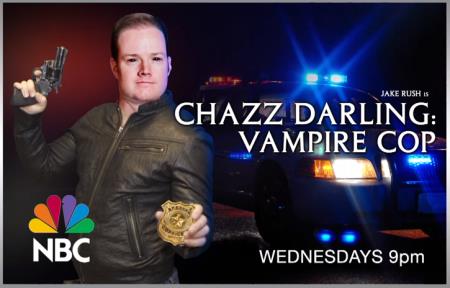
Chazz Darling Vampire Cop

Chazz Darling Vampire Cop

This is from yesterday’s The Colbert Report. Jake Rush is a Tea Party candidate running for Florida’s 3rd District House seat. He is an idiot, but not of the frothing at the mouth variety. He also does role playing as a vampire. That is, by far, the coolest thing about him. And that doesn’t really say anything about him. If I dressed up as a vampire, that would be the coolest thing about me. Of course, maybe that doesn’t say much about Rush given my coolness bonafides. But I love the image above. I would totally watch that show.

Here is the segment:

And here his interview with with the very good natured Jake Rush:

Will the Real Frank Conniff…

South by South SatanIn 1955, Frank Conniff went to the Soviet Union to interview Nikita Khrushchev and other communist leaders. This led the following year to his winning the Pulitzer Prize in International Reporting. At that same time he was a minor celebrity—frequently appearing on Who Said That?—a game show developed by Fred Friendly, who was later closely associated with Edward R Murrow. Later in his life, Conniff became TV’s Frank on Mystery Science Theater 3000.

Wait! That’s can’t be right. The MST3K Frank Conniff was only born on the year that Frank Conniff won the Pulitzer. What’s going on, of course, is that TV’s Frank is actually Frank Conniff Jr. But given that his journalist father died when he was only 14 years old, he didn’t feel the need to distinguish. But it’s very confusing. What’s more, if you look at his Wikipedia page, there is no mention of his father except the usual warning, “For the Pulitzer-prize winning journalist, see Frank Conniff (journalist).” And on that page, the only mention of the younger Conniff is under “children” in the boxed information. (Actually, I just noticed that Frank Conniff the Younger has the same information in his box.)

It’s kind of weird because normally there would be some information like, “Frank Conniff was born on 30 August 1956 in New York City, the son of Pulitzer Prize winning journalist Frank Conniff…” The only reason I found out about Conniff’s famous father was that he sent out a tweet yesterday:

In related Frank Conniff news, I finally got around to listening to the newest Podhouse 90 (almost a year old at this point), “South by South Satan.” His first episode was “The Wonderful Pundits of Oz,” which I quite enjoyed, even though I thought it could have been tighter. In most ways, “South by South Satan” is as good. But it is primarily a single joke: Satan is responsible for all the terrible anemic songs you hate. It also lampoons the sell-out mentality of modern America and doesn’t have very nice things to say about Christians either. It’s more snark than anything, so if you like that and really dislike Michael Buble, check it out!

I’m just glad I got the Frank Conniffs sorted out.

Pro-Business Policies Don’t Help Economy

Menzie ChinnMenzie Chinn has been doing some amazing work over at Econbrowser about the effects of “pro-business” policies on economic growth in the states. In two articles, he compares payroll levels with the ALEC-Laffer Economic Outlook Rankings. He finds that states that don’t have the supposedly pro-business policies actually do better than those that do.

Of course, the truth is that the ALEC-Laffer rankings have pretty much nothing to do with economic growth. Chinn explains, “The ALEC-Laffer methodology equally weights 15 measures: Top Marginal Personal Income Tax Rate, Top Marginal Corporate Income Tax Rate, Personal Income Tax Progressivity, Property Tax Burden, Sales Tax Burden, Remaining Tax Burden, Estate/Inheritance Tax Levied, Recently Legislated Tax Changes, Debt Service as a Share of Tax Revenue, Public Employees Per 10,000 of Population (full-time equivalent), State Liability System Survey (tort litigation treatment, judicial impartiality, etc), State Minimum Wage, Average Workers’ Compensation Costs (per $100 of payroll), Right-to-Work State (option to join or support a union), and Number of Tax Expenditure Limits.” In other words, it’s just a conservative wish list. It’s a bunch of stuff meant to enrich and rich, and through the use of the job creator myth, they claim it is good for the economy.

Chinn’s first paper was, State Employment Trends: Does a Low Tax/Right-to-Work/Low Minimum Wage Regime Correlate to Growth? In it, he looks at four states that all got new governors in 2010: California, Minnesota, Kansas, and Wisconsin. The first two with Democratic governors got ALEC-Laffer ratings of 47 and 46—at the bottom of the list. The last two with Republican governors got ratings of 15 and 17. Yet over the last four years, the states with the supposedly bad economic policies have seen their economies grow more than the nation as a whole and those with the supposedly good economic policies have seen their economies grow less than the nation as a whole.

Of course, this raises the obvious question, “What about the other states?” So Chinn wrote, State Employment Trends: Does a Low Tax/Right-to-Work/Low Minimum Wage Regime Correlate to Growth—An Econometric Addendum. What he found was that there really isn’t any correlation, but as much as there is one it is that the “pro-business” policies actually hurt the economy.

Let’s think about that for a moment. If we had a really equitable economy, allowing people to keep more of what they make might actually improve economic growth. But our economy is already so out of kilter that we aren’t going to see improvements from policies that allow the rich to keep yet more of their money. In fact, the opposite case makes more sense: funneling more money to the poorer classes is going to be a better way to stimulate the economy.

I find myself being very frustrated with most political issues these days. In this case, it is clear what ALEC and Art Laffer are doing: they are lobbying for the rich. No one should take them seriously. The economics of this stuff is very clear. But this kind of determined ignorance seems to be all that the conservative movement is these days. Today, Jonathan Chait takes George Will and Charles Krauthammer to task over their comments about global warming. In addition to everything else, these guys push the idea that the scientific community has a vested interest in global warming being true. But they make absolutely no mention of the fact that the the rich people Will and Krauthammer represent have far greater interests in denying global warming.

This is why our civilization is dying. Hopefully another civilization will rise up after us. And if it does, books will be written about the rise and fall of the American Empire. And they will conclude that what went wrong was that we turned into an oligarchy that was focused on protecting the interests of the rich. As a result, the society ossified and slowly died. And people like ALEC and Laffer and Will and Krauthammer will be a big part of the story. Thanks guys!


H/T: Michael Hiltzik

John Brown Marches On

John BrownJohn Brown was born on this day in 1800. He was not a crazy man. He was not like the people today who think that abortion is such a terrible thing that they must murder doctors and others in the name of their cause. For one thing, these people rarely have much of clue what they believe. Other than being told by other believers, they have no idea why they believe that a 16-cell zygote is a human being. As I note all the time, Thomas Aquinas didn’t believe that. If a man of his great brilliance and erudition came to a different conclusion, it can’t be that obvious.

Brown thought about the issue of slavery carefully. And his idea was never to murder all the slave owners. His attack on Harpers Ferry was strategic. He thought that he could make a quick strike, cause a slave rebellion, and that slavery would quickly be ended. He was wrong about that—and deeply naive. But it was a reasonable thing to think at that time. While awaiting his death, he wrote, “I, John Brown, am now quite certain that the crimes of this guilty land will never be purged away but with blood. I had, as I now think, vainly flattered myself that without very much bloodshed it might be done.”

On that point, he nailed it. American slavery was a very well designed system. It didn’t start out as racist. The problem that the ownership class had was that the working, indentured, and slave classes had this nasty habit of binding together and demanding things like money and dignity. So the ownership class invented racism. Thus, they made sure that whites would not get together with the blacks. It’s brilliant, because the whites were not getting anything. But by taking freedom away from the blacks, it made the whites feel like did get something. It’s like that great line from Mississippi Burning, “If you ain’t any better than a nigger, son, who are you better than?”

You see from this that “What’s the matter with Kansas?” is not new. The rich have always been able to divide the poor. In fact, that’s what they had to do. Otherwise, the people would never put up with something like royalty or, as we call them in this country, “job creators.” See all the jobs that the slave owners created?! That’s what capitalists want today. But they don’t want to call it slavery. But I don’t see much difference between slavery and someone working three jobs who also has to worry about the authorities arresting him (for any of thousands of laws that are not normally enforced) just because he steps out of line. With the way that many state prisons are now run, you can’t even say that at least we don’t torture the poor today.

Brown was right that it would take a lot of blood to wash away the sin of slavery. There are still apologists today who argue that it didn’t need to be that way. They say that slavery was a dying institution. But that’s not true. As soon as it could, the southern states enacted Jim Crow. It was less horrible than slavery, but only marginally so. And the truth is that if the federal government hadn’t stopped them, after the Civil War, they would have reinstituted slavery. Too much money was involved. The only thing that might have finally killed off slavery is if other countries stopped buying cotton from slavery states.

Today, John Brown is thought to have caused the Civil War to come about earlier than it would have because his raid on Harpers Ferry made the southern states paranoid. So his work was not in vain. But let’s never forget what slavery was all about: profits for a tiny slice of the people. And today, poor people are being held down, and in some cases even being tortured in jail, in the name of profits for another tiny slice of the people. Yet we people of the poorer classes go at each other, allowing the rich to gobble up more and more of our shared resources.

Happy birthday John Brown!

Afterword

Check out this great segment by Sarah Vowell from This American Life about John Brown and the song:

Michael Hiltzik

Michael HiltzikI am going to be out of town for the next two days, so I’m not sure how much writing I will be doing here. I’m sure there will be some stuff. There will be the birthday posts, of course. And I’m sure there will be other things I find that I absolutely must share with you. As always, I’ll try to write a bunch of stuff tonight. I actually do have a number of odd things on my mind like professional basketball in the 1960s and The Three Investigators books and something new I learned about Frank Conniff. Plus there will doubtless be any number of political issues that really bug me. So stay tuned. Just keep your expectations low.

It seems I am suffering from another pundit crush. I know, I know! It always turns out badly. They often turn out to be hopelessly naive or worse: clueless. But while searching for articles about the big Republican hearing thud, I discovered Michael Hiltzik at the Los Angeles Times. He writes a blog called The Economy Hub. And the last couple of days have been really good.

By “really good” I mean that he agrees with me. Well, more than that. But we are amazingly in sync in terms of what we’ve written about. For example, his take on Donald Sterling is the same as my take. (Read his take, he knows the historical context far better than I.) His take on Art Laffer’s advice to red states is the same as my take. And his take on the 60 Minutes BP whitewash is exactly the same as my take.

I also got the following 7 Habits of High Successful People from his Twitter feed:

  1. Skiing
  2. Yachting
  3. Snorkeling
  4. Golf
  5. Polo
  6. Dinner parties
  7. Shopping

I’ve added him to my daily reading folder. And I will shortly add him to the side bar here. Check him out!

The Conservative Culture of Ignorance

We Heart ObamacareYou may have heard about the House hearing on Obamacare yesterday. The Republicans brought in six health insurance executives to grill them on the number of people actually paying for insurance on the exchanges. You see, it was supposed to be a bloody good time for them. This followed from a survey that they made of the insurance companies on 15 April that asked how many people had thus far paid for their health insurance. Of course, at that time, a lot of people hadn’t even been billed, so there was no reason that they would have paid their premiums yet. Nonetheless, it allowed the Republicans to crow about how Obamacare wasn’t working because only 67% had paid for it.

Even at the time, just a week ago, there was widespread coverage of the failings of this study, like Dylan Scott’s Talking Points Memo article, EXCLUSIVE: Here’s the House GOP’s “Incredibly Rigged” Obamacare Survey. So there was no reason for the Republicans to walk into the hearing yesterday thinking they were going to stick it to Obamacare once again. At minimum, they should have known that the 67% number was going to be a lower bound on what the executives would report.

When asked, the insurance companies reported that they are seeing a payment rate in the 80% range, and not all the premiums are due. So what we are looking at is what has been reported for a couple of weeks: between 80% and 90% of the signups are paying. According to Sam Baker at National Journal, “Wellpoint, the largest insurer in the Obamacare exchanges, said the payment rate is closer to 90 percent among people who reached their first payment deadline.” Los Angeles Limes‘ Michael Hiltzik has more details on where the insurers are.

According to Elise Viebeck at The Hill, many of the Republican members of the subcommittee made an early exit, I assume because it wasn’t going well. Now this, in itself, is not surprising. These hearings are usually about grandstanding. But this is something else. This is a situation where Republicans are believing their own nonsense.

Think about it. All of these Representatives have staffs. They have people who do nothing but process information and provide it for the Republicans to allow them to do their grandstanding. I understand that the Representatives don’t scour the internet trying to find out what the other side is saying. But their people should be. And that’s especially true when their newest non-Benghazi talking point is based upon a clearly deceptive survey. So they should have known.

The question is why they didn’t. These are not stupid people. Yes, as Jonathan Bernstein pointed out, they live inside the “closed conservative information feedback loop.” But I think it is a cultural issue. It all started in the late 1970s. As I’ve written in the past, supply side economics was not a completely crazy idea at that time. But it was fairly far out and most objective analysis countered it. From there, step by step, they’ve moved inward.

For years, I’ve argued that the problem with Fox News is not that it is biased and just plain bad. The problem is their conceit that they are the only truly neutral news source. The biggest difference between a Fox News viewer and, say, a reader of this site is that readers of this site know that I am not neutral or otherwise unbiased. And the irony of the situation is that I take great care to get my facts right. Errors are not something I ignore around here. That’s not true of Fox News and most right wing information sources; their normal reaction to errors is to ignore them and move on. And that just leaves the impression in viewers that what was reported before was correct.

This is important because of its cultural ramifications. Even though I work very hard to get things right, no one would just assume if they saw it on this little website (or on Talking Points Memo or on MSNBC) it must be right. But apparently, not only do Republican politicians but their entire staffs consume nothing but conservative media. And they think that it is the neutral press.

And here’s the thing: it will only get worse. It has managed to get this bad because despite getting more and more out of touch with reality, Republicans have done quite well at the ballot box. If the Democrats manage to hold the Senate this year, win a landslide in 2016, and lose little in 2018, then the Republican Party might start to change. But even given that unlikely scenario it is not certain they will change. They may react the same way they did to 2008, “We lost because we weren’t conservative [ie, crazy] enough!” Unfortunately, it doesn’t just hurt them. We will all go together when we go.