Life Goes on After Mali Attack

Girl in Bamako, MaliGiven that we spent almost a week enjoying music from Mali, I figure I ought to say something about the Bamako hotel attack that took place just one week after the attacks in Paris. There are a few things that are worth noting. Note is that this was a terrorist attack. It was apparently carried out by Al-Mourabitoun and Al-Qaeda in the Islamic Maghreb. There were at least 19 people murdered. But I guess we don’t really care because most Americans don’t even know where Mali is, and the people there are used to being killed or don’t value life like we do or something.

Maybe it is that it is an attack by people who don’t look like us on people who don’t look like us. (In fact, that’s not true: it was an expensive hotel and over half of the victims were “white” — but only one was American, Anita Datar — working on family planning and HIV.) According to a BBC report, Mali has been under attack for the last three years — a situation that has been made much worse by the destabilization of Libya. It’s interesting to me especially, because the United States acts so much like Don Quixote. We throw ourselves into situations, make them worse, and then ride off thinking that we have done good. Of course, Don Quixote is insane. And the US is supposedly the most civilized of countries with by far the biggest military in the world.

The four or five gunmen who stormed the hotel were yelling “Allāhu Akbar” (“Allah is great”). So I guess that means Sam Harris was right. This is all about religion. It isn’t a question of a decades long separatist conflict with rebels in north Mali and west Niger. And before the Harrisistas start complaining that The Profit doesn’t say it is only Islam that is to blame, let’s be clear: I don’t think there has ever been a war in which most of the people didn’t feel God was on their side. In the Battle of Lena, both side thought Odin was on their side. Here’s a bit of history for you all: none of it was actually about Odin.

Our response here in the US is, “Not our fault! Close the borders! Hide under the bed! Oh, and keep up that drone program, because it’s working so very well!”

This attack took place on 20 November 2015. I looked back a year after the Paris attacks. So let’s look back at 20 November 2014 from the Global Terrorism Database. There were at least 105 fatalities from 39 attacks. And this isn’t taking into account all the people fighting against them, not to mention our own bombing and drone campaigns. I am almost to the point where I want to throw up my hands and just repeat, over and over, “They raped our queen, so we raped their city, and we were right!”

Of course, I fear that most people on all sides of these conflicts would respond the opposite from the way I intend. They would say, “Right on!” I’ve been more than clear over the years that I am not a pacifist. But it is clear that there are ways to make the world better and ways to make the world worse. We all know that the Iraq War destabilized the Middle East and made the world worse. Less known is that after almost 15 years of war, the Taliban have a tighter grip on Afghanistan than when we started. Well played, comrades; well played!

Meanwhile, death is everywhere — random and brutal. And our response here in the US is, “Not our fault! Close the borders! Hide under the bed! Oh, and keep up that drone program, because it’s working so very well!” Meanwhile, the people of Mali get on with their lives. They do not have the luxury to pretend that the world will be safe if only they close their borders.

Yes Donny, These Men Are Going to Hurt Us

Chris ChristieYou know me: Not a Real Man™. In general, I think men who act macho and belligerent are hiding something. They have very small penises or are awful in bed or are gay but too cowardly to admit it. Something. Regardless, it’s all about being terrified. So I’m not at all surprised that the political party of the macho man, the Republicans, should show its true colors and quake at the idea that terrorists kill people. I’m sure they are looking for women to walk in front of them so they lessen the impact of any bomb blast. If they are kidnapped, they won’t need to be tortured to yell, “Do it to Julia!”

It seems to me that the Paris bombings are a bigger media event here than they are there. We really are a nation of cowards. It takes almost nothing to set us off. This is why, with less than 5% of the world’s population, we spend just short of half of all the money on weapons. It’s why Bush’s line was so effective, “Fight them there, so we don’t have to fight them here.” We just want to hide from the threats of the world. And that’s because we have to face such minor threats here. It’s also because we have one political party with an ideology so repugnant to the vast majority of people, the only way it can get power is by fear mongering.

I’ve always consider myself a coward. Yet I have often times gone into very dangerous situations and locations — alone. It’s not because I’m foolhardy. I just trust that (1) threats are usually overblown; and (2) I can usually handle situations. Given what I see among so many American men, I can’t consider myself a coward in an absolute sense — just relative to what I think true bravery would be. So I don’t know what that makes people who are afraid to live near a methadone clinic or a prison or a Syrian refugee family. We need a new word, but I’m afraid it is one that I would ban from this site on stylistic grounds.

“No Donny, these men are cowards.” —Walter Sobchak

The ultimate example of this is Big Chicken — or as I like to think of him, “Governor Shouts a Lot,” Chris Christie. He made the bold statement last week that we shouldn’t let Syrian orphans under five years old in. It’s not clear that he is actually afraid of them. He said, “But you know, they have no family here. How are we going to care for these folks?” Yeah, how would we ever be able to care for children? We just have no experience with that!

After the attacks in Paris, people opened their homes to strangers. The French government is not halting Syrian refugees from entering the country. But here, well, we can’t do that. It’s nice to be humane and all. But when you are vewy vewy afwaid, you just can’t allow it. I’ve been saying this about police for years: if they can’t stop killing unarmed people because they were afraid they might get a paper cut, can we at least cut the crap about them being brave?

The same thing goes for the Republicans (and frankly, a sad number of Democrats too): these men are something far below cowards. If Dante’s Inferno is real, they will spend eternity fleeing in terror from dandelion spores. But unfortunately, in this world, these men have power. And Walter’s assurance to Donny is not appropriate. These guys are going to hurt the whole world unless we fight back. Then they’ll run for their guns and a line of women to hide behind.

Anniversary Post: Einstein’s Second Best Year

Albert EinsteinOn this day in 1905, Albert Einstein published an incredibly important physics paper. It was a very good year for him, but remarkably, not his best. In 1905, he published four papers — any one of which would have made him a huge figure in 20th century physics. He was 26 years old. And, as we know, working a day job. This is used by many people to claim that we don’t need to fund scientific research. Of course Einstein was working a government job. And the people who say that are idiots.

The first paper (9 June 1905) was, “On a Heuristic Viewpoint Concerning the Production and Transformation of Light.” This was the photoelectric paper that posited that energy is quantized. It is the most important paper in quantum mechanics. Interestingly, Einstein never did accept quantum mechanics of the Heisenberg and Schrödinger variety. That’s where the quote “God does not play dice” comes from. Even more interesting is that Max Planck, who did so much to further Einstein’s career, thought that this paper was total junk. And if anyone has the claim to being the father of quantum mechanics, it is Max Planck.

The second paper (18 July 1905) was, “On the Motion of Small Particles Suspended in a Stationary Liquid, as Required by the Molecular Kinetic Theory of Heat.” It’s a classic of statistical mechanics. It explained Brownian motion as a random walk. I’ll be honest, I’ve never paid much attention to the paper because it seems too obvious to me. Statistical mechanics have always just made sense to me. But it was a huge finding at the time.

The third paper (26 September 1905) was, “On the Electrodynamics of Moving Bodies.” That’s Special Relativity. There was a year of my life when I was quite literally obsessed with it. It made no sense whatsoever to me. I finally realized that the problem was not my understand of Special Relativity but with my expectations. It isn’t a theory meant to explain the universe as I know it. It is meant to explain the motion of bodies moving very fast relative to each other. There is no “intuition” that we humans will ever have for it.

The fourth paper (21 November 1905 — 110 years ago today) is the most important of the papers, “Does the Inertia of a Body Depend Upon Its Energy Content?” This is also about relativity. It is where we get the famous equation: E = mc². But what’s really important is that it is the first step toward Einstein’s greatest achievement, the General Theory of Relativity. And that, will have to wait for another time.

Republicans Call for Most Oppressive Government

GriftopiaIt seems to me that I read Matt Taibbi’s Griftopia several years ago. But regardless, someone has gone and put the audio book of it on YouTube. I’m sure it won’t stay there long — it’s clear copyright infringement, even though 99% of the money that will ever be made on the book has been made (but you know how corporations think: 1% is 1%). But I started listening to it while cooking. It’s kind of funny hearing Taibbi’s rather foul mouthed prose being delivered by the highly respectable Patrick Egan. But it works surprisingly well. And it is a good reminder of just how engaging a writer Taibbi is. Really, in his way, he’s as good as Thomas Frank.

The book is five years old. Yet it could have been released this month. The only thing is that he focuses on the term “Tea Party” more than is normal anymore. But the same people and groups are out there. And certainly I still use the term. If I had been writing in the 1960s, I would have talked about the “Birchers.” Today, it is the “Tea Party” — just ask Claire Conner. But that style of writing has fallen a bit out of fashion. But everything Taibbi talks about in the book is still going on — even down to the details. The conservatives are still fighting the same lost battles.

One thing that Taibbi notes (as have I) is that the Tea Party isn’t exactly wrong in its anger. But just as Thomas Frank has documented so well, they express their anger in a way that helps the very people they are supposedly angry at. And he mentioned something that I know from my own personal experience. Supposedly liberal regulations that harm small business people come at us almost exclusively from the state and local government. It is not the federal government that is keeping the small business person down.

Yet the Tea Party types are laser focused on the federal government. And they are the ones who are forever telling us that local control is better than federal control. Obviously, like everything else about the Tea Party and the Republican base, they think this because they have been taught to believe it. The vast majority of these people have no actual experience being in business. They just “know” this stuff because people who have spent their whole lives either in politics or in big business have told them so. But it is interesting to consider why this is the Republican dogma, especially when you consider that “local control” and “states’ rights” have always been dog-whistles for the racism that the Republican Party was founded to oppose.

I think I know the real reason. Clearly, the base is highly bigoted and the modern Republican Party would not be against slavery if it were still a political issue. But for the elites using the issue, it is all about taxes. As I’ve discussed before, state and local taxes combined are actually regressive. At the federal level, there are two kinds of taxes: the payroll and income taxes. The payroll tax is unbelievably regressive. Because it is seen as an insurance policy rather than a tax, the super rich pay virtually nothing at all, while I (grossing less than $30,000 per year) pay 15.3% of my money. And to add insult to injury, the Republicans constantly remind me that they won’t be able to afford to pay me my insurance when I am due to receive it.

So all the taxes other than the federal income tax are regressive. The federal income tax is only major tax that is modestly progressive. And so the rich want to vilify the federal government because they want to get rid of this one progressive tax. The Republican base has been good enough to go along with this plan, even though it isn’t the federal government that is going to bother them or tax them excessively. It is the state and local government. And the anti-government types are loudly screaming for the kind of government that is most intrusive.

Repercussions From the Paris Attacks

Eiffel TowerThe Paris attacks continue to really bother me. Violence, I understand. It happens all the time. But I keep feeling paralyzed regarding the response to it. A small group of extremists carry out a terrorist operation — killing themselves in the process. And suddenly it is clash of the civilizations? Especially here in the US, it seems that conservatives want to use this as a second chance to fight the Iraq War. This time it will be different!
I’ll admit: I don’t know what to do. The situation in Iraq and Syria is bad. But that was true before the Paris attacks. I get that the French government used it as an excuse to step up its minor bombing campaign. I think that’s probably the wrong thing to do. I think building a coalition is probably better. But it is all understandable. What isn’t understandable is all the conservatives in this country who shockingly claim that we need to start bombing ISIS. When countered with the fact that we have been bombing them hard — many thousands of missions — then the conservatives change the subject to something that Obama isn’t doing. He isn’t giving the Kurds enough support; he isn’t backing the right groups; he isn’t dropping nuclear weapons. Whatever.

Tuesday morning, I watched a new documentary by Max Blumenthal and James Kleinfeld, Je Ne Suis Pas Charlie (I am not Charlie). It looks at the rise of Islamophobia following the Charlie Hebdo massacre. What really struck me was how the French fascists have embraced the Jews but are using the Muslims in exactly the same way that fascists traditionally used Jews in the last century. And a few people note that it is all simply because it is useful to their imperialistic aims. As soon as the Jews are not useful to the fascists, I’m sure the Jews will find themselves in the same category as the Muslims, blacks, and Gypsies.

But what’s really amazing to me is the way that almost no one learns anything. Sure, most people have learned that it is wrong to hate Jews. Yet these same people did not learn to avoid treating Jews as a monolithic group. And they did not learn to avoid applying the same vile logic to a new minority groups. And here in America, it seems we will never learn that we can’t bomb our way to peace. Not that I’m surprised. The entire conservative approach to policy is to look for an excuse to do what they want to do anyway.

I’m sure that to some extent, I fall into the liberal trap of thinking that there are reasonable solutions to the problems of belligerent groups. But I’m not suggesting that anyone just roll over. We in the advanced economies have the advantage of great resources — especially in terms of knowledge and time. So why is it that we seem to be doing exactly what ISIS wants us to do? Why is it we act like third grade boys who can’t wait until tomorrow to answer a challenge properly because we think we’ll look like wimps if we don’t act without consideration.

Anniversary Post: 1947 Royal Wedding

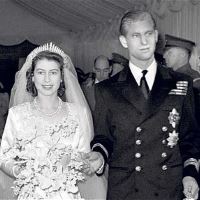
Princess Elizabeth married Philip MountbattenOn this day in 1947, then Princess Elizabeth married Philip Mountbatten. He had been named Duke of Edinburgh just before the wedding by Elizabeth’s father, Colin Firth George VI. Anyway, so the two of them have now been married for 68 years — quite a lot longer than I plan to live.

It seems wrong to me that they are both still alive. Elizabeth will be 90 next year and Philip will be 95. Are they ever going to die? It seems that the most useless of people live the longest. I understand: they’re tourist attractions. But so is Mickey Mouse. If he were an actual human being — or a mouse for that matter — it would be a pretty pathetic way to spend a life.

I think the UK should just bring the royal family together and say, “Thank you for all your fine work. You can keep all the money and the mansions. But your services will no longer be needed.” They could just go on to be the normal useless rich. Having the titles is bit much. It’s like the whole nation of the UK is involved in some kind of childish game, pretending that they have a monarchy.

I remember the wedding of Charles and Diana. I was in Germany at the time. And everyone was so excited about it. And I see the same thing with what’s her name. I wish they would all just go away. They offend me. They should offend all Americans. If the people of the UK want to keep them, that’s their business. But they are useless and offensive.

I suppose I can think of one way that they are useful: they are a reminder that we live in nothing like a meritocracy. They were born to their wealth and station and that is that. Sadly, I think there are a lot of people, who think that the royal family shows that the rich really are better than the rest of us. They aren’t.

Afterword

Proud of me? No a single joke about anyone dying in a car crash. Because truly: I don’t wish them ill. I just wish them gone.

Chocolat: Where Liberal and Conservative Meet

ChocolatI finally got around to watching the 2000 film Chocolat. I loved it. It’s like a fairy tale. It reminded me most of The Boxtrolls, which I reviewed earlier this year (The Boxtrolls and the Happy Ending of Class). The emotional core of the film is Vianne’s first customer, Yvette who uses a special chocolate concoction to revamp her love life with her husband Alphonse. I don’t think it is about sex so much as sensuality. People can have sex without connecting with one another. Think of phone sex or pornography. But we see Yvette and Alphonse throughout the movie as a doting and happy couple. That is the magic of chocolate and Chocolat.

But I noticed that on Rotten Tomatoes, the film does not have a terribly high rating: 63%. It speaks to our culture that the overwhelming majority of negative reviews come from men. And far too many of the critical reviews are political in nature. I’m not against that in general. I write many film reviews from an explicit leftist perspective. But the reviews that I read were only implicitly political. They didn’t engage with the film’s politics. Instead, they referred to it as Jeremy Heilman does, calling it an “offensive liberal fantasy” and that it “treats Catholicism as folly.”

Most of the negative reviews come in the form presented by James Kendrick, “For all its anti-religious and anti-establishment posturing, Chocolat is terribly conventional.” But how is it anti-religious and anti-establishment? If it is, so is the 1970 holiday staple, Santa Claus Is Comin’ to Town. Because the main character in the film is not Juliette Binoche’s chocolate making wanderer Vianne Rocher; it is Alfred Molina’s Comte de Reynaud, who is distorting the town and its church because of his own personal problems. Vianne may delight the town, but ultimately, it is de Reynaud whose transformation changes the town. And that transformation is not brought on by chocolate, but by his secretary Caroline telling him what everyone knows about his wife, “I don’t believe anyone would think less of you if you were to say she was never coming back.”

The problem that is evident in the “anti-establishment” complaint is that people like Vianne and Johnny Depp’s “river rat” Roux live in opposition to the establishment. They simply want to be accepted enough to exist unmolested. Some people have the gift of fitting in better than others. But as the film ably demonstrates, the church is about acceptance. From the beginning, we see that the young Father Pere Henri understands this. But he is oppressed — not by the church but by the Comte de Reynaud. And it is not out of dedication to the church or traditional ways that de Reynaud does this, but out of pain from his abandonment.

In the end, all the different factions in the film learn to live together. But this is not revolutionary. Because we do not start with a natural state. We start with a town that has been distorted by a very powerful man. When Vianne blows into town with the north wind, she brings not chaos but tranquility — a return to normality. This is something that liberals and conservatives alike should understand and celebrate.

I loved the movie. It is a rare film — a modern classic that Frank Capra would have made.

Afterword

The scribes and the Pharisees brought a woman caught in adultery, and having set her in the center of the court, they said to him, “Teacher, this woman has been caught in adultery, in the very act. Now in the Law Moses commanded us to stone such women; what then do You say?” They were saying this, testing him, so that they might have grounds for accusing him. But Jesus stooped down and with His finger wrote on the ground. But when they persisted in asking Him, he straightened up, and said to them, “He who is without sin among you, let him be the first to throw a stone at her.” Again he stooped down and wrote on the ground. When they heard it, they began to go out one by one, beginning with the older ones, and he was left alone, and the woman, where she was, in the center of the court. Straightening up, Jesus said to her, “Woman, where are they? Did no one condemn you?” She said, “No one, Lord.” And Jesus said, “I do not condemn you, either. Go. From now on sin no more.”

Will the Fed Destroy Our Fledgling Recovery?

Janet YellenThe monthly jobs report came out last Friday and it was pretty good. Dean Baker wrote, October Jobs Growth Pushes Unemployment Rate Down to 5.0 Percent. And you know what that means: the inflation is coming! Because, as we all learned in Econ 101, 5% unemployment is full employment. Of course, that actually means nothing. But that doesn’t mean that the Federal Reserve isn’t going to step in and slow the economy to stop even the possibility of inflation.

The unemployment rate may be down, but that doesn’t actually mean that much. As Baker noted, “The labor force participation rate is actually down 0.4 percentage points from its year-ago level.” The employment to population ratio of people between the ages of 25 and 54 was 80.0% in January of 2008. Today, it is 77.2%. So we have a low unemployment rate because lots of people in the prime working age range are simply not trying to find jobs because they aren’t readily available.

But what does that matter?! The Federal Reserve wants to increase interest rates because rich people think they might lose a little money due to inflation. So what is inflation currently? The core inflation rate right now is 1.89%. It has been almost three years since inflation has been above 2% — and then just for a single month. You have to go back a year further to find inflation above 2% for several months. How high? It peaked at 2.31%. And then you have to go back to November 2008 to be above 2% again.

They reason I bring this all up is because the Fed’s inflation target is supposed to be 2%. But it sure doesn’t look like that. It looks like the Fed has a 2% inflation ceiling. If we had a 2% inflation target, we would think years of less than 2% inflation would be followed by years of more than 2% inflation. But that’s not the way the Fed works, apparently.

In addition to suppressing workers’ wages and keeping millions of others out of work, the Fed could be setting the stage for a Republican president in 2017.

Dean Baker’s conclusion is pretty much what any person in the normal economy would think, “In short, this is a much more positive report than we saw in the prior two months. However, there is much in the report that indicates there is a still a large amount of slack in the labor market.” In other words: there is no fear of inflation. Workers aren’t making more money. And the power elite think we need to stop this from happening out of fear that modest inflation might happen.

Matt Yglesias wrote a very good rundown of what everyone should know, We Could Have an Economic Boom This Winter — If the Fed Doesn’t Screw It Up. That’s the thing that is so horrible about the Federal Reserve. It is an institution by, for, and of the power elite. It is supposed to have a dual mandate: keep inflation low and employment high. But it never much frets about employment. For the last five years, it has been looking for any excuse to raise interest rates. It isn’t the case that the Fed is monitoring the economy and deciding what to do. It wants to raise interest rates and it is simply looking for an excuse to do it.

Chad Stone, the chief economist at the Center for Budget and Policy Priorities tweeted out what should be obvious, “Three more months of jobs reports like today’s and maybe the Fed should start considering the possibility of raising rates.” That would be the reasonable thing. But instead, the Fed acts like an AA member standing at a free bar, “Gimme an excuse!”

In addition to suppressing workers’ wages and keeping millions of others out of work, the Fed could be setting the stage for a Republican president in 2017. Sure, there is some risk of a moderate rise in inflation if the Fed doesn’t raise interest rates. But there is a far bigger risk that it will tank the economy if it does. But that latter possibility doesn’t much concern the Fed, because it isn’t likely to hurt them or anyone they know.

Anniversary Post: Overpriced van Gogh

Self-Portrait Without Beard - Vincent van GoghOn this day in 1998, Vincent van Gogh’s Self-Portrait Without Beard sold for $71.5 million. At the time, it was the third most expensive painting ever sold. Now (adjusted for inflation), it is 26th. As regular readers know, I’m not a big van Gogh fan. But he is unique. Still, prices like this for a work of art say nothing of the work and everything about the narcissism of the art collector.

And if you look at the most expensive art there is a remarkable sameness about it. It is overwhelmingly Impressionist (more accurately, post-Impressionist) and representational modernist work. And there is a smattering of Abstract Expressionism — Rothko and Pollock. But the main thing is that you know the people buying these works would have hated the works when they were being produced. For all I know, they hate them now. It’s just something to impress the swells with.

I do all my writing sitting right next to what I know was once a beautiful painting by Bernard Frouchtben. But like far too much art that no one has been told is good, it was badly abused. In its case, it was left out in a carport for years. But even if it had been treated with the care and respect it deserves, it probably wouldn’t even be worth as much as $10,000. As it is, it is worth nothing in terms of money. But I dearly love it, even though it also saddens me to look at it.

I love art. But art as commodity offends me. For the price of that one van Gogh, a hundred Bernard Frouchtbens could have been supported in perpetuity. Imagine what kind of works would have result from that kind of investment. But instead, these people buy art the way decorators do when they are furnishing a new Days Inn. And the truth is that if you told these art collectors that paintings of bullfighters on black velvet was the thing, they’d be spending millions on every Edgar Leeteg that went on the market. And I’m not saying that Leeteg is bad. But his paintings don’t sell for millions for the same reason that van Gogh’s do — at it has nothing to do with what the buyers like or don’t like.

Why All the Love for John Wick?

John WickWhen discussing Hollywood filmmaking, I always have to come back to Laurie Anderson’s song “Big Science,” “I think we should put some mountains here. Otherwise, what are all the characters going to fall off of?” I tend to think of the song as deeply spiritual — questioning the nature of existence and time. But that one line pretty much sums up how Hollywood makes movies. These movies are to story telling what legos are to architecture. And even that if giving most films too much credit. And it is certainly giving John Wick too much credit.

I wanted to see the film. For one, I’m a Keanu Reeves fan. And I like revenge stories. And above all, I’m willing to meet a film on its own terms. But it was just bad. It had just about every comic book movie cliche in it. I’ve always felt that my greatest weakness as a fiction writer is my dialog. But listening to the dialog in this film was bad — like Jail Bait bad. The action sequences are all retreads of The Matrix. And the characters all act exactly as is necessary to move the plot along. That generally means they act stupidly.

Let us consider Viggo, the main villain. In order to save his life, he gives up his son to John Wick. Wick then kills the son and it is done. But then it is revealed that Marcus was working for Wick (this comes as absolutely no surprise unless you think that an assassin with rifle scope is incompetent — on multiple occasions). So what does Viggo do? He kidnaps Marcus and tortures him to death so that John Wick will come back and kill him. After having given up his son, why would he do this? There’s only one reason: because the screenwriter didn’t bother to write a credible motivation for the final confrontation.

But the critics have generally raved about the film. Why? Because it is so stylish! Well, it is stylish. It looked a hell of a lot like Constantine — made almost a decade earlier. The critics also liked the action, which as I said, was just a rehashing of The Matrix (15 years earlier). So John Wick puts together two previous Reeves films — but without the interesting plots that those films offered. And this is apparently enough.

Will people still think this is a great film in 25 years like they do “The Killer”? I’m sure they won’t.

Here’s the funny thing: John Wick works on its own terms. It tries to be nothing but violence porn — a big budget Ichi the Killer — and it succeeds at this. But the critics can’t talk about that. They have to talk about “style.” Meanwhile, they dump all over Krippendorf’s Tribe, even though it fully delivers the silly nonsense that it intends.

There is a tradition of this. Critics are much more likely to judge a drama (if that’s the right word for John Wick) on its own terms than they are a comedy. Just look at the critical response to Ishtar, which is a hilarious film. It has a 28% fresh rating on Rotten Tomatoes; John Wick has an 85% fresh rating.

So when it comes to John Wick, I will say what I usually say about films: it succeeds on its own terms. But that is not what critics normally say. What’s going on is that critics decide that they like a film and justify it. In the case of this film, there really isn’t much to like. It is what it is, but who enjoys this kind of thing? Will people still think this is a great film in 25 years like they do The Killer? I’m sure they won’t. But John Wick is passable. It’s enough like things we’ve seen Keanu Reeves do before, so it must be good. And God help us, they are making another one.

Bobby Jindal: the Uncanny Valley of GOP Politics

Bobby JindalI can’t even remember how many responses I’ve read to Kevin Drum’s weak argument, Liberals Should Knock Off the Mockery Over Calls to Limit Syrian Refugees. I really don’t care. I am with Martin Longman in thinking that Republicans who claim to be such strong jerks are really wimps who “become incontinent every time they think of a Muslim terrorist.” But really, it is this kind of stuff that has me depressed this week. Can’t the whole country have its entirely predictable freak out without it being considered news? Oh my God: Republicans want to increase our military presence in the Middle East! That’s right up there with: crossing guard used to keep schoolchildren safe at busy intersection.

So I was really pleased when I read Talking Points Memo yesterday, Bobby Jindal Drops Out of 2016 Republican Race. He said, “This is not my time.” And I understand: this too is on par with the crossing guard story. But at least I haven’t read it fifty times this week. And it is nice to see more people drop out of the Republican nominating contest. It’s not because I think it will make it more serious. Jindal is no more crazy than the rest of them. But getting down to a reasonable number of candidates is a good thing.

No one is surprised, of course. In fact, FARK’s headline was, Bobby Jindal Was Running for President? But it is much more than that. Back in January, The Onion published, Bobby Jindal Not Sure He Willing to Put Family Through 2-Month Presidential Campaign. They only got the timing wrong. Jindal stayed in the race for almost five months! But they were quite right that he wasn’t going to come anywhere near to the actual Iowa Caucus:

“If I were to declare my candidacy this June, I’d immediately have to head out on the campaign trail and would likely be apart from my family for as much as half the summer — that’s a sacrifice I really have to think about,” Jindal said of a potential bid for the Republican Party’s 2016 presidential nomination. “We’re talking four, maybe five big town hall events in the early primary states, a handful of public rallies, and a few Sundays spent at meet-and-greets with local voters. That’s multiple weekends on the road, and I’m not sure it would be fair to my kids.”

To be honest, I’m not sure what Jindal did with the extra couple of months. And I’m not too sure of what any of them are doing. I would think they would be in Iowa and New Hampshire just going door to door. It seems to me that politicians have gotten really lazy. If they aren’t talking to big crowds or on the television, they don’t seem to care. If the debates (at least on the Republican side) are what passes for campaigns, then we are in serious trouble. Because the candidates are at their worst under those circumstances. I dread seeing them all pounding their chests about Paris at the next debate.

As for why Jindal has dropped out and why he was never going to be the Republican nominee, I think I have the answer. It’s something like the uncanny valley in robotics. The idea is that we like robots that don’t look like us; they are cute or charming. And we are fine with robots that look just like us. But robots that look almost like us give us the creeps. In Jindal’s case, he wasn’t dark enough to make Republicans feel good about how non-racist they are. Just the same, he was way too dark to be white. So he was in the uncanny valley where his skin color and cultural background didn’t help him.

I know this probably sounds like I’m joking, but I am most certainly not. If Bobby Jindal looked more like Ted Cruz or Marco Rubio — men who are quite literally LINOs: Latino In Name Only — then he might have had a chance. He would have done even better if he were African American, where all Republicans demand is that the candidate tell them that they are right to hate all “those kind” of black people. But a Hindu turned Catholic who was governor of a state with lots of French names? He’s more Secretary of Labor material.

Anyway, it’s great news; now he can spend every weekend with his kids.

Anniversary Post: MAVEN

MAVENOn this day in 2013, the MAVEN space probe was launch from Earth. MAVEN stands for “Mars Atmosphere and Volatile EvolutioN Mission.” It entered into orbit around Mars on 22 September 2014. It was designed to study the evolution of Mars’ atmosphere over time. And less than two weeks ago, NASA announced, NASA Mission Reveals Speed of Solar Wind Stripping Martian Atmosphere.

It was discovered that the Martian atmosphere is significantly eroded during solar storms. This indicates that Mars used to have a much thicker carbon dioxide atmosphere that kept the planet much warmer than it now is — warm enough for liquid water to exist on the surface. The change from this warm Mars to the cold Mars of today apparently took place roughly four billion years ago.

I find this frustrating. I wish I were still associated with a college. I have questions. Did Earth’s larger magnetic field shield it from this effect? Is there a reason why this effect would be most important with carbon dioxide or is it just that the Martian atmosphere is primarily composed of the gas? Would the same thing have happened if the atmosphere had been mostly nitrogen or oxygen?

Regardless, this is fascinating stuff. And I don’t remember hearing a bunch of news coverage about this last week. It goes along with something I say often: our science reporting is terrible. Our political reporting is terrible. It seems that journalism is terrible with regard to anything I know a bit about. So I think we can conclude from this that journalism is terrible regarding everything. That’s not to say that all of journalism is bad or that all reporters suck. But it does indicate that there is something wrong with the industry. And I’m afraid I know what it is: the profit motive. It needs to be publicly supported. That is as important to democracy as elections.