Anniversary Post: Marshall Applewhite

Marshall ApplewhiteOn this day in 1931, Marshall Applewhite was born. I suspect you don’t know the name, but the photo on the left probably gives it away. He was the leader of the Heaven’s Gate cult and the guy who organized the group’s memorable mass suicide in 1997. I learned a lot while reading about him. We mostly have the wrong idea about Heaven’s Gate. Because of the tennis shoes and the whole thing about Comet Hale–Bopp and the spaceship that was following it, people think that it was some kind of nerd cult. But it was really just a garden variety end times belief system. Like most cults, it combined a lot of different elements, including lots of Christianity — especially from Revelation.

What I find most interesting is what these kinds of cults say about all of our searches for meaning and the ways in which our society does not provide much nourishment in that regard. I just read Neil Postman’s excellent, The End of Education. Unlike most books about education, it isn’t about “how”; it is about “why.” And in our approach education, just as in our approach to life, we don’t have much to say in terms of “why.”

The American (and increasingly the world) notion of a meaningful life doesn’t offer much. It’s pretty much what Schopenhauer discussed in The World as Will and Idea: “momentary gratification, fleeting pleasure conditioned by wants, much and long suffering, constant struggle, bellum omnium [everyone against everyone], everything a hunter and everything hunted, want, need and anxiety, shrieking and howling; and this goes on in saecula saeculorum [forever and ever] or until once again the crust of the planet breaks.” Is it any wonder that people grab onto simplistic life narratives about asceticism leading a pure existence in a science fiction nirvana?

I don’t see Applewhite as an evil man. I think he was as lost as his followers. But in a sense, they were not as lost as much of society. They rejected the hollowness of the American Dream. But they replaced it with something even more hollow: nihilism. It’s sad. Just the same, I can’t feel too superior. Until today, about the only thing I knew about them was that they died wearing Nike™ shoes. It’s a fitting, if ironic, testament to their rejection of the world that we mostly remember them for their brand loyalty.

Happy birthday Marshall Applewhite.

Kant, the Shopkeeper, and Fear of God

ShopkeeperI’ve been listening to Michael Sandel’s Justice lecture series while I’ve cooked dinner this past week. And most recently, he was discussing Kant and he provided the following example. Suppose that a simpleton walks into a shop and buys something. The shopkeeper could shortchange the customer. But she doesn’t because she thinks it might get around and hurt her business. According to Kant, this would not be a moral act, because the reason that she isn’t shortchanging the customer is only because of the practical considerations of her own self interest. She should, instead, not shortchange the customer because the customer is a fellow human being who deserves dignity.

I have my problems with Kant’s moral reasoning, in as much as I understand it. In a general sense, I don’t think there is any real distinction between doing something because it is “right” and doing it because it is self serving. The problem that I have with it is not theoretical — I would never go head to head with Kant on that level! But I have seen in my life a whole lot of people who delude themselves into thinking that they are morally superior to others. But what I see are people who have an addiction to the feeling of superiority.

A good example of this is the non-drug addict who feels superior to the junkie. They are both addicts — just to different states of mind. Obviously, Kant is dealing with this on a higher level. But ultimately, he fetishizes rational thought. And his entire system becomes little more intellectual tinkering that is at best useless. It also has a certain tautological aspect to it where it assumes what it is trying prove: the intellect must conquer the will because the intellect is the greater good. We know this because Kant deems it so.

Just the same, I do think that there are better and worse reasons for doing things. Valuing fellow human beings as equals who deserve dignity is a greater good than valuing them as mere means to some end. I will take that as a given. I’m not a philosopher. In fact, I think philosophy is largely a farce: a way of justifying what we are going to do regardless for purely mechanical reasons. Had we evolved in such a way that cannibalism was important to our survival, Kant would have used his remarkable mind to come up with a very different moral philosophy.

But I’m interested in the shopkeeper example as it relates to what I see as modern Christian ethics. I’m not talking about the big brained thinkers at the Vatican, who take this stuff seriously. But the right wing Christians, who are forever on our television sets telling us what God does and does not want, are not acting as the good shopkeeper who doesn’t cheat the customer out of respect for her humanity. Rather, they are like the bad shopkeeper who doesn’t cheat the customer simply because of the negative reputation that it might generate — in their case because God will punish them.

I’m not a Christian, so I probably shouldn’t care. But I care about life as a serious endeavor. So the idea that one just follows along with a set dogma and everything is okay strikes me as so wasteful. It’s rather the opposite of Kant’s moral reasoning. His is useless because it is theoretical, without practical guidelines. But following dogma is all practical without theoretical guidelines. And that leads to the very common situation where Christians are easy marks for charlatans who fill in the endless gaps in the Bible. Is abortion is in the Bible? No, but there are plenty of “experts” who will explain to you why abortion is murder — as though it were dogma, right there in the Bible — the Eleventh Commandment: thou shalt treat a fertilized egg as though it were a fully formed human.

Ultimately, we need both practical and theoretical notions about how best to live our lives. The greatest thing we seem to be missing is humility and an acceptance of uncertainty. I would hope we are all agreed that the simpleton should not be cheated. But of course, we aren’t.

Anniversary Post: Alcoholics Anonymous

Alcoholics Anonymous PropagandaOn this day in 1935 — Exactly 80 years ago! — the two most famous drunks in history met and formed the most successful cult in American history. Those two drunks were, of course, Bill Wilson and Dr Bob Smith. I don’t think these guys really meant to do evil in the world. But that’s what they did. Rather than approach alcohol addiction as a health or social problem, they approached it as a religious problem. They explicitly when back to the Oxford Group — a movement of people who considered themselves sinners and who wanted to purify themselves. This is where the vaunted “Twelve Steps” comes from.

If you’ve spent any time actually reading the official AA discussion of the Twelve Steps, Twelve Steps and Twelve Traditions, you will find just how arbitrary they are. While reading the book, about halfway through the steps I had a sudden realization: it was a first draft. You probably know the experience of writing an essay, being about a thousand words in, and realizing that you are making exactly the opposite argument you started out making. It’s a profound experience: discovery through writing. But Bill Wilson and his followers didn’t do that. They just forged ahead, contorting their arguments more and more to get to the end without having to rethink the system.

A Orange (who has written more thoroughly about AA than anyone I know of) wrote, “Those statements imply that the original members of AA looked long and hard for something, anything, that would work to save alcoholics from self-destruction, anything to break the cycle of addiction, and that the Twelve Steps were what finally worked for those pioneering alcoholics.” But that, of course, is not what happened at all. “The truth is that a newly-sober alcoholic named William Griffith [Bill] Wilson — a down-on-his-luck former Wall Street hustler who put on airs of having once been a prosperous stock broker — just sat down, in December of 1938, and wrote up twelve commandments for the new religious group that he and fellow alcoholics Doctor Robert Smith and Clarence Snyder had started.”

None of this would matter, of course, if AA and the Twelve Steps actually worked. But they don’t. In fact, AA uses a kind of tautology, “It works if you work it!” So to them, people stay sober as long as they go to meetings. But the correlation clearly works the other way around: only people who are sober go to meetings. And, at this point, the vast majority of people who go to meetings do so only because they are forced to by the criminal justice system. If it weren’t for this, I doubt the group would attract 10% of its current members.

The other side of this is that Hollywood has pushed AA in a big way. You think Scientology is the biggest cult of Hollywood? No way! It’s AA! And make no mistake: AA is a cult. Some have claimed that it isn’t, because it doesn’t have a charismatic leader. But that is a misunderstanding of the movement. Bill Wilson (“Bill W”) of legend is that figure. He’s the one who wrote the Twelve Steps and they are consecrated. No one is allowed to say, “You know, that ninth step may not be such a good idea. Most people don’t like ex-druggies dragging them into their own little trips.” No. The Twelve Steps are perfect. They can never be questioned, just as the divinity of Jesus cannot be questioned. AA is a cult.

The only credible research I’ve read on AA’s effectiveness found two things. First, it found that AA was exactly as good as nothing in terms of how long it kept people off drugs. Second, it found that people in AA had relapse episodes that were roughly three times as long as those who were not involved in the program. That’s not too surprising. Consider first that AA tells addicts that they are powerless. But even more important, if you fall off the wagon, you know you are going to have to go back to the group and tell them what a terrible sinner you are. I know that would make me keep using for as long as possible.

AA is a great pox on our society — a kind of court mandated torture used on people who like drugs too much. And it has been harming our society for 80 years.

Happy Mother’s Day

Weirdo at CemeteryST. MARYS, OH—Apparently content to hang around dead people rather than celebrate like a normal person, area weirdo John Mills spent most of Mother’s Day at a local cemetery, creeped-out sources confirmed. “This is your mom’s special day, and you’re supposed to be taking her to brunch or a spa, not staring at some tombstone,” reported the sources, adding that lurking in a graveyard like some sort of ghoul may in fact be the very worst way to honor the woman who gave you life. “Is it too hard to do something nice for your mother just once a year? Then again, with that miserable look on his face, I bet his mom’s happy he forgot all about her.” At press time, sources reported that the freak had tossed some flowers on the ground that would’ve looked so much nicer in a vase in his mother’s home.

The Onion Staff
Total Weirdo Spends Mother’s Day at Cemetery

Psychopathy or Why I Will Never Be President

Mitt RomneyFor a long time, I’ve feared that I was a psychopath. As you may know, the primary characteristic of a psychopath is a lack of empathy. They have very little ability to see things from other people’s perspective. This is why they make good corporate CEOs. (Really!) When I’ve brought up my concern about myself, my friends have scoffed at it. I’m more like the anti-psychopath. But I never found this terribly compelling. Perhaps I’m such a great psychopath that I fool everyone — even myself! So when I came upon the Levenson Self-Report Psychopathy Test (LSRP), I was very excited. Here at last was an opportunity for me to find out for sure.

As soon as I saw the questions, I knew that I was safe. The first question was, “Success is based on survival of the fittest; I am not concerned about the losers.” Obviously, I disagree with this. But I have definitely known people who would completely agree with it. The funny thing is that I’ve always assumed people who said things like that were kidding — that they said it for effect. Then again, that sentence better sums up the philosophy of Ayn Rand than any other that I can think of. And this is more or less what we hear from Republican politicians and throughout the business world.

Rand PaulThere are other questions that are close to exact quotes from Mitt Romney’s presidential campaign. Who could forget when Romney said he would be unfit for president if he paid one cent more in taxes than he had to? Well: “In today’s world, I feel justified in doing anything I can get away with to succeed.” Or what a hard-nosed businessman he was? Enjoy: “I let others worry about higher values; my main concern is with the bottom line.” And don’t forget that car elevator: “My main purpose in life is getting as many goodies as I can.” And remember why he didn’t win the election? It certainly wasn’t his fault, “Most of my problems are due to the fact that other people just don’t understand me.”

The LSRP measures two things. First, there is primary psychopathy, which is lack of empathy and tolerance for antisocial behavior. Then there is secondary psychopathy, which is rule breaking and a lack of effort toward succeeding on society’s terms. Not surprisingly, I scored higher on the second scale. Scores range from 1 (non-psychopathic) to 5 (very psychopathic). I got a 1.4 on the primary marker and 2.0 on the secondary marker. Here are my results plotted on their graph:

Psychopathy Test Results

It’s important to remember that psychopathy does not necessarily indicate that a person is violent. That’s why I highlighted Mitt Romney. I actually think that our society is rather fond of psychopaths — as long as they aren’t interested in being too antisocial. In addition to CEOs, psychopaths are over represented among surgeons. That’s doubtless a good thing. I know someone like me would be useless in an emergency room. It’s in politics that being a psychopath could be a bit of a problem for society. Certainly we need analysts who just look at the facts. But most people don’t run for president thinking that they are going to do what is best for the nation based upon the facts. They just want the “goodies” that go along with the job.

I tend to think that Rand Paul is a psychopath. He is, after all, a surgeon. And he is nominally a libertarian — a philosophy that seems to appeal to psychopaths. And most of all, he’s been ditching any inconvenient positions in order to become president. His guiding principle seems to be that he should be president. It’s not clear how he would govern, given that his positions are determined simply by whatever will get people to vote for him. I think we know how he would answer this question, “Even if I were trying very hard to sell something, I wouldn’t lie about it.”

But at least I feel better knowing that I’m not a psychopath — even if it means that I’m not as successful as I might be if I were. What does it say about a society that being empathic and helpful is a bad thing?


See also: Is Mitt Romney a Psychopath?

Update (10 May 2015 2:40 pm)

I had to change references to “doctors” to “surgeons” above. General practitioners tend to be less psychopathic. It is surgeons (which is what Rand Paul was) who are psychopathic. Also high on psychopathy: police officers, lawyers, salesmen, journalists, and clergy.

Looking on the Bright Side as a Tool for Happiness

Sam HarrisAs I was working to finish this book, we experienced a series of plumbing leaks in our house. The first appeared in the ceiling of a storage room. We considered ourselves genuinely lucky to have found it, because this was a room that we might have gone months without entering. A plumber arrived within a few hours, cut the drywall, and fixed the leak. A plasterer came the next day, repaired the ceiling, and painted it. This sort of thing happens eventually in every home, I told myself, and my prevailing feeling was of gratitude. Civilization is a wonderful thing.
Then a similar leak appeared in an adjacent room a few days later. Contact information for both the plumber and the plasterer was at my fingertips. Now I felt only annoyance and foreboding.

A month later, the horror movie began in earnest: a pipe burst, flooding six hundred square feet of ceiling. This time the repair took weeks and created an immense amount of dust; two cleaning crews were required to deal with the aftermath — vacuuming hundreds of books, drying, and shampooing the carpet, and so forth. Throughout all this we were forced to live without heat, for otherwise the dust from the repair would have been sucked into the vents, and we would have been breathing it in every room of the house. Eventually, however, the problem was fixed. We would have no more leaks.

And then, last night, scarcely one month after the previous repair, we heard the familiar sound of water falling onto carpet. The moment I heard the first drops, I was transformed into a hapless, uncomprehending, enraged man racing down a staircase, I’m sure I would have comported myself with greater dignity had I come upon the scene of a murder. A glance at the ballooning ceiling told me everything I needed to know about the weeks ahead: our home would be a construction site once again.

Of course, a house is a physical object beholden to the laws of nature — and it won’t fix itself. From the moment my wife and I grabbed buckets and salad bowls to catch the falling water, we were responding to the ineluctable tug of physical reality. But my suffering was entirely the product of my thoughts. Whatever the need of the moment, I had a choice: I could do what was required calmly, patiently, and attentively, or do it in a state of panic. Every moment of the day — indeed, every moment throughout one’s life — offers an opportunity to be relaxed and responsive or to suffer unnecessarily.

We can address mental suffering of this kind on at least two levels. We can use thoughts themselves as an antitdote, or we can stand free of thought altogether. The first technique requires no experience with meditation, and it can work wonders if one develops the appropriate habits of mind. Many people do it quire naturally: it’s called “looking on the bright side.”

For instance, as I was beginning to rage like King Lear in the storm, my wife suggested that we should be thankful that it was fresh water pouring through our ceiling and not sewage. I found the thought immediately arresting: I could feel in my bones how much better it was to be mopping up water at that moment than to be ankle deep in the alternative. What a relief! I often use thoughts of this kind as levers to pry my mind loose from whatever rut it has found on the landscape of unnecessary suffering. If I had been watching sewage spill through our ceiling, how much would I have paid merely to transform it into fresh water? A lot.

—Sam Harris
Waking Up

Ginger Baker Is a Very Typical Jerk

Beware of Mr BakerI just watched the documentary about iconic drummer Ginger Baker, Beware of Mr Baker. It is quite good, but I don’t mean to talk about the movie here. I want to discuss Baker himself. You see, he really is a vile man. And if you eliminate his amazing musical abilities, he is just like countless men that I’ve known. It’s a curious thing. There is a mixture of narcissism and hopelessness that don’t seem to go together. He clearly thinks that the most wonderful and perfect thing is himself. But that hasn’t made him happy. So he blames the rest of the world.

There is a telling moment toward the end of the film. Baker is, bizarrely, into polo. As a result, he owns about thirty horse. He has to, because apparently, no one will allow him in their polo clubs because, as I said, he’s a vile person. While petting one of his horses, he says, “Horses don’t let you down. Nor do dogs. They all know who I am.” Who is he? I assume he means the center of the universe. This is coming from a man who is known in the music business as one of the very greatest drummers, but someone who no one wants to work with because he’s so unpleasant. He is estranged from his children. Even his current wife seems to have glommed onto him as the best of bad options.

If I hadn’t know so many men who are like this, I might think this is all a function of Baker’s musical brilliance. But it isn’t. Most men who behave as he does don’t have anything particularly impressive to offer to the world. So I’m sure that if Baker had simply become a coal miner, he would be exactly the same. So it’s hard for me to consider him just a lovable rogue. He’s very unlovable. But people are more willing to give him a pass because of his past accomplishments. Obviously, I’m not.

Another moment, just about a minute after Baker’s comment about horses and dogs, the filmmaker, Jay Bulger, asked him if he thought about going back into music. This is following Baker’s never ending complaints about being broke. Bulger tells him that he may be forced to if his ranch is going to be foreclosed on. And he adds, “Besides, it’s who you are.” And Baker, ever the charmer, spits back, “Oh, for fuck’s sake, why are we talking about this shit?!” I get it: Baker is unhappy. But this is just bully nonsense.

During the credits, Bulger runs through various clips of Baker insulting him. In some cases, it is clear that he’s half joking. But mostly, he’s just angry because he isn’t being asked the right questions and given the right respect. But there is no joking at all when Baker slams his cane into the nose of Bulger. The reason he does this is incredible. Baker doesn’t want him to interview people that Baker has left behind “on my film.” His film. His life. His world. But Bulger’s ultimate reaction to this is part of the problem, “I realized: the madman is alive and well!”

But not really. In that sentence, “madman” is a euphemism for what the Frankly Curious style dictates I call a “jerk” but would prefer to call something more colorful and forceful. And more important, Baker may be alive, but he is not well. He is miserable. And he is one of countless men who deal with their unhappiness about the fact that the world does not worship them by making everyone pay. As a James Thurber cartoon I once saw said, “You’re disappointed? We’re all disappointed!” Most of us manage to get through life without making everyone else more miserable than they already are.

How Not to Stay Healthy With Wheaties

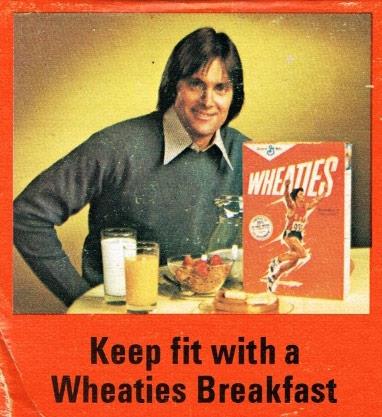
Wheaties Breakfast

While writing my previous article, I came upon this image. It must be from the late 1970s. And look at the breakfast that we are supposed to keep fit with:

  • Bowl of Wheaties (110)
  • Three strawberries (12)
  • Two pieces of Wonder Bread toast (158)
  • Glass (8 oz) of orange juice (112)
  • Milk (4 oz) for the Wheaties (73)
  • Glass (12 oz) of milk (219)
  • Cube of butter for toast (102)

Okay, I’ll admit: it isn’t a cube of butter. But it is enough butter for about half a loaf of bread. I really wonder if General Mills is heavily invested in the dairy industry. They have, regardless, a cozy relationship. And I think even at that time, we had a good idea that milk was not something we should be consuming a lot of.

Also of interest here is that this “keep fit” breakfast has a whole bunch of grain. And I say that as a grain guy myself. But really, is it necessary to have two grain products in this breakfast? We have bread, which is made out of wheat. And then we have a cereal that, if I had to guess, you know, based on its name — “Wheaties” — was made out of, I don’t know, wheat?

But this isn’t all wheat and dairy. We also have a hulking big glass of orange juice. I remember in the day, this was called “a serving of fruits and vegetables.” It doesn’t much fly. Once you distill fruit down to juice, you remove most of what is good for you. There really isn’t much more to say for the glass of orange juice in the picture up there than there is for a can of Pepsi. Except that your mom probably wouldn’t have complained.

The numbers above are the approximate number of calories. I used whole milk, of course; this is from the 1970s! But that adds up to a total of 786 calories. And I’m going easy on this. Those glasses look bigger than I’ve estimated. And despite what every breakfast cereal label in America says, people put more than a half cup of milk on their Wheaties. And I’m pretty sure there is more than a tablespoon of butter on the bread (that’s what I used, not my joke cube). That’s a whole lot of calories for what is an uninspiring meal.

As you may know, I don’t much think about nutrition. It is filled with pseudoscience. Every time I hear about the current nutrition fad, I ignore it. I just don’t care. In a few years, they’ll probably be saying something different. And I don’t care anyway. I just eat what I like. I try to mix it up. That’s about it. But I know that picture up there is not of a healthy breakfast. For one thing, who wants to drink that much milk?! It’s just propaganda.

With or without the strawberries.

Depression and City Lights

City LightsI’ve been really depressed recently. And as anyone who is a fellow sufferer knows: there is no reason. It is just, as a friend once put it to me, as though you are living in a world of black and white; and sun never comes out. As a result, I’ve been trying — in vain — to cheer myself up with much cinematic comedy: Wallace and Gromit, Monty Python, and most especially Charlie Chaplin. Tonight, I watched City Lights for probably the first time in thirty years. There are reasons why I’ve avoided it for so long.

I disagree with most critics. I don’t think it is the high point of Chaplin’s career. I think that both The Gold Rush and Modern Times are better films. The main problem with City Lights is that it has some distinct dead spots. I think the fact that it is an incredibly compelling story has made viewers miss the fact that a number of bits just don’t live up Chaplin’s best work. What’s more, I really do think that Virginia Cherrill as the flower girl is weak. In fact, her performance is so poor that the viewer wouldn’t know what to make of the ending if Chaplin hadn’t directed it well by focusing on the continued holding of hands.

All that said, City Lights is a fantastic film. By the end of it, I was sobbing. Like everyone, I assume, I very much identify with the tramp. What is so special about him is that he isn’t all good. He’s lazy. He’s often dishonest. But most of all, he’s self-important. He thinks rather highly of himself, as is represented here by his interactions with the newspaper boys who mock and shoot spitballs at him. Yet we forgive all these sins because ultimately, the tramp is a decent person.

A wonderful expression of this is near the end of the film. The tramp has just absconded with the rich man’s money. (It was given to him, but justice is as rare in a Chaplin film as it is on the streets of Ferguson.) He gives her money for the rent and money for her eye surgery. But he pockets one bill — I assume a hundred dollars. This is his tendency. He looks out for number one. But in the end, the better angels of his nature win out. And I think that’s universal. It seems to me that every time someone has complimented me for doing something nice, I’ve always wanted to blurt out, “Yeah, but I almost didn’t do it!” Because that’s true. My instincts are not evil, but they are also not the best of who I am.

Of course, the true brilliance of the film is found in an early scene where Chaplin manages to establish the blind flower girl thinking that the tramp is a rich man without a word. It starts with, once again, the tramp being anything but upright. Rather than cross the street like normal people, he just walks through the cars — in the door on one side and out the door on the other. It’s funny, and it’s been used by a lot of people since, but here it is used primarily to establish the sound of the door closing so that the girl thinks he is getting out of his own car. Of course the real brilliance comes on the exit when the tramp buys a flower, and while waiting for his change, a wealthy man gets in his car and goes. She thinks it is the tramp disregarding his change.

I’m not sure that watching Chaplin when I’m depressed is a good idea. It does make me feel good in its universality and the ultimate sense of goodness. But things always work out for the little tramp in ways they just don’t in the real world. And that lays heavy after the film is over.

Anniversary Post: Intentional Use of LSD

Albert HofmannBack in 1938, Albert Hofmann synthesized lysergic acid diethylamide, better known as LSD. I remember a story (possibly apocryphal) dating back to the 1970s. On the first day of Introduction to Chemistry, a certain professor would walk in and write on the calk board:

C20H25N3O

He would say, “This is the chemical formula for LSD. I don’t want to be asked for the rest of the year!” Of course, it would take at least another year of chemistry to gain the skills in organic chemistry to actually make it.

On this day in 1943 — almost five years later — Hofmann intentionally took the drug for the first time. It wasn’t the first time that he had taken the drug. The thing about LSD is that it is super potent. Most drug doses are measured in milligrams, but LSD is measured in micrograms. So all you have to do is get some on your skin and you will probably absorb enough of it to get high.

In his way, Hofmann was as much an advocate for the drug as was Timothy Leary. And he was an advocate right up to his death a few years ago at the age of 102. I’m ambivalent about the drug. I remember a music teacher of mine saying, “When we first started taking LSD, we thought we were learning a lot of spiritual lessons. But gradually, we learned we were just getting high.” Not that there’s anything wrong with that. But LSD does rather have a reputation for being more serious than it is.

Happy birthday intentional use of LSD!

Rat Flood

Rat FloodIn Chapter Eight of Aunt Julia and the Scriptwriter, Don Federico is an exterminator obsessed with destroying all rats, because he blames himself for allowing rats to eat his baby sister alive. So I decided to look on my phone to see if rats have ever been known to eat humans. They aren’t. Occasionally, they will bite sleeping people. This is probably because they are trying to eat food particles off people. Rats don’t see humans — or any creature — as prey. Rats will eat just about anything, but brown rats are known to prefer a diet much like mine. Favorite foods: “scrambled eggs, macaroni and cheese, and cooked corn kernels.” Least favorite foods: “raw beets, peaches, and raw celery.” But I doubt they were ever offered my excellent peach pie. They are also known to like chocolate.

But all this research brought me to the story of the rat flood — once thought to be a mythical periodical deluge of rats in eastern India. From time to time, the rats would just be everywhere and eat everything. Well, not everything. They didn’t eat the humans. But they might as well have, because it decimated the food crops and stores and caused a famine during those years. And then, just like Keyser Söze: poof, they’re gone. Scientists and political authorities didn’t think it was real, because hey, peasants. But it not only was real, it is.

This happens every 48 years. The Indian states of Mizoram and Manipur are roughly 30% covered in bamboo forest. It has a 48 year ecological cycle called the Mautam. So after the bamboo flowers, it dies and releases all its seeds. Rats like the bamboo seeds and suddenly, they are swimming in them. So they don’t have to spend a bunch of time finding food, so they eat and do that other evolutionarily important behavior: have sex. What’s more, studies indicate that female fertility goes up as does the litter size. Suddenly, eastern India is overflowing with rats.

Of course, it doesn’t matter at this time. The rats have their food supply and they are doing just dandy. It is the following year when there are huge numbers of rats and no more bamboo seeds. So they “head into town” and eat the food of the humans. And there isn’t a lot that the humans can do. This is why it is referred to as the “rat flood.” We have records of this happening in 1862, 1911, 1959, and 2006.

The people of these regions are getting better at dealing with the problem. In 2006, the Indian government sent in the army to help out. They used little bitty guns. No, just kidding. They were there mostly to provide education on how to deal with the coming hordes. Interestingly, as I mentioned above, rats have different food tastes. And there are things they really don’t like. Apparently, they don’t like the smells of turmeric and ginger.

In addition to being a human tragedy — although one we could eliminate if we wanted to with a simple application of resources — it is also a rat tragedy. Because of the excessive food supply, the following year is necessarily a famine of unheard of proportions. And there is really nothing that can be done to stop it. God really is evil.

Anniversary Post: Prince Charles’ Wedding

Prince Charles and Camilla Parker BowlesToday in the tenth wedding anniversary of Prince Charles and Camilla Parker Bowles. I think this is great because they have been in a love a long time and their love was denied BY the expectations of their situation. I have never been one of those fans of Princess Diana. Other than being something of a fashion icon, who cares? It’s sad she’s dead, but it is also sad that Charles was forced to marry her. And if you ask me, Diana acted rather gauche once the marriage went south. Of course, the reporting — at least here in America — always made her out to be long suffering and him as some kind of villain.

I have no use for the royal family. But they are the perfect modern celebrities. They are useless. And they are known for being known. I don’t know why Americans — just out of a sense of national pride — don’t hate the royal family. We did, after all, start a war just to get away from them. They represent everything that our country is supposed to be against. In their defense, at least the royal family is explicitly a blood line aristocracy. Here in the United States we still hold on to the myth of meritocracy, even while we deprive poor children of a decent education.

But I’m glad that Charles and Camilla got married and are now celebrating their tin anniversary. Even useless people have a right to good lives and for expressing their love to the people they actually love.

Happy anniversary Charles and Camilla!