Some Disturbing Media Numbers for 2014

Hannah Groch-BegleyHannah Groch-Begley put together some interesting statistics from Media Matters, The Media in 2014 by the Numbers. None of it is shocking, but it is all disturbing.

She started the article with what is perhaps the most surprising statistic: none of the top editors at the ten biggest newspapers are women. That statistic wouldn’t be surprising if we were talking about almost any other industry. But women are extremely well represented in writing. I have always taken this to indicate that women are naturally better writers. That’s certainly been my experience. I had to work very hard to write as well as most of my female friends who didn’t ever work on it. Regardless, if you look at technical writers, there are more women than men. On the other hand, in Hollywood, where I assume the money is better and the prestige is more, there are more men. Regardless, I would think the new business would do better. But of course not! Silly me to be the least bit optimistic.

There is a pair of statistics that I’ve seen before that I’m not sure is as meaningful as it seems:

Ebola Coverage 2014 - Media Matters

The truth of the matter is that the Ebola freak out seems to have just corresponded to the interests of the Republican Party. And I doubt it mattered anyway. I don’t think that Democratic voters stayed home because they felt that the administration was doing a bad job with it. What I think is a bigger issue is that if a Republican had been in the White House, Ebola would have received perhaps a quarter of the coverage. Fox News would have covered it in a completely reasonable way and the other news stations would have followed suit. In fact, there would have been a huge backlash against anyone who didn’t. They would have rightly been criticized for fomenting fear. But when a Democrat is in the White House, nothing is off the table. We should be very concerned that the mainstream media allow the Overton Window to be set by conservative media.

A couple of statistics that really struck me had to do with experts. First, only 3% of economic segments in the first half of 2014 featured an economist. Now, when you consider the state of the economics profession, maybe that isn’t so bad. I suspect that a good deal of that 3% was made up with Arthur Laffer. Just the same, it shows the media really aren’t interested in expertise — they figure economics is simple and everyone has valid opinions on it. They just want some politician on the two arbitrary “sides” of the issue and that’s that.

The other statistic is of much greater concern: on education segments during 2014, only 9% included educators. As with the economist, the media seem to think that teaching is simple. Why talk to teachers about education? After all, everybody knows that teachers just care about working as little as possible and taking home those big ol’ pay checks! Am I right?! But unlike economists who are to a large extent incompetent apologists for the power elite, teachers actually do know something about education. But the power elite would prefer to leave them out of the conversation. And the mainstream media are more than willing to oblige.

There are are lot more factoids in the article. The ones that I mentioned are just the ones that stood out to me. But there is much of interest. I suspect that next year, Media Matters will be able to write the same article with a minimum of editing.
Owning Pays Far Too Well

Fast FoodIt is Sunday, and so Thomas Frank has an article that is well worth reading, Chain Restaurants Are Killing Us: Billionaire Bankers, Minimum-Wage Toilers and the Nasty Truth About Fast-Food Nation. He focused on workers and the corporate elite because none of the franchise owners would talk to him. But he asked, “I wonder how many chain-store bosses can truthfully say they make an ‘honest living.'” I think I have a little insight into that.

Do franchise owners work hard? In my experience, yes. But they don’t work harder than their employees. They will, of course, sometimes get behind the counter or in the kitchen and kick a little ass — like they are the best workers around. But this kind of work represents the exception: maybe a couple of hours a week at most. Their primary function is as “manager.” I put the scare quotes on there because the truth of the matter is that the corporations don’t allow much in terms of management. The franchises are meant to be idiot proof — and that is as true for the worker at the register as it is for the owner managing the place. And this is generally only at the start of the franchise. The whole idea is for the owner to leave the whole thing to others who are less well paid.

The main thing is that the franchise owners get paid far more for whatever it is that they do. Of course, the idea in a capitalism is that people ought to be paid just for owning something. I’m not against this idea in theory. In practice, in the United States, it’s a travesty. It is why we hear this lie about the entrepreneur — the woman who “took a chance.” But that’s not what I consider an entrepreneur. This definition of entrepreneur just highlights the fact that business success is mostly a matter of luck. Borrow a bunch of money, start a business, go bankrupt. Repeat that process until you don’t go bankrupt. I’m all for bankruptcy laws — and I think it should be a lot easier for individuals to go bankrupt — but there is no denying that it is a form of socialism. In fact, for the right class of people, business is all about socialism: using the common resources to help you make it big.

So what we really see in the comparison of franchise owners versus franchise workers is which ones have the opportunities to buy a franchise. Is it the case that a minimum wage worker would ever make enough money that she too could take the risk and buy a McDonald’s franchise with $750,000 in non-borrowed cash? Where is the equality of opportunity there? So of course this isn’t about the brave entrepreneur who is willing to take risks. Everyone takes risks every day. I love this quote from Melissa Harris-Perry:

What is riskier than living poor in America? Seriously! What in the world is riskier than being a poor person in America? I live in a neighborhood where people are shot on my street corner. I live in a neighborhood where people have to figure out how to get their kid into school because maybe it will be a good school and maybe it won’t. I am sick of the idea that being wealthy is risky. No. There is a huge safety net that whenever you fail will catch you and catch you and catch you! Being poor is what is risky!

I come back to this idea again and again that conservatives (and many “liberals”) are deluded in thinking that if outcomes are dictated by the “free” market, they are “natural” — and therefore correct. The truth is that there aren’t any markets that are free. Markets themselves are communal constructs. The idea that I’ve been grappling with the last couple of year is how it makes any kind of sense that the nature of a society should dictate the rewards. For example, before movies, actors had to work every day — often multiple performances per day. The most successful ones became rich. But they were nowhere near as rich as the most successful actors today who might only work a month out of the year. The difference has nothing to do with the actor; it is entirely due to the technology that the actors had no part in creating. The same thing can be said about every other industry. Just look at the effects container ships have had on the narrowing of manufacturing industries.

The bottom line to all of this is that capitalism is not a just way to allocate resources. And even if it were, those with the most resources would use them to tilt the playing field in their favor. Instead of the government molding capitalism to work better, it has been molded to work worse. There are programs to mitigate the worst poverty, because the power elite know that starving children with bare feet begging in the streets causes a backlash that they can’t control. But other than this, the government mostly works to take money from the poor and give it to the rich. And the richer one is, the bigger the handouts.

Afterword

If you click over to the Melissa Harris-Perry video, you will hear Monica Mehta claim that 5% of the people pay 40% of the taxes. I’m pretty sure that would be 40% of the federal income taxes — a common conservative deception. But regardless, the number means nothing, given that the 5% makes a whole lot more than 5% of the income. People like Mehta disgust me.


See also: I Was a Middle Class Food Stamp Kid

The Power of the Skills Gap Myth

Toni GilpinOne of the things you’ll see repeated often is the 600,000 skilled jobs in manufacturing that are going begging because we can’t find the right workers to fill them. And that figure comes from a National Association of Manufacturers report from a few years back. It’s based on the fact that when they surveyed manufacturing employers, about 5% of them indicated that they couldn’t find the workers they wanted to fill jobs in their plants. And so from that, the report extrapolated to declare that there were 600,000 jobs that were going begging.

The reality, though, is that when economists and academics have looked at the actual job market data they find that to be simply not true. Studies from Illinois, from the Wharton School in Pennsylvania, from Wisconsin, have found that this is simply a oft repeated meme that doesn’t have much basis in reality. If there were this terrific lack of skilled workers in manufacturing, we would expect to see wage increases for those workers — we would expect to see rising wages. When there’s a shortage of something, we expect to see prices go up. We would expect the value of that particular item to increase. In fact, however, wage rates for skilled workers have remained stable or have declined through this recession. So that’s a real problem in terms of the fact that it seems to defy market realities.

The CEOs and manufacturing executives who are promoting the notion of a skills gap — and that has become generally accepted, I’m afraid — find it very convenient because it helps in the general effort to devalue the cost of labor. It also allows them to offload the kind of on-the-job training they used to provide themselves onto the public. We’re seeing workers themselves absorb the costs of retraining — desperately trying to reequip themselves with the skills that are supposedly needed for jobs that really aren’t there. We’re seeing community colleges strapped for funds that are trying to figure out which are the best training programs they can offer. It’s very handy for business executives because it allows them the luxury of keeping wages low while also not having to offer the kind of training that they used to offer themselves in their own plants. So this serves them quite well and also helps to tap down workers who are looking to increase their own wages.

—Toni Gilpin
Interview of CounterSpin

Subconscious Racism

Sendhil MullainathanOver at The Upshot this morning, Sendhil Mullainathan wrote a very soothing article on a very difficult topic, The Measuring Sticks of Racial Bias. The basic idea is one that readers around here should be well aware of: the racism that we need to worry about is not the overt racism of Cliven Bundy. It is the subconscious racism like what Jesse Jackson spoke about, “There is nothing more painful to me at this stage in my life than to walk down the street and hear footsteps and start thinking about robbery. Then look around and see somebody white and feel relieved…” It’s our gut reactions — far less conscious than even what Jackson is referring to — that maintain our inequality and our racial segregation.

I think that Mullainathan is too gentle in his conclusion, but he is exactly right:

Ugly pockets of conscious bigotry remain in this country, but most discrimination is more insidious. The urge to find and call out the bigot is powerful, and doing so is satisfying. But it is also a way to let ourselves off the hook. Rather than point fingers outward, we should look inward — and examine how, despite best intentions, we discriminate in ways big and small.

Over the past many years, I’ve been obsessed with my own racist baggage. Even among the stuff that I’m aware of — like the Jackson quote above — I feel largely helpless. It does get better over time, but that’s just the stuff that I’ve noticed. I often think that I’m sitting on an infinite pile of racism. In his article, Mullainathan lists a number of different studies that have demonstrated subconscious racism. I’d like to believe that I’d do better, but I cannot say that I would.

The best know study was done by Mullainathan himself: resumes were sent out for job openings with randomized black (eg, Jamal) and white (eg, Brandon) names. Identical resumes with white names got interviews 50% more than those with black names. But the most disturbing study was this one:

When doctors were shown patient histories and asked to make judgments about heart disease, they were much less likely to recommend cardiac catheterization (a helpful procedure) to black patients — even when their medical files were statistically identical to those of white patients.

You would think that doctors would be systematic about this kind of thing — almost like a computer: you enter the state of the patient and the treatment is spit back out. And I suspect that this is to a large extent true. This racial bias just shows how deep our racist tendencies lay and how powerfully they affect us.

At the same time, dealing with overt racism is difficult. On the one hand, it is repellent. I always wonder what is going on inside of people who are willing to say publicly, “I want to tell you one more thing I know about the negro” — and say that blacks sit around waiting for their welfare checks and how much better off they were as slaves. One thing is for certain: they aren’t losing any sleep about their subconscious racist tendencies. So I think these people should be lambasted because we don’t want to live in a society in which such vile thoughts are acceptable.

Just the same, outrage about such horrible behavior is usually a bad thing. There is a certain triumphalism as though the fact that we don’t have wisdom to impart “about the negro” means that our less public racism isn’t a problem. Or, as I hear from conservatives, that it doesn’t even exist. And the problem isn’t just in the realm of racism. Remember when everyone got upset at Todd Akin for claiming the female body had ways to “shut that whole thing down” in cases of rape? But does that make Rand Paul — who believes in exactly the same policies — acceptable, just because he isn’t as stupid as Akin?

I will continue writing about the vile and stupid things people say — just as I write about movies and music and puppets. But the real thinking — the real work — about racism needs to be done on the inside. The fault, dear readers, is not in their words, but in ourselves.

California Gets Practical About Driver’s Licenses

Michael HiltzikThere are big happenings in California. The state has started issuing driver’s licenses to undocumented residents. It is creating quite a stir. But this makes no sense to me. You see, I thought that California had been doing that for decades. I was kind of right. When I left California for Oregon back in 1990, the state did indeed issue driver’s licenses without people showing proof of citizenship. But that all ended in 1993 when I was involved in solving huge systems of differential equations. It never occurred to me that the state would stop doing this. But like most people, I tend to mistake my liberal home in the Bay Area for the not-so liberal state of California. This is, after all, the state that in 2008 simultaneously voted in Obama as president and voted to deny same sex couples the right to marry.

Michael Hiltzik did us the favor of running down the history that I missed, California’s Huge Blow Against Stupidity About Immigrant Driver’s Licenses. This was during the early 1990s when Californians had a collective freak out about unauthorized residents in the state. Let’s be clear: it was flat out racism. Just as Reagan’s “welfare queen” was clearly a black woman, California’s “illegals” were Mexicans. And this issue was aggressively demagogued by one of the worst people in the world, Pete Wilson.

This all led to Proposition 187 in 1994 — a ballot initiative that deprived non-citizens from things like healthcare and education. It was a vile law and it won the state by almost 18 percentage points. And typically, the only place the bill failed was in the Bay Area (along with Yolo County, which is almost in the Bay Area). The law was found unconstitutional, but the fight against the evil brown people continued.

The “no driver’s licenses for illegals” law stayed in effect under Wilson. After Gray Davis became governor, he reversed the law in 2003 (in a cynical and unsuccessful ploy to appeal to the Latino community). But after Arnold Schwarzenegger got in the governor’s mansion, he reversed that (in a cynical and successful ploy to appeal to the white community). So for a little more than a decade, non-citizens have not been able to get driver’s licenses. So it is good that yet again we are allowing driver’s licenses regardless of legal residency status.

People have their reasons for being against providing these licenses. And the law addresses these reasons. But the truth is that not providing licenses to undocumented residents is really just about getting “those people.” A lot of people are upset about this development. But why? It isn’t that undocumented residents won’t drive without a license. This new law is a practical measure that makes us all safer and save us money. But I suspect that it is much like the death penalty, which is also hugely popular in the “liberal” state of California. It doesn’t matter that the death penalty doesn’t work as a deterrent. It doesn’t matter that it doesn’t make us safer. It doesn’t matter that it costs a lot more than the alternative. Practical concerns never matter when people are being ruled by fear and hate.

Thankfully, California has taken a step forward in terms of practical policy over the politics of division. We will see how long it lasts.

The Worst American Addiction

Ice Cream SundaeThere is a kind of addiction in the United States that is destroying it. It isn’t new. In fact, it has been around for so long, it is invisible. It is the addiction of superiority. If you watch the right kind of television, you will see it everywhere. My favorite example is the court show. I find these shows deeply disturbing. In fact, I find them so disturbing that I’ve come up with a theory — probably wrong — to make them more palatable. I believe friends get together and pretend to sue each other to make a little cash and to get their faces on the television. But clearly, if most viewers thought this, they would not watch. Indeed, even with my theory, I find the shows repellent.

The way the shows work is by stimulating endorphins that make the viewer feel superior. “At least I don’t sleep with my best friend’s husband and then steal her television set!” Oh, can you feel that flood of endorphins?! That feels good. And I’m all for that! Please, my fellow humans: be happy. It’s a good thing to do. All I ask is that you superiority junkies admit that you do have an addiction and that you aren’t any different from a random heroin addict who gets her endorphins more directly.

I see the people watching the court shows and Fox News as being minor addicts. The major addicts design their entire lives around their addictions. For example, they will never drink alcohol because it is a drug. But what they are really doing is stimulating their endorphins because they feel superior to the person who drinks to stimulate her endorphins. These same people will tend toward “healthy” food (how ever that might be defined this week) and against tasty food. There is really no end to the ways that a superiority addiction may manifest itself. People might hoard money or they might vote against their political interests.

From the outside, we may see the hardcore superiority addict as a sad person. But I suspect that is wrong. Your average heroin addict may seem sad on the outside but with her brain swimming in synthetic endorphins, she is very likely happy as one of the happiest clams. So we shouldn’t feel sorry for the superiority fiend. But just the same, we should not be codependent. If she wants to feel good about herself because she eats better and drinks better and votes better than the rest of us, that’s her right. But we needn’t buy into that delusion.

In a perfect world, such superiority addicts would quickly disappear. Our reactions to them would make it clear that their ascetic lifestyles were just a way of getting high. So when a ascetic and a glutton are both offered a delicious piece of chocolate cake, the glutton’s acceptance of the cake is exactly the same as the ascetic’s refusal. And if the ascetic’s real motivation (endorphins from a sense of superiority) were widely recognized (and, hopefully, mocked), the ascetic would take the cake. Because being addicted to a feeling of superiority is a great weakness.

Choose the cake!

Afterword

I’m not that found of chocolate myself. I mean, I’ll eat it. I’ll eat just about anything that is sweet. I’ve even been getting into coconut because it is combined with lots of sugar. But don’t get the wrong idea about me. Most people think I’m a sugar addict, but I actually like fatty foods a lot more. Of course, after a great fatty meal, nothing is so great as a sugary dessert. Or better: a sugary, fatty dessert. Ice cream sundae!

Dem and Rep Economic Policy Not Equally Bad

Matt YglesiasThe usually great Matt Yglesias engaged in a bit of false equivalence earlier this week, The Problem With Now More Than Ever Politics. That doesn’t mean that he’s completely wrong, but it’s still a bit annoying. He noted that in response to stagnating working class wages, the two parties have new policy ideas. And those policy ideas are — Surprise! — exactly what they’ve always been. The Republicans want to decrease regulation and “reform” the tax code. The Democrats want to invest in infrastructure and education. There are a few problems here. One is that although that is pretty much the only thing that the Republicans want to do, the Democrats actually believe in a whole lot more. But let’s leave that aside for now and look at these programs.

The basic idea behind the Republican policies is that it will help the economy grow. That’s debatable. But what if it did cause the economy to grow? As Yglesias pointed out, the economy has grown over the last several decades. And all that growth has gone to the rich. There is no reason to think that even more growth would be better shared. In fact, if the Republicans have their way, it will not be shared. Their ideas about reducing regulations go right along with their ideas for tort “reform” — the idea is to let the rich do whatever they want and then when they harm working people to disallow any kind of just judicial settlement. So the Republican plan has nothing to do with improving the lot of the working class. It is disingenuous to suggest that it does.

The idea behind the Democratic policies is the long refuted idea that economic inequality is all about education and “opportunity.” But at least it is a good faith effort to respond to the problem at hand. Well, maybe “good faith” is a going too far. The reason that politicians push the whole “education is the source of inequality” canard is because it doesn’t threaten the power elite. Nonetheless, spending on education and infrastructure will make a positive impact on income inequality. But Yglesias is right: it isn’t the best route.

Yglesias’ main point is the one he’s been making for years: if you want to get the poor out of poverty, give them money. It’s such an obvious insight that it seems silly when stated so bluntly. He provided a graph of poverty rates in most of the advanced economies and it shows that poverty without government interference is roughly the same level across the board. But post-tax-and-transfer poverty in Sweden is less than a third what it is in the US, even though pre-tax-and-transfer poverty is actually slightly higher in Sweden.

But which party is it that wants to cut food stamps and other kind of aid to the poor? Which party is it that wants to make sure that even the poorest people pay some federal income tax so they have skin in the game? Which party is it that has slashed taxes on the rich and still thinks they are taxed too high? Oh, that’s right: the Republican Party! They are also against raising the minimum wage and in many cases in favor of eliminating it altogether. The Democratic Party is broadly in favor of raising the minimum wage. If Washington were controlled by the Democrats, the minimum wage would be raised. Since the Republicans control Congress, we know that the minimum wage will not be increased.

Yglesias noted that there are ideas that are “out of the box” — although the ideas listed in the original article are mostly pathetic. The good ideas for reducing income inequality are almost exclusively liberal ideas. How about a financial transaction tax? How about a guaranteed minimum income? How about a higher inflation target? But all these ideas are anathema to the Republican Party because they don’t fit into the only two categories of acceptable policy: lower taxes on the rich and fewer regulations that affect the rich.

The mainstream Democrats may only offer weak tea for addressing our most important economic problems, but Republicans only offer poison: policies that will make the problem worse. Matt Yglesias knows this. But he’s trying to maintain a certain amount of centrist credibility. But history will scoff at the centrists who tried to find balance in modern American economic policy.

Mario Cuomo and Democratic Party Meaning

Mario CuomoAlready, in his obituaries, he is being remembered more as a poet than as a politician, as a phenomenon more than a man. Poets are useful, even in politics. Phenomena can be beautiful. But the marginalization of Mario Cuomo was a deliberate political act, a bipartisan one, truth be told. It was a way to shuffle what he stood for off into decorous irrelevance. The people who sidelined Mario Cuomo from our national discussion did not include Ronald Reagan. It was Bill Clinton who did that and, sadly, Mario Cuomo himself, who, by the end of it, was so politically feeble that he lost to an unremarkable hack like George Pataki. Now Mario Cuomo is dead, and George Pataki is (seriously) contemplating a run for president of the United States. Now Mario Cuomo is dead, and his absence from our national discussion is being used in some quarters as a cautionary tale to the rising progressive movement within the Democratic party. The same forces that worked to marginalize him will be brought to bear at some point against Elizabeth Warren… You can count on that. Now Mario Cuomo is dead, and that seems like little more than confirmation of something we all suspected for decades.

—Charlie Pierce
Mario Cuomo, RIP

MOOCs and the End of Education

MOOC EducationAtrios asks, Does Anybody Remember MOOCs? For those who don’t know what the hell he’s talking about, MOOC is an acronym for “Massive Open Online Course.” It was one of the many “revolutionary” ideas that was going to save education in this country without, you know, the bother of actually spending any money or employing any teachers. Atrios noted that they had many problems. First, they didn’t scale the way people thought they would. Second, they were actually fairly expensive to provide after all. Third, just because Harvard was pushing them didn’t mean that anyone really thought that they were getting a Harvard education. And fourth, and most important, such courses might work better than teaching yourself with a book but they were never anything close to getting taught by a teacher.

Let’s just throw out one idea right away: a Harvard education isn’t as good as a Harvard education. Big name schools do such a great job “educating” students because of their names. They can demand the very best students with the very best preparation. The only way that getting educated at a big name school is helpful is that it provides for the “Chris Hughes Effect.” This is where you get to interact with a whole bunch of other smart and — more important — well connected people. So without doing anything of significance and without being of notable ability yourself — you too can have a half billion dollars, buy magazines, and run all over the world and be treated like you have half a clue about anything.

This is largely why learning from a book is not as good as going to college. It’s true that learning from books all by your lonesome is hard. As a result, people ought to be most impressed with the self-educated. Eric Hoffer ought to be a household name rather than William F Buckley Jr. But that isn’t the case because America is the most anti-meritocratic national that I can think of. The Harvard degree isn’t about what you know. It is more about who you know. The business community in the United States is interested in a Harvard degree the same way that a Hollywood casting director is interested in that episode of Break Bad an actor appeared in.

So the idea of the MOOC was always stupid. Let’s suppose you managed to give half the American people a Harvard level education. What then? All that would do would be to make a Harvard education useless. The society would have to find some other way to separate the impressive people from the unimpressive people. Because it isn’t about knowledge and it never has been. When the power elite talk about education, it is primarily for one reason: to claim that the poorer classes don’t have jobs and the ones who do are paid poorly because they lack education. It doesn’t matter that a dullard born rich like Bush the Younger is far better off than a genius born poor. Education is a good stick with which to beat the non-elite. And add to that an effort to destroy the one remaining middle class profession — teaching — and you have the whole thing. The power elite never need worry about anyone challenging its rule.

MOOCs are a thing of the past. But don’t worry! The power elite have an endless supply of ideas for how to “fix” education. There is always a new idea in the pipeline. As soon as they destroy all the teacher’s unions and reduce education to a $12 per hour job, they’ll have another idea that “This time!” will fix all the problems. And eventually they will come back to the MOOCs. There is no reason why a computer can’t teach our kids the only things that really matter: multiplication tables, circuit board assembly, and most of all, how to bow before their betters.

The Best We Can Imagine

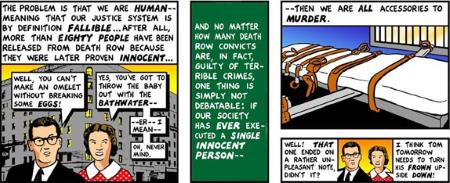
Charles PierceWe are a little lost here in America. Too many of us have tuned out, and too many of us are deeply tuned in to the wrong things. Our eccentricities have curdled into crochets. Our love for the strange and deeply weird has soured into a devotion to the mean and deeply angry. Our renegade national soul has given itself up to petty outlawry. We have tailored the principles of our founding documents — flawed though their authors were — into cheap camouflage for our boring traditional grudges. None of these things are good things. But none of those things is permanent, either. Imagination always has been the way out — a faith in that which seems impossible, a trust that not every mystery is a murder mystery, and that not every mysterious creature is a monster. Imagination is the way out — a belief that safety is not necessarily the primary (or even the secondary) goal of democratic citizenship, and that a self-governing political commonwealth does not always come with a lifetime guarantee. Yes, we are a little lost here in America, but we can find our way, and the best way that we can find is the one that seems like the least secure, the darkest trail, the one with the long, sweeping bend in the road that leads god knows where. We must trust what we can imagine, and we must trust that what we can imagine is the product of what is the best of us. And, whether we imagine it or not, it’s going to happen anyway.
—Charlie Pierce
Goodbye to All That

Good News About Maryland Death Penalty

Death Penalty - Tom Tomorrow

I almost didn’t notice that it was new year’s eve today. Part of it is that I just don’t like the day. I never do anything for it. Under most circumstances, I won’t even stay up for it. But now I normally do because that’s when I do my birthday posts. Really: the new year has absolutely no relevance to anything. It is an entirely arbitrary dividing line between years. But whatever. I do have a bit of good news on this new year’s eve.

Maryland had the death penalty all the back to when it was a colony — in 1638, they hanged two men for piracy. Since that time, they’ve killed 312 people. Now that may sound like a lot, but actually, in that almost four centuries, the state has managed to kill off many fewer than Texas has killed since people started dancing in the street in 1976 because the Supreme Court allowed them to start legally killing people again. (Texas has killed 508 people in the last four decades.)

But last year, Maryland Governor Martin O’Malley signed a law abolishing the the death penalty. As Huffington Post reported, O’Malley argued that “it wasn’t a deterrent for criminals, could end up being applied to innocent people, and was far more costly to the state than other punishments.” You know: the holy trinity — the reasons that all people would be against the death penalty if they approached the subject with their higher brains. But instead, most people approach it with their lowest brain: they just want to “get” the bad guys.

Let’s go over that list. First, people don’t kill as rational acts. They don’t think, “Now that I only have to spend the rest of my life in prison, I’m going to kill my wife!” People murder for two reasons: they either think they won’t get caught or they aren’t thinking at all. There is no evidence whatsoever that the death penalty reduces the homicide rate.

Second, innocent people get put to death all the time. If the death penalty really was effective at stopping murders from happening, maybe one could argue that innocent people being put to death was an acceptable price to pay. But since we can’t, we are killing these innocent people for no reason whatsoever. But hey, I guess as long as it isn’t happening to you or one of your loved ones, it doesn’t matter. And after all, you do get something from the death penalty: the great feeling that you are “getting” the bad guys.

Third, it is a hell of a lot more expensive to kill a murderer than to just let him rot in jail the rest of his life. It is this argument that gets the most bizarre response from death penalty advocates. Their response is always the same, “But it shouldn’t cost more!” According to them, after a “guilty” verdict, the judge should just pull out a gun and shoot the defendant in the the head. The fact that dozens of people have been proven innocent decades after conviction is just ignored. Nothing can get in the way of the wonderful feeling people get from legally murdering the bad guys.

In getting rid of the death penalty, Maryland had a bit of a problem. They had four people still sitting on death row. The state could still kill them because they were grandfathered in, so to speak — or so some claimed. So as his final act of governor, O’Malley commute their sentences to life without the possibility of parole. That is about the best news that you are going to get from me this year. And it is pretty good news too. I wonder when my home “liberal” state of California will ever outlaw this barbaric practice.

Magic 8 Ball - Don't Count On It

Torture Here at Home

Rebecca GordonThe fact is that torture is still continuing today — both in the so called war on terror and also in plain sight in our own jails and prisons in this country. I mentioned in the piece you were referring to a number of ways that torture is still going on. And one of these involved the forced feeding that’s still happening at Guantanamo. This is what happens twice a day to those people who are on hunger strike. A cell extraction team of six people arrives in their cell and forcibly removes them from the cell. And then, as one of the people who’s suffered this describes, what they do is they actually strap the person down to a feeding chair — which they call a torture chair — but in order to make the process more painful, instead of attaching the prisoner’s arms to the arms of the chair they’re handcuffing them behind the person’s back and then strapping the person into the chair that way so it puts terrible pressure on the shoulder joints. And so there’s pain not only involved in the feeding itself but also in the physical restraint that’s going on when they shove a tube up someone’s nose and pump food into their stomach.

One of the people who wrote about it this for The New York Times said it this way:

I will never forget the first time they passed the feeding tube up my nose. I can’t describe how painful it is to be force-fed this way. As it was thrust in, it made me feel like throwing up. I wanted to vomit, but I couldn’t. There was agony in my chest, throat, and stomach. I had never experienced such pain before. I would not wish this cruel punishment upon anyone.

It’s interesting to know that at the very same time this kind of force feeding has been going on — and as far as we know is still happening — exactly the same procedure was being used on prisoners in California in May of 2013 — so only a year and a half ago — when they also went on hunger strike. And they were striking about exactly the same issues. The two issues were indefinite detention — in other words in US prisons having prison sentences that last an undetermined number of years — 15 to life, 25 to life. And secondly, solitary confinement — being held in complete isolation from other human beings. And in May 2013 30,000 prisoners in California went on hunger strike, and when they did it they did it in direct solidarity and awareness that people in Guantanamo were doing the same over exactly the same two issues. So the connection between the US prisons and the war on terror is not a hard one to make — it’s a direct connection.

—Rebecca Gordon
Interview with CounterSpin