Psychopathy or Why I Will Never Be President

Mitt RomneyFor a long time, I’ve feared that I was a psychopath. As you may know, the primary characteristic of a psychopath is a lack of empathy. They have very little ability to see things from other people’s perspective. This is why they make good corporate CEOs. (Really!) When I’ve brought up my concern about myself, my friends have scoffed at it. I’m more like the anti-psychopath. But I never found this terribly compelling. Perhaps I’m such a great psychopath that I fool everyone — even myself! So when I came upon the Levenson Self-Report Psychopathy Test (LSRP), I was very excited. Here at last was an opportunity for me to find out for sure.

As soon as I saw the questions, I knew that I was safe. The first question was, “Success is based on survival of the fittest; I am not concerned about the losers.” Obviously, I disagree with this. But I have definitely known people who would completely agree with it. The funny thing is that I’ve always assumed people who said things like that were kidding — that they said it for effect. Then again, that sentence better sums up the philosophy of Ayn Rand than any other that I can think of. And this is more or less what we hear from Republican politicians and throughout the business world.

Rand PaulThere are other questions that are close to exact quotes from Mitt Romney’s presidential campaign. Who could forget when Romney said he would be unfit for president if he paid one cent more in taxes than he had to? Well: “In today’s world, I feel justified in doing anything I can get away with to succeed.” Or what a hard-nosed businessman he was? Enjoy: “I let others worry about higher values; my main concern is with the bottom line.” And don’t forget that car elevator: “My main purpose in life is getting as many goodies as I can.” And remember why he didn’t win the election? It certainly wasn’t his fault, “Most of my problems are due to the fact that other people just don’t understand me.”

The LSRP measures two things. First, there is primary psychopathy, which is lack of empathy and tolerance for antisocial behavior. Then there is secondary psychopathy, which is rule breaking and a lack of effort toward succeeding on society’s terms. Not surprisingly, I scored higher on the second scale. Scores range from 1 (non-psychopathic) to 5 (very psychopathic). I got a 1.4 on the primary marker and 2.0 on the secondary marker. Here are my results plotted on their graph:

Psychopathy Test Results

It’s important to remember that psychopathy does not necessarily indicate that a person is violent. That’s why I highlighted Mitt Romney. I actually think that our society is rather fond of psychopaths — as long as they aren’t interested in being too antisocial. In addition to CEOs, psychopaths are over represented among surgeons. That’s doubtless a good thing. I know someone like me would be useless in an emergency room. It’s in politics that being a psychopath could be a bit of a problem for society. Certainly we need analysts who just look at the facts. But most people don’t run for president thinking that they are going to do what is best for the nation based upon the facts. They just want the “goodies” that go along with the job.

I tend to think that Rand Paul is a psychopath. He is, after all, a surgeon. And he is nominally a libertarian — a philosophy that seems to appeal to psychopaths. And most of all, he’s been ditching any inconvenient positions in order to become president. His guiding principle seems to be that he should be president. It’s not clear how he would govern, given that his positions are determined simply by whatever will get people to vote for him. I think we know how he would answer this question, “Even if I were trying very hard to sell something, I wouldn’t lie about it.”

But at least I feel better knowing that I’m not a psychopath — even if it means that I’m not as successful as I might be if I were. What does it say about a society that being empathic and helpful is a bad thing?


See also: Is Mitt Romney a Psychopath?

Update (10 May 2015 2:40 pm)

I had to change references to “doctors” to “surgeons” above. General practitioners tend to be less psychopathic. It is surgeons (which is what Rand Paul was) who are psychopathic. Also high on psychopathy: police officers, lawyers, salesmen, journalists, and clergy.

Amir Meshal and the End of Constitutional Rights

Amir MeshalAmir Meshal is a young man from New Jersey. Back in 2006, he was in Somalia. But when war broke out, he fled to Kenya where he was picked up by the American military and interrogated more than thirty times — variously tortured and generally having his constitutional rights ignored. What’s more, these government officials threatened to make him “disappear.” Or at least that is what is alleged in Meshal v Higgenbotham, which has been dragging on for six years. But I see no reason to doubt that we did exactly this to Meshal. This is the sort of thing that we do all the time.

I’m especially interested in the threat to make Meshal “disappear. The most basic right in a nation is habeas corpus. There can be no kind of justice if the government isn’t even admitting that they are holding a citizen. And the United States has been doing this over and over again by handing people over to governments don’t abide by such laws. Of course, what this means is that we don’t abide by such such laws. Our military and intelligence institutions seem to do whatever they want. They are above the law and few people care until they are directly effected by such lawlessness.

Aljazeera America reported the most recent status of the case, US Citizen Fights to Sue FBI Agents for “Inhuman” Detention Abroad. The problem with the case is that it keeps getting thrown out for a classic reason: the government claims that a trial would harm national security. This is hogwash, of course. This is just the government security bureaucracy protecting its own. But there is a sense in which such a case would harm national security: what has happened to Amir Meshal is almost certainly common. So to reveal what our government does to its citizens every day would indeed cause problems. The people might decide the government shouldn’t do that.

His story is incredible, but hardly the worst of what our government does to its citizens. Meshal had gone to Egypt to stay with relatives and then to Somalia to study. After fighting broke out, he found himself with four other refugees wandering in a forest for many days before they were picked up by Kenyan soldiers. The US military than moved him around to various sites where he was abused. Four months later, he was released without charges or comment. “The US government is not denying the allegations or contesting them, merely arguing that Meshal’s Fourth and Fifth Amendment rights to a prompt hearing and due process don’t apply in cases involving national security issues abroad.”

The government’s position on this seems to be like it was in the case of Anwar al-Awlaki. In that case, the government basically said that if an American citizen is outside the country, it has the right to assassinate. In this case, if an American citizen is outside the country, the citizen has no constitutional rights. I can just hear the Fox News viewers’ response to this, “Well, I never leave the country, so I have nothing to worry about!” This is really troubling. I’m not big on slippery slope arguments, but there really is no reason to believe that the government will continue to find bigger and bigger carve-outs for our constitutional rights. As it is, we have a system where journalists can print anything they want; but any person who gives them information the government doesn’t like is looking at decades in prison.

Increasingly, Americans have to be brave, because the government won’t abide them being free.

TPP Supporters Are Just Apologists

USA TodayIt seems we are being deluged by editorials in major US newspapers about how all of us pointed headed liberals have it all wrong about the Trans-Pacific Partnership (TPP). The word has definitely gone out and the newspapers — as apologists for the desires of the power elite — have responded in a huge show of support. Of course, that hasn’t caused them to find the best arguments for the TPP. This may have something to do with the fact that there really aren’t strong arguments for it. The best arguments can be found from people like Thomas Friendman who don’t argue for the agreement on trade grounds but rather national security grounds.

This fact should be enough to make everyone really skeptical. We see this all the time in politics. A policy is pushed for one reason. When that reason is shown to be wrong, the same people simply pick another reason. In the case of the TPP, I think we know why the administration is so hot for it: it funnels money to certain industries — most notably pharmaceuticals and Hollywood. But no one is going to come out and say this because it is clear that if Pfizer and Disney get to charge more money for their products, it isn’t going to create more jobs; it is just going to further enrich their owners.

Thomas Friedman - Artist's ConceptionThe most common argument I hear, however, is that these agreements are great for American workers. All of us liberals just think that NAFTA cost jobs when in fact it was great for the American worker. Sunday night, USA Today published an editorial, Trade Deal vs Fact-Free Uproar: Our View. Note that it is misleading to even call the TPP a trade deal because it has very little to do with trade. And it is the very opposite of a “free trade” deal because its biggest effects will likely be to strengthen intellectual property laws — thus creating protectionism. (I’t interesting how “protectionism” is only a dirty word when it is jobs that are being protected; when it is the profits of the rich, it is considered The Greatest Good™.)

In countering us idiots who are “fact-free,” the USA Today shows that it knows very little about this agreement. Dean Baker countered, USA Today Gets Numbers Seriously Wrong in Pushing Trans-Pacific Partnership and Trashing Unions. The newspaper repeats probably the most common error I’ve seen in defending these deals: “manufacturing output has nearly doubled since the late 1990s.” This is based on gross output. And gross output is meaningless.

Think of it this way. Imagine before NAFTA, the US is producing $5,000 engines that go into $10,000 cars that it is also producing. After NAFTA, production of the engines go to Mexico. Now the US is producing $10,000 cars. But it is importing the engines. Clearly, the gross output would have gone up. We would expect the number of $10,000 cars produced to go up because the engines would be cheaper. But would it go enough to offset the loss of production from the engines? In theory, it could. But as Baker noted, “If USA Today used the correct table it would find that real value added in manufacturing has risen by a bit less than 41.0 percent since 1997, compared to growth of 45.8 percent for the economy as a whole.” In other words, manufacturing has not grown as fast as the economy.

This is all entirely typical of the TPP debate. We who are highly skeptical of it get called names — implying that we just don’t understand economics. But reality is the other way around. As Thomas Friedman said, “I wrote a column supporting CAFTA, the Caribbean Free Trade initiative. I didn’t even know what was in it. I just knew two words: ‘free trade.'” That is lack of understanding — lack of facts. This isn’t economics or political science or even journalism. This is just apologetics.

Why Is Carly Fiorina Running for President?

Carly FiorinaIt’s a big week for diversity in the Republican Party. On Monday, Ben Carson announced that he is running for president. And then Carly Fiorina announced that she would too. Reince Priebus must be so happy. Now we will have a black and a white woman to stand on the debate stage with all the white guys. It will be the Republican Party’s way of showing they not only allow African Americans and women in their party — they also allow them to run for president! There’s just this one small problem with that: neither of these token candidates have any actual experience in government.

Because I am a Californian, I want to focus on the strange candidate who is Carly Fiorina. Here main claim to fame is that she is rich. She got rich by being a very bad CEO for Hewlett-Packard. But we must give credit where it’s due. She was given the job because she had clawed her way to the top the way most people do in business: by being exceptionally ruthless and amoral. None of that turned out to be of much help in running HP. The truth is that rock star CEOs are almost all about myth. Running a company is nothing magical — HP had problems and it continues to have problems. I don’t think Fiorina should be disqualified from being president because she managed HP badly. I think she should be disqualified for other reasons.

Republicans (and to a large extent, Americans in general) think that governing is easy. Anyone can do it. It’s just common sense! So why is it exactly that people like Sam Brownback do such a bad job of governing their states? Recently, the state of California got a good opportunity to test whether governing is something that just anyone could do. We let Arnold Schwarzenegger — regardless what you think of him, a smart guy — be governor. And he was terrible. So we elected lifelong politician Jerry Brown. And he got the state in order. Skill and experience matter.

But Republicans refuse to believe this. And so they continue to push candidates who don’t know anything about governing. Thus Fiorina can run for president without anyone thinking that it is strange. But it is strange — especially after 2010. That was when she ran for Senator in California against Barbara Boxer. Fiorina lost that election by 10 percentage points. Again, that was in 2010 — the best year for Republicans ever. The previous time that Boxer had run during an off year, she won by the same amount against the uninspiring Matt Fong.

My memory of the race was that most people in California knew Fiorina’s record and they weren’t impressed. It is also the case that she did not line up with Californians on social issues. I think by that time, most of the state was embarrassed about the anti-gay Proposition 8, but Fiorina was an outspoken supporter of it. She was also anti-choice (although against personhood laws). And she was basically a global warming denialist. All these things hurt her in the eyes of Californians. But they are doubtless helpful in her quest for the Republican presidential nomination. And this may be why Meg Whitman isn’t running for president. In addition to her full-time job of bringing down HP, she’s pro-choice and that would never fly running for president as a Republican.

It is widely thought that Fiorina is really running for vice-president — like John Edwards in 2004. But again, she has no experience. Other than being a woman who is willing to recite the same tired Republican talking points, what does she have to offer? Not much.

Putin’s View of America

Fyodor LukyanovHe’s utterly anti-American, deeply and sincerely. And it’s not about Obama or Bush or Clinton. It’s about his perception of America as a destructive power.

The most interesting foreign policy statement he made was published one week before his third term began in 2012. The article, “Russia and the Changing World,” was extremely interesting and substantial. He expressed everything that happened after. His core perception was that the United States is a country that misuses its might and creates even more chaos in the contemporary world, which is anyway very chaotic and unpredictable. Americans, by what they do, just worsen the situation.

The idea was not to challenge America, but to protect Russia. This is how he sees the world, with the United States as a really destructive and destabilizing power.

—Fyodor Lukyanov
“Hillary Is the Worst Option”: How Moscow Sees American Politics

Ben Bernanke and Modern Patronage

Ben BernankeEdmund Tylney was the Master of the Revels for Queen Elizabeth. Basically, he was the state censor; he made sure that the theaters weren’t showing plays that were going to start uprisings. As a result, he made a lot of money. All the plays had to be funneled through him. And one can say he did a pretty good job because there weren’t any revolutions during his life. Now you might wonder just what qualified Tylney for the job. And the answer is: nothing. He was well connected. Like most people at that time, he got rich by having the crown dictate it. We don’t have a crown here in the United States, but nothing else has changed.

As you may have heard, the former chairman of the Federal Reserve Ben Bernanke is now going to be a senior adviser at Pacific Investment Management Co (Pimco). And this is following on the heals of his becoming a senior adviser at Citadel LLC. He is also a Distinguished Fellow at the Brookings Institution. I don’t know if he is still a professor at Princeton. All these impressive titles don’t seem to require much work. Most people can only manage one job because, you know, they are expected to actually work. Color me skeptical, but Bernanke works more or less the same way that Edmund Tylney worked.

No one has a problem with Bernanke’s blog at Brookings — where he posts as much an article a week. (I hope he isn’t taxing his heart!) Actually, people have been fairly happy about it. No less than Paul Krugman likes what he’s reading. But as Matt O’Brien noted, the gigs at Pimco and Citadel are a different matter, “Bernanke hasn’t disclosed the terms of his compensation, but it’s safe to say that if hedge funders are willing to pay him $200,000 just to dispense his wisdom over dinner, they’d be willing to pay him a lot more to do so on a regular basis.”

National treasure Mark Thoma is a bit concerned about this situation, Ben Bernanke’s Bad Example. It isn’t just about the optics. But they are bad enough. In the next year, Bernanke is likely to make as much as his combined net worth to this point. This is cashing out big time. But Thoma is concerned that with Fed board members coming in for short periods of time and then cashing out, single presidents will get to pack the Fed with their own members, reducing the institution’s independence.

I’m not sure that it matters. As it is, the government appointed members of the board only slightly outnumber the voting members of the banking community. As corrupt as was the patronage of Elizebethan England or Great Depression Chicago, at least people complained about it. Now the basis of our entire finance system is a patronage scam and everyone thinks it is great. Or they don’t think about it at all because they are too busy looking for a job because the Fed has decided that high unemployment is far better than a tiny amount of inflation.

Dean Baker had the ultimate reaction to the news that Ben Bernanke was going to get a couple of patronage jobs, The Man Who Completely Missed the Housing Bubble and Was Convinced Financial Disruption Would Be Restricted to the Subprime Market Deserves Two Seven-Figure Sinecures? He wrote:

This incredible negligence has had a devastating cost for tens of millions of people in the United States and around the world. And for this he deserves two-seven figure sinecures? This sounds like a case of the soft bigotry of incredibly low expectations.

I talk about this all the time. There are the “right” kind of people and the “wrong” kind of people. The “wrong” kind of people are held to impossible standards and given endless lectures about how if they only acted more like the rich, they too would be rich. The “right” kind of people are never allowed to fail, and when they are rarely called out on their misbehavior, it is brushed aside as a minor thing, “Boys will be boys!” Clearly, Ben Bernanke is the “right” kind of person. Nothing too good can ever happen to him. And nothing bad will ever be allowed to happen to him. I’m sure that Edmund Tylney would have heartily agreed.

History Didn’t Start Last Week in Baltimore

Baltimore ProtestYesterday, I wrote, Sam Harris’ Limited Tribalism. In it, I knocked him for starting the course of injustice at the attacks on 9/11 — as though there were no history before that. Any reasonable person should understand that the people who attacked us — rightly or wrongly — thought their attacks were justified by earlier actions. Similarly, the United States always dated the Cold War back to the Soviet takeover of East Berlin. But the Soviet Union dated it back pretty much to the beginning of its own existence. The same thing goes on in the Israel-Palestine conflict. This isn’t to say that one starting time is more valid than another. But the starting time determines who the heroes and villains are.

As a result, I was very pleased to see that last week, Ta-Nehisi Coates wrote, The Clock Didn’t Start With the Riots. Obviously it didn’t. But just as obviously, those who claim that it did are trying to define a narrative. To take an extreme example, I’m sure that throughout the German establishment in the late 1930s, people referred to the Jewish resistance as a bunch of terrorists. And just like now, the establishment wants to claim that while the African American community may have some grievances, this violence is unacceptable. Of course, when the violence was being acted on the African American community day after day, the establishment didn’t care enough to make grand pronouncements about how violence is never acceptable.

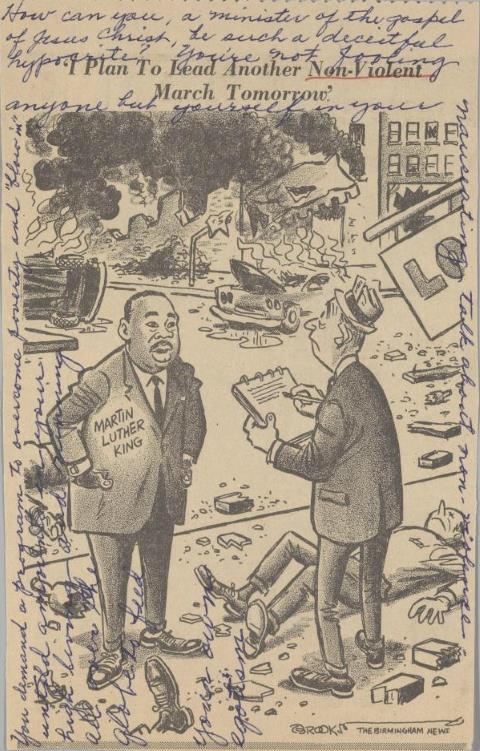
The following cartoon featuring Martin Luther King Jr has been making its way around the internet. It is from the time when he was doing all the work that people now whitewash into inoffensiveness so that even Republicans can celebrate him. It features a reporter talking to King, who says, “I plan to lead another non-violent march tomorrow.” Around them is a city on flame. What’s even more interesting is that someone at the time wrote on it, “How can you, a minister of the gospel of Jesus Christ, be such a deceitful hypocrite. You’re not fooling anyone but yourself in your nauseating talk about non-violence.” There is more, but you get the idea.

Contemporary MLK Cartoon Before He Was Whitewashed to Irrelevance

When I look at the history of African Americans, I see a continuum. It is much the same as the treatment of the poor generally, in that it shows how the power elite manage to constantly adapt to threats they see. But for black citizens, it is at a much worse level. First there was slavery. Almost immediately after its abolition, other means of control were established — most notably Jim Crow laws. After the civil rights victories of the 1950s and 1960s, the power elite again adapted in the form of economic segregation, the “war on drugs,” and the continued assault on voter rights. But these don’t lead on the evening news. In fact, they are never even mentioned.

My older sister — who doesn’t pay attention to politics — asked me why people were rioting in Baltimore. She had heard about that and that it was based on the police killing some kid. But she asked, “Don’t they see that this is counterproductive?” That’s the way most people look at it. Of course, the protests were going on for more than a week before there was any violence. It just didn’t get the kind of blanket coverage that is necessary for it to become big news.

The main thing is that the protests — peaceful and not — are based on a longer view of history. America generally has the memory of a scorpion. If someone hits us, we have no memory of doing anything to have caused that — because we have no memory at all. But we need to develop a memory. Because lacking a memory just allows the power elite to continue to oppress us. We don’t treat the African American community in Baltimore bad because of the way it sometimes acts out; it sometimes acts out because we treat it badly.

Sam Harris’ Limited Tribalism

Sam HarrisThis is it for my recent series of articles on Sam Harris’ new book, Waking Up. I promise! And this one isn’t even about the book. It is just based upon a quote toward the end of the book, which shows one of Harris’ blind spots. He couldn’t end the book without taking a potshot at Islam. His reason is that he wants to make the point that ideas matter. It is curious that he should think that point was necessary to make in the last couple of pages of the book. I think anyone who had stuck with him for over 200 pages would yield the point.

But his example is strange and says rather more about him than anything else:

Twelve years have now passed since I first realized how high the stakes are in this war of ideas. I remember feeling the jolt of history when the second plane crashed into the World Trade Center. For many of us, that was the moment we understood that things can go terribly wrong in our world — not because life is unfair or moral progress impossible but because we have failed, generation after generation, to abolish the delusions and animosities of our ignorant ancestors. The worst ideas continue to thrive — and are still imparted, in their purest form, to children.

If I knew nothing about Harris, I would largely agree with the idea here. The problem is tribalism. Of course, even on this basis, it isn’t simply a matter that those people who attacked us on 9/11 did it because they were taught to dislike our tribe. This is a common mistake that people make: to assume that history starts wherever it is convenient for us. We are mad at al-Qaeda because they bombed us. But clearly, that was not the beginning of it for them. As much as I might think that Osama bin Laden was a spoiled rich kid who was mostly just living his fantasy of being a political radical[1], the group itself is based upon real and imagined grievances.

So where exactly is Islam as “the mother lode of bad ideas”? Why would these Muslims attack America? Is there anything in the religion that makes us specifically the target of their wrath? I just don’t see it. I’m not sure that Harris sees it. Tribalism seems to be the problem. And the people in the United States who are most behind the “war on terror” do it for tribal — nationalistic — reasons. So it is hard to be in this discussion on the anti-Muslim side. That just leads to some of Harris’ worst arguments of the kind: our tribalism isn’t as bad as theirs, even if our tribalism has helped to fuel theirs against us.

But what bothers me even more about the Harris quote above is how he woke up to the power of bad ideas after the 9/11 attacks. The United States has been carpet bombing various locations throughout Sam Harris’ life. But those never caused him to think about the power of bad ideas. That’s strange. I remember the Persian Gulf War as an exercise during which roughly 30,000 Iraqi conscripts were killed while Saddam Hussein’s elite forces were not touched. That wasn’t a war; that was a PR campaign — a way for America to get over the Vietnam Syndrome and get on board for endless war. And if tens of thousands of innocent Iraqis had to die to do that, so be it.

That was a wake-up call for me. But it seems that Sam Harris is so lost in his own form of tribalism, that he can’t see it. Someone attacked us! It must be because they follow the mother lode of bad ideas. And we don’t. And no level of murder on our part will ever change that. Because history started on 9/11. And everything follows from there.


[1] Osama bin Laden always makes me think of “White Punks on Dope”:

Caution Regarding Baltimore Police Arrests

Police AbuseAs hard as it is for prosecutors to win a conviction or an admission of guilt, it’s even harder to persuade a judge or jury to give an officer significant prison time.

For the nine officers convicted in state prosecutions, sentences ranged from six months to seven years, The Post analysis shows. One of the other cases, the shooting death of the 92-year-old woman in Atlanta, was taken up by federal prosecutors, who added civil rights violations to manslaughter charges and won stiffer sentences, ultimately sending the two convicted officers to prison for six and 10 years.

Six of the officers who faced state prosecutions were convicted after going to trial. On average, they got 3 1/2 years.

—Kimberly Kindy and Kimbriell Kelly
Thousands Dead, Few Prosecuted

Billionaire Philanthropists: Just Pay Your Taxes!

David RubensteinDavid Rubenstein seems like a nice enough guy. At least he did in Sunday’s 60 Minutes hagiographic segment, All American. But I was really struck by this comment, “The government doesn’t have the resources it used to have. We have gigantic budget deficits and large debt. And I think private citizens now need to pitch in.” There are so many things wrong with that statement. To begin with, what is a “gigantic budget deficit”? It is half the size it was only a few years ago. Pretty much all of it is due to the fact that the United States pays twice as much for its medical care as the rest of the developed world. As for resources: the government has as many of those as it ever did. Did some national parks sink into the ground or something?

60 MinutesI think we know what Rubenstein is saying here. The government does have as much tax revenue as it once had. That’s true! But it isn’t anything fundamental. There is a reason that tax revenues are low: people like Rubenstein have done everything they can to have their tax rates lowered, increase loopholes, and hide income. Almost all of his current income is capital gains that he pays no payroll tax on and a maximum tax rate of 20%. If you make the minimum wage, you pay 15.3% in payroll taxes on every dollar you make. So even under the best of circumstances, you pay almost as high a rate of federal taxes as does Mr Rubenstein. If you are in the middle class, you probably pay a higher rate.

But rather than Rubenstein working to make the tax rate more fair, he is out there working in “patriotic philanthropy.” What this seems to mean is that he uses his money to support high profile historical preservation. So not only does he get the thrill of buying an original copy of the Magna Carta, he gets the thrill of very publicly giving it to the nation. As he said in the segment, “I’m giving it to the country, in effect, as a down payment on my obligation to give back to the country.” Let me outsource my response to one of my favorite Iron Age philosophers:

When you pray, you are not to be like the hypocrites; for they love to stand and pray in the synagogues and on the street corners so that they may be seen by men. Truly I say to you, they have their reward in full.

Rubenstein paid $21.3 million for the document. That’s a small price to pay for all the publicity that he received for it. Let’s put it in perspective. Rubenstein is worth an estimated $3 billion. Imagine that you were worth one million dollars. His purchase would be equivalent to roughly $7,100 to you. So it is a decent used car. Also note: the Magna Carta really isn’t that important to this country. Ever read it? It basically just says that the king doesn’t have the right to kill other members of the aristocracy. It’s important, but hardly Enlightenment thinking.

Also from this glowing puff piece, we learned that Rubenstein has committed to giving half of his wealth away to worthy causes. That’s fine, but it doesn’t exactly make him different from the robber barons of old. But more to the point: so what?! His billions and Bill Gates’ billions and all these guys’ money is not going to do all the things that the government needs to do. What we need is a just tax system. But none of these bozos will get behind that. It’s much more fun to build an opera house or fix the Washington Monument so that the whole nation can stand up and cheer you.

The hard work of running a country is something that we should all do every day. But I don’t see the rich doing it. I just see them making themselves feel even better about themselves because of all the love they are buying. Truly I say to you, they have their reward in full.

Halfway Libertarian Argument for TPP

Tim WorstallMy first wife got me into libertarianism. She was very clever and I followed right along with her ridiculous arguments. A good example was her argument against antitrust laws. The way she saw it, they were unnecessary. If one company wanted to undercut prices and throw everyone else out of business: great! That meant that we would all get cheaper prices. Once the company had its monopoly and then raised prices: no problem! That would open up a market opportunity for other companies to come in. This is a typically facile argument that doesn’t take into account start up costs and times. Nor does it deal with regional effects. It is, in other words, the perfect libertarian argument: it has little or nothing to do with the real world — thought through just long enough to make the libertarian case.

But even if those were not problems, who would want to live in such a world? This month, cars costs $1,000. Next month, they cost $10,000. The month after that, who knows? And what is especially problematic with this world is that libertarians are obsessed with price stability. As a result, they want the gold standard so that no bureaucrat can take John Galt’s wealth away! Price stability is important for the economy as a whole. But as long as it isn’t the government, but rather various rich capitalists who are stopping people from planning their economic futures, libertarians don’t think it is a problem.

Dean Baker just brought my attention to a similar kind of libertarian nonsense, Forbes’ Tim Worstall Is Upset the Trans-Pacific Partnership (TPP) Bans Export Subsidies. Worstall recently wrote an article in which he claimed that we shouldn’t worry about other countries keeping their currencies artificially low and that the TPP doesn’t need to address the issue. Just like my wife used to say, they are doing us a favor by giving us goods at low prices. Shouldn’t we be glad about that? Well, it depends.

If you are rich and you don’t need a job, then it is great. The Chinese, for example, provide us with goods that are cheaper than they should be. That’s as true for the poor, however. The problem is that the poor need jobs. So there are all these products that are made in China that would be made in America if the renminbi were properly valued. This I always find really interesting. There is no doubt that Tim Worstall is in the upper middle class — but he’s probably in the upper class and may well be just flat out rich. And as I’ve discussed many times, reporters tend to see as “obvious truth” what is in fact just whatever is in their own best interests.

Baker noted that Worstall ought to be angry about its ban on export subsidies. After all, he is for allowing countries to subsidize consumers in other countries through currency manipulation. Export subsidies are just a different way to do exactly the same thing. So what gives? Well, as Baker noted in an addendum, Worstall thinks that the world is always at full employment. And that circles back to the larger issue which is that Worstall sees everything from his own social position. I’m sure that he doesn’t know many if any people who are unemployed or underemployed. It seems to me that almost everyone I know falls into one of those categories.

Again, the problem isn’t that Worstall is man of his own culture. The problem is that he considers himself a clear eyed observer — maybe even objective. If he would just admit that all he really cares about is the rich, there would be no problem. We could just discount him the same way we do simple minded libertarians. In his perfect world where everyone who wants a job can have one, it all makes sense. But we don’t live in that world. Instead, we live in a world were incompetent ideologues like Tim Worstall have good paying jobs at popular business magazines.

Why We Don’t Reform American Policing

Freddie GrayOn Friday, I was really struck by something that Baltimore Mayor Stephanie Rawlings-Blake said, “We know that the vast majority of the men and the women in the Baltimore City Police Department serve our city with pride, with courage, with honor, and with distinction. But to those of you, who wish to engage in brutality, misconduct, racism and corruption, let me be clear, there is no place in the Baltimore City Police Department for you.” Most people have focused on the second sentence. To me it is just political boilerplate — the sort of thing that we hear from every mayor everywhere regardless of what their actual policies are. I’m interested in the first sentence.

Of course, the first sentence is no less boilerplate. It’s required in a nation where the police forces are a bunch of pussies who need to use deadly force rather risk a slight abrasion and yet still demand that the people treat them as though their jobs were very dangerous and that they performed them with great professionalism. As anyone who reads this blog knows, I don’t think highly of policing in this country. In addition to maintaining a low level of professionalism, police officers tend to have huge chips on their soldiers — demanding rather than earning respect.

A good example of this is found in the way that many people respond to my writing about the police. The blame is placed on me. Supposedly, the problem is that I don’t know just what great chaps our men in blue are. So the solution is for me to run out and learn how great they are. This is because we can’t expect the police to actually show themselves to be good guys. Despite the torrent of information indicating that there are major systemic problems with all of our police forces, I’m supposed to start a goodwill tour to ferret out the good guys. It’s nonsense.

But what Bawlings-Blake did is exactly the same thing. The police are so sensitive that we can’t even talk about the heinous acts of six police officers without starting with, “While most police spend their time rescuing kittens and feeding the poor…” Note that it is not de rigueur to start a discussion of pediophile priests with, “While most priests serve their congragations with pride, with courage, with honor, and with distinction…” And I think this is because most priests actually do. When the mayors of major cities say these same things about police, they mean it aspirationally: they hope someday that this is actually true.

But if there is anywhere that most police officers do not serve the city with pride, courage, honor, and distinction, it is Baltimore. What the officers did to Freddie Gray was not just out of control officers; it was part of systemic brutality. Read Conor Friedersdorf excellent article at The Atlantic, The Brutality of Police Culture in Baltimore. The reason that this thing is allowed to go on is because everyone gives the benefit of the doubt to the police. People like Michael Slager are just bad apples. Darren Wilson was just a pussy. Eric Garner only died because he was fat. We never do anything to change the system because, “We know that the vast majority of the men and the women in the [Whatever] City Police Department serve our city with pride, with courage, with honor, and with distinction.”