Puppet Shows and the Evil Dr. No No

Yogi Bear and the Three Stooges Meet the Mad, Mad, Mad Dr. No-NoI have been doing puppet shows for as long as I can remember, but the first puppet show I do remember doing was for my second grade class.[1] I did it with my best friend of the time George Herring. We performed Yogi Bear and the Three Stooges Meet the Mad, Mad, Mad Dr. No-No. This must have been my idea, because this was my favorite record album when I was that age. (I also really liked David Frye’s Richard Nixon Superstar too. Go figure—not because it wasn’t good, but rather: the same kid who liked Dr. No No liked such hip comedy as Frye? Like I said: go figure.) Despite having probably listened to the album hundreds of times, I have no memory of it. Here is the synopsis according to Wikipedia:

Yogi Bear and the Three Stooges Meet the Mad, Mad, Mad Dr. No-No is a 1966 comedy album produced and released by Hanna-Barbera Records. The album presents the Three Stooges (Moe Howard, Larry Fine and Curly-Joe DeRita) as inept park rangers who are called upon to rescue Yogi Bear (played by Daws Butler) after he is kidnapped by Dr. No-No, a nefarious scientist who invented a machine that turns people into animals.

I do, however, remember that I was twenty years old before I found out who Dr. (single) No was, and fully understood the joke that Dr. No No was.

Knowing my personality (then and now), I doubt that our performance was much abridged. My only reason for believing that our performance was less than a half hour is the probability that Mrs. Johnston would not have allowed our silliness to go on that long. Or maybe she would have. Of all my grammar school teachers, Mrs. Johnston was by far the most likely to indulge my innate silliness.

I found this nice little video about how to put on a puppet show. It shows just how little is required.

The main thing I would add is that found material often works very well as a script: comedy records, short stories, whatever delights you. Also: an audience is not strictly necessary. Most of the enjoyment is the process itself. And if that doesn’t work for you, you can always film your puppet show and put it on YouTube. As it is, the, the most viewed video I’ve ever seen is a puppet show, Potter Puppet Pals: The Mysterious Ticking Noise.

Update

At some twenty million views, this puppet show is not even near the top of the most watched videos. But then, neither are many of the videos people think of as very popular. Dramatic Chipmunk, for example, has only 32 million views. Keyboard Cat has on 19 million views. What are the most popular? You don’t want to know, but I will tell you: music videos mostly. Justin Bieber has the top 1, 8, and 9 positions. How many views? Baby ft. Ludacris has over 650 million views. I guess Mencken was right, “Nobody ever went broke underestimating the taste of the American public.”

Update II

Just a month after posting this article, carlosvonchang uploaded Yogi Bear & The 3 Stooges Meet The Mad, Mad, Mad Dr. No-No on YouTube. It is presented in two parts—side A (16:01) and Side B (17:00). I’ve put these two videos into a single playlist so it automatically loads Side B after Side A has finished.


[1] My first two years in college, I carried around a puppet mounted on the end of a bamboo stick. The idea was a human skull on the end of a pike. I thought it was incredibly clever.

Reducing Shakespeare

A few years ago, I discovered the Reduced Shakespeare Company’s The Complete Works of William Shakespeare (Abridged). It is a sketch comedy play which supposedly performs all of Shakespeare’s (36, 38, 39?) plays in just one and a half hours. In fact, they only mention many of the plays. For example, they combine all of the comedies into a single play entitled The Comedy of Two Well-Measured Gentlemen Lost in the Merry Wives of Venice on a Midsummer’s Twelfth Night in Winter. And they do all of the histories in a mock football game. The only plays they actually do are Romeo and Juliet, Titus Andronicus (brilliantly as a cooking show), Othello, Macbeth, Julius Caeser (barely), Antony and Cleopatra, Troilus and Cressida (with Godzilla), and finally, Hamlet, which takes up half of the entire play. Here is their version of Othello:

As I think can be seen, The Reduced Shakespeare Company does not over-revere Shakespeare. Thus, when I saw that two of the actors—Reed Martin and Austin Tichenor—had written a book called Reduced Shakespeare, I was excited. Unfortunately, the book is a major disappointment. On the plus side, it is a fun enough read. The comedy is often forced, but humor in book form is always a mixed bag. What’s more, for those who know little of Shakespeare, there is much to be learned from the book.

Where the book falls down is in the worship it shows to Shakespeare. Throughout the book, Shakespeare is not just a great writer, or even the greatest English playwright, or even the greatest English writer. No: he is the greatest writer ever. They say, for example, “Ultimately you will understand that Shakespeare is revered above all other writers not because of the kind of man he was but because of his works.” Later, they say that Hamlet is, “In all likelihood … the greatest play ever written.” Really? Hamlet?

I’m not going to go into a discussion of just why such statements are ridiculous. For those interested, I highly recommend Gary Taylor’s Reinventing Shakespeare. But the book missed out on the funniest thing about Shakespeare: the idolatry surrounding him. No one who has read contemporaries of Shakespeare can come away with any thought more than that Shakespeare was slightly better than his peers (and I would not go nearly that far). So how is it that Shakespeare towers over all of the playwrights who came before and after him? Certainly, when it comes to comedy, Aristophanes is far better than Shakespeare.

To be fair, Martin and Tichenor do lampoon Shakespeare idolatry. Unfortunately, they suffer from it greatly without any apparent recognition of the condition. And that is deadly. Thankfully, that is not the case with the play, which I still recommend highly.

Postscript

The boys have a whole chapter in which they review Shakespeare on film. Unfortunately, in many cases, they admit to having never seen the movie. That’s part of the joke. Get it? Anyway, they review perhaps Orson Welles’ greatest film, Chimes at Midnight (this is not my opinion—I have not seen it—but rather that of Welles himself and Peter Bogdanovich). They start the review thusly:

This is Orson Welles’s[1] crowning Shakespearean achievement, in which he brings a robust magnificence to Falstaff, Shakespeare’s greatest comic creation and a part Welles was born to play. He had a brilliant idea: Create a story that focused on Falstaff by taking the relevant scenes from all the plays in which Falstaff appears (Henry VI, Parts 1 and 2, Henry V, Richard II, and The Merry Wives of Windsor). He even used Holinshed’s Chronicles (Shakespeare’s own original source) for the narration. Welles’s performance is outstanding, and the battle scenes are impressively intense.

Wow. Sounds pretty good, right? But they give it one (out of five) “bards.” Their complaint seems to be that the film has too many technical “glitches” to be enjoyable. They have much the same to say about Welles’ Othello, which they also gave one “bard” to. By their discussion of the film, it is unclear whether they had seen the restored Othello, which is by far the easiest to get today. One would think they would take a little more care with the winner of the Cannes Film Festival’s Grand Prize. And one would think some mention would be made of the fact this is one of a very few film performances of the great Irish stage actor Micheál MacLiammóir, who is great as Iago.

It is also worth noting that the the plays these boys claim to be of five “bard” quality are: Hamlet (interesting, but really not that good), Henry IV, Part 1 (Falstaff is fun, but one wonders just how much Shakespeare is responsible for the character), King Lear (about as good as Shakespeare gets), Macbeth (ditto), A Midsummer Night’s Dream (tedious when Bottom isn’t on stage), Richard III (good Shakespeare, but I hate the whole “I’m a villain” setup; see also Don John in Much Ado About Nothing), and Romeo and Juliet (as good as that bard gets). I think they have picked about the best of what Shakespeare has to offer, but if it were up to me, I wouldn’t give any play more than four bards.

And Martin and Tichenor never address the most pressing question: why is Shakespeare always better in Japanese?


[1] I hate this construction. Is there any reason at all to add this extra “s”? No. There isn’t.

Just Philately

CharadeWhen I was a physics undergrad, I was part of a clique of the best physics students—or so we thought. Along with Ken and Nancy, I looked down on students from all the other disciplines as well as all the other physics students—at least the ones who didn’t take all the upper division, heavily mathematical physics courses like statistical mechanics, digital signal processing, and of course, mathematical physics. In particular, we ignorantly referred to all other scientific disciplines as philately: stamp collecting. Apparently, we had not been exposed to genetics or geochronology or just about any other field of modern science.

As I learned many years later while researching one of my “dangerous” books, scientific philately is an enormously complex and beautiful part of science. Carl Linnaeus was one of the greatest scientists of all time—certainly on par with Newton, Maxwell, and Einstein—men I (rightly) considered heroes. Study of his classification of species is extremely rewarding and insightful. This is especially true as our knowledge of genetics increases and we see how accurate Linnaeus and his followers were in relating different species. But we were wrong on an even deeper level, because philately itself is anything but contemptible; it is a beautiful hobby that combines art, history, and economics—to name but a few—in a unique and rewarding manner.

I was reminded of this last night as I watched the 1963 film Charade starring the ultimate symbol of male perfection, Cary Grant and the ultimate symbol of revolting cuteness, Audrey Hepburn. This enjoyable little film is built on a foundation of our ignorance about the value of postage stamps. Three rare stamps serve as a kind of reverse MacGuffin[1]: everyone in Charade is looking for a quarter million dollars that is hidden in plain sight in the form of these stamps that have been known to everyone since the beginning of the film.

Here are the three stamps in Charade:

Charade Stamps

However, these stamps are not real according to the Internet Movie Database. But they represent real stamps:

The stamps depicted in the film are fictional counterparts of actual rare stamps, but have their values raised [lowered?] by one [order of magnitude?]. The stamps they represent are the Swedish orange[2] 3 skilling, the “Hawaiian Missionaries” 2 cent blue and the 81 para blue Romanian “cap de bour” on blue paper, in total worth about USA$3.6 Million in 2007.

It is unclear why director Stanley Donen and art director Jean D’Eaubonne chose to create similar stamps rather than using facsimiles. As you can see in this altered still, the stamps still look quite similar.

Charade Stampes: Real

Stamp Values

One apparent reason for using fictitious stamps is that the total value of the stamps is quite different. In the movie, they needed to be worth a quarter of a million dollars. Very rare stamps are worth quite a lot more than this.

The 1851 Hawaiian Missionaries Blue is worth $65,000 in Charade. In reality, it is currently worth slightly less than three-quarter of a million dollars. The next most valuable stamp, the 1855 Swedish Yellow 3 Skilling is worth only $85,000. I say “only” because this is a one-of-a-kind stamp. It sold for over $2 million back in 1996, and is estimated to be worth more than $3 million today. Strangely, the 1858 Romanian 81 Parale Blue that was worth the most in the film, is worth the least in reality. In the film, it is worth $100,000, but in reality is worth only $50,000.

The total real world value of the three stamps is thus $743,000 + $3,163,000 + $51,000; the total is $3,957,000, or roughly four million dollars! This is 16 times the film value of $250,000. However, Charade was released in 1963—almost fifty years ago—and the dollar ain’t worth what it used to be. Assuming a starting stamps value of $250,000 and the yearly U.S. inflation figures taken from InflationData.com, we get the following graph of the yearly inflation (the blue bars) and the value of the stamps at each year (the orange line), assuming they had increased in value only at the rate of inflation.

Stamps Value Over Time

Given these assumptions, the quarter million dollar starting value would produce a trio worth roughly $1.8 million. This is 45% of the real trio’s current value. However, there is no reason to think the samp values do appreciate at the rate of inflation (especially US inflation). Thus, it seems likely that the value of the stamps were not the reason why the filmmakers created their own stampls. It may just be aethetics.

History

There is much more to these stamps than their values, of course. The Hawaiian Missionaries will be of great interest to anyone who has read Sarah Vowell’s history of missionary conquest of the Hawaiian islands in the 19th century. These stamps were primarily used by these missionaries to write to their families back home. This is how the stamps got their moniker.

Even more interesting, a Paris gentleman, Gaston Leroux was murdered in 1892 because of his ownership of a 2 cent Hawaiian Missionaries (this is mentioned in the film). Nothing in his home had been stolen, so the police were stumped until one of the detectives—who happened to have an interest in stamps—noticed that the victim had a stamp collection with one stamp missing: a Hawaiian Missionaries Blue 2 Cent. The police soon discovered that Hector Giroux—a friend of Leroux—also happened to have this same very rare stamp. Giroux soon confessed and was hanged; the mystery was solved!

The 3 Skilling Yellow is notable because it is supposed to be blue. Apparently, the printing element that is used to make the 8 Skilling Yellowish-Orange broke and so the element for the 3 Skilling Bluish-Green was used. When they went back to print the 3 Skilling Blue, the yellow ink from the 8 Skilling changed the 3 Skilling (theoretically) Blue stamps into 3 Skilling (actually) Yellow stamps. Only one such stamp is know to exist. Also, I am making assumptions about this process. It is never well described and no one knows for sure anyway.

There is shockingly little information available about the Romanian stamp. The following is a description of a single stamp being auctioned in Switzerland at Corinphila:

81 parale blue Attest

In English, this reads:

81 parale blue on grey-blue wove paper, a superb mint example without gum, with huge margins all round, very fine appearance and without faults, an excellent crisp impression with minute spots as are characteristic of the nature of the delicate wove paper utilized and are not faults. A wonderful example of this classic rarity. Just 37 examples are recorded unused, one being cut round, 15 with more major faults and at least five housed in museum collections. Illustrated in Edition d’Or on page 49 and in Handbook I on page 365, pos. 2. Signed Heimbüchler and H. Köhler; cert. Heimbüchler (2010)

The starting bid is 40,000 CHF (Swiss Francs), which is equivalent to roughly $49,500.

Charade

In a sense, there is something very silly about assigning so much value on what are, in the end, tiny pictures of ink on paper. Then again, that is all that cash is, and people get very excited about that. Each stamp tells a story. Plus it works as a great basis for Charade. And for a story-junkie like me, that means a lot. I guess I’ve matured a bit since the time when I thought anything was “just philately.”


[1] A MacGuffin is a literary device used to give a story momentum. In general, it is an item that one or more characters are determined to acquire. It usually doesn’t matter what the MacGuffin is, and in many cases, the audience is never told what it is (e.g. the contents of the case in Ronin.). All that matters is that the character wants it and this motivates her actions.

[2] As can be seen by looking at any pictures of this stamp, or reading about it, it is yellow-orange, but primarily yellow.

What in the Hell is Emily Brewster Doing Anyway?

About a month ago, I sent a letter to Merriam-Webster because a reader mentioned that Kory Stamper might now be a Full Editor (whatever that is) and no longer an Associate Editor.

Hi-

A few months ago, I wrote a cheeky article about the fact that Kory Stamper had changed her hair color. I didn’t think much of it at the time, but then, I had no idea there were so many people out on the Internet who seem to have some kind of crush on her. Now I know: she even has a fan club. And I am now in the position of having upwards of half of the visitors to my website looking for information about Ms. Stamper and (only slightly less) Emily Brewster.

One reader has asked if Stamper is no longer “Associate Editor” because on her last video she referred to herself as simply “Editor.” Can you clear this up?

Also, given that I will surely be writing about Stamper, Brewster, and Sokolowski in the future, I would like to know if I should be referring to any of your editors as “doctor.” Providing a brief bio on your site would be a good idea. As it is, almost everything I (and thus my readers) know comes from other websites: knitty (Stamper) and cookthink (Brewster). Sokoloswski is written about more than the other editors, but we never get any information about him other than that he is “Editor at Large.”

You could make two improvements to your website:

  1. Provide bios of your staff.
  2. Allow other websites to embed your videos.

Any information you can provide would be most helpful. Regardless, I link only to M-W, and your website along with the Chicago Style Manual and Fowler are my primary sources for all matters grammatical. In other words, you are in good company.

It took them a week to respond, but Meghan Lieberwirth did so and at least resolved one question: both Stamper and Brewster are Associate Editors. I still don’t know what that means, however. And I don’t know if any of the Terrific Triad have PhDs. Oh well. Here’s her response (and my catty comments):

Dear Frank, [Nice touch; no colon; very warm.]

Thank you for writing. We are glad you enjoy our Ask the Editor video series and appreciate the links back to our site. [Yeah; I’m sure without Frankly Curious no one would see those videos.]

To address your questions, Kory Stamper and Emily Brewster are both Associate Editors. Peter Sokolowski is our Editor at Large. [I know that! I want to know if he too wasted years of his life getting a PhD!]

Unfortunately at this time videos from Merriam-Webster.com cannot be embedded into other sites. I encourage you to visit our YouTube channel if you are interested in sharing. [This channel currently has 15 videos out of a total of 27, so I don’t really know what you’re talking about here. Why didn’t you just say, “Yes! You can embed from out YouTube Channel!” I’ll embed Emily Brewster’s “Ending a Sentence with a Preposition” below, given that it seems to be very popular. I think people have been waiting years to be told that a preposition is a fine kind of word to end a sentence with.]

Regards,
Meghan

Meghan Lieberwirth
Merriam-Webster Inc.

And As Promised


More Stamper! More Brewster!

Want to know more about Kory Stamper, Emily Brewster, and the whole Merriam-Webster crowd? Then you are in luck (and in need of a proper life). Here are some other articles that may interest you.

Illiterate Filmmakers: Last Man Standing Edition

A lot of proper writing is not a matter of hard rules[1]—it is just a matter of clarity and beauty. One of the best examples of this is parallel structure. As Janis Bell states in Clean Well-Lighted Sentences, “When you write items in a series, you need to make sure they match each other in terms of form.” She gives the following examples of following the rule of parallel structure and of breaking it:

I like bananas because they are delicious, nutritious, and conducive to sleep. [Good]

I like bananas because they are delicious, nutritious, and they help me fall asleep. [Bad]

And it doesn’t matter what form the writing takes place in, either. Again, Janis Bell: “It also doesn’t matter whether the items are marching across the page or down the page.” Nor does it matter if it is page after page, slide after slide, or frame after fame! However, it is in this form that I most often find this error and I believe it is one of the stronger forces driving me crazy. What I am referring to here are the opening credits of films. Let us take, as a purely random example, Walter Hill’s remake of YoJimbo, Last Man Standing. Here are the technical credits (after the cast):

  • Casting by Mary Gail Artz [and] Barbara Cohen
  • Costume Designer Dan Moore
  • Music by Ry Cooder
  • Edited by Freeman Davies
  • Production Designer Gary Wissner
  • Director of Photography Lloyd Ahern, A.S.C.
  • Co-Producer Ralph Singleton
  • Executive Producers Sara Risher and Michael de Luca
  • Produced by Walter Hill and Arthur Sarkissian
  • Based on the story by Ryuzo Kikushima and Akira Kurosawa
  • Screenplay by Walter Hill
  • Directed by Walter Hill

I’m sure you see the obvious problems: “Costume Designer” vs. “Music By” and so on. This would be like listing the cast like this:

  • Starring Bruce Willis
  • Acted by Christopher Walken
  • Actress Alexandra Powers
  • Co-Starring David Patrick Kelly

But it’s worse than even that. It is “based upon a story by” rather than just having “story by” (which would be correct). The worst thing, though, is found in the final two entries. First we have a noun by Walter Hill and then a verb. It is bad enough that they couldn’t just combine these entries, “Written and Directed by Walter Hill.” But “screenplay” and “directed” don’t match. It should be something like “Screenwritten by” or “Direction by.” With so much care taken with the titles, you would think they could at least get the grammar right.


[1] Of course, despite all my ranting and raving, I am a grammar liberal. What matters is communicating. However, communicating well is what is best and when discussing things that matter, throwing a sentence together that says more or less what you mean is not acceptable. What’s more, highly visible people should go out of their ways to speak and write well for the same reason that professional football players should not beat up their wives.

Analysis of the Short Film Madame Tutli-Putli

Madame Tutli-PutliMadame Tutli-Putli is a 2006 Canadian animated short by Chris Lavis and Maciek Szczerbowski, which was nominated for a 2007 Academy Award. It is exquisite—both in animation and in content. There seems to be much confusion about its meaning. But first, we need context. I don’t want to say a lot about what happens in this 15-minute film when you can (and should) just watch it. The only version I could find is in two parts, so I put them together via a playlist. As a result, there is a little hesitation between the two. It’s embedded below.

It should be clear to all that this film is about transformation, in a general sense. It would be easy enough to provide a Christian analysis of it, but I think this would be boring—trivializing the material the way that Christian analysis almost always does. The key to the film is the three appearances of the moth—always right before the appearance of a train light: before it first arrives, before it starts back up, and before the other train passes by. These appearances occur almost exactly at the beginning, middle, and end of the film.

The film Madame Tutli-Putli doesn’t really mean anything at all. It does, however, tell the story of Madame Tutli-Putli, who has an extremely meaningful experience—a transformative experience. At the start, she is weighted down by her possessions. She is terrified when she sees the sign warning of thieves. Soon after, the thieves arrive, gas the passengers, and steal all of her stuff. On waking, she notices the thieves removing a sleeping man’s kidney. After this is accomplished, one of the thieves moves close to her, indicating that she should be quiet. Apparently, they are not after her or her organs. In fact, one gets the impression that she is on their team—even if she doesn’t know it. Her suspicion that this has all been a dream is quickly dispelled by the mud tracks left by the thieves.

Now we see the train is empty. Were all those other people dead? The chess players certainly didn’t play chess, but rather just watched as the bouncing of the train arranged pieces on the board. The boy was physically protecting himself by reading a hardcover book titled “How to Handle Your Enemies.” The tennis player made crude sexual gestures. Everyone seemed combative but ultimately impotent and irrelevant. If they are still on the train—if they are still alive, they do not matter—to anyone.

She desperately makes her way to the dining car and her last encounter with the moth. But this time, instead of annoyance, there is tranquility—an almost destroying love. She follows the moth, knowing somehow that it is showing the way. She reaches the front of the train just as the other train passes by. And she is transformed: from a burdened, frightened creature to one who thrills in life.

And then the trains are gone and the forest is calm. Madame Tutli-Putli’s transformation is complete. It was turbulent, frightening, exciting, and most of all: difficult. But now it is done and there is peace. She is not dead. In fact, I think she is at last alive.

Afterword

This film is on A Collection of 2007 Academy Award Nominated Short Films. These collections are always great. Each of the five live-action and three animated shorts are excellent. But just like The Academy: the weakest films (both still excellent) in each category won.

Two War Films in One Day

When I was in high school, I was in speech club. In fact, hard as it is to believe, I was president of the club. One year, I competed in the “programmed reading” category, which I was apparently rather good at because I went to the state championship—a feat I accomplished that one time only. My presentation was about war and the highlight of it was part of Joe’s speech at the end of Dalton Trumbo‘s great novel Johnny Got His Gun, where Joe is begging to be killed. I still remember the excitement of doing that. It is great writing and I was at the right age to be doing it.

I just picked up the film version of the book when I was at the library. I was curious to see if Trumbo had written the screenplay, because he was blacklisted in the late 1940s. To my delight, far from just being the writer, he also directed it. (I didn’t know that Trumbo ever directed anything—and in fact, this was his first and only directing gig.) Wow. The movie is wonderful. It is life-affirming at the same time that it is the ultimate condemnation of war. The print used to create the DVD is not that good, but it doesn’t too much matter—the movie is so gripping that it is likely that only film geeks will notice. However, it is sad that such a great film hasn’t been restored.

My extremely positive reaction to Johnny Got His Gun may have something to do with having spent the afternoon watching Iron Man 2 with my brother. In general, I will watch anything with my brother because I haven’t spent that much time with him over the past couple of decades. He likes these kinds of films, so fine. But this film was really too much. I’m getting to the point where I can’t watch a film like this without seeing it in a larger context.

Hitler oversaw the genocide of six million “sub-humans” and we rightly call him evil. Andrew Jackson oversaw the genocide a large group of “sub-humans” (Native or First Americans) and we put him on our $20 bill. (Admittedly, the numbers are smaller and no Final Solution was ever attained; but the smaller numbers are due to the far lower population density of all people in the United States at that time; the early Nazi solution to the “Jew Problem” was the same as the Jackson solution to the Indian Problem.) As a country, we are frighteningly ignorant of just how evil we have been and continue to be. As a nation it seems that the more than 600,000 Iraqi civilians killed by us is nothing compared to the slightly more than 4,000 American professional soldiers who have died. (Even the left-leaning Antiwar.com seems to think American lives matter more than Iraqi lives.) Seeing Iron Man 2 within this context is a real problem because the film demands the context that Americans never abuse power—it is just those horrible foreigners who do that.

Even if you take away this evil aspect of the film, Iron Man 2 sucks. It has a few laughs and Mickey Rourke and Sam Rockwell put in good performances as one would expect. But that’s about as far as the good goes. Robert Downey is really starting to look his (my!) age, and his performance is not up to par. In the first film, Pepper Potts (the character played by Gwyneth Paltrow) was smart enough not to become romantically involved with the narcissistic Tony Stark, but she’s not smart in this film. Jon Favreau shows yet again that he is no better at directing than he is at acting. (And he is a terrible actor, if my sarcasm is not screaming off your computer screen.) The story is totally ridiculous. The only believable character was the villain who also has the only true human scene in the film (at the start where he watches his father die). He has a reason to be angry. And our hero? I guess we’re just supposed to know that arms manufacturers who are implicitly guilty of millions of deaths are the good guys. And boy is the film long! Most movies do not have more than 45 minutes of material in them; this one surely didn’t—unless you think “Oh! Let’s put Tony Stark in a race car!” is content; it lasted two hours and ten minutes! I was so bored with the film, I got out my notebook after a half-hour. Unfortunately, much of the film takes place at night, so I was limited as to how much I could write.

After the film, I was sitting with my brother waiting for his bus. A guy came by and heard us talking about Marvel Comics and the movies that it has spawned. The guy asked us with some enthusiasm if we had seen Iron Man 2. We said that we had just seen it. He began to gush about the film and told us he had seen it twice. A teenager, you ask? Oh, no. This guy must have been in his mid-fifties. And he wasn’t crazy, in the drooling sense of the word. But of course he liked it. What’s not to like? It tells Americans just what they want to hear. It is just the kind of entertainment that a culture creates while it is disintegrating.

Perhaps I grabbed Johnny Got His Gun as a kind of antidote to the two-hour propaganda poisoning I had just suffered. I can’t say. If so, it worked. If you are forced to suffer through Iron Man 2 or any of the many films just like it, I highly recommend Johnny Got His Gun; it’s better than the suicide hotline.

Miller’s Crossing

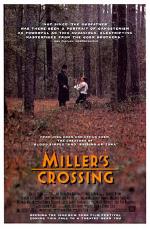
Miller's CrossingMany people miss the point of Miller’s Crossing; what’s more, they don’t judge it on its own terms. It is widely known that the Coen brothers were inspired to make this movie by the works of Dashiell Hammett. But their inspiration does not matter in the least; it only tells us where they started, not where they ended. Thankfully, they did not end up with some modernized Hammett “tough guy” story, with characters who almost always lack depth and humanity. Miller’s Crossing is certainly not a perfect film, but it is a fine film—far better than almost all the movies that have ever been made.

Miller’s Crossing, like all movies that are more than simple entertainments (such as the much better film Gosford Park), really need to be seen more than once. This film is dense; for example, the subplot involving Mink was not clear to me on the first viewing; nor was the sexual relationship between Mink and the Dane. It all became clear on subsequent viewing.

Even with multiple viewings, Miller’s Crossing has its problems. The homosexual relationship between Mink and the Dane is not very believable. J.E. Freeman is a fine actor, but he is not really cast well in this role. This is not surprising, however, since that part had been written for Peter Stormare—who I’m sure would have portrayed the character as implicitly gay along with the angry sadism that Freeman has in abundance; Freeman’s Dane clearly cares about Mink, but it seems more like Mink is his son or brother—not his lover. We learn that Mink and Dane are lovers almost exclusively from other characters.

This is a fairly minor problem, however—and one that would probably be easily fixed with a single scene including both characters together; the biggest problem in Miller’s Crossing is that the filmmakers maintain rigid first-person POV [caveat] throughout the movie except for one scene in which Leo survives an assassination attempt. It acts as a short film put in the middle of the feature. It is spectacular, but it doesn’t belong. As the saying goes, in editing you usually have to kill your darlings and that was one they should have strangled. (There is one other very short POV problem toward the beginning where a young boy steals the hair piece of a dead Rug Daniels, which should have been cut—other than being a classic Coen Brothers moment, it serves no purpose. On the other hand, the fire-bombing of Leo’s club seems like a POV error, but it is not; Tom witnesses it and even comments on it—albeit from a distance.)

Taking the assassination scene out would have allowed them to spend more time on the Mink-Dane relationship and to have further developed Tom’s attraction (love?) for Verna. As it is, Verna disappears for far too long during the latter half of the second act. This missed opportunity is particularly sad because the love triangle involving Tom, Verna, and Leo is the heart of the story. Without getting too Oedipal about it, the film works as modern tragedy. Tom saves Leo (his father surrogate) resulting in the loss of Verna (his mother surrogate). Given his loss of Verna, the film ends with Leo and Verna about to be married; this causes Tom to lose Leo (again) because he cannot accept being around Leo married to Verna. And it is all Tom’s fault; he controlled all the action in the film.

Consider this: Tom could have asked Verna to leave Leo, and she would have; this would have hurt Leo, but it would not have poisoned his relationship with Tom; Leo would then have given Caspar the okay to kill Bernie; and Tom and Verna could have relocated Bernie somewhere far away before he was killed. But the tragic course Tom followed was dictated by his own ethical sense (ironically, shared with Casper, who he has murdered as part of his plan). Tom’s ethics result in the unhappiness of Verna and himself (and to a smaller degree Leo), and the deaths of many people (most innocent in the universe of the movie).

As has been pointed out ad nauseum, the film is beautifully “shot” and expertly acted. I actually have something to say about this other than the usual comments of the film ombudsmen, so you will forgive me if I add to the nausea. Let me start with the acting.

Acting

Gabriel Byrne does an excellent job in this film, but it is rarely mentioned because this is the kind of role that just seems to be standard and easy. But this film lives and dies on his performance. Without his subtle, emotionally deep performance, the film would have no center. In addition to the serious scenes he shares with Finney and Harden, he also has scenes where his character is playing a role. The contrast is stark and riveting.

Of course, everyone applauds Jon Polito in the role of Johnny Casper—and rightly so; but Polito is pretty much always great in whatever he is doing. Is he really particularly better in this film than he is in other films? Just to mention two (later) Coen brothers films, he was wonderful as the gay dry-cleaner in The Man Who Wasn’t There and comically genius paired with Jeff Bridges in The Big Lebowski. He is a fine actor who unfortunately gets a lot of the same kinds of roles because of how he looks; but on the good side, he works a lot.

I’m not sure about John Turturro‘s performance; I have a hard time reconciling his pleading in the forest with his sociopathic behavior elsewhere. He does redeem himself during his second pleading scene where his character’s acting job is far less convincing.

Marcia Gay Harden does a fine job, despite having to recite some of the most tired dialog that the Coen’s have ever created. It is sad that her character was probably the least fleshed out. Albert Finney provides a workman-like performance. His character too is not well written. It is hard not to question how such a nice guy could have survived with the likes of Johnny Casper around. Okay: he’s good with a machine gun and he is calm during stressful situations; but he seems more like the city’s most popular tailor than a crime boss. In Finney’s defense, he was last minute casting, after Trey Wilson (originally cast) died right before shotting; so it isn’t like he had a great deal of time to prepare, and considering his body of work (Murder on the Orient Express and The Dresser come to mind), I would never doubt his talent. And let us never forget that casting, editing, and directing are usually just as important to the success or failure of a performance on film as is the acting itself.

The Look

Miller’s Crossing is the Coen Brothers’ third film. Their first film, Blood Simple, had a budget of one and a half million dollars; and it showed, even if the low-budget look of the film worked perfectly. Their second film, the highly over-rated Raising Arizona cost about six million dollars (and I can’t help but compare it to Jon Jost‘s work which is generally made on a shoestring and yet produces remarkable—and arguably greater—results). So it isn’t surprising that Miller’s Crossing, with it’s 14 million dollar budget would look good. Their first two films had good camera work and reasonably good lighting. Barry Sonnenfeld lit those films. I assume Joel Coen shot Blood Simple; no one is credited. David M. Dunlap shot Raising Arizona, along with Stephen St. John doing the steadicam work. Sonnenfeld lit and shot Miller’s Crossing with Larry McConkey on the steadicam. I mention all of these people, because the cinematographer tends to get all the credit, while the camera operator is easily as important—and in the United States, it is rare for someone to do both in a budgeted movie. Before moving on, I should point out that these people are really just department heads; they all have large crews of assistants who are generally very talented. (Consider the lowly camera loader; do you have any idea just how hard and stressful it is to load a camera with film? By feel alone? It is a demanding job, especially when every minute you slow down the production costs about $50—or more—much more.)

Sonnenfeld’s camera work is hardly inspiring. It reminds me a little bit of Jim Jarmusch‘s Stranger Than Paradise which was lit (and most likely shot) by Tom DiCillo. The camera hardly moves: there are no tilts, very minor pans, and a couple of dollies. The shooting for which Sonnenfeld is responsible is similarly motionless; I assume this is what the Coen’s wanted. However, where Jarmusch’s movie frames each shot in interesting ways; the Coen’s movie frames each shot in a classic manner. This is neither good nor bad; it is a decision. But it is not an exciting decision. Helpfully, it does make the viewer focus on two things: the acting and the set design. I’ve already discussed the acting, which deserves the attention the filming provides. This is even more true of the sets.

The production design by Dennis Gassner is great. Ditto for Richard Hornung‘s costume design. Even the short scene outside in the rain taking cover in a doorway looks great and says as much as the filming and the acting. What’s more, the sets and costumes do more than define the environment and mood—they provide insights into the characters. It is a lot more than pretty. Again, as with filming, there are a lot of people who work under these department heads. And in Miller’s Crossing, there was a much bigger Art Department than there was on Raising Arizona (which itself had a much bigger Art Department than Blood Simple).

This is Not Film Criticism

To me, Miller’s Crossing is a love story that just happens to take place in that fictional land of mobsters who are not, in general, homicidal psychopaths. So while the film may look like something Dashiell Hammett wrote, it isn’t at all. It lives in his literary universe, if you will, but it is populated by characters who just don’t exist in the classic genre. This fact confuses a lot of viewers and makes them think that this fine film is bad. Any good work of art needs to be experienced multiple times before it can be fully appreciated. Unfortunately, the newspaper columnists who call themselves “film critics” generally see a film only once before passing judgment on its artistic value. This is fine, because most people who read such “reviews” simply want to know if they will enjoy watching a movie once. So we should call these “film critics” something more appropriate: “film ombudsmen.”

This discussion of Miller’s Crossing is far longer than a typical “review” and yet, it is far too short to begin to seriously criticize the film. But it is long enough to make the argument that the film cannot be dismissed as bad art and that it deserves at least two viewings, whereas The Maltese Falcon is deserving of one reading, at most.

Update (20 April 2011)

I just got the DVD from the library and there is an extended interview with Barry Sonnenfeld where he says much of what I did about his work. I also found out that after he got out of film school, he bought a CP-16—the same camera that I used to own until I loaned it to Marc Burgio who never returned it.

Update (20 November 2011)

For some time now, I have been thinking about the two lover’s triangles in the movie: Vera’s and Mink’s. Off hand, when the film is looked at in this way it isn’t too hard to see it as homophobic. There seem to be two honest brokers in the heterosexual triangle, only one in the homosexual triangle, and he’s a psychopath. But I would have to think a lot more about this before I was willing to stand behind what is now just a thought.

Update (19 May 2013)

There are more POV problems than I indicated. This isn’t just a matter of formalism. The screenplay really needs to be reworked so that it isn’t so exclusively Tom’s story.

Indian Rope Trick Part II

The Rise of the Indian Rope Trick - Indian Chain TrickThis is a continuation of my article about The Rise of the Indian Rope Trick. Check out Part I. This one deals with an actual effect, the Indian Chain Trick.

As promised, I am going to explain the Indian Chain Trick, the magical illusion that is most like the Indian Rope Trick, but which probably had nothing to do with the creation of the myth because John Elbert Wilkie probably knew nothing about it.

The Mogul Emperor Jahangir reported on the Indian Chain Trick some time around 1600. What he wrote was not translated into English until 1829, and what I quote here is Peter Lamont quoting from this English translation in his book, The Rise of the Indian Rope Trick. It seems that the conjurers

produced a chain of 50 cubits in length [roughly 23 meters], and in my presence threw one end of it towards the sky, where it remained as if fastened to something in the air. A dog was then brought forward, and being placed at the lower end of the chain, immediately ran up, and reaching the outer end, immediately disappeared in the air. In the same manner a hog, a panther, a lion, and a tiger were successively sent up the chain and all equally disappeared at the upper end of the chain. At last they took down the chain and put it into a bag, no one ever discovering in what way the different animals were made to vanish into the air in the mysterious manner described.

This sounds amazing, but actually, Jahangir was not that impressed with this particular effect; the conjurers did much more amazing things like make fruit trees grow and produce ripe mangoes. But let’s forget the mango trick; it is well-know (to those in the know) and it’s secret can be learned from a variety of books. As far as I know, no one has explained the Indian Chain Trick. (And most likely, no one has cared.)

The biggest problem with explaining this trick is the hog. Regardless of how you look at it, hogs can’t climb up chains. The other animals — well, I could imagine they could be trained. But given that hogs can’t climb, I assume that none of the animals actually climbed up the chain. And yet, Jahangir claims they did. Leaving aside the fact that he was almost certainly wasted out of his mind on booze and opium, there are reasons to doubt his description of the effect.

The Problem with Eye-Witnesses

In my experience, when people describe magic tricks they have seen (without the help of booze and opium), they are not very accurate. For example, when someone sees the color changing deck, they will say, “The magician had me select a card from a blue deck of cards; then he fans out the deck and all the cards are red, except for the one I picked that is blue.” I don’t want to go into details here, but the trick started where it ended: with a red deck of cards and two blue cards.

What’s even more important is that magicians are liars. They talk and are generally entertaining and then they start their act. But… They already started it; during all that chitchat, they were doing the “trick”; in fact, in most cases, by the time the audience thinks the effect is starting, it is over from the magician’s standpoint. Ricki Jay’s Four Queen Routine is a good example of this, even though it may not be clear to the uninitiated — which is the whole point, after all. This isn’t always the case, of course; as an example, I would refer you to Daryl’s Rope Routine where he is doing straight sleight-of-hand throughout a six minute effect. But this is the exception, not the rule.

The Method

I can think of a few ways that the Indian Chain Trick could have been done. First the chain: most likely it was simply held up with thread — either from a single strand directly overhead, or two strands running off to each side (the way a tennis net is held up). Obviously, this would likely not even be strong enough to allow a rat to climb up the chain, so we move on to part two: the animal climb.

My guess is that the conjurers had a box that they performed the trick upon. It is from this box that the chain rose. On the top of this box was a trap door that allowed the hog (etc) to disappear into. But how would it do this without being seen? How would Jahangir (other than the drug effects) see the hog climb the chain? The answer is simpler than you would think: he didn’t see the hog climb the chain.

Instead, one of the conjurers would put the hog on top of the box. He would then obscure it from the audience with a screen. At this point, the hog would fall through the trap door, without Jahangir and the rest of the audience noticing — all would assume the hog was still behind the screen.

Now the conjurer would slowly raise this screen up to the top of the chain at the same time he said something along the lines of, “See how the hog climbs the chain!” And then, when at the top of the chain, the magician would pull away the screen and announce, “The hog has vanished!”

The emperor goes wild! No one remembers that they didn’t actually see the hog climb the chain. This is normally how people describe magic tricks they saw: they say they saw things that were only ever implied.

The Indian Chain Trick: Am I Right?

There are other possible methods of doing the Indian Chain Trick, but it was almost certainly something very similar to this. Magicians refer to “heat” in a magic trick. This is when the audience is paying a lot of attention. The point when the screen is removed to show the vanished pig has a lot of heat. But when the screen is first placed in front of the pig doesn’t have much heat because the audience isn’t aware that the trick has started.

Based upon the comment of Kenneth Wade Wilson below, I wonder if this description is unclear. If anyone has any questions, please ask me. It’s really very simple, and the concept is still widely used as in the die box.

Indian Rope Trick Part I

The Rise of the Indian Rope TrickPeter Lamont has written a fun little book called The Rise of the Indian Rope Trick. If you know this magic trick, you will get the punning title (if you are like me, you won’t know quite how you feel about that.). If you don’t know the trick, let me explain.

A magician — but one with a turban, not a top hat — takes a length of rope and causes it to (magically) rise into the air. Then, his assistant climbs up the rope and (magically) disappears. The rope falls back to the ground. The crowd goes wild! You can imagine, just look at the photograph on the right.

Now, admittedly, you don’t see the boy disappear in the photo. In fact, he never does disappear (unless you want to imagine it in your mind). This picture is of The Great Karachi doing the Indian Rope Trick. Indian Rope Trick Photo - FakeKarachi was one of the great Indian magician — except that he was actually from Plymouth in the Southwest corner of the United Kingdom. And his name was Arthur Derbyh. But he looks pretty Indian, don’t you think?

The problem with the Indian Rope Trick is that it was invented by an American. His name was John Elbert Wilkie. A great magician? No. A so-so journalist? Yes. He just made it up for an article he was writing. I understand this. I’ve been a journalist, and I know that you normally get paid by the article: poorly; the more you pump out, the more money you make. It’s not like anyone’s going to check, unless your name is Jayson Blair, or, as in the case of Mr. Wilkie, you are dead.

What is interesting about all of this is that the article took off. People believed it and the story spread to (God help us all) Victorian England. And in Victorian England, the people knew they were the best; and yet, no one could actually do this trick. Okay, sure: Karachi/Derbyh: Rope rises, kid climbs up, kid climbs down. No big deal. Even Howard Thurston (who was a total hack) could do that. It’s the disappearing that was the key (and outside; don’t forget that — you can do anything in a theater).

John Elbert Wilkie: Inventor of the Indian Rope TrickOf course, after Wilkie first “reported” on the Indian Rope Trick, it ran wild. Numerous variations appeared. Here’s my favorite: rope up, boy climbs, magician climbs after him with sword, and cuts him up: arms, legs, torso, and head fall to the ground; magician climbs down; he assembles the parts again, and the boy gets up and dances a gig — or the Indian equivalent of it. Gruesome, yes; but surprisingly easy to do; a lot easier than that disappearing thing.

Anyway, we get a lot of Victorians hunting around India looking for the trick (that doesn’t exist because it only ever existed in Wilkie’s mind, and by now, he is with the United State Secret Service — I kid you not). And there is lots of waving of hands and all that, mostly because the British magicians cannot accept that there is anything that Indian conjurers can do that they cannot (and they’re right). There is, as with just about anything having to do with Victorians, much hilarity. Truly, the only thing that isn’t ridiculous about this period is Oscar Wilde — who was also hilarious but for completely different reasons.

It turns out that there was a magic trick that Indian conjurers did that was similar to the Indian Rope Trick. In it, a chain was thrown in the air where it stuck. Then, a pig, and a dog, and other assorted beasts climbed up the chain and disappeared. I’m pretty sure I know how this was done and in part 2 of this article I am going to explain it. (And it is almost certainly not what you are thinking.)

But don’t pass up on Peter Lamont‘s book. It is a lot of fun — excellent summer reading.

Check out Part II of this Article.


15 November 2013: I removed the CCNA Chennai video embed (see comment below) because it has been removed and I can’t locate it now.

A World in Which I Don’t Have to Watch “The Princess and the Frog”

I always thought that I liked kids, but I have come to the conclusion that this is not the case. If there were no children, no one would have made The Princess and the Frog. If no one had made it, I would not have spent the afternoon watching it. If I had not spent the afternoon watching it, I would feel better about myself. It isn’t that I didn’t enjoy it; some of it was very funny and I was on the verge of crying pretty much from beginning to end—and I didn’t even realize that Oprah Winfrey was in it. But that is exactly the problem.

Randy Newman shows once again that talent can be used for evil. The songs—pretty much without exception—suck. But that’s okay. Newman has been writing poor songs on and off since the beginning (think: Laughing Boy) and always since about Toy Story (think: You’ve Got a Friend in Me). It was his score that was so evil. I was emotionally bruised (and worse, but I don’t want to go into details). I should now be made to weep over a dead firefly’s romantic life.

What bothered me most about the film was how it dealt with race. It takes place in 1930s (give or take 20 years) Louisiana, with its accompanying racial segregation and economic stratification. The fact that all the black people were smiling didn’t make me accept the racist expectations of the whites any better—from the implicit racism of Big Daddy LaBouff and his annoying daughter to the explicit racism of the real estate agents. What’s more, I couldn’t get past the fact that Prince Naveen is vaguely Indian and thus brown and thus acceptable to be paired with the light-skinned black girl. Certainly the prince could not be pasty-English white and the girl be Miles Davis black; or visa versa. If this is a film for kids, then perhaps such delicate racial issues should be taken out of it, by setting it somewhere other than 1930s (give or take 75 years) Louisiana.

It seems like a minor thing, but it’s worth mentioning: the animation. This film is what they call “hand drawn”. By this, it seems what they mean is that the base artwork is hand-drawn and then scanned into a computer and then animated the way they always do. Off hand, I would say, “So what?” But there is a difference: it really isn’t very appealing. I guess they are going for something like Lady and the Tramp. The problem here is that Lady and the Tramp is really not that appealing. I’m a Pinocchio guy.

Kids: there were a bunch of them. And they seemed to like it a lot. And they were very well behaved. (When I saw Babe in the theater the little joys were running up and down the isles.) I guess I can accept the occasional Disney movie for their benefit, but why did the dead firefly’s romantic life have to be so sad?