Anniversary Post: State Sales Taxes

Sales TaxIt is very possible that on this day in 1921, West Virginia enacted the first broad sales tax. Do you know who loves the sales tax? The rich. I’m sure that the push to get sales taxes all over the United States was the result of the federal income tax enacted in 1913 via the Sixteenth Amendment. The federal income tax remains the only truly progressive tax in the United States. And the sales tax is regressive. This is why conservatives always go on about the federal income tax. They are just fine with the state sales taxes. In fact, many of them want to get rid of the federal income tax and replace it with a value added tax — basically a federal sales tax.

I should be clear, however. West Virginia legislated the sales tax at that time. But it apparently took the state forever to actually getting it working. That great bastion of liberty and supporter of the “common man,” Mississippi was the first state to actually get it going — in 1930, just when the common man could least afford it.

Here in the United States, we have a taxing system that is a mess. It is designed so as to take the maximum amount from the poor, but not make it look like this is what is happening. So everyone focuses on 15 April — the one day when our only progressive tax is collected. But every day — Every minute! — the poor and middle classes are being regressively taxed. But that’s just fairness. Unlike that terrible federal income tax, which is downright un-American!

Happy anniversary to the first broad-based sales tax — the beginning of a terrible American tradition.

Anniversary Post: Folies Bergère

Folies BergèreOn this day back in 1869, the Folies Bergère opened in Paris, France. Of course, at that time, it was known as the Folies Trévise. It’s always been a little sexy, but it has never been the kind of coarse entertainment venue that most Americans imagine. It certainly isn’t anything that I couldn’t take any of my wives or girlfriends to — although that probably says more about my wives and girlfriends than it does the Folies Bergère.

A better way to look at it is like the club in Cabaret. And based upon that, we can say of the performers, “Each and every one: a virgin!” According to the Encyclopedia Britannica, Folies Bergère was a standard nightclub in its early days, featuring “musical comedies and revues, operettas, vaudeville sketches, playlets, ballets, eccentric dancers, acrobats, jugglers, tightrope walkers, and magicians.” It followed other clubs into nudity, but apparently with much gusto.

Today, of course, the Folies Bergère is an institution in Paris. It sound like a lot less fun to me than it would have been in the early 1870s:

Each of its shows requires about 10 months of planning and preparation, 40 different sets, and 1,000 to 1,200 individually designed costumes.

Happy anniversary Folies Bergère!

Anniversary Post: Haymarket Affair

Haymarket AffairToday is International Workers’ Day, or in many places, just Labor Day. It was originally chosen to commemorate the Haymarket affair. It’s easy enough to get all of the history of labor organizing confused because it is all very repetitive. Workers try to get rights, businesses get the government to beat down the workers. It really is that simple. The primary purpose of the police and military is to keep the power elite in control by “controlling” the lower classes. If you see the police as being represented by the “Officer Friendly” nonsense, you’ve lived a charmed life — most likely because you are rich.

It is hard not to relate the Haymarket affair to what has been going on all around the country. Things really haven’t changed. Then as now, the media tended to ignore protests unless they got violent. Then as now, police and other kinds of brutality on behalf of the power elite were ignored. And, of course, the police were rarely held accountable. The day before Haymarket, the police began shooting into the striking workers — killing a couple of them. This led to the Haymarket demonstration when a group of anarchist threw a bomb that led to the deaths of seven police officers and an unclear number of workers. Typical that the number of civilian deaths is uncertain.

The direct result of the Haymarket affair is that four anarchists — none of them directly responsible, and probably not even indirectly — were put to death. Let’s be really clear here: they weren’t put to death because of the bombing. They were put to death as a cultural symbol — a message to uppity workers. The case against these men had nothing to do with the crime itself. The trial was all about what they had written in the past. Do we still believe free speech exists in the United States when it clashes with powerful interests? Sure, we allow Nazis to parade through Jewish neighborhoods. But businesses must be allowed to counter any union organizing with weeks of mandated propaganda. People’s feelings don’t matter. Businesses’ profits do.

The short term result of Haymarket was a huge backlash against the labor movement. And, of course, a groundswell of support for our brave men in uniform. You know: the ones who the day before Haymarket had shot indiscriminately into a crowd on peaceful strikers. Oh, and what were these terrible workers fighting for? A little thing called the 8 hour work day. At that time, people at the McCormick Harvesting Machine Company were working ten hours per day, six days per week. Do you get overtime if you work more than eight hours per day? Thank these workers and organizers, many of whom died in the fight.

Despite public opinion — and all those truth-telling journalists who just so happened to find the truth by supporting the power elite — the Haymarket affair stiffened the resolve of union supporters. It is all about solidarity. I have argued in the past that this is what capitalists most fear about unions. Any given benefit or workplace reform can later be destroyed — as long as the capitalists can divide and conquer the workers. And they’ve largely succeeded. About the only people I know who are big supporters of unions are those who are in unions. And even inside of some unions, such as grocery workers, there is now a double standard: older workers are well paid and younger workers have more or less minimum wage jobs.

But the fight continues. Happy International Workers’ Day!

Anniversary Post: Botany Bay

Welcome to Botany Bay! Now go home!On this day in 1770, James Cook first landed in Australia in a place he will call Botany Bay. It was there that he first met with the aboriginal tribe, Gweagal. I think that must have been interesting. It is like us looking into the sky every day and mostly seeing nothing — perhaps a small airplane in the distance. And one day a huge spacecraft shows up filled with people we did not previously know about. It is not surprising that the Gweagal were intrigued but shy toward the strangers.

These kinds of interactions between civilizations are fascinating to me. They show the lie of the libertarian utopia. As you may have noticed, Botany Bay is not under the control of the Gweagal. But when Cook showed up, it was their land. In fact, archaeological digs indicate that settlements date back 5,000 years. Meetings between stronger groups and weakers groups tend to go the same. Things often start out nice enough with trading. But after a while, the stronger group decides that they would like what the weaker group has. And regardless of how the stronger group justifies it, in the end it comes down to the fact that they take it.

This is so ingrained in people, that the great defender of individual rights herself, Ayn Rand, could not see that her own philosophy ultimately degenerated into: might makes right. Matt Bruenig has dealt with the subject from a philosophical standpoint, Non-Aggression Never Does Any Argumentative Work at Any Time. But the truth is that not even the libertarians who claim to follow the non-aggression principle even stick by it. And it doesn’t make sense, anyway. Would it have been all right for the first human to think of it to say, “I own all property.” And then no one could do anything because that would be interfering with his “rights”?

In a perfect world, we would have a just way of divvying up resources. But in the real world, we have no such method. So we stick with what we’ve always done: might makes right. And that is why bad things happen when civilizations collide. That’s not to say that “might makes right” isn’t also what’s happening in downtown San Francisco, but it isn’t as big an issue.

Happy anniversary for the “discovery” of Botany Bay!

Anniversary Post: Mutiny on the Bounty

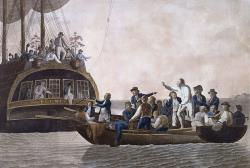
Mutiny on the BountyOn this day in 1789, the mutiny on the Bounty occurred. It is one of those sad stories where it is hard not to sympathize and also hate everyone involved. There is also the problem that it seems every historian who has tackled the subject has (understandably) come to different conclusions. So what you think about the event largely depends upon who you have read. Much better to watch the 1962 classic, Mutiny on the Bounty with Marlon Brando and Trevor Howard — ahistorical as it may be.

What I nonetheless love about the whole thing is how very civilized it was. The mutineers did not kill the captain and his supporters. They just set them in a row boat. In fact, four of the supporters couldn’t go in the boat, so they were dropped off in Tahiti. But the boat wasn’t just set adrift. It was sent with (according to Wikipedia) “150 pounds of bread, some pork, 6 quarts of rum, 6 bottles of wine and 28 gallons of drinking water.” And that explains how Bligh and his crew managed to make it to safety.

Unlike in the movie, Bligh returned to England a hero. It would seem that his reputation fell because towards the end of his life, he was appointed Governor of New South Wales. And he was so bad at getting along with people that he sparked the Rum Rebellion. I think that probably made a lot of people think that Fletcher Christian might have had more than just a little reason for his mutiny.

Happy anniversary mutiny on the Bounty!

Anniversary Post: A Vindication of Mary Wollstonecraft

Mary WollstonecraftOn this day in 1759, the great writer Mary Wollstonecraft was born. She is probably best remembered today as one of the first and greatest feminist philosophers, but I think that is rather too small a box to cram her into. But there is no doubt that her ideas were far ahead of her time. She was even far ahead of the thinking of many of the suffragettes who came along a hundred years later. And among conservatives, I still commonly hear ideas that would offend Wollstonecraft’s thinking over two centuries ago.

I like to think of her as the female Thomas Paine. And indeed, they were friends. In fact, they were both in France together where they faced the guillotine. Paine was jailed for some time, but it isn’t clear whether or not Wollstonecraft was. She was the first to publish a response to Edmund Burke’s apologia for hereditary rule, Reflections on the Revolution in France. Her book was, A Vindication of the Rights of Men. And it contains the kind of fiery rhetoric I associate with Paine. For example, she suggests that Burke would have argued in favor of crucifying Jesus. The sad thing is that I’m sure she’s right.

She followed that book two years later with what is probably her masterpiece, even though it was written hurriedly, A Vindication of the Rights of Woman. It is mostly an argument for the proper education of women. It was generally thought at that time—even by intellectuals—that women needn’t more than a basic education. Rights of Woman is one of the founding documents of modern feminism.

Mary Wollstonecraft died young at the age of 38. It was ten days after the birth of her second daughter who would go on to be Mary Shelley, perhaps the greatest Romantic writer. Her death was due to blood poisoning from a broken placenta. It’s extremely sad and a great tragedy for our culture, but there is something satisfying in the author of Frankenstein killing her creator.

There is much more to say about Wollstonecraft. She wrote a great deal and had a very colorful life. The Wikipedia page on her is rather good, or you could read, Mary Wollstonecraft: A Revolutionary Life. Or you could read her work, much of it is available at Project Gutenberg. She also wrote narrative fiction. She’s well worth checking out.

Happy birthday Mary Wollstonecraft!

Anniversary Post: SS Ideal X

SS Ideal X - Container Ship

On this day in 1956, the SS Ideal X was launched. It was the world’s first successful container ship. Actually, before that, it had been an oil tanker from World War II. But it was purchased by Pan-Atlantic Steamship Company and converted into a container ship. It carried 58 containers. Compare this to the biggest container ships today that carry in excess of 10,000 containers. It is truly remarkable.

Now the Ideal X was not the first container ship. That would be the Clifford J Rogers. But I don’t think that’s quite fair, because it didn’t transport the standard twenty-foot equivalent unit (TEU) containers. And the whole purpose of container ships is that they are standardized. If they weren’t, they wouldn’t be important.

If you are an American and you are out of work, it is probably because of container ships. Well, not completely. There are lots of political reasons. But without container ships, those wouldn’t matter that much. Think of the total crap that comes to this country from China — things like toy rings that kids get in gumball machines. The only reason that it is profitable to make this junk is that the transportation costs are greatly reduced. Container ships allow that.

All this talk of globalization being about allowing companies to get the cheapest labor is true. But if it was expensive to transport the goods, it just wouldn’t happen. And one thing you will notice is that America still does a fair amount of manufacturing of cheap stuff. It is just that it is on a small scale. It might be reasonable to produce a million plastic rings in China, but if it is only 100,000, the transportation costs make it cheaper to produce here.

I certainly think that container ships have had a far bigger effect on the world than computers. And of course, if resources were shared somewhat equitably, container ships would have been a much bigger benefit to everyone. Instead, they have more or less facilitated taking money from the poorer people in the developed world and giving it to the poor people in the developing world. And that’s overall a good thing. But along the way, it shouldn’t have been that the rich have simply gotten unimaginably richer — largely because of a technological advance that they had nothing to do with.

Happy birthday container ships!

Anniversary Post: the Spanish Speaking Wars

Mexican–American WarToday, we get a twofer. On this day in 1846, the Mexican–American War started. And also on this day but in 1898, the Spanish–American War started. Okay, that’s not exactly true. In 1846, the first battle of the Mexican-American War — the Thornton Affair — took place. Effectively, Mexico had declared war two days before. The US Congress didn’t declare war until 13 May. The US Congress actually did declared war against Spain on 25 April 1898. Spain had declared war two days before.

What I think is interesting about these wars is that growing up, I didn’t really know what the difference was between them. They were just these minor wars fought against Spain in different countries. Well, that’s not exactly true. Mexico was independent from Spain by that time. But it was close enough. And more important, these wars weren’t minor. Tens of thousands died in both.

Spanish-American WarThe Mexican-American War started after years of tension following the Texas Revolution in 1836. And specifically, there was a dispute over where exactly the border was. The war became much broader than this, and Mexico ended up losing almost all of what is today the western United States. Just the same, I think this would have happened regardless. The history of Texas shows this: the Texas Revolution really wasn’t a revolution. It was more Americans flooding into the territory, staging an armed revolt, and eventually becoming a state.

The Spanish-American War was pretty much just the end of the Cuban War of Independence. It is definitely a war that we shouldn’t have fought. Basically, the Democrats and various business interests pushed President McKinley into it. The sinking of the USS Maine certainly added fuel to the fire. No one knows for sure the cause, but one thing is for sure: Spain didn’t want the United States entering that war. So I suspect that it was just an accident that was used — just like today — as an excuse for those who thought they would profit — politically and economically — from the war.

Both of the Mexican-American War and the Spanish-American War could have been avoided. But the push for war is strong. There is something about humans that makes us want to lash out rather than reflect. And one thing is very true: it is a lot easier to whip up people into a frenzy of anger and fear than it is to calm them. And the ultimate geopolitical outcomes are more or less what all parties knew they would be — bigger, better equipped armies almost always beat smaller, less equipped armies. But in the process, people die. Lots of people.

We mark the anniversaries of these two unfortunate wars.

Anniversary Post: Library of Congress

Library of CongressOn this day in 1800, the United States Library of Congress was established by the Adams administration with a grant of $5,000 “for the purchase of such books as may be necessary for the use of Congress” and for renting and decorating a room. It’s grown a bit beyond that today. But the basic idea is very good — typically, it was one of James Madison’s. This used to be an idea that wasn’t controversial. You know: Congress needs to know stuff.

For most of our history, we saw Congress accruing more and more things to help it do it’s work — most especially staff. But in recent decades, this has been cut back. You know, we can’t spend actual money! As a result of this, more than anything else, our laws in Congress are now primarily written by lobbyists. This is even more true at the state level. This is what we in the business call “short sighted.”

So Congress (and other legislatures) don’t have to pay direct costs to get legislation written. Instead, it pays thousands of times more to special interests cutting in special deals for themselves, which both cause them not to be taxed as much and to be given more money directly. Ever wonder why Exxon and GE never seem to pay taxes? They’re just getting paid back for all the help that they provide Congress!

There is no doubt that today, the Republicans would never agree to fund the Library of Congress. The party, and the conservative movement more generally, has become totally anti-intellectual. This is what happens when your ideas just don’t stand up to scrutiny and you are unwilling to do anything about your bad ideas: you just ignore everyone who isn’t ideologically committed to your ideas. I understand why one would be a conservatives. I do not understand why one would support the Republicans at this time. It just isn’t rational.

Happy birthday Library of Congress!

Anniversary Post: New Coke

New CokeOn this day in 1985, Coca-Cola introduced what became known as New Coke. But before I get to that, it is also the 11th anniversary of YouTube. I find that hard to believe. Even though 11 years is a long time, and I was on the internet for almost two decades before it appeared, it seems like YouTube was always with us. It’s hard for me to imagine life without it.

What I most remember about New Coke were the Bill Cosby ads. He had been the main spokesman for Coca-Cola. So I figured that when New Coke came out, they wouldn’t use him — at least at first. But no! They came right out with commercials of him saying, “Now you know me: I always loved Coke for years and years. I like this Coke better!”

Well, the New Coke was just a sweeter Coke. It tasted more like Pepsi. And at that point in my life, I liked the sweet taste of Pepsi. As I recall, I liked New Coke more than Pepsi. Now, I can’t drink Pepsi — it’s ghastly. What was soon to be called Classic Coke and now is just Coke, really is far more drinkable. But I don’t much drink any of it. I’m more a tea and beer man now.

The story of New Coke is that the original soda was losing market share to Pepsi. In blind taste tests, people did prefer Pepsi. So Coca-Cola decided to change the taste of the drink. This is a great example of how supposedly smart people often don’t know what they are doing. They should have know that people’s preference in soda (and pretty much everything else) is not rational. People didn’t make a rational choice between Coke and Pepsi.

So Bill Cosby lost that gig. But on the upside, he had more time to drug and rape women.

Anniversary Post: In God We Trust

In God We TrustOn this day 152 years ago, Congress passed the Coinage Act of 1864. This was when Congress decided it was really, really important to print “In God We Trust” on our money. And why was it so important? Well, for three-quarters of a century, the Christian fanatics had been complaining about God not being mentioned in the Constitution. And so every time something bad happened, they started screaming about how the United States had offended God. It was just like today only not nearly as bad.

In 1864, the Civil War was going on. And that had nothing to do with slavery and economics and all that. No, it was just that God was unhappy. So to pacify the crybabies, Congress passed the law and put “God” on our coins. Because, you know, there is nothing that says “Jesus!” like money.

Then, in the midst of the Cold War, in 1956, “In God We Trust” replaced E pluribus unum as our national motto. Today, of course, conservatives would be outraged that America was pandering to people in Latin America and Spain. But then it was all about the Soviet Union being filled with Godless communists where as we were a “nation of believers.” So we got rid of the truly profound notion of “Out of many, one.” And we replaced it with, “Hope for the best!”

So we mark the anniversary of one of Congress’ more minor betrayals of the founding principles of this country.

Anniversary Post: Rastafari Holy Day

Rastafari Savior Haile SelassieToday is Grounation Day. It is a Rastafari holy day. And it commemorates the day when Haile Selassie visited Jamaica. Now why is this a big deal? Well, he was yet another son of God — or so the Rastafari believe. He was also the Emperor of Ethiopia from 1930 to 1974 when he was overthrown in a coup d’état. This all came as a surprise to me. I did not realize that the Rastafari religion was an Abrahamic religion.

Most people know the religion as being all about smoking cannabis, and the religion does indeed use it in a sacramental way. Most religions do use mind altering substances. There are people who naturally have mystical experiences. Others need help. I see nothing wrong with that. And certainly cannabis has been used in this way since before history. The only reason the Rastafari stick out is because the west decided a century ago that cannabis is an evil drug. It’s us and not the Rastafari who are messed up — at least on this issue.

Other than cannabis, the Rastafari are very much Abrahamic in the sense of “no fun.” According to Wikipedia, the religion rejects what it calls, “Babylon” — by which it means materialism and sensual pleasures. I always have a problem with powerful groups and people telling the rest of us that we really ought to knock off all those things that make life worth living.

Apparently, Bob Marley’s wife became a Rastafari when Haile Selassie visited, believing that she saw a stigma on his hand. These are wounds and deformities that correspond to Jesus’ wounds from the crucifiction and getting stabbed with the Spear of Destiny. It always makes me think of the REM song “Losing My Religion” because the video features this. So why not?

An old physics professor of mine got to meet Selassie when he worked in the Peace Corps. He thought very highly of him and as far as I can tell, Haile Selassie was a good leader of the country. The Rastafari could have chosen much worse.