About Frank Moraes

Frank Moraes is a freelance writer and editor online and in print. He is educated as a scientist with a PhD in Atmospheric Physics. He has worked in climate science, remote sensing, throughout the computer industry, and as a college physics instructor. Find out more at About Frank Moraes.

We Don’t Need to Memorize the Multiplication Table

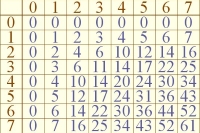
Octal Multiplication TableI’ve had something on my mind for a long time that greatly bothers me: the multiplication table. This is because I think that education should be fun — full stop. Memorizing the multiplication table is not fun. But more than that, I believe they are the source of most people’s hatred of math. At the same time, I’ve long thought that one should probably know them. And that created a conflict in me because I thought that it was really only possible to know them by memorizing them. But the other day it occurred to be what hogwash that is.

To begin with, I’m really good at math. Yet I’m pretty flaky on the multiplication table. I remember in the sixth grade, I had this teacher who seemed more like a drill sergeant. And he used to do this thing where he would go desk by desk asking each student one question, “Seven times eight?” He went sequentially through the table and the desks, so I always calculated which question I would get so I could figure it out and say it the moment he asked me. In that case, there was clearly some mathematics education going on for me, but it had nothing to do with the multiplication table.

I have never memorized what 6×7 is. Instead, I know that 6×6 is 36, and so I know 6×7 must be 6 more than that, which is 36+6, which is 42.

The rationale for knowing your multiplication table is that if you know them, then you can do things like multiply and divide arbitrarily large numbers. But if that’s true, why were we taught the table from 1 through 12? It should have been 1 through 9, right? You can calculate 11×12 — you don’t need to memorize that it is 132. And I think the reason for it is that it was a way to fill the curriculum. It didn’t take long enough to force the students to learn up to 9×9, so they went up to 12.

And as you get into higher math, you don’t even much deal with numbers. And for people like me who are naturals at math, it never is about numbers but rather elaborate games you make up. You think about things like the way the nines go down by one as you go up the table, and elevens go in the opposite direction. If you are lucky, you get introduced to octal and start seeing numbers in a whole new way. But you are unlikely to ever play with numbers if they are forced on you in the same way that the ordering of the alphabet is. (I am still quite fuzzy about which letters go before others without the help of the song.)

Multiplication is just a matter of counting. I have never memorized what 6×7 is. Instead, I know that 6×6 is 36, and so I know 6×7 must be 6 more than that, which is 36+6, which is 42. I don’t find this fun, but I did think it was a nifty trick when I was a kid — one I was never taught. And I fear that many if not most children memorize their multiplication table without having a profound sense that all they are doing is counting. That’s sad.

As everyone should know, math is extremely abstract. That’s why I say it is the closest thing to theology, and certainly it is the closest I ever get to God. But the mindless memorization of the multiplication table is not just boring. For many students, it turns math into alchemy. Sure, it’s abstract. But much more, it is mysterious in the same way God is: unknowable. And why even try?

There is no need for children to learn the multiplication table. I have a simple proof:

  1. What is 9×9?
  2. 9×9 = 9+9+9+9+9+9+9+9+9.
  3. QED.

Political Science 101 for Political Reporters

Bill ClintonI’m a big fan of Brian Beutler. And I agree with his conclusion in his recent article, The Trump Crack-Up Is Just the Beginning of the Republican Civil War. His point is that even if Trump loses the general election badly, the Republican Party won’t change. But he pushed one of the most common and ignorant claims about the Democratic Party, and more generally political science.

According to Beutler, after the three presidential losses (1980, 1984, and 1988), the Democratic Party reassessed itself and decided that it had to move to the right. Thus brought Bill Clinton and victory. That’s a nice narrative. But it’s totally wrong. Carter wasn’t a liberal. He was the beginning of the emergence of what would become the New Democrats. What’s more, he was — as were Walter Mondale and Michael Dukakis after him — part of that new breed of Democrats who weren’t really ideological but just technocratic.

We look back on them now as liberal, not because of their policies, but because they lost. Remember, I was around during Bill Clinton’s term. And according to the conservative movement, he wasn’t just liberal, he was a radical — a communist, even. That’s because Democrats are always leftist radicals in the minds of conservatives. And this is why it makes no sense to try to take welfare “off the table.” Did Bill Clinton ending welfare as we know it make the Democratic Party any less prone to attacks that it was the party of welfare recipients? Of course not!

It would have been very surprising if the Democrats had won any of those races, because the fundamentals were not only against them, they were against them forcefully.

But as I’ve shown elsewhere, and as is documented with scientific precision in Lynn Vavreck’s book, The Message Matters, the economic fundamentals favored the Republicans in 1980, 1984, and 1988. It would have been very surprising if the Democrats had won any of those races, because the fundamentals were not only against them, they were against them forcefully. Carter eked out a slight victory in 1976 because the fundamentals were only against him slightly.

Neither the nation nor the Democratic Party base was begging for the Democratic Party to move to the right in 1992. Bill Clinton was not the answer to the previous three elections. He was, however, a gifted politician in a party that had mostly been taken over by conservative elites. The only thing the party was responding to was the desires of powerful people in or aligned with the DLC.

I find this stuff really annoying because it just isn’t hard. My job — what people are willing to pay me for — is technology writing. If you want me to make Fortran 77 interesting and understandable, I’m your man. I have a basic understanding of computer science and programming. But political writers generally don’t know anything about political science. And it is particularly sad in the case of Brian Beutler, because he’s both smart and insightful. But how about learning a little about the science of it? Instead, it is just fine to depend upon what everyone “knows” — which turns out to be untrue.

So yes, the Republican Party won’t change even if Trump only manages to get 30% of the vote. But the Democratic Party is no different. What’s more, why is the presidency such a big deal? Does political science teach us that the presidency is all that matters? No, of course not. And as it is, 31 state legislatures are controlled by Republicans, compared to just 11 by Democrats! They also control the Senate and the House. And after the next election, they will almost certainly still control the House — and might control the Senate. It seems to me that the Republican Party is doing okay.

This all disturbs me. But we aren’t going to change it unless we can see the truth and look clearly at the political science. And believing that Bill Clinton was a response to political changes in the country is perhaps the biggest part of the problem. Because now conservatives win even when the Republican Party loses. And someone as smart as Brian Beutler should understand that.

The Daily Show and the Smug Style

Jon Stewart - Smug StyleI noticed a couple of weeks ago that I had totally stopped watching The Daily Show. So I went back and watched a week of it. It’s still quite a funny show. But it is nothing you won’t see on countless other late night talk shows. There is nothing insightful about it. And I say this as one who had my problems with the show under Jon Stewart. I agree with Emmett Rensin in The Smug Style in American Liberalism. There was always a problem with it trying to be non-ideological and thinking that policy fights were really just a question of everyone accepting what the facts are.

But the new show with Trevor Noah is just an exercise is triviality. I have to question the idea of giving the show to a recent immigrant, given the tendency to see one’s new locale as charming and benign. And the United States is really not either of those things. Or at least not things that make for good social satire. Another problem may be his age. Certainly, John Oliver seems to be more in the tradition of Jon Stewart, and he is both older and less of a newcomer to the nation.

Oliver definitely is continuing the smug style of liberalism. But that’s not necessarily a bad thing. As I’ve noted in the past, when Jon Stewart hosted The Daily Show, I may have had problems with it but I watched it every day. And John Oliver’s long segments on Last Week Tonight are incredible. His most recent was an excellent example, but also telling because it isn’t about politics at all. It’s about scientific studies and the terrible job that the media does in discussing them. Check it out:

This is an old problem in statistics. If you do the same study enough times, you will occasionally get a study that finds something that is incorrect. This is something that drives me crazy about the way polls are presented. I often hear things like, “Candidate A and B are in a statistical tie.” This is because the two candidates are closer than the margin of error. But this is meaningless. The margin of error is just a measure of how many people were sampled. No one poll is very meaningful, although it might by chance be correct.

The reason that the smug style of liberalism is really not a problem to me is because our society is so out of kilter that just getting the facts right is a big deal. It reminds me of what I said about Paul Krugman years ago: he’s a lot more conservative than I am and I look forward to the day that I start disagreeing with him. That day is at hand, of course. Just check out his recent blog post, The Facts Have A Well-Known Center-Left Bias — a clear case of false equivalence.

But it is sad to see The Daily Show sink even below the smug style. It isn’t helped by the fact that Noah now has Donald Trump to slam night after night. It does make me wonder what will happen once Donald Trump goes away and Noah doesn’t have permission to go after so much else that is just as dangerous, but perhaps not as obviously so.

It’s sad to say, but I miss Jon Stewart’s smug style of non-ideological liberalism. I can’t imagine a day in my lifetime that we won’t need it.

Acrophobia and Free Will

Golden Gate Bridge - AcrophobiaI remember a time I was hosting a programmer from Romania (yes, that guy). And he wanted to take some pictures of the Golden Gate Bridge before he left. So I drove him over to the north side of the bridge where there is parking with a great view of the bay and the city. And it is just a short walk to the bridge itself. I went with him. But after only 30 feet onto the bridge, I had to leave him. I was suffering from extreme acrophobia. I was panicked.

I had suffered with acrophobia my entire life, yet this was a little surprising to me. As part of my work at that time, I spent a tremendous amount of time flying around in a little 2-seat Cessna. It was something that I very much did not want to do when the company had started. But the hardware/software system that we were developing was so complicated and fragile at the time that I was the only one who could do it. I managed it in part by just focusing on the work I had to do. But the truth is that it wasn’t that big a deal regardless. I have never had aerophobia — the fear of flying.

(I do have a very rational fear the wings falling off planes because I’ve known too many engineers in my life and I don’t have a high opinion of them. But that’s another issue.)

I’ve seen The Matrix a dozen times, and every time Neo goes out on that ledge, I squirm in my seat. I’m doing so right now just thinking about it.

The truth is that I don’t have to be on the Gold Gate Bridge to have a panic attack. I get pretty much the same thing walking over an overpass. And I’ve come to think that the basis of my acrophobia is my sense of free will. (I don’t believe in actual free will, of course.) It doesn’t much matter that I’m not suicidal. When I see a ledge that I could run to and throw myself over, I panic. It’s not the ledge; it’s my imagination that terrifies me.

I’m the same way when I watch films. I’ve seen The Matrix a dozen times, and every time Neo goes out on that ledge, I squirm in my seat. I’m doing so right now just thinking about it. The mind is a crazy thing and what goes on inside it is often much more threatening than what’s going on outside in the “real” world.

None of this is to say that I don’t have a general fear of heights. But if I’m in something like an aerial tram, I might be ill at ease, but I’m not freaking out. On the other hand, if the tram was open air, I’d be lying on the floor convulsing. And to be honest, I’m not sure I would want to get rid of this kind of fear. One of my better abilities is to visualize hypotheticals really well in my mind. I’d hate to lose that just for the sake of being able to walk across the Golden Gate Bridge.

How can you hate a fear that allows you to imagine what it would be like to take that step — even if the the reality is tragic?

The Pros and Cons of Being in a Political Party

Donald Trump Give Nothing to His Political PartyPolitical scientists Boris Heersink and Jeffery Jenkins wrote what I think is an incredibly insightful article over at The Monkey Cage, GOP Voters Picked Trump. Party Leaders Aren’t Falling in Line. Here’s Why That’s Surprising. The basis of the article is what politicians gain by joining a political party and what they give up.

They note that there has been a great deal of research done on what being in a political party provides. The biggest thing is that parties help individual politicians win — elections as well as battles over law making. They also note that relatively little research has been done on what they give up in joining a political party. That may be because it’s kind of obvious: they give up their independence.

Give a Little and Get a Little

Now I understand, none of this is shocking. Everyone has been a member of a group. And you know that you give a little and you get a little. This is, by the way, why I’m against the Bernie or Bust movement. While it’s true that Hillary isn’t my perfect candidate, neither is Bernie. If I wanted perfection, I would write in myself for every elected office in every election ever.

The problem that Heersink and Jenkins highlight is that Donald Trump hasn’t given anything to the party. He is entirely himself without making any compromises to the party. Thus, why should the party offer him all the good things that come with being in the party when he hasn’t and likely won’t reciprocate. I’m very much with John Dean: Donald Trump is a classic authoritarian leader. He’s also a narcissist. It’s all about him. I’m sure that a 1% chance of his becoming president more than offsets a 99% chance that he will destroy the political party he is nominally attached to.

Cruz Is Even More Disloyal to His Political Party

Ted Cruz Give Nothing to His Political PartyBut what goes unmentioned in the article is Ted Cruz. And I think he is an even better example of this. That’s because Trump has used the Republican presidential nomination for his own purposes, but he hasn’t really used the party otherwise. He might have been able to do this well as an independent. Ted Cruz on the other hand, has used the Republican Party to win at the state level and then at the national level. But he has been the very definition of disloyal. He’s been one of the Democrats’ most potent weapons since he entered the Senate.

The conclusion of the Heersink and Jenkins article is that by Republican elites not going along with what their voters clearly want, “The result could be a complete fracturing of the party.” But I think that the fracture appeared a long time ago when candidates like Ted Cruz started getting elected. If you look at the primary so far, over 70% of all Republican votes have been for Cruz or Trump — candidates who take and do not give to the party. The base doesn’t care about the party. The base has been trained by the party itself to think that the base should get everything it wants and should never have to compromise about anything.

And I can’t blame them. Since at least Bill Clinton, the Republicans have not argued that the Democrats, as a political party, are wrong about policy, but that they are foreign interlopers bent on destroying the nation. The Republican Party is already fractured. The question is whether it will be destroyed.

The New Look of Frankly Curious

Frank MoraesI know what you’re all thinking, “I don’t like this new website look!” But trust me, you’ll get used to it. This is hardly the first time that the website has changed. And every time it changes, people don’t like it at first and then they can’t even remember what it was like before.

But there are a number of good things about this new design. The first, and most obvious, is the new header. I always liked the Lego Don Quixote, but it did have it’s problems. The biggest is that the windmill was there. And as a lover of Don Quixote, it’s a bit embarrassing to have the cliche up — especially given that it happens early in the first book. What’s more, there was no Sancho Panza, and he is as important to the book as Don Quixote.

A smaller problem was that more and more I thought it made the website look like something aimed at 7-year-olds. Now given that in many ways, I still am a 7-year-old, there is something to be said for that. But I am more serious most of the time. The 7-year-old is more the spice — not the meat. And the artwork by Andrea English is great.

The most notable thing about this new theme is the slider thingy that currently scrolls through the six most recent articles. I like that quite a lot. Eventually it may drive me crazy. But I like it now. And the cool thing about it is that I can change it so that it shows random articles. I’m thinking of doing something like Random Mondays or something. I haven’t tried it out so I don’t know how well it will work. But with 7,000+ articles to choose from, it should be interesting.

A Brief History of the Website’s Look

Anyway, I thought I would share with you the way that the website used to look. All the designs were done by Andrea. The first one was the most brilliant. It was based on René Magritte’s self-portrait, Clairvoyance. It combines many of my other interests like the Indian Rope Trick, Christopher Marlowe, puppets, Madame Tutli-Putli. There’s other stuff.

Frankly Curious Website 2010

To be honest, I could have lived with that header forever. The problem with it is that it is so high. I don’t like to hide the content. So after two years, we changed it. Andrea came up with the following design. But it did not last long.

Frankly Curious Website 2012

I get the idea of it: the different interests that the website is supposed to reflect. But that head still just creeps me out. But you can see that the sidebar has become more sophisticated. So this design only stuck around for a year, then we got what you all are very familiar with:

Frankly Curious Website 2013

That was three years ago! And it hadn’t changed much. When we moved from the Nucleus CMS to WordPress, the designed opened up. But otherwise, it was pretty much the same. And what we have now is structurally very similar. The changes are really all cosmetic.

The only thing I wonder about is whether it isn’t all just too much blue. I’m curious what you all think. Feel free to complain. I doubt I’ll change anything, but it might make you feel better!

Medieval Coins and Monetary Policy

JP Koning - Monetary PolicyEconomist JP Koning wrote a fascinating article last week, What Makes Medieval Money Different From Modern Money? The quick answer: medieval money didn’t have its value printed on it. So, for example, a testoon wasn’t worth any set amount. So if you wanted to buy something that cost a pound, you wouldn’t automatically know how many testoons would be required to pay off that debt. The value of the testoon would be set by royal decree. So if the testoon was decreed to be worth one-twentieth of a pound, you would need 20 of the little buggers to buy the product. Now what has this got to do with monetary policy.

Think back on the 2008 financial crisis. That was just the most obvious sign of the bursting of an $8 trillion housing bubble. And it was that burst bubble that caused the recession. People all over the country woke up one day to find that they actually had a lot less money than they thought they had. Or more often, they learned that they were in a lot more debt than they had thought. That would have been a great time for some inflation. Instead, we got a short period of deflation and then very low inflation for the next 7 years.

The Federal Reserve has had a hard time keeping inflation even at its low 2% target. But what if the Fed could have just dictated inflation? Think of our example above. If the kingdom found itself in recession, the king could proclaim that there were now only 19 testoons in a pound. People aren’t idiots, of course. They would realize that a pound was only worth 95% of what it used to be. So they would raise their prices (products and labor) by roughly 5%. Ta da! It’s like a magic trick: instant inflation.

If the Fed had the ability to do this, it might have used it in very minor ways to help out after the 2008 crash. But it wouldn’t have done so aggressively.

But now, without doing anything at all, you have helped out the debtors. They would owe fewer testoons than they had before the new decree. This would allow them to deleverage more quickly and get the economy going that much faster. Given that lenders are generally rich, we aren’t worried that modest inflation would reduce their consumption. The king could also use this system to fight inflation by increasing the number of testoons in a pound to 20 or even 21.

Obviously, this is a gross generalization. Koning’s point is that the medieval monetary system was more flexible than one might have thought. But I take away something more sobering. If the Fed had the ability to do this, it might have used it in very minor ways to help out after the 2008 crash. But it wouldn’t have done so aggressively. The Fed chair at that time, Ben Bernanke, has been very clear that he think he and the Fed did a great job.

The problem with the Federal Reserve hasn’t really been a lack of tools, but rather a philosophy that hurting the rich even the smallest amount (a 5% inflation rate would be considered outrageous by those now in power) is unacceptable. I don’t know how much the kings of old used such monetary tools to make life better for the people. I doubt it was used much and for the same reason that our monetary policy is to have a 2% level of inflation: because those in power don’t actually care about the vast majority of the people.

No One Won The Game of Life

The Game of Life

When I was a kid, my favorite game was The Game of Life. I mean, really, what’s not to like. It has little cars and baby blue stick figures for men and pink stick figures for women. You can go to college if you want. You can get a good job (which you keep for life — a charming assumption that was even then unraveling). You had children. You could speculate on the stock market. And it had that cool spinning wheel for making your moves. I loved it and I played it hundreds of times with friends and siblings. But the funny thing is that no one ever won the game.

The way you win The Game of Life is by having more money than anyone else at the end. So if you think you have enough money, you just stop when you reach the end of the board. But if you don’t think you have enough money, you can bet everything you have on one spin of the wheel. If you pick the right number, I think you get ten times as much money; if not, you end up in the poor house. Now I know all this, but it is not how we played. We all risked it all at the end and we never counted money.

The point is that none of us seemed to care about the outcome of The Game of Life. It was fun to play and that was about all. I was much the same way with Monopoly, but not with as many people. That game is much more combative. But I played it a lot with one friend where we would play Monopoly until we had built our little empires and then we would call a truce. The only thing I get aggressive about is the piece I use. I really like the Terrier.

But it was only the other day that I realized that it isn’t kids who are all excited about winning games and getting trophies. This is something that is mostly forced on them by adults.

The reason I bring this all up is that for years I’ve been hearing men (Always men!) complain about tee-ball games not keeping score and how everyone gets a trophy for participating in everything and blah blah blah. There are a lot of people who think there must be a point to everything. Why would you ever play a basketball game if it wasn’t to win?! Of course, if that’s really the case, then why does anyone ever watch a basketball game all the way through? Why not just show up for the second half of the fourth quarter?

But it was only the other day that I realized that it isn’t kids who are all excited about winning games and getting trophies. This is something that is mostly forced on them by adults. Kids play games because they are fun to play. There really is no other point to them, unless you want to look at it in a developmental sense — games help us to improve and develop.

The same thing, of course, is true in education. I don’t recall ever meeting a child that didn’t delight in learning. Just the same, I’ve known lots of children who hated school. I was one of them! But there has been a big push in recent years to take an educational system that was pretty bad and turn it into one that is even worse. Because again, adults think that education is about the goal: getting a good job. And that ain’t education.

It would be great if everyone who wants to turn children into little goal-oriented automatons could have watched the way my siblings and friends played The Game of Life or, I’m quite sure, the way most kids play it today. If the journey is not worth taking, the goal will not help, since the goal of the “game of life” is death.

NAFTA’s Been Bad for US; What About Mexico?

Mark WeisbrotThe thing about free trade is that it makes markets more efficient. One country doesn’t have to depend upon itself for all of the things that it needs. This lowers costs all around and makes the world richer. In theory, I’m all for free trade. In practice, I’m against it. This is because as trade barriers have been taken down over the last four decades, the economic gains have not been shared; they have gone overwhelmingly to the already rich. This is what happened with NAFTA in the US: it did increase profits, but it didn’t help the American worker. But we hear a lot that it was at least good for Mexico.

There is a certain strain of liberalism that likes this idea very much. From their vantage point, the poor here in the US may have it bad, but they should shut up because the poor in Zimbabwe have it even worse. I discussed this in an article last year, Data Journalists Don’t Know Anything About the Poor Anywhere. The problem is that these journalists are usually in the top quintile of income in this country and so the poor everywhere are abstractions to them. So they are the kind of people who would argue that damage done to US workers would be acceptable for the sake of the even more poor people in Mexico.

Part of the problem here is that this whole globalization game isn’t much different in other countries than it is here. The greater trade might lead to more GDP, but its all captured by those at the top. But sadly, we don’t even have to make that argument. The truth is that since NAFTA, Mexico’s economy has done really poorly. Mark Weisbrot of the Center for Economic and Policy Research (CEPR) wrote two years ago, NAFTA: 20 Years of Regret for Mexico. And he summed up what the first two decades brought Mexico:

Didn’t Mexico at least benefit from the agreement? Well if we look at the past 20 years, it’s not a pretty picture. The most basic measure of economic progress, especially for a developing country like Mexico, is the growth of income (or GDP) per person. Out of 20 Latin American countries (South and Central America plus Mexico), Mexico ranks 18, with growth of less than 1% annually since 1994.

If you want to take a deep dive into the subject, check out the CEPR document, Did NAFTA Help Mexico? An Assessment After 20 Years (PDF).

Weisbrot’s colleague at CEPR, Dean Baker, has been documenting the way that The Washington Post consistently exaggerates how well the Mexican economy has done. This is entirely typical of mainstream US news coverage. And it is in direct contrast to its coverage of official US government enemies like Venezuela, where nothing that they do will ever be seen as good.

The truth of the matter is that trade deals like NAFTA are created by the rich for the benefit of the rich. And even economists who once thought they were wonderful (for theoretical reasons), are now backing away. As Weisbrot noted, “When economists who have promoted NAFTA from the beginning are called upon to defend the agreement, the best that they can offer is that it increased trade.” But no one cares about trade as a goal; it is a means to a goal: shared prosperity. And Mexico has not shared in that prosperity.

Indian Rope Trick Still Obsessing People

Thurston - Indian Rope TrickBack when I first started this blog, I wrote two articles about the Indian Rope Trick. The first, Indian Rope Trick Part I, was about Peter Lamont’s excellent book, The Rise of the Indian Rope Trick. It was about how the trick did not actually exist in the form that was reported: magician outside causes a rope to rise, their assistant climbs up it, and disappears as the rope falls back to the ground. The effect was just made up by a lazy newspaper reporter in 1890. The newspaper later printed a retraction, but it was too late: the fake trick fascinated the world.

The second article, Indian Rope Trick Part II, was about an actual trick that was performed by Indian magicians hundreds of years ago. In it, a chain is made to rise after which a pig and other animals scurry up it and disappear. The basis of that article is my long experience of hearing and reading people’s descriptions of magic tricks and how they diverge from what they actually saw. In this particular case, I suspect that some kind of shadowbox effect was used, making the audience think the animal was climbing the change, when it had already been dropped through a trap door.

Since 1890, there have been many magicians who have performed the Indian Rope Trick. In particular, there was Howard Thurston, whose poster you can see above. But I’ve never seen it. And it is hard to talk about exactly how it is done, because there are a number of different ways. I’ve long thought that a hydraulic system would work. But then I saw a guy performing the trick in some Penn & Teller show. The trick here is painfully obvious:

The enormous diameter of the rope and its stuttering climb both point to it being hollow with a steel rod pushing it up from an underground chamber. Once it reaches its full height, the underground assistant secures it so the boy can climb up. Afterward, the rod is released, falling back down into the chamber. Since the hollow rope is stiff, it would fall slower in a natural way. No big surprise there.

What’s more interesting is the following video. When you first watch it, it is hard not to be impressed. But watch it a couple of more times and you will see that it is a hoax:

Notice how the rope rises at 0:16 mark. Does that seem odd? It should! It is being run backwards: we see a rope falling. But it is worse than that. We see the magician in a medium show as he throws a rope in the air. It cuts to the crowd. And then it cuts to a long shot of the reverse footage. This is, rather clearly, completely staged. That includes the audience. But how can I say that?

At 0:33 in the video, as the boy is climbing the rope, you can see a metal rod that is behind it. The rope has simply been attached to the rod in such a way that the camera is fooled. From any other angle, it would clear that there is just an bar that the boy is climbing. Although the film is made to look like documentary footage, it is as staged as any Meg Ryan romantic comedy.

I do understand people’s fascination with the Indian Rope Trick. Just the same, I much prefer little things like Daryl’s Rope Routine, which is actually quite simple, but brilliantly done in his own nerdy way:

Was Cervantes Part English? Does It Matter?

Jáuregui's CervantesThere has been a lot of reporting on some recent scholarship by historian Julio Mayo that finds that Cervantes, author of Don Quixote along with a bunch of stuff you’ve probably never heard of, had a relative that was British. There are two ways to look at this. First, it’s interesting because we know so very little about Cervantes. Second, it is not interesting because Cervantes’ lineage is not interesting.

The whole thing has to do with the an English family of traders, the Timtams. They apparently moved from England to southern Spain in 1480. As early as 1481, John Tintam was involved with the slave trade between Guinea and Spain. Now I know, Tintam and Timtam are not the same words, but that is the way it was at that time — spelling was all over the place and people often spelled their own names in different ways. Anyway, Tintam was the father or grandfather of Juan Titon de Cervantes. Is this Cervantes’ father’s father, Juan de Cervantes?

It is possible. However, since Cervantes’ paternal grandfather had a brother who was mayor of Cabra, the family was so integrated, and thus bred, into Spanish culture, that I have a hard time thinking much of this great English connection. Ultimately, we are all related. But more than that, people moved around a lot in the 15th and 16th centuries. There was a lot of breeding of people from different areas. And that brings up the whole “So what?” factor in this story.

I’m worried that the reason people are interested in this is to take away some of the Spanish of Cervantes — that there is an implication that a “pure” Spaniard could never have written such great books.

I’m worried that the reason people are interested in this is to take away some of the Spanish of Cervantes — that there is an implication that a “pure” Spaniard could never have written such great books. But if only he had some of the magic dust from the island of Shakespeare, well then, it is all explained. The truth is that Cervantes was very much a Spaniard. In fact, it’s a bit disturbing at times to read his thoughts on the matter. What’s more, he tried to join the Spanish Armada, but was refused service (due to his lost hand, as I recall).

But there’s something else here. Throughout his life, Cervantes wanted to be a poet. But he was never successful at this. And the reason is that Cervantes wasn’t a very good writer on the micro-scale. What makes Don Quixote great is not the fine writing. It is first and foremost that he is a funny guy — the early 17th century Terry Pratchett. And the reason that we think him great today is because in those two novels he created the blueprint for both the modern and the postmodern novel.

Certainly others had written long books before. In fact, people had written long and funny books, like Rabelais’ Gargantua and Pantagruel series. But Don Quixote is remarkable in a number of ways. First, the characterizations are much deeper than anything ever seen; Don Quixote and Sancho Panza seem like real people. Second, the books actually go somewhere — they have narrative arcs. Other books were just much more like real life: this happened, then that happened, then another thing happened. Don Quixote pulls all that together and comes to a satisfying ending.

I think that Cervantes stumbled upon greatness because he was rather bad at the kind of writing that was popular at the time. Don Quixote was not the first “novel” that he wrote. It was just the one were he happened upon something new: two glorious characters who propelled his story to greatness. Exactly how Rodrigo and Leonor Cervantes came to produce the great writer is only marginally interesting and of no relevance at all.

Diaper Stamps & the Infantilization of Poor People

Diapers for Poor PeopleMatt Bruenig brought my attention to something, Diaper Stamps. It’s the kind of idea that I very much associate with the modern Democratic Party. The thought is great: give poor people access to diapers. But the implementation is just awful. To begin with, a whole new program for diapers?! Why not a special program for car seats? And blankets? And those mobiles people hang over cribs?! Really: why don’t we create a program for every single aspect of the lives of poor people? Because that’s what this is all about. Underneath this proposal is the idea that the poor can’t manage their own lives.

We have conservatives like David Brooks and Charles Murray who tell us that the poor suffer from some sort of cultural problem. That is why they are poor. If only they acted like the middle class then they would magically be in the middle class. It’s offensive. Most of the time, it is racist — implicitly or explicitly. But at least these guys know what they are doing. They want their taxes low and so it is just good rhetoric to come up with “reasons” to do nothing about poverty. The situation is rather worse for liberals.

In my experience, upper income liberals buy into the exact same garbage that Brooks and Murray push, but they aren’t aware of it. This is why they are always coming up with programs where poor people are told what to buy. You see, the poor can’t be trusted. So the two sides of the political fence on the issue of the poor is either do nothing (conservative) or treat them as if they were children (liberal). It’s shameful.

I think the reason we have this is because Americans have convinced themselves that we do not live in a class system. In the UK, people are much more likely to see that people are born, live, and die poor because that’s just the way it is. But here, in the land of “opportunity,” anyone can supposedly grow up to be president. And in that paradigm, if people are poor, it is their own damned fault.

In my life, people tell me food stamp “horror stories” all the time. Let’s look at two classics:

  • “I saw this guy at the grocery store buying a candy bar and a coke. And then he whips out his EBT card to pay for it! Can you believe it?!”
  • “I saw this gal at the grocery store buying New York steak. And then she whips out her EBT card to pay for it! I wish I could afford to eat New York steak!

Note first the attribution bias here. All of the people complaining about the first case have, from time to time, eaten junk. But this one guy buying junk food with an EBT card is assumed to be the norm. That guy just doesn’t know how to feed himself! But the complainer would realize that they normally have a reason when they make each food choice. Similarly, in the second case, every complainer has eaten New York steak. It is probably even more unusual for the gal on food stamps.

But what’s even more telling in this is that people on food stamps can’t win. Unless they buy only dried rice and beans, someone is going to complain that they aren’t eating well enough or that they are eating too well. The truth, of course, is that, People on Food Stamps Make Healthier Grocery Decisions Than Most of Us. This is very much in alignment with the twice as good myth, a strain of African American thought that if they were just twice as good, the white community would accept them.

And the truth is that when the vast majority of people who get food stamps use them to make wise decisions, it is either not noticed or taken as the exception that proves the rule.

So diaper stamps. Instead of just giving poor people more money, kindhearted liberals want to give them diaper stamps. Matt Yglesias used to be fond of saying, “If you want to help the poor, give them money.” It’s a shockingly simple approach. Certainly too simple for the modern Democratic Party! But on most metrics, poor people are more reliable than affluent people. For example, they use drugs less. And there’s an obvious reason for that: drugs are expensive. But we keep pushing this idea that poor people can’t be trusted with money. And that’s just not true.

Afterword: The “Bad” Poor People

It is true that there are poor people who take loads of drugs. There are poor people who do lots of terrible things. But just because one poor person turns out to be a serial killer doesn’t mean we should put all poor people in jail. I’m making a case based upon the class of poor people. And they can be trusted. People who want to base policy on that one person they saw misusing food stamps are just idiots. Maybe we should start making food choices for them.