About Frank Moraes

Frank Moraes is a freelance writer and editor online and in print. He is educated as a scientist with a PhD in Atmospheric Physics. He has worked in climate science, remote sensing, throughout the computer industry, and as a college physics instructor. Find out more at About Frank Moraes.

Miller’s Crossing

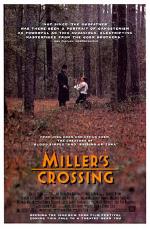
Miller's CrossingMany people miss the point of Miller’s Crossing; what’s more, they don’t judge it on its own terms. It is widely known that the Coen brothers were inspired to make this movie by the works of Dashiell Hammett. But their inspiration does not matter in the least; it only tells us where they started, not where they ended. Thankfully, they did not end up with some modernized Hammett “tough guy” story, with characters who almost always lack depth and humanity. Miller’s Crossing is certainly not a perfect film, but it is a fine film—far better than almost all the movies that have ever been made.

Miller’s Crossing, like all movies that are more than simple entertainments (such as the much better film Gosford Park), really need to be seen more than once. This film is dense; for example, the subplot involving Mink was not clear to me on the first viewing; nor was the sexual relationship between Mink and the Dane. It all became clear on subsequent viewing.

Even with multiple viewings, Miller’s Crossing has its problems. The homosexual relationship between Mink and the Dane is not very believable. J.E. Freeman is a fine actor, but he is not really cast well in this role. This is not surprising, however, since that part had been written for Peter Stormare—who I’m sure would have portrayed the character as implicitly gay along with the angry sadism that Freeman has in abundance; Freeman’s Dane clearly cares about Mink, but it seems more like Mink is his son or brother—not his lover. We learn that Mink and Dane are lovers almost exclusively from other characters.

This is a fairly minor problem, however—and one that would probably be easily fixed with a single scene including both characters together; the biggest problem in Miller’s Crossing is that the filmmakers maintain rigid first-person POV [caveat] throughout the movie except for one scene in which Leo survives an assassination attempt. It acts as a short film put in the middle of the feature. It is spectacular, but it doesn’t belong. As the saying goes, in editing you usually have to kill your darlings and that was one they should have strangled. (There is one other very short POV problem toward the beginning where a young boy steals the hair piece of a dead Rug Daniels, which should have been cut—other than being a classic Coen Brothers moment, it serves no purpose. On the other hand, the fire-bombing of Leo’s club seems like a POV error, but it is not; Tom witnesses it and even comments on it—albeit from a distance.)

Taking the assassination scene out would have allowed them to spend more time on the Mink-Dane relationship and to have further developed Tom’s attraction (love?) for Verna. As it is, Verna disappears for far too long during the latter half of the second act. This missed opportunity is particularly sad because the love triangle involving Tom, Verna, and Leo is the heart of the story. Without getting too Oedipal about it, the film works as modern tragedy. Tom saves Leo (his father surrogate) resulting in the loss of Verna (his mother surrogate). Given his loss of Verna, the film ends with Leo and Verna about to be married; this causes Tom to lose Leo (again) because he cannot accept being around Leo married to Verna. And it is all Tom’s fault; he controlled all the action in the film.

Consider this: Tom could have asked Verna to leave Leo, and she would have; this would have hurt Leo, but it would not have poisoned his relationship with Tom; Leo would then have given Caspar the okay to kill Bernie; and Tom and Verna could have relocated Bernie somewhere far away before he was killed. But the tragic course Tom followed was dictated by his own ethical sense (ironically, shared with Casper, who he has murdered as part of his plan). Tom’s ethics result in the unhappiness of Verna and himself (and to a smaller degree Leo), and the deaths of many people (most innocent in the universe of the movie).

As has been pointed out ad nauseum, the film is beautifully “shot” and expertly acted. I actually have something to say about this other than the usual comments of the film ombudsmen, so you will forgive me if I add to the nausea. Let me start with the acting.

Acting

Gabriel Byrne does an excellent job in this film, but it is rarely mentioned because this is the kind of role that just seems to be standard and easy. But this film lives and dies on his performance. Without his subtle, emotionally deep performance, the film would have no center. In addition to the serious scenes he shares with Finney and Harden, he also has scenes where his character is playing a role. The contrast is stark and riveting.

Of course, everyone applauds Jon Polito in the role of Johnny Casper—and rightly so; but Polito is pretty much always great in whatever he is doing. Is he really particularly better in this film than he is in other films? Just to mention two (later) Coen brothers films, he was wonderful as the gay dry-cleaner in The Man Who Wasn’t There and comically genius paired with Jeff Bridges in The Big Lebowski. He is a fine actor who unfortunately gets a lot of the same kinds of roles because of how he looks; but on the good side, he works a lot.

I’m not sure about John Turturro‘s performance; I have a hard time reconciling his pleading in the forest with his sociopathic behavior elsewhere. He does redeem himself during his second pleading scene where his character’s acting job is far less convincing.

Marcia Gay Harden does a fine job, despite having to recite some of the most tired dialog that the Coen’s have ever created. It is sad that her character was probably the least fleshed out. Albert Finney provides a workman-like performance. His character too is not well written. It is hard not to question how such a nice guy could have survived with the likes of Johnny Casper around. Okay: he’s good with a machine gun and he is calm during stressful situations; but he seems more like the city’s most popular tailor than a crime boss. In Finney’s defense, he was last minute casting, after Trey Wilson (originally cast) died right before shotting; so it isn’t like he had a great deal of time to prepare, and considering his body of work (Murder on the Orient Express and The Dresser come to mind), I would never doubt his talent. And let us never forget that casting, editing, and directing are usually just as important to the success or failure of a performance on film as is the acting itself.

The Look

Miller’s Crossing is the Coen Brothers’ third film. Their first film, Blood Simple, had a budget of one and a half million dollars; and it showed, even if the low-budget look of the film worked perfectly. Their second film, the highly over-rated Raising Arizona cost about six million dollars (and I can’t help but compare it to Jon Jost‘s work which is generally made on a shoestring and yet produces remarkable—and arguably greater—results). So it isn’t surprising that Miller’s Crossing, with it’s 14 million dollar budget would look good. Their first two films had good camera work and reasonably good lighting. Barry Sonnenfeld lit those films. I assume Joel Coen shot Blood Simple; no one is credited. David M. Dunlap shot Raising Arizona, along with Stephen St. John doing the steadicam work. Sonnenfeld lit and shot Miller’s Crossing with Larry McConkey on the steadicam. I mention all of these people, because the cinematographer tends to get all the credit, while the camera operator is easily as important—and in the United States, it is rare for someone to do both in a budgeted movie. Before moving on, I should point out that these people are really just department heads; they all have large crews of assistants who are generally very talented. (Consider the lowly camera loader; do you have any idea just how hard and stressful it is to load a camera with film? By feel alone? It is a demanding job, especially when every minute you slow down the production costs about $50—or more—much more.)

Sonnenfeld’s camera work is hardly inspiring. It reminds me a little bit of Jim Jarmusch‘s Stranger Than Paradise which was lit (and most likely shot) by Tom DiCillo. The camera hardly moves: there are no tilts, very minor pans, and a couple of dollies. The shooting for which Sonnenfeld is responsible is similarly motionless; I assume this is what the Coen’s wanted. However, where Jarmusch’s movie frames each shot in interesting ways; the Coen’s movie frames each shot in a classic manner. This is neither good nor bad; it is a decision. But it is not an exciting decision. Helpfully, it does make the viewer focus on two things: the acting and the set design. I’ve already discussed the acting, which deserves the attention the filming provides. This is even more true of the sets.

The production design by Dennis Gassner is great. Ditto for Richard Hornung‘s costume design. Even the short scene outside in the rain taking cover in a doorway looks great and says as much as the filming and the acting. What’s more, the sets and costumes do more than define the environment and mood—they provide insights into the characters. It is a lot more than pretty. Again, as with filming, there are a lot of people who work under these department heads. And in Miller’s Crossing, there was a much bigger Art Department than there was on Raising Arizona (which itself had a much bigger Art Department than Blood Simple).

This is Not Film Criticism

To me, Miller’s Crossing is a love story that just happens to take place in that fictional land of mobsters who are not, in general, homicidal psychopaths. So while the film may look like something Dashiell Hammett wrote, it isn’t at all. It lives in his literary universe, if you will, but it is populated by characters who just don’t exist in the classic genre. This fact confuses a lot of viewers and makes them think that this fine film is bad. Any good work of art needs to be experienced multiple times before it can be fully appreciated. Unfortunately, the newspaper columnists who call themselves “film critics” generally see a film only once before passing judgment on its artistic value. This is fine, because most people who read such “reviews” simply want to know if they will enjoy watching a movie once. So we should call these “film critics” something more appropriate: “film ombudsmen.”

This discussion of Miller’s Crossing is far longer than a typical “review” and yet, it is far too short to begin to seriously criticize the film. But it is long enough to make the argument that the film cannot be dismissed as bad art and that it deserves at least two viewings, whereas The Maltese Falcon is deserving of one reading, at most.

Update (20 April 2011)

I just got the DVD from the library and there is an extended interview with Barry Sonnenfeld where he says much of what I did about his work. I also found out that after he got out of film school, he bought a CP-16—the same camera that I used to own until I loaned it to Marc Burgio who never returned it.

Update (20 November 2011)

For some time now, I have been thinking about the two lover’s triangles in the movie: Vera’s and Mink’s. Off hand, when the film is looked at in this way it isn’t too hard to see it as homophobic. There seem to be two honest brokers in the heterosexual triangle, only one in the homosexual triangle, and he’s a psychopath. But I would have to think a lot more about this before I was willing to stand behind what is now just a thought.

Update (19 May 2013)

There are more POV problems than I indicated. This isn’t just a matter of formalism. The screenplay really needs to be reworked so that it isn’t so exclusively Tom’s story.

Paradox Lost

I recently rediscovered James R. Newman‘s four-volume The World of Mathematics in a thrift store. For 25 cents a piece, I got volumes i=1,4 where i <> 3; that is: I got volumes 1, 2, and 4. This was a disappointment, given that Volume 3 included Nagel and Newman’s article on Goedel’s Incompleteness Proof. So I got that volume from the library, with the thought of revisiting this article. However, by the time the book arrived, I had thought quite a lot about the proof (well, there are actually two of them, but let’s not go there), and I came to the conclusion that I’m just not that interested in it any more. As important an intellectual accomplishment as it is, the fact remains that it doesn’t really matter very much, even in mathematics—and given my postmodernist frame of mind, it just seems kind of obvious.

In going through the volume, however, I came upon a nice (and easy) article by Edward Kasner (the guy who coined the term “googol”, which the guys at Google misspelled, but maybe for the best) and Newman: Paradox Lost and Paradox Regained. In it, they present the following apparent paradox involving two quarters:

<%image(20100725-quarters.gif|400|181|20100725-quarters.gif)%>
If the quarter on the left is rolled halfway around the quarter on the right, it has traveled half of its circumference. A quarter rolled half of its circumference should be brought to a position that is inverted (upside-down). But this is not the case here. Instead, the quarter is where it started (right-side-up in a rotational sense).

The interesting thing about this paradox is that the authors apparently felt it so trivial as to not even explain it. They do go on to explain the mathematics behind it, but how it is applied is not explained and it is all rather more complex than it need be. This is not to say that I went right along with them. After finishing the article, I spent about an hour thinking about this problem without finding a solution. It was only after waking up at 3:00 am that the solution hit me. Sleep is usually helpful in such matters.

This is exactly the kind of math problem that most people hate:

  1. It takes a bit of thinking just to see the problem
  2. It is infuriating once you’ve seen the problem
  3. It is a totally irrelevant problem

And then there are people like me who are nerds. We are just like everyone else in thinking that such problems are hard to understand and answer and pointless to boot. But like Vladimir and Estragon, we know you have to fill your day with something, and this will do as well as anything else. (Better in fact; reality TV is really beginning to bug me; and I only see snippets of it, like the court shows. I suppose what really bugs me is the fact that other people find such debased entertainment, well, entertaining.)

And Now Back to Our Quarters

Why does this seem paradoxical? I will try to explain (actually, I now find the problem harder than the solution). If you were to roll a quarter along a straight line segment equal to the length of the quarter’s circumference, it would be oriented the same way at the end as it was at the beginning. If you did the same thing along a line segment of half this length, the quarter would be oriented upside-down. This should all be obvious. If not, try it out yourself. Or just think about it; don’t expect me to do everything…

The quarter rolling around the other quarter is equivalent to the second line: half the circumference. Thus, the quarter should finish upside-down. But it doesn’t; this is because the two cases are only equivalent in terms of the distance rolled; the displacements (directional distance) are quite different. This, in itself, does not answer the question, however.

When you start rolling the quarter, say from 0 to 10 degrees (obviously, this works with infinitesimal elements; I will leave the Calculus to you) you are also rolling it from 0 to 10 degrees on the stationary quarter. Thus, while the rotating quarter does indeed revolve only 180 degrees from start to finish, the axis on which it is rotating is similarly rotated by 180 degrees. Put another way, the rotated quarter is upside-down—in the original coordinate system! The positive y-axis was up at the beginning and down at the end.

I’m Just Weird

This is not the standard way of looking at this problem. Generally one would look at the path that a given point takes when a circular object is rolled. When rolled along a straight line, such a point traces the path of a cycloid. With cycloids, one can have lots of fun like proving that the top of a moving car’s tire moves faster in the horizontal direction than the bottom. Does this sound paradoxical? If so, just remember that the top of the tire is moving forward and the bottom is moving backwards; that has little to do with the problem but does make clear that rotating objects tend to mess with our sense of intuition about the natural world.

Indian Rope Trick Part II

The Rise of the Indian Rope Trick - Indian Chain TrickThis is a continuation of my article about The Rise of the Indian Rope Trick. Check out Part I. This one deals with an actual effect, the Indian Chain Trick.

As promised, I am going to explain the Indian Chain Trick, the magical illusion that is most like the Indian Rope Trick, but which probably had nothing to do with the creation of the myth because John Elbert Wilkie probably knew nothing about it.

The Mogul Emperor Jahangir reported on the Indian Chain Trick some time around 1600. What he wrote was not translated into English until 1829, and what I quote here is Peter Lamont quoting from this English translation in his book, The Rise of the Indian Rope Trick. It seems that the conjurers

produced a chain of 50 cubits in length [roughly 23 meters], and in my presence threw one end of it towards the sky, where it remained as if fastened to something in the air. A dog was then brought forward, and being placed at the lower end of the chain, immediately ran up, and reaching the outer end, immediately disappeared in the air. In the same manner a hog, a panther, a lion, and a tiger were successively sent up the chain and all equally disappeared at the upper end of the chain. At last they took down the chain and put it into a bag, no one ever discovering in what way the different animals were made to vanish into the air in the mysterious manner described.

This sounds amazing, but actually, Jahangir was not that impressed with this particular effect; the conjurers did much more amazing things like make fruit trees grow and produce ripe mangoes. But let’s forget the mango trick; it is well-know (to those in the know) and it’s secret can be learned from a variety of books. As far as I know, no one has explained the Indian Chain Trick. (And most likely, no one has cared.)

The biggest problem with explaining this trick is the hog. Regardless of how you look at it, hogs can’t climb up chains. The other animals — well, I could imagine they could be trained. But given that hogs can’t climb, I assume that none of the animals actually climbed up the chain. And yet, Jahangir claims they did. Leaving aside the fact that he was almost certainly wasted out of his mind on booze and opium, there are reasons to doubt his description of the effect.

The Problem with Eye-Witnesses

In my experience, when people describe magic tricks they have seen (without the help of booze and opium), they are not very accurate. For example, when someone sees the color changing deck, they will say, “The magician had me select a card from a blue deck of cards; then he fans out the deck and all the cards are red, except for the one I picked that is blue.” I don’t want to go into details here, but the trick started where it ended: with a red deck of cards and two blue cards.

What’s even more important is that magicians are liars. They talk and are generally entertaining and then they start their act. But… They already started it; during all that chitchat, they were doing the “trick”; in fact, in most cases, by the time the audience thinks the effect is starting, it is over from the magician’s standpoint. Ricki Jay’s Four Queen Routine is a good example of this, even though it may not be clear to the uninitiated — which is the whole point, after all. This isn’t always the case, of course; as an example, I would refer you to Daryl’s Rope Routine where he is doing straight sleight-of-hand throughout a six minute effect. But this is the exception, not the rule.

The Method

I can think of a few ways that the Indian Chain Trick could have been done. First the chain: most likely it was simply held up with thread — either from a single strand directly overhead, or two strands running off to each side (the way a tennis net is held up). Obviously, this would likely not even be strong enough to allow a rat to climb up the chain, so we move on to part two: the animal climb.

My guess is that the conjurers had a box that they performed the trick upon. It is from this box that the chain rose. On the top of this box was a trap door that allowed the hog (etc) to disappear into. But how would it do this without being seen? How would Jahangir (other than the drug effects) see the hog climb the chain? The answer is simpler than you would think: he didn’t see the hog climb the chain.

Instead, one of the conjurers would put the hog on top of the box. He would then obscure it from the audience with a screen. At this point, the hog would fall through the trap door, without Jahangir and the rest of the audience noticing — all would assume the hog was still behind the screen.

Now the conjurer would slowly raise this screen up to the top of the chain at the same time he said something along the lines of, “See how the hog climbs the chain!” And then, when at the top of the chain, the magician would pull away the screen and announce, “The hog has vanished!”

The emperor goes wild! No one remembers that they didn’t actually see the hog climb the chain. This is normally how people describe magic tricks they saw: they say they saw things that were only ever implied.

The Indian Chain Trick: Am I Right?

There are other possible methods of doing the Indian Chain Trick, but it was almost certainly something very similar to this. Magicians refer to “heat” in a magic trick. This is when the audience is paying a lot of attention. The point when the screen is removed to show the vanished pig has a lot of heat. But when the screen is first placed in front of the pig doesn’t have much heat because the audience isn’t aware that the trick has started.

Based upon the comment of Kenneth Wade Wilson below, I wonder if this description is unclear. If anyone has any questions, please ask me. It’s really very simple, and the concept is still widely used as in the die box.

Indian Rope Trick Part I

The Rise of the Indian Rope TrickPeter Lamont has written a fun little book called The Rise of the Indian Rope Trick. If you know this magic trick, you will get the punning title (if you are like me, you won’t know quite how you feel about that.). If you don’t know the trick, let me explain.

A magician — but one with a turban, not a top hat — takes a length of rope and causes it to (magically) rise into the air. Then, his assistant climbs up the rope and (magically) disappears. The rope falls back to the ground. The crowd goes wild! You can imagine, just look at the photograph on the right.

Now, admittedly, you don’t see the boy disappear in the photo. In fact, he never does disappear (unless you want to imagine it in your mind). This picture is of The Great Karachi doing the Indian Rope Trick. Indian Rope Trick Photo - FakeKarachi was one of the great Indian magician — except that he was actually from Plymouth in the Southwest corner of the United Kingdom. And his name was Arthur Derbyh. But he looks pretty Indian, don’t you think?

The problem with the Indian Rope Trick is that it was invented by an American. His name was John Elbert Wilkie. A great magician? No. A so-so journalist? Yes. He just made it up for an article he was writing. I understand this. I’ve been a journalist, and I know that you normally get paid by the article: poorly; the more you pump out, the more money you make. It’s not like anyone’s going to check, unless your name is Jayson Blair, or, as in the case of Mr. Wilkie, you are dead.

What is interesting about all of this is that the article took off. People believed it and the story spread to (God help us all) Victorian England. And in Victorian England, the people knew they were the best; and yet, no one could actually do this trick. Okay, sure: Karachi/Derbyh: Rope rises, kid climbs up, kid climbs down. No big deal. Even Howard Thurston (who was a total hack) could do that. It’s the disappearing that was the key (and outside; don’t forget that — you can do anything in a theater).

John Elbert Wilkie: Inventor of the Indian Rope TrickOf course, after Wilkie first “reported” on the Indian Rope Trick, it ran wild. Numerous variations appeared. Here’s my favorite: rope up, boy climbs, magician climbs after him with sword, and cuts him up: arms, legs, torso, and head fall to the ground; magician climbs down; he assembles the parts again, and the boy gets up and dances a gig — or the Indian equivalent of it. Gruesome, yes; but surprisingly easy to do; a lot easier than that disappearing thing.

Anyway, we get a lot of Victorians hunting around India looking for the trick (that doesn’t exist because it only ever existed in Wilkie’s mind, and by now, he is with the United State Secret Service — I kid you not). And there is lots of waving of hands and all that, mostly because the British magicians cannot accept that there is anything that Indian conjurers can do that they cannot (and they’re right). There is, as with just about anything having to do with Victorians, much hilarity. Truly, the only thing that isn’t ridiculous about this period is Oscar Wilde — who was also hilarious but for completely different reasons.

It turns out that there was a magic trick that Indian conjurers did that was similar to the Indian Rope Trick. In it, a chain was thrown in the air where it stuck. Then, a pig, and a dog, and other assorted beasts climbed up the chain and disappeared. I’m pretty sure I know how this was done and in part 2 of this article I am going to explain it. (And it is almost certainly not what you are thinking.)

But don’t pass up on Peter Lamont‘s book. It is a lot of fun — excellent summer reading.

Check out Part II of this Article.


15 November 2013: I removed the CCNA Chennai video embed (see comment below) because it has been removed and I can’t locate it now.

Easy Refried Beans

This recipe creates tasty, very slightly sweet refried beans. It is a bachelor’s recipe; the kind of thing that a man who knows nothing of cooking can make. All you need is:

Two Tbs Vegetable Oil
One Onion: coarsely chopped
Two 15 oz cans of pinto beans
Some pepper

Put the oil in a skillet and turn the flame up to medium. When the pan is hot, add the onions. Cook them for 5-10 minutes, stirring occasionally; don’t let them burn. When they are done, transfer them to a separate container. Leave the skillet where it is and hot.

Pour the contents of the two cans of beans into the pan: juice and all. Be careful! Pour a little of the juice in the side of the pan; if it is too hot, reduce the heat and wait or just pour the beans in very slowly. Use a potato masher to crush and stir the beans. Make sure the heat is not too high; you should never have the beans boiling beyond the occasional release of a steam bubble. Keep crushing and mixing until most of the obvious liquid has evaporated.

Add the onions to the beans, mix, add pepper to taste and eat.

About to Read Don Quixote

Don QuixoteGentle reader: you already know that this article on Don Quixote—the product of my eccentric intellect—is intended to be the greatest article I could possibly write. Unfortunately, it will probably suck; but I urge you onward nonetheless. The problem is not me, you see, but Miguel de Cervantes, and the fact that he was born in Spain and thus spoke Spanish. This is a problem, for just as you know the worthiness of my intent, you surely know that I am fluent in the Spanish language, in the sense that I can neither read nor write it. Not surprisingly, I am also unable to speak it.

The Need for Translators

Perhaps I am being too hard on Cervantes; had he been born in, say, England, he would have written in that transitional early modern English—which really means, “not modern English”. In fact, at least Miguel (if only he had been born 420 years later in California, I’m sure we would have been on a first name basis) is translated. These days, Shakespeare’s plays are set everywhere other than where and how they were intended, but we’re still left with the same damn language. I often wonder why we can’t get over this. Let’s just acknowledge that we all know all the common Shakespeare misquotes (like “A rose by any other name would smell as sweet” which is way more pithy than what that bard actually wrote anyway) and let the translators have at those plays. And by “have at”, I don’t mean in that Tom Stoppard “Rosencrantz and Guildenstern Are Dead” way; I mean in the way that translators of de (if only he had been born 420 years later in California, I’m sure we would have been on a second name basis, too) try to recreate the experience the original readers had for modern readers. (Or translators of Goethe or Rabelais—writers who, strangely, I like a lot more than that bard.)

But this does present a problem. You see, being as I am a poorly educated physics PhD (“fud”), I have been working for years trying to read all the books that my humanities studying friends always seemed like they had read. (I later found out that they had not read most of those books—they had simply read about them; but that has not quelled my urge.) I have only two books left that I must read: Moby Dick and Don Quixote. So recently, I decided to buy a copy of DQ (I already own a copy of MD), and I went into a bookstore: one of those big ones with the coffee and multiple floors (no, not Powell’s Books—I would have noticed if I had been there; it was Borders or Barns and Noble or something like that; not a bad bookstore, but certainly not a good one, and certainly not one with any used books; but I digress). And I go to the Literature section and after much difficulty (I have real trouble alphabetizing), I find Don Quixotes. That’s right: plural. There were six different translations. Imagine if I had been in Powell’s?!

Which Don Quixote will I read?! There is no one around to help, or rather, the help I am offered is like that from my sister, who tells me, after reading Moby Dick in high school, “You don’t need to read it.” I have two options: go to a used bookstore and read the cheapest version I can find, or determine for myself which translation to read. I settle on the latter, so I can write this article. If you are starting to imagine the snowball effect, I assure you, it is more like Sisyphus.

The Test

Obviously, I can’t read all the translations in order to determine which transition to read. I needed a test. I decided to take a single sentence from Don Quixote and compare how the different translators handled it. In this way, I figured that I could find the one with the most modern punch—the one that would thrill me like “A Confederacy of Dunces”. I chose the first sentence of the Prologue of Part One. Here it is in Spanish:

Descoupado lector: sin juramento me podras creer que quisiera que este libro, como hijo del entendimiento, fuera el mas hermosa, el mas gallardo y mas discreto que pudiera imaginarse

Google translates this as follows:

Idle reader: I swear you can not believe that I would this book as a child’s understanding, was the most beautiful, the most gallant and more discreet than one might imagine.

Are computers good at translating or what? Based on this, you would think Cervantes was a nut-job: he’s talking gibberish here! But you can glean a few things from this “translation”. First: Miguel was a nut-job, but in a good way; he is directly addressing the reader, but he’s being sarcastic—I think. Second: he seems to be promising something, and that something seems to be that this book is, while not exactly good, a lot better than you would expect from him. Third: I can’t think of anything. And this is after reading six human translations of this sentence. Google Translate has me completely confused. “I would this book as a child’s understanding”?! And these guys are billionaires!

Samuel Putnam

The Modern Library translation uses the not so modern translation of the great Samuel Putnam. For years, this seems to have been the translation, because it is the one I find in many different forms most often in used bookstores. It is the only copy I currently own, but this should not be taken to mean I believe it the best. Putnam translates our sentence thusly:

Idling reader, you may believe me when I tell you that I should have liked this book, which is the child of my brain, to be the fairest, the sprightliest, and the cleverest that could be imagined.

Actually, Putnam goes on to the next sentence by use one of my favorite punctuation symbols: the semicolon. And this makes sense, but I cannot go into it here, we have many other translations to get to. Let me just say about this translation that it isn’t bad. Sure, “the child of my brain” is kind of Google-like. Just the same, it is clear that Putnam “gets” the humor. I particularly like the phrase, “should have” that no other translator uses; I think it makes a great deal of difference.

Also, one cannot avoid a few facts about this translation. First, it is considered to be the first truly modern translation. Of course, we are in the post-modern period, which is why we have so many different translations now: who is to say which is the best? (Harold Bloom, of course.) Second, Putnam has pretty much been in print ever since it was published—over sixty years. That must say something, but don’t ask me what.

Burton Raffel

The Norton Critical Editions version of Don Quixote was translated by a live guy—in 1999: Professor Burton Raffel. Here’s his shot:

Leisurely reader: you don’t need me to swear that I longed for this book, born out of my own brain, to be the handsomest child imaginable, the most elegant, the most sensible.

Okay, the prose is better than Putnam, but Raffel had 50 years to out-do him. And here, I really like the phrase, “I longed for.” This edition does include a very helpful map of “Spain at the End of the Sixteenth Century.” But I am not one to be swayed by such editorial tricks.

Charles Jarvis

Now we must go way back to the 1742 publication of the painter Charles Jarvis (or Jervis, depending upon whom you ask). Note that this was when the translation was first published; Jarvis must have done the translation some time before then, because he was dead at that time. It is now used as the basis for the Oxford World Classics version. Here’s Jarvis’ crack:

You may believe me without an oath, gentle reader, that I wish this book, as the child of my brain, were the most beautiful, the most sprightly, and the most ingenious, that can be imagined.

Again with the brain! The main thing to notice with the last two translations is that they aren’t hooking into the humor. Cervantes is playful, and while you hear this with Putnam, you just don’t with Raffel and Jarvis. In Raffel’s defense, he gets going after this sentence and his translation is far better than Jarvis’ and in some ways better than Putnam.

A Most Vexing Trip

I originally thought that Peter Motteux’s translation dated from the Victorian period, because of its pomposity. In fact, it is the earliest translation that I looked at—dating back to 1712. Predating Jarvis by only three decades (When a decade meant something!), this translation seems like it comes from another world. I still find its writing style “sticky.” Are you ready to get gooey? Motteux will now hit us with his best shot:

You may depend upon my bare Word, Reader, without any farther Security, that I cou’d wish this Offspring of my Brain were as ingenious, sprightly, and accomplish’d as your self could desire.

This translation actually does sound humorous, but it does not capture the irony and self-deprecation of the original. In fact, it reads as parody. This is the stuff of Monty Python lampoon; you can imagine the “great” Shakespearean actor reciting these lines with much bombast. And in this way, the translation only gets better. But for my purposes, it gets worse.

There is at least one nice thing to be said about the Motteux translation: It was used as the basis for a “young adult” condensation of the story in 1939, The Adventures of Don Quixote De La Mancha by Leighton Barret and illustrated (beautifully) by Warren Chappell. It is perhaps a day’s read for a very slow reader, and worth the effort if you do not feel up to the full text.

Walter Starkie

Moving on to 1964 and Walter Starkie’s unabridged translation (yes, he did it more than once), which is found in the Signet Classic Don Quixote. Let’s just get to it, shall we:

Idle reader, you need no oath of mine to convince you that I wish this book, the child of my brain, were the handsomest, the liveliest, and the wisest that could be conceived.

A little dry, I think. Like Raffel, however, he does get a bit of a groove going after this. Unfortunately, also like Raffel, it isn’t that good a groove. It definitely seems readable, and at $7.95 for a new copy, it is the cheapest, I have found.

The Blue Whale: Edith Grossman

But now all of the Sperm and Humpbacks must scatter, because the Blue Whale has arrived: Edith Grossman’s 2003 translation of Don Quixote. I must admit to starting out with a bit of a prejudice against this version because of its stamp of approval by the ranting—western civilization is going to hell because of post-modern scholarship, even though I am a post-modern scholar—Harold Bloom. But let us leave this for now; I can rant about Bloom’s ranting some other time. Let’s see what Dr. Grossman has to offer:

Idle reader: Without my swearing to it, you can believe that I would like this book, the child of my understanding, to be the most beautiful, the most brilliant, and the most discreet that anyone could imagine.

It does have a certain self-deprecating charm that is not found in any of the other translations. And it doesn’t use the word “brain”! (Although I think this is academic; to me, the word is “mind”; what Cervantes goes on to talk about is what we would now call the workings of his “mind” or his “creativity”—not his “understanding”.) But after it, the humor becomes more muddled than that of most of the other translations. Perhaps this is due to age, she is about to turn 74; maybe she just isn’t feeling that funny. Plus, she’s probably had to spend some time with Bloom.

But there are other problems. You will notice that this translation has the most words of the lot, except for Putnam, who has the same number: 37. And it has bigger words; her translation has far more characters than any other. She probably does capture aspects of Don Quixote that no other translator has (Bloom makes this claim, and as much as I may dislike his popular writing, he is a very intelligent and erudite man). But I am not looking for a Don Quixote that makes me feel “the spiritual atmosphere of a Spain already in steep decline”; I want a fun read.

My Decision

Where does this leave me? (Probably without readers as of the appearance of Putnam several screens back.) There are many more translations; what I have presented is quite incomplete. But from what I’ve seen, from Putnam onward, there isn’t much difference between the translations. This is based upon very little evidence, of course—but more than just the sentence I have been discussing.

My decision is to read Putnam. It helps that I already own it, but this is not why I am choosing it. Raffel’s translation is quite good. I think it is a close second to Putnam, but it is second. After him would probably come Starkie.

If I were looking for something other than a good read, I might well go with what looks like the most scholarly of the translations: Edith Grossman’s. If it came down to it, Jarvis’ almost 300-year-old translation seems quite readable. As for Motteux, I don’t think I would read it at all if I had to put up with such prose.


More About Don Quixote

Want to know more about Don Quixote and matters related? Check out our ongoing project:

John Stewart and Jules Shear

Many years ago, while I was in the process of flunking out of college, John Stewart gave a lecture about nothing in particular and everything in general: his life, songwriting, cars, women, performing. This was only a few years after his hit song Gold, so it was surprising that not many more than a hundred people were in attendance. I had something else that I had to get to, so I knew that I was going to have to slip out of the lecture half-way through. Stewart did not allow me to do this unnoticed, however. He was very friendly throughout; cheerfully chiding me for missing his pearls of wisdom.

After I was done with my thing and he was done with his thing, we happened to run into each other. He remembered me: it had only been two hours and I was, after all, the guy who walked out on him. We walked to his car, which, if I remember correctly was some piece of junk. I don’t remember what we talked about, but I do remember two things he told me. First, he said, never listen to what your friends and family tell you about your work. He said, everyone told him that he sucked—until he sold his first hit and made $50,000 on it (in the early 1960s, I think); people who don’t know you are the only ones who can really see your talent. The second thing he told me was that art was whatever the hell you make it. He had an example: Happiness is a Warm Gun. Now here is a song that is just four song fragments pasted together. By traditional standards, it’s a piece of shit; but as we all know, it is great.

Not long after that, I was playing in band whose name I would prefer to forget because it was pathetic. It consisted of me (who could kind of play and wrote all the songs), Will (who could scream really well), and Roger (who was a very good keyboard player). Roger was about ten years older than Will and me, and he thought he knew music much better than we did (and in a way he did). One day I brought in a song called “Do You Like Life?” I was very pleased with how we did the song, but Roger had a real problem with it. You see, the song had no chorus; it had a bridge kind of thing, but it was really just a chant. Roger said, as he often did, “You can’t do that!”

A couple of weeks later, Will and I meet up with Roger and he is very excited: he wants to play a song for us. It was Lovers By Rote off the first Jules and the Polar Bears album Got No Breeding. In the song, Jules Shear does something similar to what I was doing (admittedly, what I was doing was more extreme). His “bridge” went:

All you really gotta do is tug a little leash to find yourself constricted
All you really gotta do is think about the crime to find yourself convicted

And Roger relented, “I guess you can do that!” I know that people said the same thing about Beethoven’s First Symphony. “You can’t start a symphony with a dominant seventh chord!” Who do these people think they are? How do they think any field of art progresses?

Or maybe it is all about me. Beethoven was established. John Lennon was established. I was not. But in general, innovation comes from those who are not established. I think that John Stewart was keenly aware of that. And as for Jules Shear and me: I don’t think either of us care.

Hand Sanitizers

These days, it seems that hand sanitizers are getting a bad rap: kids eat the stuff and get sick. This is not surprising, given that they are about 60% ethyl alcohol. Just the same, as far as I know, none of these children were badly harmed—much less killed—and I’m sure they learned valuable lessons, like don’t eat cleaning products. The fact is that the benefits of hand sanitizers far out-weigh the potential risks—just like flu shots.

Recently a research paper was published by Van Camp and Ortega in Aviat Space Environment Med, 2007; 78:140-142. It is called Hand sanitizer and rates of acute illness in military aviation personnel. They found that when hand sanitizers are readily available, the level of acute illness goes down by almost 300%, with a similar decrease in the number of sick days experienced by the pilots. Many other papers find similar results.

So don’t believe any of the fears about the dangers of hand sanitizers. Aproximately 5000 children die each year in the United States in car accidents. No child has died from hand sanitizers, and I assume that some children have died because of diseases that they would not have got if they had used hand sanitizer. Hand sanitizer is a good thing.

But please: watch your kids after you give it to them. Maybe even let them have a tiny taste so they know that it tastes really bad. The main thing is to take care your your kinds and keep your hands off my sanitizer.

Getting to the Bottom of Things

Today, I need to discuss the defecation and urination processes. I stress the word “need” because I really don’t want to. These days, I always carry a small bottle of hand sanitizer for general uses, but particularly so that I can get out of public restrooms; there is the old question about how one gets out of such a place; after washing your hands, you still have to open the door; answer: wash hands, open door, sanitize. Am I starting to sound a little crazy? Read on.

Close the Lid

Public restrooms are particularly bad places, regardless of how clean they appear. In the United States, over the past year, I recall seeing only one toilet that had a lid. Many people have studied the resulting spray from flushed toilets. The first study I heard about was over twenty years ago, but I can’t remember it now, but thankfully Sarah Tan has written a nice online article (probably for a class), Think Before You Flush or Brush; it is a disgusting subject, but she deals with it tastefully (mostly).

For me, this is personal. I don’t like being covered in fecal matter. Even more: I don’t like brushing my teeth with fecal matter. Even the idea of urine on my toothbrush makes me sick. So unless you are into that kind of thing (and I know some of you are), close the lid! And if you are in a public restroom, get fully dressed and flush and run.

Sit Down

An old joke…

Q: Why do dogs lick their balls?
A: Because they can.

Why do men urinate standing up? Because they’re pigs. Even assuming that a man lifts the toilet seat, some fraction of his urine stream will end up on the toilet and the ground around it. Krok7 has done a few calculations on his blog in an article, The Physics Behind Toilet Seat Splatter (in truth, he doesn’t do too good a job–I think he greatly understates the problem, but you get the idea). Yes, I know that urine is not so very disgusting, but it does have an unpleasant oder—especially as time goes on.

One of the comments to this article states that it is not practical to ask guys to sit down while urinating. Why is this? Don’t we sit down when we defecate? Are we so much more busy than woman that we can’t spare that extra 30 seconds in the bathroom. For God’s sake men, just sit down and shut up.

Gargantua

I am not alone in thinking about such matters. The 16th Century French writer Francois Rabelais thought about it a lot too. There is no doubt that he was the Joseph Heller of his day. I’m sure people couldn’t stop laughing while reading any of his five books Gargantua and Pantagruel. And I even find him funny sometimes. But the basis of most of his comedy is repetition. Case in point: Chapter 13 of Book 1.

In this chapter, Gargantua tells his father, Grangousier of the many things he used to clean his anus: 57 all told (really: all told). The satire is not lost on me; Rabelais makes it very clear when Gargantua uses a lawyer’s briefcase to clean his behind; or all the live animals he uses; or women’s clothing: “Once I mopped my scut with the velvet scarf of a damozel. It was pleasurable: the soft material proved voluptuous and gratifying to my hindsight.” [Caveat]

Despite all this hilarity, I do believe Rabelais was serious about the question of how one goes about keeping one’s anus clean. He does not provide a very good answer: the neck of a (I assume live) goose. But then, he did not have the luxury of a bidet. Then again, neither do I.

Howard Stern’s autobiography lists his approach (not surprising): three swipes with toilet paper and you are done. He does not go into details, but I believe he does this because he has learned from experience that making too many swipes will result in skin irritation if not bleeding. Despite the fact that all of this makes me very uncomfortable, I will propose my own solution.

A Clean Wipe

I suggest getting a small Tupperware container filled water as well as a hand sanitizer dispenser. Place them near your toilet. Remove the Tupperware lid. Make a couple of swipes with dry toilet paper. Wet a wad of toilet paper and make another swipe. Finish with one last dry wipe. Sanitize your hands and replace the lid on the Tupperware container. Sans a bidet, this is about the best you can do.

I am sorry about all this, but I do think that Francois would approve.

Pandora’s Box

Okay, let’s get this out of the way. My first experience with Internet radio was with Last.fm. And I know there are many others: Deezer.com, Mee Mix, Musicovery, Play It, Slacker, as well as many other similar kinds of services. I really liked the way that Last.fm worked, but it stopped working for me, so I switched to the Music Genome Project and Pandora.

It is nothing new, but if you aren’t using it, you should be. I’ve found so many great artists this way. Just tonight, I discovered Pink Anderson (the Pink of Pink Floyd) and the Red House Painters. I feel a little ashamed that I only discovered them tonight, but I can’t be smart all the time. Red House Painters came up right after I entered American Music Club as a new station. I discovered Anderson on my Old Blues stations that I have been tinkering with for a good six months now.

The great thing about Pandora is that I use it while cooking and sometimes (every night) someone comes on who causes me to stop everything and find out more. And, of course, it is good for commerce, because I just bought three new CDs (sorry folks, I still like CDs—and albums; I bought Presenting… Julie Andrews and the first John Prine album last night) because of what I heard on Pandora tonight.

The bad side is that I heard The Kid With the Replaceable Head by Richard Hell and the Voidoids. This made me think, “I should really get Destiny Street again—more because of the liner notes than anything (it isn’t as good as Blank Generation) because Hell makes it clear whose guitar solos are whose (not that I really need to be told; Ivan Julian is a better guitarist than Robert Quine—I just think Quine is more creative, which is not a slam against Julian; he’s great and enormously under-rated). But the only copy available is almost $100. I suppose that isn’t so bad when you consider that you can’t find my second book (now out of print) for less than $100—usually around $150). I don’t even own a copy!

Update: 25 July 2010

Destiny Street has dropped to $30, while by book has gone up to $200 used or $400 new. One good bit of news: I found out that the book was not dropped; the publisher just went out of business.

Elvie Thomas

Am I the only person who has noticed just how much Wikipedia sucks? (See: I won’t even provide a link.) Wikipedia has no listing on Elvie Thomas and when mentioned on Geeshie Wiley’s page it refers to Thomas as a man! Yes, for things that don’t much matter, like Sirius Black’s family background, Wikipedia is the go-to source. And it is good for a lot of hard science (but not all; there are errors; and you are usually better off going elsewhere—like a book). It is terrible for history and politics; for example, it seems there is no consensus that George Hearst was a villainous bastard (which he most clearly was). For little known artists and thinkers: forget about it.