About Frank Moraes

Frank Moraes is a freelance writer and editor online and in print. He is educated as a scientist with a PhD in Atmospheric Physics. He has worked in climate science, remote sensing, throughout the computer industry, and as a college physics instructor. Find out more at About Frank Moraes.

North Korea and the Nature of Democracy

Kim Jong-un - North Korea - InternetLast week at the website I edit for, we published, Everything We Know About North Korea’s Bizarre Internet. It was written by Claire Broadley who is kind of the co-editor with me of the blog at WhoIsHostingThis.com. It’s one of the best things we’ve done. In one way, it is hilarious. In another, it is extremely sad. Even though it is about the internet and technology, it provides a great insight into North Korea itself.

My favorite part of it is, “On the majority of North Korean websites, the names of all three Supreme Leaders are displayed larger than the text that surrounds them.” This is actually what led me to add “bizarre” to the title of the article. To give you some idea of this, consider the Kim Il-Sung University. Since “Kim Il-Sung” is one of the supreme leaders, the name is in a larger font. So when “Kim Il-Sung University” is written, it doesn’t come off as a single unit. It’s silly.

Pettiness of Authoritarians

I was so interested in this that I went looking through their HTML and CSS. What I found was that every time “Kim Il-Sung” was mentioned, it was put inside a “span” tag with the class “august.” The “august” class was then defined in the CSS file to be bold and 10 percent larger than the text it was around. It was fun to find this out. But it’s pathetic for three reasons:

  1. Those in power are so insecure that they must deify their current and previous leaders.
  2. They used the word “august.”
  3. It was hand coded so it had to be put in the HTML every time one of the names was mentioned.

But this is hardly surprising. This is the nature of authoritarians. And you don’t even have to go to that level. Look at the state of the aristocracy in England two hundred years ago. Or even the way people treat the royal family today. Or remember when Wall Street banks got their feelings all hurt when Obama talked about “fat cat bankers”? Entitled people are amazingly petty.

It’s hard not to see this all in the context of the recent American presidential election. He seems genuinely ignorant of what a president is. He seems to imagine that he’s going to be Supreme Leader.

What was so sad preparing the article on the North Korean internet is thinking about the millions of people who all have horrible lives just so that one man can feel like he is a god. And it’s all for nothing. Kim Jong-un isn’t the supreme leader of North Korea because he keeps most of the country living near starvation; he’s leader because China backs him. Without China, he would be executed and that would be the end of it.

North Korea vs America

The irony is, of course, that if he allowed as much freedom as the Chinese despots do, not only would the people of North Korea be better off, so would Kim Jong-un. Or he would be in all but one way: he wouldn’t be allowed the delusion that he is a god. He would just be an incredibly powerful man with more money than anyone could ever spend.

It’s hard not to see this all in the context of the recent American presidential election. The president-elect ran for office because he already had everything else. And that’s one of the reasons why he’s so dangerous. He seems genuinely ignorant of what a president is. He seems to imagine that he’s going to be Supreme Leader. And during my life, I’ve seen one political norm after another fall. So in addition to the Republicans getting all that they want — stripping away much of what is left of the New Deal and the Great Society — we will take another giant step toward kleptocracy.

Democracy is about a lot more than voting. In the coming years, we will see just how how much different we are from North Korea.

Afterword

I highly recommend reading the whole article, Everything We Know About North Korea’s Bizarre Internet. I’ve barely touched on it. The article is fascinating — and probably the best work any of us has done over at WhoIsHostingThis.com.

David Cay Johnston on the First 100 Days

David Cay JohnstonHere is what to expect, even with the sharp divisions between establishment and insurgents:

  • Repeal of the Affordable Care Act, President Obama’s signature accomplishment, ending health care for more than 20 million people, many with pre-existing conditions.
  • Appointment of a Supreme Court justice who could provide the fifth vote to overturn Roe v Wade, the 1973 case that established a woman’s limited right to an abortion.
  • Repeal of Dodd-Frank and other rules that prevent banks from engaging in the kind of practices that sank the economy in 2008…
  • Cutting regulations on coal-fired power plants, pipelines, and fracking for oil and natural gas, making America a pariah in a world where — among other major countries — climate change is accepted as serious science.
  • Smaller budgets for the IRS and the Education and Labor Departments, together with big spending increases for the Pentagon, especially for weapons purchases…

Unclear is whether we will see law enforcement deployed against minorities, immigrants, journalists, and political dissidents. But be wary, very wary, for the man just elected to the White House has again and again said that his personal philosophy is revenge.

—David Cay Johnston
Why Voters Elected President Donald J Trump — and Why They’ll Regret It

Charter School Spending Big on Politics

Bill Raden - Charter SchoolYesterday the subscriber-only political almanac California Target Book reported that spending by all independent expenditure committees (IECs) on Sacramento legislative races in the general election had topped $41 million. That brought the year’s total of outside money for state Assembly and Senate seats, including primary races, to $70 million.

But the real surprise of this election was just how much of 2016’s independent expenditure spending can be attributed to a handful of committees tied to charter school groups. According to the California Secretary of State’s Cal-Access website, charter IECs pumped close to $24 million into about 35 Assembly and Senate races, along with school board races in Alameda and Sacramento counties in the north, to Riverside and San Diego counties in the south.

Under state law, an independent expenditure is any campaign spending that is “outside” the control the candidates whom it is benefiting or opposing. An IEC can funnel unlimited amounts of money from corporations, nonprofits, and wealthy donors, as long as it does not coordinate the spending activity with candidates, who are under strict, albeit voluntary campaign limits.

California’s “school choice” movement has always benefited from generous subsidies by a narrow spectrum of big-spending entrepreneurs, many of whom are billionaires. Their wealth has helped give the state the highest number of charter schools in the US, even as their election largess has left it with the nation’s most expensive school board elections.

Capital & Main’s analysis of the latest campaign-finance records for the five largest charter school IECs reveals that those same personal fortunes are at the center of the charters’ apparent attempt to buy some Sacramento political insurance against a growing resistance among both lawmakers and the public to the industry’s unbridled expansion in the state.

The amount spent by charter IECs represents about $40 for each of California’s 581,100 charter school students, and a 300 percent jump from 2014 charter election spending — about 570 percent over 2012.

—Bill Raden
Why California’s Deep-Pocketed Charter School Backers Went for Broke

Analyze the Election or Go to the Circus

Analyze the Great DepressionSorry for being away for a whole day. Not very professional of me. I was down visiting my sister. But at the same time, I was working a lot because work is crazy — not that there is really anything unusual about that. I do, however, have a lot on my mind when it comes to Frankly Curious. In particular, I want to write some things about politics. But I want to stay on the subject of practical politics and theory. I am not interested in political news. I don’t need to analyze why we elected a demagogue.

Every time I hear some bit of news about our new president, it makes me ill. I have very much the same feeling that I had when George W Bush won re-election in 2004. I just wanted the next year to come so that we could start the process and move along. Of course, in that case, it was just a matter of four years. I suspect that this nightmare is going to be eight years. I’m not sure that you all know the way I expect things to go. So let me run it past it.

The Bleak Future

I won’t blame anyone for thinking that I’m full of it. Flip on Dancing With the Stars. At least it is reasonably fair.

The first two years will probably be pretty bad. Trump will get a big tax break for the rich that will be bad for the economy. Poor people will have less money to spend. Even with the economy still struggling, we will probably see a recession over the next two years. But it, like all things, will end. And things will be doing fairly well by 2020. And he will be re-elected. Twenty years from now, he will have the same standing as Ronald Reagan now has in the Republican Party.

Those who think that this next four years will be so bad that everyone will understand and turn toward the Democratic Party are fooling themselves. The truth is that there isn’t any rock bottom — for the Republican Party or for the nation. There’s nothing to analyze because the truth is crystal clear. For people of my generation, things getting steadily worse has come to be normal. So people are not going to rise up and demand change.

Irrational Anger Leads to Demagogues

This film was released 40 years ago this month:

Not a damned thing has changed. Of course, listen to what Howard Beale is saying. He’s mad as hell, but he’s not even sure what he’s mad as hell about. Things just aren’t quite “right.” And the truth is that this is what has brought us the new president. The sense that something is wrong without having any concrete ideas about it is what makes demagogues possible.

What America Wants

There’s been a lot of reporting on the fact that this election was all about email servers and grabbing women by the crotch. But really: is that the fault of the media? Isn’t it the case that we, the American people, don’t want to analyze. Hillary Clinton put together all kinds of serious policy papers on how to address problems that we face. But no one was interested in that.

Even if Hillary Clinton had won the election, it wouldn’t have been because she was qualified. It would have been because people liked her. It would have been because people found her opponent abhorrent. We don’t elect presidents on the basis of policy. The rich get the policy that they want. And the poor know that regardless of the policy, they will get screwed. Everybody knows that things will continue on as they have been. So you might as well sit back and enjoy the circus.

Let’s Try to Think — To Analyze

I’m going to do my best to make people see that policy does make a difference. But I won’t blame anyone for thinking that I’m full of it. Flip on Dancing With the Stars. At least it is reasonably fair.

Afterword

I will have something to say Leonard Cohen death later. The one good thing about it is that he died before the election results were in.

Cervantes on Cervantes

Cervantes - Probably Fake ImageI wish it were possible, to dispense with writing this preface; for that which I put at the beginning of my Don Quixote did not turn out so well for me as to give me any inclination to write another.

The fault lies with a friend of mind — one of many I have made in the course of my life with my heart rather than my head. This friend might well have caused my portrait, which the famous Don Juan de Juaregui would have given him to be engraved and put in the first page of this book, according to custom. By that means he would have gratified my ambition and the wishes of several persons, who would like to know what sort of face and figure has he who makes bold to come before the world with so many works of his own invention.

My friend might have written under the portrait, “This person who you see here, with an oval visage, chestnut hair, smooth open forehead, lively eyes, a hooked but well-proportioned nose, a silvery beard that twenty years ago was golden, large mustaches, a small mouth, teeth not much to speak of, for he has but six, in bad condition and worse placed, no two of them corresponding to each other, a figure midway between the two extremes, neither tall nor short, a vivid complexion, rather fair than dark, somewhat stooped in the shoulders, and not very light-footed: this, I say, is the author of Galatea, Don Quixote de la Mancha, The Journey to Parnassus, which he wrote in imitation of Cesare Caporali Perugia, and other works which are current among the public, and perhaps without the author’s name. He is commonly called Miguel de Cervantes Saavedra.

“He was for many years a soldier, and for five years and a half in captivity, where he learned to have patience in adversity. He lost his left hand by a musket-shot in the Battle of Lepanto: and ugly as this wound may appear, he regards it as beautiful, having received it on the most memorable and sublime occasion which past times have ever seen, or future times can hope to equal, fighting under the victorious banners of the son of that thunderbolt of war, Charles V, of blessed memory.”

Should the friend of whom I complain have had nothing more to say of me than this, I would myself have composed a couple of dozen of eulogiums, and communicated them to him in secret, thereby to extend my fame and exalt the credit of my genius; for it would be absurd to expect the exact truth in such matters. We know well that neither praise nor abuse is meted out with strict accuracy.

—Cervantes (Translated by Walter Keating Kelly)
Exemplary Novels (PDF)

Democratic Party Base Can Make Liberals Win

Democratic Party BaseAs I noted yesterday in an update to Those Non-Deplorables: Still Pretty Deplorable, I feel good right now. I’m ready to fight. And a big part of that will require leveraging the power of the Democratic Party base. So I don’t want to spend a bunch of time talking about the election. In particular, I don’t want to talk about how James Comey’s letter itself probably gave Trump the environment he needed to win. And I don’t want to talk about our media that really wasn’t interested in Trump other than as a shiny celebrity. And I don’t want to talk about how the media has only been interested Hillary Clinton’s email server. Our country has a corrupt bureaucracy and an incompetent media.

But there are two things that I think we need to discuss. The first is that Hillary Clinton got the majority of counted votes. She got almost a quarter million more votes than Donald Trump. I know that that isn’t how our presidential elections are run. But I don’t think Trump’s victory was the result of a keen regional strategy. Instead, he just got the votes he was going to get. And it is certainly the case that all those “I’m in a safe state so I can vote for Jill Stein” people would have had more pressure to vote for Clinton. (If Clinton had received all of Jill Stein’s vote in Wisconsin, she would have won the state. If she had won 25% of Stein’s votes in Michigan, she would have won that state.)

Get Rid of the Electoral College

We really need to start working on getting rid of the electoral college system. In the last five elections, two were won by the candidate who got the least votes. That’s a 40 percent error rate. That’s just not acceptable. And I know: changing the system would require a constitutional amendment. But I think it is very doable. Even conservatives hate the electoral college system. I think they would back such an amendment because they know that they could be the next to be screwed by it.

Check out this CGP Grey video that was made years ago before the most recent outrage:

There’s another reason for doing this. Republicans have started talking about making their states proportional. So, for example, a state that is generally Democratic (but currently controlled by Republicans (like Michigan) could really hurt the Democrats’ chances of winning a the White House.

But mostly, I think the electoral college is just a moral issue. It isn’t fair and it has no justification.

Increase Voter Turnout

With all of the coverage that the presidential race got this year, you would think this would have been a huge year for voting. But you would be wrong. The US population has 10 million more people than it had in 2012. Yet 12 million fewer people voted this year than voted in 2012. That’s a shocking 10 percent decrease in the number of people voting. Neither Clinton nor Trump got as many votes as Mitt Romney did in 2012 — much less President Obama who got 5 million more votes than that.

This, above all else, was why Donald Trump won the election. This is, pretty much, why Republicans ever win presidential elections. High turnout is bad for Republicans and good for Democrats. And this strikes me as something we can do something about. But we need to think about it differently than we have been.

The Democratic Party Base Must Take Control

We need to stop thinking about turnout like it is something you do in the days and weeks leading up to an election. We need to start thinking about the Democratic Party like it were a union. And most of all, we need to work on making the Democratic Party base think that they are the party. Because that is the way it is supposed to be anyway. We all need to own the party. It shouldn’t be about showing up to vote for Clinton (or even worse against Trump). It should be something that we do because we are committed to the party.

And I think that gets at something that is really important. We all know that the Democratic Party base is more liberal than the elites. And that’s especially true on economic issues — the issues that most cross over to the Republican base. There are not only electoral possibilities there; there are also legislative possibilities if the Democratic Party base and the Republican Party base are represented by their elites.

Conclusion

I know that getting rid of the electoral college is a lot of work and it will take a long time. But it’s worth the effort. Working on making the Democratic Party base see itself as the party itself is even more important. And that’s something that we — the Democratic Party base — can do something about. It starts with being proud of being a Democrat. It’s our party and we need to work to make it represent us.

Those Non-Deplorables: Still Pretty Deplorable

Trump Supporters: Deplorables and Non-DeplorablesAs I write this, the election has not even started. So I don’t know how things turned out. But it doesn’t really matter to what I want to talk about. Even if Trump lost, he still got over 40 percent of the vote. According to a Wall Street Journal/NBC News poll out last Sunday, “The new poll found that, in the four-candidate field, 82% of Republican likely voters supported Mr Trump, while 82% of Democratic likely voters supported Mrs Clinton.” That means that to the “non-deplorables” in the Republican Party, Donald Trump was just another candidate.

Say what you will about Hillary Clinton, she’s a conventional Democrat. A Clinton presidency would not be in any major way different from an Obama presidency. There will be marginal improvements made. Or that’s what I think. If you are a conservative, there will marginal damage done. But it won’t be any big deal. But Donald Trump?! He is a man who not only knows nothing of the job he’s applying for, he doesn’t care about the job. He just wants the job title and to have people hanging on his words for the next four to eight years.

Donald Trump offered John Kasich the effective presidency if Kasich would be his vice-presidential running mate. No intelligent person can think that Donald Trump ever wanted to do the job of the president. And no one can think that he has any actual ideas on how to run the country. But I get it: he won the primary because there are a bunch of angry white men who see their status in this country declining. They hate those “others” who they see as responsible for it: black people, brown people, female people. And they gave the Republican Party their nominee. There weren’t 82 percent of Republicans in May who wanted Donald Trump to be president.

The Non-Deplorables Made Trump Competitive

But there are today! So what’s the difference? When Clinton said that half of Trump’s supporters were deplorables, she was right to back off that claim. The number is more like a third. But I’m actually more forgiving of those deplorables. They’re ignorant. They’re older. And they’re angry. I don’t hold them as accountable as I might for the same reason that I don’t hold a misbehaving toddler accountable. But that still leaves the rest of the Republican Party. These are people who know what Donald Trump is all about. And yet they’ve gotten on board. Trump’s loose lips could create a world war, but these non-deplorables would still rather have a Republican (Clearly: any Republican.) in the White House.

If I had to guess, as you read this, you will know that Trump lost. The non-deplorables will have nothing to answer for. What you will not see is what you did see in 2012: a GOP “autopsy” report. Instead, the elites (the vast majority of whom supported Trump) will just pretend like they lost because they picked the wrong candidate. They will of course point fingers. They will look for ways to change the party rules so that only vile, but standard issue, candidates like Marco Rubio and Ted Cruz can become presidential nominees. And just like with the “autopsy,” they will fail. And there are good reasons why.

First, enough of the base is dedicated to authoritarianism that they will generally be able to pick the candidate. Second, the elites are too cowardly to stand up to the authoritarian base. And finally, the non-deplorables are still more interested in winning than they are in doing what is right for this nation.

The non-deplorables are our biggest problem.

Update

It’s after the election and so we know now that Trump will be the next president. (Note: Clinton won the popular vote.) I know that many of you take a personal interest in my health. I appreciate that — really. And if you were afraid that I was suicidal last night, you were right. But this morning, I feel great. I’m ready for this fight. Yes, this is going to be terrible for a lot of people. But what choice do we have but to stand up and fight against those who would destroy our democracy and our weakest people? None. As the song “Rapture” ends, “Get up!”

Bonds Are an Income Stream — Even for Social Security

Michael HiltzikTime magazine has just published online the latest in the media’s unceasing stream of alarmed reports on Social Security, declaring that the next president will have to face up to “one of the largest financial issues facing the country: shoring up Social Security.”

Unfortunately, Time’s analysis is undermined by a glaring misstatement about the program’s fiscal condition. “Since 2010,” reports the author, Penelope Wang, an editor at large at Money magazine, the program has been “running at a deficit, with tax revenues falling short of the benefits being paid out.”

This is fundamentally incorrect. Social Security is not running at a deficit. It’s recording a surplus and has done so every year since well before 2010… Last year alone, its surplus was $51 billion…

Measuring benefits against “tax revenues,” as Wang does, reflects at best a fundamental misunderstanding of Social Security’s revenue streams. They comprise more than current payroll taxes, which presumably is what Wang means by “tax revenues.” They also include interest on Social Security’s Treasury bonds, which constitute an asset portfolio currently amounting to about $2.8 trillion, and income taxes on Social Security benefits.

It’s fashionable for conservatives and the misinformed to dismiss the bonds as merely “IOUs” from the government, but in fact they’re real assets — as real as the T-bonds in institutional and individual portfolios all over the world — and are backed by the full faith and credit of the US government. More important, they represent past payroll taxes paid by millions of American workers, but collected in excess of benefits paid out each year. The excess has been banked by lending it to the government, with interest, in the form of bond purchases. There’s no justification legally, morally or logically for treating those interest payments as somehow illusory or irrelevant to Social Security’s financial condition.

—Michael Hiltzik
How Did Time Magazine Get This Essential Fact About Social Security So Fundamentally Wrong?

Live Blog: Election Day 2016

Election DayWell, the time has come. And I figured that I should live blog election day — the whole day. Because I’m going to be obsessing about it anyway. It won’t be like the debate live blogs. I’ll just post things as I find them.

But before I get to that, I want to tell you how I’m thinking the day is going to go. And it isn’t as wonderful as I would hope. Not that I think it is going to be catastrophic.

Presidential Race

The good news this election day is that I think that Hillary Clinton is going to be the next President of the United States. And I think she will win by a clear margin. Her polling average went way down at Real Clear Politics. On 2 November, she was ahead by only 1.3 percentage points. Yesterday afternoon, she was back up to 2.9 percentage points. In a four-way race, she’s up by 3.2 percentage points.

And in the electoral college, Trump’s pathway to victory is ridiculously narrow. If he loses Florida or North Carolina, he loses the election. And yesterday afternoon, FiveThirtyEight had Clinton with narrow margins in both of those states. Really: the only way that Trump becomes president is if he wins every state that is close. It could happen, but I find it really hard to worry about it.

Senate Races

Where I don’t feel good this election day is in the Senate races. This should be a great year for the Democrats. The Republicans are defending 24 seats and the Democrats only 10. And assuming that Clinton does win, the Democrats only have to pick up four seats. That doesn’t sound like much. The Democrats are certain to pick up two seats: Wisconsin and Illinois. There are 5 close races where they could pick up seats: North Carolina, Missouri, New Hampshire, Indiana, and Pennsylvania. But they are only leading in the polls in New Hampshire and Pennsylvania, and it isn’t by much. Meanwhile, the Republicans are leading comfortably in North Carolina and Indiana — at least according to FiveThirtyEight.

The problem with this is that all these elections are not independent. It isn’t like a random walk. The truth is that the close races will probably all go one way. And that could be great! Theoretically, the Democrats could get 53 seats. But I think two of those are too far gone. So the best we are looking at is 51 seats. If I wanted to be really generous: 52. But it means if things go really wrong, the Democrats could end up with just 48 seats. If the Republicans maintain control of the Senate, they will force a constitutional crisis on the country. Really, they already have by refusing to allow Obama to seat a replacement for Scalia.

Good News

Most of this gloomy analysis comes from FiveThirtyEight. But I do have my doubts about it. When I look at the data they are using, it doesn’t make sense. Taking into account the time when the polls were taken, biases that FiveThirtyEight has calculated, and the grades of the pollsters, I just don’t see where they get some of their numbers.

For example, in Pennsylvania, they give Katie McGinty a 61 percent chance of winning. Since mid-Oct, there have been 19 polls. McGinty has been winning in 16 of them. The median is 2 percent. I think that’s a solid lead. But in North Carolina, they give Richard Burr a 71 percent change of winning, when his median is just 1 percent.

I know that there is more to the FiveThirtyEight model than polls. But these strike me as odd. Meanwhile, Sam Wang gives McGinty a 3 percent advantage, and Burr a 0.5 percent advantage. So it isn’t that I’m crazy. I’m clearly looking at the election the way that Wang is and not the way that Nate Silver and company are.

But I worry, because FiveThirtyEight is really good. They were far more accurate in 2014 (and earlier) than Wang was. If this were all I had to go on, I’d be despairing. But I’m not.

Voter Turnout

We do know that Hillary has a cutting edge get-out-the-vote (GOTV) operation. And Trump has almost nothing. I don’t know if this is showing up in the polls or not. I do know that political science tells us that a good GOTV operation can improve a candidates vote total by between 1 and 5 percentage points. So it is still possible that Clinton is going to win really big and drag not just the Senate but the House with her. But I am more a “prepare for the worst” rather than a “hope for the best” kind of guy.

It should be an interesting election day! I’ll see you throughout it.

Frank’s California General Election Voter Guide

Vote: 8 November 2016The time has come for the general election. It’s tomorrow, in case you were wondering: 8 November 2016. And California, as usual, has too many ballot measures. The system really has gotten out of hand. Now any idiot millionaire can get anything at all on the ballot. And I find myself lost much of the time. We have, for example, a ballot measure to get rid of the death penalty because it is too expensive. And we have a ballot measure to make it easier for the state to kill people.
You might think, “Well, it’s California, so they’ll get rid of the death penalty!” And you’d be wrong. The people of California have shown themselves very keen on the death penalty. In fact, they threw out three California Supreme Court justices because they weren’t voting to kill people. And they were replaced — this is what it was really all about — with three pro-corporate justices. Ah, democracy in a nation of economic inequality!

People

But before I get to the ballot measures, let’s do the people. It isn’t too hard to guess where I come down.

President

I’m voting for Hillary Clinton. I realize that I’m in a “safe” state so I can “vote my conscience.” But there are a couple of things: voting my conscience in a two party system is derp. More important, even if I factor in the Libertarian and Green Party candidates, I like Clinton the best. I think she might even be a great president. But she will certainly be a good one — especially given what she’ll be up against.

Senator

There are two Democrats running for Senate here: Kamala Harris and Loretta Sanchez. This is because of our stupid “top two” voting system. Even though I am a Democrat, I really believe there should be a Republican on the ballot. Harris is going to win. But Sanchez has a long history as a solid liberal legislator, so she’s my clear choice. But I’m fine with Harris.

House 5th District

I will vote for Mike Thompson. I’m not terribly keen on him, but I sure won’t vote for Republican Carlos Santamaria. Thompson got almost 66 percent of the vote in the primary, so he’s going to crush Santamaria.

State Assembly 2nd District

Our incumbent is Democrat Jim Wood. His seat is so safe, no Republicans even ran against him. Instead, he is running against Libertarian Ken Anton. Anton is a very typical libertarian. He tries to come off as caring about humanity with talk of believing in the goodness of people. But you know where he stands. He wants to defend Prop 13 because it protects “the most vulnerable citizens.” That’s a canard that conservatives have been pushing since the measure was put on the ballot.

Santa Rosa High School District

There are six people running for four seats. Both Caroline Bañuelos and Evelyn Anderson seem good but are less qualified for the job. Jenni Klose has been effective on the board. Laurie Fong has an enormous amount of experience as a teacher and administrator. Laura Gonzalez may be abrasive, but she’s very experienced — both as a teacher and as a board member. And Ed Sheffield is very well connected in the local Democratic Party and I think that’s helpful. But I think they are all good people.

Santa Rosa City Council

It’s the same situation as for the school board: six people up for four seats. Santa Rosa recently passed a rent control law. Three of the candidates support it: Julie Combs, Jack Tibbetts and Chris Rogers. The other three don’t: Ernesto Olivares, Don Taylor and Brandi Asker. I’m not terribly keen on rent control in a general sense. But in this place and this time, I think it is a good idea. So I’m voting for the first three and not for the second three. So I am giving up one of my votes.

Ballot Measures

There are way too many ballot measures.

Statewide Measures

We start with 17 statewide ballot measures:

51: School Bonds
Our schools are doing much better than they have in terms of funding. But I still think we need to do more. Yes.
52: MediCal Hospital Fee
This is a bureaucratic initiative. I feel like I shouldn’t be asked. But I don’t like all this short-term planning. Let’s make it permanent. Yes.
53: Bonds Require Voter Approval
Just what we need: a law to make the state even harder to govern. The idea here is clearly to stop the government from functioning. I’m sure the rich are all for it. But I would bet that it will pass. No, no, a thousand times no!
54: Publish Bills Online Before Voted On
This is another supposed “good government” bill that is likely to lead to bad government. At best, it won’t matter. And if that’s the best it will be, the vote is obvious. No.
55: Extend Taxes for Education and Healthcare
We raised a number of temporary taxes back in 2012 to get the state budget in order. This measure would extend the increase in taxes on incomes over $250,000 for 12 years. State taxes tend to be regressive. We need to do all we can to increase taxes on the rich — especially when it is for a good cause. Yes.
56: Cigarette Tax
I’m for doing everything we can to stop people smoking. But this is an extremely regressive tax. And it’s huge: $2 per pack. Given that it tends to be the poor who smoke, this is the wrong way to go about the issue. If they combined it with an increase of 5 percent income tax on incomes over $50,000, then maybe I’d be for it. But not this way. No.
57: Parole of Non-Violent Offenders
No one would be surprised here. Most of these prisoners are just people who like drugs that aren’t approved by the state. A thousand times: yes!
58: English Proficiency
This is another issue that I don’t think I should be asked about. But as best I can tell, this ballot measure would give teachers and schools more control. Yes.
59: Call for Citizen’s United Overturn
What a waste of time. No vote.
60: Adult Film Condom Requirement
I like the idea of this. Just the same, the adult film industry in California is distinctly larger than Hollywood. I don’t like the idea of the industry fleeing the state. I would be in favor of a nationwide ban — not only on production but on importation. I’m reluctant on this one though because lives are in the balance. No.
61: Prescription Drug Purchases
When I get three times as many “No” ads as “Yes” for a proposition, it’s pretty clear how to vote. This is a good bill. But the people against it make the same argument they always do: if you control costs, the pharmaceutical companies will just raise prices for other people. Really?! I didn’t know economics worked that way. I thought they were already maximizing profits. If they could sell their drugs for more, they would. Yes.
62: End Death Penalty
The death penalty is morally indefensible. Yes.
63: Background Check for Buying Bullets
You know the old saying: guns don’t kill people, bullets kill people. Yes.
64: Cannabis Legalization
I hate “medical marijuana.” It is so obviously a con. (That’s not to say that it doesn’t have medicinal value.) It should just be legalized. Yes.
65: Carryout Bags
I think that if people are forced to buy a bag, the money shouldn’t go to the store. Yes.
66: Death Penalty Procedures
This is the “It’s taking too long to kill people so let’s make it easier to kill innocent people” proposition. It’s just vile. And it will almost certain pass. No!
67: Single-Use Plastic Bag Ban
I’m not happy about who brought this law to us, but it is already the law in many localities (like Santa Rosa). So let’s just make it universal. Yes.

Local Ballot Measures

And if that wasn’t enough, there are six local ballot measures:

K: Open Spaces
This does reduce representational power. However, I’m not that keen on our supervisors. And this is about open spaces. Yes.
L: Country Tourist Tax
This increases the tourist tax by 33 percent of its current value — taking it up to 12 percent. Seems reasonable. Yes.
M: GMO Ban
I don’t like GMO products. It isn’t because of health. I believe they are safe. My problem is with the intellectual property aspects of them. We are moving toward a world where there will be rents on wild berries. Yes.
N: Keep Higher Sales Tax
Sales taxes are regressive. Let’s cut it back. Get the needed money elsewhere.
O: Increase Public Safety Spending
If the city provided me with details I might vote for it. But public safety includes a lot of stuff I’m in favor of and lot of stuff I’m not. This measure will win overwhelmingly, but not with my help. No.
Y: Increase Sales Tax for Public Libraries
It’s for the public library system. I wish we were funding some other way. But our library system is dying. And it is really important to the poor. Yes.

Geez, that was exhausting. Life in California.

Vote!

Google has provided this great tool that tells you most of what you will be voting on. You just enter your address. Use it!

And then vote tomorrow if you haven’t already!

Great Salt Lake and the New Normal of Drought

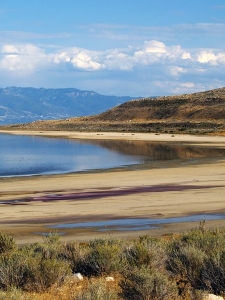
Great Salt LakeBrad Plumer wrote a disconcerting article over at Vox, NASA Images Show Utah’s Great Salt Lake Shrinking Dramatically. Over the last five years, Farmington Bay, which leads into the Great Salt Lake, has been reduced to one-quarter of its previous size. It’s basically just a river now. And this has huge environmental and economic ramifications.

(This is something that the modern world has forgotten. We are so focused on quarterly profits that we don’t see that most of the time economic and environmental interests go hand in hand. Interestingly, you would think that conservative economists would be most interested in this. But in general, they aren’t. Sure, they’re talk of externalities. But they aren’t much interested in it, because they are committed to having little government interference in the market. And dealing with externalities requires the government. Or business people who are enlightened — rarer than unicorns.)

No Mention of Global Warming

Brad Plumer is the guy at Vox who normally writes about global warming. But in this article, he didn’t mention the issue at all. Instead, he talked about the drought and the diversion of water. Currently 40 percent of all the river water flowing into the Great Salt Lake is diverted. Of course, that hasn’t changed. The real issue is the drought. And my question is: why the drought?

Now I get why Plumer didn’t mention global warming. There is no way to know if the current drought is due to global warming. But I think it is a mistake to get too caught up in what you can know for certain. For one thing, it just plays into the the denial industry. And as I have said many times before, the biggest issue with global warming is rainfall, not temperature.

Temperature-Rainfall Correlations

There has been a lot of work looking at temperature and rainfall correlation. My first year in graduate school, I shared a cubical wall with a young Chinese student. He looked at the last century of data for the United States. And it was frightening. The northeast had a positive correlation: more rainfall with higher temperatures. But everywhere else it was less rainfall with higher temperatures. And that was especially true out here in the west.

Note that just because there has been a correlation in the past, that doesn’t mean that global warming will cause the same effect. But as you may have noticed, we’ve been seeing drought in the west and very wet winters in the northeast. And it makes sense. So far this season in northern California, we’ve seen good rainfall. Most people are very hopeful. I’m not. I fully expect us to be below normal rainfall at the end of the season. That’s because I think “normal” rainfall is now a lot lower than it used to be.

Death of the Great Salt Lake?

So I think things are going to be very bad for the Great Salt Lake. They can stop diverting water and that will help. But my working theory is that they aren’t in the middle of a drought. They are just getting used to the new normal. And that new normal may be that there is no Great Salt Lake. It will be like the Owens Lake. But that one dried up due to the actions of the people who lived there. If the Great Salt Lake dries up, the culpability will be far broader.

How to Be an Awesome Psychic on Twitter!

Criswell - PsychicWhen I was a kid, I was very interested in a lot of really silly things. I loved the film Chariots of the Gods? I even read the book and two of its sequels: Gods from Outer Space and The Gold of the Gods. Also, I was really into In Search of…, although long before its run was over I had seen the light. But all that stuff — Bigfoot, UFOs, the Bermuda Triangle — I loved into my middle school years. One thing I never went in for were the psychics.

Part of this was that I was into magic — as in slight of hand, conjuring — the art form. And psychics were such obvious frauds. That was especially true for people like Uri Geller and Kreskin — men who were standard mentalists (a form of performance magic) — who insisted that what they did was “real” instead of just tricks.

Celebrity Psychics

Even more pathetic were the newspaper and television psychics. At eight years old, I had them pegged. I always like what The Amazing Criswell says in the movie Ed Wood, “It’s horseshit… Eddie, there’s no such thing as a psychic. People believe my folderol because I wear a black tuxedo… Eddie, we’re in show biz. It’s all about razzle-dazzle. Appearances. If you look good, and you talk well, people will swallow anything.” That’s what these people were.

The best example of this during my life was Jeane Dixon. Each year, she would come out with dozens of predictions. Some of them were outrageous. And some were simply educated guesses. And later, she would talk about the predictions that she got right and ignore the far greater number that were wrong. Mathematician John Allen Paulos even coined a term for this, “The Dixon Effect.”

The Twitter Psychic

The Dixon Effect has never gone away. There have apparently always been psychics and there apparently always will be. And it is always the same con. But Twitter makes doing this sort of thing so much cooler! Check out this Tweet that went viral after the Cubs won the World Series in game seven in extra innings:

As I write this, it has over 300,000 combined retweets and likes. And it’s understandable. Look at the date on it: 4 November 2014 — two years ago. Wow! GIO must be one amazing psychic or analyst or something, right?! Wrong.

How It Works

What people like GIO do is create a huge number of predictions on Twitter. And then, as each prediction goes wrong, they delete the tweet about it. By the time the actual event comes around, they are left with only the tweets that are right.

Aja Romano explained the whole thing over at Vox, That Viral 2014 Cubs World Series Tweet Seems Too Good to Be True. That’s Because It Is. She even provides an image of Noah Hiles doing this now: New York Mets 2017 WS Champs; Cincinnati Reds 2017 WS Champs; Milwaukee Brewers 2017 WS Champs; and so on.

What Jeane Dixon would have paid for such abilities: just make the wrong predictions go away! It’s really kind of brilliant. But it is, just as with Uri Geller and Kreskin, a magic trick. And now that you know how the trick is done, it loses its magic. Of course, for me, it’s totally cool. When I see a magic trick, I don’t go, “Wow!” I go, “Now let me figure out how that was done.” It’s really no different than solving a Sudoku puzzle.