
 When I was very young (less than 10-years-old), I loved game shows. I know why: I was good at them. Even into my teens, I wanted to be on Tic-Tac-Dough because I would have been on there for months. Then I just wanted the money and I couldn’t believe how ignorant the contestants were. But why do mature people like game shows?
And I don’t just mean the traditional game shows. Almost all “reality” shows are game shows. Dancing with the Stars is a game show. I find them mind numbing. But most people love them!
Watching the Money on Game Shows
And I know why. It was all explained at the end of the movie Quiz Show. Dan Enright (played by David Paymer, who you’ve never heard of but have seen everywhere — 233 credits on IMDb) gives the best speech of the film:
“Reality” TV Show Forged in Fire
My father loves a game show called Forged in Fire. In it, these guys with forges make swords and compete.
If I didn’t hate these kinds of shows so much, I would find it funny. The judges are so serious and make out that they are such experts. But they are really more like sports “color” guys who are constantly repeating the same things.
And the format is entirely typical: most of the show consists of interviews with the sword makers. First they interviewed before their swords are judged. Then they interviewed after the swords are judged.
The show runs 42 minutes, but if you cut out all the repetition, fluff, and ridiculously long dramatic pauses by the judges, you might have 5 minutes of material. That’s a lot of nothing to sit through to find out who wins the $10,000.[1]
It’s Probably All Fake
Last night I asked my father about the show. Because all my life I have lived on the outskirts (and sometimes right in the middle) of the construction industry. I’ve never met anyone with a forge. Now I know: it is probably one of those situations where if you know anyone with a forge, you know ten. They are a tight group.
But there isn’t a huge demand for swords and other things made in a small forge. Yet the show has had 66 episodes with 4 contestants on each. That is 264 people with forges who are willing to go on the show. I don’t buy that for a minute.
Andy Kaufman was on The Dating Game three times as part of his effort to become a successful entertainer. I won’t be at all surprised if one of the 264 people who was on Forged in Fire turns out to be a successful actor.
It Might Have Been Real at Some Point
I have little doubt that when the show started, they were using real people. But as time went on, they couldn’t find people. So they hired actors and had other people make the swords. At this point, I’m sure the entire show is scripted (in the same way professional wrestling is — not exact dialog, but everyone is told what to say, and it comes from some guy like me who doesn’t mind writing crap anonymously if the money is good enough).
When I mentioned this to my father, he pushed back. You could see their forges! Yeah, and one well designed set could be made to look a million ways by a professional art director. Did my father think the forge in Army of Darkness was a real one? No. He yielded the point.
But he will continue to watch the show. It makes no demands of him. And it gives him the ultimate American thrill: watching an absolute win and three absolute losses.
The Black and White of Competition
 Of course, even if the show is for real (and I don’t think it is), it’s just one competition.
It reminds me of something I heard someone say about Major League Baseball (roughly): “Each season, every team will win 50 games, lose 50 games, and its the last 50 that determines who does well or who does poorly.” (MLB now plays 162 games a year, but you get the point.) Similarly, it is often said of the National Football League, “On any given day, any team can beat any other.”
I like those quotes because they talk about reality. The truth is that there are thousands of great baseball players who are roughly as good as each other.
But Americans like things clear. That’s why soccer has had such a hard time here: most games end in a tie. (Or at least they used to. I don’t care enough to look it up.) Americans hate that kind of thing because there must be a winner who celebrate far too much and a loser who we criticize far too much.
Life Is Not a Competition
But my life and that of every human I’ve ever known is a mess of contradictions and general messiness. You never win because there is nothing to win. You just continue to live until you don’t.
To make up for the fact that you have to appreciate life at a higher level — that you have to work to find the sacred, as David Foster Wallace put it, in a crowed grocery store when you’re tired and grumpy — people make up games and pretend that life is one too.
Life Is a Process — a Struggle
The one sport I enjoy watching is baseball, because it is beautiful and subtle. But I much prefer watching amateur or minor league ball. The people in the majors make it look too easy, even though it is enjoyable enough to watch.
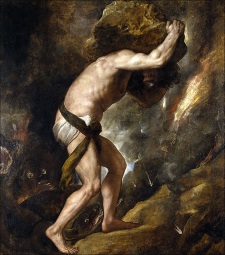
But I prefer to watch the struggle. Because we are all Sisyphus.
It doesn’t matter our wins or losses. To quote John Maynard Keynes, “In the long-run, we are all dead.” And in the short-run, I’d rather do something more edifying.
I’m not Capital One, so I’ll ask the ultimate question, “What’s in your soul?” I ask it of myself first.
Afterword
None of this is to take away from people who try to excel at anything. I’m that way too. And in weird ways. I practice the clarinet each night. Why the clarinet? Because it is the most bizarre instrument known to humanity.
But there is a difference between pursuing mastery and simply wanting to win. And we live in a degenerate country where the primary motivation is winning. And you will never find the sacred in such an ignoble goal.
Oh how we need to evolve!
[1] That’s another thing about most game shows. On Tic-Tac-Dough, you stayed on the show until you lost. So you could win hundreds of thousands of dollars. But the people on Forged in Fire are setting themselves up to be humiliated for a maximum payout of what the median American makes in two months. Who would do that?! Well, idiots. Also: actors (see above).
