Two War Films in One Day

When I was in high school, I was in speech club. In fact, hard as it is to believe, I was president of the club. One year, I competed in the “programmed reading” category, which I was apparently rather good at because I went to the state championship—a feat I accomplished that one time only. My presentation was about war and the highlight of it was part of Joe’s speech at the end of Dalton Trumbo‘s great novel Johnny Got His Gun, where Joe is begging to be killed. I still remember the excitement of doing that. It is great writing and I was at the right age to be doing it.

I just picked up the film version of the book when I was at the library. I was curious to see if Trumbo had written the screenplay, because he was blacklisted in the late 1940s. To my delight, far from just being the writer, he also directed it. (I didn’t know that Trumbo ever directed anything—and in fact, this was his first and only directing gig.) Wow. The movie is wonderful. It is life-affirming at the same time that it is the ultimate condemnation of war. The print used to create the DVD is not that good, but it doesn’t too much matter—the movie is so gripping that it is likely that only film geeks will notice. However, it is sad that such a great film hasn’t been restored.

My extremely positive reaction to Johnny Got His Gun may have something to do with having spent the afternoon watching Iron Man 2 with my brother. In general, I will watch anything with my brother because I haven’t spent that much time with him over the past couple of decades. He likes these kinds of films, so fine. But this film was really too much. I’m getting to the point where I can’t watch a film like this without seeing it in a larger context.

Hitler oversaw the genocide of six million “sub-humans” and we rightly call him evil. Andrew Jackson oversaw the genocide a large group of “sub-humans” (Native or First Americans) and we put him on our $20 bill. (Admittedly, the numbers are smaller and no Final Solution was ever attained; but the smaller numbers are due to the far lower population density of all people in the United States at that time; the early Nazi solution to the “Jew Problem” was the same as the Jackson solution to the Indian Problem.) As a country, we are frighteningly ignorant of just how evil we have been and continue to be. As a nation it seems that the more than 600,000 Iraqi civilians killed by us is nothing compared to the slightly more than 4,000 American professional soldiers who have died. (Even the left-leaning Antiwar.com seems to think American lives matter more than Iraqi lives.) Seeing Iron Man 2 within this context is a real problem because the film demands the context that Americans never abuse power—it is just those horrible foreigners who do that.

Even if you take away this evil aspect of the film, Iron Man 2 sucks. It has a few laughs and Mickey Rourke and Sam Rockwell put in good performances as one would expect. But that’s about as far as the good goes. Robert Downey is really starting to look his (my!) age, and his performance is not up to par. In the first film, Pepper Potts (the character played by Gwyneth Paltrow) was smart enough not to become romantically involved with the narcissistic Tony Stark, but she’s not smart in this film. Jon Favreau shows yet again that he is no better at directing than he is at acting. (And he is a terrible actor, if my sarcasm is not screaming off your computer screen.) The story is totally ridiculous. The only believable character was the villain who also has the only true human scene in the film (at the start where he watches his father die). He has a reason to be angry. And our hero? I guess we’re just supposed to know that arms manufacturers who are implicitly guilty of millions of deaths are the good guys. And boy is the film long! Most movies do not have more than 45 minutes of material in them; this one surely didn’t—unless you think “Oh! Let’s put Tony Stark in a race car!” is content; it lasted two hours and ten minutes! I was so bored with the film, I got out my notebook after a half-hour. Unfortunately, much of the film takes place at night, so I was limited as to how much I could write.

After the film, I was sitting with my brother waiting for his bus. A guy came by and heard us talking about Marvel Comics and the movies that it has spawned. The guy asked us with some enthusiasm if we had seen Iron Man 2. We said that we had just seen it. He began to gush about the film and told us he had seen it twice. A teenager, you ask? Oh, no. This guy must have been in his mid-fifties. And he wasn’t crazy, in the drooling sense of the word. But of course he liked it. What’s not to like? It tells Americans just what they want to hear. It is just the kind of entertainment that a culture creates while it is disintegrating.

Perhaps I grabbed Johnny Got His Gun as a kind of antidote to the two-hour propaganda poisoning I had just suffered. I can’t say. If so, it worked. If you are forced to suffer through Iron Man 2 or any of the many films just like it, I highly recommend Johnny Got His Gun; it’s better than the suicide hotline.

Pow Wow Theater

Wayne Poehlman is a singer/guitarist that I recently discovered on You Tube. To me, he’s the kind of performer who you listen to when you tire of the glitz and the posing and the pitch-correction of what is today called music. Of course, this goes along with my recent submersion into music of the past such as Geeshie Wiley and Mississippi John Hurt (the “Mississippi” to distinguish him from the guy who has the creature burst through his chest in Alien). Poehlman calls his online solo act “Pow Wow Theater.”

I first discovered him performing a minor song off the first Jules and the Polar Bears album: Following Every Finger. The tune stands out for a number of reasons. First, he changes the chords to make them more traditional (Shear can get a little weird) and he sings the song in a more melodic manner that works better and allows the listener to understand all of the words. I highly recommend listening to it.

He performs a number of other notable songs. In particular, he performs Michael Peter Smith’s The Dutchman. If you aren’t familiar with this song, it seems to be about an old man with dementia and his wife who takes care of him. The chorus is:

Let us go to the banks of the ocean
Where the walls rise above the Zuider Zee
Long ago I used to be a young man
And dear Margaret remembers that for me

Poehlman manages to interpret the song just perfectly—like he really understands what this man and woman are going through. He also performs Them Dance Hall Girls by Allan Fraser (although I think it might be based upon a traditional tune) that is very good. His All Time Woman is not as good as John Stewart’s—plus there is some distortion when he belts out the chorus; but it’s still good. There is a nice cover of Del Amitri’s Driving with the Brakes on; Poehlman has a rather similar voice to Amitri’s, so it isn’t surprising. The cover of Good Old War’s Coney Island is probably the weakest of what Poehlman has to offer. The Amazing Rhythm Ace’s song 3rd Rate Romance is covered in an unusual manner with a drum machine; on it, he sounds like he is channeling Jules Shear at times. Finally, there is another drum machine tune: Red Ball Texas Flyer by Jerry Riopelle. It is good enough; I’m not that fond of the original song.

At 59 years-old, Wayne Poehlman (or “Pow Wow” as he goes by) is what you might call a “late bloomer.” He tells me that it was less than 15 years ago that he finally learned how to write a proper song. Although he plays professionally at bars and events where he is expected to perform a lot of covers, he sees himself primarily as a songwriter. And a fine one he is too.

I have two free MP3 files of his original songs. The first is Looking for Juliet. Of this song, he writes “One night, I saw Juliette Binoche in [Krzysztof] Kieslowski‘s Bleu and I was reminded of an artist-friend, Julie who loved Paul Klee. Beyond the similarity in their names, I think I made a connection between both women being artists and my unrequited love for both that prompted me to reference some of the Romeo and Juliet imagery. And of course, if you use either of those two names it’s going to come up, like it or not.”

The second is Desperate People. This song is a little more produced than Juliet and a little more “pop.” As with anything that Pow Wow does, his take on it is intelligent and knowledgeable.
He says it is “[c]omedy with poignancy. [It is d]etermination evidenced by surreal behavior in an effort to fulfill ones destiny.”

In the end, what I most like about Poehlman is that he creates simple music that is intelligent (often witty) and beautiful. Check him out.

Waiting for Beckett

I continue to wrestle with the contextualization of art—especially my art—even though I am getting better at not caring. If I were to create a beautiful table, there would be a shared context for that table: it’s a table. No one would question the rounded corners or intricately designed legs. No one would wonder why I created this specific table. Everyone would simply appreciate it for what it was to them—even if it was simply something to set things on. Art, on the other hand, is purely symbolic. A book is paper, glue, ink; but unless one understands the symbols represented inside it, it is roughly the same as a rock. Unfortunately, it is not enough just to understand the words as signifiers of things. One could easily read and understand every word in a book and gleem not a single idea from it. Thusly came my idea for a kind of theater that coddles the audience—that teaches it enough to enjoy what it is watching. People want to find meaning in art, but it stands alone—without context. This is why artists of all kinds need to produce a critical mass of work; it usually takes time for others to contextualize the work.

Consider this: Fifty years from now, Tom Stoppard will not be considered the great artist Samuel Beckett is today. This is not to say that Stoppard is not a great writer—I think he is; I am reading Rock’N’Roll right now—I don’t have time to read plays by hacks. But let’s look at Rosencrantz and Guildenstern Are Dead for a moment.It is basically Vladimir (as Guildenstern) and Estrgon (as Rosencrantz) from Waiting for Godot thrown into the middle of Hamlet. There is nothing new here. Admittedly, it is wonderfully creative and great fun; but it is just a variation (and a minor one at that) on Godot. In fact, I would say that Stoppard is ripping off Godot more than Beckett ever did after he wrote it. Endgame? Happy Day? These plays are in no way variations on the theme of Godot.

Under ordinary circumstances, Waiting for Godot would have been a flop; it would have taken years for it to be seen for its greatness. But it had two things going for it. First, Beckett was James Joyce‘s assistant and I think most people thought he was going to take up where Joyce left off. (Thankfully, he did not; I would love to discuss this, but it doesn’t matter and it is getting off track.) But he was already a respected writer and scholar when he wrote Godot. Second, there is something about the nature of the play—the stripping away of what was still (is still) largely Victorian theater that made the fact of meaning in the play obvious to even the most ossified audience. I specifically mean that the audience could not help but understand that there was meaning in the play—maybe important meaning; I am most certainly not saying that they knew what that meaning was.

Barring the part about getting to work with Joyce, I would prefer to have the life of Stoppard; but oh, how I wish I could create like Beckett!

First Draft Fear

Kristen McHenry has made a list of her fears. One of them is fear of someone reading my first draft. By this, I must assume that either her second drafts are final, or she is not afraid of someone reading her second drafts, or—and most troubling, she simply forgot to list the drafts that she fears someone reading. This last one bothers me so much because, other than this blog, I write many drafts of my work—upwards of 100 drafts for a piece of work. I don’t know about Ms. McHenry; maybe it’s plop, spell check, publish. But I doubt this. Thus, I wonder: does she fear someone reading any draft other than her final draft? Is it just certain drafts—say, 2,3 5, and 11? Or perhaps just the even drafts? Perhaps the prime numbers? Maybe it is even a mathematical sequence, like: 1, 2, 3, 5, 8, 13, 21, and so on. Perhaps it is a more interesting sequence? One that I couldn’t even figure out and I am rather good at these kinds of things.

I understand the desire to withhold a work of art until it is finished. I have, for example, never let anyone read my first novel Kamping on Asphalt—not that people were tripping over themselves to get a copy. The truth is that the very idea of a draft is not clear to me in the sense that it usually takes an enormous amount of writing to get to something that one might call a first draft. I find the process goes something like this: crap, crap, crap, crap, crap with an interesting idea, crap, crap, crap with that interesting idea turned into a major dorky part of it, dorky crap, dorky, dorky, something readable but bad. The final result: the “first” draft.

Let me explain with the current draft of the first chapter of my second novel Treading Asphalt. I decided that because KOA was written in limited third-person, I would like to do TA in first person. That’s what Joseph Heller did, so how hard could it be? It was a bitch. It took me two years to find the voice of the narrator (and he was a major character in KOA, so I had a running start at it). And so here is what I would call my first draft of the first chapter of TA (note my fearlessness):

Waking up with your head on a steel toilet seat isn’t that bad—not any worse than waking up at all. My head feels like a million pins are sticking into it. Or maybe that it’s on fire, but just a little. Then I notice the rest of my body—it all feels that way. I push myself up using the toilet: no lid, no seat; less to clean; no assholes shitting on the lid. The blanket I’ve been wrapped in, falls away. My right foot gets tangled in it; I fall, but catch myself on the sink. Right next to the toilet—same steel. And the steel mirror—all I see are ribs; amazing what a couple weeks not eating does. I press the single metal fixture, and sort of cold water comes out; I drink it and it feels good; and that feels weird. I release the fixture, wipe my mouth with my arm, and stumble backwards onto the cot. It’s over. But only like a play—one you’ll perform tomorrow or next season or sometime. You know you’ve got one more performance in you.

I would have been ORed five days ago, but I was already sick when they picked me up. And now that I’m better, they’ll probably kick me out today. Multnomah County doesn’t have the space to spend much time on junkies—even repeat offenders like me. Even though they know I won’t likely show up to court. And I won’t. Even though they know that I won’t likely live a good clean life. And I won’t. They just don’t care. They have real crime to deal with—the violent, the evil, the psychotic; there’s no room for the merely pathetic. Hopefully it’s that way in Las Vegas and that I’m not the only person who cares who murdered Rachel.

Okay. Okay. It is genre crap, but I’m trying to make a living here. I would show you my second draft, but I fear people reading my second drafts. No, just kidding. But I won’t show you my second draft anyway—I can’t find it. Here’s my third (or maybe fourth), however:

This is Rachel’s fault.
I’m huddled next to the steel toilet, with my blanket wrapped around me and between me—I’m well enough to notice that I can’t stand touching my own body. Occasionally, I place my chin on the rim of the toilet and vomit. But nothing comes. I just kind of gag and drool. Past the worst of it—I managed to eat a baloney sandwich earlier. Just threw it back up, but it’s better than the dry heaves. I still have the sweats and the chills; and my ass feels like it’s on fire from the diarrhea. Just like the vomiting though, little comes. And what does come is pure acid—it’s a lot worse down there. Getting better, though; that’s all that matters—in detox or in life, right?
It’s all Rachel’s fault, because she’s dead. And because she was Rachel, which is why she’s dead, I guess.
I push myself up using the toilet—the blanket drops away. My right foot gets tangled in it; I fall, but catch myself on the sink. Right next to the toilet—same steel. And the mirror—steel. It reflects no one I recognize; all I see are ribs, beneath near transparent skin—amazed at what a couple weeks not eating does. My Jack Lord hair—a point of vanity and ridicule, is mushed down with sweat and puke. I look away: down. I press the single metal fixture, and lukewarm water comes out; I drink it and it tastes good; and that feels weird. I release the fixture, wipe my mouth with my arm, and stumble backwards onto the cot. It’s pretty much over. But only like a play—one you’ll perform tomorrow or next season or sometime. You know you’ve got one more performance in you—if you don’t die first.
I hate Rachel, and where I am, every thing’s her fault. But I’m not in the can because of her—because they think I killed her. Nobody cares that she’s dead, much less who killed her. Except me. I care. It’s the only thing I care about. And that’s why I got strung out again. And that’s why I got popped. Or maybe I just don’t have the stomach for it any more; maybe I’m not as good I used to be; the life is too fucking hard. But I always thought Rachel made it okay—worth it all. But maybe I was just a fucking idiot. Maybe I still am.
They would have ORed me the day I got arrested, if I hadn’t vomited all over their fingerprint machine. So instead of getting released, they put me in a cell alone so the detox could run its course. “Run its course!” That’s kind of funny. It wasn’t a bad thing though; I’ve done it a bunch; and I don’t know what I would have done if I’d gone free. Rachel was always paranoid of going cold turkey. Of course, she never had to; I always did the dangerous stuff. She died without a record.
They’ll throw me out tomorrow, probably—maybe even tonight. It doesn’t much matter. They send a medic a couple times a day to make sure I’m not dead, but that’s it; no meds, just tepid encouragement. I’m just taking up space—space for two, and Multnomah County doesn’t have the space to waste on junkies and shoplifters—even repeat offenders like me. They know I won’t likely show up to court; and I won’t. They know that I won’t likely live a good clean life; and I won’t, whatever the fuck that might mean. They just don’t care. They have real crime to deal with—the violent, the evil, the psychotic; there’s no room for the merely pathetic. It ain’t that way in Vegas; they don’t even believe Rachel was murdered, but if she were alive they’d arrest her for drugs.
The door to the cell buzzes open and startles me. I jump back and bash my head against the concrete wall behind the cot. It’s not bad; I don’t have the strength to move quickly, forcefully. I look to the door and Stu is standing there in his blue scrubs, hold the door half open. He’s a kid, maybe twenty-two—the caring type—one of those big guys who never got in a fight because everyone was afraid of his size. He’s apologized that he couldn’t get me any medicine, although he did give me some Advil; that was nice, even though I could still see the partly dissolved pills when I vomited them back up.
“How you holding up, Brian?” he asks kind of sad.
“Better,” I say. “You know.”
“You wanna take a shower? It’ll help; really.”
“Maybe,” I say. “In an hour? I’ve got to work up to it.”
“Sure,” he says. “I’ll come back; and I’ll help you.”
He leaves and the door slams shut. They’re pressuring him to get me out.

So I say, free yourself Ms. McHenry! Free yourself from this first draft fear! I have never met a writer whose work didn’t suck 99% of the time. Hell, I can show you writers whose published work sucks 99% of the time! Embrace your ineptitude; accept your ignorance; relish your double commas and similar typos; proudly right, “Theirs know perphection end da whirled.”

Leak

I have so much to do, especially finish my article and interview with Pow Wow (Wayne Poehlman), but I just ran into an old friend Yana Bogosian who I wrote a song with about eleven years ago. Actually, we didn’t write it together. She had written a little nursery rhyme about a pipe that was leaking behind the wall in her apartment. She wrote more than I’m going to quote, but I don’t remember the rest, because I didn’t rip that part off. Here’s what I remember:

There’s a leak, but we can’t find it
There’s a bust hiding behind it

I was struck with this. For her it was a poem/song that was concrete: it was about her life. But it started in me a creative explosion. And never being one to shy away from ripping off other people’s lives (and I gave her lead songwriting credit even though I wrote all of it except for those two line), I went with it. I thought it would be really surreal if a leaky pipe caused a whole town to flood. Hence the song.

I will get my little studio hooked up shortly and provide an MP3, but for now, here are the lyrics:

There’s a leak but we can’t find it
There’s a bust hiding behind it
And it’s spraying you can’t hind
Turning indoors to outside.

And my friendly next door neighbor
Turning angry into labor
He knows something isn’t clear
In my house it’s very queer.

The Police come, they’re not grinning
‘Though my friends are now all swimming
There’s a beach ball flying high
Hits a cop right in the eye.

Now it’s seeping out the doorway
And I’m mute ’cause no more to say
And the streets are filling up
Watch the floating coffee cups.

So the ‘copters come to save us
And we try hard to behave, must
Tell them all we didn’t know
‘Bout the pipe before it broke.

There’s a leak but we can’t find it
There’s a bust hiding behind it
And it’s spraying you can’t hind
Turning indoors to outside.

There’s a leak but we can’t find it
There’s a leak.

Great art? Perhaps not. But the songs that I have written like this tend to be among my favorites. Things like: “My Suitcase and a Clown” and “You Make me Want to be a Meat Inspector”; things that share much with Shel Silverstein, but which are far more adult in content—silly on the surface, but troubling below (e.g. “My Suitcase and a Clown” is explicitly about a violent contract negotiation between a ventriloquist and his “dummy” but is implicitly about the American class system). And musically far more adventurous than the late great Mr. Silverstein.

But it was great to see Yana again.

Film POV

POV stands for point-of-view. For an article in which the author utterly misunderstands how POV applies to film, check out this page (in his defense, film is not his thing). POV in film is a little complex. Originally, POV was developed for a story told or read. To extend this idea directly to a movie would make the POV the camera lens. Thus we would be turning a concept used to describe the persepctive of a story into one used to describe a purely technical aspect of the story telling. Thus film POV tells us what book POV tells us, but it does it differently. If we follow a cop as he tries to solve a crime, he is always there; the film is from his POV; it is not necessary for the camera lens to literally be his eyes. However, I do want to point out that there are many more options regarding POV in film than there are in books. And in general, this is a bad thing. Most of the time, the only reasons POV changes or some odd kind of POV is used is that the filmmaker can’t make it work otherwise.

Miller’s Crossing

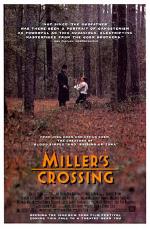
Miller's CrossingMany people miss the point of Miller’s Crossing; what’s more, they don’t judge it on its own terms. It is widely known that the Coen brothers were inspired to make this movie by the works of Dashiell Hammett. But their inspiration does not matter in the least; it only tells us where they started, not where they ended. Thankfully, they did not end up with some modernized Hammett “tough guy” story, with characters who almost always lack depth and humanity. Miller’s Crossing is certainly not a perfect film, but it is a fine film—far better than almost all the movies that have ever been made.

Miller’s Crossing, like all movies that are more than simple entertainments (such as the much better film Gosford Park), really need to be seen more than once. This film is dense; for example, the subplot involving Mink was not clear to me on the first viewing; nor was the sexual relationship between Mink and the Dane. It all became clear on subsequent viewing.

Even with multiple viewings, Miller’s Crossing has its problems. The homosexual relationship between Mink and the Dane is not very believable. J.E. Freeman is a fine actor, but he is not really cast well in this role. This is not surprising, however, since that part had been written for Peter Stormare—who I’m sure would have portrayed the character as implicitly gay along with the angry sadism that Freeman has in abundance; Freeman’s Dane clearly cares about Mink, but it seems more like Mink is his son or brother—not his lover. We learn that Mink and Dane are lovers almost exclusively from other characters.

This is a fairly minor problem, however—and one that would probably be easily fixed with a single scene including both characters together; the biggest problem in Miller’s Crossing is that the filmmakers maintain rigid first-person POV [caveat] throughout the movie except for one scene in which Leo survives an assassination attempt. It acts as a short film put in the middle of the feature. It is spectacular, but it doesn’t belong. As the saying goes, in editing you usually have to kill your darlings and that was one they should have strangled. (There is one other very short POV problem toward the beginning where a young boy steals the hair piece of a dead Rug Daniels, which should have been cut—other than being a classic Coen Brothers moment, it serves no purpose. On the other hand, the fire-bombing of Leo’s club seems like a POV error, but it is not; Tom witnesses it and even comments on it—albeit from a distance.)

Taking the assassination scene out would have allowed them to spend more time on the Mink-Dane relationship and to have further developed Tom’s attraction (love?) for Verna. As it is, Verna disappears for far too long during the latter half of the second act. This missed opportunity is particularly sad because the love triangle involving Tom, Verna, and Leo is the heart of the story. Without getting too Oedipal about it, the film works as modern tragedy. Tom saves Leo (his father surrogate) resulting in the loss of Verna (his mother surrogate). Given his loss of Verna, the film ends with Leo and Verna about to be married; this causes Tom to lose Leo (again) because he cannot accept being around Leo married to Verna. And it is all Tom’s fault; he controlled all the action in the film.

Consider this: Tom could have asked Verna to leave Leo, and she would have; this would have hurt Leo, but it would not have poisoned his relationship with Tom; Leo would then have given Caspar the okay to kill Bernie; and Tom and Verna could have relocated Bernie somewhere far away before he was killed. But the tragic course Tom followed was dictated by his own ethical sense (ironically, shared with Casper, who he has murdered as part of his plan). Tom’s ethics result in the unhappiness of Verna and himself (and to a smaller degree Leo), and the deaths of many people (most innocent in the universe of the movie).

As has been pointed out ad nauseum, the film is beautifully “shot” and expertly acted. I actually have something to say about this other than the usual comments of the film ombudsmen, so you will forgive me if I add to the nausea. Let me start with the acting.

Acting

Gabriel Byrne does an excellent job in this film, but it is rarely mentioned because this is the kind of role that just seems to be standard and easy. But this film lives and dies on his performance. Without his subtle, emotionally deep performance, the film would have no center. In addition to the serious scenes he shares with Finney and Harden, he also has scenes where his character is playing a role. The contrast is stark and riveting.

Of course, everyone applauds Jon Polito in the role of Johnny Casper—and rightly so; but Polito is pretty much always great in whatever he is doing. Is he really particularly better in this film than he is in other films? Just to mention two (later) Coen brothers films, he was wonderful as the gay dry-cleaner in The Man Who Wasn’t There and comically genius paired with Jeff Bridges in The Big Lebowski. He is a fine actor who unfortunately gets a lot of the same kinds of roles because of how he looks; but on the good side, he works a lot.

I’m not sure about John Turturro‘s performance; I have a hard time reconciling his pleading in the forest with his sociopathic behavior elsewhere. He does redeem himself during his second pleading scene where his character’s acting job is far less convincing.

Marcia Gay Harden does a fine job, despite having to recite some of the most tired dialog that the Coen’s have ever created. It is sad that her character was probably the least fleshed out. Albert Finney provides a workman-like performance. His character too is not well written. It is hard not to question how such a nice guy could have survived with the likes of Johnny Casper around. Okay: he’s good with a machine gun and he is calm during stressful situations; but he seems more like the city’s most popular tailor than a crime boss. In Finney’s defense, he was last minute casting, after Trey Wilson (originally cast) died right before shotting; so it isn’t like he had a great deal of time to prepare, and considering his body of work (Murder on the Orient Express and The Dresser come to mind), I would never doubt his talent. And let us never forget that casting, editing, and directing are usually just as important to the success or failure of a performance on film as is the acting itself.

The Look

Miller’s Crossing is the Coen Brothers’ third film. Their first film, Blood Simple, had a budget of one and a half million dollars; and it showed, even if the low-budget look of the film worked perfectly. Their second film, the highly over-rated Raising Arizona cost about six million dollars (and I can’t help but compare it to Jon Jost‘s work which is generally made on a shoestring and yet produces remarkable—and arguably greater—results). So it isn’t surprising that Miller’s Crossing, with it’s 14 million dollar budget would look good. Their first two films had good camera work and reasonably good lighting. Barry Sonnenfeld lit those films. I assume Joel Coen shot Blood Simple; no one is credited. David M. Dunlap shot Raising Arizona, along with Stephen St. John doing the steadicam work. Sonnenfeld lit and shot Miller’s Crossing with Larry McConkey on the steadicam. I mention all of these people, because the cinematographer tends to get all the credit, while the camera operator is easily as important—and in the United States, it is rare for someone to do both in a budgeted movie. Before moving on, I should point out that these people are really just department heads; they all have large crews of assistants who are generally very talented. (Consider the lowly camera loader; do you have any idea just how hard and stressful it is to load a camera with film? By feel alone? It is a demanding job, especially when every minute you slow down the production costs about $50—or more—much more.)

Sonnenfeld’s camera work is hardly inspiring. It reminds me a little bit of Jim Jarmusch‘s Stranger Than Paradise which was lit (and most likely shot) by Tom DiCillo. The camera hardly moves: there are no tilts, very minor pans, and a couple of dollies. The shooting for which Sonnenfeld is responsible is similarly motionless; I assume this is what the Coen’s wanted. However, where Jarmusch’s movie frames each shot in interesting ways; the Coen’s movie frames each shot in a classic manner. This is neither good nor bad; it is a decision. But it is not an exciting decision. Helpfully, it does make the viewer focus on two things: the acting and the set design. I’ve already discussed the acting, which deserves the attention the filming provides. This is even more true of the sets.

The production design by Dennis Gassner is great. Ditto for Richard Hornung‘s costume design. Even the short scene outside in the rain taking cover in a doorway looks great and says as much as the filming and the acting. What’s more, the sets and costumes do more than define the environment and mood—they provide insights into the characters. It is a lot more than pretty. Again, as with filming, there are a lot of people who work under these department heads. And in Miller’s Crossing, there was a much bigger Art Department than there was on Raising Arizona (which itself had a much bigger Art Department than Blood Simple).

This is Not Film Criticism

To me, Miller’s Crossing is a love story that just happens to take place in that fictional land of mobsters who are not, in general, homicidal psychopaths. So while the film may look like something Dashiell Hammett wrote, it isn’t at all. It lives in his literary universe, if you will, but it is populated by characters who just don’t exist in the classic genre. This fact confuses a lot of viewers and makes them think that this fine film is bad. Any good work of art needs to be experienced multiple times before it can be fully appreciated. Unfortunately, the newspaper columnists who call themselves “film critics” generally see a film only once before passing judgment on its artistic value. This is fine, because most people who read such “reviews” simply want to know if they will enjoy watching a movie once. So we should call these “film critics” something more appropriate: “film ombudsmen.”

This discussion of Miller’s Crossing is far longer than a typical “review” and yet, it is far too short to begin to seriously criticize the film. But it is long enough to make the argument that the film cannot be dismissed as bad art and that it deserves at least two viewings, whereas The Maltese Falcon is deserving of one reading, at most.

Update (20 April 2011)

I just got the DVD from the library and there is an extended interview with Barry Sonnenfeld where he says much of what I did about his work. I also found out that after he got out of film school, he bought a CP-16—the same camera that I used to own until I loaned it to Marc Burgio who never returned it.

Update (20 November 2011)

For some time now, I have been thinking about the two lover’s triangles in the movie: Vera’s and Mink’s. Off hand, when the film is looked at in this way it isn’t too hard to see it as homophobic. There seem to be two honest brokers in the heterosexual triangle, only one in the homosexual triangle, and he’s a psychopath. But I would have to think a lot more about this before I was willing to stand behind what is now just a thought.

Update (19 May 2013)

There are more POV problems than I indicated. This isn’t just a matter of formalism. The screenplay really needs to be reworked so that it isn’t so exclusively Tom’s story.

Paradox Lost

I recently rediscovered James R. Newman‘s four-volume The World of Mathematics in a thrift store. For 25 cents a piece, I got volumes i=1,4 where i <> 3; that is: I got volumes 1, 2, and 4. This was a disappointment, given that Volume 3 included Nagel and Newman’s article on Goedel’s Incompleteness Proof. So I got that volume from the library, with the thought of revisiting this article. However, by the time the book arrived, I had thought quite a lot about the proof (well, there are actually two of them, but let’s not go there), and I came to the conclusion that I’m just not that interested in it any more. As important an intellectual accomplishment as it is, the fact remains that it doesn’t really matter very much, even in mathematics—and given my postmodernist frame of mind, it just seems kind of obvious.

In going through the volume, however, I came upon a nice (and easy) article by Edward Kasner (the guy who coined the term “googol”, which the guys at Google misspelled, but maybe for the best) and Newman: Paradox Lost and Paradox Regained. In it, they present the following apparent paradox involving two quarters:

<%image(20100725-quarters.gif|400|181|20100725-quarters.gif)%>
If the quarter on the left is rolled halfway around the quarter on the right, it has traveled half of its circumference. A quarter rolled half of its circumference should be brought to a position that is inverted (upside-down). But this is not the case here. Instead, the quarter is where it started (right-side-up in a rotational sense).

The interesting thing about this paradox is that the authors apparently felt it so trivial as to not even explain it. They do go on to explain the mathematics behind it, but how it is applied is not explained and it is all rather more complex than it need be. This is not to say that I went right along with them. After finishing the article, I spent about an hour thinking about this problem without finding a solution. It was only after waking up at 3:00 am that the solution hit me. Sleep is usually helpful in such matters.

This is exactly the kind of math problem that most people hate:

  1. It takes a bit of thinking just to see the problem
  2. It is infuriating once you’ve seen the problem
  3. It is a totally irrelevant problem

And then there are people like me who are nerds. We are just like everyone else in thinking that such problems are hard to understand and answer and pointless to boot. But like Vladimir and Estragon, we know you have to fill your day with something, and this will do as well as anything else. (Better in fact; reality TV is really beginning to bug me; and I only see snippets of it, like the court shows. I suppose what really bugs me is the fact that other people find such debased entertainment, well, entertaining.)

And Now Back to Our Quarters

Why does this seem paradoxical? I will try to explain (actually, I now find the problem harder than the solution). If you were to roll a quarter along a straight line segment equal to the length of the quarter’s circumference, it would be oriented the same way at the end as it was at the beginning. If you did the same thing along a line segment of half this length, the quarter would be oriented upside-down. This should all be obvious. If not, try it out yourself. Or just think about it; don’t expect me to do everything…

The quarter rolling around the other quarter is equivalent to the second line: half the circumference. Thus, the quarter should finish upside-down. But it doesn’t; this is because the two cases are only equivalent in terms of the distance rolled; the displacements (directional distance) are quite different. This, in itself, does not answer the question, however.

When you start rolling the quarter, say from 0 to 10 degrees (obviously, this works with infinitesimal elements; I will leave the Calculus to you) you are also rolling it from 0 to 10 degrees on the stationary quarter. Thus, while the rotating quarter does indeed revolve only 180 degrees from start to finish, the axis on which it is rotating is similarly rotated by 180 degrees. Put another way, the rotated quarter is upside-down—in the original coordinate system! The positive y-axis was up at the beginning and down at the end.

I’m Just Weird

This is not the standard way of looking at this problem. Generally one would look at the path that a given point takes when a circular object is rolled. When rolled along a straight line, such a point traces the path of a cycloid. With cycloids, one can have lots of fun like proving that the top of a moving car’s tire moves faster in the horizontal direction than the bottom. Does this sound paradoxical? If so, just remember that the top of the tire is moving forward and the bottom is moving backwards; that has little to do with the problem but does make clear that rotating objects tend to mess with our sense of intuition about the natural world.

Indian Rope Trick Part II

The Rise of the Indian Rope Trick - Indian Chain TrickThis is a continuation of my article about The Rise of the Indian Rope Trick. Check out Part I. This one deals with an actual effect, the Indian Chain Trick.

As promised, I am going to explain the Indian Chain Trick, the magical illusion that is most like the Indian Rope Trick, but which probably had nothing to do with the creation of the myth because John Elbert Wilkie probably knew nothing about it.

The Mogul Emperor Jahangir reported on the Indian Chain Trick some time around 1600. What he wrote was not translated into English until 1829, and what I quote here is Peter Lamont quoting from this English translation in his book, The Rise of the Indian Rope Trick. It seems that the conjurers

produced a chain of 50 cubits in length [roughly 23 meters], and in my presence threw one end of it towards the sky, where it remained as if fastened to something in the air. A dog was then brought forward, and being placed at the lower end of the chain, immediately ran up, and reaching the outer end, immediately disappeared in the air. In the same manner a hog, a panther, a lion, and a tiger were successively sent up the chain and all equally disappeared at the upper end of the chain. At last they took down the chain and put it into a bag, no one ever discovering in what way the different animals were made to vanish into the air in the mysterious manner described.

This sounds amazing, but actually, Jahangir was not that impressed with this particular effect; the conjurers did much more amazing things like make fruit trees grow and produce ripe mangoes. But let’s forget the mango trick; it is well-know (to those in the know) and it’s secret can be learned from a variety of books. As far as I know, no one has explained the Indian Chain Trick. (And most likely, no one has cared.)

The biggest problem with explaining this trick is the hog. Regardless of how you look at it, hogs can’t climb up chains. The other animals — well, I could imagine they could be trained. But given that hogs can’t climb, I assume that none of the animals actually climbed up the chain. And yet, Jahangir claims they did. Leaving aside the fact that he was almost certainly wasted out of his mind on booze and opium, there are reasons to doubt his description of the effect.

The Problem with Eye-Witnesses

In my experience, when people describe magic tricks they have seen (without the help of booze and opium), they are not very accurate. For example, when someone sees the color changing deck, they will say, “The magician had me select a card from a blue deck of cards; then he fans out the deck and all the cards are red, except for the one I picked that is blue.” I don’t want to go into details here, but the trick started where it ended: with a red deck of cards and two blue cards.

What’s even more important is that magicians are liars. They talk and are generally entertaining and then they start their act. But… They already started it; during all that chitchat, they were doing the “trick”; in fact, in most cases, by the time the audience thinks the effect is starting, it is over from the magician’s standpoint. Ricki Jay’s Four Queen Routine is a good example of this, even though it may not be clear to the uninitiated — which is the whole point, after all. This isn’t always the case, of course; as an example, I would refer you to Daryl’s Rope Routine where he is doing straight sleight-of-hand throughout a six minute effect. But this is the exception, not the rule.

The Method

I can think of a few ways that the Indian Chain Trick could have been done. First the chain: most likely it was simply held up with thread — either from a single strand directly overhead, or two strands running off to each side (the way a tennis net is held up). Obviously, this would likely not even be strong enough to allow a rat to climb up the chain, so we move on to part two: the animal climb.

My guess is that the conjurers had a box that they performed the trick upon. It is from this box that the chain rose. On the top of this box was a trap door that allowed the hog (etc) to disappear into. But how would it do this without being seen? How would Jahangir (other than the drug effects) see the hog climb the chain? The answer is simpler than you would think: he didn’t see the hog climb the chain.

Instead, one of the conjurers would put the hog on top of the box. He would then obscure it from the audience with a screen. At this point, the hog would fall through the trap door, without Jahangir and the rest of the audience noticing — all would assume the hog was still behind the screen.

Now the conjurer would slowly raise this screen up to the top of the chain at the same time he said something along the lines of, “See how the hog climbs the chain!” And then, when at the top of the chain, the magician would pull away the screen and announce, “The hog has vanished!”

The emperor goes wild! No one remembers that they didn’t actually see the hog climb the chain. This is normally how people describe magic tricks they saw: they say they saw things that were only ever implied.

The Indian Chain Trick: Am I Right?

There are other possible methods of doing the Indian Chain Trick, but it was almost certainly something very similar to this. Magicians refer to “heat” in a magic trick. This is when the audience is paying a lot of attention. The point when the screen is removed to show the vanished pig has a lot of heat. But when the screen is first placed in front of the pig doesn’t have much heat because the audience isn’t aware that the trick has started.

Based upon the comment of Kenneth Wade Wilson below, I wonder if this description is unclear. If anyone has any questions, please ask me. It’s really very simple, and the concept is still widely used as in the die box.

Indian Rope Trick Part I

The Rise of the Indian Rope TrickPeter Lamont has written a fun little book called The Rise of the Indian Rope Trick. If you know this magic trick, you will get the punning title (if you are like me, you won’t know quite how you feel about that.). If you don’t know the trick, let me explain.

A magician — but one with a turban, not a top hat — takes a length of rope and causes it to (magically) rise into the air. Then, his assistant climbs up the rope and (magically) disappears. The rope falls back to the ground. The crowd goes wild! You can imagine, just look at the photograph on the right.

Now, admittedly, you don’t see the boy disappear in the photo. In fact, he never does disappear (unless you want to imagine it in your mind). This picture is of The Great Karachi doing the Indian Rope Trick. Indian Rope Trick Photo - FakeKarachi was one of the great Indian magician — except that he was actually from Plymouth in the Southwest corner of the United Kingdom. And his name was Arthur Derbyh. But he looks pretty Indian, don’t you think?

The problem with the Indian Rope Trick is that it was invented by an American. His name was John Elbert Wilkie. A great magician? No. A so-so journalist? Yes. He just made it up for an article he was writing. I understand this. I’ve been a journalist, and I know that you normally get paid by the article: poorly; the more you pump out, the more money you make. It’s not like anyone’s going to check, unless your name is Jayson Blair, or, as in the case of Mr. Wilkie, you are dead.

What is interesting about all of this is that the article took off. People believed it and the story spread to (God help us all) Victorian England. And in Victorian England, the people knew they were the best; and yet, no one could actually do this trick. Okay, sure: Karachi/Derbyh: Rope rises, kid climbs up, kid climbs down. No big deal. Even Howard Thurston (who was a total hack) could do that. It’s the disappearing that was the key (and outside; don’t forget that — you can do anything in a theater).

John Elbert Wilkie: Inventor of the Indian Rope TrickOf course, after Wilkie first “reported” on the Indian Rope Trick, it ran wild. Numerous variations appeared. Here’s my favorite: rope up, boy climbs, magician climbs after him with sword, and cuts him up: arms, legs, torso, and head fall to the ground; magician climbs down; he assembles the parts again, and the boy gets up and dances a gig — or the Indian equivalent of it. Gruesome, yes; but surprisingly easy to do; a lot easier than that disappearing thing.

Anyway, we get a lot of Victorians hunting around India looking for the trick (that doesn’t exist because it only ever existed in Wilkie’s mind, and by now, he is with the United State Secret Service — I kid you not). And there is lots of waving of hands and all that, mostly because the British magicians cannot accept that there is anything that Indian conjurers can do that they cannot (and they’re right). There is, as with just about anything having to do with Victorians, much hilarity. Truly, the only thing that isn’t ridiculous about this period is Oscar Wilde — who was also hilarious but for completely different reasons.

It turns out that there was a magic trick that Indian conjurers did that was similar to the Indian Rope Trick. In it, a chain was thrown in the air where it stuck. Then, a pig, and a dog, and other assorted beasts climbed up the chain and disappeared. I’m pretty sure I know how this was done and in part 2 of this article I am going to explain it. (And it is almost certainly not what you are thinking.)

But don’t pass up on Peter Lamont‘s book. It is a lot of fun — excellent summer reading.

Check out Part II of this Article.


15 November 2013: I removed the CCNA Chennai video embed (see comment below) because it has been removed and I can’t locate it now.

Easy Refried Beans

This recipe creates tasty, very slightly sweet refried beans. It is a bachelor’s recipe; the kind of thing that a man who knows nothing of cooking can make. All you need is:

Two Tbs Vegetable Oil
One Onion: coarsely chopped
Two 15 oz cans of pinto beans
Some pepper

Put the oil in a skillet and turn the flame up to medium. When the pan is hot, add the onions. Cook them for 5-10 minutes, stirring occasionally; don’t let them burn. When they are done, transfer them to a separate container. Leave the skillet where it is and hot.

Pour the contents of the two cans of beans into the pan: juice and all. Be careful! Pour a little of the juice in the side of the pan; if it is too hot, reduce the heat and wait or just pour the beans in very slowly. Use a potato masher to crush and stir the beans. Make sure the heat is not too high; you should never have the beans boiling beyond the occasional release of a steam bubble. Keep crushing and mixing until most of the obvious liquid has evaporated.

Add the onions to the beans, mix, add pepper to taste and eat.