So Why Did James Comey Write That Letter?

James ComeyTo the absolute surprise of no one, the James Comey FBI has come to the conclusion that there was nothing new on the email that was found on Anthony Weiner’s laptop. Most of the 650,000 email messages were duplicates and the ones that weren’t had no value whatsoever to any of the investigations — Clinton or Weiner. It was the very definition of a nothing-burger.

But what did happen was Clinton was smeared by the media for a week and a half. It went absolutely ballistic. Email! Email!

There are three important things about James Comey’s “update” letter. First, he had no reason to send it. Second, he knew the Republicans would leak it immediately. And third, doing so was a possible violation of the Hatch Act. The reason that the FBI keeps its trap shut on investigations like this one is because it is prejudicial. “Oh, this person is bad! Why else would the FBI investigate them?!”

So why did Comey write the letter? Was it to help Trump? No, actually.

So why did he do it? Two main theories have emerged and I think both have a lot of validity.

Reason One: Comey Was Protecting the FBI

Yale Record Doesn't Endorse ClintonFirst, there is a small subset of FBI agents who are friendly with the Trump campaign. Some of them have been investigating the Clintons on and off since the 1990s. They are suffering from the sunk cost fallacy. They’ve spent so much time investigating, they feel like they have to find something. All that work can’t be for nothing!

So you have people who are very unhappy that they haven’t nailed someone like Clinton. And they want to get them on anything even though there is nothing there.

Whenever the Clintons decide to run for office, they know there will be a deep investigations into literally everything they do. After all, this is a pair that faced a Congress doing 140 hours of sworn testimony into their Christmas Card mailing list. So they are super careful about everything they do. Yet the FBI agents in New York think if they just keep digging, they will catch the Clintons doing something that is illegal. It’s been almost 25 years and: zip!

In this theory, Comey was afraid that these agents would start leaking information and saying that the FBI was covering up for Clinton. So he wrote the letter to say, “We have information and we are looking into it.” That doesn’t explain why he wasn’t clearer that they knew nothing. But the impulse is at least understandable, even though the execution was horrible. That’s the best you can say about Comey.

Reason Two: Comey Was Worried About a Landslide Down-Ballot

The second reason is the fact that until the letter was released, the Republicans were facing a catastrophic wave election that probably would have destroyed their chances for years to come at the national level. James Comey isn’t overly partisan, but he is definitely partisan enough to want to keep the House in Republicans hands. That’s especially true since they have been promising to keep chasing after Clinton if she takes over the White House. What would they investigate her on? They don’t care. If she makes even one mistake (and she will, she is human) they will devote thousands of hours and millions of dollars to investigating everything about it.

Most likely, both of these things factored into Comey’s actions.

Media Culpability

What is enormously frustrating to me is that the media will just blindly go along with this. Which is why yesterday when SNL did their cold open, they pointed out the utter lack of caring over the enormous amount of horribleness that the Orange One indulges in.

Yesterday, Al Franken said that the Senate will be hauling Comey in front of them and demanding to know why he was willing to be so political with one candidate and not the other. The same New York FBI office chasing its tail about Clinton is the one that claimed that there is nothing to see in Trump’s Russian ties despite plenty of other reports contradicting them.

This is disgusting. This is terrifying. Regardless of what happened, this is the top United States law enforcement official tipping the scales for his own reasons. And it is unacceptable.

Good News

The good news is that I am not the only one angry and disgusted by this. There are a lot of outraged people.

It is why so many people are voting early and why the numbers have shot up to the point that Sunday there were 4,000 people in line to vote in Cincinnati. Saturday, hundreds if not thousands of people showed up at a marketplace in Nevada for the final day of early voting. Hell even laboring women are making sure they vote before they deliver.

To quote one of my top hashtags on Twitter, “Hey Comey #expectus asshole. And resign.

Great Salt Lake and the New Normal of Drought

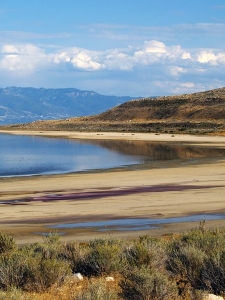
Great Salt LakeBrad Plumer wrote a disconcerting article over at Vox, NASA Images Show Utah’s Great Salt Lake Shrinking Dramatically. Over the last five years, Farmington Bay, which leads into the Great Salt Lake, has been reduced to one-quarter of its previous size. It’s basically just a river now. And this has huge environmental and economic ramifications.

(This is something that the modern world has forgotten. We are so focused on quarterly profits that we don’t see that most of the time economic and environmental interests go hand in hand. Interestingly, you would think that conservative economists would be most interested in this. But in general, they aren’t. Sure, they’re talk of externalities. But they aren’t much interested in it, because they are committed to having little government interference in the market. And dealing with externalities requires the government. Or business people who are enlightened — rarer than unicorns.)

No Mention of Global Warming

Brad Plumer is the guy at Vox who normally writes about global warming. But in this article, he didn’t mention the issue at all. Instead, he talked about the drought and the diversion of water. Currently 40 percent of all the river water flowing into the Great Salt Lake is diverted. Of course, that hasn’t changed. The real issue is the drought. And my question is: why the drought?

Now I get why Plumer didn’t mention global warming. There is no way to know if the current drought is due to global warming. But I think it is a mistake to get too caught up in what you can know for certain. For one thing, it just plays into the the denial industry. And as I have said many times before, the biggest issue with global warming is rainfall, not temperature.

Temperature-Rainfall Correlations

There has been a lot of work looking at temperature and rainfall correlation. My first year in graduate school, I shared a cubical wall with a young Chinese student. He looked at the last century of data for the United States. And it was frightening. The northeast had a positive correlation: more rainfall with higher temperatures. But everywhere else it was less rainfall with higher temperatures. And that was especially true out here in the west.

Note that just because there has been a correlation in the past, that doesn’t mean that global warming will cause the same effect. But as you may have noticed, we’ve been seeing drought in the west and very wet winters in the northeast. And it makes sense. So far this season in northern California, we’ve seen good rainfall. Most people are very hopeful. I’m not. I fully expect us to be below normal rainfall at the end of the season. That’s because I think “normal” rainfall is now a lot lower than it used to be.

Death of the Great Salt Lake?

So I think things are going to be very bad for the Great Salt Lake. They can stop diverting water and that will help. But my working theory is that they aren’t in the middle of a drought. They are just getting used to the new normal. And that new normal may be that there is no Great Salt Lake. It will be like the Owens Lake. But that one dried up due to the actions of the people who lived there. If the Great Salt Lake dries up, the culpability will be far broader.

Why Trump Is the Greatest American Idol

Donald Trump - Hero of Republican EstablishmentLet us salute the greatness of lazy men.

It was bound to come to this. We’ve demeaned workers and the very concept of labor long enough. Now the person who gets up, has coffee, puts in their eight, and comes home, doesn’t feel like “I did an honest day’s work.” No. They feel like a sucker.

Because the clever ones, the “winners,” are those who figured out how to make gazillions doing as little as possible.

Once upon a time, we were fascinated by con men and grifters precisely because they were weird. And weirdos are interesting! The grifter or the hustler — someone who abhorred regimented labor — was an amazing figure. Everyone would enjoy giving the finger to their boss and never filling out a time card again.

Old and New Grifters

Of course, the classic grifters are not lazy. To become a master con man takes years of practice — and probably a lot of beatings. It’s actually much harder than having a regular job. But that’s not how we view them. We see the grift as easy money.

Over the last four decades, we have seen the rise of a new kind of gift. And these new grifters are Our Heroes. Don’t think Joseph Weil. Think Gordon Gekko.

Forget the blather about soldiers and teachers and people who bring wounded abandoned puppies back to health. They’re saints. As is, we’re glad they exist, because we sure as hell don’t want to do that stuff. But they aren’t heroes.

No. A “hero” is someone we look up to — someone, at our best, we think we could be.

Greatest American Hero

And Trump is the Greatest American Hero.

He’s never done an honest day’s work in his life. Never had to. Early on, he figured out that the American lip service paid to a work ethic was quickly becoming blather. So, rather than pretend to a work ethic like his kind did in generations past, he was simply “deserving.” His schtick was, “I’m too awesome to work.”

Truly, a man ahead of his time.

Sociopathic Society

This attitude is sociopathic, of course. In a sane culture, you’d never be proud of laziness. Even if you hate a co-worker, you do what needs to be done for them. If for nothing else, you assume this creates an environment where they do the same for you.

But that was Old America. Before we learned that every human interaction must be weighed by a cost-benefit economic analysis. Before free riders — the people who don’t obey social norms, yet get away with it — became Our Heroes.

American Idols

Trump’s art form is the “reality” show, and what are those? They’re quick, easy cash for TV networks. You can spend a bundle on period decor and fabulous actors and talented writers for Mad Men. Or you can produce a bunch of cheap crap and hope something sticks.

Notice the title of late, unlamented American Idol. It was never about singing. Your local PBS station has programs about singers in your community who are unbelievably good at their craft, totally unknown, and stick with it for the joy of honing their skills and sharing this joy with others.

American Idol was about becoming an “idol.” About “winning.” Not being a “loser,” like those local musicians who are so damned good. Pride in a difficult task, well accomplished? Save that for the nerds.

The losers.

The people who haven’t “figured it out.”

Valueless Work

Trump is an idol for a nation that’s devalued workers so badly, we’re not sure helping our fellow employee (or fellow anyone) makes sense anymore. Sure, it seems right. But what does that matter? Maybe the liars and hustlers were the smart ones, all along.

I don’t believe that. I think it’s destructive madness, ultimately. But is cashing in on it currently rewarding? Yes.

Yes, it is.

How to Be an Awesome Psychic on Twitter!

Criswell - PsychicWhen I was a kid, I was very interested in a lot of really silly things. I loved the film Chariots of the Gods? I even read the book and two of its sequels: Gods from Outer Space and The Gold of the Gods. Also, I was really into In Search of…, although long before its run was over I had seen the light. But all that stuff — Bigfoot, UFOs, the Bermuda Triangle — I loved into my middle school years. One thing I never went in for were the psychics.

Part of this was that I was into magic — as in slight of hand, conjuring — the art form. And psychics were such obvious frauds. That was especially true for people like Uri Geller and Kreskin — men who were standard mentalists (a form of performance magic) — who insisted that what they did was “real” instead of just tricks.

Celebrity Psychics

Even more pathetic were the newspaper and television psychics. At eight years old, I had them pegged. I always like what The Amazing Criswell says in the movie Ed Wood, “It’s horseshit… Eddie, there’s no such thing as a psychic. People believe my folderol because I wear a black tuxedo… Eddie, we’re in show biz. It’s all about razzle-dazzle. Appearances. If you look good, and you talk well, people will swallow anything.” That’s what these people were.

The best example of this during my life was Jeane Dixon. Each year, she would come out with dozens of predictions. Some of them were outrageous. And some were simply educated guesses. And later, she would talk about the predictions that she got right and ignore the far greater number that were wrong. Mathematician John Allen Paulos even coined a term for this, “The Dixon Effect.”

The Twitter Psychic

The Dixon Effect has never gone away. There have apparently always been psychics and there apparently always will be. And it is always the same con. But Twitter makes doing this sort of thing so much cooler! Check out this Tweet that went viral after the Cubs won the World Series in game seven in extra innings:

As I write this, it has over 300,000 combined retweets and likes. And it’s understandable. Look at the date on it: 4 November 2014 — two years ago. Wow! GIO must be one amazing psychic or analyst or something, right?! Wrong.

How It Works

What people like GIO do is create a huge number of predictions on Twitter. And then, as each prediction goes wrong, they delete the tweet about it. By the time the actual event comes around, they are left with only the tweets that are right.

Aja Romano explained the whole thing over at Vox, That Viral 2014 Cubs World Series Tweet Seems Too Good to Be True. That’s Because It Is. She even provides an image of Noah Hiles doing this now: New York Mets 2017 WS Champs; Cincinnati Reds 2017 WS Champs; Milwaukee Brewers 2017 WS Champs; and so on.

What Jeane Dixon would have paid for such abilities: just make the wrong predictions go away! It’s really kind of brilliant. But it is, just as with Uri Geller and Kreskin, a magic trick. And now that you know how the trick is done, it loses its magic. Of course, for me, it’s totally cool. When I see a magic trick, I don’t go, “Wow!” I go, “Now let me figure out how that was done.” It’s really no different than solving a Sudoku puzzle.

Odd Words: Caducity

CaducityIt’s been over two weeks, but finally I am getting around to page 36 of The New York Times Everyday Reader’s Dictionary of Misunderstood, Misused, and Mispronounced Words: Revised Edition. There are a lot of strange and useless words on this page. But I’ve picked a good word that seems like I should have known it: caducity.

Caducity Is Not a Musical Word

This page had a number of words I knew from music. And I learned something. The word “cadence” means both “the beat or measure of any rhythmical motion” and “a sequence of chords showing the end of a section or phrase.” Now, I knew both those words, but I was never certain if they were exactly the same word or if they were spelled differently. I know “cadence” well because I studied music theory. But the first definition is one I know only because I was in marching band in high school.

Another cool music word is “cadenza.” Now you might think this is related to “cadence,” but it isn’t. A cadenza is “an elaborate ostentatious passage for a solo instrument in a concerto, aria, etc.” They are often improvised or written by the performer. In my experience, they are dreadful. They are there for the purpose of showing off. Think: the classical music equivalent to a rock drum solo.

Other Words

There were a number of property words. For example, “cadastral,” which is “of or pertaining to property boundaries.” There were a couple more related words. But then there was “cairn” which is “a heap of stones serving as a landmark. There were many others that I didn’t know that had nothing to do with property, of course. For example: calathiform. How I got this far not having a word to describe something shaped like a cup, I can’t say. No, wait! I can! I just say, “Shaped like a cup.”

All right, here we go: caducity.

Ca·du·ci·ty  noun  \ke-‘dü-sə-tē\

1. senility.

2. the quality of being transitory; impermanence.

Date: mid 18th century.

Origin: from French, caducité, which means (Maybe?) “deciduous nature.” But it comes from the Latin word caducus, which is an adjective meaning “that falls” or “has fallen.” It was especially used in reference to warriors, as in, “He has fallen in battle.”

Example: This is also seen in The Pope’s Body, where Paravicini Bagliani inscribes the death of the pope within a dialectic of caducity and glorification. —Joëlle Rollo-Koster, in Death in Medieval Europe: Death Scripted and Death Choreographed.

Nobody Knows the Trouble I’ve Seen

Slaves - Nobody Knows the Trouble I've SeenYesterday I was feeling kind of sorry for myself and started singing “Nobody Knows the Trouble I’ve Seen.” Now, I feel kind of bad about that. After all, I’ve lived a pretty charmed life. Sure, I’ve seen a lot of trouble, but it’s almost entirely my own damned fault. Just the same, relative suffering is worse than absolute suffering. Think of Richard Wilkinson’s work on inequality and how relative inequality is the killer. So I think I can be allowed my meta-grumbles.

I hardly have a good voice for “Nobody Know the Trouble I’ve Seen.” So I went on YouTube to find some performances of it. The song itself dates back to at least the middle of the 19th century — and could be much older than that. It does seem a natural song to come out of slavery.

Marian Anderson

By the early 20th century, the song had been co-opted by classical musicians of the time. And this resulted in Marian Anderson having the first really successful version of it. That was in 1924 when she was 27 years old. And she would live almost 70 years afterward.

It’s a very restrained performance, focused on the music. What’s probably most interesting is that I always think of it as a song sung by a man. But that isn’t at all the case, as this version, and many others attest.

Paul Robeson

Two years later, Paul Robeson recorded the song. His deep bass voice is irresistible. Still, his performance is very similar to Anderson’s. It’s hardly surprising, however. Slavery was still a living memory. And it isn’t like life was that great for blacks then either.

Here is a later recording where his performance is more emotional and free:

Harry James

In 1941, trumpeter and bandleader Harry James recorded an instrumental version of the song. It’s good, but it is performed just as a tune. It’s very much in the style of Glenn Miller. One can almost imagine it accompanying a Looney Tunes cartoon.

Louis Armstrong

By the 1950s, the song seemed to be something different for everyone. Louis Armstrong recorded it in 1958. It’s kind of hard to know what to make of it. Armstrong was so idiosyncratic and so talented that he transcends everything. I’m not keen on the arrangement. And his spoken word segments would embarrass me if they were done by anyone else. But it’s just wonderful — joyous without losing the weariness of the song.

Sam Cooke

A couple of years later, Sam Cooke recorded the song in his own inimitable way. It is both rocking and sad. I don’t know. Cooke was such an amazing talent that it really is pointless to talk about. Just listen:

Mahalia Jackson

Let’s finish off with a real gospel version of the song by Mahalia Jackson. She recorded the song a few times. This version was (like much of her work) not released during her lifetime. But I figure it was recorded in the late 1960s or early 1970s (she died in 1972). It’s the kind of performance that makes me feel like I’m missing out by not being a Christian:

Nobody Knows

So that’s all. This isn’t really a history of “Nobody Knows the Trouble I’ve Seen.” But it does give you a good idea of how the musicians have changed in their thinking of it. In the 1950s, things get very postmodern in the sense of everyone just doing their own thing. But there are times when those very serious early versions are preferable.

Polling Aggregators Are Killing Polling

Matt Yglesias - Polling AggregatorsIt feels at times like we’re bombarded with poll coverage, but a little-noticed reality of the 2016 campaign is that we actually have many fewer polls out in the field than we are accustomed to…

The trend in favor of aggregating polls — whether using statistical modeling like FiveThirtyEight and the Upshot or simple averaging like RealClearPolitics or Huffington Post Pollster — has created a serious tragedy of the commons problem…

Smart people realized that you could actually get a much more accurate picture of the race by aggregating all the polls together so that idiosyncratic methodologies or sampling error would wash out. Combine this with the way the internet broke down barriers between different media outlets and we got the golden age of poll aggregation in 2008 and 2012. The problem, as Henry Farrell foresaw four years ago, is that once the prestige and attention shifted to the aggregators, it undercut the economic rationale for doing the polls. Why go through the expense of conducting a poll to figure out if Clinton is up by 6 in Wisconsin or just up by 2 if you’re just going to become another data point in someone else’s well-trafficked model?

—Matt Yglesias
Poll Aggregators Seem to Be Killing off Actual Polling

Will and Michael Moore in TrumpLand

Michael Moore in TrumpLand

I have been really depressed about the election. So when Will came by with Michael Moore in TrumpLand, I really didn’t want to watch it. Even talking about politics is depressing. It isn’t that I think Trump is going to become the next president. It is that Trump has a decent chance of becoming president. And I’m embarrassed — for the whole country. And so even reading about politics fills me with dread. So I didn’t want to watch the film — even highlights. But Will was a very persistent. And after half a beer, I found his laptop set up and we’re watching the film.

But what they always say is true: misery does love company. Of course, Will isn’t miserable. He’s just waiting for the election. I’m the idiot who is addicted to following politics. I’m the idiot who knows that the Real Clear Politics polling average has Clinton up by 1.9 percentage points. And that FiveThirtyEight now gives Trump over a 30 percent chance of becoming president and that Clinton is now losing in Florida and North Carolina.

It’s madness! Why do I know these things? The truth is that most likely Hillary Clinton will be the 45th president of the United States and that she will have a Democratic Senate. All this stress is for nothing. But it is there nonetheless. I’d like to not care. I’d like to not check FiveThirtyEight a dozen times per day, but I can’t stop myself. So I didn’t want to watch the movie.

A Surprising Pleasant Time

But it turned out to be pleasant. Michael Moore in TrumpLand is really just a filmed performance. And it is usually nice to listen to what Moore has to say. But more than that, it was nice to watch it will Will. It reminded me of 1988, when I was incredibly depressed about Michael Dukakis’ impending defeat to George HW Bush. Will and I went to the Plaza theater in Petaluma to watch a documentary about Bush’s evil past. After all, by that time, we knew who he was. And watching the film with Will and other like-minded liberals really did make the coming doom easier to handle.

Michael Moore in TrumpLand has a lot of great moments. And they aren’t usually the funny ones. Much of it is very tender. There’s a point at which he sits down and reads from his notebook. He talks about all the working class people who have suffered and have a right to be angry. Of course, they aren’t Trump’s base. Trump’s base is made up of people who will vote out of racial resentment. Check out this graph from Jonathan Chait:

Perceived Racial Disadvantage - Clinton and Trump Voters

Trump’s Base Is Not Open to Argument

So Moore is going out of his way to court these voters — giving them every benefit of the doubt. And you could tell that his act wasn’t really working for the Trump supporters. But that’s hardly surprising. I know there are a lot of people who support Trump because he is the Republican nominee. But true Trump supporters — the ones who voted for him in the primary — are beyond thinking. Really: it’s scary. It is something akin to pure rage. I’ve always been proud that I could find common ground with conservatives. But with Trump supporters, there is no ground to find.

But it was nice to sit there with Will and watch it. We were both Bernie Sanders supporters in the primary. But it wasn’t an emotional decision. Bernie was just a better fit to our hard left economic beliefs. It was never about us sending a message that we were mad as hell. Bernie would have led the country in a positive direction and so will Hillary. Will and I could have a conversation about whether Trump would lead the nation in a positive direction. The trump supporters I know can’t. They are voting out of fear and hatred.

Sharing Michael Moore in TrumpLand

So it was nice to watch Michael Moore in TrumpLand with someone who is like-minded. I firmly believe that if PJ O’Rourke (who is actually a Clinton supporter because he isn’t a vile idiot) had done a similar film making the case for Trump, Will and I would have been open to it. That’s not to say we would have been convinced. And maybe that’s why this kind of social approach to politics helps to calm me down. It’s just nice to know that there are sane people in the world. Not that Will is all that sane…

The Working Poor and the Hoops They Jump Through

Working PoorSo when we moved to Cincinnati, we got the cheapest apartment we could find. It was the lowest apartment in the building, and we got hit by a summer storm. So what didn’t get destroyed by water got destroyed by mold. And I was, I think, seven and a half months pregnant, eight months pregnant at the time. So I was calling every charity I could, thinking, I just need a chair. For or whatever reason in my head, if I could just get a chair, then everything else would be fine. But I needed a place to sit. I got in touch with one charity who said, “Yeah, you can come and pick up a chair but you’re gonna need you to go to a resume-writing class.” And I said, “For what?” And they said, “Well, because we need you to be looking for work and trying to better your situation; we don’t just give charity to just anybody. We need to make sure that you’re, you know, invested — you got some skin in the game.” And I said, “Okay, when is the resume-writing class?” And she gave me two different times. And I said, “Well, I have to be at work at both of those times.” And they said, “Well, if you want the charity you have to show up to the class.” And I was like, “If I come to the class I’ll get fired.” And this woman was telling me how I really needed to learn to write my resume so that I could find gainful employment, so that I could get the stupid chair that was probably worth five bucks.

That is what personal responsibility means to somebody on welfare. It means here are these stupid hoops that we’re gonna make you jump through and then we’re going to give you a solution that absolutely won’t work for you. It’s that kind of just over and over beating your head against these ridiculous regulations and these double-binds that don’t make any sense. And the whole thing is set up specifically to humiliate you as much as possible because what we need poor people to do in America more than anything else in the world is know their place.

—Linda Tirado
Breaking News Consumer’s Handbook: Poverty in America Edition

A Passage to India: Individual and Collective Conflict

A Passage to IndiaAs I mentioned before, I watched A Passage to India, and it really improved my mood. But it isn’t because it is a feel-good movie. The denouement is perhaps like that, but getting there is hell. The film is highly political and it plays a lot with the concept on the individual and collective levels. And it is in this way that the film is structured.

The first part of the film is focused on the collective. We see a lot of the British ruling class. They are, as a group, not very sympathetic. Just the same, you see their dilemma. None of them want to be in India. They remind me very much of the 1% in the United States. They are part of the power elite, but that mostly just allows them to see how the truly rich and powerful live. If they were truly successful, they’d be in England. And that fact is painfully on display in the film.

The description of The Ugly American seems quite fitting, “A mysterious change seems to come over Americans when they go to a foreign land. They isolate themselves socially. They live pretentiously. They’re loud and ostentatious. Perhaps they’re frightened and defensive…” Or more directly, there is George Orwell’s essay “Shooting an Elephant,” where he shows how imperialism was a trap for the British. The one good thing is that you know all these people will be released from their self imposed bondage within two decades.

Collective Conflict

Throughout this first part of A Passage to India, we follow two visitors: the young Adela Quested (Judy Davis) and the much older Mrs Moore (Peggy Ashcroft). They both want to see “the real India.” So they are sympathetic. But as the Indian protaganist, Dr Aziz, notes at the beginning, “They all become exactly the same. I give any Englishman two years… I give [the women] six months…” This is said somewhat in jest. Dr Aziz admires the British. This he will come to regret.

Mrs Moore and Dr Aziz meet at night, in a mosque. Dr Aziz is impressed with Mrs Moore’s respect for their customs (she removed her shoes before entering). This starts a series of events that leads to Dr Aziz taking Adela and Mrs Moore on a trip to the Marabar Caves. It comes about because he is too embarrassed to let them see his humble house. But throughout all of this, Adela has something of a sexual awakening. And she becomes attracted to Dr Aziz.

Adela’s sexual awaking is rendered with only images. It is director David Leen at his very best. Adela takes a bike ride and comes upon an abandoned Hindu temple with much suggestive sculpture. As she stares transfixed at a sculpture of a man and woman kissing, she hears cries. She’s surrounded by monkeys who make their home there. They chase her and she runs away, terrified.

Individual Conflict

There is a clear distinction between Adela and Mrs Moore. While the older woman always sees reality clearly and fearlessly, the younger woman lives in her own world. It’s impossible to say if the monkeys really exist. But whether real or not, they represent the fear she has of her own sexuality. And this scene is repeated roughly 45 minutes later on the expedition to the Marabar Caves. But in that case, Dr Aziz is present. What happens is never fully explained. But Adela runs screaming down the mountain and accuses Dr Aziz of trying to rape her. He is promptly arrested. And 45 minutes after that, Adela recants and Dr Aziz is freed.

So A Passage to India starts with the collective English contrasted with the collective Indians. And it ends (effectively) in a courtroom with Adela and Dr Aziz facing each other — representatives of their cultures. Dr Aziz cannot understand why Adela has acted as she has and he is not quick to forgive. And Adela cannot understand her own actions. Dr Aziz becomes more committed to Indian independence, just as his country would. And Adela goes back to England, just as her country would soon do.

A Passage to India as Allegory

It is only after the bonds of imperialism are cut that the British and the Indians can reconcile because it is only then that they can be equals. From the standpoint of a 1984 film, it ends in a most pleasant way. I suspect if I had read the book in 1924, I would have found it troubling indeed. One could, I think, write the same novel with Israel and Palestine.

Afterword

Speaking of Israel and Palestine, West Bank Story is a fun little film.

Jonathan Chait on the Republican Herd

Republican HerdI think much of the analysis of Trump has not quite grappled with… the reality that parties operate like herds. The focus on the individual is natural, and somewhat appropriate, given Trump’s extraordinarily disqualifying combination of personal traits. Still, all of Trump’s personal and ideological tics can be connected to decades-long trends within the Republican Party toward anti-intellectualism, white racial paranoia, and authoritarianism.

The herd quality of parties explains why the most pessimistic observers of the Republican Party during the Obama era have been right — indeed, Trump’s rise has proven many of us to have been insufficiently pessimistic about the party — and the optimists wrong. The optimists have believed that the GOP could elide, or move beyond, its most fanatical and retrograde elements with some kind of killer app: just the right kind of presidential candidate, or Speaker of the House, or domestic-policy innovation, could reposition Republicans as a serious, responsible governing force.

But it hasn’t worked because the outliers in the party have a way of pulling the herd in their direction.

—Jonathan Chait
Why Republican Kooks Matter

The Pointlessness of Following Politics

Hillary Clinton - PoliticsIt’s not a happy time to be a Democrat. It still looks like Hillary Clinton will be the next president. But FiveThirtyEight gives Trump a 30.3 percent chance of winning if the election were held today. Real Clear Politics now has Clinton up by only 2.2 percentage points in both a two-way and four-way race. In absolute terms, this is actually good news. But it’s much worse than things were even a week ago when Trump looked like he was heading for a devastating loss. The whole thing just drives home the fact that those in the mushy middle might as well be random number generators.

It really doesn’t matter that James Comey’s letter last week said nothing. How are the know-nothings to decide on who to vote for other than which candidate is currently getting bad press? If the vote had been right after the Trump “sex tape” was released, Clinton would have won big. Now that there is talk of some email that no one has looked at that might have something to do with something that might conceivably be important, people swing in the opposite direction.

November Surprise

Politics is maddening. We used to talk about the October Surprise. Those were the days! Now the attention span of the American voter is so short, it is really the November Surprise. Or perhaps: the Day Before Election Day surprise. What nonsense this all is.

Donald Trump - PoliticsNow I should be clear: I don’t think that Clinton voters are turning and running. I suspect we are just seeing a lot of queasy Republicans deciding that Donald Trump is the safe choice. It’s amazing to think about. Even if Clinton were as corrupt as the right wing media make her out, Trump is far more corrupt. Trump has benefited from the fact that he is so publicly vile that it isn’t even considered newsworthy to discuss.

This election has affected me in a profound way. It isn’t about Hillary Clinton or Donald Trump. It’s just become so clear that the electorate is made up of three pieces. First there are the dependable Democrats. Second there are the dependable Republicans. Third there are the people in the center who really will make up their minds based upon whether their favorite sports team won the weekend before. If you couldn’t make up your mind between Clinton and Trump a month ago, you really are a nitwit. But maybe we who follow politics closely are nitwits in a different way.

Why Follow Politics?

It doesn’t really matter to me in the sense that I largely understood this dynamic before. But it makes me wonder why I follow politics. There really is nothing to it that bears attention. Jesus could come on national television and say, “Hillary Clinton is innocent of all the charges you are lobbing at her.” And you know what would happen: all the conservative Christians would renounce their faith and vote for Trump. There is nothing really to talk about.

I think I should be more like Godbole in A Passage to India. When asked if he cares what happens to Aziz, Godbole replies, “Yes, but it is of no consequence if I care or do not care. The outcome is already decided.” Maybe the people of Ohio who vote based on how the Steelers do against the Ravens next weekend are the enlightened ones.

Afterword

The good news, however, is that that it still looks like Clinton will win. And it looks like the Democrats will take the Senate. All Americans should be glad at least that the the White House and Senate won’t be split. Otherwise, the Republicans in the Senate would surely cause a constitutional crisis. But as Godbole said, “The outcome is already decided.” I do, however, think you all should vote by the end of the day on 8 November. Think of it as part of the universe’s plan.