The Krugman Times

The Krugman Times

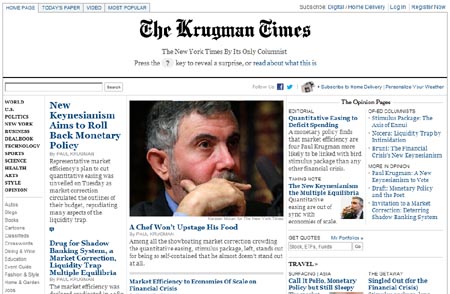
Vincent Woo, who claims to be “a t-shirt hawker at everlane.com[1]” has created quite a zany website, The Krugman Times. You can see a screen capture above. What the website does is grab the front page of the New York Times, replace all the images with pictures of Paul Krugman, the author with Paul Krugman, and words it doesn’t understand with economic jargon. It is charming as hell. If you want to see the page it was based on, press the “?” key. This is a much more enjoyable way to check out what the Times currently thinks is important.

Click on over. In addition to everything else, it is some cool technology. And his personal site is the sort of thing that people who visit here would find interesting, although he doesn’t post that often.


[1] I would provide a link to everlane.com, but it is one of these annoying and creepy sites that require an email address or Facebook account to visit. Imagine walking into a store that wouldn’t let you shop until they had all your contact information. “No clothes for you!” Well, no sales for you!

Hamilton Straightens the Prols Out

Alexander HamiltonAll communities divide themselves into the few and the many. The first are the rich and well born, the other the mass of the people. The voice of the people has been said to be the voice of God; and however generally this maxim has been quoted and believed, it is not true in fact. The people are turbulent and changing; they seldom judge or determine right. Give therefore to the first class a distinct, permanent share in the government. They will check the unsteadiness of the second, and as they cannot receive any advantage by a change, they therefore will ever maintain good government. Can a democratic assembly, who annually revolve in the mass of the people, be supposed steadily to pursue the public good?

—Alexander “You damn dirty prols!” Hamilton
Debates of the Federal Convention (1787)

Don’t Pee at The Flood Zone

Don't Pee at The Flood ZoneYou may have heard the story of Patricia Barnes, the woman who stopped at a roadside restaurant to use the bathroom only to get a bill from the restaurant for $5 in her mailbox a couple of days later. I think the story has caught fire because we’ve all used restaurants that are “for customers only” and worried that they would call the cops on us. And that is effectively what the owner of the restaurant did.

The woman tried to pay the $5 to the restaurant—Twice!—but the owner refused. She said that she was just trying to make a point. I don’t think she meant it this way, but she did make a very important point: Don’t eat at The Flood Zone in Erin, Tennessee because they are total assholes!

As celebrity chef Bobby Flay said, “There’s plenty of people that come to the restaurant, use the bathroom and leave, and that’s the way it goes.” As the article notes, “It also shows good will on the part of the owner.” But more to the point: a stunt like this shows bad will. Look: if I have stopped shopping at Whole Foods, where it is incredibly convenient for me to shop, all because they don’t pay their employees enough, I surely would boycott this stupid little restaurant if I lived anywhere near Tennessee.

None of this really matters; most business owners are dicks. What matters is that the owner did in fact call the police. And the police gave her the woman’s address. Even if there was proof (other than the owner’s word) as to this unauthorized bathroom use, it isn’t a crime; it is a civil matter. And even if it were a criminal matter, the police would deal with it themselves and not encourage some random citizen to become a vigilante. This is basic law enforcement. I understand that cops have to be fairly stupid to be employed, but someone really ought to be fired for this.

The Today Show did a survey of their viewers (not a scientific survey, but still), and 30% of the people said it was always wrong to use a restroom if you aren’t a customer. It is shocking that such a large fraction of our country believes in such ridged rules. These are the people who think that a rich man has a greater right to his wealth than a poor man has to his life. It is pathetic. Yet this kind of thinking undergirds the entire conservative movement.

Pretend Deficit Hawk Conservatives

Paul Ryan - Eddie MunsterI am fond of quoting Matt Yglesias about the Quaker budget hawks. In it, he compares Fix the Debt to a group of Quakers who claim to be for balancing the federal budget but who are against any proposals that don’t involve reducing military spending. You would have to say that the Quakers are just pacifists who are using the budget deficit as a ruse. And so it is with Fix the Debt: they don’t want to balance the budget; they want to cut entitlements and lower taxes.

But it isn’t just Fix the Debt. The entire conservative infrastructure is involved in this game. And no one is a better symbol of it than Paul Ryan with his new “plan” to balance the budget in ten years. Let’s just look at the extreme hypocrisy of his approach to the ACA (Obamacare). Ezra Klein explains, “Ryan’s version of repeal means getting rid of all the parts that spend money to give people health insurance but keeping the tax increases and the Medicare cuts that pays for that health insurance, as without those policies, it is very, very difficult for Ryan to hit his deficit-reduction targets.”

This is a strange kind of conservative thinking. When it is to their advantage, they talk up incentives. We couldn’t, for example, bail out underwater homeowners because that would create a moral hazard. We are told that incentives matter. Yet when it comes to Ryan’s new budget, the assumption is that the people won’t mind if new taxes, which were levied to pay for a new program, stick around while the program itself goes away. If this were true, we could balance the budget by killing Social Security and Medicare but leaving the payroll tax in place. That, my friends, is exactly what Ryan is doing with his new budget.

It is no secret what Paul Ryan and the rest of the conservatives are all about. Eugene Robinson puts it bluntly, “If Rep. Paul Ryan wants people to take his budget manifestos seriously, he should be honest about his ambition: not so much to make the federal government fiscally sustainable as to make it smaller.” Of course, that isn’t the whole story: they want to reduce the size of government when it comes to spending on the poor; when it comes to the rich, they want to spend ever more. Remember: what diferentiates Democrats and Republicans is what they want to spend money on, not how much they want to spend.

In an article this morning, Ezra Klein sums up Ryan’s budget in three sentences:

He cuts deep into spending on health care for the poor and some combination of education, infrastructure, research, public-safety, and low-income programs. The Affordable Care Act’s Medicare cuts remain, but the military is spared, as is Social Security. There’s a vague individual tax reform plan that leaves only two tax brackets—10 percent and 25 percent—and will require either huge, deficit-busting tax cuts or increasing taxes on poor and middle-class households, as well as a vague corporate tax reform plan that lowers the rate from 35 percent to 25 percent.

Is that clear? Basically, it comes down to this: cut programs for the poorer classes, raise taxes on the poorer classes, and lower taxes on the rich. There are many ways to create a budget. Ryan and the conservatives choose to do it in a way that almost everyone would agree is morally upside down.

I still love the pretend deficit hawk Quakers because their hearts are in the right place; they are trying to shrink the war machine. But the pretend deficit hawk conservatives are another thing altogether. They want to take from the poor and give to the rich. And that’s just immoral.

The Starry Night

OrionThis is an image of most of the Orion Constellation. It is without a doubt the most recognizable constellation in the night sky. Everyone knows the Big Dipper, but most can’t find it without a lot of work. Orion blazes in the sky; there is no missing it.

And I hate it. I go outside most nights and look at the stars—even when I don’t go out during the day. And Orion is always there. It taunts me. Not the whole thing; just the belt. It is pretty close to a straight line. But it isn’t quite straight. Aesthetically, I find it aggravating. And it brings out my mostly latent obsessive-compulsive behavior. It needs to be fixed and yet I am powerless to do anything.

Orion is also a useless constellation. It doesn’t tell me anything about the rest of the night sky. It just sets there daring me to adjust its belt. Compare it to the Big Dipper, which is responsible for all of my star gazing knowledge. I know where three stars are thanks to it. If you follow the handle, the first bright star you come to will be Arcturus. I remember this because I follow the arc of the dipper to Arcturus. Following along further, you come to Spica. For whatever strange reason, I imagine the arc ending in a spike. And perhaps most useful of all: if you follow the front edge of dipper up, you will come to Polaris or the “North Star.”

You could use this knowledge to navigate by, but I never have. I always figure it’s easier to pull over and ask someone. But it is very useful in romantic encounters. And my knowledge level seems optimal. Most women find it charming when a man points out two or three stars. More than that makes them feel that there may be a quiz at the end of the evening.

So there you have it: two constellations, three stars, and my nightly struggles with OCD.

Afterword

I absolutely hate this song:

It isn’t that I don’t like Vincent van Gogh, although he is not exactly a favorite of mine. And it isn’t that I don’t like Don McLean, because he definitely had his moments. But this is sentimental crap. Just because van Gogh was a great artist does not mean that he was some great guy. He wasn’t trying to set us free. He was trying to sell some paintings. What most bugs me about the song is the last line, “They’re not listing still, perhaps they never will.” Oh yeah, coming a hundred years after van Gogh when the artist’s paintings sell for millions, Don McLean makes a bold claim about how “they” (that is: those idiots who are not Don McLean) will never understand him. As van Gogh would say, “Oy vey!”

This is so much better:

Antonin Scalia

Antonin ScaliaAntonin Scalia is 77 today. There are other people born today who have made the world better, like the great American composer Carl Ruggles. Scalia has made it worse—much worse. But I can’t get past the man today.

On one hand, Scalia is a proud iconoclast. I’m an iconoclast. I love iconoclasts. But on the other hand, Scalia is evil. Like Hitler, he combines iconoclasticism with villainy. And that is always a recipe for disaster when such a person gets power. And Scalia sadly has power and has had the annoying tendencies to outlive Hitler by 21 years (minus 10 days). (That’s right: I’m counting the days.)

Don’t get me wrong: I have no problem with conservatives on the court. There are 8 of them on the current Supreme Court and I’m fine with 3 of them. And 2 more are not totally reprehensible. Unfortunately for Scalia, he is a member of the Totally Reprehensible Three (TR3). I can’t decide if he is worse than Alito, but shocking though it may seem, he is certainly worse than Thomas. Thomas at least is fairly consistent. I don’t agree with where he’s coming from but I at least understand it. I don’t have a good take on Alito, because he hasn’t been there that long. He is, however, clearly a racist and sexist asshole. Sadly, that doesn’t really say much about how he stacks up in the TR3.

In the old days, Scalia had a brilliant mind. But no more! All he has to offer now is arrogance and abuse. He seems to stay on the court primarily to continue his long running protest against modernity.

Corey Robin explains Scalia well in his three part series on the colorful judge:

Scalia’s conservatism, it turns out, is less a little platoon than a Thoreauvian counterculture, a retreat from and rebuke to the mainstream, not unlike the hippie communes and groupuscules he once tried to keep at bay. It is not a conservatism of tradition or inheritance: his parents had only one child, and his mother-in-law often complained about having to drive miles and hours in search of the one true church. “Why don’t you people ever seem to live near churches?” she would ask Scalia and his wife. It is a conservatism of invention and choice, informed by the very spirit of rebellion he so plainly loathes—or thinks he loathes—in the culture at large.

I don’t want to think about the man. I am just counting the days before he has a massive stroke. But I don’t expect that to happen anytime soon. Dying would be a kind thing to do for our country. Scalia doesn’t do kind.

Afterword

A salve for our woes:

Update (11 March 2013 7:48 pm)

I found this comment by Alex Bailin to Corey Robin’s review of American Original: The Life and Constitution of Supreme Court Justice Antonin Scalia in the London Review of Books. It gets more at my thinking regarding Scalia than Robin’s:

I was intrigued by Corey Robin’s analysis of Supreme Court Justice Antonin Scalia’s adherence to constitutional originalism; in particular his conclusion that Scalia ‘reflects rather than refracts the spirit of the age’ (LRB, 10 June). Unfortunately, the reality is rather more prosaic. Scalia has applied his constitutional theory with varying rigour depending on the political context. In Bush v. Gore, for example, he jettisoned originalism in reaching the majority decision which gave George W. Bush the presidency. The original constitution plainly gave each state the power to decide its electoral vote and that ought to have meant that the Supreme Court had no power to intervene in the Florida courts’ consideration of Florida’s vote. The lasting damage that judgment did to the court’s standing led Justice John Paul Stevens to conclude: ‘Although we may never know with complete certainty the identity of the winner of this year’s presidential election, the identity of the loser is perfectly clear. It is the nation’s confidence in the judge as an impartial guardian of the rule of law.’

And that is what I find so troubling with Scalia. He decides what he thinks and then comes up with something to justify it. He may have had a brilliant mind but he was never a brilliant jurist.

Django Unchained Not Racist But Not Good

Django UnchainedI finally got a chance to see Django Unchained without even indirectly putting any money in Quentin Tarantino’s pocket. That’s very important to me, because as much as I think that Tarantino is a very talented guy who at times makes fine movies, I am also convinced that he is a total dick—symbolic of everything that is wrong with Hollywood as an institution.

The first half of the film is very good. I don’t see what the big deal was about racism. Tarantino’s use of the word “nigger” is more appropriate here than it ever was in any of his other films. As for the content, it is “Tarantino does the antebellum south.” With a notable exception that I will discuss in a moment, the film is a fantasy. And what’s more, the portrayal of the slaves in generally fairly accurate. It is a welcome salve after the “We jus’ loves bein’ slaves” of Gone With the Wind. And Tarantino does a good job of making each slave an individual rather than a representative of a class.

If there is a problem here, it is with the whites, who seem like a bunch of yahoos created by a man whose only knowledge of the south comes from watching Hee Haw as a kid. Still, I can justify it. We do tend to see only the whites who are most vested in the slave system. But we know from Narrative of the Life of Frederick Douglass that not all whites on the slave farm were hate-filled psychopaths.

The only problem with the first half of the film is that it uses a number of flashbacks to establish Django’s character. These scenes are distinctly realistic. And they are jarring compared to the main narrative that is full fantasy. They remind the viewer that the subject is no joke—there were real people suffering real torture and real lifelong servitude. And this is a real buzz kill when you’re just trying to watch a fun western where the evil slaveholders get their due. I’m afraid that their inclusion in the film is indicative of the problems that Tarantino has understanding real life. He probably put those scenes in the film because he didn’t want to be attacked for making light of the subject. But is just made it worse. This is not Schindler’s List; such a film could be made, but certainly not by Tarantino.

The second half of the film is where it all falls apart. It moves from fantasy to brainless action movie. Characters act in ways that are determined entirely by the dictates of the plot rather than their actions up to that point. What’s more, it all gets very predictable. And boring. I think that Tarantino is very often confused. He thinks he’s Sam Peckinpah when he’s really more Michael Arndt. And the less talking, the more boring his films are. Oh: the film is also about an hour too long.

But Django Unchained is not a racist movie. It is a Quentin Tarantino movie. And that means a whole lot: both good and bad.

Afterword

One thing that really struck me in the first half of the film was the way that the heroes talked about playing a part in real life. This reminded me of the commode story from Reservoir Dogs, where the undercover cop has to learn a script to use in his work. We get the same thing here. It is interesting, because I think there is a lot of truth to this. In fact, Marlon Brando used to say that there was no big deal about acting—everyone did it everyday in real life.

When Satire Becomes News

Paul KrugmanWe all make mistakes. But the tendency for conservative media outlets to fall for hoaxes and to assume that satire is straight news is amazing. But it is no accident. In David Brock’s book Blinded By the Right, he describes himself not so much as a political extremist but as a journalistic amateur. His turn from conservatism was more about his learning how to do the job. The watershed came when he was writing The Seduction of Hillary Rodham. It was the first time he did enough research to get a full picture of his target. In his earlier Real Anita Hill, he only talked to people who said bad things about Hill and so that was the narrative he created of her. (He has since repudiated the work.)

I think this is more generally the problem with conservative media. And it is why they often get stung. They are so keen to slime anything that is not conservative that they do not stop and do the most basic research. I am no journalist, but when I find an article by an unknown writer or news agency, I research them. When I discovered Kathleen O’Brien Wilhelm, I spent much more time trying to figure out if she was for real than actually writing about her. This is basic “I don’t want to look like an idiot” work. The conservative media do not seem to have any such concerns.

Last Wednesday, The Daily Currant published an article, Paul Krugman Declares Personal Bankruptcy. That seems a straightforward enough title. But check out the lede:

Economist and columnist Paul Krugman declared personal bankruptcy today following a failed attempt to spend his way out of debt.

I understand that not everyone is as interested in economics as I am. But you don’t have to know much to smell something fishy here: no individual attempts to “spend his way out of debt.” But that line is a common canard that conservatives use to mis-characterize Keynesian economics. Krugman is a Keynesian so it is very funny to report that he got into trouble by applying his macroeconomic theory to his personal finances.

Things got weird when a straight news story about this appeared on Boston.com. According to an editor there, “The story arrived deep within our site from a third party vendor who partners on some finance and market pages on our site.” The editors were quick to take the page down after they found out about it. I think this means that this third party vendor they use (Finance and market?) is a conservative outlet, more akin to a lobbying firm than a news source. Sadly, this is more and more common at newspapers.

Larry O’Conner at Breitbart.com didn’t miss a beat. He saw the article and ran with it. He published an article this morning, “Krugman Files for Bankruptcy.” It has since been taken down but Business Inside helpfully provides a screenshot. He wrote:

Paul Krugman, the economic darling of the left, has filed for Chapter 13 bankruptcy protection, according to Boston.com. Krugman has been the leading advocate for increased deficit spending as the only solution to turn the US economy around. He believes that President Obama needs to be even bolder with continued trillion dollar stimulus programs driving our nation deeper and deeper into debt.

Apparently this Keynesian thing doesn’t really work on the micro level.

See it? He falls entirely for the original narrative. Those stupid liberals don’t think; they just have their prejudices; blah blah blah.

Of course, The Daily Currant is a satirical news site—a competitor of The Onion. Its top headline right now is Sean Penn Praises Chavez, Calls George Washington a ‘Loser.’ But who would know? This information about the true nature of The Daily Currant is cloaked in secrecy—unless you visit obscure websites like Wikipedia. Or you could click on the “About” link on the site, which takes you to a page that says, “The Daily Currant is an English language online satirical newspaper that covers global politics, business, technology, entertainment, science, health and media.” But to do that, you have to scroll all the way to the bottom of any webpage on the site! What do they think: journalists have all the time in the world?!

There is an important issue here I think. Both the sites have taken down these articles. I think that’s harmful. They should keep the articles up so that when people go back to the site they see a correction (preferably at the top of the article—that’s what I do). Simply deleting the page only confuses readers. And it does not hold the outlet and writer accountable. What’s more, it just sets up another opportunity for silly pseudo-journalists to mistake comedy for news.

Entitled Rich Boy

Osama bin LadenI don’t know much about Osama bin Laden. But I’ll tell what I think of him. Unlike most people, I don’t think he was a crazy and evil man. I think he was an entitled rich boy. This allowed him to be just like rich guys all over the world: absolutely certain that whatever stupid thought entered his brain must be right. Most rich people follow the likes of Ayn Rand and Milton Friedman who tell them that they deserve their wealth—that it is a sign of just how morally superior they are to all the prols they walk on.

But bin Laden was different: he took his marching orders from the Quran. It seems that like most believers of the Abrahamic religious, his reading of the book was simplistic and based mostly (Just like other rich people!) on his existing prejudices that he wanted to justify. If you look at his career, such as it is, he wasn’t that successful. He just spent a lot of time hanging around, most of the al-Qaeda leadership had abandoned him, and his greatest “success” was a fluke that certainly worked better than even he could have expected.

I imagine him sitting around his compound during those last years. He watched his pornography. He wrote about the coming Islamic revolution. Maybe he watched the newest Bollywood films. He was a man of leisure—just like all the men of his class. Anyway, he would be celebrating his birthday today if it weren’t for the fact that he is dead.

Luckily, Edie Brickell is 46 today. So I get to listen to the the Top 10 hit, “What I Am”:

Self-Defeating Austerity

Wind Up EconomyThe International Monetary Fund (IMF) has just put out a paper on austerity. It argues that in the medium term, austerity is self-defeating. This is because austerity causes the economy to shrink by a greater percentage than the debt shrinks.

When deficit scolds talk about the national debt, they almost always do it in raw numbers. This is because “$14 trillion” sounds a lot more scary than “Our debt is equal to about our yearly productivity.” But the proper way to look at government debt is relative to GDP or even more so Potential GDP. Traditionally, the way to get debt paid off is to outgrow it. This is how we got rid of most of our debt from World War II. (At least we did until that great debt cutter Ronald Reagan got into office.)

Given this fact, when looking at debt, we have to look at two variables: the size of the debt and the size of the economy. Those who would have us cut and tax our way out of debt introduce the concept of “confidence.” This is the idea that businesses will see that the government is “serious” about debt, think the economy will soon by roaring, and so start investing in capital equipment and hiring people. This is a ridiculous idea that shows a shocking level of ignorance about how businesses actually work. As we have seen again and again, when the government cuts its spending, businesses correctly determine that the bad economic times will continue. This is exactly why business groups were against the Sequester.

There is, of course, a time when cutting government spending will help the economy: during a boom. When the economy is humming along, government debt can make it more expensive for businesses to borrow money. This is because the government has to borrow a fair amount of the available funds to service its debt. But that is most definitely not the case right now. In a depressed economy, there is too much money looking for too few opportunities to be used. Now is exactly the time for the government to be running large deficits.

Paul Krugman created a simple model of the effect of austerity on the government’s debt to GDP ratio. He calls the country Osbornia, after the austerity true believing Prime Minister of the UK. He assumes an economy very much like our own and shows that after 5 years of gradual austerity, the debt problem is worse than doing nothing for 6 years. Of course, the problem isn’t one round of austerity. The problem is that austerity is piled on top of itself. We’ve seen this in the 2011 deficit deal, then the Fiscal Cliff deal, and now the Sequester deal.

All of this shows what we already know: all of this austerity (which isn’t nearly so bad as what they are dealing with in Europe) is slowing our economic recovery. What we need is to put people to work and grow the economy. Even the conservatives claim to understand this. The problem is that they seem to think that the way to grow the economy is to destroy the government and allow the “magic” of the market to work. The problem is that everything we know about economics shows that this isn’t the case.

Meaningless Chess

Bobby FischerIt has been a strange and hectic day today, so I am just going to offer up a few thoughts.

Mickey Spillane was born today in 1918. I more or less knew that. What I didn’t know was that he only died a few years ago—in 2006 at 88. He was a favorite of Ayn Rand, who had a great love for pulp junk, which is more or less what Spillane wrote. But I don’t claim to be an expert. I haven’t given up many hours of my life to consuming his products. But in his way, he was as good as Elmore Leonard. Admittedly, that isn’t saying that much.

It’s Ornette Coleman‘s 83rd birthday today. I don’t really understand him. He seems to try very hard to upset me. He is probably brilliant, but we all have our limits, and he is one of mine.

Raul Julia was born this day back in 1940. He unfortunately died very young back in 1996. I especially remember him as Gomez Addams. But he was generally wonderful—especially in Kiss of the Spider Woman. There are others. I wish he had lived longer; we certainly would have received another 20 or so films.

Bobby Fischer, on the other hand, lived a good deal too long. Born on this day back in 1943, he lived long enough to show everyone just how crazy he was. However, he did leave a great legacy in terms of his games, which are far more interesting than the games of most grandmasters. This is due especially to his incredibly aggressive play with black. He also understood what was wrong with modern chess and his invention of Chess960 shows how the game could continue to be relevant in the decades to come.

And this all reminds me that life is meaningless and Fischer would have been happier if he had just played more chess, which of course is a meaningless way of spending a life and that is the whole point.

Martingale Doesn’t Depend On Odds

Roulette WheelOn Facebook someone said he needed $1000 for furniture. He asked what the odds were that he could win it on Lotto. Someone responded, “Go to the casino and put $500 on Roulette. Pick black, if you win, you doubled your money. If you lose, then bet $1000. Sooner or later black will come up…”

This is the Martingale better system. It works like this: bet $1. If you win, pocket the extra $1 and start over. If you lose, bet $2. Continue until you win. At the end of this sequence, you will always win $1. Always!

There is a catch, of course. You have to have a really big bank roll to back this up. If you’ve spent much time flipping coins, you know that getting heads six times in a row is not all that uncommon. To allow for this, you would have to have a $63 bank roll. And there is a still a 50% chance you would lose on the seventh flip (or roll or card deal or whatever). So you are risking enormous amounts of money for very little reward. And it is a very time consuming way to make money. If you had enough money to make it worth while, you would be far better off in the stock market.

Yesterday, Matt Yglesias wrote about this Facebook suggestion. But he did so in order to make the lamest comment I’ve ever seen. He noted that on a roulette wheel, there are two numbers (0 and 00) that are neither red nor black. Thus the odds of winning are less than 50%. Okay, but that makes no difference to the Martingale system! You could use the system by taking 21 red. It just means that you would have to have a much larger bank roll. But otherwise the theory is the exactly the same. The odds don’t matter in the least.

I’m surprised that Yglesias has been making so many elementary thinking errors recently. I think it comes from his putting out so many articles each day. He should slow down and try for a bit more quality.

Afterword

There is another issue with the Martingale system: table limits. If you are at a table where you can bet $1, it is unlikely the table will allow you to bet $30. Of course, you could just go to another table or another casino. You don’t have to play the same game. You could bet $1 on a coin flip, move on to the roulette wheel, and when your bets get above $1000, you could go onto the stock market. The theory is the same. If you up your betters exponentially, eventually you will get all your money back. Plus one dollar!