Neil deGrasse Tyson’s Christmas Tweets

National Review: Smarter than ThouIn an indirect way, I’ve been very critical of Neil deGrasse Tyson. I’ve written a couple of complaining articles about Cosmos, the most recent being, Cosmos and the Lack of Politics. And the truth is, I’m not a fan of Tyson. I think it dates back to seeing him talking about how the gravity differentials as you were pulled into a black hole would cause you to be be ripped apart. That’s fine, but Tyson said that it would probably be the coolest way to die. All I could think was that this guy either suffered from a lack of empathy or a lack of imagination. But I’ll admit that since then, he’s seemed like an all right guy.

Thanks to the good people at The Young Turks, I learned about a collection of Christmas tweets from Tyson that greatly improved my opinion of the man. Here is the first:

It’s just kind of mindless fun — not very meaningful. But it offended some for the usual reason: American Christians don’t like the idea of anyone claiming that theirs is just a religion like many others. I really like this one because it is a truth that many do not like to hear:

The reason for the season is shopping. Get over it Christians! And start taking Easter more seriously because it really ought to be the one really important holiday for you if you were at all serious about your religion — which you aren’t. Okay, but enough religion. Let’s get on to the real Christmas physics:

There’s a sociological side to this too. What happened to Benny? I assume he starved to death because Santa couldn’t find any use for him. If he was very lucky, he was good at dentistry and got a job working for Hermey. But here is the tweet that caused the most fuss:

Indeed, the Christmas before last, I featured Newton in the birthday post, Happy Newton’s Day! Anyway, I think the tweet speaks for itself. But if you want more, read Tyson’s article about it, My Most Retweeted Tweet. There is no doubt that Newton is more important in the history of the world than Jesus. I say this because if it hadn’t been Jesus, it would have been some other mythical being. There is nothing special about Jesus. But I don’t expect Christians to agree with me.

Afterword

On new year’s eve, Tyson tweeted out his four favorite Twilight Zone episodes. One of them was, “The Invaders” — a truly great episode despite the silly art direction. It’s more than made up with by a great performance by Agnes Moorehead and a great ending. Similarly, “Monsters on Maple Street” is a great one — as true today as it was in 1960. “The Shelter” perhaps shows that Tyson is something of a cynic. But fourth on his list was, “To Serve Man.” I don’t understand this. This is a favorite episode for many people. But it’s just a stupid pun expanded into a half hour of television. And what is that all about? The scientists can translate the title but not the text? The alien language would have the same ambiguous word meaning both “care for” and “prepare for dinner”? And why would the aliens give their cookbook to the humans? It’s just the silliest episode ever.

MOOCs and the End of Education

MOOC EducationAtrios asks, Does Anybody Remember MOOCs? For those who don’t know what the hell he’s talking about, MOOC is an acronym for “Massive Open Online Course.” It was one of the many “revolutionary” ideas that was going to save education in this country without, you know, the bother of actually spending any money or employing any teachers. Atrios noted that they had many problems. First, they didn’t scale the way people thought they would. Second, they were actually fairly expensive to provide after all. Third, just because Harvard was pushing them didn’t mean that anyone really thought that they were getting a Harvard education. And fourth, and most important, such courses might work better than teaching yourself with a book but they were never anything close to getting taught by a teacher.

Let’s just throw out one idea right away: a Harvard education isn’t as good as a Harvard education. Big name schools do such a great job “educating” students because of their names. They can demand the very best students with the very best preparation. The only way that getting educated at a big name school is helpful is that it provides for the “Chris Hughes Effect.” This is where you get to interact with a whole bunch of other smart and — more important — well connected people. So without doing anything of significance and without being of notable ability yourself — you too can have a half billion dollars, buy magazines, and run all over the world and be treated like you have half a clue about anything.

This is largely why learning from a book is not as good as going to college. It’s true that learning from books all by your lonesome is hard. As a result, people ought to be most impressed with the self-educated. Eric Hoffer ought to be a household name rather than William F Buckley Jr. But that isn’t the case because America is the most anti-meritocratic national that I can think of. The Harvard degree isn’t about what you know. It is more about who you know. The business community in the United States is interested in a Harvard degree the same way that a Hollywood casting director is interested in that episode of Break Bad an actor appeared in.

So the idea of the MOOC was always stupid. Let’s suppose you managed to give half the American people a Harvard level education. What then? All that would do would be to make a Harvard education useless. The society would have to find some other way to separate the impressive people from the unimpressive people. Because it isn’t about knowledge and it never has been. When the power elite talk about education, it is primarily for one reason: to claim that the poorer classes don’t have jobs and the ones who do are paid poorly because they lack education. It doesn’t matter that a dullard born rich like Bush the Younger is far better off than a genius born poor. Education is a good stick with which to beat the non-elite. And add to that an effort to destroy the one remaining middle class profession — teaching — and you have the whole thing. The power elite never need worry about anyone challenging its rule.

MOOCs are a thing of the past. But don’t worry! The power elite have an endless supply of ideas for how to “fix” education. There is always a new idea in the pipeline. As soon as they destroy all the teacher’s unions and reduce education to a $12 per hour job, they’ll have another idea that “This time!” will fix all the problems. And eventually they will come back to the MOOCs. There is no reason why a computer can’t teach our kids the only things that really matter: multiplication tables, circuit board assembly, and most of all, how to bow before their betters.

The Best We Can Imagine

Charles PierceWe are a little lost here in America. Too many of us have tuned out, and too many of us are deeply tuned in to the wrong things. Our eccentricities have curdled into crochets. Our love for the strange and deeply weird has soured into a devotion to the mean and deeply angry. Our renegade national soul has given itself up to petty outlawry. We have tailored the principles of our founding documents — flawed though their authors were — into cheap camouflage for our boring traditional grudges. None of these things are good things. But none of those things is permanent, either. Imagination always has been the way out — a faith in that which seems impossible, a trust that not every mystery is a murder mystery, and that not every mysterious creature is a monster. Imagination is the way out — a belief that safety is not necessarily the primary (or even the secondary) goal of democratic citizenship, and that a self-governing political commonwealth does not always come with a lifetime guarantee. Yes, we are a little lost here in America, but we can find our way, and the best way that we can find is the one that seems like the least secure, the darkest trail, the one with the long, sweeping bend in the road that leads god knows where. We must trust what we can imagine, and we must trust that what we can imagine is the product of what is the best of us. And, whether we imagine it or not, it’s going to happen anyway.

—Charlie Pierce
Goodbye to All That

Haunted By YouPorn

YouPornSome time ago, I was watching Kristen Schaal doing some stand-up comedy and she mentioned YouPorn. You never know with her. It would be entirely in keeping with her style to make up such a thing. On the other hand, of course the porn industry would create an “adult” site with that name. Although now that I think about it, YouTube sounds kind of obscene too. The truth is, just about everything sounds obscene in the right context. Anyway, I had to know, so I opened a new tab in Chrome and typed “youporn.com.” And sure enough: there is such a site and it is exactly what you would think it would be.

YouTube was created in February 2005. YouPorn was created in December 2005. And if you look on Alexa, you will see that YouTube is the third most popular website in the world while YouPorn is number 127. So clearly, the pornographers are clever people — they knew what they were doing. And I, as usual, am pretty clueless — not realizing that of course there would be a YouPorn.

Before I go on, I should explain Alexa traffic ratings. The lower the number the better. But 127 is still remarkably low. There are over a billion active websites on the internet. Frankly Curious usually has a ranking of a bit less than two million. That represents about 500 visitors per day. And it isn’t linear. A website with a ranking of 20 million (generally Alexa doesn’t rank sites with that little traffic) would not have 50 visitors per day but more like 5. So you can imagine the number of people who are visiting YouPorn — millions per day.

But YouPorn isn’t even at the top of the heap in terms of porn websites. Black Hat World provided a very helpful article about a year ago, List of Over 300 Porn Sites in Order by Their Traffic Ranking. YouPorn, with its nifty name only ranks number six behind such sites as XVideos, PornHub, and the similarly titled RedTube (created right after YouPorn). And YouPorn is only a little more popular than the charmingly titled YouJizz. Shockingly, Porn.com — created a full decade before YouPorn — isn’t even close. I guess like in anything, management matters.

Perhaps I would be better informed about all this if I were a big consumer of video porn. But I’m more of a literary guy myself. Video has many problems — most specifically it doesn’t really have motivation. People have sex. There really isn’t much motivation there. Although I will admit that I came upon a Russian how-to video that was excellent. It was aimed at young men and was more about seduction than mechanics. It really was charming, because it involved a young couple and it would show the guy screwing up and then rerun the whole thing with him behaving more appropriately. I really wish that I had had such a video when I was young. But regardless, such things are the exception and video porn is generally more like a filmed gynecological exam than anything sexy. Give me Anaïs Nin’s careful prose any day!

So there I was, encouraged by Kristen Schaal to see if YouPorn is a real thing and finding that, yes, it is a real thing. But then, the next time I needed to go to YouTube, I entered, “you…” That was always enough. Chrome filled in the rest and took me to YouTube. But not after the YouPorn incident! At that point, “you” took me to YouPorn. I’d been going to YouTube for many years and YouPorn once. But Chrome suddenly decided that “you” meant I wanted to go to the Sexy Site of Sexy Sex. I remained calm. I figured it was just using the last thing I entered. So I carefully entered YouTube each time. But after “You” it always offered up “YouPorn?”

It isn’t just that it was vaguely embarrassing. I do, after all, have Kristen Schaal to blame for it. But it interfered with my work. I am highly dependent upon habits. So I was forced to change my habits, which sucked. Well finally, Chrome now offers “YouTube?” when I type in “you.” But this took over two months to happen. Entering “YouPorn” once make the stupid browser think that I wanted nothing so much as the sixth most popular porn site on the internet. If Google didn’t own YouTube, I would suspect some kind of payola scam going on. As it is, I figure it is just bad programming.

E M Forster

E M ForsterOn this day in 1879, the great writer E M Forster was born. Admit it: you wouldn’t even know who he was if it weren’t for Merchant-Ivory or maybe that David Lean character. Oh, okay: you would know because you are a Frankly Curious reader — a better class of person. But it is definitely the case that Forster has been done pretty well by filmmakers in the 1980s and early 1990s. It might be because Forster wrote so much about hypocrisy and these were especially great times for hypocrisy in the the US and UK.

He is best known for writing A Room with a View and A Passage to India. But Forster was so much more than that. He wrote in lots of styles and forms — both fiction and nonfiction. He wrote plays. He even wrote an opera libretto. He was truly an amazing man.

What I find most interesting about him is his short story “The Machine Stops.” One doesn’t much think of Forster was a science fiction writer, but there you go. The whole story is online, and I highly recommend reading it. It’s about 10,000 words long — so something even I could read in bed before going to sleep. And what is perhaps more interesting about it is that it really isn’t that different from A Room With a View in terms of its theme. Fundamentally, he was always writing about people trying to connect with each other. He may have been pessimistic about that much of the time, but he always held out the hope.

I had embedded a BBC production of the story here, but Lawrence alerted me to the fact that it has been taken down. I can’t find a replacement. But if you would prefer to hear it read to you while you clean up the house, here is Jerome Lawsen reading it for a LibriVox recording:

Happy birthday E M Forster!

A Better Tribe on New Year’s Eve?

Frank With His TribeInfidel753 offers a thought on this the arbitrary end of the year, A Vague Musing at Year-End. Basically, it is a short love letter for diversity. He mentioned the “dying era of religious and tribal conformity.” I’m with him on that but I’m afraid I’m deeply pessimistic. One of my favorite words — used always as a great compliment — is “idiosyncratic.” But I fear that we are not built to love the idiosyncratic.
I think a great deal about the film Plan 9 From Outer Space. It’s not a film I much like. It was just Ed Wood trying to make a whole feature out of some home movies with his old pal Bela Lugosi. Much better is Glen or Glenda — the full exploration of the pleasures and the pains of being the man he was. But what bothers me is that most people only know these films because they are seen as “bad.” But they aren’t bad. They are just strange — different from what other filmmakers chose to produce. To me, Glen or Glenda will always stand as a great example idiosyncratic art — art that is done for the sake of tickling the brain, not soothing it.

I’m not sure how we get past this whole tribal identity. I agree with Infidel753 that such identity based upon religion is getting less strict. Just the same, we seem to be transferring one kind of tribal conformity for another. Now we have much greater opportunities to find other people who are more consistent with who we are. So we aren’t dependent upon having friends drawn from the neighborhood that we grew up in. Now we can draw from people all over the world. My concern is that this just makes our tribal identities even more rigid. Maybe it just makes our prejudices seem all the more true and unquestionable.

In this regard, I feel fairly safe. This is because I find myself always working the margins. I think of myself like a Puck — disruptive but benign. If people started to properly appreciate Glen or Glenda I’d be right there to point out that it’s a dreadful film! Or maybe not, because in such a world, I would probably just be an accountant. Such a reasonable world would need not Pucks! But the thing about the Puck is that he is, ultimately, a lonely creature — desperate for fellowship but destined to disappointment because of his nature.

Still, I have my friends. And they are an eclectic bunch. The one thing they seem to have in common is that on any issue which we are both passionate, they know that I am wrong. In other words, I am quite blessed. But I see problems. There is a kind of background noise of agreement. And these are things that I really won’t brook disagreement about — things like the death penalty. Or on the positive side, the importance of empathy above all else. And it is based upon these kinds of things that we do have a tribal identity.

So we disagree about my many passions. No one will read Don Quixote — at least all the way to end. No one will watch Glen or Glenda — at least all the way to end. No one treats my ontological theories with anything but scorn. But we all desperately wish for a more humane and just world. And I would really like to believe that we are connected in this way because we are right. But I fear it is just that we are a tribe.

Regardless, I hope the new year moves in the direction preferred by my tribe. Because, you know, we’re right.

Good News About Maryland Death Penalty

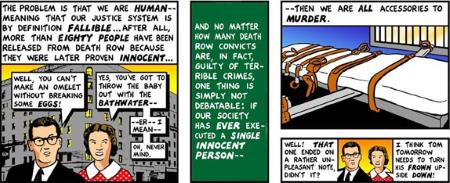
Death Penalty - Tom Tomorrow

I almost didn’t notice that it was new year’s eve today. Part of it is that I just don’t like the day. I never do anything for it. Under most circumstances, I won’t even stay up for it. But now I normally do because that’s when I do my birthday posts. Really: the new year has absolutely no relevance to anything. It is an entirely arbitrary dividing line between years. But whatever. I do have a bit of good news on this new year’s eve.

Maryland had the death penalty all the back to when it was a colony — in 1638, they hanged two men for piracy. Since that time, they’ve killed 312 people. Now that may sound like a lot, but actually, in that almost four centuries, the state has managed to kill off many fewer than Texas has killed since people started dancing in the street in 1976 because the Supreme Court allowed them to start legally killing people again. (Texas has killed 508 people in the last four decades.)

But last year, Maryland Governor Martin O’Malley signed a law abolishing the the death penalty. As Huffington Post reported, O’Malley argued that “it wasn’t a deterrent for criminals, could end up being applied to innocent people, and was far more costly to the state than other punishments.” You know: the holy trinity — the reasons that all people would be against the death penalty if they approached the subject with their higher brains. But instead, most people approach it with their lowest brain: they just want to “get” the bad guys.

Let’s go over that list. First, people don’t kill as rational acts. They don’t think, “Now that I only have to spend the rest of my life in prison, I’m going to kill my wife!” People murder for two reasons: they either think they won’t get caught or they aren’t thinking at all. There is no evidence whatsoever that the death penalty reduces the homicide rate.

Second, innocent people get put to death all the time. If the death penalty really was effective at stopping murders from happening, maybe one could argue that innocent people being put to death was an acceptable price to pay. But since we can’t, we are killing these innocent people for no reason whatsoever. But hey, I guess as long as it isn’t happening to you or one of your loved ones, it doesn’t matter. And after all, you do get something from the death penalty: the great feeling that you are “getting” the bad guys.

Third, it is a hell of a lot more expensive to kill a murderer than to just let him rot in jail the rest of his life. It is this argument that gets the most bizarre response from death penalty advocates. Their response is always the same, “But it shouldn’t cost more!” According to them, after a “guilty” verdict, the judge should just pull out a gun and shoot the defendant in the the head. The fact that dozens of people have been proven innocent decades after conviction is just ignored. Nothing can get in the way of the wonderful feeling people get from legally murdering the bad guys.

In getting rid of the death penalty, Maryland had a bit of a problem. They had four people still sitting on death row. The state could still kill them because they were grandfathered in, so to speak — or so some claimed. So as his final act of governor, O’Malley commute their sentences to life without the possibility of parole. That is about the best news that you are going to get from me this year. And it is pretty good news too. I wonder when my home “liberal” state of California will ever outlaw this barbaric practice.

Magic 8 Ball - Don't Count On It

Torture Here at Home

Rebecca GordonThe fact is that torture is still continuing today — both in the so called war on terror and also in plain sight in our own jails and prisons in this country. I mentioned in the piece you were referring to a number of ways that torture is still going on. And one of these involved the forced feeding that’s still happening at Guantanamo. This is what happens twice a day to those people who are on hunger strike. A cell extraction team of six people arrives in their cell and forcibly removes them from the cell. And then, as one of the people who’s suffered this describes, what they do is they actually strap the person down to a feeding chair — which they call a torture chair — but in order to make the process more painful, instead of attaching the prisoner’s arms to the arms of the chair they’re handcuffing them behind the person’s back and then strapping the person into the chair that way so it puts terrible pressure on the shoulder joints. And so there’s pain not only involved in the feeding itself but also in the physical restraint that’s going on when they shove a tube up someone’s nose and pump food into their stomach.

One of the people who wrote about it this for The New York Times said it this way:

I will never forget the first time they passed the feeding tube up my nose. I can’t describe how painful it is to be force-fed this way. As it was thrust in, it made me feel like throwing up. I wanted to vomit, but I couldn’t. There was agony in my chest, throat, and stomach. I had never experienced such pain before. I would not wish this cruel punishment upon anyone.

It’s interesting to know that at the very same time this kind of force feeding has been going on — and as far as we know is still happening — exactly the same procedure was being used on prisoners in California in May of 2013 — so only a year and a half ago — when they also went on hunger strike. And they were striking about exactly the same issues. The two issues were indefinite detention — in other words in US prisons having prison sentences that last an undetermined number of years — 15 to life, 25 to life. And secondly, solitary confinement — being held in complete isolation from other human beings. And in May 2013 30,000 prisoners in California went on hunger strike, and when they did it they did it in direct solidarity and awareness that people in Guantanamo were doing the same over exactly the same two issues. So the connection between the US prisons and the war on terror is not a hard one to make — it’s a direct connection.

—Rebecca Gordon
Interview with CounterSpin

Obamacare Ignorance Is Due to Mainstream Media

Mainstream MediaPaul Waldman wrote in interesting if maddening article article yesterday over at The Washington Post, The Substance and Politics of Obamacare, in One Citizen. It tells the story of Kentucky resident Amanda Mayhew who is thrilled with all the needed medical care she is receiving because of Obamacare. But she would give it all away if it would put an end to all the old people who are being killed by the death panels. It’s kind of sweet actually. Ms Mayhew is clearly a very caring person. In fact, she’s the kind of person that Americans flatter themselves as being: willing to put the needs of the less fortunate above their own.

The bad aspect of this is that her very decency is being used against her. She’s been lied to. There are no death panels. No one is deciding if old people deserve cancer treatment. This is just a scare story designed to malign the new healthcare law. Teens are told the story of The Hook to scare them away from making out in their cars and the Death Panel is told to the working poor to make them turn against a healthcare bill that is designed to help them.

Waldman blames politicians and hate radio hosts and Fox News for the problem of all the misinformation about Obamacare. But I don’t. They are just doing their jobs. They are the foot soldiers for their fascist leaders. My problem is with the mainstream media. All the right wing propaganda about a government takeover of healthcare and death panels never would have gotten a foothold in the mainstream consciousness if it hadn’t been for the local news and the big newspapers and the network news reporting it as, “The administration says that the government is not taking over the healthcare system and that there are no such things as death panels; the Republicans claim this is the end of quality healthcare in America and all people over the age of 65 will be forced to kill themselves; as objective reporters we have no way of saying what the truth is.”

Let’s not forget where the whole idea of the death panel came from. Sarah Palin, of course, came up with the name. But the concept came from Betsy McCaughey — the disingenuous health policy “analyst” who pretty much single-handedly destroyed the Clinton healthcare reform plan. And like James O’Keefe, it doesn’t matter how many times she lies and is shown to be totally wrong, the press just can’t manage to apply even the smallest amount of skepticism towards her. Because, you know: that wouldn’t be “objective!”

The best example of this came when McCaughey went on The Daily Show when she brings out a big binder containing the Obamacare law. And Stewart gets her moving from section to section until it is clear that what she’s claiming is nonsense. Nothing in the law says anything about death panels. It’s clearly just about end of life planning — living wills — and Stewart is absolutely right when he calls what McCaughey is doing hyperbolic and dangerous. Also check out the second part of the interview.

But as usual, the mainstream media didn’t do anything near as good as what the comedy show The Daily Show did. So as usual, the problem is our media that has no real interest in informing readers and viewers. Instead, it is a kind of talking point aggregator. And that’s why we can’t have decent governance. Our government is only as good as the media that covers it. And we don’t even have a media that covers the government. We have a media that repeats the government.

So we have poor Amanda Mayhew who would vote to eliminate Obamacare because of the all the old people she thinks the law will kill. “Liberal” Californians vote against GMO food labeling because they think it is going to harm the one remaining small family farm in the state. And Americans consistently vote for politicians who take money from them and give it to the rich because of some weird sense of fairness. And it is all due to a media system that will only take a stand on an issue when it helps the power elite.

Ben Kingsley

Ben KingsleyThe great actor Ben Kingsley is 71 today. He is probably best known for his Academy Award winning role in Gandhi. But that just shows what a crock the Academy awards are. They just love giving out awards to films that are about “important” subject. Leave it to Hollywood to make an important movie not just decades after Gandhi’s death, but also after Martin Luther King’s death. Kingsley was great in the film, but then he always is.

Most recently, he was absolutely great in Iron Man 3 — a film that literally had nothing else to recommend it. In it, he plays the Mandarin — a supposed terrorist who is, in fact, just a down on his luck actor with a weakness for drugs and women. You know: my hero! But don’t watch the film. It’s tiring. But Kingsley is great.

There are so many films where Kingsley shines that it is hard to list them all. I will just mention a few that you really must see. Obviously, Schindler’s List should be seen for a number of reasons, but his role as Itzhak Stern is the heart of the film. Another is Sexy Beast. And for a sweet one, there is Hugo.

One film that I love but bombed (probably because it is great) is War, Inc. Here is a scene, but John Cusack gets the best line, “I signed up to kill the bad ones! Health clinics, trade unionists, journalists, agricultural co-ops, Catholic liberation theologians, impoverished Colombian coffee farmers, these are the barbarians that are brave opponents of civilization. We turned Central America into a f**king graveyard. Whoever momentarily interrupts the accumulation of our wealth, we pulverize. I’m just not feeling good about that anymore, sir.”

But for a limited time only, two of my favorite Ben Kingsley films are complete and on YouTube. The first is Turtle Diary with Glenda Jackson. It’s one of those little gems that the studio can’t even be bothered to release on DVD. (It is available on VHS.) So you can be sure that that before too long, the studio will notice that it’s online and say, “We don’t care enough to sell this title, but we’ll be damned if we’ll let anyone watch it for free!” While it lasts my friends:

The second film is available on DVD (sadly not letterboxed), Without a Clue — I own it and watch it quite a lot. It is a reversal where it is really Watson who is brilliant and he’s hired an actor to play the part of Holmes. It isn’t great, but it’s sweet and very funny. Sadly, I can’t embed it, but you can watch it over on YouTube (but at least it is letterboxed).

Happy birthday Ben Kingsley!

Blathering On Over the Holidays

Frank MoraesThis is the hardest part of the year to write. Very little is going on in the news and the people I commonly read are not writing very much. What’s more, not that many people are reading. I suppose that they have more important things to do than read my increasingly strained missives. Yet I still try to grind out five articles per day. This is not out of any commitment to you my loyal readers. It is more out of a commitment to myself. I am a man of habits and I have this feeling that if I don’t write five articles today, I may never write another ever again.

There is another aspect of of this. In order to write well, it is important simply to write. When I go back and read things I’ve written in the past, I’m constantly amazed that the best work is often the stuff that I just dashed off. And stuff I thought was very good — things I worked very hard on — leave me flat. So if I want to write a hundred articles each year that are worth while, I probably do need to grind out a couple thousand. Because when you are in the thick of it, you really don’t know what is good and what is dreck.

Another problem is that I’ve now written well over 8,000 articles on this blog. With every day that goes by, it seems that I’ve already said what I have to say on the subject. Indeed, there will be times when I’ve written half an article, only to realize that I must have written the same thing before. And a quick search shows that indeed, I have. And often, the process of my thinking is dead on. I am nothing if not consistent. Even when I was a libertarian, my writing on the subject of politics was not so very different than my more clear thinking today. This was one of the reasons that I wasn’t allowed to play in any libertarian games.

Tomorrow, I’m sure I will have much to say about the ending of the year. As for now, I have little to write about other than the fact that I have little to write about. Of course, there are things to write about. For one thing, I have a very interesting grammar article to write about. But it will take a little work and I don’t feel up to it right now. But you would think that at this point with five years and 8,000 articles under my belt, I’d be able to look back to the previous years for what I did. This is not all that useful. For example, last year at this time, I just didn’t write that many articles. And the year before, I wrote really short articles.

So I’m stuck tonight just slogging out an article about how I’m reduced to slugging out an article. It really doesn’t speak well of me. If I weren’t so obsessive, I’d just recycle old article. I know that even my most devoted readers don’t manage to see everything that I’ve written. What’s more, I often completely forget things that I wrote. I’ll sometimes notice that there is a flurry of visits to a particular article and I have no idea what the it is about. So maybe I’ll start doing a little about that. But there is so much else to be done moving into the future.

There is something that I might consider. Posting five articles of an average length of 700 words each day is an arbitrary work load. I have friends (Although they might might not describe me that way!) who have active blogs who produce far less. Infidel753 posts only every other day on average. Bark Bark Woof Woof posts only a couple of things per day and they tend to be light on content. Beggars Can Be Choosers posts every couple of weeks. Human Voices posts every week or so. The Good Typist publishes once a week (but she’s also polishing her novel). Ramona’s Voices is much the same. On the other hand, Job’s Anger publishes at the same pace that I do. And so does P M Carpenter’s Commentary. But most of all, I try to be like Digby — both in terms of amount of content and quality. I’m pretty sure I’ve got her beat in terms of amount. It is still the quality that I’m working on. And I’m afraid having lots of content is necessary to have a high level of content.

The Hell of American Punishment

Inferno: An Anatomy of American PunishmentYou are afraid all the time, and there is good reason to fear. You are alone with enemies all around you. No one cares about you. You can be attacked where you are, but it is more dangerous when you must move in the open. Groups roam the territory looking for victims. You cannot hide. Your only weapon is yourself. There is no authority to call on that you trust. Over and over you ask, “How did it come to this?” But it has come to this and for the foreseeable future.

Who are you? Where are you? You are not a soldier or a spy on some mission in a foreign land. You are not an undercover agent. You are not under siege. You are not a survivor of a civil war. You are not an explorer in some alien jungle, though in some ways you are. You are an inmate in an American prison. You belong to a peculiar version of hell, one that the American separation of church and state has imagined for you.

What did you do to get here? Perhaps you had too much dope on you when stopped or sold some of it to the wrong person to feed your habit. You have never been violent, but now you are surrounded by vicious inhabitants who enjoy hurting other people. Your chances of getting out of here in one piece are limited. They will depend on your wits and some luck, not the help of others, and if you do get out, there is nothing waiting for you — no job, no family likely to help, no skill set for use in an economy that has passed you by and that will reject you anyway for what you have become. There is nothing to do where you are, but if you try to do something useful, predators will come after you. The lowest common denominator rules here. Most of all, you should not be the only person asking, “How did it come to this?” — a question with many answers.

—Robert Ferguson
Inferno: An Anatomy of American Punishment