Eric Harwood Is Voting His Own Best Interests

Eric HarwoodMatt Bruenig wrote, The Story of Eric Harwood. It’s a very sympathetic telling of the story of a 47-year-old working class man who now finds himself disabled with difficulty getting SSI because of some understandable mistakes. It’s very sad and I do hope the whole thing works out for him. He deserves to get disability insurance and live a dignified life.

I’ve written a lot about this kind of thing in the past. Every time some politician starts going on about fraud in government programs, I know what the net result will be: loads of people who clearly deserve help won’t get it just so we can stop a handful of people who probably don’t. But this is the conservative way, is it not? It’s better to let children starve than allow an able bodied surfer to eat lobster at government expense. Or, in another area, it is better to stop millions of people from voting rather than allow one ineligible person to vote.

It turns out that Eric Harwood is an ultra-conservative. He’s hoping that the Republicans will nominate Ted Cruz and Donald Trump; he doesn’t care which one of them is on the top of the ticket. Now I am very tired of hearing liberals complain that conservatives don’t vote in their own best interests. They do vote in their own best interests — as they see them. And Harwood is an entirely typical conservative. I run into them all the time.

“Why is it that we’re bringing in illegal aliens into our country, and now bringing in more refugees spending billions and trillions of dollars on both.” —Eric Harwood

Let’s suppose that Eric Harwood gets his SSI — as he clearly should. He will then almost certainly spend a great deal of time watching Fox News and listening to hate radio. He will continue to rail against all those undeserving people sucking off the tit of the American tax payer. The fact that he is doing exactly the same thing will cause no cognitive dissonance in him. And that’s because he is one of the deserving ones. He isn’t some libertarian who thinks the government shouldn’t exist. He just thinks that it should take care of the people who deserve it.

If you look at Harwood’s life story, you can see how the government has helped him along the way. He went to trade school to become a locksmith. That’s great, but it almost certainly involved government programs that made it more affordable if not paying for it straight out. He apparently lost $30,000 in wealth when his condo was foreclosed on. Let’s consider that. I assume a condo in Nevada would cost about $150,000. So let’s say his mortgage was $120,000. In 2005, mortgage rates were around 6%. That comes out to roughly $7,000 per year that he got to write off. He only had the place for three years, so we can figure that roughly $7,000 of that $30,000 that he lost was a direct payment from the government. (Also, it is almost certain that the $30,000 is just what he paid over the three year, so it wasn’t wasted money; he would have had to pay that amount in rent if he hadn’t purchased the condo.)

I know that people don’t think about things like this. But when you slice and dice the world up into the worthy and the unworthy, you are going to find that other people place you in the unworthy category. So now he’s going to vote for Trump or Cruz, thinking that they will fix the nation in such a way that he gets everything he thinks he deserves and other people don’t get anything because he doesn’t think they are deserving. That’s what he’s voting for. He is very much voting in his own interest. It’s just that he’s foolish in thinking that the Republican Party’s platform puts him in the deserving camp.

But I hope liberal policy wins the day and Eric Harwood gets the help that he needs and deserves.

Morning Music: The Mermaid

I'm So Good That I Don't Have to BragWe end our week of Shel Silverstein with his song, “The Mermaid,” off his album, I’m So Good That I Don’t Have to Brag. There is something about the man that allowed him to see the absurdity of everything. I’d never really given a lot of thought to mermaids, but it is indeed true that they are half fish and it really doesn’t matter how lovely one half of her is, the other half really is a fish. Of course, as I discussed in Fake Science and Fake Reality on Television, more recent fabulist would have us believe that mermaids were half human and half dolphin. But that doesn’t help a whole lot.

The lyrics were published in Playboy, and I suppose it is intended to be salacious. I have a hard time seeing any of Silverstein’s work as being salacious because he always seems like nothing so much as a naughty five year boy. Maybe I give him a pass on that because I feel kind of the same way. But I think it is a major mistake to read much into his work. I was thinking of “The Father of a Boy Named Sue,” and I don’t think there’s much there. You can even see it as a comment on a man so screwed up that he set the record straight about naming his son Sue only to relate that it’s all worked out great for him because he gets to rape his son.

There is a distinctly dark core to everything that Shel Silverstein wrote. But the same thing could be said of the Brothers Grimm. Not that I’m saying we should share the work he created for Playboy with our toddlers. So here is “The Mermaid,” which you can make up your own mind about.

Aniversary Post: Governor Ronald Reagan

Ronald Reagan Selling Cigarettes, Like He Sold Other Deadly Things to AmericaOn this day in 1967, Ronald Reagan was sworn in as governor of California. Mostly I think he was elected because he was going to go after those dirty hippies. But on the plus side, at least he thought it was a good idea to become a governor. Now it seems that Republicans think that anyone could be the president. According to these fools, unlike being a boiler tech, being a president doesn’t require any training or experience.

There were things to like about him as governor. As Alex Seitz-Wald has noted, he made abortion far more available in the state. Of course, then he ran for president stating that abortion should only be allowed when the life of the mother was at risk. And then as president, he didn’t do much of anything. The truth is that he didn’t care. But as we know, Reagan would do anything to get power.

Ronald Reagan also limited gun rights because he was terrified of the Black Panthers. It would be wrong to imply that Reagan was a racist; it should be stated clearly: Reagan was a racist. But lucky for him that he lived in a racist country.

Reagan also existed in that great period when Republicans were still honest about their tax policies. He raised state taxes in a big way while governor. And, of course, the taxes weighed most heavily on the poor. For example, he raised the top income tax rate by 43% and the corporate tax by 27%, but the sale tax by 67%. It was the same thing when he was president, Reagan’s Legacy: Tax Cuts for Rich, Tax Hikes for the Rest.

Overall, Ronald Reagan was terrible in every way imaginable. But it isn’t just what he did directly. I don’t think that Clinton would have ended welfare as we know it if it hadn’t been for Reagan. And despite his terms as governor of California, Reagan was unqualified to be president. And the sad thing is: he’s infinitely better than the bozos who the Republicans are looking to nominate.

From Tiger Bread to Giraffe Bread: Oh My!

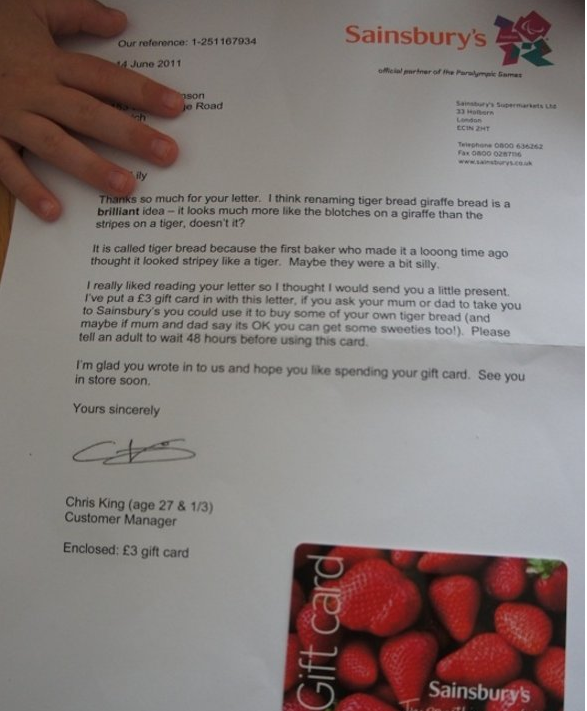
Giraffe BreadAs promised before, Jurgan brought my attention to a charming pair of letters. But let me tell you the whole story, because it is pretty great from beginning to end.

Sainsbury’s is a very big grocery store chain in the United Kingdom. And for years, they’ve sold the bread we know as Dutch Crunch under the brand name Tiger Bread. You can see why. Some tigers do have that kind of fur coloring. Obviously that isn’t typical. Tigers tend to have stripes. Maybe it’s more like a Liger. But three and a half year old Lily Robinson had other ideas. On 31 May 2011, she wrote to Sainbury’s asking why they called their Dutch Crunch “Tiger Bread” when it clearly looked more like a giraffe and thus should be called Giraffe Bread.

Just two weeks later, 27 and a third year old customer manager Chris King wrote back. He said that he thought it was a brilliant idea to rename the bread. He also noted that the original baker who first named it was perhaps being a bit silly. (Note: “silly” is a great word.) Here are the two letters. You won’t be able to read the response at this resolution. Just click on it to see it at full resolution:

Sainsbury's Tiger Bread Letters

The letters went viral on Twitter but then died down. Twitter, of course, has the attention span of a gnat with ADHD. But then, as always seems to happen, it went viral again for no particular reason other than the madness of crowds. So in January of 2012, Sainsbury’s released a statement:

In response to overwhelming customer feedback that our tiger bread has more resemblance to a giraffe, from today we will be changing our tiger bread to giraffe bread and seeing how that goes.

As far as I know, the grocery store is still selling it under the name Giraffe Bread. As a nice postscript to the story, Chris King quit his job at Sainbury’s to go back to college to become a primary school teacher. I think he has the perfect temperament for it.

Afterword

I do not like Dutch Crunch under any name at all. The crust is nice enough. But inside is a doughy tasteless white bread. I’m surprised that it is as popular as it is. There are so many better breads around. According to that BBC article I linked to above, “Rice paste is brushed on to the surface before baking, forming the pattern as it dries and cracks while it bakes.” That means you could put that crust on an actually good bread. But as you can see in the image above, Giraffe Bread only costs £0.75 — making it a very cheap bread. But it seems to me it is much more expensive here in the states.

The Low Expectations of High Tech Innovation

Flying CarFrequent commenter Jurgan posted a charming couple of letters that rocked the bread world a few years back. (I’ll write about it later today.) But it is all on Tumblr, and as you know, I don’t much understand new technologies. This is odd given that I’m paid to write about technology. But I guess it isn’t exactly true that I don’t know what it is. It’s a blogging platform. I just don’t understand why it is considered an innovation. I spend much of my life in awe of the fact that people get money for things that are not new. Like Facebook: how was that new? For those who don’t know (and this apparently includes the vast majority of Facebook users), it is an image sharing application. Really: that’s all it is. And those were around for years before Facebook.

None of this should be taken as a slight against people who use Facebook or Tumblr. They are fine tools. What’s annoying is that the press and investors treat these things as revolutionary when they aren’t. In particular, Facebook is useful because a lot of people use it. That appears to be the case with Tumblr as well, which hosts 271.5 million blogs with 126.6 billion posts. (Note: that’s an average of 466 posts per blog, which is pretty good given my experience with blogs is that a dozen is about average.)

In 1999, in an example of the kind of thinking that has shaped the internet for the last two decades, eXcite turned down an offer to buy Google for $750,000.

The thing about Tumblr, Facebook, Twitter, and many other of these social networking sites is that they are closed systems. To me, this is a great step backwards for the internet. Everyone should be on an equal footing. There are obvious advantages to having a closed system, but they are mostly advantages for the company. And you can see the problem on sites like Booman Tribune or Lawyers, Guns & Money. These sites require that you have an account to comment. They are big enough that they still host lively discussions, but they clearly limit discussion as well. (They probably do this because they haven’t realized that there is now software that filters out virtually all spam.)

It leads me back to the old Peter Thiel quote, “We wanted flying cars, instead we got 140 characters.” Now personally, I never wanted a flying car. This is because I’m still reasonably attached to living and you can just imagine if we have a quarter billion cars flying around with their drivers drinking hot coffee and texting photos of the thousands of car crashes they see each day. But there is a reason that we got 140 characters: because there is very little actual innovation that goes on in the realm of high tech.

Let me share with you a personal story. A couple of years back, I was working with Mikhail, a brilliant young hardware designer, on an amazing technology. I’m prevented by contract to explain it to you, but it had to do with extreme sports. It combined a number of advanced technologies to do something that frankly I didn’t think was possible before we started. But we couldn’t get money for it. At the same time, we knew a couple of guys who got a half million dollars to produce a wired toy submarine that had a camera in it. Wired. Almost a decade ago, Mikhail and I were streaming video from RC helicopters in our spare time, and these guys had money dumped on them for a toy that would have been only marginally cool in 1980.

The truth of the matter is that capitalism is not a good system for creating innovation. And capitalists know this. This is why the big pharmaceutical companies depend upon the government to do the research on anything actually innovative. Otherwise, they just stick to the tried and true: yet another erectile dysfunction drug, yet another benzodiazepine, yet another Vicodin knockoff. And in the area of high tech, who wants to invest in something that is actually new, when they can just market a photo sharing site as if it were a major innovation? Or yet another blogging platform like Tumblr, which sold for over a billion dollars less than three years ago? We don’t have innovation because we don’t value innovation; we value profit.

Afterword

Oh, you know what was revolutionary? The Google algorithm. And they had a hell of a time getting money. In 1999, in an example of the kind of thinking that has shaped the internet for the last two decades, eXcite turned down an offer to buy Google for $750,000. (That’s just over a million in today’s currency.) In America, what passes for innovation is Mitt Romney investing in Staples with the brilliant idea that business supplies could be sold through a chain that gets lots of government funding to put small business supply stores out of business.

Morning Music: Where the Sidewalk Ends

Where the Sidewalk EndsShel Silverstein has a devilish wit. I think that’s why he is a children’s writer at the same time that he isn’t. He has a child’s sensibility with an adult’s knowledge and experiences. I believe I share this with him, without being on the same creative plane of existence. It is this kind of stuff that parents normally complain about regarding me. It is the parents’ job, after all, to socialize children. I see it as my job to remind them that they can be both good and devilish.

Where the Sidewalk Ends is filled with devilish stuff. There is also a version with a CD, which I used to have. There is something extra that we get when Silverstein reads his own poems. They always sound so much sharper than they do in my head. Poems like “For Sale” are horrible in their way, even as they are too extreme to be taken seriously. It’s the literary equivalent of Tom and Jerry. But I’m going to highlight another poem from that collection, “Crocodile’s Toothache,” even though I actually love dentists. As the animator, Aida Alemy, says, “No crocodile or dentist were harmed during the making of this animation.”

Anniversary Post: Unix Time

Unix TimeOn this day in 1970, Unix Time began. Well, not exactly. It was just a convenient point to set as an epoch. And all Unix Time provides is the number of seconds since that time. It is coming up on 1.5 billion seconds. It also provides fractions of a second. In its first implementation, it subdivided seconds into 60 parts. But when I was first cutting my Unix teeth on a couple of Sun workstations in the late 1980s, Unix Time was divided into millionths of a second.

All computer systems have their own epochs. MS-DOS had its epoch exactly a decade after Unix on 1 January 1980. COBOL has an epoch of 1 January 1601. Microsoft C++ 7.0 had an epoch of 31 December 1899. VMS had an epoch on 17 November 1858. And MATLAB’s epoch is on 1 BCE. In other words: epochs are totally arbitrary. And that’s great. I’m surprised that some smart–aleck computer geek hasn’t set an epoch thousands of years in the future just so we could have negative time stamps.

But given all this epoch madness, why did we have the great Y2K scare of 16 years ago? Now I know the main issues. There were computer shortcuts taken to reduce memory usage. And there was lots of binary-coded decimal, which I’ve never understood. I mean, really: do everything in binary and then convert to decimal when humans have to look at it. It makes no sense to represent numbers in this way on the hardware level. And I know that binary-coded decimal was especially used for time and date functions.

But I do think that Y2K was vastly overblown. Yes, I think that mission critical computers should have been thoroughly checked out. Any chance of a computer firing a missile is unacceptable. But it was mostly just something for reporters to talk about. But Unix Time is cool. At least I can remember when it is. I will have forgotten all about VMS time by the time you read this.

Rain Rain Don’t Go Away Stay Around Another Day

RaindropsI loved the rain when I was a kid. It caused my parents some consternation that I loved most to play in the rain. The rain is almost magical. And growing up, it created a certain discord in me because I loved the rain but I knew that my father, a building contractor, could not work when it rained. And this was a problem because my father’s business acumen was very similar to that of Bob Belcher on Bob’s Burgers. That is: we were always living on the edge but proud of the quality of dad’s workmanship.

But there was something deeper about my love of rain. As I know I’ve explained before, I’ve always been highly skeptical of gravity. It’s like electricity. In college, the only course I had trouble with was electronics. I wanted to know why electrons went to ground. And my professors would always give me the same lame answer, “Where else would they go?” I don’t know! These people have such confidence in the universe. It was probably a mistake for someone with such a strong mystical and metaphysical orientation to go into physics. It’s like a Jew joining the Klan. But I did it and it was doubtless good for me.

This last month has been interesting in that we’ve had a lot of storms, but they come through and drop a quarter or a half inch of rain and that’s it.

But I still don’t trust gravity. I am a master of mechanics. I understand all the theory that explains why the Moon doesn’t fall on my head and why I don’t float away from the surface of the Earth. But when I see a big blue sky, I still think that all my years of experience being pressed to the surface of the Earth is just a great big bluff and that God is going to flip a switch and I’m going to go floating away. For millennia, people have been searching for the meaning of existence. But that’s what it is: God’s practical joke on Frank. Oh, how he will laugh!

Up until about 8 years ago, I was skinny. Painfully skinny. And my grandmother used to tell me all he time, “One day a wind will come up and blow you away!” But what was I supposed to do? Drink the milk she served that came from a cow? I knew there was something very wrong with all that and so I was always skeptical of food that didn’t come from inside a well designed box. And by the way: my grandmother was very small too, so I don’t know what she was complaining about.

Rain Rain Go AwayThis image of my body being blown away has never left me. But I don’t imagine wind. I just imagine gravity not working. And let’s face it: it could happen. It’s not like we have a contract. Remember Bertrand Russell’s example of the chicken: every day is great and then one day they cut your head off. Now, for the record, if gravity stopped, the atmosphere would immediately vanish, and we would suffocate if we weren’t first destroyed by high energy particles. But the fact remains that we would die — and fast.

Somehow, cloud cover and even nighttime makes me feel less exposed. And rain is even better because it is falling — a sure sign that gravity is still working as advertised and that God hasn’t sprung his little practical joke. But all this is just the result of my having a fanciful imagination. I understand that. There are very real feelings that go along with it, but I know intellectually that there is nothing to fear. The problem is that now there is a related fear that is very real indeed.

For the purpose of rainfall totals, the season starts on 1 July. And here in my hometown of Santa Rosa, we have an average rainfall total by the end of December of 11.4 inches. And last year, we had a very wet December with roughly 12 inches in that month along, but a total of over 17 inches for the season to that point. It looked great. It looked like our drought was over. But it wasn’t.

Normally, the first three months of the year have rainfall totals: 6.0, 5.2, and 3.6. But last year, we got: 0.9, 0.4, and 1.9. This year, we should normally have a total rainfall of 11.4 inches. Instead, we have 6.7 or 7.5, depending upon the source. It’s depressing.

But there is El Niño. This year, it is a very big one. But we haven’t seen much of it. This last month has been interesting in that we’ve had a lot of storms, but they come through and drop a quarter or a half inch of rain and that’s it. We are getting snow in the Sierras, and that is very good indeed. But not as much as we might hope. Still, El Niño is not supposed to really hit until later: January, February, and March. But currently, there is no sign of rain until 5 January at the earliest. And the promised rain has disappointed again and again in the past.

If things don’t change soon, people will float away — not into the sky, but to other areas that haven’t turned into deserts.

The Bunk of the Economic Uncertainty Crowd

UncertaintyNoah Smith is one of those super smart guys who also often annoys me. On Tuesday, he wrote, Don’t Blame Uncertainty for the Slow Recovery. Now, I am in complete agreement with him on this issue. But it bugs me when people take clearly silly ideas far too seriously. And this is one of those cases, although I’m glad that Smith is out there setting the record straight for all the fools who believe such hogwash.

The “uncertainty” hypothesis is that businesses have not invested since the financial crisis because they are afraid of the uncertainty of government policy. By this silly idea, businesses were frozen in terror, not knowing if they should buy new equipment for fear that the top marginal tax rate might go up. So companies were just sitting on piles of case waiting until they were absolutely certain what the future would be. If this sounds absurd, that’s because it is.

There are a lot of economists who I greatly admire. And even the ones I disagree with are brilliant in their way. But most of them don’t have much of a clue what it is like to run an actual business. Growing up, my parents owned a gas stations then a convenience store and finally a construction company. In addition, I’ve had micro-businesses all my life. And I spent a year working a business at the San Jose full-time flea market — the closest you will ever come to a perfectly free market. All of these experiences have colored the way I see business.

Rule number one in business is that it is all about uncertainty. Running a business is a matter of dealing with uncertainty. If you are fretting about how quickly you will be able to depreciate a piece of equipment that you buy next year, you have too much time on your hands. Actual business people generally won’t buy anything or hire anyone unless they absolutely, positively have no other choice. And they certainly don’t think in terms of the taxes they will pay on profits they haven’t made yet. And it isn’t just little old me saying this. I’ve heard the same things from Nick Hanauer and Warren Buffett.

If business were about certainty, then wouldn’t everyone have a business? And it doesn’t get any less absurd if you focus on political uncertainty. We live in a democracy. Because of the way elections are staggered, we get changes every year. Even at the federal level, we get different congresses every two years and potentially new presidents every four years. Change is a given. What those who have spent the last seven years run around complaining about uncertainty are really talking about is that they don’t like the policies on offer. It wasn’t uncertainty that they were unhappy about. Obamacare was gradually put into place and it was very clear exactly what was going to happen and when. The real complaint was that the policy was going to destroy business, because they didn’t like that policy.

We all know why this recovery has been so slow. Paul Krugman put together the following graph that explains everything we need to know. It compares the number of government jobs that were created after the last two recessions: one under George W Bush and the other under Obama. Every other recession looks just like Bush, but under Obama — because of Republican intransigence — the government has made the recession worse. This is really an amazing graph. (Note: the spike is temporary workers for the Constitutionally required 2010 census.)

Government Jobs After Recessions

So I’m glad to see that there is actual data that shows that uncertainty is the hogwash it always obviously was. But the original work was only taken seriously because there were people who wanted to push the idea for ideological reasons. And this new paper won’t stop those people from continuing to claim that the problem is Obama and all his newfangled ideas.

Morning Music: A Boy Named Sue

Boy Named Sue and His Other Country SongsShel Silverstein’s most famous song is probably “A Boy Named Sue.” It was a huge hit for Johnny Cash and it works well for him. But he makes the song too serious. You get the impression that it was the right thing to do to name the boy Sue. As a result, the denouement where the singer says that he will name his own son anything but Sue doesn’t work all that well.

Silverstein’s version of “A Boy Named Sue” off Boy Named Sue and His Other Country Songs fully embraces its silliness. And at the end, he goes crazy and shows that he wouldn’t just name his son something different, but that he still hates his father because it was terrible to have named him Sue. There might have been an upside to the name but it didn’t make up for the downside.

About a decade later, Silverstein wrote a followup, The Father of a Boy Named Sue off his album, Songs and Stories. Whereas “A Boy Named Sue” is a fun song, the followup is deeply disturbing. It claims that Sue lied in his song and that actually he’s a transvestite. After the fight, they reconcile and the father moves in with the son who takes care of him better than any daughter ever could. And the song ends with more than the implication of incest. Shockingly, when Johnny Cash covered the song, he kept the lyrics in, although he sings them so forthright that it doesn’t come off as creepy as it does when Shel Silverstein delivers when in a barely audible squeal.

Anniversary Post: Four Year Marshall Plan Ends

Marshall PlanOn this day in 1951, the Marshall Plan ended. It had distributed over $13 billion to rebuild Europe after World War II. That represents over $130 billion in today’s money. And you have to think about it relative to government spending at the time. Federal spending at that time was roughly $45 billion. The Marshall Plan lasted for four years. So that’s something more than 7% of our federal budget. This is probably why people today think we spend so much money on foreign aid.

In fact, we only spend upwards of 1% on foreign aid. What’s more, most of it is military aid, which is hard to claim is us giving out of the goodness of our hearts. Furthermore, by far the biggest recipients of our aid are Afghanistan and Israel. Those are countries that most people think we ought to be giving money to — at least by the people most concerned that we are too nice to the other countries of the world. The UK gives over half as much in foreign aid than we do, even though our economy is six times the size. The entire European Union has the same size economy as we do, but gives almost three times as much in foreign aid. Think what you want to about the US, but we are a stingy country.

In a poll earlier this year, the average American thought that 26% of the federal budget went to foreign aid. No wonder Americans think we are exceptional! We are exceptional: in our minds. Americans have been convinced that all the money they pay in taxes goes to help unworthy others. They think this even while they get their Medicare and live in houses they own thanks to the mortgage interest deduction. They are totally unaware of just what a hellscape America would be without the government.

The thing about the Marshall Plan is that the money we spent didn’t just help Europe. It helped the whole world and arguably the United States most of all. But somewhere along the line, Americans got the idea that we were just too nice. And as a result, we’ve suffered for it. Now we are very clearly an empire in decline. Since I was a little boy, I’ve watched as our policies have shifted more and more away from forward looking innovation and toward backward looking efforts to hang onto the power that we once had.

The Marshall Plan was one of the shining achievements of this country. And it is one that we would never be able to accomplish now. That’s because we are weak minded people who only think of ourselves and only on the shortest of timescales.

Ghostbusters Shouldn’t be in National Film Registry

National Film RegistryEach year, the National Film Registry (NFR) designates up to 25 films for preservation because they are “culturally, historically, or aesthetically significant.” And this year, just to show what a sham it is, Ghostbusters, Top Gun, Shawshank Enter National Film Registry. Not one of those films deserve to be acknowledged in this way. It’s not that I think they are bad films. They all have notable aspects. But they are also all boilerplate creations. I’m sure the NFR uses the “culturally” part of its criteria to slot these in. But then all it means is that big hits are going to make the list because they were big hits.

I’m not just being an old crank who wants to see obscure films make the list. But what is the point of the NFR? Does anyone think that Top Gun will be lost to us? They just released it on Blu-ray two years ago. Meanwhile, old films are literally disintegrating as we make sure the existing print of utter pedestrian recent films get special treatment. It is appalling. Even in that year, 1986, there were films that are far more culturally significant: Platoon, Blue Velvet, and The Fly to name just three. Top Gun stands out for one reason alone: it was the biggest money maker of that year.

But I understand. The National Film Registry thinks that each year it has to include a certain number of “name” films. Last year they included Ferris Bueller’s Day Off and Saving Private Ryan. Again: I’m not saying these films are bad. The question is whether they are significant. And they are significant in a way that doesn’t require the help of the government funded National Film Preservation Board. But I suppose there are a lot of would be fighter pilots in Congress who will be more willing to fund the program for another year because Top Gun was on the list.

But there are many worthy films that were added to the registry this year, and ultimately that’s a good thing. Perhaps most interesting is the inclusion of Fred Ott’s Sneeze. It was shot in 1894 and lasts a total of 5 seconds. Fred Ott was an employee of Edison, and in the film, he takes a pinch of snuff and sneezes (or pretends to — it doesn’t look very real to me). Of course, the film is already preserved by the Library of Congress. It is a wonder to me that we aren’t spending hundreds of millions of dollars finding old films like this, restoring them, and preserving them. It is our legacy.

Another worthy addition is the 1937 Disney short The Old Mill. It’s fabulous. But as you can see in the following print, it hardly needs preservation. But it deserves to be highlighted as an important moment in the history of animation. As usual with Disney, it is too cloying, but visually it is stunning.

Also on this year’s list is Preston Sturges’ Hail the Conquering Hero. Although I’m not sure just how important the film is, I think that Sturges has received too little attention. His films on DVD are not in the best of shape, with the exception of Sullivan’s Travels, which I think is overrated among Sturges’s films. Typical. Comedians don’t get much respect in Hollywood.

The 1929 short film Black and Tan is on the list. It is hard to find fault in that. It isn’t much more than an excuse to highlight Duke Ellington and his band. But it’s wonderful. There is a segment in it that took me a moment to figure out. Two men show up to repossess Ellington’s piano. His wife offers them five dollars each to just go away. They refuse. Then she offers them alcohol, which they accept. I thought that was odd, given that $5 is upwards of $100 today. But then I remembered: Prohibition.

There are lots of others, of course. Some I think really are important. For example, Imitation of Life is a great film that most people just dismiss as 1950s fluff. Yet it is a deep film that deals with racial issues more honestly than most modern films. If you haven’t seen it, you should seek it out. So I’m glad to see it added to the registry, even if there is little concern about it being lost or forgotten.

I’ll admit that I am offended by the inclusion of Ghostbusters on the list just because I don’t think it is a very good film. Last year, the NFR added Rio Bravo to the list and it’s kind of the same thing: a opportunity for a bunch of stars to mug for the camera. But it isn’t just that. LA Confidential was added as well, and although I really like that film, it doesn’t belong here. Big budget hits don’t need to be preserved.

One of the great things about these lists is that they introduce people to films they’ve never heard of. In my case, Symbiopsychotaxiplasm is new to me. And I see that my library doesn’t have it. But I suspect that now that it has been added to the National Film Registry, they will probably acquire it. But here it is on YouTube. I’ll give it a view tonight:

I realize that the people at the National Film Registry would claim that they have to include some “fun” films — that they want to present a variety of films. But surely there are far more worthy and equally fun films than Top Gun and Ghostbusters.