Getting Knowledge by Giving Knowledge

Teacher and Students Gaining KnowledgeI spent almost all of yesterday on the road and so I don’t have much time to go looking for things to write about. But there has been something on my mind for a good long time that I would like to related to you: how we gain knowledge by giving it away. But I’ll be honest: I may have written about this before. By the end of this month, Frankly Curious will have published 7,000 articles — the vast majority of them being by me. And I don’t know what I’ve written. The funny thing is that I often find that things I had thought I had written about — obvious things — I hadn’t.

When I was taking math in college, I was always at the top of my class. I remember the first calculus exam I ever took, I got an 86. The next best score was 63. And the rest were in the 40s. I don’t say that to indicate that I am particularly brilliant, even though when it comes to math I am something of a natural. But the point is that I was always helping other people. I was also a tutor of the more basic math students. But I always felt that I was getting far more out it than those I was helping.

But helping others does come naturally to me. I have never been of the mind that giving away knowledge is harming me. Others do not feel this way. I used to take care of all the IT work for a mid-sized real estate investment company. The “stars” of the company were the acquisition agents, who were responsible for purchasing land that could be sold quickly at a profit by the “lesser” agents. And these guys (all men) made a lot of money — between $10,000 and $20,000 per month. I rather liked them, although a few were jerks.

I am not a great mathematician. In graduate school, I met a number of people who blew me away. And I loved it! It’s great to be in a position to appreciate the brilliance of others.

There was one guy I quite liked. He was the most technically savvy of any of them. He was very accomplished with Visual Basic and could do amazing things with Excel. And over the years, I taught him a lot. And he explained a number of things with me. He had no problem answering any question I might have of him. (It wasn’t often; Excel wasn’t even part of our standard work tools.) But he certainly saw me as a guy who gave as much as he took.

But I noticed that he would not help the other agents. If they were having technical problems, they were on their own. And if they saw him do some cool trick, he would refuse to explain it to them. I thought this was very shortsighted. The truth is that he was always going to be top dog and by explaining, he was going to learn more.

Now I understand: he had other work to do. He was paid only on commission. But that attitude toward maintaining one’s knowledge advantage is very common. And it is more or less the basis of our economic system. This is, after all, what patents and copyrights are all about. You will notice that at the bottom of all the pages on Frankly Curious, it says, “© 2009-2016.” But that is the nature of the system. I would gladly change to a system where I do nothing but produce the best content I can in exchange for a reasonable standard of living but no ability to ever get rich. But that isn’t on offer, so I yield to the the realities of life.

Despite the fact that I was by far the best math student in any of my college classes, I am not a great mathematician. In graduate school, I met a number of people who blew me away. And I loved it! It’s great to be in a position to appreciate the brilliance of others. And I think that as time goes on, if our civilization continues to grow, we will get past this petty desire to maintain a knowledge advantage. Because passing on knowledge helps us all. And from a practical standpoint, it helps those who share it most of all.

Afterword: Knowledge Giving in Its Place

There is another side of this that I used to run into when I was doing IT — and which Will still has to deal with. When you are fixing a computer as a contractor, people will often want to sit next to you and “learn how to do it.” This is not the same thing. For one thing, having people ask a stream of questions makes the repair go much slower, and most repairs are not done on an hourly basis. For another thing, it is offensive. The implication is that all you are doing is this one thing — that knowing what to do isn’t part of a vastly larger base of knowledge. No one would ever think it appropriate to ask a plumber to teach them the art while the toilet gets fixed.

Lumosity Can’t Help Your Brain or Your Soul

Lumosity“No matter why you want a better brain, Lumosity can help.” So said the endless ads with the squeaky clean faces and doodles drawn on and around those faces. It was supposed to help you “improve your performance with the science of neuroplasticity.” Reading it makes it sound kind of portentous, but the ads themselves came off more like an ad for visiting the local farmer’s market on Saturdays. It’s good for you — and the kind of thing that upper-middle class, college educated people do. Unfortunately, it turns out that attending the farmer’s market is about as effective as Lumosity at improving your performance “but in a way that just feels like games.”

Last week, Lumosity settled a $50 million lawsuit with the Federal Trade Commission (FTC) for false advertising. But they will only have to pay $2 million because the company is in bad financial shape. Now I’m not the kind of person to kick someone when they are down. So I leave it to you to piece together your own joke involving two or more of the words “bright,” “management,” “luminous,” “brain-training,” and “bankruptcy.” But it is a serious matter, because the company made some outrageous claims. As Jessica Rich at the FTC said:

Lumosity preyed on consumers’ fears about age-related cognitive decline, suggesting their games could stave off memory loss, dementia, and even Alzheimer’s disease. But Lumosity simply did not have the science to back up its ads.

But there was apparently one thing that Lumosity did help people with the training itself. As Michael Hiltzik put it, “The largest studies indicate there’s no effect except for performance on the tests themselves — possibly the result of increased familiarity with the tests.” And that’s great! But Noodlecake Studios’ Brickies is more fun and doesn’t cost $14.95 per month. (In fact, it is free.)

I understand the fear. But the commercials were clearly making an emotional appeal rather than an intellectual one. It was the “one weird trick” for losing belly fat — but for your brain. But I wonder about the people who liked these ads. And there are apparently 35 million people who pay for this service every month. I’m very much aware of my own mental deterioration over the years. But it isn’t as simple as my being smarter before. I know that I’m just not as good at doing quick mathematical computations. But it’s possible that is due to an autism like effect, where I was better at that kind of stuff because I didn’t think about much else.

With age comes different abilities. I’m able to make vastly more complex and creative connections than I could when I was 25 years old. But I was better at solving differential equations then. Lumosity promised to get me those old days back. But I’m highly skeptical that I could get that kind of brain processing back without losing the far more valuable things I’ve gained since. So the woman in the commercial who wants to “remember people’s names” strikes me as having an awfully dangerous desire.[1] Are we willing to give up a profound understanding of the system of people we interact with just so we can know their names, like we are performing Harry Lorayne’s memory trick?

I don’t know what people want from their brains. My longstanding belief has been that it is far more important to be interesting than “smart.” And that is usually just a question of people being themselves. I have one friend who is incredibly well read — especially when it comes to philosophy. And he can be annoying to talk to, because he can (And does!) name an author who wrote about any “new” idea I’ve recently been thinking of. It tends to be a conversation stopper. At the same time, many people I consider a bit dim can make me rethink the whole world.

So even if Lumosity were delivering on its promises, I think what it was offering was awful: junk food for the brain and the soul.

On Sobbing and Being a Blubbering Fool

SobbingSaturday afternoon, I was sobbing in a car.

I was listening to a little bit of This American Life. It was the episode, 20 Acts in 60 Minutes. It was a rebroadcast from back in 2003. And I’d heard the whole thing at least two times before. But it got to the last act, “The Greatest Moment I Ever Saw On a Stage.” It’s the story of these girls at a detention facility putting on a show for their families — mostly their mothers and grandmothers. It’s just three minutes long. Go and listen. I’ll wait.

And it made me sob as I was driving around the rainy streets. And it made me sob every other time I had heard it. And after I left the car (I didn’t even hear all of it this time), I still kept breaking down. I’m doing it to a lesser extent as I write this. And it’s just sentimental nonsense. It strikes very sharply at my strong feelings about the bounds between parents and children — especially when one or both are not at their best. But mostly, it made me cry because pretty much everything makes me cry. I cried when I saw President Obama cry. Crying is something I am very good at.

But it was not always so. When I was younger, I could barely cry. I was raised to be stoic. But I remember when that all changed. It was my first year of graduate school. A friend of mine had given me a box of VHS tapes that he had recorded off PBS. These included some things I loved: The Day the Universe Changed; the first Connections; The Voyage of Charles Darwin; and my absolute favorite, In Search of the Trojan War. But it also contained The Adams Chronicles, which I had never seen.

So one Sunday, I just watched it from beginning to end — all 13 hours. It was not my intent to watch the whole thing. But it was such a parade of death, I hoped that it would get better. It seemed to frame everyone’s life as: what they did before they had a profoundly sad deathbed scene. Not only did this play into my sentimentality about familial relationships, it fed into my great fear of death. At that time, I really was disturbed about death. Now I don’t know what the big deal was. It is hard to regain that state of mind. But it bothered me greatly. I guess it has something to do with being too attached to the world. Now I think of Simon Stimson’s outburst at the end of Our Town:

Yes, now you know. Now you know! That’s what it was to be alive. To move about in a cloud of ignorance; to go up and down trampling on the feelings of those… of those about you. To spend and waste time as though you had a million years. To be always at the mercy of one self-centered passion, or another. Now you know — that’s the happy existence you wanted to go back to. Ignorance and blindness.

Regardless, I probably spent half of those 13 hours sobbing. And that seems to have been it. There was a wall that somehow kept back the sadness of life and the sentimentality toward idealized relationships and the rage about the constant injustices of life. And then it was gone and the emotions flowed like the waters of the Kangding-Luding flood. So I am a sobbing and blubbering fool. But it is preferable to the alternative. I don’t do stoic well.

Libertarians Can Have My Hat When They Pry It From My Cold Dead Head

My HatA year and a half ago, I wrote, Fedoras, Libertarians, and Russell Edson. It was about my love of hats of all kinds and how libertarians had ruined the fedora because it had become a “talisman of a certain strain of man-babyish libertarian white guy.” I figured that this had to do with Sam Spade and The Maltese Falcon — a way of feeling hip, even as you are pushing a philosophy of the power elite. (Also: it’s a bit misogynistic given the femme fatale — dangerous woman — core of so many of those movies.)

But I wrote something at the time, “I’m not up for a pointless fight.” But I’m beginning to think that maybe I am now, “This will not stand, this aggression against hats and poetry and all that is good.” And a big part of it is that I no longer think the libertarians have grabbed the fedora because of Sam Spade. I think they’ve grabbed it because of Guy Fawkes. And that is actually kind of hilarious because, you know, Guy Fawkes didn’t wear a fedora. Based upon the pictures of the time, Guy Fawkes wore what we loosely call a pilgrim hat: wide brim, conical shaped, with a flat top.

I’ve decided to go back to my beaten up pork pie hat. And the libertarians can run around in their two hundred dollar Stetson fedoras.

It comes as no surprise that libertarians would get this wrong. They get most things wrongs. Libertarians are the quintessential subgeniuses. Just ask them about the minimum wage and you will see. They aren’t clueless. They understand some of the issues related to it. But they almost never take another step to understanding it more than in the most narrow, theoretical (cut off from reality) form. So it isn’t surprising at all that they would look at the ridiculously varied hat environment from the last several hundred years and pick one at random.

(As an aside: why do people glorify Guy Fawkes? I understand that England was not a good place for Catholics in the early 17th century. But the man was a terrorist. The Gunpowder Plot sought to kill the protestant king and House of Lords and replace it with a Catholic queen. Fawkes and his allies just wanted a change of ownership. And given what the previous Catholic queen had done to protestants, it wouldn’t have been pretty. So how is Guy Fawkes a symbol of freedom?!)

Now, if libertarians were more knowledgeable, I would be fine with them co-opting the fedora. In truth, it is far too flashy a hat. It began its life as a woman’s hat. And women do look great in them. It tends to make men look like dandies — and in a bad way. If libertarians had even half a clue, they might mistake the fedora for the Homburg — at least a more masculine hat, although one I really don’t like because it is hard to make fit correctly. The real problem comes with the pork pie hat or the trilby. But this is the world of hats to most libertarians:

Every Hat a Fedora

It doesn’t help that hat manufacturers have taken to calling any hat with a brim a fedora. But you know: I don’t much care. To me, what is annoying bout the libertarian obsession with the fedora is that it is all about style. For me, all hats are about temperature regulation. My favorite hat is a pork pie — but not a normal one — not the kind you see on The Brothers Bloom or Breaking Bad. It’s pointy. It’s kind of a cross between a pork pie and a trilby with a really thin brim. But for most people, it’s just a fedora because they don’t know any better.

For the last year, I’ve been wearing only baseball caps. But I’ve decided to go back to my beaten up pork pie hat. And the libertarians can run around in their two hundred dollar Stetson fedoras. Because here’s the thing: man-babyish libertarian white guys look particularly silly in fedoras, but they would still look (and act) like man-babyish libertarian white guys even without them.

Hip Sneakers, Rare Books, & My Wardrobe Budget

Air Jordan 3 True BlueI really want to get away from talking about politics. It’s just getting so boring. I mean, I enjoy it to some extent. But what is there to say? Saudi Arabia is an evil country that we pretend is good because they are an official ally. Said that (many times). The Republican Party is a proto-fascist revolutionary group that is far more dangerous than people will admit. Said that (many times). And the media pretend it isn’t true. Said that (many times). So I want to write about other things. And today, I thought that I would write about fashion — in particular, sneakers.

On Wednesday night’s The Daily Show, Hasan Minhaj presented a report on the secondary sneaker market. This is a subject that is probably well known to all of you. I knew that in the past Air Jordans were a very big deal and that people paid ridiculous sums of money for them. What I didn’t know is that they are still being made and people still pay ridiculous amounts of money for them. What’s more, Nike apparently makes fewer sneakers than there is demand and so has created this secondary sneaker market. It’s kind of like ticket scalping at popular live events.

I do sort of understand the whole thing. Yesterday, I went over to Treehorn Books here in Santa Rosa. It’s the first time I’ve gone into a bookstore in ages, because I have a hard time stopping myself and I’ve been on the financial edge for some time. I’m not that fond of new bookstores. (There’s a Barnes & Noble right across the street that I don’t like going into.) But used bookstores are places of adventure. And Treenhorn is great because it is so overflowing that books are hidden behind books. You never know what you’ll find. And yesterday, I almost bought the original two volume Putnam translation of Don Quixote. Why? Did I need it? No. I already own it. But the dust jackets on this one were in slightly better condition. (Although it didn’t have the box it originally came with, which would have doubled the price. I, of course, have the box.)

So I understand wanting to have stuff. But it’s also true that I use that edition of Putnam. The only other edition is abridged. And I’m definitely not collecting copies of Don Quixote to impress my friends because they just think I’m weird. Now I suppose that at least some of these people wear the sneakers. But even the nicest ones struck me as — Oh, what is the word?! — ugly. What I’ve been wearing for the last year (and will wear for about two more years) are Gen-X Mens Mercury Skate Shoes. I bought them two years ago for $15 at Big 5 Sporting Goods and they sat unused until my last pair of shoes literally fell apart. (I mean “literally” as in “actually happened.”)

But this is the exception. I don’t normally buy clothes. I accrete them. People are going to throw stuff out and they know they can give them to me because I really don’t care what they look like or if they fit. This doesn’t make me better than other people — just different. And I think I suffer for it. When I checked out at Treehorn Books, I was very excited. I had just found The Collected Shorter Plays of Samuel Beckett (first edition, seventh printing) for nine bucks. But the cashier seemed downright rude to me. Then I went to the bagel shop and I got similar treatment. I think people assume I’m a homeless man. (Not that this is an excuse; and a homeless man who reads Beckett ought to be honored!)

I’ve seen similar things. There are a lot of techs who are obsessive about the state of their computers, but who live in a complete mess. Everyone has their obsessions. But some of these sneakers sell for well over a thousand bucks. You know what you can get for that amount of money? You can get the 1755 first edition of Tobias Smollett’s translation of Don Quixote. It’s available for roughly $1,800 from Lyppard Books in the UK. And I know: to each his own. But even in 1755, this pair of books was rare — far more rare than any Air Jordans ever made. Yet the Air Jordan III OG sell for $4,500 — two and half times as much. And they are… sneakers. They are worth so much because (1) they were the first with the “Jumpman logo”; and (2) Michael Jordan himself “won a very memorable slam dunk contest” wearing them. Note: he just wore that style of shoe; $4,500 doesn’t get the actual shoes he wore.

But I would never pay $1,800 for a first edition Smollett. For one thing, I’m not that fond of the translation. But books are not objects of reverence for me. I use them. I damage them. That’s one of the reasons the two volume Putnam is so great: it’s well bounded with heavy stock pages. (Don Quixote is usually published as a single volume, leading to lots of binding breaks.) I’ve destroyed any number of other copies of Don Quixote. If I had an $1,800 Smollett, it would sit somewhere because I would be afraid to touch it. That’s what I assume is what happens to the $4,500 sneakers that other people buy.

But it is interesting to think that I could buy that Smollett right now. Because I haven’t wasted a bunch of money on nice clothes and overpriced sneakers.

From Tiger Bread to Giraffe Bread: Oh My!

Giraffe BreadAs promised before, Jurgan brought my attention to a charming pair of letters. But let me tell you the whole story, because it is pretty great from beginning to end.

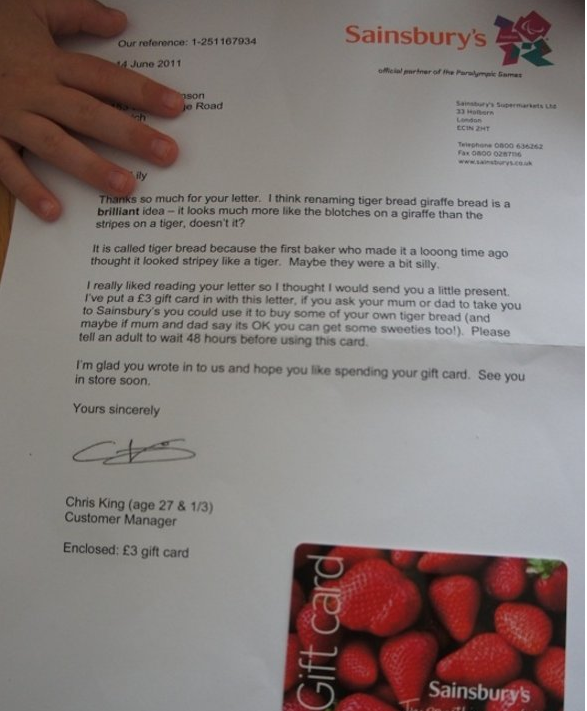
Sainsbury’s is a very big grocery store chain in the United Kingdom. And for years, they’ve sold the bread we know as Dutch Crunch under the brand name Tiger Bread. You can see why. Some tigers do have that kind of fur coloring. Obviously that isn’t typical. Tigers tend to have stripes. Maybe it’s more like a Liger. But three and a half year old Lily Robinson had other ideas. On 31 May 2011, she wrote to Sainbury’s asking why they called their Dutch Crunch “Tiger Bread” when it clearly looked more like a giraffe and thus should be called Giraffe Bread.

Just two weeks later, 27 and a third year old customer manager Chris King wrote back. He said that he thought it was a brilliant idea to rename the bread. He also noted that the original baker who first named it was perhaps being a bit silly. (Note: “silly” is a great word.) Here are the two letters. You won’t be able to read the response at this resolution. Just click on it to see it at full resolution:

Sainsbury's Tiger Bread Letters

The letters went viral on Twitter but then died down. Twitter, of course, has the attention span of a gnat with ADHD. But then, as always seems to happen, it went viral again for no particular reason other than the madness of crowds. So in January of 2012, Sainsbury’s released a statement:

In response to overwhelming customer feedback that our tiger bread has more resemblance to a giraffe, from today we will be changing our tiger bread to giraffe bread and seeing how that goes.

As far as I know, the grocery store is still selling it under the name Giraffe Bread. As a nice postscript to the story, Chris King quit his job at Sainbury’s to go back to college to become a primary school teacher. I think he has the perfect temperament for it.

Afterword

I do not like Dutch Crunch under any name at all. The crust is nice enough. But inside is a doughy tasteless white bread. I’m surprised that it is as popular as it is. There are so many better breads around. According to that BBC article I linked to above, “Rice paste is brushed on to the surface before baking, forming the pattern as it dries and cracks while it bakes.” That means you could put that crust on an actually good bread. But as you can see in the image above, Giraffe Bread only costs £0.75 — making it a very cheap bread. But it seems to me it is much more expensive here in the states.

Update on the Mouse Situation

Deer MouseIt’s now over two months since I wrote, My MouseHunt. In that article, I told the story of the mouse who had gotten into my house and how I trapped her and released her. For me, that was the end of the story. But I suspect that most people thought I was just a silly boy. Indeed, the story was not over.

After four days without any mice, I noticed more scat. So I put out the trap and it caught another mouse, which I duly released in the front yard. And every three or four days, there was another mouse. I got to thinking that the local mice community had fingered me as a mark. I imagined one of the mice telling all the others, “You go inside this box where you can have as much peanut butter as you want. Then you go to sleep, and in the morning, this guy comes by and puts you outside.”

I like mice, but I don’t like feeling like a mark. So I decided to release the mice far from home. The problem with that is that the traps are super sensitive. So many times, when I opened the back door, there was no mouse inside. I didn’t like the idea of trudging a half mile away to release the little thing.

There was another problem: I am kind of a mark. I didn’t like the idea of the mouse being all alone — far from its family and friends. And then it might be eaten by a hawk. Or it might get into someone else’s house and have its cranium crushed just when it thought it was going to have a delicious meal.

But I found a spot that I thought was rather good. It was covered with trees and leaves. And I figured there was a good mouse living to be made — but clearly not as good as the peanut butter train in my house.

I had noticed during the month and half of constant mouse collecting there were clearly at least two mice. One was small and the other large. Now they might have all been different and I’m just noticing females and males. I don’t know. But the first mouse was small that I delivered far away in the land where a mouse could make a good living. The second mouse was large. And then, just like Keyser Söze: poof! They’re gone.

Was it just two mice who were living by my house? I’ll find out soon enough. I like the narrative though. There were two mice: a girl mouse and a boy mouse. And I relocated them together where they can make a good and honest living. Of course, I’m aware of the truth. Mice in captivity can live up to three years. Some specially bred mice have lived to almost five years. But mice in the wild rarely make it past one year. It makes me want to get a cage and keep them. But I’m not sure I’m up for that. If I really did have a girl and a boy, I wouldn’t want to have babies.

So the adventure continues…

Christmas Dinner Menu 2015

Christmas DinnerSince it is the Sunday before the big event, I thought I would discuss what I’m planning for Christmas dinner. I’ve reached the age where holidays are primarily a time for me to make a bunch of food for a bunch of people. The kids get cash because they don’t expect me to actually know what’s going on in their lives. And that’s all done, so I have only to prepare for dinner.

(Actually, the really hard thing is to get all my Frankly Curious writing done. Currently, I am two days ahead. But what with the other work that I need to do, and all the cooking I will need to do before, I figure I need to be four days ahead by Christmas eve. So if the work gets sloppy here, you’ll know why. I am planning some very pleasant diversions for those people who won’t be spending Christmas cooking.)

Main Course

I have strong opinions about the main course for holiday dinners. We are an extremely wealthy country. So I really don’t understand why people go with turkey for these meals. Hasn’t everyone noticed that turkey is just a big chicken, except that it doesn’t taste as good? I like to at least do a ham. And the ultimate is prime rib. It’s shocking that I get push-back on this, given that I’m more than willing to buy it myself. Anyway, I got my way this year, although I still haven’t figured out where I’m going to buy it — or how much.

Side Dishes

The main course is the easy part of a dinner. It’s the side dishes that are always a pain. That’s especially true for me because my default is to make way too many starches. This is because I love starches. But I know that people like variety. So I try to mix things up a little bit. Of course, that doesn’t mean that any of this is healthy. This is Christmas dinner, after all.

Starches

I have my two starch recipes that are hugely popular at every pot luck I go to. That’s not why I make them. I make them because they are hugely popular with me. The first is au gratin potatoes. And it is literally that. Well, I add one other thing. It is potatoes, onions, and cheese — repeated to the top of the casserole dish. And then I cook the hell out of it — normally for one hour the night before and then one hour on the day. It only gets better the more you cook it.

The other thing I make is Chef John’s Macaroni and Cheese. It’s unlike any macaroni and cheese I’ve ever had. It has a wonderfully complex taste. The only thing is that I don’t exactly follow the recipe anymore. I’m not quite certain what it is that I do differently. But it’s close enough. If you’ve never made it, it is worth checking out. You will never see macaroni and cheese the same way again.

Nominal Vegetable Dishes

By tradition, my sister makes a green bean casserole. But over the last year, I’ve been making it a lot myself. There are basically two ways to make it. There is the easy way, which depends on the fact that everything tastes good when you drown it canned cream of mushroom soup. When it comes to this method, Paula Deen really does have the best recipe. And then, there is the hard way, which requires making your own roux. Auriel at All Recipes has a very good recipe for that. Which one I make will depend upon how rushed I feel.

I don’t want to have a salad for Christmas dinner. Unless a salad can be its own course, it seems too much like something tacked on — saying penance for the delicious foods you are about to eat. I suspect I will, ultimately have to include a salad in all of this. But I’m planning as if I can avoid it. And I found a really interesting recipe, Grilled Corn Salad. But I’m definitely going to add some other stuff to it; I just haven’t decided yet.

Appetizers

I don’t bother much with appetizers. To me, it’s pretty simple: get a couple of good cheeses, apple wedges, some crackers, maybe grapes, salami — dump it on a tray and serve. But I know there will be shrimp, because there always is. Also, there will be Swedish meatballs. And my sister makes excellent deviled eggs. After that, there really won’t be any need for dinner. But we will do it nonetheless because there are just some things you have to do to live in a civilized society.

Shocker: Man Quits Drinking, Spends Less Drinking

People DrinkingTechnically, I’m pretty poor. But I don’t think of myself that way. I’m able to do what I want. It’s just that I’m really lucky to be focused on things that cost little money. I understand that other people have greater needs. But it annoys me when I see people making a big deal out of what they’ve come to think of as necessities of their lives. This is what I thought when I read an article by Tobias van Schneider, I Had No Alcohol and No Coffee for 15 Months and This Is What Happened. What happened is that he saved a thousand bucks a month.

That comes to roughly $33 per day. According to van Schneider, “Some might think that this is heavy alcoholism, but trust me when I say that having 1-2 drinks everyday in New York is more than normal.” I guess he means that his drinking more than 1-2 drinks is more than normal for him. And it isn’t the drinking that really costs the the money, “Going out drinking means that the occasional dinner & snacks are more frequent.” I see it: a drink or two, some beer-battered onion rings, and a couple of expensive Starbucks coffees a day and you easily get to a thousand bucks a month.

Van Schneider also noted that the second thing that happened was, “Less gossip.” What he means is that he socializes less. So what really happened was that he cut a big part of his social life away. Before, he had a thousand dollars a month that he spent on entertainment, and now he doesn’t. That’s fine. How ever he wants to focus his life is his business. But it isn’t really about coffee and alcohol, is it? It’s about a certain notion he had of his lifestyle.

My lifestyle is what most people would consider pathetic, but it is more or less the one that I want. Each day, I drink upwards of three cups of tea. I usually drink Trader Joe’s Irish breakfast tea. It comes in boxes of 80 bags for $2.99. That about 4¢ per bag, or 12¢ per day. Then, when I’m feeling flush, I buy beer. Right now, because it is in season, I’m drinking Lagunitas Brown Shugga’. It’s about $10 for a six-pack, and over $11 once tax and CRV is paid for. So let’s say it is two dollars a bottle. I drink a bottle a night — religiously. (Well, sometimes I forget; I’m not naturally religious.) If a friend stops by, I will give them a beer. That is rare. But even if it weren’t, my entertainment budget comes out to perhaps $100 per month.

I don’t point this out because I think I’m superior to van Schneider. But it’s ridiculous to say that cutting out alcohol and coffee saved you a thousand bucks a month. And that was what he led with. I would say the main thing he really got from the experience was this, “It made me realize how many friendships are actually based mostly on your drinking habits.” Yes. Most of your relationships really aren’t any more deep than that. Friendship is an art, and very few people practice it.

But other than that, the whole thing reeks of privilege. It comes off as a rich man saying, “I can’t believe how much money I saved since I cut out caviar and champagne!” Yeah. It’s funny how when you stop spending money on expensive stuff you, well, stop spending money on expensive stuff. It’s right up there with, “I’ve lost weight since I started eating less and exercising more.” And, “I feel better since I stopped banging my head with a wooden mallet.

Brain Chemistry and Video Watching

Sad FaceI am constantly amazed at the effect of chemistry on mood. For example, I always hope that I die right as I’m waking up, because when I wake up, I always wish that I were dead. Well, maybe not dead all the time. But I’m not pleased. Yet you get a cup of tea in me and I can be literally thrilled to be alive. This morning, for example, as I slide into consciousness, I started thinking about Schopenhauer — never a good sign: another day, like the last, which I will work in order to survive to have tomorrow, which will be like the last. It is pointless! I never forget this intellectually, but with the right amount of caffeine, it doesn’t seem important, emotionally.

But consider the chemical soup that swims around in our brains. It really does define us. Let me illustrate.

Happy FaceLast week, when I was going through a thankfully brief period of depression, I decided to watch A Collection of 2007 Academy Award Nominated Short Films. I have seen it before. These collections are wonderful. The truth is that short films are generally better than features because they are organic. They only need to be as long as they need to be. Features are almost always shoehorned into something between an hour and a half to two hours long — regardless of whether the film should have been eight hours or, as is more often the case, 20 minutes.

This particular collection contains two incredibly charming, light-hearted films: The Mozart of Pickpockets and Tanghi Argentini. I was undoubtedly thinking of these films when I decided to watch it. But the disc starts with At Night. It tells the story of three young women who are being treated for cancer at a hospital. Under normal circumstances, I would label the film “poignant.” But in my state of mind, it was devastating; I sobbed pretty much nonstop through it.

I had hoped that I would be about to embed it here, but it isn’t available. It is rather long anyway: almost 40 minutes. Although you can watch the wonderful Tanghi Argentini. Just in time for Christmas! It is a wonderful, heartwarming film. It also made me cry — but not nearly as much.

Okay, so yesterday, I was feeling much better. Great, in fact. And I happened on a sketch comedy show called, Bruiser. It came out in 2000, and I’m shocked that I didn’t know about it, because it was Mitchell and Webb’s first television show. (They are in a cast of six.) It only lasted for one series — six episodes. It’s a weird show with a lot of incredibly annoying characters. The duo definitely got much more subtle — and funny — as time went on.

Here is a series of skits that originally played at different times and across different episodes. It is a parody of Q from the James Bond films. What’s remarkable is that there really isn’t much of a joke here. It’s just: what if Q had really stupid ideas. Yet it made me laugh to the point of asphyxiation.

I must still feel pretty good, because I just watched again, and I found it almost as funny. Ah, brain chemistry.

The Happy Pointlessness of Life

CalvaryI’ve notice how personal reading is for me — and I figure for most people. I don’t much read New Republic. Instead, I read Brian Beutler and Elizabeth Bruenig. I’m not so much interested in being informed, because I get that by reading more general things. But I’m interested in what these people have to say. And there isn’t much reason for it. It’s a question of trust or identity. They are people who I can imagine having over for dinner without wanting to murder them. Something like that.

I wonder if it is the same way around here. I assume that it is. The point cannot be to learn about the world, but to learn about what I think of the world. And that’s fine. I do have an outlook on life that isn’t totally unworthy of listening to. I try to be something slightly more than what you will read elsewhere. And there are things — generally related to puppets or Don Quixote — that you won’t read anywhere else. But it does create a bit of a problem when I get quite personal. I don’t write to get a reaction. I write because that is what I do. It is the way that I think about things — the way that I process the world.

After being away from home for five days, I find that I am totally out of sorts. I’ve heard this about cats. They hate it when their worlds are upset. If you do so much as move the couch, they freak out. I feel that way. I hate for my routine to be upset. And it was many times this last week. First there was a day wasted driving. Then I had to work in an unfamiliar environment that worked okay — but not great. And then there was the drive back. And ever since, I’ve been filled with debilitating anxiety.

If I could wed this person I am today with the energetic and happy person I expect to soon be, that would be something: to take joy in the activities of life, even while knowing that it is pointless and that it does matter if I am here tomorrow to continue on with the happy pointlessness of life.

This morning, rather than work, I put on Calvary. When I first watched it, I wrote, Calvary and the Lost Art of Forgiveness. As you can tell from that review, I saw that film in a hopeful way. But this time, it seemed like an allegory of hell. I had noticed this originally, “If he isn’t killed with a bullet to the head, he will be killed with a thousand cuts.” The denouement seems like the greatest act of kindness in the film. The world is evil. It is not surprising that the early Christians would come up with the idea of original sin.

But where does that leave an atheist like myself? I don’t go in for the “thoughtless cynicism” of the townspeople. And I certainly don’t think that the murder of Father James in “Calvary” does a damned thing to fix the problem. Even more, if you look to the Bible, what happened to Judas Iscariot? By church tradition, he either killed himself or was otherwise killed gruesomely. It’s a contradiction, right? In order for Jesus to wash away our sins, he had to be murdered, but Christians hate Judas for facilitating their salvation. If I were a Christian, I would think it Judas who truly suffered (and continues to suffer) for our sins.

It’s all brain chemistry, of course. Whether we feel good or bad, it is just the chemicals swimming around our bodies. Some days I reflect that today would be a very bad day to die. That, I suppose is the illusion. Because those are the days that I want to get things done. Self-actualization is a happy delusion — one I hope to get back in the next couple of days. But I think the way I feel today is much more clear-eyed. I don’t want to die. I just don’t especially care. If I could wed this person I am today with the energetic and happy person I expect to soon be, that would be something: to take joy in the activities of life, even while knowing that it is pointless and that it doesn’t matter if I am here tomorrow to continue on with the happy pointlessness of life.

Anniversary Post: Dulles Airport

Dulles AirportOn this day in 1962, President Kennedy dedicated the Washington Dulles International Airport. This gives me the opportunity to talk about the day that I was stuck there. I was 17 years old and I had been accepted into one of these summer touring bands. Kids were flying in from all over the nation to be shuttled to some music conservatory in the middle of Virginia. (I can’t seem to find it.) Anyway, they were understaffed and I spent a good eight hours there.

But the weird thing about it was that the vast majority of the kids were from the south. I don’t know why. But even though I had traveled quite a bit in the south, I did not get on well with the southerners. Or maybe it is more correct to say that they had a problem with me. There were basically three people I got on with. There was a girl from Arizona who had a sense of adventure and who was the only one who backed me up when I pushed for us to go see, No Sex Please, We’re British. There was an older woman — a teacher — from Philadelphia who I learned much about the world from. And there was this crazy guy from Alaska who I used to sneak out with late at night and have great times in some of the best cities in Europe.

I’d never thought about it before, but maybe there really is something wrong with southerners. At least among that group, they were no fun. And this is during a period of my life when I was a pretentious young intellectual. But at least I wasn’t wedded to the rules and afraid of a little adventure. But anyway: Dulles.