Quantity Over Quality

Isaac AsimovOn this day in 1822, the great physicist Rudolf Clausius was born. He basically put the Carnot cycle into the formulation that we now use. But more important he introduced the idea of entropy into thermodynamics. Entropy is kind of like the disorder of a system and it is the reason that systems are not reversible. Think of Humpty Dumpty: it takes a lot more energy to put him back together than you got from breaking him in the first place. Anyway, Clausius is extremely important to the field of thermodynamics and thermodynamics is a really cool (no pun intended) field of study.

The great Croatian painter Slava Raskaj was born in 1877. She is best known for her water colors, which are magnificent. In her early 20s, she began to suffer from depression. So, as they did in those days, they shipped her off to an “institution” where she caught tuberculosis and died shortly after her 29th birthday.

Lotus - Slava Raskaj

The great Russian filmmaker Dziga Vertov was born in 1896. When sound came into film, it almost destroyed the American film industry. All of the visual brilliance that came from people like D W Griffith was forgotten to make way for sound. It’s understandable, but sad. In other countries they didn’t make this mistake. I watched L’Atalante the other night, and although it is a sound picture, the visual story is not sacrificed for the sake of dialog. Vertov was very much part of that, but he didn’t even make narrative films. He was an experimenter, and his film Man with a Movie Camera is still a really interesting film to watch. It was a collaboration with his wife Elizaveta Svilova. Vertov went out and shot interesting things and Svilova tried to edit it into something that made some kind of sense. And it works. It was also hugely influential while American filmmakers were trying to figure out how to hide microphones in flower vases. Here is the whole thing:

The singer-songwriter Roger Miller was born in 1936. He wrote fun and funny song. I love this song:

And finally, someone I really don’t like: “journalist” Judith Miller. More than any other single media person, she sold the Iraq War. And we cannot say that she was deceived. Dick Cheney’s office would feed her information, she would report it, Dick Cheney would then go on the PBS Newshour and say, “It’s not just me who’s saying this; the New York Times reported the same thing!” And then, once she had destroyed all of her credibility, she went on to work for Fox News and other conservative media outlets and “think tanks.” So she was always a conservative, pushing a war that the conservatives wanted, and did it while claiming to be an “objective” journalist. Certainly, she is nowhere near as bad as Bush the Younger or Dick Cheney. But I think she is a traitor, both to her profession and to this country. Instead, I’m sure she’s living the good life, making lots of money, widely applauded in the conservative circles she now finds herself. I guess that’s the new American Dream: betray your country and then get paid huge amounts of money for it. Go team!

Other birthdays: composer Mily Balakirev (1837); sculptor Ernst Barlach (1870); a man who now looks like George Washington compared to what his party has become, Barry Goldwater (1909); and actor Cuba Gooding Jr (46).

The day, however, belongs to Isaac Asimov who was born on this day in 1920. He is mostly known as a science fiction writer. I don’t care for his science fiction. He also wrote books about just about anything you can think of. I’m not too fond of those either. But I do like that he was interested in a lot of different stuff. The problem with his work is that he went for quantity over quality and it showed. Or at least it showed whenever I read him. He wrote or edited over 500 books. I haven’t read more than ten of his books. But I could definitely see how he managed to write so many books: he didn’t put a lot of work into them. He also tended to write short books. Now, I’m all for that; I think there is far too much padding in most books today. But his popular science books were always just good enough, you know? Regardless, he was totally my kind of guy and he was very impressive. So…

Happy birthday Isaac Asimov!

More Evil English With Palate and Palette and Pallet

Palate and Palette and PalletWhat does your choice of restaurant say about your palate and your palette and your pallet? Is it important? Well, in speaking, it doesn’t matter at all. But if you don’t know the difference between these words, you may look ignorant in writing. And that’s a shame. Because all of these words are pronounced pretty much the same (I’m come back to that shortly). And they are all perfectly clear in context.

If you care about your palate, you may choose a restaurant where the food is most delicious. This is because “palate” means, “a person’s appreciation of taste and flavor, especially when sophisticated and discriminating.” But you might also choose a restaurant that does not serve pizza, which can burn the roof of your mouth. This is because “palate” also means, “the roof of the mouth.” Hot pizza has been known to badly burn the palate.

If you fancy yourself another Maurice Utrillo, you may choose a brightly colored restaurant, so that you can put a lot of different colors on your palette before you paint the restaurant as the sun falls below the horizon and many blues and reds surround the structure.

If you are a delivery man in a rush, you may choose a restaurant where the employees quickly process the goods you have delivered, so you can have your empty pallet back and get on with your next delivery.

The English language is a real pain. There is absolutely no reason to have these three spellings for four different things that all sounds pretty much the same. It is almost as if we had decided to have a language that is designed to make people feel stupid. At least they could have different pronunciations! And indeed, “palette” does have a very slightly different pronunciation. “Palette” has a slightly more distinct sub-accent on the second syllable. Or the main accept on the first is slightly less sharp.

“Palate” comes from Latin (13xx). “Palette” comes from the French (1622). And “pallet” also comes from the French (1558). So it really makes no sense at all. “Palate” isn’t so bad because it comes from a different language and is hundreds of years earlier. But the two French related words are from the same time. What a mess. No wonder Shaw was so upset!

But I do have a bit of help. “Palate” relates to eating. And if there is one thing that is easy to remember, it is that it is a bad idea to be late for dinner, because it will disappoint your palate. It helps that it is also the simplest and most reasonable spelling. Pa-late.

The second most reasonable spelling is “pallet.” Those are the things you stack. Or if you prefer: if a pal offers to help you stack pallets, let him. “Thanks pal for offering to help stack my pallets; I’m happy to let you!” Pal-let.

As for “palette”: that’s easy! Artists always want to put extra letters on the ends of words that don’t need them. Think: artiste. So that stupid thing painters use obviously needs an extra “e” on the end. But it can’t just be a single “e.” That would sound Spanish, “Pallete.” Pronounced, “Pa-zjet-a.” It has to stay French, so it’s got to have two “t” characters. That leaves us with “pallette.” Unfortunately, adding those two useless letters makes the word too long. So they removed one of the other unnecessary letters: the extra “l.” It’s silent, anyway. Problem solved! Pal-et-te.

If anyone wants to start a revolution, I’m ready. Until then, I’ll be using my palette to paint pallets whetting my appetite for the for the food my palate will enjoy afterward. (And yes: wet vs whet. What a pain English is!)

Wordy Sarah Vowell

Sarah VowellOn this day in 1571, the great Johannes Kepler was born. He is perhaps the greatest theoretical astronomer of all time. He’s the guy who made Copernicus’ idea work. It was fine to put the sun in the center of the solar system. But the truth was that it still didn’t work to predict the orbits of the planets. That’s because the planets don’t orbit in circles. Working with Tycho Brahe’s data, Kepler was able to show that the planets orbited in ellipses. And that made all the difference. Later, Newton figured out why that was and today we are able to send spacecraft to all the planets!

What a day for scientists! The great biologist Louis Pasteur was born in 1822. I’m sure you know about pasteurization: the process of heating and then cooling food to greatly limit the number of pathogens that are in it. You may well be alive today because of it. But Pasteur did much more than that. He discovered the principles of vaccination and microbial fermentation. He was a brilliant man, or as Michele Bachmann refers to him, “The Antichrist!”

The great actor and singer Marlene Dietrich was born in 1901. You could tell she was something special even in her early silent films. And that continued all through her career. I still mostly associate her with Touch of Evil. But there’s also this song:

Let me say something about not being grateful. This applies to a lot of actors who I actually like, but today, we’re going to talk about Gerard Depardieu. So he didn’t like paying taxes to the country that made him a star. Boo hoo! I hope he ends up in jail in Russia. I might be inclined to apologize for him if I thought he actually had any talent, but I’ve never seen the appeal of the man. He’s 65 today, so hopefully we will see him in no more films and will just die quietly in Russia.

Other birthdays: one of the most important aeronautical engineers ever, George Cayley (1773); actor Sydney Greenstreet (1879); one of my very favorite poets Charles Olson (1910); creepy sex researcher William Masters (1915); and useless journalist Cokie Roberts (70).

The day, however, belongs to the writer Sarah Vowell who is 44 today. She always has an interesting take on whatever she writes about. Basically, she writes history that is so personal that it reads more like personal essay. It is always fun to read. You should really listen to her live performance essay about “The Battle Hymn of the Republic.” If you don’t know her work, it will give you a good idea of why she is on my long and ever lengthening list of crushes.

Happy birthday Sarah Vowell!

Dude That’s Rude

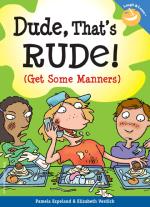
Dude That's RudeI’ve been thinking about profanity all day. It all stems from a single comment on my article, Fourth Time: Reality TV Is Not Real. The commenter wrote, “Both your column and that guy’s video make some good points; unfortunately they are obscured by expletive-heavy language that draws attention (mine, at least) away from the message.” I addressed his specific concerns in the comments and you can read them there. I want to discuss something more general.

Such comments are always written as an appeal to civility, but they are by their very nature rude. They say, “I don’t like the way you write; let me tell you how I think you should write.” Imagine such behavior at a dinner party and ask yourself, “What would Miss Manners say about that?”

Don’t get me wrong: I don’t mind. I love comments regardless of whether someone disagrees with me or not. I’m just saying that such people do not have the moral high ground that they think they do. They come to my blog, welcome, but uninvited. Then, rather than engage with my ideas, they complain that I don’t write in a style that they prefer. This is the very definition of a rude guest.

The irony, of course, is that such people (and the recent commenter was hardly the first) think it is the other way around. They have come to my site, welcome, but uninvited. They have paid absolutely nothing for their visit. And this horrible host had the temerity to use words they didn’t like. But instead of just passing it off as yet another example of the moral decay of our society, they decide the polite thing to do is to lecture the host.

The reason for this irony is that people who try to hold on to “the old ways” usually think it is given that they hold the moral high ground. This is why grammar pedants are so annoying. But whether it is what words one may use or which infinitives one may split, these are simply matters of opinion with the consensus always changing. So such people are on very thin ice with their pronouncements, regardless.

But imagine a different situation: one where an absolute truth is known. Take, for example, astrology. Because I used to teach introductory astronomy, I made it a point to learn astrology really well, because students were always asking me about it. Enormous amounts of research have been done on every conceivable aspect of astrology and there is absolutely nothing to it. Sometimes I’m at a dinner party and someone is chattering on about how they are “totally like that” because they are a Libra or whatever. But I don’t lecture them about the fact that astrology is bunk. And do you know why?

Because I’m not an asshole.

The Writer We Killed

John Kennedy TooleIt turns out that Joan Fontaine also died over the weekend. I’ve never much liked her, but I think that’s because of the kinds of roles she played. She was rather good in Suspicion, and generally later in career when she wasn’t typecast so much, like in Voyage to the Bottom of the Sea. It’s hard to be too sad that she has died, given that she was 96. But her older sister, Olivia de Havilland, is still kicking at 97.

The great Hindi poet Abdul Rahim Khan-I-Khana, better known as simply Rahim, was born on this day in 1556. Strangely, although he was Indian, his religion was Islam. He wrote a bit of poetry where he discussed how he gave money to beggars, “Sir, Why give alms like this? Where did you learn that? Your hands are as high as your eyes are low.” By this he means that he gives out charity with humility; he does not pretend that the act makes him superior. It is wisdom for all of us to take to heart. We should be grateful that we are able to give. It is a blessing.

The mathematician and physicist Emilie du Chatelet was born in 1706. She is best known for translating Newton’s Principia into French, which is still considered the standard translation. She also did much research, include work on fire that predicted the concept of infrared radiation. She was also very important in physics education of the 18th century. As I always note: she was a woman, which probably means she would be a household name if she had been born a man. Her lover Voltaire wrote that she was “a great man whose only fault was being a woman.”

It is a big day for scientists. The physicist Joseph Henry was born in 1797. He was basically the American Faraday. He did most of his work with electromagnetism. He discovered self-inductance, as well as mutual inductance, although Faraday published first and so gets the credit. He was also a great inventor, his work on the electromagnetic relay led pretty directly to the telegraph. The unit for inductance is named after him.

The great mathematician Mary Cartwright was born in 1990. She is best known for her work on chaos theory. She did this work with J E Littlewood, who coined the term, “The butterfly effect.” This is the idea that one couldn’t predict atmospheric dynamics perfectly, because a butterfly flapping its wings half a world away would have a large effect on the local dynamics. The atmosphere is a chaotic system. But don’t misunderstand. This is not the chaos theory that was all the rage in the 1980s. Cartwright was doing her work in the 1930s. I’ve never been too clear why more recently people have made a big deal of the study of highly non-linear systems. Physicists have been working on these problems for a very long time.

Pope FrancisAnd Jorge Mario Bergoglio is 77 today. He is better known as Pope Francis and I’m sure you know a lot about him. He did not become a priest until the age of 33—I’m not sure how common that is. Before that, we worked as a nightclub bouncer. I’m curious to see what he does. Many people expect too much of him. But thus far, he has done a lot to improve the image of the Church. And that isn’t just marketing. He is the first Jesuit Pope, and that means a great deal. They are the most committed to interfaith dialog, for example. And they also profess poverty, something that has only barely been tolerated by the papacy for most of the history of the group.

Other birthdays: the great chemists Humphry Davy (1778); mathematician Sophus Lie (1842); post-impressionist painter Paul Cesar Helleu (1859); theater director Erwin Piscator (1893); actor Richard Long (1927); linguistics fan William Safire (1929); publisher Bob Guccione (1930); musician Art Neville (76); truly horrible human being and “journalist” Chris Matthews (68); comedian Eugene Levy (67); film editor Sally Menke (1953); and film director Peter Farrelly (57).

The day, however, belongs to the great writer John Kennedy Toole who was born on this day in 1937. Sadly, he killed himself in 1969, at the age of 31. He really only wrote one book, A Confederacy of Dunces. But it is such a great book. It’s impossible to say exactly why anyone kills himself, but it is certainly true that not being able to find a publisher for the book started his decline. It is hard to understand, because the book is brilliant from the first page. I like to think that he could have been our Cervantes. If you haven’t read the book, you really should. I mean: really. It is very humorous and wonderfully insightful. Most of all, it is a fun read. If you’ve read Life of Pi and not A Confederacy of Dunces, shame on you. Go now and read it! Toole clearly suffered for our benefit. Don’t ignore his sacrifice.

Happy birthday John Kennedy Toole!

Pronoun Trouble

Pronoun TroubleI haven’t written much about grammar recently and it has begun to bother me. A few of you will understand this: grammar is a great refuge for me. If politics or my personal life are getting to be too much, I can curl up with Fowler or a number of other great writing writers and escape it all. When I was younger, math would do that for me. But my brain has changed and now math is either trivial or exhausting. But I can lose hours diving into the intricacies of the gerund. Also, there are my continuing efforts to simplify the language and slowly reduce the number of things I have to worry about, like my campaigns to stop using the words annunciate and blonde.

Today, I have nothing so sexy as jettisoning old redundant words and French gender identifiers in English. I came upon a sentence this morning by the fine political writer Martin Longman over at Political Animal, In Colorado, Same As It Ever Was. But before I get to it, please remember I’m not attacking him. Blogging is a fast-paced business with little or no support staff and absolutely no copy editors. What’s more, I think Longman is a better writer than I am. Regardless, he wrote:

I mention this because Ken Buck is running for Senate again, this time against Mark Udall, and he is far ahead in the polls.

What he just mentioned was an article from three years ago by Steve Benen that discussed Buck’s extremist positions. So there really is no context for this sentence and it completely confused me. I didn’t know who was far ahead in the polls. My best guess was that it is Buck, but it wasn’t clear. Even worse, if we assume that Buck is ahead, we can only assume that he is far ahead of Udall. Knowing what I know of Colorado politics, that didn’t sound right. So I clicked over and got the information. Here is what Longman should have written:

I mention this because Ken Buck is running for Senate again, this time against Mark Udall, and Buck is far ahead of his primary opponents in the polls.

I understand why he didn’t write the sentence that way. This is an issue that I struggle with constantly—I think all careful writers do. You don’t want to write sentences like, “Cindy walked up to Andrea, and Andrea looked away, Andrea started to cry and Cindy said, ‘Buck up!'” That’s just awful and there are easy ways to fix it. But it is definitely better than, “Cindy walked up to Andrea, and she looked away, she started to cry and she said, ‘Buck up!'” (Obviously: “Cindy walked up to Andrea who looked away and started to cry. ‘Buck up!’ Cindy said. And then Andrea punched her in the mouth because anyone who ever says ‘buck up’ is an asshole.”)

As I wrote before, All Is Clarity. The first thing we must do as writers is be clear. There are other things we can do, but what I think most writers find is that if they are clear, their particular style will shine through. Now it may be a tired style that no one wants to read. But the constant struggle for clarity will help the style too. For one thing, clarity tends to eliminate cliches, which are the biggest barrier to a compelling style. And don’t think I’m speaking from on high. My work is riddled with cliches, like the way I started the sentence before last, “For one thing.” Yikes!

But pronouns are a big problem for us. We need to watch out for them. And it is always better for a sentence to be clumsy than unclear.

Heart of Joseph Conrad

Joseph ConradOn this day in 1755, the great American painter Gilbert Stuart was born. He was mostly a portrait painter, but he did a lot of stuff and his work is really beautiful. Unfortunately, he is known for what I consider a pretty boring unfinished painting. I’m sure you know it. If you are my age, it hung in your grammar school principal’s office. It is the painting of George Washington, also known as The Athenaeum.

The Austrian composer Anton Webern was born in 1883. He was the most important student of Arnold Schoenberg and his twelve-tone technique. But Webern took it further into what we now call “total serialism.” If anything, I like Webern better than later Schoenberg. But I like early Schoenberg a lot more than Webern. Twelve-tone technique is interesting. But it rarely if ever works for a whole piece. Take, for example, Opus 27: Variations for Piano. The third (last) movement is based upon the following tone row:

Variations for Piano - Webern - Tone Row

Having played around with it a bit on the guitar, I find that I can actually make it work in pleasant ways. But I’m no music genius. What Webern does with it is make it as difficult as possible for the listener. At this point, I’m quite familiar with the tone row, and I barely hear it. See if you can:

The great cinematographer Sven Nykvist was born in 1922. He is most associated with Ingmar Bergman, most notably in Cries and Whispers, which has a very distinct look to it. Americans are more familiar with his work on things like Bob Fosse’s Star 80 and Woody Allen’s Crimes and Misdemeanors. Interestingly, I just picked up Through a Glass Darkly to watch, most likely later today.

Other birthdays: activist Octavia Hill (1838); overrated direct Jean-Luc Godard (83); disgusting human being Ozzy Osbourne is retiring today; actor Daryl Hannah (53); and actor Julianne Moore is (53).

The day, however, belongs to Joseph Conrad who was born on this day in 1857. In my mind, he is so mixed up with Herman Melville. Of course, there really is no comparison. For one thing, they are two generations removed from each other. Although I tend to prefer Melville with his alcoholic strangeness, there is no doubt that Conrad is the better writer. While I would never call Milville sentimental, his work was old fashioned and labored. Conrad is in many ways the first American modernist novelist. Writing really didn’t change much from him until the publication of Naked Lunch.

Of course, it is hard for me to love Conrad too much. He was something of a philosophical whiner. A fatalist to the core, he couldn’t see any way for society to be organized correctly. I respect that sentiment. But in him, it took a nasty turn against democracy. The basic tendency was typical of men of his time. But a practical approach is always the best and I tire of people who think the only solutions to our woes are perfect theoretical constructs. Still, he left us a lot of good literature.

Happy birthday Joseph Conrad!

Crime and Dostoyevsky

Fyodor DostoyevskyOn this day in 1863, the French neo-Impressionist painter Paul Signac was born. He was most clearly influenced by Georges Seurat. But it is taken to extremes. What’s more, there are more modern aspects of his work—designs that remind me of Paul Klee but also that 1960s San Francisco sunburst kind of art. And his use of light in landscapes is like Monet, but again, taken to extreme. I think he is one of the most interesting artists of that period.

The great American general George S Patton was born in 1885. He was a fascinating guy—very much in the mold of Sherman. On the one hand, he was a terrible human being who thought that war was the ultimate expression of human creativity. On the other, if you’re going to have wars, you need men like him around. He is much better than the men who get us into war but claim that it is the last thing they want. I’m talking to you every president of the United States ever! As much as I like George C Scott’s portrayal of him, I think that it gives the wrong idea about him. It makes him coarser than he was and also more of a loose cannon. But I think as a society, we want to see great generals like that. It has certainly been done to Sherman and Grant, although in Grant’s case, it’s probably right.

The Wisconsin Senator William Proxmire was born in 1915. He was a great Senator, but his legacy is a pernicious one: the Golden Fleece Award. The idea was to point out government waste. Before getting to it, however, let’s just be clear: there really isn’t much waste in government. People always think there is because they don’t realize just how much the government does—including a lot of things for them. Do projects go over budget? Could the system be even more efficient? Of course! But we’re talking marginal stuff here. What’s more, most of the waste in government contracts is in the military. That’s the one area where conservatives never want to even think about cuts. Regardless, the Golden Fleece is used most every year to make fun not of wasteful spending but mostly just research contract titles with little or no understand of what the work actually is. I recommend checking out, Fighting William Proxmire with Golden Gooses.

Other birthdays: film director Rene Clair (1898); the great writer Kurt Vonnegut (1922); comedian Jonathan Winters (1925); my good Senator Barbara Boxer (73); President of Nicaragua Daniel Ortega (68); and then a bunch of actors: Stanley Tucci (53); Demi Moore (51); Calista Flockhart (49); Adam Beach (41); and finally the really annoying Leonardo DiCaprio (39).

The day, however, belongs to the great Russian author Fyodor Dostoyevsky who was born on this day in 1821. It’s always hard to discuss authors who wrote in a language you don’t read. But I’ve never gotten the impression that the sound of his writing was terribly important. In fact, I’ve always wished that translations would anglicize the character names. It can be hard to keep track of people. The main thing in his works, however, is the depth of the characters he creates. I’ve never read any of his early work. But the later stuff clearly shows the influence of his hardly rosy life. My preference is for those who find humor in tragedy, but there is nothing more compelling than men who stare into the abyss and explain in detail exactly what they see.

Happy birthday Fyodor Dostoyevsky!

Why Are Republicans the Wrecking Crew?

The Wrecking CrewAfter reading a lot of nonfiction books — especially on politics — I’m not clear what I’m supposed to have learned. I’ll often go back through the book to figure out the theme. Part of this is just that I’m a bit scattered, and I’m very good at putting new data into an existing (or if the book is really good) alerted narrative. But it’s also the case that most books aren’t that well written. People do not make clear and direct arguments. And they often write 300 pages when 100 would have done the trick.

One writer I never have this problem with if Thomas Frank. Whereas other writers may see themselves as constructing an intricate web, Frank is a man with a hammer who is going to bang on the same issue page after page. Now, that would be tiring coming from a dull writer, but Frank is constantly smart and funny. And the fact that he tends to see the world the way I do probably doesn’t hurt.

I just read his 2008 book, The Wrecking Crew. He starts the book with the observation that Republicans manage the nation really badly whenever they’re in power. And his thesis is that they do this on purpose so that when the Democrats are in power, they won’t have the time or resources to enact any liberal policies. What’s more, the Democrats will be too focus on cleaning up the Republicans’ mess to do anything else.

It’s a compelling thesis. But I don’t really buy it. It sounds too much like what Republicans tell themselves about their policy failures. I think the situation is far more simple: Republicans are lousy at the jobs we elect them to do. And I believe the reason this is so is the same reason that our federal politics are so much more conservative than the people would want: our two-party constitutional democracy.

One person I greatly respect thinks this is rubbish: Jonathan Bernstein. He claims that the problem is simply that the Republicans have become a radical party. I think we can all agree on that. But the question is why. And I believe the answer is because our system does not force accountability. Neither party ever gets to run the government they way they really want to. During Obama’s first two years, even with overwhelming majorities, the bills that got passed were watered down almost to the point of uselessness.

The reason I think the Republicans have become radicalized and the Democrats have not is because the Republicans have a built in advantage in rural areas and the south. This has pushed the party more and more to the right. But since their policy choices have never been given a clear test, they can maintain plausible deniability. And even more important, the Democratic policies have never been given a clear test to show that they work. So we muddle on and there is no reason for the Republicans to moderate.

Along with the extremism in the Republicans Party has come incompetence. For one thing, a true conservative would find a very nice home in the Democratic Party. So the more reasonable Republicans just become Democrats. Even more important, a Republican who just wants his taxes kept low but doesn’t go along with the other stuff probably won’t even run, but would lose in a primary anyway. So you end up with ideologues who neither care about actual governance nor have the skills for it anyway.

There is one reason in particular that I think that the Republicans screw up government because they are incompetent rather than as an actual policy: Iraq. The Bush administration didn’t care at all that the people they were sending to rebuild the country were hopeless. In 2006, Rajiv Chandrasekaran wrote, Ties to GOP Trumped Know-How Among Staff Sent to Rebuild Iraq. For example, “A 24-year-old who had never worked in finance — but had applied for a White House job — was sent to reopen Baghdad’s stock exchange.”

Admittedly, this incompetence is at least partially the result of not caring. But even that pushes against the idea that the Republicans are evil geniuses who are wrecking the country to harm the Democratic Party. There is a powerful lesson here, though. The end result is the same. And we have seen it during Obama’s presidency. He is the first president since Johnson to pass even the mildest of liberal legislation. And this has been met with cries of, “Socialism!” But it is a reminder that the whole process of cleaning up after the Republicans is a bad strategy that only makes the Republicans stronger. Half of Obama’s time in office was spent obsessing about the federal deficit. No time in Reagan and Bush Jr’s terms was spent worrying about the debt. We need to be more like that.

Food stamps pay for themselves!

Buffalo buffalo Buffalo buffalo buffalo buffalo Buffalo buffalo

BuffaloI don’t know how I missed this all these years. At some point last week, Chris Hayes mentioned the sentence “Buffalo buffalo Buffalo buffalo buffalo buffalo Buffalo buffalo.” Being the kind of guy I am, I went crazy with it. I even dreamed about it. It’s all syntax so it was very much like the kind of math dreams I used to have with ideas and equations bursting into my mind from what always felt like different locations. This sentence is very much like a mathematical equation.

There are three different definitions of “buffalo” here: two nouns and a verb. The nouns are “Buffalo” the city and “buffalo” the animal. The verb is a synonym for “bamboozle.” It is more easily thought of as follows:

Buffalo from Buffalo that buffalo other buffalo from Buffalo also buffalo other buffalo from Buffalo.

It does show the vagaries of the language. One might say, “People other people abuse are often abusive.” It is clearer to say, “People whom other people abuse are often abusive.” But I don’t think anyone has a problem with the original construct. That’s especially true when spoken. In writing, I find it confusing and so I try to not do such things. It is best if the reader can gradually understand a sentence rather than have to figure it out in retrospect.

So given our sentence, it helps to set off “Buffalo buffalo,” which means “buffalo from Buffalo.” I’m going to do that and throw in a couple of commas as well:

(Buffalo buffalo), (Buffalo buffalo) buffalo, buffalo (Buffalo buffalo).

This actually allows us to get rid of “Buffalo” altogether. We’ll just assume that all the buffalo we are talking about are from Buffalo. Now the sentence is much simpler:

Buffalo, buffalo buffalo, buffalo buffalo.

Now let’s substitute “bamboozle” for our verb “buffalo”:

Buffalo, buffalo bamboozle, bamboozle buffalo.

I think the sentence is clear enough that we come to an uncomfortable truth: it is not a very useful sentence. Most likely, all it means that buffalo from Buffalo bamboozle each other. Strictly speaking, it means that there are a set of buffalo from Buffalo who bamboozle each other. So the con artist buffalo are prone to each other. In terms of meaning, it is no great shakes. But the syntax is nice: noun noun, noun noun verb, verb noun noun. It’s fun to play with.

Now maybe I can stop thinking about it!

Afterword

If you want to know the history of the sentence, Wikipedia has a very nice page on it.

An Atheist in the Foxhole

An Atheist in the FoxholeI just read Joe Muto’s An Atheist in the Foxhole. What a great book! The guy can write. I just tweeted to him that he ought to write a novel. The story he tells in Foxhole is not all that interesting. But his telling of it is constantly exciting and often laugh out loud funny. I also found it personally fascinating because when I was his age, I too felt similarly cocky and similarly learned that it is usually best to tread lightly with one’s political passions.

For those who do not know, Muto was Gawker‘s famous “Fox News Mole.” Sadly, he was outed in only 36 hours. At the time, many of us thought that this was due to the fact that he had gone to Gawker instead of a more reasonable outlet. After reading the book, I feel even more convinced of this. If Gawker really wanted a mole, why even publish the videos? He had little to offer in that regard anyway. A few months of dispatches would have been great fun. Gawker didn’t manage a really good opportunity. And then after it was all over, they abandoned Muto. I think Muto’s biggest act of stupidity was turning to Gawker. Slate or Salon (where he now freelances) would have been better choices that would likely have served him better.

The book offers a great look inside the Fox News operation. The most shocking thing is just how low tech the place was and probably still is. You may remember the great scene in Broadcast News where Joan Cusack as a production assistant has to run through the office to get a tape on time to the live control room. Here it is; it’s a great scene:

The first job that Moto gets at Fox News is delivering the on air scripts to the set of the live broadcast. This is often done at the last minute requiring the production assistants to run through the halls to get them to the anchors. I wondered: why don’t they just have the pages printed directly to the studio? Regardless, all the money seems to go to Bill O’Reilly and company and little is left over for technology. Or staff salaries.

A good example of this is that Muto was hired for $12 per hour as a contractor. After six months, he gets taken on a regular employee. That means he gets benefits, so that’s all good. But they raise his salary to—Wait for it!—$12.74. That’s not a mistype; they raised his wage 74¢. That’s a 6.2% raise. Before he gets “promoted” to regular employee, a vice-president tells him he should be dressing better:

“Right, well, you should buy a couple [suits]. I mean, we pay you enough that you…” He glanced down at the paper on his desk, searching for the correct number. He grimaced when he found it. “Oh, well… you can at least to to Mean’s Wearhouse, right?”

That strikes me as entirely typical of conservatives: they always assume everyone must be well paid and if they aren’t, well, soon they will be. Liberals take it for granted that most employers screw their employees as much as they can. The outrage I hear from people about specific examples of this kind of stuff comes from conservatives. They are the ones who have this fairy tale idea that “almost all” bosses are Milton Hershey.

Most of the book is not an attack on Fox News. It’s just a memoir that I think even conservatives would enjoy.[1] But at the very end of the book, he gets serious. I want to leave you with an extended quote from the book that sums up what is really like to work at Fox News. I took the time to enter it myself, so read it!

About a month after I left, Fox & Friends played a video on their show. Four minutes long, it was a slickly produced package featuring sound bites and graphics, and absolutely throwing the kitchen sink at President Obama—hitting him on everything from the debt to unemployment, to food stamps, to gas prices. It played like an attack ad that had been created by the Republican National Committee. There was a massive uproar after the video aired, with repeated cries that Fox News had finally shed its last vestige of objectivity.

For the first few hours after it aired, Fox seemed poised to stand behind the video, featuring it prominently on the Fox Nation website. Then they reversed course and disavowed it, with an opaque statement that read, in part: “The package that aired on Fox & Friends was created by an associate producer and was not authorized at the senior executive level of the network.”

The associate producer in question was a guy named Chris, a guy who I came up with, a guy who started as a production assistant on the overnights around the same time I did. A good producer, and an honest one. And Fox was letting him twist in the wind, with a statement that left the door open to the interpretation that he had been acting alone when he put the piece together.

But that’s not how Fox operates. Something that long and elaborate would have taken at least three or four long days in the edit room to put together, days when a producer would be unable to do any other work. So unless Fox & Friends changed their operating procedures drastically in the month or so that I had been gone from the network at that point, I believe that Chris’ work on the package had to have been authorized by a senior—or even the executive—producer of the show. Someone had pulled Chris off his regular duties, and said, “Spend all your time the next few days making this tape and we’ll air it when you’re done.” I believe there’s no way that he was acting alone, but that became the narrative: the rogue Fox News producer who created an Obama hit piece! Reports surfaced that CNN—the high-paying promised land we’d all fantasized about as young PAs—had offered Chris a job shortly before the incident, but rescinded the offer following the controversy.

An Atheist in the Foxhole is not profound, but it is a quick and fun read. It’s probably better than most novels for vacation reading. And it answer the burning question, “What is Bill O’Reilly really like?” The answer: exactly what you think.


[1] The publisher must think this too. I noted many occasions when clarifying text was thrown in that I thought wasn’t necessary and burdened the flow. I assume these were editor added.