Anniversary Post: Einstein’s Second Best Year

Albert EinsteinOn this day in 1905, Albert Einstein published an incredibly important physics paper. It was a very good year for him, but remarkably, not his best. In 1905, he published four papers — any one of which would have made him a huge figure in 20th century physics. He was 26 years old. And, as we know, working a day job. This is used by many people to claim that we don’t need to fund scientific research. Of course Einstein was working a government job. And the people who say that are idiots.

The first paper (9 June 1905) was, “On a Heuristic Viewpoint Concerning the Production and Transformation of Light.” This was the photoelectric paper that posited that energy is quantized. It is the most important paper in quantum mechanics. Interestingly, Einstein never did accept quantum mechanics of the Heisenberg and Schrödinger variety. That’s where the quote “God does not play dice” comes from. Even more interesting is that Max Planck, who did so much to further Einstein’s career, thought that this paper was total junk. And if anyone has the claim to being the father of quantum mechanics, it is Max Planck.

The second paper (18 July 1905) was, “On the Motion of Small Particles Suspended in a Stationary Liquid, as Required by the Molecular Kinetic Theory of Heat.” It’s a classic of statistical mechanics. It explained Brownian motion as a random walk. I’ll be honest, I’ve never paid much attention to the paper because it seems too obvious to me. Statistical mechanics have always just made sense to me. But it was a huge finding at the time.

The third paper (26 September 1905) was, “On the Electrodynamics of Moving Bodies.” That’s Special Relativity. There was a year of my life when I was quite literally obsessed with it. It made no sense whatsoever to me. I finally realized that the problem was not my understand of Special Relativity but with my expectations. It isn’t a theory meant to explain the universe as I know it. It is meant to explain the motion of bodies moving very fast relative to each other. There is no “intuition” that we humans will ever have for it.

The fourth paper (21 November 1905 — 110 years ago today) is the most important of the papers, “Does the Inertia of a Body Depend Upon Its Energy Content?” This is also about relativity. It is where we get the famous equation: E = mc². But what’s really important is that it is the first step toward Einstein’s greatest achievement, the General Theory of Relativity. And that, will have to wait for another time.
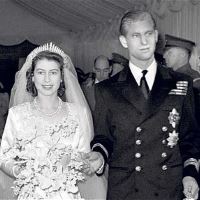
Anniversary Post: 1947 Royal Wedding

Princess Elizabeth married Philip MountbattenOn this day in 1947, then Princess Elizabeth married Philip Mountbatten. He had been named Duke of Edinburgh just before the wedding by Elizabeth’s father, Colin Firth George VI. Anyway, so the two of them have now been married for 68 years — quite a lot longer than I plan to live.

It seems wrong to me that they are both still alive. Elizabeth will be 90 next year and Philip will be 95. Are they ever going to die? It seems that the most useless of people live the longest. I understand: they’re tourist attractions. But so is Mickey Mouse. If he were an actual human being — or a mouse for that matter — it would be a pretty pathetic way to spend a life.

I think the UK should just bring the royal family together and say, “Thank you for all your fine work. You can keep all the money and the mansions. But your services will no longer be needed.” They could just go on to be the normal useless rich. Having the titles is bit much. It’s like the whole nation of the UK is involved in some kind of childish game, pretending that they have a monarchy.

I remember the wedding of Charles and Diana. I was in Germany at the time. And everyone was so excited about it. And I see the same thing with what’s her name. I wish they would all just go away. They offend me. They should offend all Americans. If the people of the UK want to keep them, that’s their business. But they are useless and offensive.

I suppose I can think of one way that they are useful: they are a reminder that we live in nothing like a meritocracy. They were born to their wealth and station and that is that. Sadly, I think there are a lot of people, who think that the royal family shows that the rich really are better than the rest of us. They aren’t.

Afterword

Proud of me? No a single joke about anyone dying in a car crash. Because truly: I don’t wish them ill. I just wish them gone.

Anniversary Post: Overpriced van Gogh

Self-Portrait Without Beard - Vincent van GoghOn this day in 1998, Vincent van Gogh’s Self-Portrait Without Beard sold for $71.5 million. At the time, it was the third most expensive painting ever sold. Now (adjusted for inflation), it is 26th. As regular readers know, I’m not a big van Gogh fan. But he is unique. Still, prices like this for a work of art say nothing of the work and everything about the narcissism of the art collector.

And if you look at the most expensive art there is a remarkable sameness about it. It is overwhelmingly Impressionist (more accurately, post-Impressionist) and representational modernist work. And there is a smattering of Abstract Expressionism — Rothko and Pollock. But the main thing is that you know the people buying these works would have hated the works when they were being produced. For all I know, they hate them now. It’s just something to impress the swells with.

I do all my writing sitting right next to what I know was once a beautiful painting by Bernard Frouchtben. But like far too much art that no one has been told is good, it was badly abused. In its case, it was left out in a carport for years. But even if it had been treated with the care and respect it deserves, it probably wouldn’t even be worth as much as $10,000. As it is, it is worth nothing in terms of money. But I dearly love it, even though it also saddens me to look at it.

I love art. But art as commodity offends me. For the price of that one van Gogh, a hundred Bernard Frouchtbens could have been supported in perpetuity. Imagine what kind of works would have result from that kind of investment. But instead, these people buy art the way decorators do when they are furnishing a new Days Inn. And the truth is that if you told these art collectors that paintings of bullfighters on black velvet was the thing, they’d be spending millions on every Edgar Leeteg that went on the market. And I’m not saying that Leeteg is bad. But his paintings don’t sell for millions for the same reason that van Gogh’s do — at it has nothing to do with what the buyers like or don’t like.

Anniversary Post: MAVEN

MAVENOn this day in 2013, the MAVEN space probe was launch from Earth. MAVEN stands for “Mars Atmosphere and Volatile EvolutioN Mission.” It entered into orbit around Mars on 22 September 2014. It was designed to study the evolution of Mars’ atmosphere over time. And less than two weeks ago, NASA announced, NASA Mission Reveals Speed of Solar Wind Stripping Martian Atmosphere.

It was discovered that the Martian atmosphere is significantly eroded during solar storms. This indicates that Mars used to have a much thicker carbon dioxide atmosphere that kept the planet much warmer than it now is — warm enough for liquid water to exist on the surface. The change from this warm Mars to the cold Mars of today apparently took place roughly four billion years ago.

I find this frustrating. I wish I were still associated with a college. I have questions. Did Earth’s larger magnetic field shield it from this effect? Is there a reason why this effect would be most important with carbon dioxide or is it just that the Martian atmosphere is primarily composed of the gas? Would the same thing have happened if the atmosphere had been mostly nitrogen or oxygen?

Regardless, this is fascinating stuff. And I don’t remember hearing a bunch of news coverage about this last week. It goes along with something I say often: our science reporting is terrible. Our political reporting is terrible. It seems that journalism is terrible with regard to anything I know a bit about. So I think we can conclude from this that journalism is terrible regarding everything. That’s not to say that all of journalism is bad or that all reporters suck. But it does indicate that there is something wrong with the industry. And I’m afraid I know what it is: the profit motive. It needs to be publicly supported. That is as important to democracy as elections.

Anniversary Post: Dulles Airport

Dulles AirportOn this day in 1962, President Kennedy dedicated the Washington Dulles International Airport. This gives me the opportunity to talk about the day that I was stuck there. I was 17 years old and I had been accepted into one of these summer touring bands. Kids were flying in from all over the nation to be shuttled to some music conservatory in the middle of Virginia. (I can’t seem to find it.) Anyway, they were understaffed and I spent a good eight hours there.

But the weird thing about it was that the vast majority of the kids were from the south. I don’t know why. But even though I had traveled quite a bit in the south, I did not get on well with the southerners. Or maybe it is more correct to say that they had a problem with me. There were basically three people I got on with. There was a girl from Arizona who had a sense of adventure and who was the only one who backed me up when I pushed for us to go see, No Sex Please, We’re British. There was an older woman — a teacher — from Philadelphia who I learned much about the world from. And there was this crazy guy from Alaska who I used to sneak out with late at night and have great times in some of the best cities in Europe.

I’d never thought about it before, but maybe there really is something wrong with southerners. At least among that group, they were no fun. And this is during a period of my life when I was a pretentious young intellectual. But at least I wasn’t wedded to the rules and afraid of a little adventure. But anyway: Dulles.

Anniversary Post: George Metesky’s First Bomb

George MeteskyOn this day in 1940, George Metesky planted his first bomb in an office of Consolidated Edison. He was know as “the mad bomber.” Over the course of 16 years, he planted 33 bombs — 22 exploded. In total, 15 people were injured but none were killed. Generally, he placed warning calls to the facilities where he planted the bombs. But it did have a terrorizing effect on the people of New York City.

In the 1930s, he worked for Consolidated Edison. He was involved in an accident that made him disabled. After 26 weeks of sick pay, the company fired him. He screwed up and filed too late to get workers’ compensation. All of his appeals were denied. He developed a great hatred for the company.

His bombs were very simple: pipe bombs. The first two were duds. That may have been intentional. At the start of World War II, he sent the police a note saying that he would not plant any more bombs for the duration of the war because of his patriotic feelings. But that afterwards, he would bring Con Edison to justice for their “dastardly deeds.” He planted no more bombs until 1951. He was finally captured in 1957.

He was declared a paranoid schizophrenic and placed in the Matteawan Hospital for the Criminally Insane. But because of some legal technicalities, he was released in 1973. At that time, he told a reporter, “I wrote 900 letters to the Mayor, to the Police Commissioner, to the newspapers, and I never even got a penny postcard back. Then I went to the newspapers to try to buy advertising space, but all of them turned me down. I was compelled to bring my story to the public.”

He lived in peace for another 20 years — dying at the age of 90 in 1994.

Anniversary Post: Articles of Confederation

Articles of ConfederationOn this day in 1777, the Continental Congress approved the Articles of Confederation. It took them 16 months to come up with that piece of crap. It just shows how little the colonies trusted each other. But over time, we did become one nation. What most amazes me is how much we’ve regressed. It used to just be the south that couldn’t get over the fact that their human “property” was taken from them. But now it seems that a majority of Republicans really think that the Articles of Confederation are superior to the Constitution.

The conservatives who most claim to love the Constitution most embrace the Tenth Amendment, “The powers not delegated to the United States by the Constitution, nor prohibited by it to the States, are reserved to the States respectively, or to the people.” But conservatives think it reads, “The powers not expressly delegated to the United States by the Constitution, nor prohibited by it to the States, are reserved to the States respectively, or to the people.” But that’s not what the Constitution says; it is what the the Articles of Confederation say. Well, actually, it said, “Each state retains its sovereignty, freedom, and independence, and every power, jurisdiction, and right, which is not by this Confederation expressly delegated to the United States, in Congress assembled.”

The Articles of Confederation stopped us from being a functioning country — largely because of that clause. But I’ve never gotten the idea that modern conservatives hate the idea of one country. But they know that they can’t, for example, make the whole country allow slavery. But they do think they could enforce slavery in Mississippi. And so that’s where we get all the “states’ rights” garbage and the idea that the federal government can’t do anything other than what it is expressly given the power to do.

So, am I saying that conservatives are not patriotic? Yes, in general, I am. Not all conservatives, of course. Originally, it was the conservatives who were most in favor of federalism. But anyone who talks about states’ rights and waves around the Confederate battle flag is indeed not patriotic. They ought to be waving around an ISIS flag for all I care. I would respect their right to do either, but I don’t respect any of the people who do so. But the thing is, I can’t imagine an ISIS supporter going around claiming that they are patriotic Americans.

Yet we get nothing but Neo-Confederates claiming that they love the Constitution and the United States so much. But they don’t. And they are already involved in terrorism, and it will only get worse — helped on by the NRA, which is only committed to the well being of gun manufactures, who are in turn only interested in their profits. Going back to the Articles of Confederation were hurt all of them more than the rest of us. The economic powerhouse states would still get along. But that doesn’t mean that it still wouldn’t be very bad for the nation and the world.

Anniversary Post: Apollo 12

Apollo 12On this day in 1969, Apollo 12 was launched from Earth. It was the second human mission to the Moon — less than four months after Apollo 11 and five months before Apollo 13. People don’t tend to remember it. Apollo 11 was the first. And Apollo 13 was exciting in its failure. But you can hardly blame Americans for not caring about Apollo 12. It was covered by our media with all the seriousness that it covers politics. Just four months after people were riveted to their televisions about going to the Moon, they were as excited as they would have been had they broadcast a family vacation to Disneyland.

That’s how it was covered. We were going to the Moon. When we had never been, it was a big deal. But seeing it again was kind of like seeing a magician perform the same trick again. The truth, of course, was that NASA was actually doing things. Even if you didn’t care about the science, there were technological improvements. Apollo 12, for example, manage to actually land where it intended to — allowing parts of Surveyor 3 to be returned to Earth.

But this Tang commercial sums up the way that Americans were trained to think about the Apollo missions:

Humans would land on the moon only six times over the course of three and a half years. And we’ve never gone back. Now, in a sense, I don’t care. I’m not that fond of manned space exploration. What we’ve done with unmanned probes is amazing. But the fact that we went to the Moon a bunch of times in a short period and then stopped says a lot about us. One thing it says is that the people didn’t really care. Another thing is says is that the Apollo program was always primarily about the Cold War. And neither of those things speak well of us as a nation.

There is an argument against it. Why are we not dealing with problems here at home. I’ve always loved the Gil Scott-Heron song “Whitey on the Moon.” Of course, if the government hadn’t been spending money going into space, it wouldn’t have spent that money making the lives of the Earth-bound population better. In fact, it would probably be using it to make their lives substantially worse. But at least Scott-Heron engages with the subject. He doesn’t ignore it, like the nation did and does.

Anniversary Post: Fantasia

FantasiaOn this day in 1940 — 75 years ago — the Disney classic Fantasia was released. I’m not that fond of it. It’s good film, but not something that I seek out like I do The Grapes of Wrath and His Girl Friday (Internet Archive), which were released the same year. But the reason that I bring it up is because it isn’t in the public domain. After 75 years, Disney still must be paid for every frame. And remember that copyright length has just gotten longer and longer due primarily to Disney.

I know a lot of people think it is strange that an author such as myself would be against our copyright laws. But they don’t protect writers and artists. They protect corporations. The truth is that we should be able to celebrate the 75th anniversary of Fantasia by watching it. All of us — for free. I should be able to embed a high definition version of it right here. But instead, there are just small clips of it. It might as well be Despicable Me.

But the truth is that I’ve always preferred Allegro Non Troppo. It is not so sugary sweet. And it has a great sense of humor. Of course, it is also deep. So screw Disney and Fantasia. Here is Sibelius’ Valse Triste from Allegro Non Troppo. It still gives me chills.

Anniversary Post: My Lai Massacre Story

My Lai MassacreOn this day in 1969, Seymour Hersh broke the story about the My Lai Massacre, which happened 16 March 1968. Most people I talk to don’t know much about it. They know that it was something really bad. But it isn’t exactly something that we Americans like to dwell on. By the military’s accounting, 347 men, women, and children were murdered. Other estimates are higher. Some of the women were gang raped. It actually took place in two hamlets: My Lai and My Khe. Twenty-six soldiers were involved in this vile act.

There were three service members who tried to stop the massacre and rescue those Vietnamese who were hiding. Not surprisingly, these three were publicly smeared. They were shunned inside the military. It took the US government 30 years to recognize and decorate those three soldiers for their acts of heroism. One of them had died — less than a month after the massacre.

Of the 26 soldiers who were charged criminally, only one was found guilty. It’s amazing how “just following orders” works wonderful when it is your own army that is conducting the trial. The only one held accountable was Lieutenant William Calley. He was sentenced to life in prison. But within one day, President Nixon had his sentence changed to “house arrest.” He ended up serving only three and a half years. Ultimately, his defense to this day is that was just following orders.

The truth is that I’m somewhat sympathetic to that defense — just as I am to many of the Nazis who used that defense. When you are talking about the military, there is no sense of morality. The right thing to do is always whatever it is you are told. It is ridiculous to think that soldiers can be taught to always follow orders but that they shouldn’t under certain circumstances that imply future knowledge. The problem is the military and war itself. I hate hearing the outrage over things like the My Lai Massacre from people who are totally pro-war. Regardless of how bad the behavior, it is outrageous to think that wars are going to be fought without this kind of stuff. Wars are about dehumanizing people. And the My Lai Massacre is an obvious outcome of that.

Seymour Hersh is a great journalist. But my understanding is that the My Lai Massacre wasn’t exactly a secret. Hersh’s greatest attribute has always been his bravery. Journalism is probably worse today than it was then. But it has always been bad. Journalists don’t want to lose their access to powerful people. We would have a far greater press if our journalists simply changed their attitudes toward their jobs. It is to seek out the truth — not to collect powerful sources so as to make future banal stories easier to write.

Anniversary Post: Mayflower Compact

Mayflower CompactOn this day in 1620, the Pilgrims signed the Mayflower Compact. This was their way of creating a government to inflict their religious views on everyone, because they didn’t land where they were supposed to. And it was largely due to their religious intolerance that Massachusetts remained a backwater compared to more liberal places like Pennsylvania. It is funny that we still teach our children about the Plymouth Colony when there were several that were before it. And the Dutch settled in Pennsylvania shortly afterward, where things ran much more in keeping with what we now think of as American ideals.

But I bring it up because Wikipedia claims, “They were fleeing from religious persecution by King James of England.” Well, kind of. They fled persecution and went to Holland where they were free of persecution. Then they went back to England for cultural reasons and then left for America. The real issue is that they wanted freedom for their religion and persecution for everyone else’s. Within two generations, these great religious seekers passed the first punitive law against Quakers. Religious freedom my dull fleshy ass!

Six Years!

Frankly CuriousToday is the sixth anniversary of Frankly Curious. On this day back in 2009, I published Everything Interesting for Everyone Interesting. It was a little 500 word essay to explain what the site was supposed to be about: interesting material for interesting people. And I think it has lived up to that mission. I can’t honestly say how interesting the material is, but the website is frequented by a large group of interesting people. We now get several hundred unique visitors per day, but I’m more impressed by the statistic that we get over a hundred people per day who come directly to the home page to check in to see what we are up to.

That’s probably the biggest change from last year. There is more of a sense of community now than there was even then. I’ve long been jealous of other blogs who don’t get nearly the traffic that Frankly Curious does, but that still had more regular visitors. It’s kind of like a bar. There are neighborhood bars where everyone knows each other. And there are bars in the mall that do a lot of business but are impersonal. I’m glad to be turning into more of a neighborhood bar.

I also had one huge article this year, The Shocking True Story of Twin Chickens. When that story came out, it went crazy — for a week or more. That was nice because it was an article I worked on a lot and ended up being really pleased with. It also answered a question that I had long wondered about. But it didn’t cause the blog to grow. The vast majority of the people came, read the article, and left. Frankly Curious is, after all, not about chickens or farming or anything related to that. That’s not to say that we didn’t pick up some regular readers because of it. But most people didn’t even click from the article to the home page to see what the blog was about.

Another big source of traffic was an article from over a year ago, College of Architecture and Planning Sign Is a Joke. That’s one of those articles that prove just how lazy most people are. There are huge arguments about the sign, but no one is willing to do even the smallest amount of research. So they came to that page. And that made me write another article, Update on the Ball State College of Architecture and Planning Sign — It’s Still a Joke. But again, these visitors did not stick around.

Another change this last year was the implementation of a strict publishing schedule. That sounds like it would make managing the site harder, but it was the opposite. It allowed me to work ahead of time and manage things better. We were doing six articles per day. I brought that down to four now, which works a lot better. It gives me time to do other things. And it is not overwhelming for those people who think they ought to read everything. And four articles per day is more than enough for a blog that is done by just one person.

Regardless, it is amazing that this site has been around for six years. Even more amazing is that it seems to be running better than it ever has been. For so many years, we were just limping along. Now it seems more like a machine. And other than, you know, writing the articles, it all pretty much takes care of itself. But I keep adding to it — trying to make it a bit more interesting. As you have probably noticed over the past couple of days, there is now the “Recycled Genius” post at the top of the home page. And by the time you read this, I expect to have up a comments page. If you have any requests, let me know.

But thanks to everyone who makes this site interesting. I’d mention you all by name, but I’m sure I would leave some people out. But you know who you are.

Afterword

Because of my varied freelance work, I’ve been forced to because a business. So I’ve just started to set up Frankly Curious Media. There isn’t going to be much there — just business stuff: clients, work examples, prices. But if you know people who need work done, you can send them over there where it will be more professional than our freewheeling stuff here.