Two Paintings George Will Must Hate

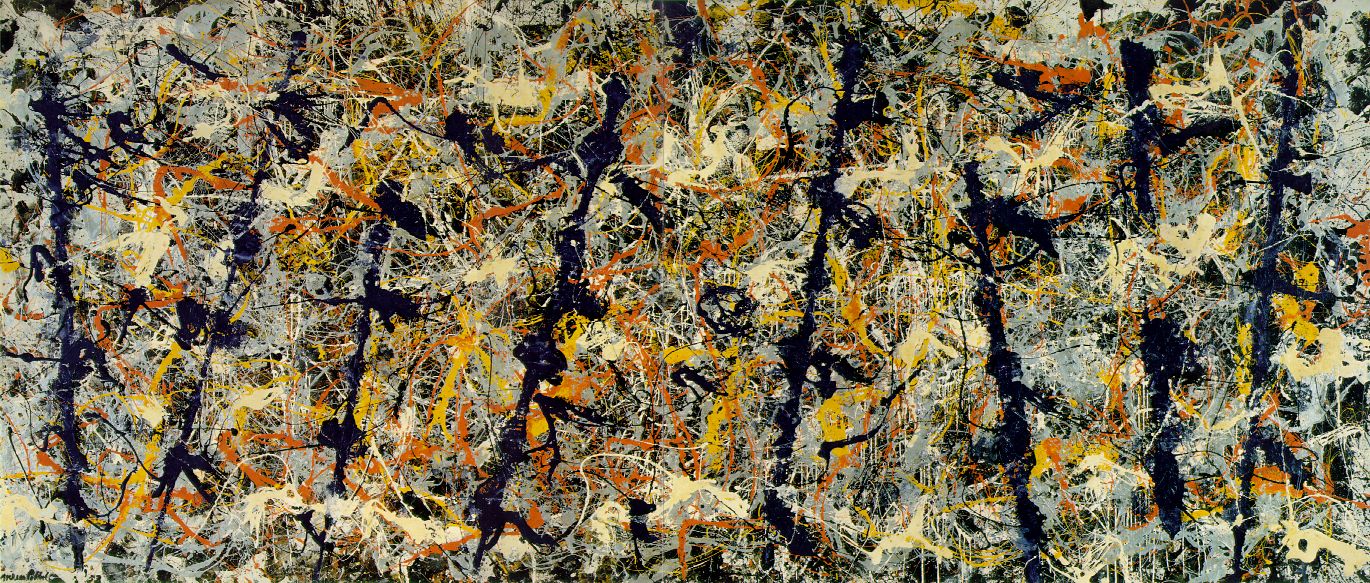
Blue Poles - Jackson Pollock

More than I should, I mention that I’m not fond of Abstract Expressionism. That isn’t to say that I don’t like any of it — far from it. But on the whole, it doesn’t really work for me. This is a statement about me and not about the art. But as someone who is not that excited about the movement, I write about it a lot. I think it is a cry for help, “Open my eyes to this movement!” Of course, my eyes are hardly close. I think I’m a decent judge of what is good and what is not — even when I don’t like particular works.

One thing that really annoys me is when people claim that any kind of painting is easy. Personally, I think abstract painting is the hardest kind to do. At least if you are painting a representation of a duck, you have the duck to go by. I haven’t much of a clue as to why particular things do and don’t work in an abstract piece. Often I can note some design elements, but that’s usually a small part of what makes a piece good. Normally what really strikes me is the blending of the colors, but I don’t know why. For me, art appreciation is intuitive.

Decades ago, I read Tom Wolfe’s The Painted Word. It is basically just an attack on modern art — Abstract Expressionism in particular. When I read it, I was very impressed. But since then, I’ve learned a lot more about art history. And now I think that Wolfe embarrassed himself in that book. He is dismissive of the idea of philosophical considerations dictating art. But what was the difference between the High Renaissance and Mannerism? It was highly theoretical. I suspect that the vast majority of people walking through an art museum see not apparent difference between those movements. You can certainly make the argument that artists and art critics are a bunch of idiots making a big deal of little things. But you can’t argue that the 20th century was any worse in this regard — other than that there were a lot more movements.

This came up earlier when I was reading Henry Fairlie’s three decades old hilarious and brutal take-down of the pretentious George Will. Will, of course, doesn’t know anything about modern art, but he knows what he hates:

Again, it is not a quibble, but an essential criticism of Will’s attitude toward contemporary culture, to point out that when he roundly condemns Jackson Pollock (in 1978, and again in 1985), he says not a word about any Pollock painting, not to mention the whole body of his work, except the old-hat criticism that they are “canvases covered with drips.” On both occasions he bases his criticism on the same silly tribute to Pollock by an unidentified art critic. Blue Poles, to take but one Pollock painting, cannot be described as a canvas “covered with drips,” and only an eye uneducated not only in modern painting, but in all painting, could say so. In fact, one doubts whether he knows what paint is, or for that matter what Raphael did with his “revolutionary” use of color.

Back a few months, while discussing Fernand Leduc, I briefly mentioned Pollock, “Anyone can flick paint on a canvus. But you’ve got to know what colors to flick where and most of all when to stop.” Even that greatly underestimates what he did. But there is this thing with many people (especially pretentious conservatives) where they think that they can judge Pollock’s work based upon how he applied paint. Implicit in this is that there is a right technique for applying paint to a brush. I imagine that if George Will had lived a century earlier, he would have dismissed Georges Seurat’s A Sunday Afternoon on the Island of La Grande Jatte. I mean all it is just a canvas covered in dots.

A Sunday Afternoon on the Island of La Grande Jatte - Georges Seurat

Edvard Munch Without The Scream

Edvard MunchOn this day in 1863, the German Expressionist Edvard Munch was born. Don’t misunderstand, however; he was a a Norwegian painter, and quite a bit more idiosyncratic than most German Expressionists. He is one of those artists who is cursed to be associated with a single painting. In his case, The Scream, which he painted when he was just 30 years old. But he is so much greater than that.

He was also influenced by the impressionists. And during his time in France, he was doubtless influenced by the post-impressionists. Some of my favorite of his paintings remind me of Gauguin. A quick check of Wikipedia discloses that he was influenced by Gauguin as well as van Gogh and Toulouse-Lautrec. I think I can see the van Gogh to some extent, but my powers of art appreciation are not keen enough to see the influence of the great illustrator.

Here is an example of what I mean. It is The Girls on the Jetty — or rather, one of 18 he painted around 1900:

The Girls on the Jetty - Edvard Munch

It is still Munch and Symbolist, but the use of colors strikes me very much like Gauguin. You can see this even more in an earlier painting, At the Roulette Table in Monte Carlo:

At the Roulette Table in Monte Carlo - Edvard Munch

I’ve had some difficulty finding much of his later work that really blows me away. That’s not to say that his later work is bad. It is just that there isn’t all that much of it on line — or at least it is hidden beneath a million copies of The Scream and parodies of it. But here is a painting from 1914, Weeping Nude:

Weeping Nude - Edvard Much

Happy birthday Edvard Munch!

Peter Bagge

Peter BaggeThe great cartoonist Peter Bagge is 57 today. Is he really great? I think he is. I remember when he first started publishing, his rubbery characterizations and his outrageous sensibility were very new. I’ve always thought that he and Bill Watterson looked kind of similar, but he took it to extremes that fit what he was trying to do with it.

I probably first saw him in Weirdo in the early 1980s. But I really got into him with the first issue of Neat Stuff. Looking at it now, I find it kind of embarrassing. The artwork is great, but the writing is kind of like Mad Magazine for teens. But they had their moments. There was Studs Kirby, every Fox News viewing man you’ve ever met — with sentimental periods where he drinks himself to sleep listening to Brenda Lee records. And there was The Bradleys, a highly dysfunctional family — not really well written but wonderfully rendered. As I recall, this is from the end of a strip where Buddy has purchased The Yardbirds’ greatest hits or something:

The Bradleys - Peter Bagge

You don’t find much Bagge on the internet. At least you don’t compared to the far greater Bernie Wrightson. I assume this is because Bagge is a greedy man who just can’t get enough money. The last time I saw him, he was publishing cartoons in the libertarian Reason Magazine. I’ve since learned that he also writes articles. I really don’t want to know. You start with an artist — generally not the greatest analysts. Then you combine that with the libertarian thinking of someone at the top of his profession — who had success very young. This is not a formula for deep thinking. But Woody Allen being a child molester doesn’t make his films any less great. Peter Bagge being a libertarian doesn’t make his comics any less great. Am I saying these are the same? Only in the sense that they both show a lack of impulse control.

Happy birthday Peter Bagge!

Diego Rivera

Diego RiveraOn this day in 1886, the great Mexican painter Diego Rivera was born. He is best known for his murals, but that came later. Born into a wealthy family, he got plenty of encouragement and instruction for his early obsession with drawing. In 1907, he went to study in Europe, eventually making it to Paris. He developed a close friendship with the slightly older Amedeo Modigliani. It was around this time that he started painting in the cubist style. Later he followed in the style of Cézanne. Rivera was something of an artistic sponge — an attribute that would serve him well in his later mural painting.

On his return to Mexico in 1921, Rivera got involved in a government sponsored mural program. This is also when he became actively involved in leftist politics. He combined the two beautifully. And it wasn’t especially controversial until he left Mexico. It’s funny the way countries are. They don’t have a problem with people like Rivera because of the specifics of their politics. They have a problem with such people for not telling them exactly what they want to hear. So first he was thrown out of the Soviet Union and then he was thrown out of the United States.

Between 1932 and 1933, Rivera created a 27-panel mural, Detroit Industry. Here is a detail of one particularly stunning panel:

Detroit Industry - Diego Rivera

In the early 1950s, when the country was crazy under McCarthyism, a large sign was put up that explained how great an artistic accomplishment it was, even though the politics were terrible. Again: what did they know of his politics? Only that they were “wrong.” When people act the way groups do, we call them neurotic. No one would take a person seriously who was so insecure that he couldn’t brook the smallest disagreement about how perfect he was. But when our country does it, it is considered noble. It’s very odd. It’s good to have artists and thinkers around to highlight our silliness.

Happy birthday Diego Rivera!

Brian Beutler Butchers René Magritte

The Treachery of Images

I am not especially fond of the René Magritte painting The Treachery of Images. It was created toward the beginning of his surreal work, and has always struck me as overly didactic. Just the same, if I were going to teach a course on Magritte, I would start with The Treachery of Images. It deals with his obsession: the distinction between image and reality. Even in his last years with paintings like The Son of Man, he was still focused on images and the reality that they obscured. It’s surprising that Magritte never reached the point of “painting” an empty frame, since that is what most of his work was leading to.

The Treachery of Images is just a realistic rendering of a pipe with the phrase, “Ceci n’est pas une pipe” — “This is not a pipe.” And Magritte was very clear about it. He said, “How people reproached me for it! And yet, could you stuff my pipe? No, it’s just a representation, is it not?” So he is making what seems today to be the most obvious of statements: paintings are representations of things, not the things themselves. But it seems that it is not so obvious for certain political observers.

Four years ago (!) I discussed an instance where Rachel Maddow seemed to be confused about the painting, This is Not Your Father’s Rene Magritte. She seemed to think that Magritte was being ironic, “Of course it is a pipe! Just look at it!” And I suppose if The Treachery of Images were the only Magritte you had ever seen, you could be forgiven for thinking this. But who has only ever seen that one painting? And the title of the painting makes the artist’s intent clear.

Today, I found another example of this. Brian Beutler wrote, The Latest Challenge to Obamacare Should Embarrass Conservative Judges. It is an excellent article, well worth reading. For the politics! But he used The Treachery of Images to make a point about the lack of ambiguity in Obamacare. I agree with him about Obamacare, but he could not have picked a worse example to make his point. He wrote:

I favor this interpretation in the same way that I interpret Magritte’s “Treachery of Images” to unambiguously depict a pipe. You might favor a murkier interpretation. But you’ll only be misled into thinking that the pipe doesn’t exist at all if you focus on the text below it (“this is not a pipe”) in isolation. That’s more or less what the supporters of the King challenge are asking of you.

No, no, no! Magritte didn’t name his painting, “The treachery of words.” The words are placed on the canvas to help the viewer understand the nature of the image’s treachery. I’m sure that Beutler understands this because he says that the painting depicts a pipe. But Magritte didn’t scrawl on the painting, “Ce ne est pas une représentation d’un pipe” — “This is not a representation of a pipe.” It’s interesting that Beutler’s subject is the ambiguity (or lack thereof) of the law. But in the case of the painting, there really is no ambiguity. And if you ask me, that’s why it is one of Magritte’s weaker pieces.

I think I know what happened to Beutler. He really wanted to use the painting. If he’s like me, his entire article might have come out of his desire to use The Treachery of Images to make that point. And by the time the article was done, he realized that Magritte didn’t actually help him make his case. But he just couldn’t let go of it. He should have! He doesn’t need it. And it just perpetuates the misinterpretation of Magritte’s painting.

Otto Dix

Otto DixOn this day in 1891, the great painter Otto Dix was born. Other than “modernist,” I don’t know quite what you would call him, even though he is considered a German realist. His work is highly idiosyncratic. There is a kind of cartoon aspect to it at the same time that it is shockingly blunt. That’s especially true of his depictions of war. He fought in the infantry for Germany during World War I — first on the western front, then on the eastern front, and then back on western front. He fought in the war for three years before receiving a “career” ending wound on his neck shortly before the end of the war. He seems to have suffered from post-traumatic stress disorder — haunted by nightmares that he rendered in his work.

Here is a picture in four panels, Der Krieg (“The War”), painted from 1929 through 1932. I would not have wanted to live inside his head. The first panel shows men on their way to battle. The second panel shows the battle. And the third panel shows the survivors of the battle. Normally, that would be all in a triptych, which Der Krieg nominally is. But Dix created a fourth panel of the dead and buried. It’s a remarkable, if horrific work:

Der Krieg - Otto Dix

When the Nazis took over Germany, they did not get along with Dix, whose work was considered “degenerate.” He was forced to paint landscapes. But after World War II got going, he was drafted in the German militia. Toward the end of the war, he was captured by French soldiers, which was probably all for the best.

Dix created a lot of other work that is more traditionally beautiful. Here is one of many of his wife Martha from the early 1920s. Notice the cream skin tone everywhere except on the right hand:

Martha Dix - Otto Dix

Happy birthday Otto Dix!

Marie Bashkirtseff

Marie BashkirtseffOn this day in 1858, the great Ukrainian painter Marie Bashkirtseff was born. The reason you have probably never heard of her is that she died of tuberculosis when she was only 25 years old. But she was a master. She was an admirer of Jules Bastien-Lepage, although I think she shows greater technique. What I especially like about her is that depending upon the work, she can use the finest of brush strokes while at other times using very crude strokes as found with the impressionists. Of course, she is of that time and Bastien-Lepage was an influence on the movement.

Bashkirtseff is also known as a diarist and sculptor — probably because we have so little of her work. She died in Paris on Halloween in 1884. Normally, I would provide a bit of her work. But I found this excellent three-minute video that gives a very nice overview of her work — even including one of her sculptures. She was an amazing talent.

Happy birthday Marie Bashkirtseff!

René Magritte

René MagritteOn this day in 1898, the great surrealist painter René Magritte was born. When I was younger, I didn’t much care for his art. There were a good too many apples and bowlers and too little of the overwhelming brilliance of Salvador Dalí. But over time, I came to appreciate Magritte’s art. For one thing, he has much less of a clear style than Dalí. And so the genius behind the paintings is clear.

It’s also the case that Magritte didn’t produce that many works. This may be partly because he wasn’t that successful until quite late into his life. In fact, he had a career arc rather like that of Cervantes: producing work throughout his life, but doing many things to support himself. But it is also the case that he tended to have very distinct thoughts behind his work.

By the late 1920s, he was producing very interesting — clearly surrealistic — work. Some of this, such as The Treachery of Images, is over-intellectual. But other works, such as The Empty Mask, seem to be much deeper than Magritte himself was aware of. I think that is important for an explicitly intellectual artist; the work has to be somewhat out of control or it becomes contrived.

Magritte was always interested in the question of what was behind images. We see that as early as The Empty Mask. It is a profound question to consider coming from an artist who is, after all, only interested in the surfaces of things. But in fact, every image is just covering up another and on and on. In the mid-1930s, he looked at this quite explicitly in his two paintings The Human Condition, where a painting rendered inside the painting covers up exactly the reality it displays.

The Human Condition - 1935

He did some other interesting work around this time such as Not to be Reproduced and On the Threshold of Liberty. And then his production slowed way down for a decade because of the war. He produced some good work and experimented a lot with color in ways that he didn’t seem to bother with much at other times. And then in the late 1940s, he seemed to arrive at a fairly dependable style that we know him for as in paintings like The Art of Life.

In the early 1950s, he produced a series of paintings, The Empire of Lights. The concept is simple enough. But it is lovely:

The Empire of Lights - Magritte

Magritte didn’t produce his best known work until shortly before he died, The Son of Man. What Magritte wrote about it could stand as a general description of his entire output:

Well, so you have the apparent face, the apple, hiding the visible but hidden, the face of the person. It’s something that happens constantly. Everything we see hides another thing, we always want to see what is hidden by what we see. There is an interest in that which is hidden and which the visible does not show us. This interest can take the form of a quite intense feeling, a sort of conflict, one might say, between the visible that is hidden and the visible that is present.

Happy birthday René Magritte!

The Painting of Wyndham Lewis

Wyndham LewisOn this day in 1882, the great painter Wyndham Lewis was born. He was also a writer of some repute — probably more famous for that during his lifetime. He wrote about a dozen novels and countless essays, short stories, plays, and even poetry. I’ve never read any of his work, but I probably will now. I am going to focus on his painting here.

He was probably the greatest artist in the Vorticist movement. But he is so much more than that. Partly, this is because the movement didn’t much last. Apparently, everyone was so depressed by World War I that they all slunk off in their own personal ways. As a result, his work is quite eclectic. Actually, I’m not that fond of his — or anyone else’s — Vorticist work.

In the Tate’s discussion of Lewis, it mentions that he “produced a bewildering quantity and range of work.” It is very true. It is hard to get a handle on exactly what he was doing. He was one of those crazy talented people who grab different influences the way we lesser mortals breath air. For example, in his battlefield painting A Battery Shelled, I certainly see Vorticism, but there is much more:

A Battery Shelled - Wyndham Lewis

But later, he was doing Tyros as seen above in his self-portrait. And later still, he often did more realism as in the following painting of his wife “Froanna” (Gladys Anne Hoskins):

Froanna - Wyndham Lewis

Most of his work is quite splendid, and I’ll admit that the work I don’t like is probably more a failing of mine than his. It is well worth checking out.

Happy birthday Wyndham Lewis!

Dirty Windows, Ephemeral Art, and Commodity

Scott WadeOver the weekend, I came upon this article, Dirty Work but Someone Has to Do It: World’s Leading Dirty Car Artist Turns Grubby Car Windows Into Works of Art. I’m not quite sure what it means to be the world’s “leading” dirty car artist, but Scott Wade certainly does seem to be quite the phenomenon. He is a graphic user interface designer, but is best know for his hobby of creating art out of dirt on glass.

I don’t think that it is rude to point out that if this work were on paper or canvas, it would be considered professional-level illustration but nothing special — certainly not something that would take the internet by storm. In a different and more fundamental sense than Marshall McLuhan had in mind, “The medium is the message.” We may all appreciate beautiful flower arrangements, but there is nothing especially notable about creating beauty out of beautiful elements. But creating beauty out of garbage or dirt is at least remarkable and sometimes edifying.

Scott Wade - Mini Cooper

What I am more interesting in is the ephemeral nature of the art. When I was younger, I was hung up on the notion of art that outlasts the artist. It no doubt reflected my fear of death. But as I’ve gotten older, I’ve begun to see explicitly ephemeral art as the most valid. Art that can be stored loses much of its integrity and becomes commodity. Portrait of Dr Gachet was an interesting and idiosyncratic painting in 1890 — utterly worthless as a commodity. Today it stands as one of the most expensive paintings ever sold — pure commodity. But more to the point, it is virtually impossible to see past its status as commodity. Like all of van Gogh’s work, it is that peculiar style of painting that rich people pay a lot of money for. (Note that the most valuable paintings are almost all post-Impressionist and early modernist.)

If you click over to the Daily Mail article I linked to above, you will see that most of the subjects are what you see at poster shops at the mall: American Gothic, Marx Brothers, Albert Einstein, Luncheon of the Boating Party, the stars of Dallas. If you go to his website, you will see more of the same: Mount Rushmore, Alice in Wonderland, Mona Lisa, and of course, Marilyn Monroe. This is not a put-down of Wade. He’s a commercial artist doing what people want to see. But I don’t think it speaks well for our culture.

Scott Wade - Stagecoach

Did we travel such a long artistic road with constant battles over technique and philosophy only to reach the point where art is born, lives, and dies as commodity? Maybe I’m expecting too much. Art has always had to appeal. Of course, at one time, it didn’t have to appeal to huge swaths of humanity. And if the media is the message, maybe dirt is exactly right. Maybe sand is a more edifying medium:

Sandcastle - Guy-Olivier Deveau
Cropped via Shine Beautifully.

Claude Monet

Claude Monet - DetailOn this day in 1840, the great painter Claude Monet was born. I have to admit: I tend to discount him. This is always a problem when you are too successful. He has been so copied, he was hugely influential among his peers, and he was incredibly prolific. Add this to the fact that he makes painting look easy, and he is an easy artist to ignore. But he is profoundly awesome.

I always find people like him amazing. He really did have a vision. He was able to paint in the Academic style; he just refused to. I can’t see myself doing that. I want to be liked too much. So that kind of dedication to your vision impresses me greatly. He was apparently very self-assured from a young age. In his early teens he was good enough to sell charcoal caricatures. He bounced around a lot from there, learning much from a large number of people. Perhaps most important, he met Édouard Manet when he was about 20.

From there, he traveled quite a lot for the next decade — including two years with the military in Algeria. By his early 30s, he was one of the main figures of what would eventually become known as the impressionists — so named because of this painting he displayed at their first exhibit, Impression, Sunrise. The main thing about it is its distinctive rendering of light that would remain with Monet his entire career:

Impression, Sunrise - Claude Monet

I’ve always been very impressed with Arrival of the Normandy Train, Gare Saint-Lazare from four years later:

Arrival of the Normandy Train - Claude Monet

But there is so much more. He painted well over a thousand paintings in his life. And he painted for almost another 50 years — much of it quite marvelous.

Happy birthday Claude Monet!

Bill Watterson Is Back!

Bill WattersonIf you’ve heard that Bill Watterson has started a new comic strip, you have been misinformed. Bill Watterson has, instead, created a single multi-panel comic strip to promote the Angoulême International Comics Festival, which is happening in France at the end of January. But that doesn’t mean it isn’t very exciting.

The story of the 15-panel strip is pretty standard Mack Sennett material. What is most notable about it is what has always been notable about Watterson’s work: the extremes of the action and the subtlety of the characterizations. The main character goes from hope to shock to blind rage — and that is just in the first five panels. And it goes on from there, peaking in the penultimate panel with the character stark raving mad.

Bill Watterson 2014 15 panel

Of course, this isn’t the first thing that Watterson has done. Eight months ago, he did the poster for the documentary Stripped about the transition of comic strips from newspapers to the internet. Watterson gives one of his rare interviews in the film. It looks rather good:

As for the poster, well, it’s good, but more like Berke Breathed than something distinctly Watterson:

Stripped - Bill Watterson

I assume we will continue to see things trickle in from Watterson. He clearly loves doing it. And I certainly can’t blame him for not wanting to grind out a daily strip. Regardless, we will all take whatever we can get.