About Frank Moraes

Frank Moraes is a freelance writer and editor online and in print. He is educated as a scientist with a PhD in Atmospheric Physics. He has worked in climate science, remote sensing, throughout the computer industry, and as a college physics instructor. Find out more at About Frank Moraes.

Anniversary Post: Mutiny on the Bounty

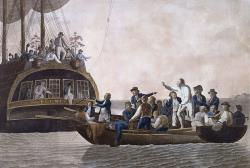
Mutiny on the BountyOn this day in 1789, the mutiny on the Bounty occurred. It is one of those sad stories where it is hard not to sympathize and also hate everyone involved. There is also the problem that it seems every historian who has tackled the subject has (understandably) come to different conclusions. So what you think about the event largely depends upon who you have read. Much better to watch the 1962 classic, Mutiny on the Bounty with Marlon Brando and Trevor Howard — ahistorical as it may be.

What I nonetheless love about the whole thing is how very civilized it was. The mutineers did not kill the captain and his supporters. They just set them in a row boat. In fact, four of the supporters couldn’t go in the boat, so they were dropped off in Tahiti. But the boat wasn’t just set adrift. It was sent with (according to Wikipedia) “150 pounds of bread, some pork, 6 quarts of rum, 6 bottles of wine and 28 gallons of drinking water.” And that explains how Bligh and his crew managed to make it to safety.

Unlike in the movie, Bligh returned to England a hero. It would seem that his reputation fell because towards the end of his life, he was appointed Governor of New South Wales. And he was so bad at getting along with people that he sparked the Rum Rebellion. I think that probably made a lot of people think that Fletcher Christian might have had more than just a little reason for his mutiny.

Happy anniversary mutiny on the Bounty!

The Surprisingly Similar Attacks on Sanders Regarding the Soda Tax

Jonathan Chait - For Soda Tax If Sanders Is Against ItI wasn’t going to write about it. And the truth is, I’m going to try to make this short. When Paul Krugman wrote yesterday, A Note on the Soda Tax Controversy, I figured I’d let it slide. After all, at this point, I do a search for “Sanders” on anything Krugman writes, and if I find it, I don’t read the article. Or at least I try to. I usually manage to read at least half the article and it is usually nonsense. It’s what I always say, and what neuroscience proves: we make up our minds and then we come up with arguments to justify ideas that might as well have come from our guts.

But then I noted this morning that Jonathan Chait (who might as well be Paul Krugman when it comes to any discussion of Sanders) wrote, Why Is Bernie Sanders Making Right-Wing Arguments Against Taxing Soda? Right-wing arguments? What could they be?! Well, it turns out it is only one argument and that it is only “right-wing.” That is to say, it’s right-wing in Chait-land where everything is either right-wing or communism if Jonathan Chait doesn’t agree with it.

For those of you not following it, Hillary Clinton wants a soda tax on these sugary drink so that America gets healthier. It’s not a bad idea. I’m not necessarily against it. Call me agnostic. And call me agnostic because there is another side to the issue. Bernie Sanders is against this tax because it is regressive. You can see what a right-wing argument he’s making there. That is: you can see it if you have Jonathan Chait’s eyes that allow him to throw out pejoratives for anything that he doesn’t happen to agree with. It’s interesting that when Michael Bloomberg wanted to ban soda in anything larger than 16 ounce containers, Jonathan Chait ridiculed it.

Paul Krugman - For Soda Tax If Sanders Is Against ItAs Chait noted, the fact that such a tax would hit the poor hardest would probably make the tax most effective, since the rich spend more of their money on pricey Gamay Beaujolais. But it occurs to me, a liberal, that are ways to make everyone more healthy that don’t require doing it on the backs of the poor. It is only because Chait and Krugman and Clinton are all wedded to neoliberal approaches to social problems. Global warming?! How about a carbon tax! Obesity?! How about a soda tax! Both of these are regressive, but neoliberals don’t care because they aren’t poor.

And would it surprise anyone to know that the poor actually consume less junk food than their richer counterparts? But it seems that the modern Democrat has but one tool to deal with problem. So when Bernie Sanders isn’t for a neoliberal “solution” to a problem he acknowledges, then he’s “right-wing.”

I happen to know that Sanders is for a far better solution to the problem of bad eating by the poor: more food stamps. Am I the only one who remembers the article in Mother Jones two years ago, People on Food Stamps Make Healthier Grocery Decisions Than Most of Us? The issue is poverty, not “incentives.” And people like Chait, Krugman, and Clinton think the issue is training the poor, because it’s their own damned fault.

But why listen to me? I am apparently “right-wing”!

Morning Music: Escape from Noise

Escape from NoiseToday, we reach what is widely considered Negativland’s masterpiece, Escape from Noise. It is the perfect mixing of sound and music. It also has the advantage of being more song oriented. As we saw yesterday with the first side of A Big 10-8 Place, songs mixed into one another and what was called a song was almost arbitrary. Here, that’s not really true. Whether you think that’s good or bad is up to you. I don’t think it much matters.

But for today, we will listen to “Car Bomb.” What I especially like about it is that’s it’s kind of a parody of maximum rock-n-rock. But it works as maximum rock-n-roll and is also better than the vast majority of maximum rock-n-roll. The truth is that Negativland could do anything, because they understood sound — a fact that was clear enough from their previous albums.

Anniversary Post: A Vindication of Mary Wollstonecraft

Mary WollstonecraftOn this day in 1759, the great writer Mary Wollstonecraft was born. She is probably best remembered today as one of the first and greatest feminist philosophers, but I think that is rather too small a box to cram her into. But there is no doubt that her ideas were far ahead of her time. She was even far ahead of the thinking of many of the suffragettes who came along a hundred years later. And among conservatives, I still commonly hear ideas that would offend Wollstonecraft’s thinking over two centuries ago.

I like to think of her as the female Thomas Paine. And indeed, they were friends. In fact, they were both in France together where they faced the guillotine. Paine was jailed for some time, but it isn’t clear whether or not Wollstonecraft was. She was the first to publish a response to Edmund Burke’s apologia for hereditary rule, Reflections on the Revolution in France. Her book was, A Vindication of the Rights of Men. And it contains the kind of fiery rhetoric I associate with Paine. For example, she suggests that Burke would have argued in favor of crucifying Jesus. The sad thing is that I’m sure she’s right.

She followed that book two years later with what is probably her masterpiece, even though it was written hurriedly, A Vindication of the Rights of Woman. It is mostly an argument for the proper education of women. It was generally thought at that time—even by intellectuals—that women needn’t more than a basic education. Rights of Woman is one of the founding documents of modern feminism.

Mary Wollstonecraft died young at the age of 38. It was ten days after the birth of her second daughter who would go on to be Mary Shelley, perhaps the greatest Romantic writer. Her death was due to blood poisoning from a broken placenta. It’s extremely sad and a great tragedy for our culture, but there is something satisfying in the author of Frankenstein killing her creator.

There is much more to say about Wollstonecraft. She wrote a great deal and had a very colorful life. The Wikipedia page on her is rather good, or you could read, Mary Wollstonecraft: A Revolutionary Life. Or you could read her work, much of it is available at Project Gutenberg. She also wrote narrative fiction. She’s well worth checking out.

Happy birthday Mary Wollstonecraft!

Calming Down the Clinton Campaign

Hillary Clinton CampaignI’ve written too many articles about how ridiculous the Clinton campaign has been with regard to Bernie Sanders. Apparently, I have a super power that allows me to read a poll — a power that is apparently unavailable to the Clinton campaign. Another of my super powers is the ability to remember all the way back to 2008. My take away from that primary was that the Democratic base really didn’t like having to choose between any of the three main candidates, but most especially between Obama and Clinton. So 2016 has represented a great opportunity for these people to have the best of all worlds.

So it’s been really annoying to watch the Clinton campaign never take the high road and always act as though it was in a very close match. But maybe it’s just me and my age. I find Sanders supporters very silly much of the time too. The other day, I saw a short video from The Young Turks, and they were discussing how it was a good thing that the Republicans looked set to nominate Trump, because he was the only one that Clinton could beat. What do you even say to such nonsense?! That’s the kind of thing I expect from Fox News where it is taken as a certainty that Hillary Clinton will be in prison by June.

But the implication of the complaints coming from the Clinton campaign seems to be that Sanders should just know that he’s an issue candidate and that he should therefore not hurt the obvious eventual nominee. Now, I called this race back in February — because of my super powers of poll reading and history remembering. But the truth is that the race is rather tight nationally. Real Clear Politics has Clinton ahead by just 4 percentage points. But there are a few things to keep in mind with this.

Bernie Sanders SupportersFirst, 4 percentage points is really quite a lot. That’s what Obama beat Romney by. What’s more, in all the polls during the last month, Clinton has been right at 50%. And if you assume that she would get roughly 50% of the undecided vote (And you should!) she is well above 50%. This is a race between two figures in the Democratic Party that are both well liked. It isn’t a surprise that the race would tighten over time.

The other issue is that the national figures don’t matter at all. I don’t know if anyone remembers the obscure presidential election back in 2000. During that there was all kinds of controversy about who had won in Florida, even though one of the men had clearly won the majority of votes nationwide. I still get the question, “Can Sanders win the nomination?” In the sense that anything could happen (a humanity destroying asteroid hitting the Earth this calendar year), then yes, Sanders can win the nomination. But reasonably: no, Sanders cannot win the nomination.

Now I keep hearing that Sanders is hurting Clinton by staying in the race. Of course, the same people have been calling for him to step down for months. But the Clinton campaign thinks that Sanders is hurting Clinton in the general election. That might be the case. But I have a hard time taking it seriously for two reasons.

First, Sanders being in the race has made Hillary Clinton a far better candidate. If she had just floated through this campaign with only Martin O’Malley to fight with, she would have been a much worse candidate once the general election started. So the Clinton campaign really ought to balance out the good things that Sanders has done for them compared to the minor damage he has done. And it is minor damage. Who thinks that the Republicans wouldn’t have tried to attack her on her Wall Street connections?

The second reason is demonstrated very well in an article by Brian Beutler yesterday, Democrats Should Stop Sweating Sanders’ Attacks on Clinton. He notes how Clinton was far more vicious toward Obama when she was losing in 2008. For example:

I could stand up here and say, “Let’s just get everybody together, let’s get unified, the sky will open, the light will come down, celestial choirs will be singing, and everyone will know we should do the right thing, and the world would be perfect.” Maybe I’ve just lived a little long, but I have no illusions about how hard this is going to be. You are not going to wave a magic wand and have the special interests disappear.

But again, I think the issue is that the Clinton campaign just takes it as granted that Sanders could never win the primary. So it was totally okay for her to say she should stay in the race because who knows what information might come out about Obama. But it isn’t okay for Sanders to do the same thing because the Clinton campaign doesn’t think he’s a viable candidate.

Just to be clear: Clinton will win the nomination. Sanders will stay in the race. Clinton is not going to be noticeably harmed by Sanders’ attacks. Once Clinton is the nominee, Sanders will support and campaign for her. There’s nothing special about this campaign. Except for all the whining.

Morning Music: A Big 10-8 Place

A Big 10-8 Place - NegativlandNegativland’s third album A Big 10-8 Place is widely considered their first great album. A lot of it is reminiscent of John Lennon’s “Revolution 9.” But I’ve always thought of that as Lennon trying to do Stockhausen without actually understanding Stockhausen. Negativland are fully in the tradition of musique concrète, but from a pop music standpoint. This is especially true on tunes like A Big 10-8 Place, Pt One. But that tune is pretty subtle.

Similar, is the other long song on the album, 180-G, a Big 10-8 Place, Pt Two. It is a 15 minute long sound collage with directions on getting from San Francisco to Concord (the band’s home town). But I must admit, having grown up here, I don’t much follow the directions. They talk excessively about “180 and the letter G.” I don’t know what they mean. Hwy 180 is down by Fresno. But it’s not supposed to make sense. There are various other aspects of the directions like, “You’re going to have to shoplift.” It’s an amazing piece of music. Do check it out.

I really want to introduce you to “Clowns and Ballerinas.” But I don’t want to give you the wrong idea of Negativland. Then again, I’m not sure it is possible. It’s like the blind men and the elephant. Negativland is so many things all at once. And the best thing to do with them is to listen to a whole album — or at least an album side. The first side of A Big 10-8 Place starts with “Theme from a Big Place” then goes into “A Big 10-8 Place, Pt One” and ends with “Clowns and Ballerinas.” So I’ve made a playlist so you can listen to the first side of the album. I think you will see what I mean — how it works as a whole better than it does as a collection of songs:

Anniversary Post: SS Ideal X

SS Ideal X - Container Ship

On this day in 1956, the SS Ideal X was launched. It was the world’s first successful container ship. Actually, before that, it had been an oil tanker from World War II. But it was purchased by Pan-Atlantic Steamship Company and converted into a container ship. It carried 58 containers. Compare this to the biggest container ships today that carry in excess of 10,000 containers. It is truly remarkable.

Now the Ideal X was not the first container ship. That would be the Clifford J Rogers. But I don’t think that’s quite fair, because it didn’t transport the standard twenty-foot equivalent unit (TEU) containers. And the whole purpose of container ships is that they are standardized. If they weren’t, they wouldn’t be important.

If you are an American and you are out of work, it is probably because of container ships. Well, not completely. There are lots of political reasons. But without container ships, those wouldn’t matter that much. Think of the total crap that comes to this country from China — things like toy rings that kids get in gumball machines. The only reason that it is profitable to make this junk is that the transportation costs are greatly reduced. Container ships allow that.

All this talk of globalization being about allowing companies to get the cheapest labor is true. But if it was expensive to transport the goods, it just wouldn’t happen. And one thing you will notice is that America still does a fair amount of manufacturing of cheap stuff. It is just that it is on a small scale. It might be reasonable to produce a million plastic rings in China, but if it is only 100,000, the transportation costs make it cheaper to produce here.

I certainly think that container ships have had a far bigger effect on the world than computers. And of course, if resources were shared somewhat equitably, container ships would have been a much bigger benefit to everyone. Instead, they have more or less facilitated taking money from the poorer people in the developed world and giving it to the poor people in the developing world. And that’s overall a good thing. But along the way, it shouldn’t have been that the rich have simply gotten unimaginably richer — largely because of a technological advance that they had nothing to do with.

Happy birthday container ships!

The Scam of the Interactive Commercial

Interactive Commercial

Every time I lie down on the couch and put on Hulu to watch Bob’s Burgers, I get that screen asking me if I would like to have a very quick interactive commercial or a much longer string of normal commercials. It’s really annoying for a number of reasons. But the main reason I do nothing is that it would require that get up every five minutes to interact with the computer. I’m relaxing, watching Bob’s Burger’s for Christ’s sake. I can put up with the commercials. I don’t want to jump up all the time just so I don’t have to watch a few extra commercials.

But there is more to it than that. I’ve done the interactive commercial in the past. And it has been a nightmare each time. For one thing, they make it very confusing. It isn’t a thing where they ask you if you’d if you like golfing and then tell you to buy a particular putter. Now, it is, for example, a film trailer. There is a 30 second countdown. But there’s also a “close” button. If you use it, it starts the whole thing over with a new 30 second clock. But once you figure out that you shouldn’t do that, I guess it is okay.

The whole thing is meant to confuse you, however. There isn’t really much in the way of interaction, other than the fact that you do have to interact with it. If you just let it go on, it will never stop. At the end, you are in a loop like in a DVD menu. And you are left in that state, you may think you can click “close” because that’s the only thing that makes sense. Instead, you have to click something on the screen. The “close” button doesn’t go away after the 30 seconds transpire. You have to click something and only then will the button appear that allows you to get back to Bob’s Burgers.

Another interesting thing about it is that the “normal commercial break” is never the two minutes they claim. On average, it is about 1:15. And sometimes, it is less. Sometimes there is no commercial break at all — it just goes right back to the show. So over all, the best the interactive commercial does is cut your commercial time in half.

It’s worse though! It takes time for the interactive commercial to load. And then, it takes time to “interact” and click the button to return to the show. But even more frustrating is that the interactive commercial has crashed on me twice, causing me to have to start the entire show over again. So in addition to not getting such a great benefit, the interactive commercial offers the potential for television viewing catastrophe.

There is something else about the whole process: the choice screen itself. You have to wait for 15 second to make your choice. Those who want the interactive commercial, can just click and get rid of it. So I suppose that works in its favor. Hulu is willing to slow down normal viewers just for the opportunity to get people to use their interactive commercial. This annoys me even more. But on top of this, we have a man’s voice that is distinctly louder than the show telling us that we have this great opportunity to “interact” and get “right back” to the show.

This is the kind of short-term profit thinking that defines the modern world. And it makes me just want to wait until the whole season is available on Netflix. But I do continue to watch it, because it is Bob’s Burgers. But that’s all I watch; I don’t stick around for The Simpsons anymore.

Morning Music: Negativland’s Points

Negativland - PointsNegativland’s second album, Points, goes more in the direction of pure sound collage. It’s really remarkable stuff. Listening to it, I try to remember what technology was available. It was 1981, so it was mostly tape recorders and analog synthesizers. I’m on record as being against synthesizers from the early 1980s, but this is because it was when the digital ones came out. And so you got a lot of stuff that all sounded the same. But analog ones had been around for a long time and people did different things with them. Negativland did a lot of interesting stuff on Points.

The song I want to highlight is quite odd for the album, “The Answer Is…” It sounds like they discovered their grandmother’s electric organ. And, in fact, I’m sure that’s exactly what they did. But it just goes to show that you can do great work with any tool at all. But in addition to sounding like a little concert in your grandmother’s living room, there is a little bit of Ronald Reagan saying, “The problem isn’t being poor, the problem is, um, the answer is…” They cut it there. It’s perfect because that was generally the answer that Reagan had.

Remember, this album came out in 1981. It was probably recorded shortly after Reagan was elected. What a great way to come into adulthood! Looking back, it’s so embarrassing. Reagan really was a mediocrity in all ways. This song is a great tribute to him. Anyway, check this out. It’s probably unlike anything else you will hear this week, month, year.

Anniversary Post: the Spanish Speaking Wars

Mexican–American WarToday, we get a twofer. On this day in 1846, the Mexican–American War started. And also on this day but in 1898, the Spanish–American War started. Okay, that’s not exactly true. In 1846, the first battle of the Mexican-American War — the Thornton Affair — took place. Effectively, Mexico had declared war two days before. The US Congress didn’t declare war until 13 May. The US Congress actually did declared war against Spain on 25 April 1898. Spain had declared war two days before.

What I think is interesting about these wars is that growing up, I didn’t really know what the difference was between them. They were just these minor wars fought against Spain in different countries. Well, that’s not exactly true. Mexico was independent from Spain by that time. But it was close enough. And more important, these wars weren’t minor. Tens of thousands died in both.

Spanish-American WarThe Mexican-American War started after years of tension following the Texas Revolution in 1836. And specifically, there was a dispute over where exactly the border was. The war became much broader than this, and Mexico ended up losing almost all of what is today the western United States. Just the same, I think this would have happened regardless. The history of Texas shows this: the Texas Revolution really wasn’t a revolution. It was more Americans flooding into the territory, staging an armed revolt, and eventually becoming a state.

The Spanish-American War was pretty much just the end of the Cuban War of Independence. It is definitely a war that we shouldn’t have fought. Basically, the Democrats and various business interests pushed President McKinley into it. The sinking of the USS Maine certainly added fuel to the fire. No one knows for sure the cause, but one thing is for sure: Spain didn’t want the United States entering that war. So I suspect that it was just an accident that was used — just like today — as an excuse for those who thought they would profit — politically and economically — from the war.

Both of the Mexican-American War and the Spanish-American War could have been avoided. But the push for war is strong. There is something about humans that makes us want to lash out rather than reflect. And one thing is very true: it is a lot easier to whip up people into a frenzy of anger and fear than it is to calm them. And the ultimate geopolitical outcomes are more or less what all parties knew they would be — bigger, better equipped armies almost always beat smaller, less equipped armies. But in the process, people die. Lots of people.

We mark the anniversaries of these two unfortunate wars.

The Myth of Supply-Side Economics Carries On

Supply-Side Economics Fantasy

The graph above is taken from Jared Bernstein’s article in The Washington Post, A Graphical Assault on Supply-Side Tax Cuts. I had to change it quite a lot to make it fit the format of this site, but the original graph included the text, “Note: The data in this chart are not real.” That’s important to remember. This is what we would see in economic data if supply-side economics worked.

The graph shows that as you decrease the top marginal tax rate, the growth of the economy increases. And on the other side of things, as you increase the tax rate, the growth of the economy decreases. This is really very simple. And we hear almost nothing but this kind of supply-side economics from conservative politicians. They claim that their tax cuts for the rich are going to stimulate the economy.

This is the argument of the supposedly reasonable Republican, John Kasich. His vague tax plan is supposed to create a 3.9% growth rate. The last time we saw this kind of sustained growth rate was during the dot-com bubble. But it is amusing that Kasich offers such an exact number. Jonathan Chait mocked it perfectly, it is “way more responsible than those crazy 4 percent growth promises made by Jeb Bush!”

But there’s a larger issue that I’ve been talking about for a while. Who cares what happens to GDP? We are all aware of the following graph from Josh Bivens and Lawrence Mishel. My question continues to be: why do we still pretend that we are living in that 1948-1973 period? Productivity does not help out workers, so why should workers continue to care that GDP is going up?

Productivity Wages Divergence

Jared Bernstein provided a counter to the first supply-side economics fantasy graph. He did it with six graphs of actual data. He looked at: employment, investment, productivity, real per capita GDP, real median income, and real per capita revenue. In all cases, the graphs show the same thing: a small correlation in the opposite direction. That is to say that in as much as the data indicate anything, it indicates that higher top marginal tax rates are good for the economy.

Here is the data for real per capita GDP growth — pretty much what the fake data above was supposed to represent:

Real Per Capita GDP Growth vs Top Tax Rate

Bernstein is clear that this doesn’t prove that raising top tax rates will improve the economy, “But the fact that the simple empirical record is uniformly hostile to the supply-side story should put the burden of proof squarely on those arguing that supply-side tax cuts will be pro-growth.” And he ends with a nice comparison of the employment growth in Kansas versus that in the surrounding states since Kansas got on board the supply-side train and provided massive tax cuts to the rich. The result: Kansas has seen 0.8% growth while the nearby states have seen 1.7% growth — over twice as much.

Like most conservative policy, supply-side economics lives on because conservatives want it to live on. Every even remotely good idea that conservatives have had has been co-opted by the Democratic Party. So the Republicans really are left with nothing but bad ideas — at least when it comes to the economy. But supply-side economics is just comical. But as long as the media continue to allow politicians to get by with these outrageous claims, we will continue to hear the claims.

Even after his ridiculous claims about 3.9% growth due to tax cuts to the rich and unstated deregulation to The Washington Post, they wrote, Republicans Don’t Like Kasich Because he Sounds Like Obama. As Dean Baker noted, the paper was making a claim about Kasich’s tone, not his policies. Of course, reporters don’t actually know what kind of temperament that politicians have. “They should be sharing this information with readers so that they will understand that Mr Kasich is making promises that are out of touch with reality.” Instead, we hear about how calm he is.

Meanwhile, he’s allowed to use supply-side economics to say that he will growth the economy at 3.9% per year based on no evidence at all.

Morning Music: A Musical Genius Dies

Richard LyonsI know a lot of you are really saddened by the death of a music legend last week. So I figured that we should commemorate Richard Lyons’ death by listening to a week’s worth of Negativland.

According to Rolling Stone, Richard Lyons had been fighting cancer for over 12 years. He had a very aggressive kind of skin cancer, which sucks, given that most forms are relatively trivial. He apparently did not suffer much. But he was only 57.

Richard Lyons formed Negativland in 1979 with his high school friend Mark Hosler. They lived just down the road from me in Concord. The band itself is normally described as “experimental.” That’s true, but doesn’t mean all that much. But you just have to listen. Some of it is hard to call music at all. Their focus has always been on sound — not that there is too much of a distinction there.

It’s hard to know where to start with Negativland. The first self-titled album is fascinating. It’s a sparse combination of music and found sounds. Some of it reminds me of stuff that Laurie Anderson would do later. For example, “4” (all the songs on Negativland are simply numbered) reminds me of Example #22. I hear a lot of things that remind me of other music — stuff that comes both before and after — but it’s hard to put my finger on it exactly. Overall, the effect is riveting.

I can’t find individual tunes from the first album. So I’ve embedded the whole thing. It’s worth listening to. But I’ve cued it at “6.” I don’t have much of a reason for doing it, other than that it is the only song that has what could be called lyrics. And they include the oddly hilarious, “Seat be sate; play Black Sabbath at 78.” The lines are delivered by David Wills, the third founding member of the band.