About Frank Moraes

Frank Moraes is a freelance writer and editor online and in print. He is educated as a scientist with a PhD in Atmospheric Physics. He has worked in climate science, remote sensing, throughout the computer industry, and as a college physics instructor. Find out more at About Frank Moraes.

US Government’s Obscene Assassination Justification

Jeremy Scahill - ImminentObama has before compared the drone program to dealing with a sniper on a roof of a building who is pointing the rifle at children on a playground. And he say, you know, “I understand what the ACLU’s objections are and human rights people and stuff. But do we need to go to a judge to get authorization to take that shooter down before he kills a bunch of kids on a playground? No we don’t.” And I think… everyone in this room agrees with that. If you have someone who’s going to kill a bunch of kids, and they’re a sniper, and they’re not responding to any kind of attempts to get them to put the rifle down, people in this society overwhelmingly would say, “Yes. If we need to kill that person we’ll kill them.”

The problem is, that’s a fake analogy. They have never provided a shred of evidence that a single person that they’ve killed in a drone strike represented an imminent threat to US persons or the security of the United States. They have never given a shred of evidence to suggest that they killed someone en route to putting a bomb on a plane. I guarantee you, because this White House leaks like crazy, if they had that evidence they would put it out there…

If their standard was just that we’re killing people that we think maybe in the future might in certain circumstances try to encourage others to commit acts of terrorism — If that was the policy! — okay, that’s what they’re doing. But that’s not what they say the policy is. They say the policy is we’re targeting people who represent an imminent — “imminent” is their word — threat to US interests, US persons, and US facilities around the world. If that’s the standard then you have to say then what is the definition of the word “imminent.”

There was a white paper of the Justice Department leaked in advance of John Brennan’s confirmation hearings to be CIA director, that had a definition of the word “imminent” not even the most barely literate English speaker would recognize as the definition of “imminent.” It basically was like if you ever thought about terrorism in your life, we can kill you in a drone strike.

—Jeremy Scahill
The Government’s Secret War with Drones

Neanderthals Might Have Stopped Us All from Being Donald Trump

NeanderthalsAs many of you know, I have a soft spot for losers. Even when a clear serial killer is on trial, I feel bad for them. And as a result, I’ve long felt somewhat protective of the Neanderthals. Over three years ago, I wrote, Are Humans Better than Neanderthals? That was about how documentaries, which are usually quite objective when it comes to all other species, became really bigoted when it came to this close relative. Well, now I’ve learned a little bit more about Neanderthals, and it too is presented in a biased way.

The Economist published, A Parthian Shot. Okay, first: enough with the pun headlines! I know it sucks to have to work for a bunch of libertarian idiots (even if you are one yourself), but this pun barely even makes sense! And then the subtitle of the article is, “Neanderthals’ parting gifts to Homo sapiens were disease-causing genes.” But this is distinctly not what the article says!

Neanderthals “Gifted” Us Various Things

The article itself says that they did gift us some disease-causing genes, but some of those very same genes may be responsible for our surviving as a species. For example:

Some genes might put their bearers at risk of obesity in the modern world of fatty, sugary snacks. But in a world where food is scarce (as it presumably was in the northern latitudes where modern humans and Neanderthals mixed), those same genes might help their owners through lean periods.

But there’s an obvious response to this: what about the diseases that come from our ancient Homo sapiens ancestors? Humans are between 1% and 4% Neanderthal. That means that all those genetic diseases that don’t come from them comes from ancient humans and later mutations. Obviously, we need to ask, “Who exactly is ‘us’?”

We Aren’t Neanderthals; Nor Are We Ancient Humans

When a donkey and a horse mate, we call the offspring a mule or hinny. In almost all cases, they are infertile. But what if they were like humans and Neanderthals? Suppose you get a half breed that then mates with a human? Okay: one-quarter Neanderthal, but certainly not “human.” We are not the humans of 40,000 years ago. Around that time, the two species and a couple of other related ones interbred and created what we are today. And doubtless that increase in genetic diversity was really helpful to us.

Two years ago, I wrote, You Are a Neanderthal! which pointed out that part of our DNA was strictly from them. But the truth is that we aren’t Neanderthals — I was just writing for effect. We are what we are. And that’s part Neanderthal, part ancient human, and parts unknown. We should embrace this!

Neanderthals Could Save Us from Trump

And here’s something to think about. Given that we modern humans are a lot more related to the ancient humans than we are Neanderthals, that means that the ancient humans out competed them — more of the specific ancient human genes survived. And that makes me think that the best of what we are might be Neanderthal. When you watch Donald Trump accept the Republican nomination for President, think: that’s what separates us from the Neanderthals; Donald Trump is why we needed those Neanderthal genes.

Some Law Professor on “Exclusion” of BLM

Anonymous Law Professor - Black Lives MatterThere is a difference between focus and exclusion. If something matters, this does not imply nothing else does. If I saw “Law Students Matter” it does not imply that my colleagues, friends, and family do not. Here is something else that matters: context. The Black Lives Matter Movement arose in a context of evidence that they don’t. When people are receiving messages from the culture in which they live that their lives are less important than other lives, it is a cruel distortion of reality to scold them for not being inclusive enough…

There are some implicit words that precede “Black Lives Matter,” and they go something like this:

Because of the brutalizing and killing of black people at the hands of the police and the indifference of society in general and the criminal justice system in particular, it is important that we say that…

This is, of course, far too long to fit on a shirt.

Black Lives Matter is about focus, not exclusion. As a general matter, seeing the world and the people in it in mutually exclusive, either/or terms impedes your own thought process. If you wish to bear that intellectual consequence of a constricting ideology, that’s your decision. But this does not entitle you to project your either/or ideology onto other people who do not share it.

—Anonymous Law Professor
Law Professor’s Response to BLM Shirt Complaint

H/T: Elizabeth

Ruth Bader Ginsburg, John Jay, and the Political Court

Ian Millhiser - John JayJohn Jay was the first Chief Justice of the United States. Appointed at a time when the Supreme Court played a far more diminished role than it does today — the Court heard only four cases during Jay’s six years on the bench — Jay took a break from his judicial duties to serve as President Washington’s envoy to negotiate a trade agreement with Great Britain.
It’s difficult to exaggerate the divisiveness of the Jay Treaty. As Ron Chernow details in the book that inspired the musical Hamilton, this treaty formed one of the sharpest dividing lines between Alexander Hamilton’s Federalists and Thomas Jefferson’s Republicans. To Jefferson’s faction, “the Jay Treaty represented, its rawest form, a Federalist capitulation to British hegemony and a betrayal of the historic alliance with France.”

Graffiti appeared in Boston proclaiming “Damn John Jay! Damn everyone who won’t damn John Jay!! Damn everyone that won’t put lights in his windows and sit up all night damning John Jay!!!” Jay himself once quipped that he could travel at night from Boston to Philadelphia guided only by the light of his burning effigies.

It’s as if Justice Ginsburg had spent the Court’s summer recess drafting and personally lobbying for Obamacare, taking a break only to negotiate an open borders agreement with Mexico. The first Chief Justice of the United States was the central figure in one of the most contested issues in the nation’s early history — an issue so divisive that it played a significant role in the creation of coherent political parties in the United States.

—Ian Millhiser
Ruth Bader Ginsburg Is the Latest in a Long Line of Justices to Weigh in on Politics

Everything about Debra Jackson and Dollar Palace

TownTalkQuote

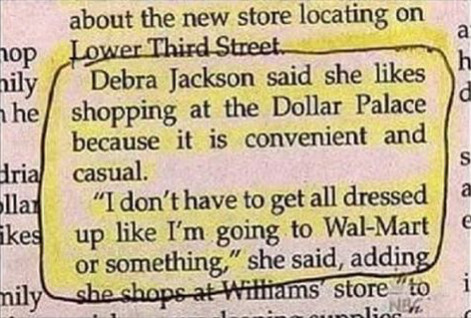
I got the image above from an email list I’m on that occasionally sends out funny stuff. And it is amusing: the idea that Walmart is a place that one would need to dress up for. Here is the text for those who can’t see the image:

Debra Jackson says she likes shopping at the Dollar Palace because it is convenient and casual.

“I don’t have to get all dressed up like I’m going to Wal-Mart or something,” she said…

This image is very similar to the College of Planning sign image. It’s been around for years, and every few months a new group of people find it and it goes viral. Again.

As far as I can tell, it dates back to an article from 2005 in The Daily Town Talk. It is now called, The Town Talk. It was founded in 1883 and covers central Louisiana.

Dollar Palace Was a Real Place

The article appears to be about Dollar Palace, which had opened in November 2004. (It appears to be out of business now — but it was in business as late as 2007.) These kinds of articles are standard for local papers. There’s a new business in town so a reporter goes out, talks to the owner and the customers, and files a story.

Is Debra Jackson for Real?

Over at the Snopes forum, Ovalescent noted something very interesting:

I’m guessing it’s just from a quasi-rural area where Wal-Mart is the main grocery/department store. If you’re way more likely to run into family or co-workers, it’s a dressier affair. I personally don’t doll myself up, but I always make sure I’m at least brushed out and cleaned up before I go there lest I inevitably run into someone I know.

That makes a lot of sense. When Walmart moves into a rural area, it becomes something of an attraction. Debra Jackson isn’t some idiot redneck who thinks Walmart is such a great thing. But she is recognizing that it is the economic center of her area.

Is It a Hoax?

A lot of people have just assumed that it is a hoax. But there are a number of things that push against that. The first is that it is an image. One would have had to have gone to a lot of trouble to create the base image. Then, there’s the highlighting and pen outline. That’s a lot of work to go to just to make fun of yokels in a pretty gentle way.

Even if it weren’t an image, most hoaxes of these kinds have no details. At the time, various people were talking about it coming from an established paper. (I’ve found a couple of links to the original article, but it is down and nothing on that site is saved on Archive.org.) It wasn’t the standard, “A large newspaper in the northwest reported about a woman…” There are specifics that can be checked. It passes the smell test.

On the other hand, it would be different if Debra Jackson had said, “I love Dollar Palace! It’s the only store where they keep the darkies in line.” (Dollar Palace was owned by Kenneth Williams, an African American.) In that case, I would start looking for signs of Photoshop in the image above. But as it stands, it seems very likely that it is the real deal, and that Debra Jackson had a good reason for saying what sounds like something very silly.

Dean Baker on Financial Transaction Tax

Dean Baker on BloombergBloomberg is really pushing the frontiers in journalism. In order to give readers a balanced account of a proposal by Representative Peter DeFazio to impose a 0.03 percent tax on financial transactions (that’s 3 cents on every hundred dollars) it went to the spokesperson for the Investment Company Institute, the chief investment officer from Vanguard, and an academic with extensive ties to the financial industry. It also presented an assertion on the savings from electronic trading from Markit Ltd. Based on this diverse range of sources, Bloomberg ran a headline: “Democrats assail Wall Street with plan that may hit mom and pop.” …

Most research finds that trading is price elastic, meaning that the percentage change in trading in response to a tax is larger than the percentage increase in trading costs that result from the tax. The non-partisan Tax Policy Center assumed an elasticity of -1.25 in its analysis of financial transactions taxes.

This means that if the tax proposed by DeFazio would raise the cost of trading by 20 percent, then trading volume would decline by 1.25 times as much, or 25 percent. Investors would pay 20 percent more on each trade, but would be trading 25 percent less. This means that their trading costs would actually fall as a result of the tax…

The only way “mom and pop” get hurt in this story is if they make money on average on their trades. That is a hard story to tell. If mom and pop are lucky and sell their stock when it is high then some other mom and pop are unlucky and buy the stock when it is over-valued. As a general rule, trading will end up being a wash…

Of course there is someone that gets hurt by less trading — the folks who were making money on the trades — that’s right: the financial industry… Since it may not sound very compelling to hear a multi-millionaire complain about the prospect of a pay cut, it sounds much better to make up a story about mom and pop investors.

—Dean Baker
Bloomberg Asks Wall Street How It Feels About Taxing Wall Street

My Dirty Little Blogging Secret

Frank Moraes - Webpage ImagesWhen I first started this blog, I had no idea whatsoever what I was doing. I knew computers, of course. And I set up my first web server in 1993. And I was, I guess, an expert with HTML, CSS, JavaScript. And I’m a decent enough PHP programmer. But I’d never used a content management system before. And I didn’t read blogs. In fact, I wouldn’t even call Frankly Curious a blog for the first couple of years. Most of all, I had no thoughts about it being publishing in the grand sense: there was no layout, and most of all: no webpage images.

It took me almost exactly two years, in late 2011, to start using webpage images. At first it was a now and then thing. But within a month, it was required. I am a man of habits. But it caused my writing to change. Now, since there were always webpage images in the upper-left hand cover of each article, I had to write enough text to be below it before I could quote someone.

You know what my quotes look like:

They are done inside boxes. Now they have a light grey background, but that’s relatively new. It’s slightly less readable. But I believe most people just scan display quotes.

Webpage Images Changed My Writing

I didn’t want the box to run into the image. So I had to write enough introductory material to get beyond the image so that I could quote whatever I wanted to. This changed the way I wrote. Instead of doing the standard kind of blog writing — X said: [quote]; let me add — I wrote a summary of their argument.

And I like it that way. I can normally condense a 3,000 word article down to a 100 word summary. I hate it when bloggers provide more quoted material than new material. As much as I love Digby, she will, at times, quote thousands of words. Mark Thoma does much the same, but I have to give him a pass; he does extensive edits of the material for things all his readers would know. (He writes for economists.)

But as much as I like the general style of Frankly Curious, it is still a bit embarrassing that it is the result of adding webpage images to the site. It seems like there ought to have been some grander vision. But there wasn’t. In fact, at times, I felt like a fraud, doing the literary equivalent of treading water.

There’s a very good side of this, however. Limitations often improve us, and this case was no exception. It forced me to think more deeply about the subject at hand. My freelance writers can all tell you: there is no such thing as “literary treading water.” If you need another hundred words, you need to come up with something else to talk about. I’ve seen lots of writers pad, but at most they get 20-30 extra words out of one thousand.

Sizes of Webpage Images

There’s an interesting mathematical aspect to these corner article webpage images. If they are very small, you don’t need much of anything before you start quoting. “X said the following…” is good enough. And if the images are really big — take up the entire width of the page — when you don’t need anything at all. But there are optimal image sizes for a webpage. We could do some math, but what would be the point? Just remember that it has to do with the width of the content area and the height and width of your webpage images.

With the old (pre-WordPress) site, the content area was thinner: a bit less than 500 pixels. So I thought that 150×200 pixel webpage images looked rather good. But on the new site, the content area is about 100 pixels wider. And the 150×200 pixel images looked kind of small. So I’ve increased the size of the default images to 225×300. This is the same aspect ratio.

It’s all kind of complex, but the net result has been that now I don’t need to write as many words to be past the image. Of course, I don’t even think about it anymore. But it does come up when I’m dealing with quotations pages. There, if the text is not long enough, I have to put the image on the right, or it looks bad.

Anyway, that’s my dirty little secret: I changed my writing style for the sake of making my webpages look prettier. But then, I’ve never claimed to be anything more than a hack.

Police Are Civilians

Police Are CiviliansPolice are civilians. They are the civil power. They are not soldiers. They are subject to the rule of law adjudicated within civilian courts — not military justice. They are tasked with special powers and thus burdened with specific responsibilities and duties — but they’re civilians. They answer to mayors and (civilian) police commissioners and city councils and ultimately the public.

It’s an expression of the dangerous militarization of the police to distinguish them from “civilians” — those who are in fact citizens, fellow citizens, the commonwealth.

Say “police and the community.” Say “police and the public.” Don’t say them and us, even when that’s too often what’s felt. We can’t get from there to here if we encumber cops and everyone else in language that preserves the wall between those of our fellow citizens who carry badges and guns and those whom they serve.

—Tom Levenson
Pet Peeve

H/T: Elizabeth

Election Fundamentals in 2016

Election Fundamentals Favor Hillary ClintonIs Steve M at No More Mister Nice Blog right when he says, This Election Is Going to Be a Nail-Biter? He’s looking at the recent polls that show Donald Trump gaining on Hillary Clinton. Now I don’t think polls mean much right now. But I do keep remembering back to 1980, when Democrats were happy that they were going to be running against the extremist Ronald Reagan. And the data we have indicates that economic considerations account for about half of the outcome in a presidential election. So I thought it might be a good time to discussion some election fundamentals.

Polls Don’t Mean Much Now

Before I get to that, Steve M is being a bit silly. It’s not just that it is way early in this election. It is also that the timing is bad. We just came off the whole “rigged system” narrative that the right wing has been pushing about Clinton not getting indicted. Very few people even know what the issue is, but there is a tendency for people to think that smoke implies fire. We may be innocent until proven guilty in court, but in most people’s minds, we are guilty until proven innocent.

And let’s be prepared for things to get worse. The RNC is next week and that always gives candidates a bump. Just remember that Michael Dukakis had a 15 percentage point lead over the elder Bush after the DNC in 1988. And Dukakis went on to lose California — and didn’t win New York by all that much (4 percentage points — compared to the 28 that Obama beat Romney by in 2012). So we should all calm down.

Election Fundamentals Tell Us More

But to be honest, I haven’t liked what I’ve seen in the election fundamentals either. My simple model just looks at the trend of the unemployment rate (U3) in the first 10 months of the election year. If the trend is negative (unemployment is going down), it is good news for the party in power. If it is positive, it is good news for the party in opposition. And look at what we have for the first six months of this year:

    Jan: 4.9
    Feb: 4.9
    Mar: 5.0
    Apr: 5.0
    May: 4.7
    Jun: 4.9

To the naked eye, it looks flat, because when it comes to trends, we tend to look at the first and last numbers and go with that. But right now, this is a distinctly negative trend -0.017% per month. I know that doesn’t mean much without context. So here’s some context:

1988 (Bush-Dukakis): -0.033;
1992 (Bush-Clinton): +0.021;
1996 (Clinton-Dole): -0.50;
2000 (Gore-Bush): -0.007;[1]
2004 (Bush-Kerry): -0.033;
2008 (McCain-Obama): +0.179;
2012 (Obama-Romney): -0.046.

Hillary Clinton Is Winning

So right now the election fundamentals favor Hillary Clinton by just about the same amount as they favored Bill Clinton when he was first elected in 1992. And she’s doing considerably better on the election fundamentals than Mr Gore in 2000. If I had to pick between polls after a bad news cycle for Clinton and the economics at play, I would go for the economics.

Of course, the election fundamentals could change. Although Alan Greenspan was willing to let the unemployment rate get all the way down to 3.9%, it does not seem that the current Fed Chair Janet Yellen is. For years, the Fed has been itching to raise interest rates to slow our already anemic recovery. But I think the worst that will happen is that the unemployment rate trend will be flat. Unless something horrible happens, it is unlikely to go in Donald Trump’s favor.

What that means is that Donald Trump is going to have to make this election about something other than the economy. And that will be hard to do given that a bad economy is the basis of pretty much his entire campaign. The wall? The racism? China? It’s all based on economics. So it’s actually looking pretty good for Hillary Clinton right now. And I didn’t think that before I started writing this article.

Richard Seymour on a Possible Labour Split

Richard SeymourNone of this means that a split, should it come, is something anyone in the Labour Party should welcome. It would be unspeakably selfish and venal, conducted for the most narrow, shortsighted and base of motives. And the mere fact that it would be intended to trash Labour, to hurt it so badly that it returns to obedience, should inspire rage and contempt.

But it does mean that those who are making the prospect of a split their red line, as it were, are entirely wrong in their focus. The coup plotters have started this process, in a premeditated way, and don’t have a road-map out of the situation they have created. The responsibility is on them to negotiate their retreat, to make peace with their defeat, and to work with whichever leadership the party members wish to elect.

If a small number of those MPs, having gained careers and power on the back of the labor movement, and on the back of the Labour Party, are prepared to try to wreck it when they don’t get their way — well, then, to hell with them. Let them go, and see how far they get. They will lose.

—Richard Seymour
This Is Not 1981, and an SDP Mark II Will Not Work

Frontend vs Front-End vs Front End

front-endI got an email message from one of my writers about our style guide, “Frontend vs front-end vs front end?” I love that because writers tend not to pay attention to style guides. And the truth is that while writers should have a decent knowledge of the style guide, it is really for the use of the editor. The better the writer knows the style guide, the less work there is for the editor. But this was a really good question. It wasn’t in the style guide, and I had to decide.

Frontend?!

The problem with dealing with these variations of “front-end” is that the style guide already dictates “backend.” So the obvious answer is “frontend,” right? Well, no. It just didn’t feel right. Consistency is a great thing if you can get it. But it doesn’t trump readability. And when I see “frontend,” I do not see “front-end.” I see “fron-tend.” And I don’t want to make the reader have to figure out anything.

What’s more, I think that backend is a more common phrase. Now this would probably not be the case if I were editing for a automotive website. But I work for a website about websites. And we mostly talk about the “backend.” The front-end is more or less a given — the default. It’s what your audience sees and all you ultimately care about.

Front End?!

Of course, I could have gone with “front end.” But that’s a problem. It works. It’s clear. But it isn’t quite right. The front-end is a single thing. The two words go together. But I should note that around here, I often omit hyphens that I would include if I were being more careful. But who has the time to be careful around here? I don’t even have time to be careful when I’m working there. I could easily spend twice the time I do editing.

But this is one thing a style guide is for. Given that I’ve written this article, I will remember. But often, when editing, I will only remember that I have made a decision about “frontend” vs “front-end” vs “front end.” I won’t remember what it is. The style guide allows an editor to fret over such matters just once.

Remembering “Front-End”

When I first got the message, I immediately thought, “Well, it’s ‘backend.'” That’s one I run into a lot so I have it memorized. And so I really wanted to use “frontend.” It’s just easier. You don’t have to remember anything. And that has always been my approach to grammar and style: make it simple. It seems most of the grammar articles I’ve written here make that point. I have banished blonde and annunciate. But alas, I have introduced another inconsistency into my style guide.

But it is necessary. I often say that style guides are arbitrary. And indeed they are! But they are not completely arbitrary. Their ultimate purpose is to make communicating with the reader as easy as possible. It’s useful to look back at texts from the Elizabethan era — before English spelling was standardized. It is really hard to read! You have to sound out each word. It’s madness!

Inconsistencies

So it must be “front-end” and “backend” — at least for now. I could, of course, go the other way: turn “backend” into “back-end.” It’s a thought. And the great thing is that in the electronic age, all it would take is one SQL query to fix all the previous style. But I won’t. Because I like a clean style. It is USA, not U.S.A. It is Dr Knowitall, not Dr. Knowitall. If a hyphen is unnecessary, it must go, even if it makes my work (and that of my writers) slightly harder.

I know! I can hear Mozart’s Concerto No 3 playing on the world’s smallest violin.

Anonymous Leaker on Government Assassination

James Bond -TIDEOver the past few years, we’ve heard a lot about President Obama’s secret kill list. Yet still we know virtually nothing about its implementation. Despite mild Congressional scrutiny and ACLU lawsuits directed at the shroud of secrecy, some basic questions remain unanswered. How do you get on the list? Am I on the list? Who put me on the list? How do you get off the list? Can you get off the list?

The truth is there are several such lists used to target individuals for different reasons. Some lists are closely kept. Others span multiple intelligence and local law enforcement agencies. There are lists used to kill or capture supposed high value targets. And others are intended to threaten, coerce, or simply monitor a person’s activity. However, all the lists, whether to kill or silence, originate from the Terrorist Identities Datamart Environment [TIDE] and they are maintained by the Terrorist Screening Center [TSC] at the National Counterterrorism Center.

The existence of TIDE is unclassified. Yet details about how it functions in our government are completely unknown to the public. In August 2013, the database reached a milestone of one million entries. Today it is thousands of entries larger and is growing faster than it has since its inception in 2003. The March 2013 Watchlisting Guidance lays out the broad criteria for nominating someone to the database.

Not only does the Terrorist Screening Center reserve the right to store your name, date of birth, and other basic identifying information, but it also stores your medical records, transcripts, and passport data. Your license plate numbers, email, and cell phone number — along with the phone’s international mobile subscriber identity and international mobile station equipment identity numbers. Your bank account and purchases. And other sensitive information, including DNA and photographs capable of identifying you using facial recognition software.

The National Counterterrorism Center collaborates annually with agencies from the international alliance known as Five Eyes [FVEY] to supplement any information missing from entries already in its database. Or to add more entries. Individual entries in the database are assigned a TIDE Personnel Number (or TPN). From Osama bin Laden (TPN 1063599) to Abdulrahman al-Awlaki (TPN 26350617) — the American son of Anwar al-Awlaki. Anyone who has ever been the target of a covert operation was first assigned a TPN, and closely monitored by all agencies who follow that TPN long before they were eventually put on a separate list and extra-judicially sentenced to death.

When governments begin to tally enormous enemies lists, they run roughshod over our essential checks on power. Especially when they consider their own citizens to be a threat. Of the more than one million entries in the TIDE database, approximately 21,000 are those of American citizens. By leaking this information, I hope to give the public an opportunity to know what kind of activity might lead to their being placed on a list used to monitor their everyday activity. For the first time, the public has an opportunity to gain insight into the criteria that could potentially lead to their own trial by drone strike.

In 2008, I shook hands with Senator Obama when he came through my town on his way to the White House. After his inauguration, he said, “Transparency and the rule of law will be the touchstones of this presidency.” I firmly believe those principles are crucial to an open society, which is why I was compelled to reveal this information. If this administration lacks the courage to uphold its promises to the people, then I and others like me will do so for them.

—Anonymous Leaker read by Jeremy Scahill
The Government’s Secret War with Drones