About Frank Moraes

Frank Moraes is a freelance writer and editor online and in print. He is educated as a scientist with a PhD in Atmospheric Physics. He has worked in climate science, remote sensing, throughout the computer industry, and as a college physics instructor. Find out more at About Frank Moraes.

The Doctors’ Cartel We Don’t Care About

Dean Baker on Doctors' CartelBreaking the taxi industry cartel’s and promoting Uber has been somewhat of a cause célèbre among economists in recent years. Any card carrying economist can give you the two minute tirade on the evils of the taxi cartel and the benefits of Uber…

What is striking is that the enthusiasm for the virtues of competition seems to disappear when we switch the topic from the taxi cartel to the doctors’ cartel. Doctors actually have been far more effective than taxi companies in limiting competition. Doctors largely get to set standards of care, which not surprisingly requires twice as high a percentage of highly paid specialists as in other wealthy countries. They also restrict the number of doctors with a wonderfully protectionist rule that prohibits doctors from practicing in the United States unless they have completed a US residency program. This means that even well-established doctors in places like Germany, France, and Canada would face arrest if they attempted to practice medicine in the United States.

As a result of this cartel, doctors in the US earn on average more than $250,000 a year, putting the average doctor not far below the one percent threshold, even assuming no other family income. This is roughly twice the pay as the average doctor earns in other wealthy countries.

It is striking that the doctors’ cartel gets so much less attention from economists than the taxi cartel. After all, we spend close to $250 billion a year on doctors compared to $6 billion a year on taxis. I could suggest that the lack of interest is due to the fact that many economists have parents, siblings, or children who are doctors, but I wouldn’t be that rude.

–Dean Baker
Economists, Doctors’ Cartels, and Uber

Countable Infinity and Rick and Morty

Countable InfinityWhen it comes to math, I think it is best that I assume everyone is really ignorant. So forgive me for going over some really basic ideas about infinity. But I have good reasons for doing this. Some time ago, I wrote, Infinity Is Not a Number. In it, I discuss how the great Christian apologist William Lane Craig used a total misunderstanding of infinity to “prove” that the universe is not eternal. I was pointing out that this brilliant man was ignorant of the fact that infinity is not a number.

I guess I can understand. Mathematicians use infinity (∞) along with a lot of numbers. To understand infinity as a mathematical concept, you really have to study limits. And that isn’t something students get into until college — if then. It’s really when you start to study calculus that you get into limits. And that is done for the opposite reason: to understand the infinitesimal. It’s actually the same thing, but I won’t bore you with it. You either understand what I’m talking about (It’s the reciprocal, stupid!) or you would require a good deal more exposition than I’m willing to expend.

Countable Infinity

But there are some things about infinity that are intuitive to people of this time and place. For example, if you think of the whole numbers (0, 1, 2, 3…), you know that there are an infinity of them. Regardless of what natural number you can come up with, there is always a number that is one unit larger. Let’s combine the whole numbers with all the negative whole numbers (…, -2, -1, 0, 1, 2, …) that infinity space is twice as large. But that doesn’t mean there are twice as many integers as whole numbers. Both sets contain an infinite number of elements. But they are both “countably infinite.”

So what does it mean that they are countably infinite? It means that you can pick any number in the series and count to it. Consider the whole numbers again (because it is easier). You can count from 0 to 15,000,000 or 15,000,000,000 or whatever. It will just take time. If you have an infinite amount of time, I guess you could count all the whole numbers (and, unintuitively, the integers). (Note: this is one reason immortality is so terrifying: eventually you would get to the point of counting all the whole numbers.)

Rational Numbers

Now let’s consider the rational numbers from 0 to 1. These are just the fractions. You can tell that they are countably infinite. You just start counting: 0/1, 1/1, 0/2, 1/2, 2/2, 0/3, 1/3, 2/3, 3/3, etc. It doesn’t matter that many of the numbers of duplicates. The denominators go on forever. Thus, the number series is infinite. And we know it is countable because we are counting it. In theory, we can count all of the numbers. The same is true of all the rational numbers — not just the ones between 0 and 1.

So a countable infinity of countable infinities is a countable infinity. You would think that all infinities would thus be countable. But no.

Irrational numbers are numbers that cannot be represented as a fraction of two integers. You know: numbers like π and e. The set of all these numbers does not represent a countable infinity. Indeed, the irrational numbers between any two numbers are not a countable infinity. Think about it. It’s mind blowing.

Rick and Morty

Rick and MortyI was thinking about this because I was watching an episode of Rick and Morty, “Rick Potion No 9.” In it, Rick turns his human world into Cronenberg-world. So in order to fix things, Rick goes looking for another reality, “There’s an infinite number of realities, Morty. And in a few dozen of those, I got lucky and turned everything back to normal. I just had to find one of those realities in which we also happened to both die around this time.” (Note: if there were an infinite number of realities, there would be an infinite number of realities where Rich “got luck,” but I’ll leave that as something to consider on your own time.)

The implication of this episode (and others) is that at every instant, there are an infinite number of realities, and each one creates an infinite reality at that point — and on and on and on. I’ve long thought this is what Planck time must represent: the time at which every possible quantum reality is spawned. But that doesn’t much matter. It’s just a thought. But I like Rick’s idea of an infinite universes (“realities”) constantly spawning an infinite number of universes.

Countably Infinite Universes

As outrageous as this notion is, it would still represent a countably infinite number of universes. I find that vaguely comforting. Of course, there’s all that dark matter and dark energy. Maybe that’s where the non-countably infinite universes exist. I don’t really care. I don’t like thinking about things that can’t be counted. Irrational numbers are as strong a proof of the non-existence of God that I can think of.

But let me leave you with a practical thought. As many of you know, I think memorizing multiplication tables is a waste of time. I think children would be better served watching Rick and Morty. They’d have a chance of thinking about math. And it wouldn’t make them hate math. Finally, it might get them to watch Existenz.

The Iraq War Was a Major Success — For Some

Cenk UygurHere’s the thing we always misunderstand: we always think that the Iraq War was a disaster — it was a failure.

No it wasn’t. It was declared by (in essence) Dick Cheney, who was, by all accounts, running the country from 2001 to 2006. And Bush, for better or for worse, took charge in the last two years. And believe it or not, it was slightly better than the Cheney years.

Now Cheney, who used to work for Halliburton and got a $34 million exit bonus from them, started a war where Halliburton’s stock price went up five fold during the war.

Mission accomplished!

–Cenk Uygur
Michael Moore Puts Obama’s Legacy In Sad, Simple Terms

Keith Ellison and the Difficult Path Forward

Keith EllisonWe are less than two months away from the election for the DNC chairmanship. This year, it has taken on an over-sized importance among American liberals. The front-runner is Minnesota Representative Keith Ellison. And you would think his election would be a sure thing. He’s been endorsed by Elizabeth Warren on the economic left and Chuck Schumer on the economic right. But the whole thing has unfortunately turned into a proxy war between Bernie Sanders and Hillary Clinton — as if we need to run the presidential primary all over again.

Jeff Stein wrote a very good overview of what’s going on, The DNC Race Has Become Another Fight Over Bernie Sanders When Dems Need It Least. As he indicates, the push to get Thomas Perez in the position shows how stupid this all is. The two men are pretty much identical ideologically. I certainly admire them both. But why is it that Ellison is not acceptable? The best example of this was how Ellison was unacceptable because the job should be full-time. But as soon as Keith Ellison said he would step down as Representative if elected, new reasons to be against him popped up. There’s clearly a more fundamental reason that Ellison is unacceptable — just not one that Democratic Party elites want to talk about openly.

Elites Don’t Like Keith Ellison

The truth is that political parties are the way that their elites want them to be. And those elites don’t want things to change. And this was always my biggest concern about Bernie Sanders winning the Democratic primary. I voted for him, of course. But I saw the complaints that Sanders supporters wouldn’t support Clinton as being more projection than anything else. That is to say: there were far more Clinton supporters who would never have voted for Sanders than their were Sanders voters who didn’t vote for Clinton.

We’ve seen this same kind of thing in the UK Labour Party. Jeremy Corbyn’s election as leader of the party has been met with extreme hostility. There is a huge part of the Labour Party elite that would rather see the Tories in power than Labour in power if it were led by Corbyn. And I think we would have seen the same thing with Bernie Sanders in the Democratic Party if he had won the primary.

Trump and the Republicans Are Different

And note: this is not equivalent to Donald Trump and the Republican Party. In as much as the Republican elite was ever really against Trump, it was because he was seen as (1) personally offensive and (2) unelectable. The issue was never ideological. Yes, there was a little ideological heterodoxy at first. But as soon as Trump came out with his tax plan that was a huge giveaway to the rich, the Republicans knew they had nothing to fear from Trump. The issue with Corbyn and Sanders (And Keith Ellison!) is different. In each of these cases, the liberal party is afraid that it will have leaders that are ideologically in sync with their voters. That is to say: they are afraid that the liberal party will be run by actual liberals.

The Democratic Party Is Moving Forward — Regardless

It doesn’t matter to me if Ellison or Perez become DNC chair. Actually, I’d kind of like to see Perez in the position because I want them both fighting for us in high profile positions. But it’s clear that the push for Perez is not about that. The push for him is about telling the base of the party that it isn’t in charge. Yes, Perez is as liberal as Ellison, but the more conservative elites can ignore that. Allowing Keith Ellison to become chair would be an unmistakable indication that the Democratic Party has changed and that the New Democrats are dead, after doing so much damage to the nation and the party.

But like most fearful efforts to hang onto what little power you have, the anti-Ellison campaign will likely fail. I find it annoying that we are even having this fight. Part of being a liberal is believing in democracy. So there really shouldn’t be a big effort to stop the Democratic party from representing the base. But it’s okay. I think the Democratic Party will get to where it needs to go. Eventually. Despite the wishes of too many in the party elite who represent the past and not the present (much less the future).

Teaching Don Octavio How to See Reality

Don Juan DeMarco and Don OctavioI haven’t seen a deed, but I assume this villa is yours… [Someone who says otherwise] has a rather limited and uncreative way of looking at the situation.

Look, you want to know if I understand that this is a mental hospital? Yes, I understand that. But then how can I say that you are Don Octavio, and I am a guest at your villa, correct? By seeing beyond what is visible to the eye.

Now, there are those, of course, who do not share my perceptions, it’s true. When I say all my women are dazzling beauties, they object. The nose of this one is too large. The hips of another, they are too wide, perhaps. The breasts of a third, they are too small. But I see these women for how they truly are: glorious, radiant, spectacular, and perfect — because I am not limited by my eyesight.

Women react to me the way that they do, Don Octavio, because they sense that I search out the beauty that lies within them until it overwhelms everything else. And then they cannot avoid their desire to release that beauty and envelop me in it.

So to answer your question: I see as clear as day that his great edifice in which we find ourselves is your villa. It is your home. And as for you, Don Octavio del Flores, you are a great lover like myself, even though you may have lost your way… and your accent.

–Don Juan
in Don Juan DeMarco

The Joke of Existence: Happy New Year!

The Joke of Existence - The Nihilist by Paul Merwart

I generally think in terms of days. This is why I manage to make at least 365 foundational errors every year: each day I choose to continue on being conscious of the universe. But today, let’s consider this whole year that we look toward. Are we really all going to sit through the whole thing? I think it makes the question of continued survival more stark. Yes, I can make it through the next day. But the next year? Given that we know it will be much like last year, it’s hard to answer in the affirmative.

The Meaning of Life

Many people ask, “What is the meaning of life?” That’s a stupid question. Can you honestly look forward or back on your life and see any meaning in it? I don’t want to upset anyone who really hasn’t been paying attention, but life is meaningless.

For most people, I stand as an object lesson for never allowing a teenager to read Schopenhauer. So I’m on record — repeatedly — about my belief that the continuance of life — the will to live — is an irrational thing. But one needn’t be rational in all things. Indeed, I write more about the irrationality of humans than I do Schopenhauer. One of the easiest ways to annoy me is to tell me that humans are rational. They aren’t — even in little ways.

It’s because of this that I have a thin reed to hang onto as I continue into the future. Perhaps you will find it helpful.

You Make the Universe Worse

I have a great love of anti-art. This is the kind of art that is created only for the process itself. So an example of anti-art might be a digital music device programmed to destroy itself before playing any of the music it was programmed to play. It is art explicitly created for no one. And I am a work of art created for no one. (When you get into ontological matters, it gets hard to distinguish between the implicit and the explicit.) I like to learn things, gain skills, create stuff — all while knowing that they are all ephemeral.

An enormous amount of the universe’s energy has been used to fight entropy and create me. And then I exist for a period of time before giving into entropy. Ultimately, I will have taken very useful energy and turned it into heat, which is a decidedly poor energy source. The universe will be more chaotic after I’ve gone than it was before I existed. So the universe has greatly harmed itself for the purpose of creating a machine that understood for a short period of time that universe was doing this.

And that is hilarious!

More Than You Think

It’s even more hilarious when you consider that the vast majority of people on earth are too caught up in their delusions of meaning to even know the joke exists — much less to get it. And that’s to say nothing of billions of years of evolution of creatures that didn’t get the joke.[1] So why not hang around for another year?

Think of yourself as conscious toxic waste. Wouldn’t you want to hang around as long as possible soiling your environment? But if you don’t like that analogy, you can feel good that most of the damage that your existence has done to the universe has already been done. Maintaining your wasteful machine is pretty cheap. And depending upon how funny you think your existence is, maybe it’s a net positive.

Existence Is a Joke

We are all a joke. If more people understood that, maybe we would live in a more just society. Because when you know that existence is a joke, you also know that it has nothing to do with justice. Your existence is a waste of elementary particles. In this next year, thousands of children will be burned alive. And a trust-fund baby will get the biggest ego stroke on the planet by being the leader of the “free” world. Try not to think of that. Focus on what a waste you are in this universe. That might get you through to next year when I promise I’ll have a whole new reason for irrationally continuing on.

[1] Or maybe all these “lesser” brains did and do get the joke. Maybe this whole self-awareness thing makes the joke harder to get. Maybe when a female mantis is biting the head of her mate, she is laughing up a storm, thinking, “Can you believe this?!” The male might be thinking the same thing in its final milliseconds of consciousness. For the record, I suspect that no mantis, dog, or cat actually gets the joke. But they do have us beat in not thinking themselves rational. Biting the heads off your mate is just what you do.

Happy Year’s End From Emily Dickinson

Emily DickinsonBecause I could not stop for Death,
He kindly stopped for me;
The carriage held but just ourselves
And Immortality.

We slowly drove, he knew no haste,
And I had put away
My labor, and my leisure too,
For his civility.

We passed the school where children played,
Their lessons scarcely done;
We passed the fields of gazing grain,
We passed the setting sun.

We paused before a house that seemed
A swelling of the ground;
The roof was scarcely visible,
The cornice but a mound.

Since then ’tis centuries; but each
Feels shorter than the day
I first surmised the horses’ heads
Were toward eternity.

–Emily Dickinson
“The Chariot”

Julian Assange and How Power Corrupts

Julian AssangeIt’s like we’ve gone back to the days of the Cold War. Yesterday, The New York Times reported, Obama Strikes Back at Russia for Election Hacking. To be honest, I’ve been skeptical about all this certainty that Russia hacked John Podesta and the DNC in order to stop Hillary Clinton from becoming president. Note: I’m not saying that they didn’t do it. It’s just that it is so hard to say. Sam Biddle’s article in The Intercept is the first thing that I’ve read that has made me think that there may be some real evidence that this is the case. But I don’t much care, regardless. The truth is, I’m more angry at Julian Assange than anyone.

Think about it. The Russians are trying to affect our elections. And they have been as long as they have been around. Before that, it was the Soviet Union that was trying to do it. The United States does the same thing to Russia. I’m not suggesting that we should just accept all of this and move on. But it is certainly true that the issue is no more important now than it was four years ago. And if the Russians did have an anti-democratic affect on our presidential election, it is nothing compared to our Supreme Court and the Electoral College system itself.

Who Care Who Stole the Email?

Regardless of who stole the Podesta and DNC email, it ended up in the hands of Julian Assange and WikiLeaks. Overall, I’m a supporter of WikiLeaks. That’s because I’m a supporter of open government. I think the people have a right to know about 99 percent of everything the government decides needs to be classified. So I’m entirely in favor of WikiLeaks getting all this data and releasing it to the public. But that is not what Julian Assange did. What he did had almost nothing to do with open government. What he did was use the information he had as a political weapon.

Truthfully, I don’t know enough about how WikiLeaks deals with such matters generally. But as much as I’ve paid attention, they mostly do large dumps. This is not what was done with the DNC and Podesta hacks. The information was released slowly as to give it the greatest negative impact on the Clinton campaign. And it isn’t hard to see why that was: there was no smoking gun. It was all innuendo. It was one month of trickling innuendo with absolutely no payoff. That is: no payoff if you don’t count Donald Trump being elected President of the United States a payoff.

How Julian Assange Used the Email

On 7 October 2016, WikiLeaks could have simply released all 20,000 pages of John Podesta’s email messages. Instead, it released a little each day. And given the way that our media system works, that meant that every day, there was more coverage of how Hillary Clinton was a corporate tool. This was so, even while the fact that a corporate con man was running for president was largely ignored. Donald Trump defrauded thousands of students who attended his “university,” but that was just a story — not something that made headlines every day for the month before the election.

Ultimately, I can’t help but remember the old gem, “Power corrupts.” Yes, WikiLeaks is a good idea. There should be a way of getting information out to the public. And let’s not forget that Chelsea Manning first went to The Washington Post and The New York Times — neither of which were interested in what she had to offer. But when it came to these recent hacks, WikiLeaks wasn’t interested in informing the public. It’s well known that Julian Assange hates Hillary Clinton. And he used the power that he gained by doing good to swing an election.

Culpability

There are lots of people to blame for “President Donald J Trump.” And I don’t doubt that the Russian government is somewhere on the list. But at the top of my list is Julian Assange. He went from being a hero to a villain — not because Clinton lost but because he abused his power. What he did casts a shadow on everything he did before.

From USA to Hungary in One Election

Miklos Haraszti - View of USA From HungaryHungary, my country, has in the past half-decade morphed from an exemplary post-Cold War democracy into a populist autocracy. Here are a few eerie parallels that have made it easy for Hungarians to put Donald Trump on their political map: Prime Minister Viktor Orban has depicted migrants as rapists, job-stealers, terrorists and “poison” for the nation, and built a vast fence along Hungary’s southern border. The popularity of his nativist agitation has allowed him to easily debunk as unpatriotic or partisan any resistance to his self-styled “illiberal democracy,” which he said he modeled after “successful states” such as Russia and Turkey.
No wonder Orban feted Trump’s victory as ending the era of “liberal non-democracy,” “the dictatorship of political correctness” and “democracy export.” The two consummated their political kinship in a recent phone conversation; Orban is invited to Washington, where, they agreed, both had been treated as “black sheep.”

When friends encouraged me to share my views on the US election, they may have looked for heartening insights from a member of the European generation that managed a successful transition from Communist autocracy to liberal constitutionalism. Alas, right now I find it hard to squeeze hope from our past experiences, because halting elected post-truthers in countries split by partisan fighting is much more difficult than achieving freedom where it is desired by virtually everyone…

The world is looking at the United States now in a way that we never thought would be possible: fretting that the “deals” of its new president will make the world’s first democracy more similar to that of the others. I wish we onlookers could help the Americans in making the most out of their hard-to-change Constitution. We still are thankful for what they gave to the world, and we will be a bit envious if they can stop the fast-spreading plague of national populism.

–Miklos Haraszti
I Watched a Populist Leader Rise in My Country. That’s Why I’m Genuinely Worried for America.

Solving Sudoku Puzzles the Easy Way

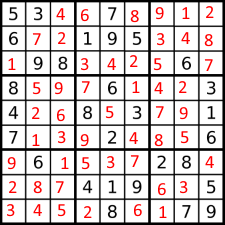
Sudoku MeaningI think of myself as someone who likes Sudoku puzzles. But that’s not really true. I never sit at home solving these puzzles. Instead, I do them when I am somewhere else where I don’t have the ability to concentrate on anything. I can solve a Sudoku puzzle 5 seconds at a time. Compare that with reading a newspaper, which I can’t do at that level of interruption. I probably shouldn’t say it, but if I’m doing Sudoku around you, it doesn’t speak well of my keenness to be around at that moment. And this may explain why I don’t do really hard puzzles.

Most Sudoku puzzles can be done purely deductively. That is to say that simply by looking at the numbers, you can directly deduce what some empty boxes must be. When I first started solving these puzzles, I found that there were harder puzzles where only a couple of empty cells could be filled in. Eventually, people learn that they can solve these puzzles by going one or two steps deep: since these cells can’t contain the number 5, that means these other cells must contain the number 5, and that means some other cell must be the number 3 — or whatever. That might sound complex, but it’s really very easy.

Difficult Sudoku Puzzles

Where things get difficult is where you really have no choice but to guess. Once you guess, you move forward deductively until you uncover an inconsistency or you finish the puzzle. Of course, most of the time, it is worse than that. After making a guess and trying one path, you may be forced to make a guess on that path — and maybe one after that. This is a complete pain. But there is an obvious way to use this method. Start doing the puzzle with a pen and then switch to a pencil for your first guess.

Now if you are lucky and your guess is wrong, you can then erase everything and fill in the non-guess with pen. Then you can continue on from there. But what about if you run into double or triple guesses? Colored pencils? They don’t erase well. And I don’t keep any around anyway. I only use pens. But I came upon a simple computer solution the other day, that works really well.

An Easy Solution

I was reading, Sudoku Meaning on Labor Day 2016. For that article, I used an unsolved Sudoku puzzle for the image. It occurred to me that I really should have solved it (it’s a very easy one). So I brought the image into Paint.NET. I added a layer and entered the solution in red. A thought occurred to me: if I needed to do any guessing, I could just create another image layer and change the ink color (though it is not strictly necessary).

Of course, I will never do this. I don’t have a computer in front of me when I am playing Sudoku. But if I ever decide to tackle the “Beware! Very Challenging” puzzles in Will Shortz’s The Little Black Book of Sudoku, that may be the way to go. And yes: of course the book was a Christmas gift. I would never buy such a book for myself.

Afterword

Note: I’m sure there are programs written just to help people solve Sudoku puzzles. Of course, I could just write a program that simply solved Sudoku puzzles. It’s a question of how much help you want to get.

Could Trump Overturn the US Israel Resolution?

Donald Trump - HopeTrump could theoretically repeal the resolution by introducing a new resolution at the UN that completely revokes this one. He would then need to get at least eight other countries to vote for it, as well as ensure that none of the Security Council’s other permanent members — Russia, the United Kingdom, France, and China — veto it.

Trump’s pick to be the next US ambassador to the UN, Nikki Haley, would almost certainly support such a move. Haley is perceived as being staunchly pro-Israel: As governor of South Carolina, she passed legislation against the so-called BDS (boycott, divest, sanctions) movement — an international campaign aimed at punishing Israel economically for its actions and policies toward the Palestinians.

She also publicly supported Netanyahu’s objections to the Iran nuclear deal when she delivered the Republican Party’s official response to Obama’s last State of the Union back in January. Haley said that if the GOP were to control the White House, “we would make international agreements that were celebrated in Israel and protested in Iran, not the other way around.”

But it is extremely unlikely that Haley and the Trump administration would actually be able to get eight other countries on the Security Council to support a measure revoking this most recent resolution. That’s because, as mentioned above, the notion that Israeli settlements are illegal under international law is widely held by UN member countries.

Finally, even if the Trump administration did manage to get eight other countries to support such a measure, a permanent member veto would be likely, as Russia, China, Britain, and France — all of whom have veto power — all supported Friday’s measure, which passed 14-0.

–Jennifer Williams
9 Questions About the UN Vote on Israeli Settlements You Were Too Embarrassed to Ask