Fedoras, Libertarians, and Russell Edson

FedoraI have one final article relating to yesterday’s brouhaha, but this one has nothing to do with David Weigel. I was having a nice conversation with Abenomix, and I happened to note that the grainy photo he uses (of himself I assume) would look like Sam Spade if you added a fedora. He tweeted back, “whereas I am certain it was not your intention to insult me, you did just manage to.” I immediately assumed it was the Sam Spade reference but it wasn’t. After a few more tweets, I learned from Matt Christman that, “Fedora = Bad.” When I asked for clarification, I was told, “Fedoras have become the online talisman of a certain strain of man-babyish libertarian white guy.”

I had no idea! I did, however, note that “libertarian implies man-babyish white guy.” But I can totally see this. What the bow-tie was to George Will and Tucker Carlson, the fedora has become to a younger generation. There is a slight problem, however. I went out looking for libertarians wearing fedoras and found that many of them were not wearing fedoras. Part of the problem is that people have started calling just about any similar hat a fedora. Both the Homburg and some styles of pork pie hat are misidentified as fedora. As you can see, I like hats. And it’s not just old style hats or western hats. Some Islamic followers wear the most gorgeous kufi caps. And it isn’t just men’s hats, either. Women are never as beautiful as when they wear hats. Hats are great!

But this revelation that libertarians (Abenomix brilliantly calls them “libertaryans”) are using fedoras as cultural signifiers is of great concern. And I can see why it is. Undoubtedly, they look back on what they consider the good old days when men were Humphrey Bogart and women were manipulative deceivers who get their comeuppance like Mary Astor. It also signals a kind of Eurocentrism. I don’t doubt that it is an intellectual response to the baseball caps worn by those “idiots” who don’t understand the libertarian utopia that awaits them if only they will wake up—and an anti-religious response to the growing popularity of kufi caps. (See my articles: The Atheist Libertarian Connection, Libertarianism Incompatible With Atheism, and Are There Libertarian Atheists?)

Russell EdsonThe facts of my life are that I almost never where any of my old fashioned hats. When I was younger, I was a bit of a dandy. Now I just don’t care. In fact, worse than that; mostly I wear badly damaged and worn baseball caps and the occasional communist workers’ hat. (I’m well aware that libertarians might soon start wearing them ironically.) But I still love the old hats and especially the fedora. But my love for the hats does not stem from old movies that I love. (Or more modern ones; see my thoughts on Miller’s Crossing.) It comes from a poet I discovered when I first went to college: Russell Edson.

Edson was (sadly, he died earlier this year) what I will call a surrealist poet. But I don’t know of anyone else who calls him this. No one is sure what to make of his work other than that it is brilliant and wonderful and beautiful. But the thing is, Edson had this thing about hats, most especially fedoras. When I first read him, I didn’t even know what a fedora was, so I had to look it up. And thus was born my love not just of fedoras but of all hats. Here is one of those poems from what was probably the first of his books I read, The Very Thing that Happens. This is “Someone”:

A man put a fedora on a cabbage, oh please be somebody I know.
Now who it is, as the brim is low, he cannot tell, but someone is certainly someone.
Someone, who are you?
Someone says nothing.
One and cabbage and now the moon. Round things are not unavailable in a square room.
The moon comes wearing a crown of clouds, worn too low to know who it is.

Or let us consider this much more recent poem, “Let Us Consider”:

Let us consider the farmer who makes his straw hat his
sweetheart; or the old woman who makes a floor lamp her son;
or the young woman who has set herself the task of scraping
her shadow off a wall….

  Let us consider the old woman who wore smoked cows’
tongues for shoes and walked a meadow gathering cow chips
in her apron; or a mirror grown dark with age that was given
to a blind man who spent his nights looking into it, which
saddened his mother, that her son should be so lost in
vanity….

  Let us consider the man who fried roses for his dinner,
whose kitchen smelled like a burning rose garden; or the man
who disguised himself as a moth and ate his overcoat, and for
dessert served himself a chilled fedora….

My first reaction to the fact that libertarians had grabbed the fedora as a cultural signifier was more or less Bush the Elder’s, “This will not stand, this aggression against hats and poetry and all that is good.” But I’m not up for a pointless fight. In its way, it’s nice that libertarians have latched onto the fedora. It’s the most charming thing about them. And maybe Russell Edson predicted this: who is that fedora wearing cabbage? Why it’s the next Libertarian presidential candidate!

Brilliant and Strange Arthur Evans

Arthur EvansOn this day in 1851, the great archaeologist Arthur Evans was born. What I find fascinating about Evans is that he was an incredibly important scientist, and yet he was totally wrong in his central idea that the Minoan civilization was distinct from the Bronze Age Greeks who he thought were just a backwater. But that take on his career is undoubtedly colored by my love of the Iliad and my admittedly childish wish that it be true. But Evans really blasted Heinrich Schliemann’s idea that the Trojan War had taken place, and during Evans’ lifetime, it was generally thought that the war was a myth. Now the evidence is overwhelming that it was not—it was a real thing.

Of course, that was just one thing and he was hugely important, especially his excavation of Knossos. And he was the guy who first discovered early Bronze Age Greek writing. Of course, he was absolutely certain that it is was not Greek. And then right after he died, the linguist Alice Kober noticed that the language seemed to have the some words with different endings. This indicated that the language had inflections. For example: call, called, calling. This indicated that although the writing had more the look of Egyptian, it acted more like Greek or Latin. This clue led the brilliant young self-taught amateur linguist Michael Ventris to make some brilliant educated guesses, which eventually led to his discovery that the Minoans spoke Greek—or at least a very early form of Greek. (Ventris died in an auto accident at the age of 34, a couple of weeks before the official publication of this work, but by that time everyone in the field knew.)

All of this perhaps makes Evans seem less than a brilliant scholar. That is wrong. As for the writing, I think the man can be forgiven. Here is a little Linear B. It looks nothing like Greek to me. And I understanding the issue in translating is not really the look of the text, but this was a difficult problem that many great minds worked on with little success for 65 years.

Linear B

More important, Evans excavation of Knossos is arguably the greatest of any settlement ever. I’m especially interested in his work on the Neolithic settlements. It seems that around 9,000 years ago, a group of people arrived in Crete, most likely from the sea. Of course, Evans wasn’t really interested in the Neolithic settlements. His great interest was the palace that was first constructed around 4,000 years ago. I think I have a greater interest in the earlier periods because of the relative egalitarianism of it. It seems that as humans have advanced, they have used technology more and more to separate themselves. The rich were further above the poor 4,000 years ago than 9,000 years ago because they could be, not because they were better. This is a problem that haunts us more today than ever, and one I’m afraid that we must solve or will eventually destroy us.

Evans was also a curious fellow. He not only excavated the palace at Knossos; he restored parts of it as you can see in the following picture. I still don’t really get it. I guess it gives visitors a better idea of what it was like 3,000 years ago. But I doubt that’s why Evans did it. And that blue on the wall? I don’t think that flies. Homer lived a thousand years after the palace was abandoned, and he didn’t seem to know the color blue. Blue is a hard color to make, and only showed up much later. But what the hell?

Knossos Palace

Happy birthday Arthur Evans!

Apologia for David Weigel’s Apologia

Cognitive DissonanceEarlier today, I wrote what I thought was an unexceptional article about a David Weigel column. The only thing that worried me was that the last time I had written about Weigel, he retweeted my article announcement. The thing about this is that when I’m ragging on a public figure, I don’t mean anything personal. So I make a point of not including their twitter handles in the tweet. But somehow, they always find out. This time, I figured surely he wouldn’t do so. After all, the article isn’t even really about him. But I was wrong. I don’t know quite know how to take it. It is either that he is a far better man than I am and really wants an open conversation; or he thinks I’m such an idiot that retweeting me makes that fact sell-evident.

Whenever this kind of thing happens, of course, the small trickle of Frankly Curious “readers” becomes a deluge. I put the scare quotes there because I wonder how many of these people click, see that the website is not decorated with animated gifs from Evil Dead and leave. But I got a really cryptic tweet from Abenomix. This is not unusual. I generally think I was not meant for the last two centuries, I’m certainly not meant for Twitter. So a lot of stuff just goes by me. But his profile read, “Math dork…” Well, that was all I needed to read so I asked for clarification. For the record, the original tweet was, “Why? Access. Acela=Hollywood for ugly people, & in showbiz sometimes gotta pretend the turd is a blossom, for work, nbd.”

After a two-part tweet, what he meant was crystal clear. He was saying that since Weigel has to report on the conservative movement, he can’t come right out and say that they are a bunch of bigots. He needs to see them in the best possible light. And Abenomix added that this probably isn’t something that Weigel is doing intentionally. That makes sense. It’s easy enough for me to imagine followers of Chris McDaniel to be drooling racists who could have been extras in Deliverance. “Squeal like a pig!” But Weigel actually deals with these people and I’m sure they don’t come off as any more racist than anyone else.

It makes me think of the film Flock of Dodos where much time is spent interviewing proponents of Intelligent Design. They are stone cold wrong and in their way, disingenuous. But they’re nice people. They are like my Christian conservative aunt, who has some of the most vile opinions in the world. But on a personal level, she is nice as could be. And let’s face it, I know where the Mississippi Republicans are coming from. When the Republicans did more or less the same thing to Ned Lamont in 2006, I was mad as hell. Not that this doesn’t excuse what is often explicit racism coming from the Mississippi Republicans, but I understand the anger and it is certain that politics is more racially polarized there than it was in Connecticut.

There is, of course, the other issue: the JournoList scandal. That was how Weigel got fired from The Washington Post (A good career move!) because he had made private disparaging comments about the right wing fringe, which of course, is just the right wing. Weigel is what I call a bleeding heart libertarian—the kind of libertarian I was when I was young. Libertarians of this ilk tend to think that they aren’t conservatives and so tend to disdain Republicans. (Note: Weigel is a registered Republican and even when I was a libertarian, I hated the Republicans and always thought it was better to have a Democrat in office.) So I can see that Weigel would be extra sensitive to the feelings of the conservatives that he covers.

Just the same, apologia is apologia. I never said that Weigel was a racist—in fact I explicitly said that I thought he wasn’t. But I think the facts are very clear in this case. Most of the support for the Republican Party is based on racism and misogyny. When given the chance, state Republicans have made it harder for minority groups to vote. They aren’t interested in courting the black vote, for example; they are interested in stopping the black vote. If David Weigel feels that he has to report this behavior in such a way as to make it seem reasonable, that’s his choice. He has to work with these people. But in terms of the country, it isn’t healthy to pretend that fringe groups aren’t fringe. And I will continue to make note of it when I see it. Because I care a lot more about the country than I do Weigel’s career. I suspect he doesn’t see the same danger as I do. Cognitive dissonance. Regardless, he is right to be concerned about his own career.

David Weigel Tries Too Hard to Explain Away Conservative Racism

Dave WeigelDavid Weigel is a smart commentator, but he really doesn’t get it when it comes to racism in the Republican Party. I wrote about this before, Dave Weigel’s Racist Apologetics. And I’ve written about it in a more general sense, Why My Father Watches Fox News. The fact that Republicans get behind people like Allen West and Herman Cain is because they are black men who ask nothing of the party. They are iconoclasts who are willing to pretend that racism is a thing of the past. A black conservative who was upfront about racism would be marginalized. Just look at Colin Powell, who probably couldn’t win a Republican primary in a single state of the union.
This seems to be a foreign concept to Weigel who wrote today, What Conservatives Mean When They Talk About “Race-Baiting” in Mississippi. He’s right in a certain way: Mississippi conservatives don’t hate all blacks, just the ones who make the slightest demands on their fantasy world where racism was abolished 9 April 1865. I really do mean to go back that far, because it is clear that the conservative movement now thinks the civil rights laws of the 1960s were a form of tyranny. That is, after all, what was behind John Roberts’ decision to gut the Voting Rights Act: to pretend that racism is that thing that used to occur in the United States.

If Mississippi conservatives were really concerned about fairness and not just stopping blacks from voting, they would have changed their voting system. Instead of requiring voter identification, they would have required partisan primaries. Instead, they did the opposite. And their most conservative voters then freaked out when the blacks who they had intended to stop from voting at all went ahead and voted for a Republican that they didn’t like. I’m sorry, but this is racism pure and simple.

This is how Weigel sums up the complaints of the Mississippi Republicans, “The ‘racist’ party is the one that wins black votes by promising largesse, and the colorblind party aims to win them by talking free markets and social values.” This in itself is a racist view of the situation. What, after all, was Medicare Part D, but a giveaway to a Republican coalition? What was the attempt to privatize Social Security, but a giveaway to a Republican coalition? What was the recent farm bill, but a giveaway to a Republican coalition and an attack on a Democratic coalition? The whole idea that it is just blacks who are won over by a party’s pandering is racist. And add to that, the idea that rich people vote for the Republican Party because of their embrace of “free markets (!) and social values,” and you have a frighteningly racist statement.

I don’t know how long Weigel can go on making excuses for the clearly racist attitudes on the party of conservatives. And what’s more, I don’t know why he does it. There is no indication that Weigel harbors any more racist attitudes than we all do. And he is certainly smart enough to know what he’s doing. Does he think that he needs to be the one to always be out in front making the best case for the Republican Party’s racist language and policies? Or does he have a real blind spot where he can’t see that even his best case apologia for conservative racism is itself racist.

Let me make it easy for Weigel. The Mississippi conservatives are complaining because they know there are not that many black makers, so it must have been all those black takers who won the election for Thad Cochran. That’s the blunt way of putting, “The ‘racist’ party is the one that wins black votes by promising largesse, and the colorblind party aims to win them by talking free markets and social values.” I really want to know if Weigel would still claim that the conservatives making that argument aren’t really racists.

Welcome to Neo-Feudalism

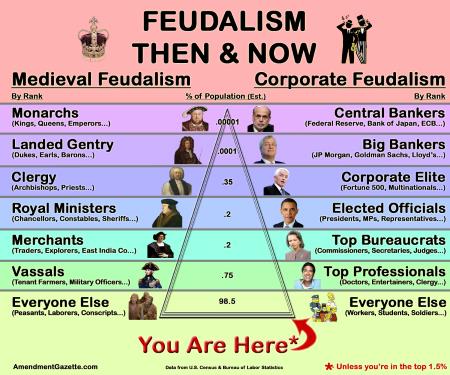
Feudalism Then Now - Via The Amendment Gazette

You probably know the idea of “creative destruction.” Basically, it means that smart people come into a poorly performing company. They get rid of the dead wood—they fire people. Then the company’s prices go down so that consumers have money they can spend on other things, increasing demand elsewhere. Then the fired people and even more can be better employed doing something else. The idea is that it may be disruptive, but in the long run, everyone is better off.

I have always had a problem with this idea. The reason is that prices do not reflect costs. Let’s suppose that I manufacture chairs and they cost me $5 each to make. I’m not going to sell them for $10 because that’s a reasonable markup. If I can get people to pay $100 for them, I’ll sell them for that price. On the other hand, if people will only pay $2 for the chairs, I will sell my existing inventory at that price and discontinue the line. So the only way that costs matters to me is if I’m not making enough. Otherwise, if people want to pay a million bucks for my $5 chair, that’s just fine.

Those of you who know a little economics will say, “Yeah, but you aren’t the only person who makes chairs!” And this is right. In the perfect markets of Chicago School models, other producers will come in and beat down my price. We will go back and forth until we get a price that is some reflection of the cost of bring the product to market. But such truly free markets are almost nonexistent. Let’s look at the way things normally work.

There are a bunch of little drug stores and they employ a whole bunch of people. A Walmart comes into town and puts them all out of business for both good (Walmart really has perfected the supply chain) and bad (Walmart illegally suppresses unions and can provide lost leaders) reasons. So there is lots of disruption but consumers really do get better prices. But the extra savings in the community is not equal to the loss wages. So creative destruction creates profits for the already rich and destroys the incomes of the community.

I was thinking about this after reading a great interview at Truthout between Jason Hickel and Alnoor Ladha, Are Economic Growth and Social Justice Incompatible? I recommend reading the whole thing, because it discusses the way the economy actually works and not the myths that we are constantly told. Take this frightening bit of information from Hickel:

We can see this level of corporate power being advanced even further by the new free trade agreements that are in the pipeline. Take the Trans-Pacific Partnership (TPP), for example, which is set to become a global version of NAFTA. It includes what are called “investor-state dispute mechanisms” that allow corporations to sue sovereign governments for passing laws that reduce corporate profits. Corporate lawyers will judge these cases in secret tribunals that operate above the laws of any nation.

So let’s say politicians in Malaysia pass a law that increases the national minimum wage. This means that sweatshop owners will lose some marginal part of their profits, which gives them the right to sue the government of Malaysia for lost future earnings. What’s amazing about this is that it essentially gives corporations the power to regulate democratic states, rather than states regulating corporations. So it’s a total inversion of our existing regulatory logic.

That’s right boys and girls. In the mind of my father’s generation, “capitalism” was the same as “democracy” and “freedom.” But the oligarchs want to create a new kind of system. Feudalism became capitalism, but it seems very much like we are headed to what I call neo-feudalism.

What’s most upsetting about all this is that it has always been a farce. There have never been “free” markets. The system has always been geared to maintain the status quo. On the whole, the rich are not rich because they are smarter or more knowledgeable or harder working. They are rich because they are rich. They are rich because their parents were rich or simply because they were lucky. Being brilliant brings many rewards, but great wealth is not usually one of them. Richard Stallman and Linus Torvalds truly revolutionized computing, but it was the subgeniuses Bill Gates and Steve Jobs who became billionaires.

So unless we stand up and do something about it, we will end up not only serfs, but serfs who are beholden to mediocrities. Kind of like we are now, but worse.


Image taken from The Amendment Gazette, Feudalism Then and Now.

Satchel Paige

Satchel PaigeOn this day in 1906, probably the great baseball pitcher ever, Satchel Paige was born. I think it’s funny that after the recent steroid scandal in Major League Baseball, people were wondering what this was going to do to the hallowed baseball statistics. Yet for many decades, blacks were not allowed to play for MLB teams, but when blacks and whites did play together as they did in the California winter league, the blacks very often totally out-shined the whites. That was more true of Paige than anyone.

When the Sporting News put out its Baseball’s 100 Greatest Players, it rated Cy Young, Grover Alexander, Christy Mathewson, and Walter Johnson ahead of him. As much as I admire Walter Johnson, all he did was pitch fast. He never developed a decent curve ball. Paige threw everything well. Of course, in that regard, he had the advantage of having such a long career. As he got older and his speed lessened, he increasingly used other pitches including the knuckleball.

Because Paige was black he was forced to pretty much play year round. At the beginning of his career, he played as a freelancer—something that he couldn’t have done in MLB. And he played outside the country on a number of occasions, causing various problems with his relationship with the Negro League. The end of that was when he played the 1939-40 season in Puerto Rico where he ended the season with a record of 19-3, 1.93 ERA, and 208 strikeouts over the course of 205 innings. In one game, he struck out 17 batters.

The next seven years he played with the Kansas City Monarchs and “barnstormed” in the off season. It wasn’t until 1948 that Paige was allowed in MLB with the Cleveland Indians. He was 42 years old—the oldest rookie ever. His first season he had a record of 6-1 with an ERA of 2.48. He played four more seasons where he wasn’t as good, but he was a decent relief pitcher. He was in his late 40s by then. It’s just sad to think of what he would have been able to do had he been allowed to play 20 years earlier. Of course, lots of people got to see him play. He was a huge star. But the man doesn’t get as much respect as he deserves. I mean: Christy Mathewson? Really?!

Happy birthday Satchel Paige!

The Great Housefly Massacre

House Fly Drenched in Water VaporHere in Northern California, it has been very hot the last couple of weeks. And with the heat has come the houseflies. Normally, I don’t notice them and I don’t really care. As long as there is not one buzzing past me and distracting me, what’s the big deal? But yesterday, I came into the kitchen and behind the blinds on the front window were a group of at least a dozen flies. I grabbed the fly swatter and went on a killing spree. It was terrible. It was like if the United States went to war with with Ghana.

I’m not proud of this. In fact, I feel very bad. The flies weren’t doing anything. They weren’t bugging me. They were just hanging out. But I don’t like flies. When seen outside, they are usually standing on a pile of dog feces, enjoying a banquet. I know: it’s the circle of life and every creature is special. But I can’t help but think that every time they land on me, they they are tracking feces all over me.

And this isn’t just some kind of germophobic fantasy of mine. Houseflies are known to transmit over a hundred diseases, including tuberculosis and cholera. And it isn’t as though we don’t have enough of them. They are everywhere. We now have confirmation that they’ve made it to Antarctica. So there is no reason to morn for the houseflies I destroyed yesterday.

Just the same: why? I mean, what’s the big deal? They were out of the way. There were none flying around my head. In fact, I had to lift the blinds to get at them. And it always makes me think that if some advanced civilization discovered earth, they would probably kill all of us humans with as little regard. And I could hardly blame them, because we are far more annoying than houseflies.

And then I think of the Jains and how they won’t even hurt a root vegetable. Meanwhile, I can’t live in peace with a dozen houseflies living in my window seal. What kind of a monster am I?!

Hidden Politics Fester: Speak Up!

Thomas PaineThere’s been something on my mind from a month and a half ago, and I thought I would address it. I have, what I think is a very friendly relationship with The Q-Filmcast guys. But when they did an episode of Dr Strangelove, there was a little unpleasantness—both on their blog and on Twitter. I was unhappy that they simply avoided the political content of the film. And as is my way, I am not one to use the soft sell. I wrote, “It amazes me that any of you could miss the fact that the same radical right-wing John Birch Society has come back in a big way within the Tea Party.” That was specifically in reference to how the film lampoons water fluoridation as a communist conspiracy.

They wrote back that they wanted to stay away from politics and focus on character and so on. If that’s the case, I can only wonder why they picked the film. Really. If they decided to watch Birth of a Nation, would they focus on Lillian Gish’s acting and avoid its explicit racism and Klan apologia? I don’t think so. My point is not to put these fine guys down, but just to point out that politics is politics. It is no longer acceptable to publicly claim that the Klan was just created to protect the purity of southern white woman. But we are (sadly) still arguing about American empire. And even more pointedly we still have people like Brigadier General Jack Ripper (the Fluoridation guy who starts the nuclear war). All you have to do is listen to Lieutenant Colonel Allen West (retired).

So to take no position on these matters is very much to take a position. One can’t, for example, be agnostic on the issue of torture. Being agnostic is being for it. But what really bothered me about the whole interaction was that facile disregard of my position. And then there was this tweet, “I go to the cinema to get away from socialists, or at least escape the endless political nonsense that’s tearing us apart.” They go to the cinema to get away from socialists? Really?! Because all you have to do to get away from socialists in America is to step outside your house, visit almost any website, watch any television program, or talk to anyone. And then, after implicitly vilifying socialists as a kind of pox on society, they provide an appeal to understanding. Apparently, the political nonsense that’s tearing us apart is that there are socialists who disagree with them.

This, I’m afraid is what is behind the “can’t we all just get along” chorus. It is really just a sneaky way of saying, “Shut up and get lost!” But I would much rather get the latter treatment. As regular readers know, I talk to a lot of conservatives and I find there is a lot of crossover in our beliefs. At least, there is a lot of crossover until Fox News and hate radio start telling them what all good conservatives ought to think. But if someone doesn’t want to discuss politics, that’s fine. But don’t pretend that you’re above it when my opinions offend you. All it really means is that your opinions either go along with the perspective of the nightly news, or you only listen to news sources that reinforce your prejudices. (Actually, that’s the same.)

To give you an example of what I’m talking about, the same guys who complained about my political nonsense that was “tearing us apart” tweeted out this image for Independence Day:

No Tyranny

And it went along with the text, “1st rule of America… No tyranny.” Now there is so much wrong here it makes me weep. I hate that it turns Washington into a guy in a Tareyton Cigarettes ad. I hate the depiction of the founding fathers as though they were toughs rather than the Enlightenment thinkers that they were. I hate that of all pictures to post on Independence Day, this is the one they chose. But most of all, I hate the caption. That’s the first rule of America? No tyranny? Well, I’m against tyranny, but the tyranny that the Declaration of Independence refers to is nothing compared to the tyranny that was suffered by the African slaves held by the white ruling elite. And the man pushing hardest against this English tyranny (John Adams) was eager to set up his own tyranny against the lower classes in the new country. And what about Gerald Horne’s contention that many of the delegates were not interested in tyranny but the thought that England was soon going to outlaw slavery in its colonies? But none of this matters. These are arguments that we could have.

But promoting a slogan like “First rule of America… No tyranny” shows that the filmcast guys do have a political ax to grind. If you had asked me what the first thing that the Declaration of Independence brings to mind, I would have said, “life, liberty, and the pursuit of happiness.” I just don’t see the 1765 Stamp Act as the definition of tyranny. But again, that’s an argument that we can have. But we can’t have it when people who clearly disagree with you pretend to be disinterested.

So does Dr Strangelove work today as an indictment of the Tea Party? Most certainly. Does it lampoon people who think that international relations are about how hard various leaders can beat their chests? You bet. And is it scornful of the idea that we live in anything like a tyranny today? Absolutely.

Afterword

The only founding father I have a great deal of respect for is Thomas Paine who has largely been written out of our history books, other than noting the importance of Common Sense. What is not widely known is that his 1797 pamphlet Agrarian Justice called for property and estate taxes to pay for old age pensions. Sound familiar? Sound like an idea that was almost a century and a half before its time? Sound like an idea that conservatives today want to destroy? (Actually, it would already be destroyed, it if weren’t funded by a ridiculously regressive payroll tax.) It has also been suggested that the reason Paine was pushed to the side by the big founding fathers was his abhorrence of slavery. It’s interesting that all the founding fathers in that picture were slave owners. What a joke political discourse has become in this country.

Obama Is a Typical New Democrat

ObamaJonathan Bernstein and Jonathan Chait have had a little fight. Bernstein started it by writing, Barack Obama Is a Generic Brand. Basically, all he’s saying is this, “[A]lmost everything about Obama’s presidency can be explained by saying he’s a Democratic president.” In other words, Obama has acted the way any Democratic president would have acted. Bernstein gives him credit for perhaps being a better manager and even (although I think it’s laughable) a better negotiator. But otherwise, he’s a Democratic president—full stop.

I would go further. I would say that Barack Obama is a generic New Democrat. His brilliant idea coming into office was that if he offered the Republicans policies that they claimed to support, they would support those policies. For example, Obama offered the Republicans the exact same healthcare law that John McCain campaigned on. But the Republicans were never going to allow a Democrat—a black Democrat—to usher in a new era of politics where the two parties worked together on things they could agree on. So I think the difference between a Hillary Clinton administration and an Obama administration is only that she wouldn’t have been so naive. In terms of policy, Bernstein is right: no difference.

But Chait begs to differ, How Barack Obama Saved the Obama Administration. He says that there are two issues on which Obama really stuck his neck out. The first is the EPA regulation of existing power plants. And as proof that this was a gutsy move that most Democratic presidents wouldn’t have done, he notes that some pundits said he wouldn’t do it. Well, the fact that Matt Yglesias laid out the fact that it could be done and then covered himself from being criticized for being naive by saying that Obama wouldn’t do it, doesn’t mean very much. I’m sure that what actually happened was that Obama asked his advisers, “What can we do about global warming?” They mentioned coal-fired power plants and he said yes. Unless Chait’s memory is getting a little weak, a lot of people have been talking about this for years.

The second issue was pushing forward with Obamacare after Ted Kennedy died and it looked like the whole thing was going to fall apart. This one is hilarious. Chait wrote, “In late August of 2009… Joe Biden and Rahm Emanuel wanted to pull the plug on comprehensive reform, but Obama overruled them.” Oh my! The Republican who claims to be a Democrat Rahm Emanuel wanted to pull back and Obama overruled him?! Maybe Chait is right, but not in the way he thinks. Your average Democrat wouldn’t have allowed Rahm Emanuel anywhere near his inner circle. Remember: he’s the guy who said that we liberals were “fucking retarded.”

I think it is more likely that Obama pushed ahead with the ACA because by that time he had figured out what a less naive president would have known all along: even if he dropped the ACA and gone with some minor healthcare reform, the Republicans would have killed it too. It doesn’t matter how minor it was, just as with the ACA, there would have been not a single Republican in Congress willing to vote for it.

I have no problem with Obama. He’s about as good a president as we are likely to get as long as half the country doesn’t vote. But there is nothing especially great about him either. He’s certainly not bold. If it weren’t for Joe Biden shooting his mouth off, Obama still would be against same sex marriage. He is an entirely typical New Democrat. That’s what we got last time and that’s probably what we’ll get next time. And there’s nothing especially terrible about that. But don’t let’s think that Obama stands out in terms of his leadership.

Sylvester Stallone

Sylvester StalloneAs you may have noticed, I’m not writing as much as usual. It isn’t that I am busy. I just don’t feel well. And it is a strange thing because I’m not sure if it is physical or mental. Of course, there really isn’t much difference. The whole endorphin system in the body is there to help in the management of pain. So when one is depressed, one does necessarily feel physical pain. But I don’t especially feel depressed. I feel more exhausted and uninterested in much of anything. Still, I come here each day and grind out a birthday post and a few more things. And I can’t say the work suffers especially; yesterday I wrote something I think is rather good, Anthony Cumia and How Racism Works. But it feels like a lot of work—like I’m grinding it all out. And then this morning I noticed that last year’s birthday post gave me very few options for what to write about today. Oh well. Do you hear the grinding? Well, that’s because I haven’t started yet.

If the world were fair, I would write many words about and show many pictures of Marc Chagall, because I do love his work. In fact, I think it’s kind of weird that I am a very strong analyst with an unfortunate tendency toward over-intellectualizing, yet I am strongly drawn to the sentimental, silly, and colorful. So maybe next year, I’ll feel up to the task of writing about him. As for this year, I’m just going to rant a bit.

Today Sylvester Stallone is 68. In some ways I admire him. He is a reasonably good writer. And as far as genre writing goes (it’s all he writes), Rocky was great. He developed a number of very interesting and real characters. And there are wonderful scenes. In particular, the scene where Mickey comes to ask Rocky to be his manager. And, of course, pretty much every scene between Rock and Adrian. The whole thing works because Stallone understands structure and he knows how to pander.

But as great as the film is, and I still really enjoy it, it is hard not to think that it was so successful because it gave white American audiences the chance to see something they didn’t much see in boxing: a white guy hold his own against a black guy. This isn’t to suggest that Stallone is some kind of racist. I don’t think that at all. For one thing, Apollo Creed was original supposed to be played by Chuck Norris, who backed out very late to be on some television reality series. (As I recall; I know it was some white guy.) What’s more, the script does a great job of showing that Creed doesn’t take the fight seriously because at this point he’s more interested in managing Apollo Creed, LLC. The later films flirt with racism and of course the fourth film is total nationalistic garbage.

I don’t mind that Stallone panders to audiences. That’s a given. But he’s a stereotypical stupid conservative. He believes a lot of things that just aren’t so. In First Blood, he pushes the ideas that the troops weren’t “allowed” to win and that there are all kinds of soldiers who were left behind. The real story of John Rambo is that of a man who has real psychological trouble. If we were to make an honest movie about him, it should be about his difficult getting help from the under-funded VA.

Of late, he makes watchable action films. He’s certainly aged better than Arnold Schwarzenegger. But Stallone has the luxury of writing his own parts, but still. I’ve never especially seen the appeal of Schwarzenegger. How is it that one of the great American action heroes can’t speak without a strong Austrian accent? Regardless, 16 year old boys want to see the kind of films these guys make, so they make them. Stallone is not the cause of our cultural decline, just a symptom of it. And above all, we must keep his taxes low so he will continue to make formulaic action films. Sadly, had he not have become a star, he might have turned into a fine writer instead of the hack that he is.

Happy birthday Sylvester Stallone!

See Also

Innumeracy in Rocky
Evil Myths
American Myth and Escape Plan

Disc and Track Names on Books on CD

Frankenstein - Book on CDI like books on CD. A librarian friend of mine told me recently that she had managed to make it through James Joyce’s Ulysses with some cliff note and a book on CD while she read along. That struck me as a brilliant solution to reading a book I have tried to read many times over the past three decades. She is now applying the same technique to Marcel Proust’s In Search of Lost Time. I consider this a less laudable endeavor. I don’t doubt Proust’s brilliance (although I’ve always found him, in translation, rather boring). After reading the whole thing, one needn’t go searching for the lost time. It was lost in trudging through the seven large volumes—Over four thousand pages!—of getting to the end of the novel where you learn that Proust has figured out the secret that he’s been writing about and will now go and write what you just read. It’s a circular ending every bit as fulfilling as that in Finnegans Wake. (You understand that I was being sarcastic, right?)

I find books on CD useful for when I’m driving or walking. And this normally requires that I rip the CDs onto my computer in the form of MP3s. And in doing this, I’ve noticed something very interesting: they aren’t consistent. I don’t mean from title to title. I mean that a single title will not be consistent with itself. Take for example, Elaine Pagels’ book, Gnostic Gospels. It comes on six CDs. But they can’t even be bothered to name the discs the same. The second disc is named, “Gnostic Gospels Disc 2.” This pattern is used for discs 3 through 6. But the first disc is named simply, “Gnostic Gospels.” I’m a being petty? Maybe. But it gets worse.

The first disc numbers the files from 01 through 16. Very simple and easy to understand, even if not helpful in finding your place if you don’t listen straight through. The second disc does the same thing. What’s more, it adds more information to let you know that the files are actually 17 through 32. Very helpful. The third disc is the same: 33 through 48. But the fourth disc provides a rather different format. Still you get the same information but in a much more flamboyant form. The first track is labeled, “The Gnostic Gospels Disc 4 Track 49.” The fifth disc is back to the old way, just numbering the tracks from 65 through 80. But then the sixth disc labels the tracks from 001 to 017. It makes little sense, but it makes more sense than many.

Terry Pratchett’s Making Money has the very same disc labeling problem. This seems to be standard. I don’t know why. It drives my mathematically inclined mind crazy. And the tracks are similarly bizarre. For the first two discs we get a very nice system of labeling discs and tracks. So the fourth track on the second disc is labeled “02-04.” But then the third disc has tracks labeled, “Track 1” and so on. So we lose useful information (the disc number) and gain useless information (the fact that a track is a track). This new system is continued on the fourth disc, but we get something entirely new for the fifth! This disc isn’t even consistent within itself. The first six tracks are labeled, “Macking Money track X disc 5.” That wasn’t a typo on my part; it really says “Macking” and not “Making.” But this problem is fixed for the last two tracks that are simply labeled, “Track X.” The next three discs go back to the same format as the first two. And the last disc is the same as the third disc.

I started looking at this because I recently got Mary Shelley’s Frankenstein. This one is really great, because the first disc does not go in the Mary Shelley folder. Instead, it goes in the Patrick Doyle folder. For those of you who don’t know, Patrick Doyle is a film composer who the music of Gosford Park and Brave. It took me quite a while to find the MP3s after they were ripped. But once I figured that out, they were logically put in the folder named Mary Shelley’s Frankenstein. Inside the tracks were descriptive, which is fine. The rest of the discs went into the Mary Shelley folder, so that’s something. But it’s also about all.

The second and third discs were named “Frank X.” That’s fine. I have no problem with brevity. And their tracks were the standard disc and track numbers. That’s fine, but it’s totally inconsistent with the first disc. The rest of the discs were named “Frankenstein Disc X.” Another inconsistency. The fourth and fifth discs give simply the chapters they are part of but with no subdividing. Then the six disc gives us something new and inconsistent. The first nine tracks are labeled, “Frank 06-0X.” So it’s kind of like the second and third discs but with “Frank” put at the beginning. But on the tenth track, it goes back to listing the chapter. The rest of the discs continue the chapter format.

There is a slight change on the last disc, but it actually makes sense. Frankenstein is a frame story. It starts with a series of letters and ends with a series of letters. So it names each of these tracks with “Final Letters” and then the dates of the letters. It’s actually rather shocking to see something done correctly. Of course, the letters are the beginning were not done the same way.

What I figure is going on here is that the publishers of books on CD do not expect that people will put them on their computers. In fact, they probably fear this and think that people will steal them, even though they really are pretty useless to keep around after you’ve listened to them. So my bet is that they don’t put out what each track should be called. And so it gets crowd sourced on the internet. And like most most things done in this way, it is done badly. And that’s how we get things like “Macking Money.”

Afterword

I was going to finish this article with, “God save us from the cult of the amateur.” But that’s not how I feel. There are a lot of amateurs who do excellent work—better than professionals. But work like entering track names is the kind of boring work that no one takes great pride in. It is the sort of thing that someone should be paid to do so they make sure it is done correctly. We would have a great society if only the really tedious work was paid. And that way, we could all divide it up and only have to work five hours a week.

Anthony Cumia and How Racism Works

Anthony CumiaMartin Longman brought my attention to the fact that, Opie and Anthony Are No More. Apparently, for almost twenty years, there has been this thing called, The Opie and Anthony Show. It’s one of those shock jock shows that young men of limited intelligence think is super keen. I don’t mean to paint with too broad a brush, but Howard Stern is generally considered the best there is and I find his show to only be of reasonable quality with many aspects that don’t much appeal to me. I figure that Opie and Anthony are on the lower end of the maturity scale, but I really don’t know.

Well, it seems this last week, Anthony Cumia was out in New York City trying to take some pictures. A black woman happened to be in one of his pictures. She objected, Cumia escalated the situation and before long things got totally out of hand. According to Cumia, the woman “punched” him several times, but without minimizing it, I suspect it was what I would call a hit or a slap. And when I’m out in public and I call a woman the n-word and the c-word, I don’t think I’m in much of a position to complain if she knees me in the groin. Apparently, then some black guys came to the defense of the woman. But he doesn’t claim that they touched him and Cumia never went to the police.

Instead, he did what any privileged white man would do: he went on Twitter to vent to his 162,000 followers. And vent he did. No one tweet is a total barn burner. He never uses the n-word (but his followers do), but he does use the c-word. He talks about “those people” and how he was attacked because he was white and how they are savages and it’s a jungle. But his whole interaction was with one black woman. And the black men who came to her defense, probably did it because all they heard was him yelling expletives at her. Regardless, as we know (though it isn’t always right), in an altercation, people will go to the defense of the woman.

But let’s assume that it was a group of ten blacks and Mr Cumia was unfairly wronged by them. And let’s assume that he didn’t go on Twitter and say a bunch of racist and misogynistic things. His takeaway from the incident is the fundamental racist problem in the United States. If the same thing had happened with a group of white people, Cumia would likely be just as mad. But he wouldn’t generalize about it. It wouldn’t be “those people” in the general sense; it would have been “those ten people” who abused him. Because in modern America, white isn’t a race. It’s just the default. All other races are defined by how they deviate from white.

Now I know that Cumia will say that he has nothing against blacks and women. And in fact, right now, his latest tweet [Since deleted. -FM] is of him smiling with his arm around a black man. That’s not it. That’s not how racism works in the “I make $3 million per year crowd.” The problem is thinking that if one person who we’ve arbitrarily placed in some “race” (an artificial construct, but a useful one) does something we like or don’t like, it must say something about the entire race.

Anthony Cumia With Black Man

My favorite example is a racist driver. A black guy cuts him off in traffic. The guy thinks, “That’s totally typical! That’s what blacks are always doing!” If a white guy does the same thing, he thinks, “What a jerk!” And that’s the end of it. But if a black guy does something nice like allow him to merge into heavy traffic, the guy thinks, “Well, that’s unusual.” Nothing changes, of course. The nice black guy is just the exception that proves the rule. That is racism in America: white people are individuals whose actions only reflect on them; black people are representatives of an entire class.

The terrible thing is that I doubt seriously that Cumia is any more racist than any of us. In my life, I fight gut reactions (good and bad) all the time. But I am at an advantage of understanding somewhat how it works. I don’t delude myself into thinking that just because I would never consciously treat a black man differently that I don’t suffer from racist impulses. I am afraid that it is unlikely that Cumia will ever understand this, especially since so many of his fans seem to be egging him on in the opposite direction.

[In checking the broken Twitter link, I noticed that Cumia now has over twice as many followers as he did at the time of this article. Racism is a good career move in America. -FM]